






Abstract
Objectives
To quantify the risk glaucoma patients are at, having their eye treatment omitted on admission to non-ophthalmic wards at a tertiary referral centre.
Design
A criterion audit surveying all adult inpatients on 13 wards at a tertiary referral centre on two separate dates to reduce convenient sample bias.
Setting
A tertiary referral centre in the West Midlands of England.
Participants
All inpatients on 13 general medical and surgical wards were surveyed on two different dates. Glaucoma patients were identified by looking at electronic clinical letters.
Main outcome measures
Glaucoma patients were identified based on the electronic clinical letters. Their inpatient drug charts were scrutinized to determine whether their eye treatment was omitted. In case of omission, a standardized message was left with the drug chart notifying the team looking after the patient of the missing treatment. The response to the message prompt was noted two weeks later.
Results
In total, 837 patients were surveyed. Thirty-one glaucoma patients were identified. Eighteen patients (58.06%) had their drops omitted. Out of the 18 patients, 16 (88.88%) had no documented indication for stopping regular glaucoma treatment. None of the 18 patients had an alternative treatment prescribed.
Conclusions
This audit confirms that eye drops are often overlooked on non-ophthalmic wards.
DECLARATIONS
None
The authors were granted the ethical approval of the trust where the study took place prior to the start of data collection
IM
IM and RR drafted the manuscript; IM did all data collection and analysis, and performed the literature search; both authors read and approved the final manuscript
Susan Mollan
Introduction
In 2010, glaucoma will affect 2.65% of the world population over the age of 40 years. 1 Almost 75% of all glaucoma cases are of the primary open angle type (POAG) 2 . Of the total POAG cases, 44% are aged 55-74 years. 2 The majority of the inpatient population belongs to this age group. Despite this, there is evidence3,4 that longterm ophthalmic therapy is poorly prescribed when patients with chronic eye conditions are admitted to non-ophthalmic wards.
Method
Patients with glaucoma were identified by searching the clinical letters on the hospital computer system for all inpatients admitted on several general medical and surgical wards. All letters were read to identify any diagnosis of glaucoma or treated ocular hypertension. Patients with a positive diagnosis of glaucoma then had their drug cardex checked to see if their ophthalmic medication had been prescribed. If not, admission notes were read to identify any reasons to withhold glaucoma treatment. When no such information was found, a standardized message was left attached to the cardex, notifying the team looking after the patient to prescribe the missing drops unless clinically contra-indicated.
Data collection was performed on two separate days, two weeks apart, to reduce convenient sample bias.
Two weeks after the second day of data collection, patient cardexes were re-visited to note the response to the messages left attached to the drug charts. In cases where the patient had been discharged, the online discharge letter was viewed to see whether the drops had been prescribed.
Results
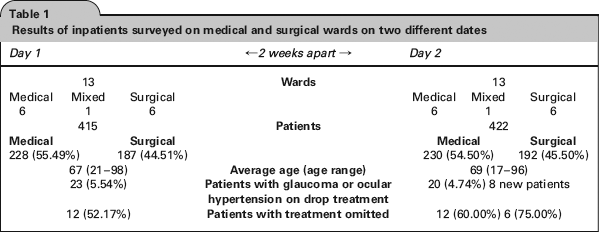
In total, 31 inpatients were found to have glaucoma. Eighteen of the 31 patients (58.06%) did not have their glaucoma drops prescribed. Only 2/31 (11.11%) had a documented indication for stopping the drops (neither of the two patients had any alternative treatment suggested).
Response to message prompt: Even with prompting, only 6/18 (33.33%) had glaucoma treatment re-started.
Results are shown in Table 1.
Results of inpatients surveyed on medical and surgical wards on two different dates
Conclusion
This audit confirms that eye drops are often overlooked on non-ophthalmic wards. When there were indications to withhold glaucoma medication, alternative glaucoma treatment was not provided. Finally, even after prompting the medical/surgical team about the missing medication, eye drops were still not prescribed for the majority of patients.
Recommendations
A culture of shared responsibility between patients and admitting staff for prescribing eye medication should be encouraged.
A Trust-wide campaign directed towards non-ophthalmic medical and nursing staff to prompt patients regarding their eye conditions and topical eye treatment on admission has been introduced. This is now included in the hospital induction for new medical staff.
Education on the use and side-effects of ophthalmic medications has been incorporated into the hospital junior (and more senior) training programs.
Glaucoma patients are now advised at the time of diagnosis to always mention their eye drops when admitted to hospital.
The cycle of the audit will be completed to evaluate the impact of the measures mentioned above.
Footnotes
Acknowledgements
None