






Abstract
In biomedical research, single housing of rats is used in different test paradigms and the rats are traditionally group-housed prior to testing. Intuitively this separation may have a negative impact on animal welfare. The objective of this study was to assess the importance of non-tactile contact with a social partner. The hypothesis was that rats, previously housed in pairs, prefer non-tactile contact with a partner to single housing. Moreover, it was hypothesized that females show a higher preference for non-tactile contact than males. Animals were housed for 48 h in two-compartment cages, where the animal could choose either to spend time in the compartment, where only a perforated plexiglas wall separated it from its social partner, or to spend time in the compartment with no rat behind the plexiglas barrier. The proportion of time spent in the two compartments was evaluated. We found a significant effect on gender (P = 0.0368) with females spending significantly more time close to the companion animal. During their inactive period, females spent approximately half their time close to their partner, whereas males preferred to stay in the cage next to the empty compartment. Female rats also demonstrated more activity compared with males (P < 0.0001).
Keywords
In biomedical research, single housing of rats is used in different test paradigms, e.g. tests requiring individual feeding, when using catheterized animals or when applying dermal test substances. The rats are traditionally group housed prior to the testing and intuitively this separation may have a negative impact on their welfare.
Rats are social animals and single housing results in increased frequencies of different stereotype behavioural patterns and escape-related behaviours.1-5 In female rats, Hurst et al. demonstrated that intermediate degrees of contact with a neighbour (obtained by separating the rats using perforated perspex sheets) enhances escape-related behaviours compared with females housed with a solid barrier between them. 3 Single-housed males, on the other hand, showed more stereotyped behaviours than single-housed females. 3 In mice, Van Loo et al. 6 demonstrated that single-housed males prefer to sleep in close proximity to a familiar male. However, this may not be true for rats, as Pattersone-Kane et al. 7 showed that rats in a choice-test set-up do not show any significant preference for being in the vicinity of conspecifics, if these are contained behind a wire screen.
The objective of this study was to establish whether pair-housed rats that gets separated by a barrier during both active and resting periods prefer to be singly housed with no possibility for physical contact, or if they prefer to maintain limited contact (‘semi-contact’) through a perforated plexiglas wall allowing for olfactory, visual, auditory and - to a very small extent - tactile contact.
We used a total of 16 female and 16 male NTac:SD rats (Taconic Europe, Ejby, Denmark) weighing 200 g at arrival. All rats were marked on their tail with a permanent marker and paired with a social partner of the same gender using a random number table. All 32 rats were pair-housed for 35 days prior to testing. They were housed in transparent Euro-standard Makrolon type IV cages (Tecniplast, Buguggiate, Italy) measuring 595 x 380 x 200 mm with a floor area of 1820 cm 2 with a grid lid and the cage contained 300 g aspen bedding (Tapvei, Finland), 50 g paper-derived Enviro-Dri® nesting material (Lillico Biotechnology, Surrey, UK), an aspen gnawing stick, size M (Tapvei, Kortteinen, Finland) and a black-transparent plexiglas rat shelter (Repsol, Brønderslev, Denmark). Room temperature was maintained at 20°C, with a relative humidity of 55–60% and 10–15 air changes per hour. The artificial light period started at 06:00 h and lights were turned off at 18:00 h. The rats had free access to food (Altromin 1324, Brogaarden, Denmark) and tap water. The cages and water bottles were changed twice a week.
For the preference test, a choice test set-up was constructed using two cages that were modified using a plexiglas barrier (Figure 1). This barrier consisted of a transparent plexisheet perforated by 18 holes measuring 6 mm in diameter in the upper part of the sheet. This barrier separated the cage into two identical compartments, A and B, both with food and water supply, bedding, nest material and a shelter (same as in the pair housing condition). These cages were connected using a 5 cm long PVC tunnel, allowing the test animal to pass between compartments 1B and 2A (Figure 1).
‘Semi-contact’ cage set-up. Each cage was divided into two separate compartments. Two of these compartments (2A and 1B) were connected with a tunnel (T). The test animal (TA) could move freely between compartments 1B and 2A. The companion animal (CA) was confined to either compartment 1A (left) or compartment 2B (right)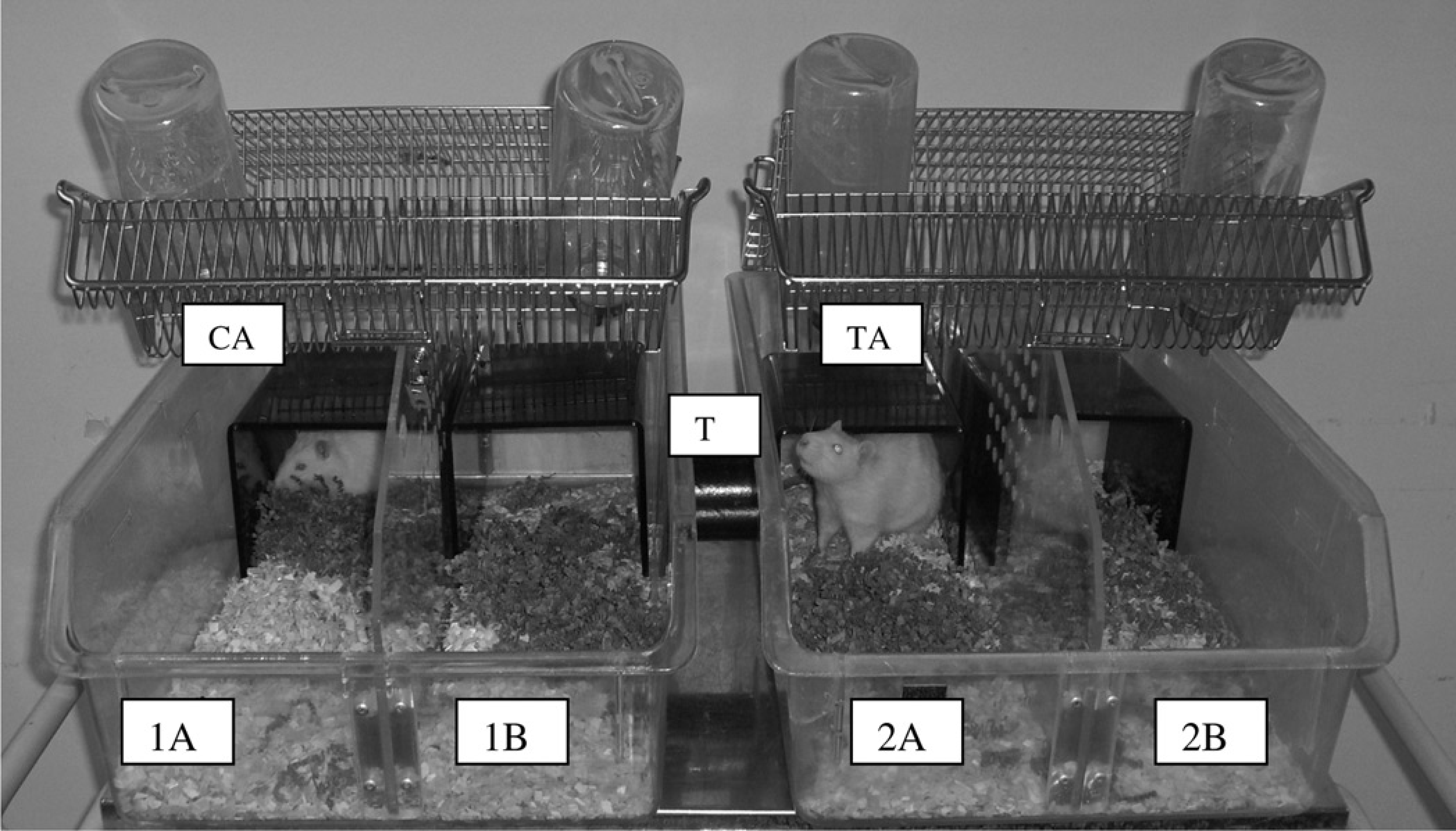
Each cage was placed on a digital scale (EA6DCE-L, Sartorius AG, Göttingen, Germany). Prior to testing, the companion rat was placed in either compartment 1A (left) or 2B (right), and the scales were reset. The test animal was introduced and the system started. A software program (WinWedge 16 pro, TAL Tech, Philadelphia, PA, USA) stored data from the scales every 15 s on a PC (Pentium 2, 233 MHz, 32 Mb RAM, Datafilen, Denmark). A total of four cages/four scales, i.e. two choice test set-ups were used. These cages were placed in a ventilated cabinet with two purpose-made shelfs (a modified Scantainer, Scanbur, Denmark) to minimize the impact of sounds and olfactory stimuli from the surroundings (see Ref. 8 for further details). Half the animals were placed on the lower shelf in the cabinet, and half the animals were placed on the upper shelf. In 50% of the tests the companion animal (CA) were placed in the cage to the left (Figure 1, compartment 1A), and in the other 50% of the tests, the CA was placed in the cage to the right (compartment 2B).
Test time was 48 h (from Tuesday afternoon at 18:00 till Thursday afternoon at 18:00 h). No testing was carried out during weekends, and thus two pairs of rats were tested per week. The total test time for eight pair of rats was thus four weeks. Male rats were housed and tested in November and December, whereas females were housed and tested in January and February.
Data were split up into four periods, namely night 1, day 1, night 2 and day 2. The preferences were calculated as proportion of time spent in each compartment during each period. Moreover, the number of transitions between cages in each period was measured.
The Statistical Analysis System (SAS) was used for all statistical analyses (SAS Institute Inc, Cary, NC, USA, version 9.1) using a 5% significance level.
Normality of the data was evaluated using both the normal probability plot of the residuals and Shapiro–Wilks test statistic. A residual plot was used for assessing whether the assumption of equal variances was fulfilled.
An analysis of variance (ANOVA) was performed of the outcome variable ‘proportion of time spent in CA cage’ including the position in the Scantainer (upper or lower shelf), period (day or night) and CA side (the horizontal position of the CA cage) as fixed effects. The effect of each pair of animals was included in the model as a random effect and moreover this effect was assessed separately.
The data on the proportion of time spent in the CA cage were not normally distributed, and an arcsine square root transformation did not normalize the data. Hence, an ANOVA was performed on ranked data.
During daytime (their inactive period), female rats spent only approximately half their time close to the partner, whereas male rats preferred to stay in the cage next to the empty compartment (Figure 2). An overall effect of gender on proportion of time spent in proximity to the CA was found (P = 0.0368).
(a and b) Proportion of time spent in the two cage compartments over the four periods of time (percent time spent ± standard deviation). The total test time was 48 h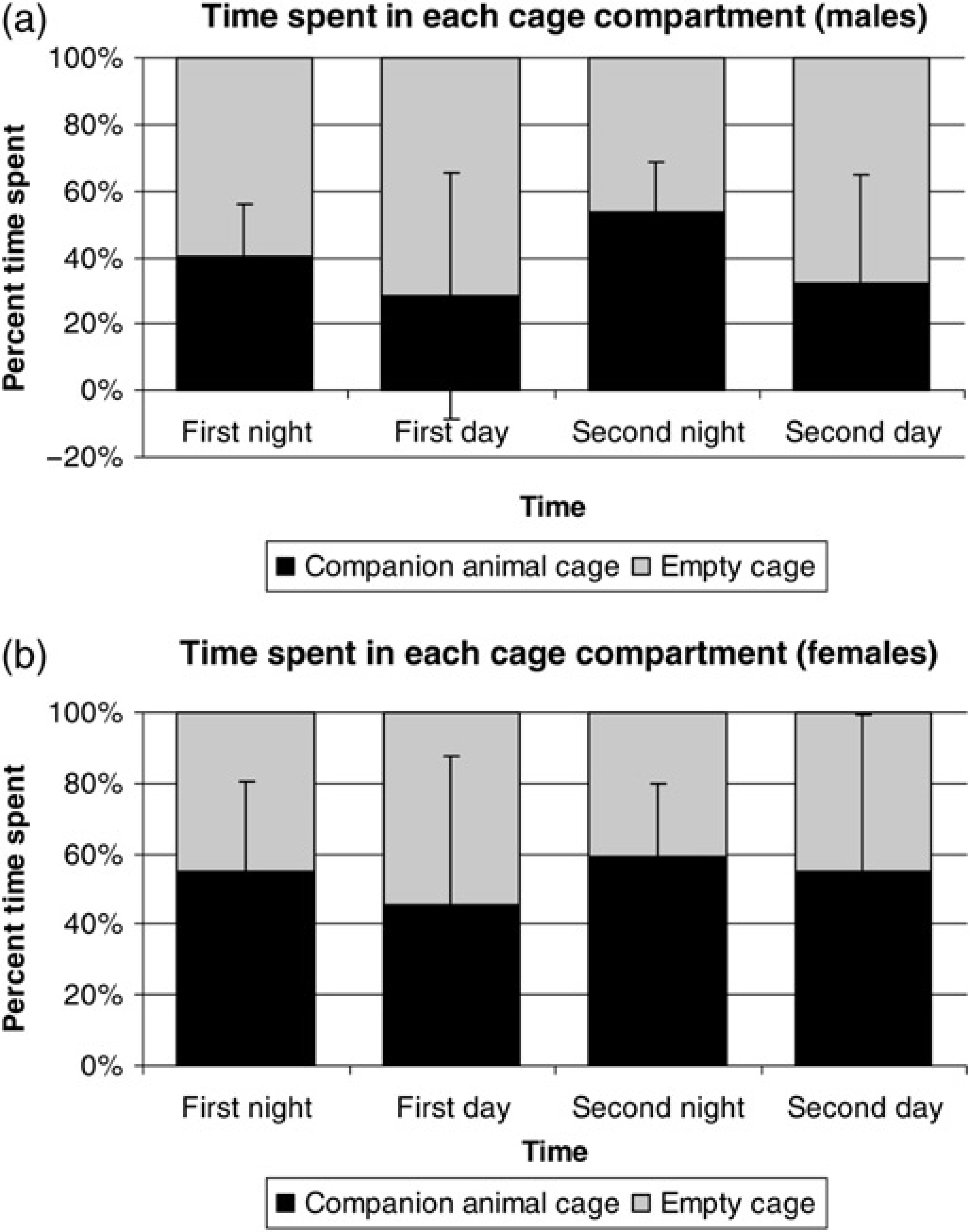
Moreover, a significant effect of the positioning of the CA (CA side; P = 0.0160) was found (Table 1). If the CA was placed in compartment 2B (to the right), rats spent less time in the CA cage compared with the set-up where the CA was situated at the left (compartment 1A). This effect was most pronounced in male rats, although the statistical analysis did not show any interaction between gender and CA side. Bearing in mind that males seem to prefer staying away from the CA, these findings seem to indicate a preference for the left compartment. When the CA was situated to the right, the males preferred to stay in the left compartment. This preference seems to be reduced, when the CA was situated to the left, thus ‘occupying’ the preferred space. No apparent explanation for this preference could be identified.
Mean proportion spent in companion animal cage ± SD
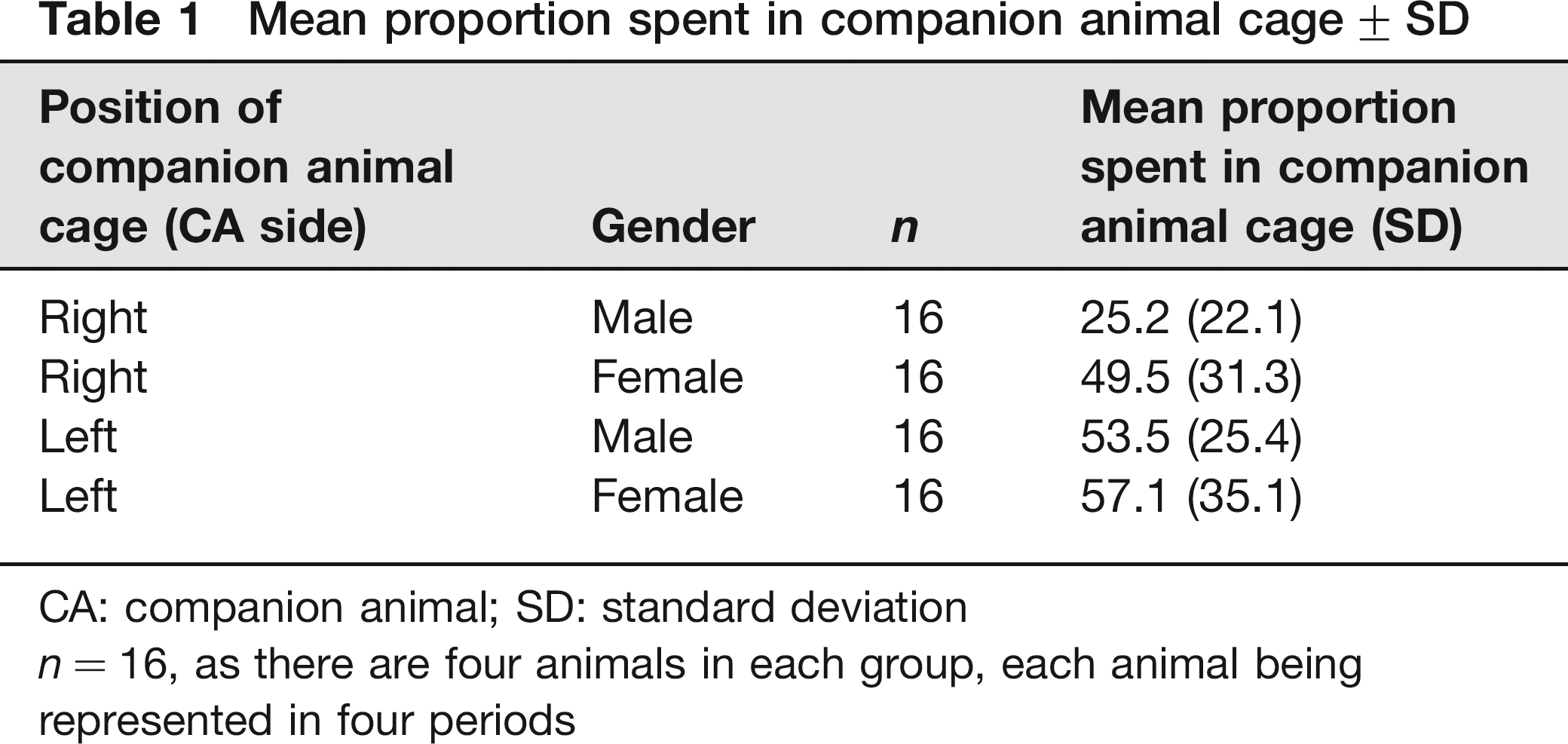
CA: companion animal; SD: standard deviation
n = 16, as there are four animals in each group, each animal being represented in four periods
The independent variable ‘animal’ was assigned to each pair of test animals, acknowledging that such pairs may be more or less harmonious, and that a submissive test rat from a less harmonious pair probably will not seek the proximity of its social partner to the same extent as would a dominant test animal or an animal from a harmonious pair. An ANOVA on ranked data was performed, demonstrating an overall significant effect of pairs (P = 0.0006).
The data on the activity of males and females during the test were normally distributed and an ANOVA was carried out on the number of transitions between compartments. Males showed a significantly (P < 0.0001) lower number of transitions (42.9 ± 3.7 SD) than females (68.0 ± 3.7 SD). Interestingly, but not surprisingly, no significant difference in number of transitions (and hence the activity of the nocturnal rats) were found between the two dark periods and the two light periods, whereas the activity was significantly higher (P < 0.0001) in the two dark, active periods compared with the two light resting periods.
The present study indicates that male rats seem to prefer to be fully separated from a known companion compared to being separated by a perforated plexiglas sheet. Hence, separating male rats for brief periods may not present a threat to the welfare of the males. On the other hand, it should be considered whether there could be welfare consequences when re-grouping these animals. Female rats spend approximately half their time in close proximity to a known companion. Moreover, females are significantly more active, which could be a result of a higher level of exploratory and escape-related behaviours. 3 If females - to a higher degree than males - want social company and contact, then separating females may reduce their welfare. Moreover, being able to smell and see, but not to touch a social partner, may affect females more than males. This idea needs to be confirmed; however, it would be consistent with the findings by Hurst et al. 3 Intuitively, to humans, semi-contact seems to be the best solution, when considering animal welfare; however, these results could suggest that male rats prefer single housing to having semi-contact and that female rats react to the lack of possibility to perform social behaviour. When considering animal welfare in the laboratory animal facility, the possibility that single housing should be preferred to semi-contact in short-term separation in both genders - although for different reasons - should not be ignored.