






Abstract
Idiopathic environmental intolerances, such as ‘multiple chemical sensitivity’ and ‘electrosensitivity,’ can drastically affect the quality of life of those affected. A proportion of severely affected patients remove themselves from modern society, to live in isolation away from the purported causal agent of their ill health. This is not a new phenomenon; reports of hermits extend back to the 3rd century AD. We conducted a literature review of case reports relating to ancient hermits and modern day reclusion resulting from idiopathic environmental intolerance, in order to explore whether there are similarities between these two groups and whether the symptoms of these ‘illnesses of modernity’ are simply a present-day way of reaching the end-point of reclusion. Whilst there were some differences between the cases, recurring themes in ancient and modern cases included: dissatisfaction with society, a compulsion to flee, reports of a constant struggle and a feeling of fighting against the establishment. The similarities which exist between the modern-day cases and the historical hermits may provide some insight into the extreme behaviours exhibited by this population. The desire to retreat from society inorder to escape from harm has existed for many centuries, but in different guises.
Introduction
Recently, the BBC reported a growing community of ‘wifi refugees’, that have moved to Green Bank, West Virginia, in order to escape illness they believe to be caused by wireless technologies. 1 Green Bank does not allow mobile phone masts in order to prevent interference with nearby radio telescopes and is viewed as a safe haven by those affected. The following month a story emerged from France about two women living in caves above the French town of Saint-Julien-en-Beauchêne due to ‘terrible headaches’ attributed to the installation of mobile phone masts. 2
DECLARATIONS
None declared
None declared
Not applicable
SW
SW had the initial idea for the study. All authors contributed to the study design. IB conducted the literature review and wrote the first draft of the manuscript. All authors contributed to, and approved, the submitted manuscript
Reviewer
Keith Petrie
In each case the sufferers were certain that their symptoms were caused by exposure to non-ionizing electromagnetic radiation. Such people have been described as suffering from ‘electro-hypersensitivity’ (EHS). Many people with this condition maintain that the spread of wifi and other communication networks pose a new threat to human health, though experimental provocation studies have not found this to be the case. 3
But is EHS really a new phenomenon? There are striking similarities between these cases and those reported in previous decades, but with a substitution of the purported causal agent. In suggesting that these apparently disparate phenomena are linked, we are not breaking new ground. These disorders, or ‘somatic syndromes’, have been grouped under the rubric of ‘modern illnesses’, ‘environmental illnesses’ and of ‘medically unexplained syndromes’4,5; and it has been reported that many patients with one somatic syndrome also meet the criteria for another.5,6
Regardless of any demonstrable proof of harm, these syndromes propose a recognized, new agent as causing illness, such as new chemicals or technologies. McGraw explored the historical perspective on these conditions, describing the evolution of such syndromes within the ‘cycle of history’, concluding that what he termed ‘hysteria’ has ‘assumed its latest expression as a “painful” reaction to a panoply of moderate industrial materials.’ 7
The diagnosis of these syndromes often shows a temporal distribution that matches media interest. It has been reported that some patients may incorporate newly publicized hypotheses into their own attribution of symptoms during the course of their illness, 8 and this ability to change beliefs allows the maintenance of symptom recognition and attribution despite a shifting medical backdrop.
The severity of symptoms reported in multiple chemical sensitivities (MCS) and EHS ranges from mild annoyance to debilitating disability requiring complete isolation, and this most severely affected population is of particular interest. Although media articles have reported cases of individuals moving into isolated rural settings to escape from such syndromes,1,2,9,10 little research exists regarding this sub-group. However, the behaviours they show are not specific to MCS and EHS; references to hermits and recluses occur throughout literary and historical texts, with reports of individuals turning to reclusion for a multitude of reasons: religious endeavour, personal events and societal dissatisfaction to name a few. Societal motivations for reclusion often stem from perceived injustices and anxieties regarding the state of the world and the way of living.
The possible similarities in outlook between historical hermits and those living reclusive lives with MCS and/or EHS raises intriguing questions: whilst suggestions have been made that MCS and EHS are not new conditions, 7 can the parallels be extended to join the modern-day hermits with their historical counterparts? In this essay, we explore the possibility that there are similar underlying psychological processes in the isolation of oneself from society and that these ‘20th century diseases’ should be seen less as a unique and specific reaction to a hitherto unknown hazard, but more as part of a longer tradition of isolation from an impure world.
To compare these two groups, we identified modem and historical case studies, and compared their views and beliefs about the position they find themselves in.
Methods
A search for media articles was completed for EHS or MCS-related terms alongside terms relating to ‘recluse,’ ‘retreat,’ ‘isolation’ and ‘hermit’ using Nexis, a comprehensive database of media reports. Having identified cases in this way, the search was then extended to include other sources, including information from blog posts, support groups, online books and forums, in order to gather more information for each case. To identify older cases, relevant historical literature was examined, and, where possible, copies of the individual's contemporary writings were sourced, as well as detailed biographies.
Once case studies were selected, their writings and/or contemporary life biographies were examined. For each individual, IB extracted those themes that occurred in their writings which specifically related to their motivations for entering seclusion. Themes were revised where required as new material was read, until a stable set of themes was identified which appeared to adequately explain the main motivations appearing in the literature. All themes were supported by quotations from at least seven of the cases that we examined. The nature and labelling of the themes were discussed by all authors.
Results
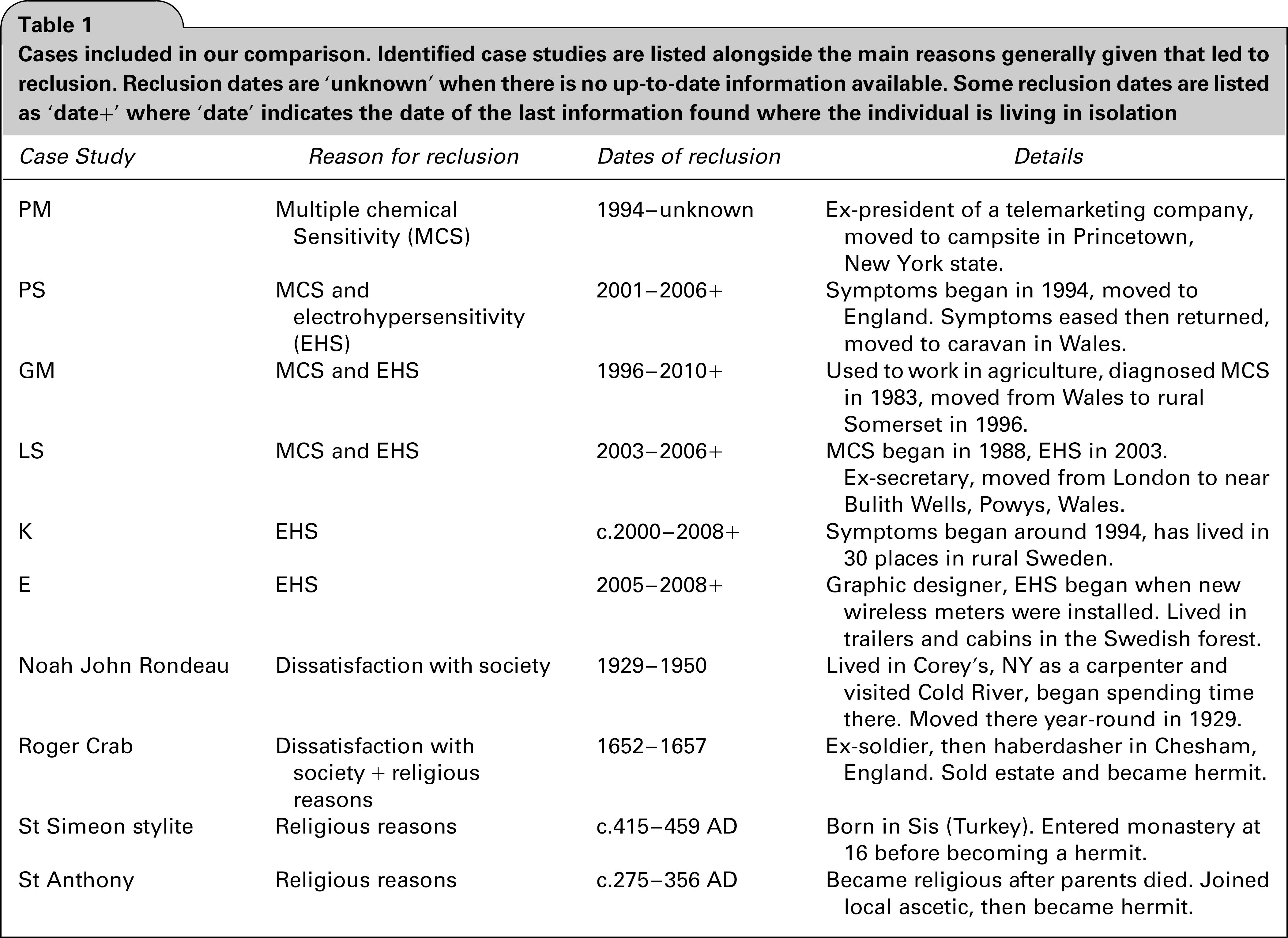
We indentified six contemporary cases of people with EHS or MCS (dating from late 20th and early 21st century) and four historical cases (dating from the third, fifth, 17th and early 20th centuries). Details of the cases are given in Table 1. Several key areas of comparison were noted.
Cases included in our comparison. Identified case studies are listed alongside the main reasons generally given that led to reclusion. Reclusion dates are ‘unknown’ when there is no up-to-date information available. Some reclusion dates are listed | as ‘date+’ where ‘date’ indicates the date of the last information found where the individual is living in isolation
Contemporary society as a source of anger and anxiety
Of initial interest were the factors that individuals reported as leading them into reclusion. In the modern cases, the reported factors were often symptoms. For example, PS explained ‘I couldn't sleep. My skin was itching. My nerves were tingling’, 11 exposure to everyday chemicals caused GM to sound ‘as if I'm drunk and my legs swell up’ 9 while working with computers made E develop ‘heart trouble, headaches, skin and eye irritations.’ 12 Yet disquiet about the ‘ill’ society that has resulted from modernity was also important. K epitomizes this belief:
‘Nowadays people use a lot of medicine, sleeping pills and antidepressants. They suffer from fibromyalgia, headaches and muscle tension. When I watch people at work, I wonder: ‘Why are their bodies so tense?’ What was it like during the Bronze Age, for instance? Did people suffer as much from headaches at that time too?’ 12
PS too wants to explain to society that ‘the way we live today will ultimately cause more illness’ 13 and warns of the unseen dangers of modernity, whilst GM describes people with MCS as ‘an early warning system’ and ‘the canaries of the 20th century’ 14
For the historical case studies, the impetus to become a recluse also often reflected anger or anxiety about changes in contemporary society. Noah John Rondeau spent his life in the Adirondack Mountains of New York State, in a place he called ‘Cold River City (population 1)’. 15 Rondeau was ‘not well satisfied with the world and its trends’ 15 and was fiercely critical of ‘big fool American big business’ and the ‘slavery of industrialism’. 16 He disapproved of the health implications of a crowded city, for ‘there ain't any cold germs back in my mountains.’ 17 His dissatisfaction with society is evident and it appears this was the main influence behind his self-imposed isolation.
Three hundred years previously Roger Crab sold ‘a considerable estate’ 18 and became a hermit, living near Uxbridge, England. In his pamphlets, he attributed his decision to become a recluse to the Scriptures, citing Mark 10:21: 18 ‘Sell whatsoever thou hast, and give it to the Poor.’ However, his writings indicate a deeper frustration with the contemporaneous political and social situation, with his religious beliefs underpinning his resolute opinions in the face of public derision. He considered that ‘the body of England has become a monster’, 19 and his hatred of the Church (the ‘whore's house’) and the clergy (‘pimps’), which at the time controlled every aspect of society, permeates his writings. 19
Religious reasons for reclusion were also the motivator for St Anthony and St Simeon. St Anthony, a Desert Father, gave away his possessions after hearing the Scriptures, 20 and St Simeon also pursued religious perfection, developing a desire for austerity following study of the Beatitudes.+ However, there also appears a sense of escape, from the ‘demons’ that were ready to ‘make an attack by temptation and place hindrances’ and St Anthony derided the world where ‘everything is sold at its price, and a man exchanges one equivalent for another.’ 20 So here too, a distaste of contemporary life with its monetary emphasis and spiritual emptiness spurred on a desire to retreat. Like the modern hermits, these saints perceived an underlying need to escape the evils of modern society, though their stated reasons for reclusion were different.
In a sense, each of the cases’ isolation can therefore be considered a reaction to the perils of their society. In all cases these people eschew modernity and retreat into what they consider a more natural state, free from the constraints and dangers of culture and community.
Compulsion to flee
In tracing each individual's journey to isolation, it is clear that many of the case studies feel they have had no choice in making their decisions. PM asserts: ‘This is not a lifestyle I choose’; 22 PS believes ‘I have no choice,’ 11 whilst CM states ‘nobody would live like this if they had a choice.’ 23 Furthermore, E reports ‘I felt I just had to get away’ 12 while LS asks ‘do you think I would have given up a satisfying life … if I had a choice?’ 10 This sense of compulsion is not limited to the modern studies, for St Anthony, when ‘entreated to stay’ in society, replied ‘fishes, if they remain long on dry land, die. And so monks lose their strength if they loiter among you.’ 20 For both St Simeon and Roger Crab also, the sense that their behaviours were the will of God meant that to disobey was unthinkable. As Crab said in The English Hermite (1652): ‘If John the Baptist should come forth againe’, then he would preach ‘he that had two coats should give away one of them, and he that hath food should doe likewise’, 18 indicating that, in Crab's literal interpretation of the Scriptures, he had no choice if he was to behave in a true Christian manner. For both modern and historical hermits, this removal of autonomy can provide a powerful belief to adhere to when views and behaviours are questioned.
Opposition and struggle
Neither modern nor historical cases were able to fully isolate themselves from society and one discrepancy between them is their perception of how they are viewed by society at large. Whilst modern case studies usually report feeling unsupported by society - LS claims ‘people like me are treated like pariahs’ 10 - ancient saints were revered by the public and those in power. Saint Simeon's surviving letters include replies to Emperor Leo (I) Thrax and Basil, Bishop of Antioch, 24 and St Anthony was reported to have so many visitors that he chose to move ‘on account of the many hindrances.’ 20 However, they did still have many troubles during their isolation, fighting the ‘demons’ that ‘place hindrances to hamper our way’ 20
This idea of a constant struggle, whether it is against evil spirits, restrictions of society laid out by those in power, or by ubiquitous chemicals or radiation, is a strong characteristic of all the studies. Some report a sense of persecution, others a distinct apathy from those in power. K believes: ‘Today, people are not allowed to get sick. If you suffer from what is considered a medically diffuse illness, you are out of luck,' 12 whilst E thinks ‘it is appalling that we have to argue about basic human rights.' 12 Such feelings are not confined to Sweden, for in America, PM believes ‘the system is not set up for this,' 25 and in the UK, GM is ‘tired of fighting. The system said it would help, but so long has passed I have just about given up.' 23 She voices both disappointment and anger, suggesting deliberate maltreatment: ‘They're just waiting for me to peg it, then the problem will be removed.' 23
This sense of persecution can also be felt in the diaries of Rondeau, who wrote in code to conceal information from ‘snooping game protectors’. 26 Roger Crab also fought against the establishment; his hatred of the materialism that pervaded society and organized religion led him to be tried four times for sabbath-breaking. 19 However, his publications are full of triumphant rhetoric reflecting celebration of personal endeavour and his propensity to fight those in power:
‘And they brought this Scripture, which saith, Submit your selves to the Higher Powers; then I replyed to them again, That I with them have stood with my sword in my hand against the Highest Powers in England, namely the Kings and Bishops, upon which account ye sit here.’ 19
Crab undoubtedly viewed himself as a pioneer of social and political change; his egalitarian principles set him apart from the traditional powers and he describes himself as an enforcer of social and physical revolution. He and the other historical cases revel in their chosen path. To a degree, this idea of fighting against injustice also occurs in the modern case studies. PM feels ‘more like a guerrilla warrior,' 25 and PS explains: ‘I like to think of myself as a pioneer.' 13 GM has been undertaking research into MCS, and explains that ‘even if I cannot achieve my own survival, I am endeavouring to ensure that that research and that garden survive.' 27 In GM's case particularly, the sense of being a leader is evident; she receives support from a variety of groups and individuals, almost a microcosmic version of the support the Desert Fathers enjoyed.
Discussion
Our examination highlights similarities between modern and historical hermits which go beyond behaviour and encompass outlook. These have implications for further research and treatment for the most severely disabled patients who describe having MCS, EHS and other medically unexplained syndromes. At the most basic level, the lack of any literature regarding this sub-group with respect to their numbers, circumstances, attitudes, behaviours, needs or prognosis must be rectified. Arranging appropriate, evidence-based treatment for this group can be difficult but is clearly also important. If it can be considered that in their extreme forms, symptoms attributed to MCS or EHS are a contemporary way of reaching the end-point of isolation, it may be that treatment focused on the symptom attribution of these patients will not necessarily help to reintegrate them into society. Instead, identifying and discussing themes of feeling like a pioneer or ‘human canary,’ openly acknowledging the rhetoric of struggle and viewing symptoms as part of a reaction against unwelcome aspects of contemporary culture may provide a better starting point. The support that GM receives also raises questions as to the role of the media and support groups in the maintenance of such a situation – do such groups help provide essential support to vulnerable people, do they add extra pressure that makes it harder to return to society or, in contrast, can they help act as gateway to facilitate their reintegration?
Our analysis is clearly limited in the number of cases we could draw on, the details that were available to us and our reliance on our subjective impression to understand and compare cases. The lack of any academic literature also meant that media articles and other literature had to be used, which adds a degree of self-selection to our sample: people who chose not to engage with the media will not have been accessible to us. However, our case studies do appear to show a number of recurring themes, many of which additionally fit with the cases initially referred to in the introduction. Whilst there is limited information on the French ‘cave refugees’, interviews do suggest, once again, a feeling of opposition from the establishment, as one sufferer's daughter reports: ‘People think my mother is crazy, but her symptoms are real. Are telecoms companies so powerful as to make laws themselves?’ Again, there is also a strong sense of a compulsion to become reclusive, with no other options, for, as one woman reports: ‘I don't say I enjoy the conditions of my life. But I have no choice.' 28
Furthermore, whilst similarities can be demonstrated between the individuals in a variety of aspects, there are important differences to consider. The main concern is the religious overtone to three of the historical cases. This is unsurprising as, at that time, religion was all-powerful in society and many decisions would have been made within a religious context. Religion now has, for the most part, lost its stronghold, and modernity has consumed our lives. This has led to a backlash from certain communities and nostalgia for a cleaner, purer, more ‘natural’ time (although of course the idea that the past was cleaner or purer does not withstand historical scrutiny). Nevertheless, this contemporary pursuit of purity has its similarities to faith. As with religion, it provides direction for lives, gives answers to things that seem random and unwelcome, and generates solutions and a way forward. Success involves avoidance of potential threats to health, which are often reported by the media, 29 which acts as the source for most people's risk perception. 30 In today's litigious, risk averse society, with news-media readily available to all, it is perhaps not surprising that new technologies are often viewed with suspicion. Considering this, it may seem less surprising that our modern-day hermits have attributed their symptoms in such a way, while still reaching the same end-point as their historical counterparts.
Conclusion
It appears there are similarities between those who live in isolation due to MCS or EHS and hermits that lived previously. The similarities focus on problems living in society, compulsion to flee, a sense of persecution, and ideas of fighting for an under-recognized cause. The similarities exist despite extensive differences, such as the historical religious focus and differing public attitudes.
Many of the modern cases find it difficult to imagine re-integrating into society, with its ever-increasing use of computers and wireless technologies. Whereas St Anthony and St Simeon remained hermits until their deaths, neither Crab nor Rondeau could sustain such harsh ways of living into their old age. With the modern case studies showing both similarities and differences with their historical counterparts, it remains unclear whether, without intervention, they will be able to return to society and re-join ‘the land of the living.' 23
Footnotes
Acknowledgements
None