






Abstract
Objectives
The British honours system is one of the oldest in the world rewarding individuals, including those of the medical profession. The authors were interested to see if any particular specialty was honoured to a greater extent. We aimed to establish the number of those honoured, the duration of clinical practice involved, as well as additional factors.
Design
A retrospective analysis of doctors receiving honours (Knight/Dame, CBE, OBE, MBE) in the last decade was performed.
Setting
UK-registered doctors.
Participants
Doctors were identified from publicly available listings.
Main outcome measures
Demographics of all honoured doctors, including number of years of service, specialty affiliation and the number of recipients holding professorial status were collected. Clinicians were stratified into four subgroups: General Practitioners, Physicians, Surgeons and Others. Data were analysed using parametric statistical tests.
Results
Four hundred and seventeen doctors were identified. Four hundred and two clinicians had a documented subspecialty affiliation. Of the 402: GPs (n = 142), Physicians (n = 100), Surgeons (n = 34) and Others (n = 126). The number of years in clinical practice from registration to conference of honours was significantly shorter for GPs when compared to hospital-based specialties (P < 0.05). The top 10 specialties of individuals honoured are tabulated. Professors constituted 30% (n = 131) of those honoured. These individuals were sub-divided according to specialty affiliation with a significant difference observed (P < 0.05).
Conclusions
The most honoured specialty was General Practice. However, when corrected for total subspecialty population, the number one ranking specialty was Public Health Medicine. Academic clinicians are well represented. The findings may be of interest to the medical community.
Introduction
The British honours system rewards doctors for achievement and services to medicine. A knighthood remains one of the highest honours a doctor in the United Kingdom can achieve. To what extent does ones choice of specialty influence the chance of attaining such recognition? Furthermore is there any difference between professors and clinicians, or between large specialty groups, such as General Practice, Medicine and Surgery?
A retrospective study was undertaken to assess the demographics of doctors upon whom honours were conferred in the last 10 years. Based on these data we explored the aforementioned subject. We also aimed to identify factors which may help expedite selection and perhaps confer an advantage.
This information may be useful to medical practitioners interested in the rates at which individuals from various specialties are conferred honours. As far as the authors are aware this is the first study of its kind.
Methods
We carried out a retrospective analysis of all medical doctors receiving honours (Knight/Dame, CBE, OBE or MBE) between January 2000 and January 2011. These doctors were identified from the lists of honours and awards as published in The London Gazette (see
Results
A total of 417 medical doctors were identified. Subspecialty affiliation was obtained for 402 doctors. Number of years since primary registration with the GMC and subsequent conference of honours was obtained for 351 practitioners.
Of the 417 doctors identified 72% (n = 302) were men and 28% (n = 115) were women. GPs (34%, n = 142) were the most honoured specialty. Physicians accounted for 24% (n = 100), Surgeons approximately 8% (n = 34) with others accounting for 30% (n = 126). Numbers of doctors receiving such an award has been relatively constant over the last decade (range 31–46).
The number of years post graduation prior to the achievement of honours for the specialties are summarized in Table 1. Analysis of variance highlighted a significant difference in the mean number of years of clinical practice and the subsequent achievement of honours between the specialty groups (F = 8.4, df = 3, P = 0.001). Tukey's post hoc test revealed that the number of years from initial registration with the GMC to the conference of honours was shortest for GPs (mean years 31.8, SD 8.6/median 33 [IQR 24–38]) when compared with all other specialties (Table 2). The number of years of clinical practice and subsequent conference of honours for the secondary care specialties were remarkably similar with the apparent magic number being ‘36 years’ (Figure 1). The crude incidence rates for the conference of honours: GP 2.4 cases per 1000, Physicians 8.3 cases per 1000, Surgeons 3.0 cases per 1000, Others 4.4 cases per 1000.
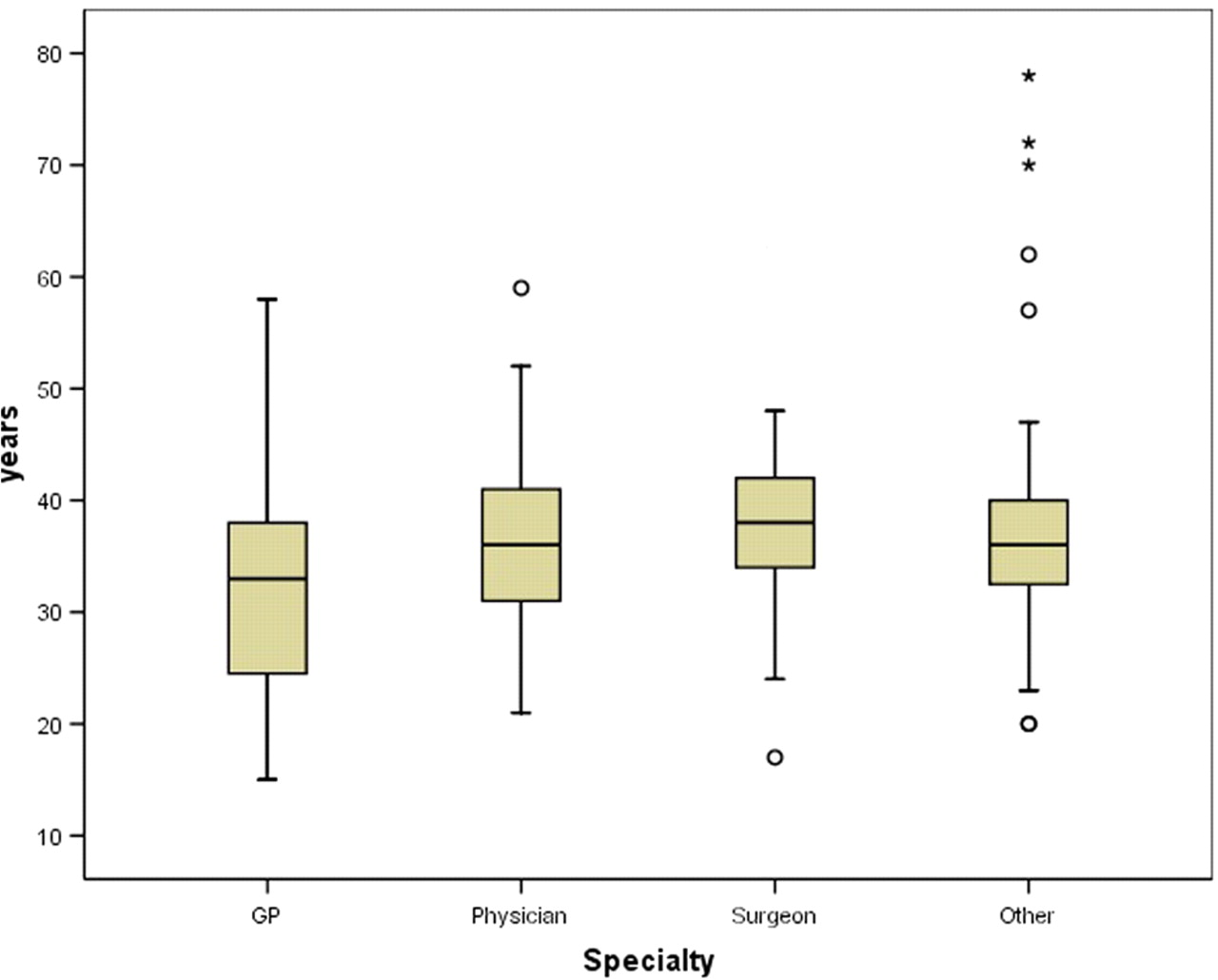
Box plot representation of number of years of practice prior to the conference of honours for different specialties
Number of years in clinical practice and the subsequent conference of honours
SD = standard deviation, IQR = interquartile range
Results of Tukey's post hoc test comparing mean differences and confidence intervals of years of clinical service by specialty groups
MD = mean difference (x–y), CI = confidence intervals
Top 10 specialties for honours in the last decade
*Number registered in general psychiatry
†Number of histopathologists
(GMC LRMP statistics data – http://www.gmc-uk.org/doctors/register/search_stats.asp)
Of 417 honoured doctors 30% (n = 131) were professors. The percentage of honoured academics varied significantly between specialties (P < 0.05): GPs 16/142 (11%), Physicians 44/100 (44%), Surgeons 18/34 (53%), and Others 51/125 (41%), respectively (Figure 2). However, the mean number of years since registration with the GMC and achievement of honours was significantly shorter for clinicians when compared to professors (33.2 vs. 37.1, 95% CI 1.5–5.2, P < 0.001).
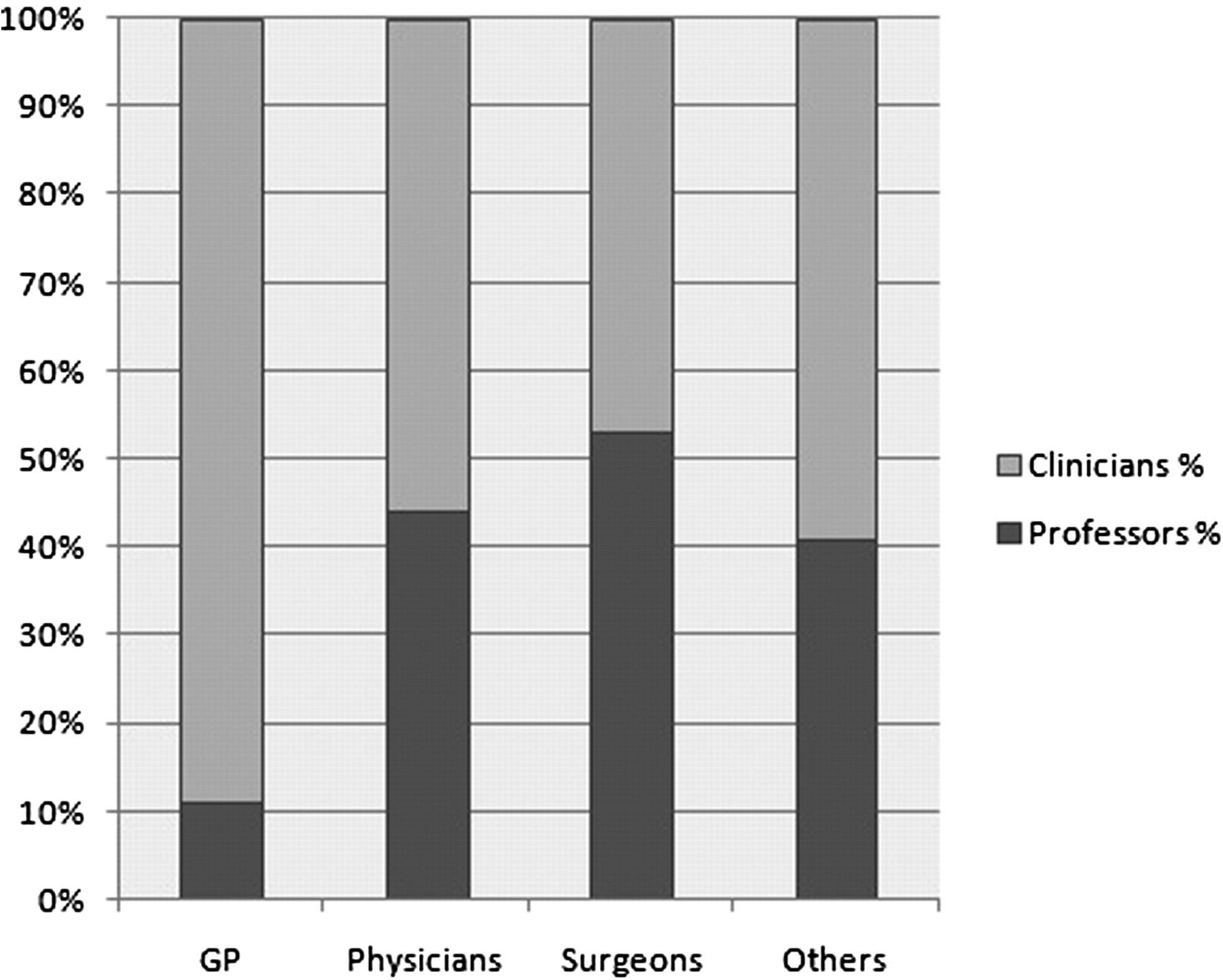
Percentage of honoured professors in different specialties
The top 10 specialties for the attainment of honours over the last decade, and the mean number of years for the awarding of honours for these subspecialties are illustrated in Table 3.
Discussion
The UK honours list is published bi-annually. Many people are nominated and it remains extremely competitive. The honours system has evolved over 650 years. 1 Doctors may be considered for awards in the Order of the British Empire; an ‘order of chivalry’ that was created in 1917 by King George V. 1 Peerages are also part of the honours system; and this area will be explored in greater detail in a subsequent paper. Although there would appear to be no set criteria for honours selection, these accolades are awarded on merit, and on the basis of exceptional achievement or service. The Cabinet Office has selection committees to oversee the process with a sub-committee that focuses specifically on nominations from the field of medicine. 2
The primary aim of this study was to assess whether any particular specialty was honoured to a greater extent. In addition, we wished to evaluate the overall duration of clinical practice involved, and check for differences between large specialty groups.
Of the total number of practitioners honoured in the last 10 years GPs ranked number one (Table 3). This finding is perhaps not surprising given the fact that GPs collectively constitute the largest single group of the medical workforce. However, this figure when converted to a percentage of all registered GPs reveals that a relatively small proportion of this specialty (0.23%) received honours. Based on these calculations our results demonstrate that despite ranking fourth overall, in absolute numbers, Public Health Medicine is actually number one when the total number of doctors affiliated to this specialty was taken into consideration (17/1488, 1.14%).
An interesting finding of this study was the surprising similarity in the mean number of years of clinical practice and the subsequent conference of honours for secondary care specialties, with no statistically significant differences between these groups (Table 2). Honoured doctors in primary care, however, achieved this award earlier than their secondary care counterparts (P < 0.05).
Despite the fact that academics make up around 6% of the medical workforce (less in the case of professors), our results have highlighted that in the last decade, approximately one-third of honoured medical practitioners were professors. This finding suggests that the honours system appears to recognize and reward clinical and academic excellence. The proportion of honoured professors varied between specialties, with the highest proportion among Surgeons (Figure 2). Although professors make up a large proportion of the honoured clinicians, perhaps unsurprisingly, the mean number of years of service was significantly longer for this group of doctors (P < 0.001).
There are some limitations to this study worthy of mention. Data relating to the number of clinicians achieving recognition under the honours system were meticulously extracted from listings published in the London Gazette; however, some cases may have been inadvertently missed from the study. We calculated crude incidence rates for doctors in each of the large specialty groups achieving an award. As a reflection of subspecialty population for each group, we also calculated a proportion (percentage) of doctors honoured based on speciality affiliation. Denominator data for these calculations were obtained from the GMC's published registration statistics of the number of UK doctors on the GP and Specialist Registers, respectively. 3 The authors are mindful of the fact that this denominator may not reflect eligibility and possible changes in subspecialty populations in the last 10 years.
Despite the above limitations, the results of this study are very interesting. The data from the last decade suggest that the number one specialty of those individuals honoured would appear to be Public Health and Epidemiology. A repeat study in 10 years time would be of considerable interest to assess potential changes in the demographics of doctors honoured under the auspices of the coalition government.
DECLARATIONS
Competing interests
None declared
Funding
None
Ethical approval
Not applicable
Guarantor
SI
Contributorship
SI designed the study, analysed the data and wrote the initial draft of the paper; JC collected data and contributed to the final draft; CT was involved in the conception and design and contributed to the final draft of the paper; all authors approved the final version
Acknowledgements
The authors thank Gary R Hoffman for his input in the preparation of this paper
Reviewer
Chidi Molokwu