Abstract

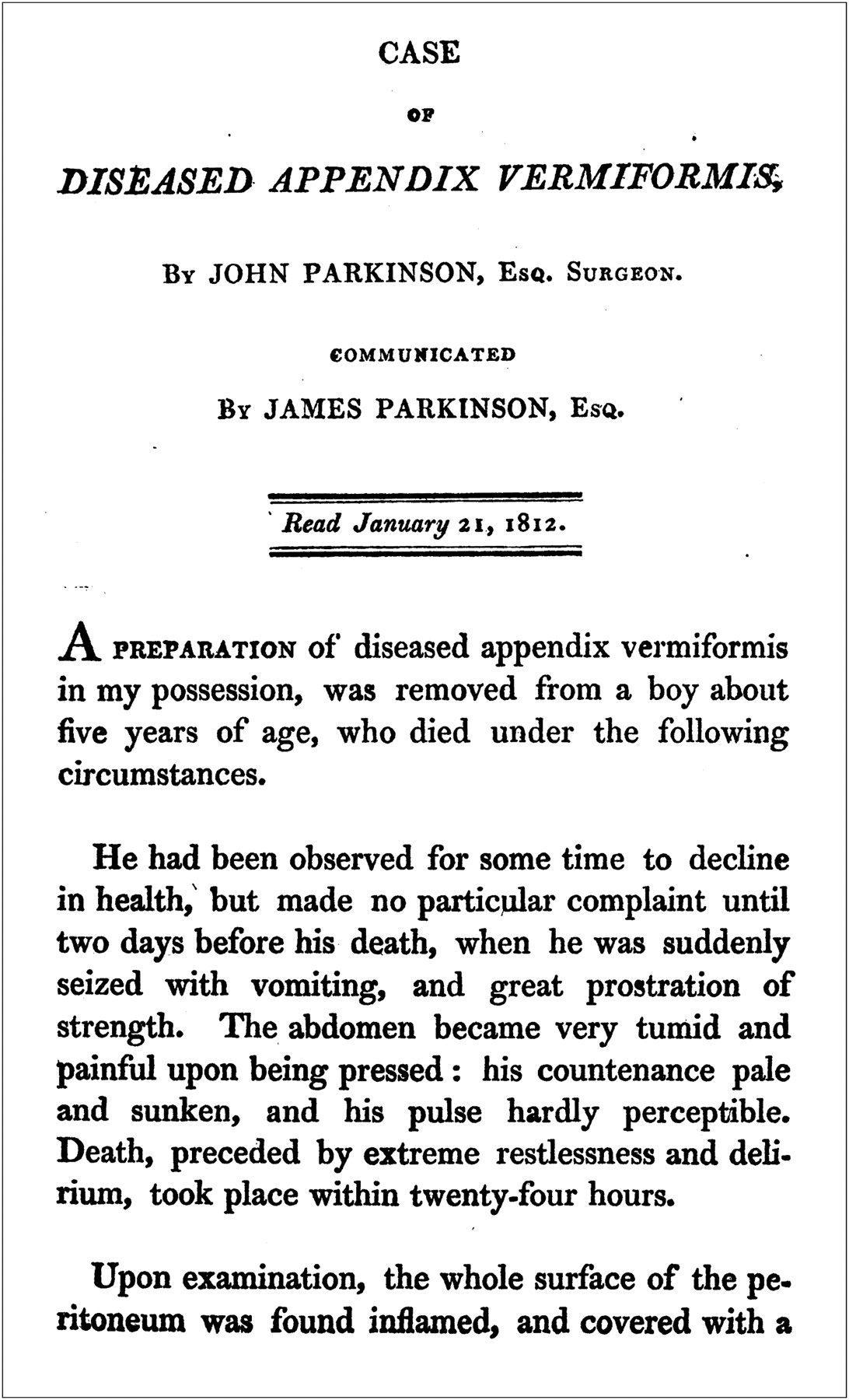
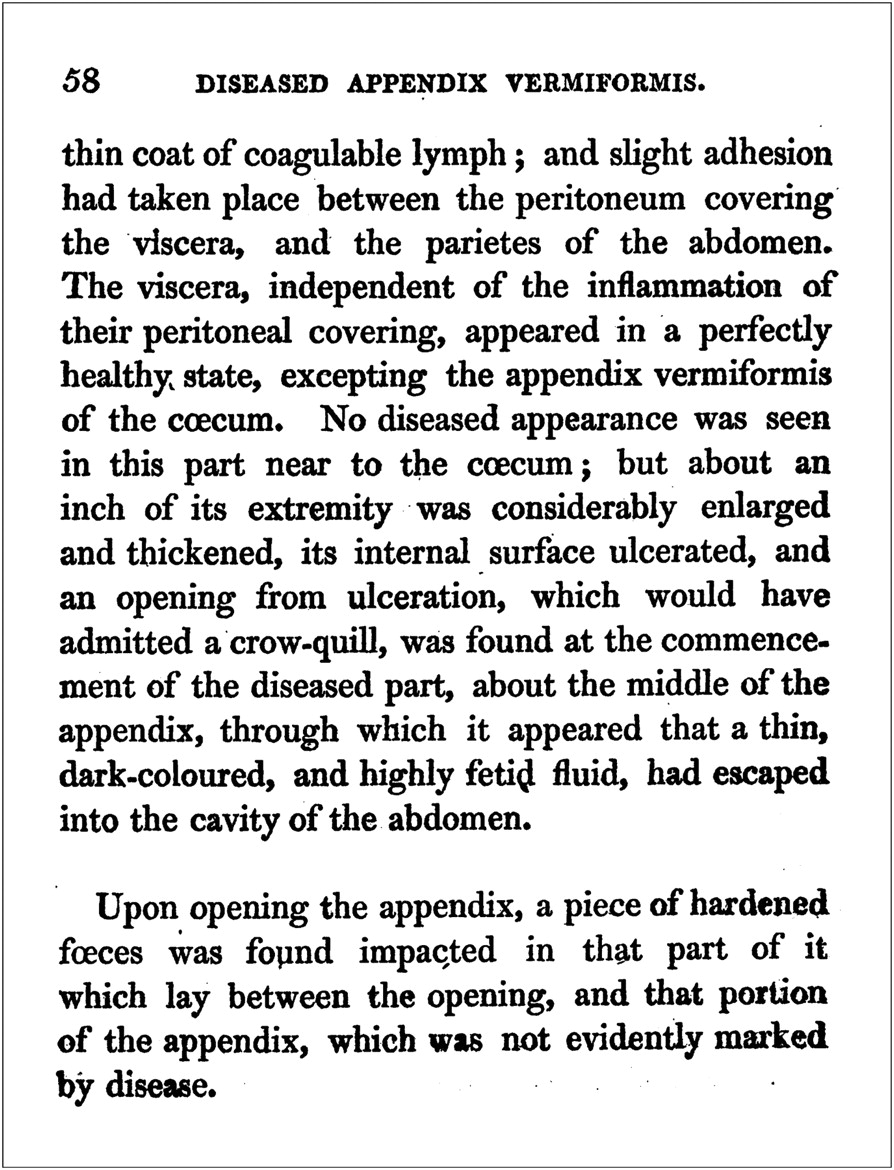
The first paper to describe acute appendicitis was read by James Parkinson, on behalf of his son John, to the Medical and Chirurgical Society on 21 January 1812. The paper describes a case of diseased appendix, which had resulted in the death of a 5-year-old boy under the Parkinsons' care. This paper was also the first description of appendicitis leading to perforation and subsequent death.
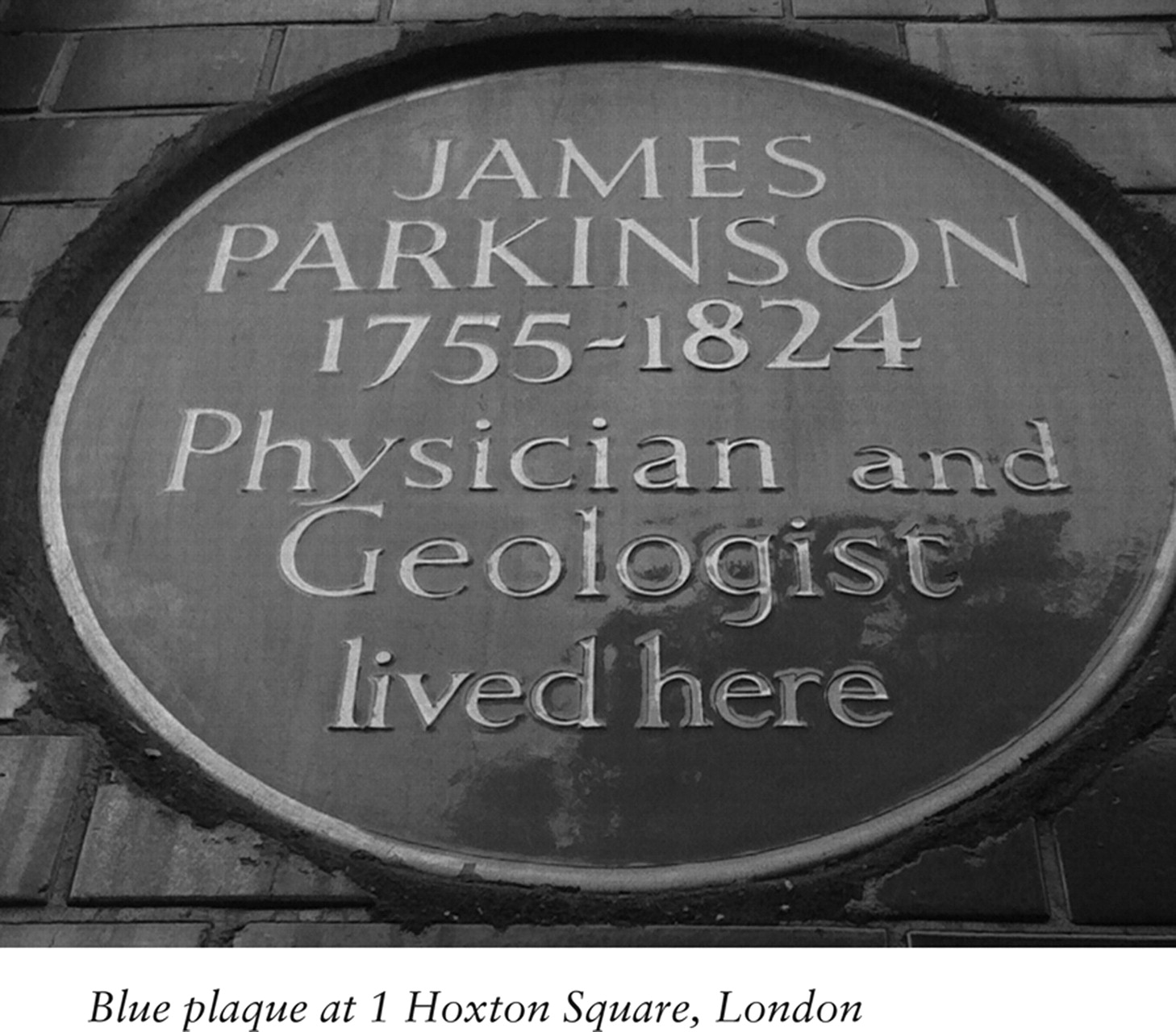
James Parkinson was born on 11 April 1755 in Hoxton Square, Shoreditch, London. There are no known portraits of him. His father was John Parkinson (c.1725–84), an apothecary and surgeon who practised in the Square, and his mother was Mary. James began to study medicine at the London Hospital Medical College when he was aged 20 as a ‘dressing pupil’ of Richard Grindall and was then apprenticed to his father for 6 years. He was awarded the diploma of the company of Surgeons in 1784, when he was 29. After 18 months of medical studies he became an honorary medalist of the Royal Humane Society for having assisted his father on 28 October 1777 in using resuscitation methods on a Hoxton man who had hanged himself.
Soon after his marriage to Mary Dale in 1783, and after his father's death in 1784, James succeeded him in his practice at 1 Hoxton Square. Of James's four children, John William Keys Parkinson qualified in medicine and shared his father's practice. JWK Parkinson later moved his own practice to Islington, London.
In 1785, James Parkinson attended a series of lectures by John Hunter on the principles and practices of surgery, taking them down in shorthand and afterwards transcribing them. His son John published them in 1833 under the title Hunterian Reminiscences.
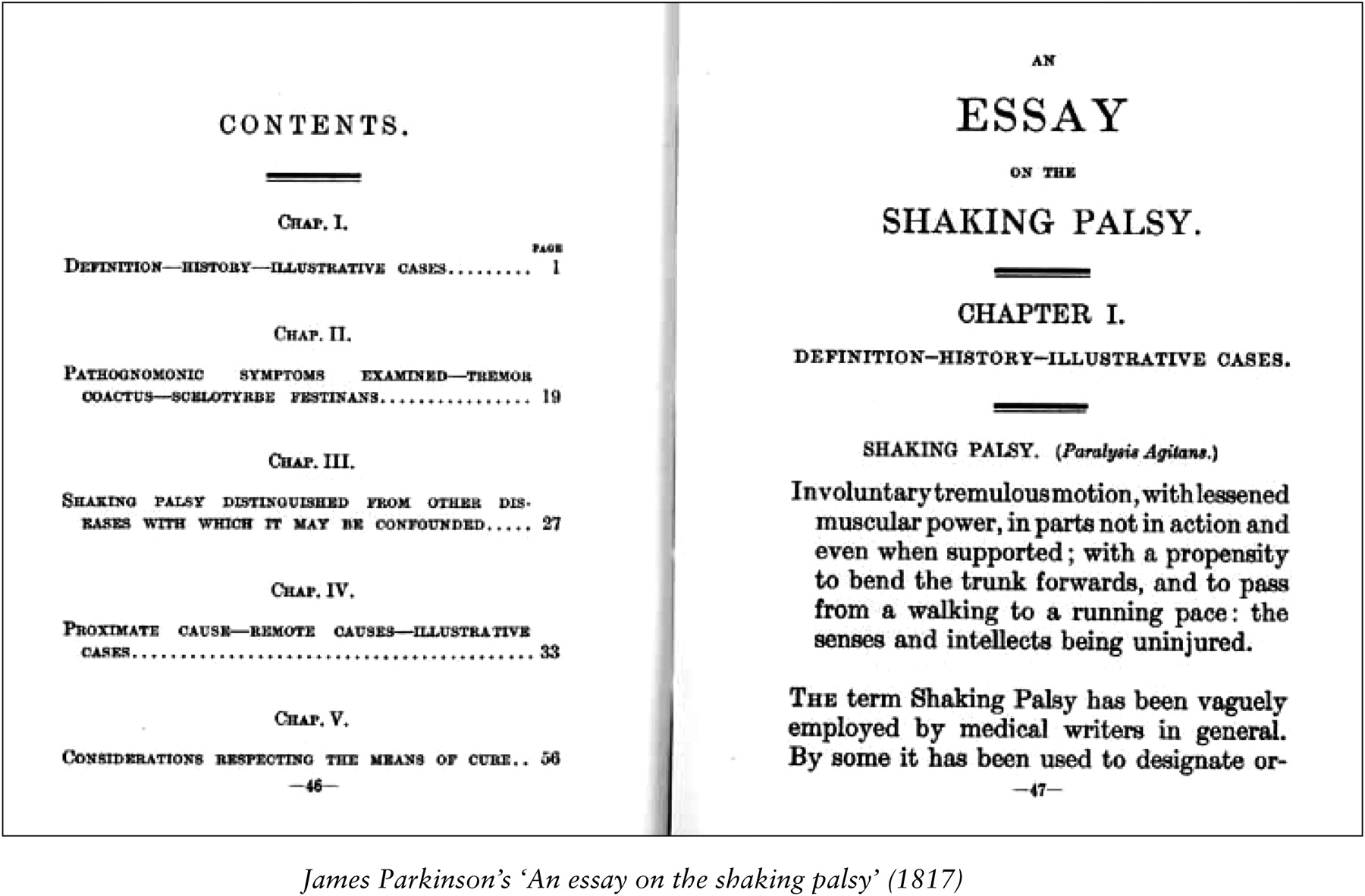
James Parkinson published his classic text Essay on the shaking palsy in 1817, establishing the disease, which he called paralysis agitans, as a clinical entity, based on six cases he had studied from a range of patients with a variety of palsied conditions that he had observed throughout his career.
Parkinson gave the classic clinical description of the condition:
Involuntary tremolous motion, with lessened muscular power, in parts not in action and even when supported; with a propensity to bend the trunk forewards, and to pass from a walking to a running pace: the senses and intellect being uninjured.
Jean-Martin Charcot added rigidity to Parkinson's clinical description in 1876 and named the condition ‘maladie de Parkinson’.
James Parkinson wrote papers and books on a wide range of medical subjects, including the effects of lightning; the distinction between disorders of memory, dysphasia, and true madness; parish fever wards; mental illness and mad houses; gout; and the education of medical students and apothecaries. In addition to medicine, James Parkinson had other wide interests in subjects as diverse as politics, social reform, geology, and paleontology.
He was a founding Member of the Geological Society of London, whose first meeting was at the Freemasons' Tavern in London on 13 November 1807 with, among others, Sir Humphry Davy, Arthur Aikin, and George Bellas Greenough.
He was also involved in many medical associations and served as President of the Society of Apothecaries for two years. At the end of his career, he became the first recipient of the Honorary Gold Medal of the Royal College of Surgeons in 1822. James Parkinson died after a stroke at his home at 3 Pleasant Row, Kingsland Road, Hoxton, on 21 December 1824.
On 21 January 1812 James Parkinson read a paper to the Medical and Chirurgical Society on behalf of his son John, who was not a Member of the Society. The paper begins with a description of a 5-year-old boy who had died with a diseased appendix vermiformis, which is followed by an account of the postmortem appearances. This case marked the beginning of a period during which many similar cases were described, including reports from Addison in England and Dupuytren in France.
The appendix was first described by Berengarius Carpus, Professor of Surgery at Pavia and Bologna, in 1522. Gabriello Fallopio (Fallopius) in 1561 compared it to a worm, and it therefore became known as the appendix vermiformis, although not everyone clearly distinguished between the appendix and the adjacent caecum.
Appendix abscess was well described, but the condition of inflammation of the appendix was generally referred to as typhlitis, which properly means inflammation of the caecum. James Murray omitted the word ‘appendicitis’ from the first edition of the Oxford English Dictionary, on the advice, so it is said, of Sir William Osler, then Regius Professor of Medicine at Oxford, who said that it was medical jargon that wouldn't last.
However, the word gained currency when, just before he was due to be crowned in 1902, King Edward VII, already on the throne, fell ill with an appendix abscess, which was drained by Frederick Treves. Treves's operation note read “A large abscess was opened at a depth of 4 in[ches] and two widecalibre drainage tubes were inserted surrounded by iodoform gauze. The appendix was left.” Treves described the condition as ‘perityphilitis’ [sic; it should be ‘perityphlitis’]. Since then the OED has traced the first recorded use of ‘appendicitis’ to a paper by Reginald H. Fitz in the October 1886 issue of the American Journal of Medical Sciences: ‘As a circumscribed peritonitis is simply one event … in the history of inflammation of the appendix, it seems preferable to use the term appendicitis to express the primary condition’.
It is notable that Parkinson's description makes it clear that in this case the caecum was not inflamed, only the appendix. The use of the suffix ‘itis’ to denote inflammatory processes dates back to the 16th century, the first example being ‘arthritis’ in 1543. So the Parkinsons missed an opportunity, in describing this case, of introducing the word ‘appendicitis’.
Eponyms associated with James Parkinson
Parkinson's disease: paralysis agitans, due to primary nigrostriatal degeneration
Parkinsonian facies or sign: the expressionless face characteristic of Parkinson's disease
Parkinsonism: the signs of Parkinson's disease, whether primary (in nigrostriatal degeneration, ‘idiopathic parkinsonism’) or secondary (e.g. to drugs such as dopamine receptor antagonists)
Selected bibliography by James Parkinson
Revolutions without Bloodshed; or, Reformation Preferable to Revolt (1794)
The Chemical Pocketbook; or Memoranda Chemical (1801)
Organic Remains of a Former World (1804)
Essay on the Shaking Palsy (1817)
A Pictorial Atlas of Fossil Remains, Consisting of Coloured Illustrations Selected from Parkinson's ‘Organic Remains of a Former World’, and Artis's ‘Antediluvian Phytology’, with descriptions by G.A. Mantell (1850)
DECLARATIONS
Competing interests
None declared
Funding
None
Ethical approval
Not applicable
Guarantor
MR
Contributorship
Both authors contributed equally
Acknowledgements
This paper was originally published as Chapter 4 of Doctoring History by Manoj Ramachandran and Jeffrey K Aronson, published by the Royal Society of Medicine Press in 2010