





Abstract

Ernst Ludwig Kirchner was born in Aschaffenburg in Germany on 6 May 1880 and grew up in Chemnitz. From 1901 he studied architecture at the Technische Hochschule in Dresden, continued his studies in Munich in 1903–1904, and completed in Dresden in 1905. In June 1905 Kirchner, Erich Heckel, Karl Schmidt-Rottluff and Fritz Bleyl founded an artistic group that they called Die Brücke (the Bridge), marking their desire to bridge the past and the present, by reviving old art forms and paying homage to their predecessors, such as Dürer, Grünewald and Cranach the Elder. They were among the founders of Expressionism in German art. Kirchner revived the woodcut, inspired by old prints from Nuremberg, Heckel carved wooden figures and Schmidt-Rottluff made lithographs on stone. But the main focus of their work was to depict naturalistic female nudes. The movement broke up in 1913, when Kirchner wrote the ‘Chronik der Brücke’ without consulting his colleagues, who thought it very one-sided. 1
In 1911 Kirchner moved to Berlin, and with Max Pechstein, also a one-time member of Die Brücke, founded the Moderner Unterricht im Malen (MUIM) Institut, a private art school dedicated to teaching modern methods of painting; the institute was a financial failure and closed in 1912. Between 1913 and 1915 Kirchner painted a series of Großstadtbilder (pictures of the metropolis), showing Berlin street scenes. 2 Kirchner's first exhibition as an individual artist at the Folkwang Museum in Essen in 1914 established him as a contemporary artist.
On the outbreak of war in September 1914, Kirchner volunteered for military service, enlisting as a driver in the artillery, in order to avoid conscription into the infantry. However, in 1915 he suffered a nervous breakdown, started to drink, and became addicted to morphine. He was discharged and spent the next two years in sanatoria in Taunus and Davos in Switzerland, recovering from depression and drug abuse.
In 1918 Kirchner took up permanent residence in Davos, the site of Thomas Mann's 1924 novel Der Zauberberg (The Magic Mountain). He lived in a farm house and mainly painted mountain scenery. Today the Kirchner Museum in Davos, which opened in 1992, houses many of his paintings.
Kirchner's Selbstbildnis als Soldat (Self Portrait as a
Soldier) dates from 1915 (
Selbstbildnis als Soldat (Self Portrait as a
Soldier) (1915) by Ernst Ludwig Kirchner (oil on canvas, 69 × 61 cm;
Allen Memorial Art Museum at Oberlin College, Ohio). Available in colour
online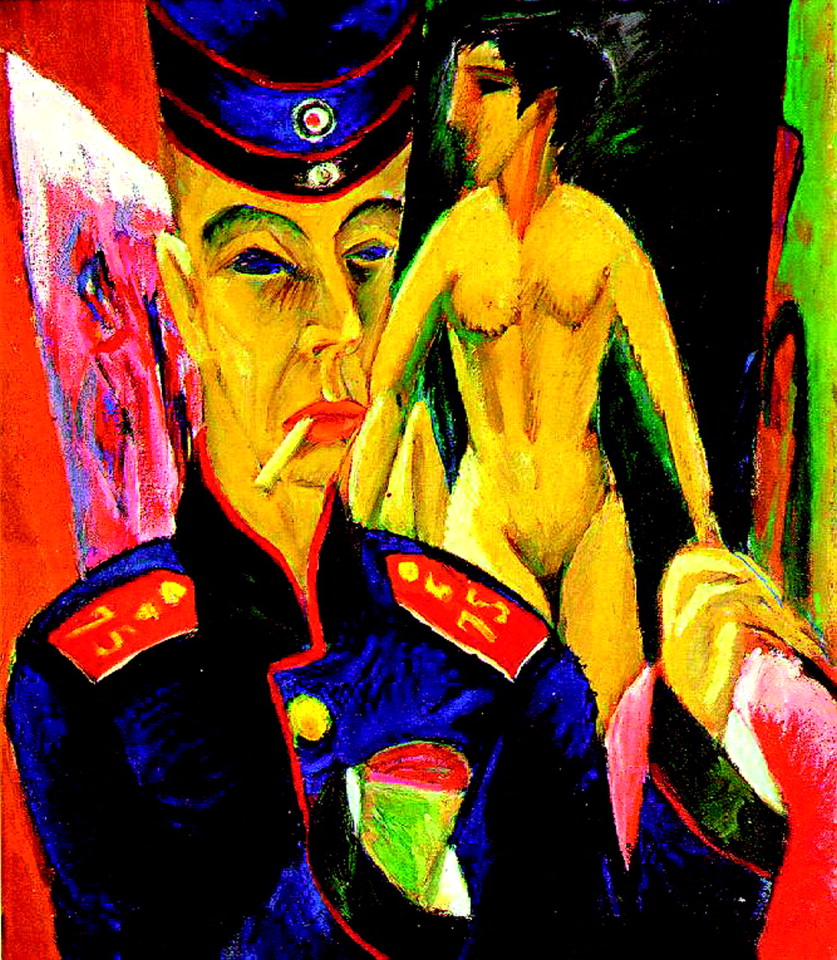
In 1917 Kirchner painted another frank portrait of himself (
Selbstbildnis als Kranker (Self Portrait as a Sick
Man) (1917) by Ernst Ludwig Kirchner (oil on canvas, 57 × 66 cm;
Pinakothek der Moderne, München). Available in colour online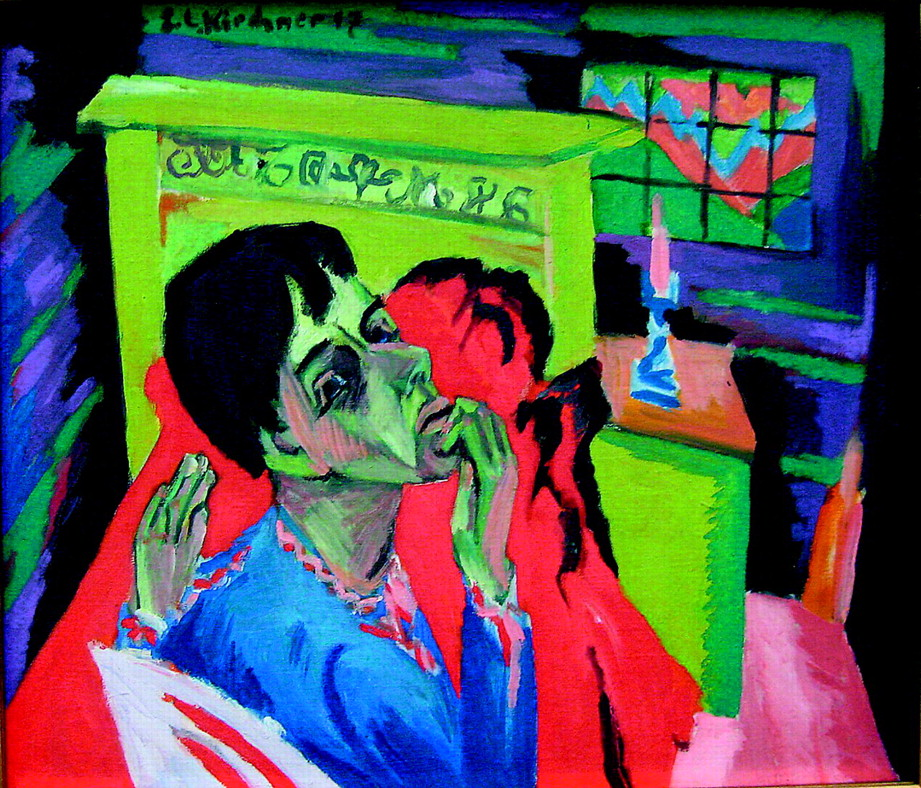
In 1923 Kirchner moved to Frauenkirch, just south of Davos. Various exhibitions in 1920 had introduced his work to a wider public in Germany and Switzerland, and when his work was shown at the Kunsthalle in Basel in 1924 it prompted the Swiss painters Paul Camenisch, Albert Müller and Hermann Scherer to found the group called ‘Rot-Blau’.
In 1926 an extensive exhibition of Kirchner's work was staged in Davos, following the publication of a catalogue raisonné of his graphic work. A commission for murals in the Folkwang Museum followed in 1927, and in 1928 he took part in the Venice Biennale. He became a member of the Prussian Academy of Arts in 1931, but did not find favour with the Nazis, and was forced to resign in 1933. The Self Portrait as a Soldier was exhibited in the reactionary Munich exhibition of ‘entartete Kunst’ (degenerate art) in 1937, 3 alongside works by such as Marc Chagall, Otto Dix, Max Ernst, George Grosz, Wassily Kandinsky, Oscar Kokoschka, Laszlo Moholy-Nagy and Piet Mondrian. Over 600 of Kirchner's paintings on display in public museums were confiscated and many were destroyed.
Kirchner committed suicide on 15 July 1938.
Footnotes
DECLARATIONS
Footnotes
Acknowledgements
None