





Abstract
We read with interest your comments facing the future of medical journals. 1 Many of the lessons from patient safety are applicable to mistakes in the medical literature. Unintentional errors should be used as learning opportunities and editors (and authors) should welcome their detection. Retractions and corrections are rare 2 and (as in clinical medicine) probably massively under-reported due to concerns about embarrassment and discomfort by authors.
Errors may vary in degree and type from minor typographical, system error (study design and execution) to the intentional acts of scientific misconduct (plagiarism, research fraud, duplication of publication). One study found that the highest number of retractions were in the following journals: Science; Proceedings of the National Academy of Sciences; and Nature. 2
Perhaps differential corrections rates reflect the quality of postpublication scrutiny and the rigour of its readership. It has been suggested that corrections should be prominent, informative and citable, and mentioned within the table of contents. 3
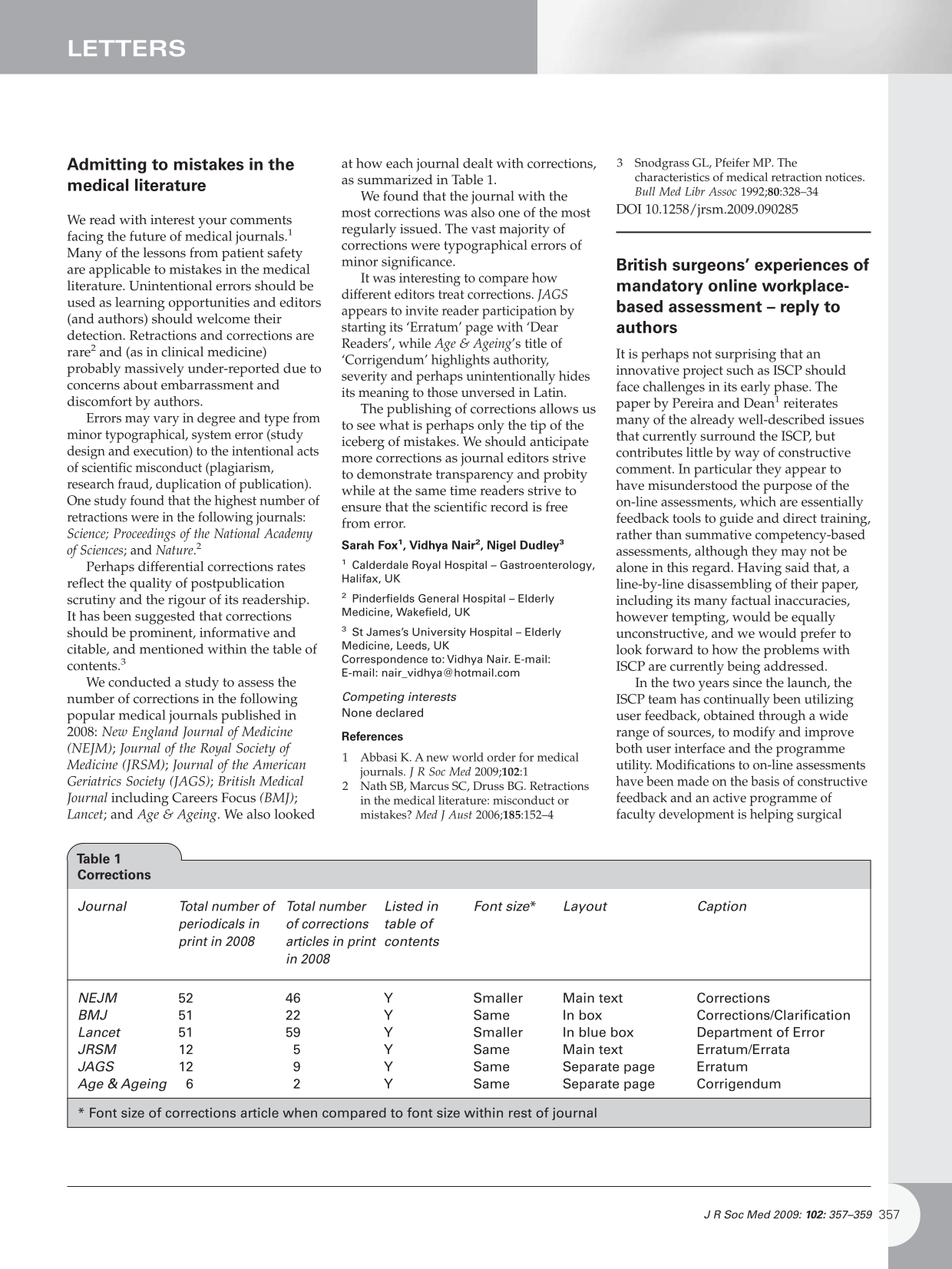
Corrections
Font size of corrections article when compared to font size within rest of journal
We found that the journal with the most corrections was also one of the most regularly issued. The vast majority of corrections were typographical errors of minor significance.
It was interesting to compare how different editors treat corrections. JAGS appears to invite reader participation by starting its ‘Erratum’ page with ‘Dear Readers’, while Age & Ageing’s title of ‘Corrigendum’ highlights authority, severity and perhaps unintentionally hides its meaning to those unversed in Latin.
The publishing of corrections allows us to see what is perhaps only the tip of the iceberg of mistakes. We should anticipate more corrections as journal editors strive to demonstrate transparency and probity while at the same time readers strive to ensure that the scientific record is free from error.
Footnotes