




Abstract

Introduction
When the first edition of The Lancet was published in London on Sunday 5 October 1823, it was unusual in that it did not represent the interests of a particular professional group, or report the transactions of a learned society. It was, instead, the product of the fiery indignation and reforming zeal of its founding editor Thomas Wakley. The Lancet was issued at a time when the Government had imposed a tax on newspapers to prevent public unrest and within a decade it had begun to lay the foundations of evidence-based medicine, medical audit and the regulation of the medical profession. The influence of the journal came, however, at a price and with a touch of notoriety, and was in part the result of a series of high-profile clashes between Wakley, senior medical figures and the British legal system.
Historical background
In 1811 the reign of George III ended in porphyria-induced madness. His son, the Prince of Wales, later George IV, was appointed Prince Regent and held this title until his father's death and his own coronation in 1820. The extravagances and achievements of the Regency period were played out against a background of industrialization and civic unrest in England, beginning before the end of the Napoleonic wars in 1815, and culminating, in 1820, in a plot to murder Lord Liverpool's Cabinet.
The first decades of the 19th century were a time of tremendous cultural and artistic accomplishment, which included the paintings of Constable and Turner, the poetry of Keats, Coleridge and Wordsworth, and the novels of Jane Austen. The incomparable London Regency buildings of John Nash and his idiosyncratic Royal Pavilion at Brighton stand as reminders of this remarkable era.
Early 19th century medicine, by contrast, was primitive and unregulated. Poorly-trained doctors grappled with diseases of which they knew almost nothing and for which there were no effective treatments. Surgery was barbaric and there were no anaesthetics. Infection was everywhere and standards of hygiene were abysmal. Louis Pasteur was not born until 1822 and Joseph Lister in 1827. Nepotism and patronage were the norm. Body-snatching was rife. Wakley came to London in 1815 and, in 10 years, had begun to change the face of English medicine.
Thomas Wakley
Thomas Wakley was born in 11 July 1795, the youngest son in a large and prosperous
Devonshire farming family.
1
He was a handsome, athletic boy, fond of sports and adept at boxing, and had
been well-educated at West Country grammar schools ( Thomas Wakley (from an engraving by WH Egleton, after a painting by K
Meadows)
Arson and attempted murder
At around midnight on Sunday 27 August 1820, Wakley, who had been applying leeches to his temples because he had not been feeling well, answered the door to a stranger who claimed that he had come to deliver a message. He said he was tired after a long journey and asked for a drink and, while Wakley was going down to the cellar to get him a glass of cider, a number of other villains rushed into the house. They stabbed Wakley, beat him with clubs and set fire to his house, which was gutted. Wakley was lucky to escape with his life.
The motives for this horrific attack remain a mystery. It is likely that Wakley's assailants were co-conspirators or acquaintances of five criminals who were hanged at Newgate earlier in the year for their part in the Cato Street Conspiracy, the plot to assassinate the Prime Minister, Lord Liverpool and members of his Cabinet. After the hangings the corpses were decapitated, in public view, by a masked figure whose speed and dexterity in severing their heads roused suspicions that he was a member of the medical profession. Later events, however, indicated that the decapitator was probably a dissecting-room assistant called Tom Parker, but a newspaper article had stated that the masked operator was ‘a young surgeon of Argyll Street’ pointing the finger of guilt firmly, but erroneously, at Wakley.
Although Wakley was publically exonerated from any part in the decapitations, his problems multiplied. The Hope Fire Assurance company, with whom Wakley's property was insured, refused to pay out. Wakley had increased the sum insured shortly before the attack, and the company insinuated that Wakley had started the fire himself in order to obtain the insurance payments. Wakley's first of many legal battles was heard before the Lord Chief Justice who, after protracted proceedings, found entirely in Wakley's favour and ordered the insurance company to pay out in full and also to cover Wakley's considerable legal costs.
William Cobbett
Fate then took a hand, when Wakley became acquainted with the radical politician and journalist William Cobbett. Cobbett had recently returned from the United States and his antipathy towards the Government of the day was further fuelled by the Peterloo massacre of 1819, when 60 cavalrymen, brandishing sabres, charged into a large crowd of men, women and children protesting against the Corn Laws, killing 11 and injuring 500 people. Cobbett, who edited The Weekly Political Register and The Evening Post, had been concerned that the Cato Street conspirators might have had evil designs on him as well as Wakley, and sought out Wakley, with whom he developed a firm friendship. Wakley, it appears, was deeply impressed by meeting Cobbett's radical journalist friends and by the way in which they used writing and publication to attack wrong-doing. During his time in London, Wakley had become increasingly aware of widespread corruption within the medical profession, where influence counted for more than ability and where ignorance and avarice were rampant. Within two years he had put together his plans to launch The Lancet.
The Lancet
The Lancet of 5 October 1823 was to be the first issue of a weekly
newspaper devoted to the interests of the medical profession. In its preface, Wakley
served notice on the profession's pursuit of ignorance, prejudice and patronage and on
the self-interest of its leaders. He also laid the foundations of evidence-based
medicine when he wrote:
‘… we conceive, to supply, in the most ample manner, whatever is valuable
in these important branches of knowledge; and as the lectures of Sir Astley
Cooper, on the theory and practice of Surgery, are probably the best of the
kind delivered in Europe, we have commenced our undertaking with the
introductory address of that distinguished professor given in the theatre of St
Thomas' Hospital on Wednesday evening last. The course will be rendered
complete in subsequent numbers.
In addition to Lectures, we propose giving under the head, Medical
Surgical Intelligence, a correct description of all the important Cases that
may occur, whether in England or on any part of the civilised continent.’
2
Warming to his theme Wakley continued:
‘… we shall exclude from our pages the semibarbarous phraseology of the
Schools, and adopt as its substitute, plain English diction … We hope the age
of “Mental Delusion” has passed, and that mystery and
concealment will no longer be encouraged.’
2
As well as Cooper's lectures, the first Lancet contained a number of unusual case reports, including hydrocephalus and hydatids of the liver, an editorial on the fatal effects of fear and a critical review of a number of quack medicines, including Daffy's Elixir and Spelbury's Antiscorbutic drops. The publication ran to 36 pages and, as well as its medical content, also featured reviews of The Rivals at Drury Lane and Much Ado About Nothing at Covent Garden, as well as an inexplicable and virulent attack on William Pitt the Younger. 3
While Wakley was probably correct in his assessment of the quality of Sir Astley Cooper's lectures, he had overlooked (or had decided to ignore) one important fact, which was that Cooper himself had not given permission for his lectures to be published.
Sir Astley Paston Cooper
Cooper, like Wakley, was a countryman, the son of a Norfolk parson.
4,
5
Like Wakley he had married well and his personal brilliance and his wife's
wealth propelled him into a glittering surgical career in London ( Sir Astley Paston Cooper (from the portrait by Sir Thomas Lawrence, Royal
College of Surgeons)
He was also one of the richest doctors in London and much of his income was derived from his extremely well-attended public lectures, for which medical students paid handsomely. Publication of these lectures in a sixpenny newspaper had the potential to severely damage his income.
Cooper's response typified his playful nature. He posed as a patient to gain entry to Wakley's office where, incredulously, he discovered Wakley in the very act of editing a further lecture destined for publication in The Lancet. There are different versions of this encounter – probably not their first, because Wakley studied under Cooper at Guy's – but the most appealing is that both men simultaneously recognized the absurdity of the situation, broke into laughter and became firm friends. 7 Other accounts portray a less charitable reaction from Cooper, 8 although the outcome was the same. Wakley was, on this occasion, spared the prospect of a law suit for plagiarism and Cooper agreed to further publication of these lectures as long as he was not identified as their originator.
Dr John Abernethy
Wakley was not so fortunate in his dealings with John Abernethy ( John Abernethy (from an engraving by Charles Turner after Charles William
Pegler)
Three days into the trial proper the Lord Chancellor reversed his previous opinion and refused to grant Abernethy's application, withdrawing the interim order restraining The Lancet from publishing the lectures. Characteristically the Christmas Day issue of The Lancet was devoted to a full report of the court case and not only was the publication of the lectures resumed in the New Year but Wakley continued to taunt Abernethy in print, 11, 12 to the extent that a second application for an injunction was brought by Abernethy to the Lord Chancellor in May 1825. Abernethy's timing was not particularly good because, by then, The Lancet had stopped reproducing his lectures and Wakley seemed to be tiring of the fight, although he did have the energy to write: ‘He may possibly have vanity enough to suppose that we shall re-print his lectures … our pages have been already obscured with his hypothetical nonsense during six tedious months, and when we read the proof of the last paragraph we felt relieved of a most intolerable incubus’. 1
However, Abernethy's second application for an injunction was successful and the Lord Chancellor's judgement was that lectures could not be published for profit and if any pupil who had paid to hear them then sold them to a publisher he infringed the law and the publisher was guilty of fraud ‘in a third party’. This judgement forms the precedent against which matters of copyright relating to lectures are still tested.
Wakley's contretemps with Astley Cooper and John Abernethy were almost certainly responsible for the passage of a cynical by-law by the Royal College of Surgeons. The College's Court of Examiners ruled that doctors wishing to become members of the College needed to show proof of attendance at lectures on the theory and practice of surgery at specified London hospitals, unsurprisingly including Guy's, St Thomas' and St Bartholomew's. Even though the lectures were available in print, students still needed to attend them to obtain their certificates.
Mr Frederick Tyrrell
While the Abernethy case was being played out in Chancery, Wakley was engaged in yet another, and more serious, action in which he was being sued for libel by the St Thomas' surgeon Frederick Tyrrell. Wakley had begun to turn his attention to the standards of medical practice in the metropolitan hospitals. The first volume of The Lancet had contained fairly neutral, and occasionally complimentary, reports of the conduct and outcome of interesting surgical cases, but in his preface to the second volume Wakley had sounded a warning note, threatening closer scrutiny: ‘The next distinguishing feature of The Lancet is the publication of Hospital Reports. It has long been a matter of astonishment that from the different hospitals in this great metropolis no reports of cases have been sent forth to the world. This deficiency we shall endeavour to supply, and our reports will have this advantage of any that might be published by the surgeons of the different institutions – that while they would have an interest in concealing many circumstances which might reflect discredit on themselves and the institution to which they belong, we cannot be influenced by any such considerations …’ 13
Relentless scrutiny it was. Using personal observation and reports from colleagues, Wakley set about describing surgical mishaps in great detail, unafraid to identify idle, ignorant or callous clinicians. These revelations did not go down well and Wakley was banned from entering St Thomas' Hospital by order of its surgeons on 22 May 1824. Relationships between The Lancet and the metropolitan hospital officials deteriorated sharply. Despite his ban, Wakley continued to obtain information about the surgeons, particularly those working at St Thomas', for whom he had little respect, designating the three senior surgeons – Travers, Tyrrell and Green – as ‘the Three Ninny-hammers’, and describing their practice as ‘Hole-and-Corner Surgery’. 14
Things came to a head when Wakley mounted a vigorous two-pronged attack against Frederick Tyrrell, one of the surgeons who had him expelled from St Thomas'. 15 He accused Tyrrell, ironically, of plagiarism when The Lancet's version of Cooper's lectures appeared in a book on surgery published by Tyrrell, to which Tyrrell himself had appended so-called illustrative cases. One of these cases was recognized by Wakley and, contrary to Tyrrell's description of a successful outcome, Wakley knew about the patient in question, who had been treated by Tyrrell for a compound fracture of the skull which, in reality, had led to the patient's death. An account of the postmortem examination of this case had previously been published in The Lancet.
Tyrrell sued for £2000, offended as much by the tone as by the content of Wakley's accounts. The trial began on 25 February 1825, and Wakley was ably defended by the radical Edinburgh lawyer Henry Brougham, who later went on to become Lord Chancellor. Brougham played with Tyrrell, painting a picture of him as Cooper's poodle, and ridiculing his management of the fractured skull. In his summing up, Lord Chief Justice Best attempted to guide the jury towards a guilty verdict, which after one-quarter of an hour they returned, but assessed the damages at a mere £50. Predictably, perhaps, Wakley ripped into the Lord Chief Justice in the next available issue of The Lancet, accusing him ‘… while shielded by his office, of throwing into the scale of the plaintiff's case the preponderating influence of his authority …’, 1 and continuing unabated his attack on Tyrrell's medical competence.
The somewhat equivocal outcome of this case had one important result, which was that The Lancet became recognized as a powerful publication with an editor to be reckoned with. Its circulation had risen to 4000 but its original publishers, fearing further legal liability, passed the paper on to Mills, Jowett & Mills of Fleet Street. Perhaps emboldened by the outcome of the Tyrrell case, Wakley continued to publish accounts, some of them verging on the lurid, of medical mishaps and malpractice in the London hospitals, which eventually brought him into conflict with not one but two Coopers, in the personages of Sir Astley and his nephew Bransby, later his biographer.
Mr Bransby Cooper
Bransby Cooper ( Bransby Cooper (from an image held by the Gordon Museum, King's College
London)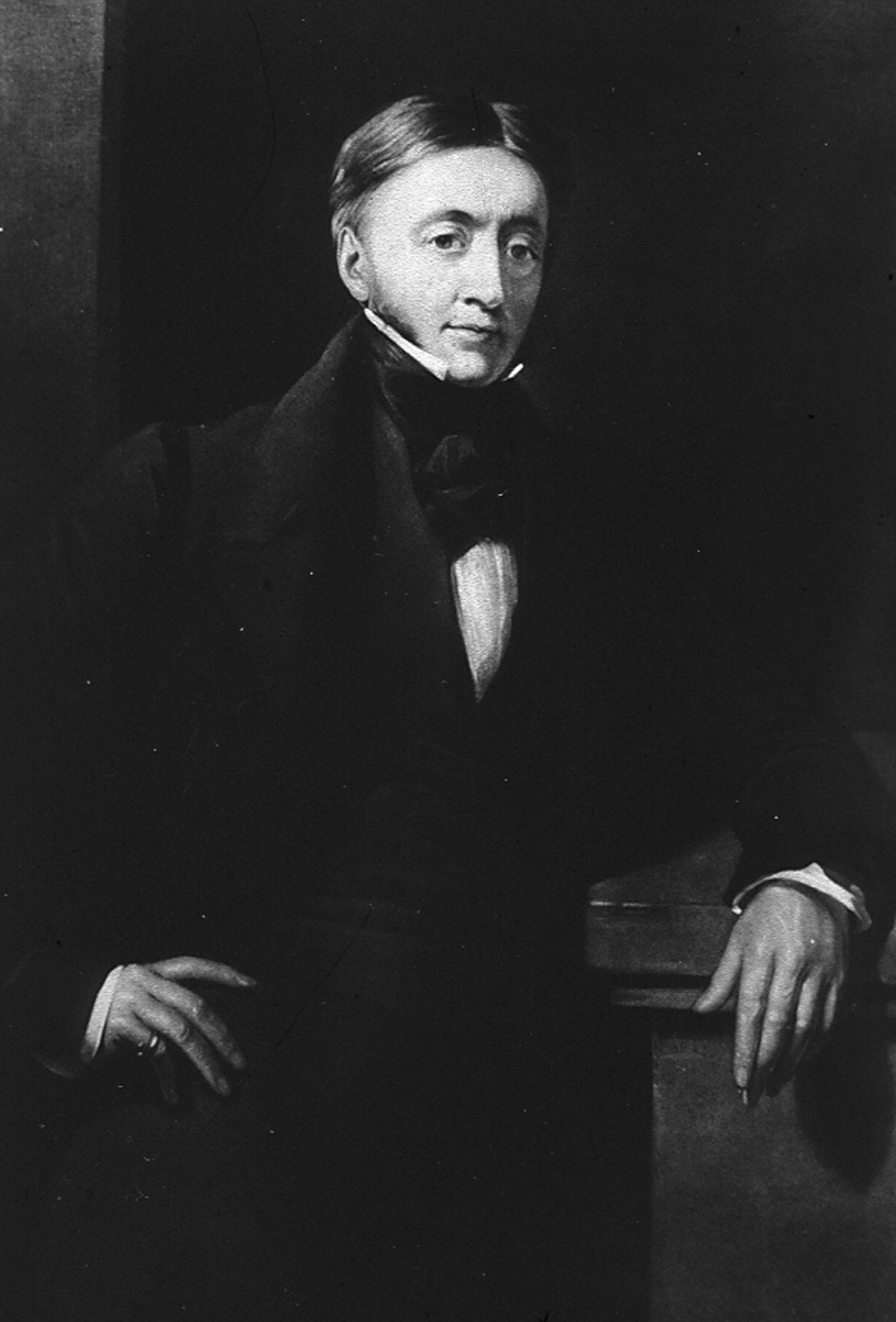
The case was heard promptly, in December 1828, in the Court of the Queens Bench before
Lord Tenterden. Cooper was represented by Sir James Scarlett and Mr F Pollock, and
Wakley defended himself, bringing into court a number of props, including a model of a
child in the lithotomy position, a set of pelvic bones and examples of the various
instruments used by Cooper in the fatal operation. Wakley conducted his defence with
great skill and made the important point that not only should hospitals aspire to the
highest standards of care, but mechanisms should be in place to ensure that standards
are set and met. Wakley's belief in the rightness of his cause made him a difficult
witness to shake under Scarlett's aggressive cross-examination. Much of Scarlett's
defence of Bransby Cooper relied, probably inadvisedly, on the fact that he had been
chosen by Astley Cooper as someone fit to practise at Guy's. Scarlett attempted to
discredit Mr Lambert, The Lancet reporter, but Wakley was able to
produce one of Cooper's assistants at the operation, a Mr Calloway, who confirmed the
precise details that had been reported in The Lancet. After a long case
the jury deliberated for two hours and returned a verdict for the plaintiff, but for
damages of only £100. This was another triumph for Wakley and The
Lancet, and was recognized nationally as a landmark case. Wakley's legal
costs amounted to over £400, and this amount was quickly raised by public subscription,
with the excess funds being forwarded to the widow of Cooper's unfortunate patient,
whose bladder calculus has been preserved in the Gordon Museum at Guy's Hospital ( The bladder calculus
The later years
Wakley did not slow down, and continued to edit The Lancet until his death. He became Member of Parliament for Finsbury and was largely responsible for the content of the Medical Act of 1858, under which a General Council of Medical Education and Registration was established. He was also a prominent Coroner, and in both roles was responsible for further social reform in such fields as corporal punishment and food safety. Diagnosed with tuberculosis he settled briefly in Madeira where, typically, he set about exposing the export of fake Madeira wine. When his health began to improve he planned to return to London but, following a fall on the beach, he sustained a massive and fatal pulmonary haemorrhage, and died on 16 May 1862. The editorship of The Lancet passed to his youngest son William, after whose death Wakley's eldest son and his grandson, both named Thomas, assumed joint editorship of the journal.
Wakley's courtroom dramas and his untiring pursuit of honesty and probity were largely responsible for the reform of English medicine in the mid-19th century. His brave and far-sighted editorship of The Lancet laid the foundations for the practice of medical publishing and journalism for the next 150 years. We owe him an enormous debt.
Footnotes
DECLARATIONS
Footnotes
Acknowledgements
RJ is most grateful for the assistance and advice given by Bill Edwards, Curator of the
Gordon Museum and the staff of the Information Centre, Royal College of Physicians,
London. A short version of this paper has previously been published in The
Lancet 2008;