





Abstract

Case report
A 38-year-old man was brought to A&E having collapsed at home after complaining of right-hand paraesthesia and discolouration. A self-employed plumber and smoker, he had been diagnosed with Crohn's disease aged 18 years although he was not receiving any treatment at this time.
On arrival 35 minutes post onset of symptoms he had a right-sided weakness plus inattention. His airway was patent, he was ventilating spontaneously (RR 24 breaths/min) and he was haemodynamically stable (pulse 90 bpm sinus rhythm, NIBP 115/65 mmHg). His Glasgow Coma Score (GCS) was 11/15 (Eyes 4, Verbal 2, Motor 5 [R]) with right-sided hypotonia and weakness (3/5) and upward right plantar reflex. Four minutes post arrival he vomited and dropped his GCS to 8/15 (Eyes 2, Verbal 1, Motor 5 [R]) which necessitated a rapid sequence induction of anaesthesia (propofol and suxamethonium) and tracheal intubation. The digits of his right hand were markedly discoloured with a capillary refill time of 5 seconds. His radial pulse was weakly palpable and ulnar pulse detectable on doppler examination.
CT head with contrast performed 65 minutes post onset of symptoms showed low attenuation involving the insular cortex and lentiform nucleus with associated sulcal effacement consistent with an acute left middle cerebral artery territory infarct and no evidence of haemorrhage (Figure 1).
He was given Alteplase (81 mg) 85 minutes post onset. A transthoracic echocardiogram (TTE) performed in A&E showed good biventricular function, no clots or masses, a normal aortic root and arch and no obvious patent foramen ovale although TTE cannot safely exclude such an abnormality. A repeat CT performed 8 hours post onset showed an increase in low attenuation. A CT aortogram performed to examine for great vessel dissection or occlusion found no abnormalities.
Venous blood tests suggested probable active low grade Crohn's disease despite his wife's reports of no recent episodes (Hb 10.0 g/dL, MCV 70.9 fl, Plt 481 × 109/L, Alb 25 g/L, CRP 86 mg/L, Mg 0.67 mmol/L).
On the ITU 23 hours post onset he developed signs of raised intracranial pressure (Pulse 65 bpm, IBP 200/100 mmHg). CT showed infarct progression with extensive attenuation reduction and accompanying mass effect with midline shift but still no haemorrhage. Brainstem testing was later performed with family present and he died 34 hours post onset of symptoms.
Discussion
The July 2008 guideline on stroke published by NICE 1 stresses the importance of recognizing those patients at increased risk of stroke. One such group occasionally forgotten is young patients with co-existing inflammatory bowel disease (IBD).
The incidence of systemic thromboembolic (TE) events in IBD ranges between 1–7% in clinical studies rising to 41% in postmortem data while population-based research has shown IBD patients to have a three-fold increased risk of developing DVT and PE compared to the general population. 2 For those affected the TE event occurred at a younger age than the non-IBD cohort (52 years vs. 64 years). 2 Such increases have not been found in other chronic inflammatory or gastrointestinal conditions such as rheumatoid arthritis or coeliac disease. 3 After peritonitis and cancer, TE events rank as the third highest cause of death in IBD patients. 4
Crohn's disease is associated with the development of a hypercoagulable state the extent of which is thought to relate to disease activity.
3
Its cause is unclear, but it may be related to increased levels of plasminogen activator inhibitor, factors V and VIII and fibrinogen or to decreased levels of factor V Leiden, factor XIII, antithrombin III, and proteins C and S. Thrombocytosis and increased spontaneous platelet aggregation also occurs.
4
CT scan demonstrating left middle cerebral artery occlusion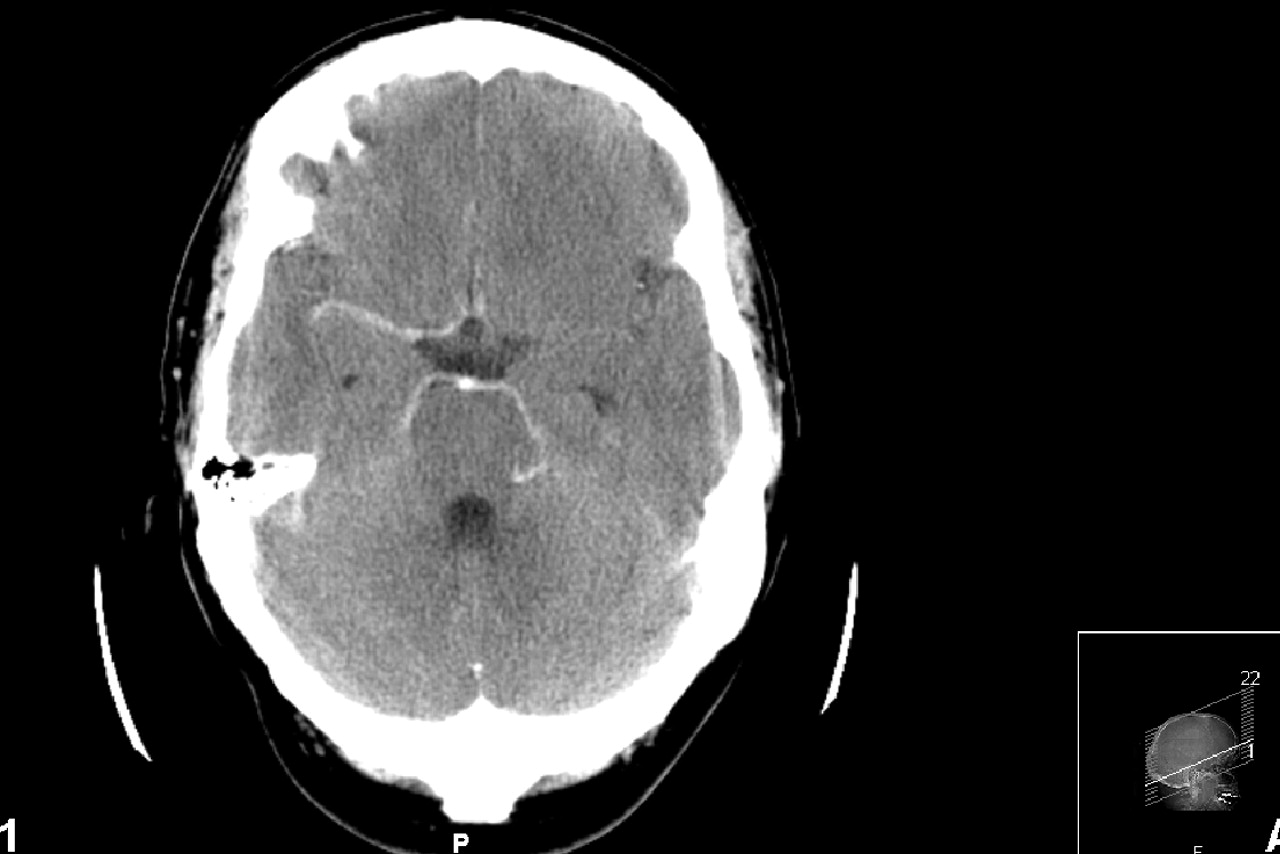
Hyperhomocysteinaemia is an independent risk factor for arterial and venous thrombosis as well as atherosclerotic endothelial cell damage in young people 2 and increased levels of homocysteine have been found in both the circulation and intestinal mucosa of Crohn's patients. 2 Methionine synthase is a vital component of the metabolic pathways that prevent hyperhomocysteinaemia developing through the remethylation of cysteine, but this process is dependent upon folic acid and vitamin B12 4 which Crohn's patients are episodically deficient in during times of increased disease activity.
Although this patient reported no symptoms to his wife prior to this presentation, his blood results suggest ongoing disease.
Cerebral vasculitis is a further pathology associated with cerebral ischaemia in IBD 3 but the co-existing discolouration and poor perfusion of the patient's right hand at the time of stroke suggest either a thrombus of central arterial origin or a venous thrombus that had passed through a patent foramen ovale. Such simultaneous thrombotic events have only been reported once before in the literature. 3
This case highlights two important clinical points. The first is the need for aggressive disease activity suppression and vitamin level assessment even in mildly affected Crohn's patients in order to minimize their risk of thromboembolism. The second is the need for vigilance when assessing any IBD patient who reports minor or atypical neurological of vascular symptoms that might be the antecedent of significant clinical events.
Footnotes
DECLARATIONS
Footnotes
Acknowledgements
None