




Abstract

‘Not having the information you need when you need it leaves you wanting. Not
knowing where to look for that information leaves you powerless. In a society
where information is king, none of us can afford that.’ Lois Horowitz
The 2004 United Kingdom white paper ‘Better information, better choices, better health’ sets out an ambitious strategy for the provision of health information. 1 Everyone should have improved access to high quality information, health professionals should communicate more effectively with patients, and there should be a nationally coordinated process to produce and deliver information. There has been some progress towards these goals (e.g. NHS Direct now provides consumer health information by telephone, internet and digital television), but many patients and consumers still do not have access to the information they need or want, in a format they can understand. 2 A lack of appropriate health information can have serious or even fatal consequences. 3 As the target date for implementing the strategy is 2008, we discuss health information provision and what can be done to improve health communication.
Why do we need health literate patients?
Despite substantial investment by the NHS in quality improvement programmes, national service frameworks and the new general practitioner contract, the management of many long-term diseases remains suboptimal. One factor that limits the promotion of clinical effectiveness is low health literacy among patients (Box 1). This is a major obstacle to providing high quality care, as long-term diseases require self-management skills and the ability to negotiate complex treatments and health services.
A health literate individual has sufficient knowledge and skills to handle the information demands of the health system, communicate with health professionals, make appropriate use of health services, and contribute to optimizing the management of their own disorders. 4 Patients with good health literacy skills can also act as advisers and mentors for other patients with long-term diseases and thus help spread best practice and improve disease management.
Access to information
Health literate patients require access to appropriate information to participate effectively in their health care. Health literacy is not only about access to information, but it is an important component. Engagement with health information is a prerequisite for shared decision-making and exercising choice, and limited consultation times force increasing reliance on information outside the clinical encounter.
In recent years, considerable progress has been made in increasing public access to high
quality health information ( Health literacy is the ability to obtain, understand, act on and communicate
health information. A health literate individual is able to obtain and use the
information needed to make everyday health decisions. Health literacy is related
to, but distinct from, basic literacy (reading, writing, numeracy).
4,
39,
40
Health literacy skills can be categorized as functional (able to read
basic health information), critical (able to evaluate health information), and
interactive (able to apply the information).
41
All three levels are needed by an empowered patient, but functional health
literacy is the foundational skill. Low health literacy is very common. Most measures of health literacy have been
developed in the USA, where approximately 40% of the population have inadequate
health literacy.
6
UK prevalence is unknown, but at least 20% of UK adults have literacy and
numeracy skills insufficient to read simple written information; these people are
at risk of having inadequate or marginal health literacy.
42
Older adults, ethnic minorities, people with lower socioeconomic status,
people with long-term illness or disability, and those with limited education or
language proficiency are especially vulnerable to having low health literacy.
4,
43
As well as difficulty reading health information, people with low health literacy
may be less able to comprehend verbal instructions and are less able to
communicate with health professionals. Low health literacy is associated with
worse global health, lack of health knowledge, increased use of emergency and
inpatient services, a low uptake of preventive services, higher medical costs, and
reduced compliance with treatment.
44
NHS Direct: www.nhsdirect.nhs.uk
A range of NHS sites for children and young people: www.nhs.uk/youngpeople/
MedlinePlus (USA): www.medllineplus.gov
DirectGov Health and Wellbeing: www.direct.gov.uk/en/HealthAndWellBeing/index.htm
Health Canada: www.hc-sc.gc.ca/index_e.html
HealthInsite (Australia): www.healthinsite.gov.au
Health Finder (USA): http://www.healthfinder.gov
Patient UK: www.patient.co.uk
BMJ Best Treatments: www.besttreatments.co.uk
Net Doctor: www.netdoctor.co.uk
Male Health – The Men's Health Forum: www.malehealth.co.uk
Women's Health Concern: www.womens-health-concern.org/index.php
Directory of Patient Experiences: www.dipex.org
Patient UK Self-help and Support Group Directory: http://www.patient.co.uk/selfhelp.asp
UK Self-help Directory: http://www.ukselfhelp.info/
Description of health literacy
Consumer health websites
Government sites
Medical publishers
Charities
Self-help groups
What can health professionals do?
The prevalence of low health literacy means that health professionals have an important role to play in checking patient comprehension and initiating open discussion about health information. Better information, better choices, better health recognizes this role. It says that patients should have access to information delivered in the way they want it, and that their information needs should be discussed during each contact with a health professional. They should also be supported to understand the information and be empowered to ask questions and make decisions. Taken at face value this seems to put an enormous burden on health professionals. Given that access to health information has a number of patient benefits, but does not usually have a direct effect on health, 7 limited clinical time might be better spent on other matters. There are, however, simple steps that are reported to improve health communication, 1, 3 and these could be delegated to other members of the health care team.
The teach back method
Patients of all literacy levels benefit from plain language explanations but those who do not understand may not admit this. A simple method for health professionals to increase the amount of information communicated to patients is the ‘teach back’ technique. Patients are given information and then asked to ‘teach’ it back to the doctor. Mistakes are corrected and comprehension checked again, until the patient has correctly understood the information. The technique is frequently recommended in American literature, but seems to be less well established in other countries. Observational evidence suggests that using this method does not increase the length of consultations, 8 although the method does not seem to have been tested in a randomized controlled trial.
Signposting patients to reliable information
Information provision does not have to take place within a consultation. It is often
more appropriate to guide the patient to a reliable source of information and then
invite the patient for a follow-up consultation if necessary. The Picker Institute
has shown that a lack of signposting by UK health professionals means that patients
struggle to find the reliable information they need about health services.
9
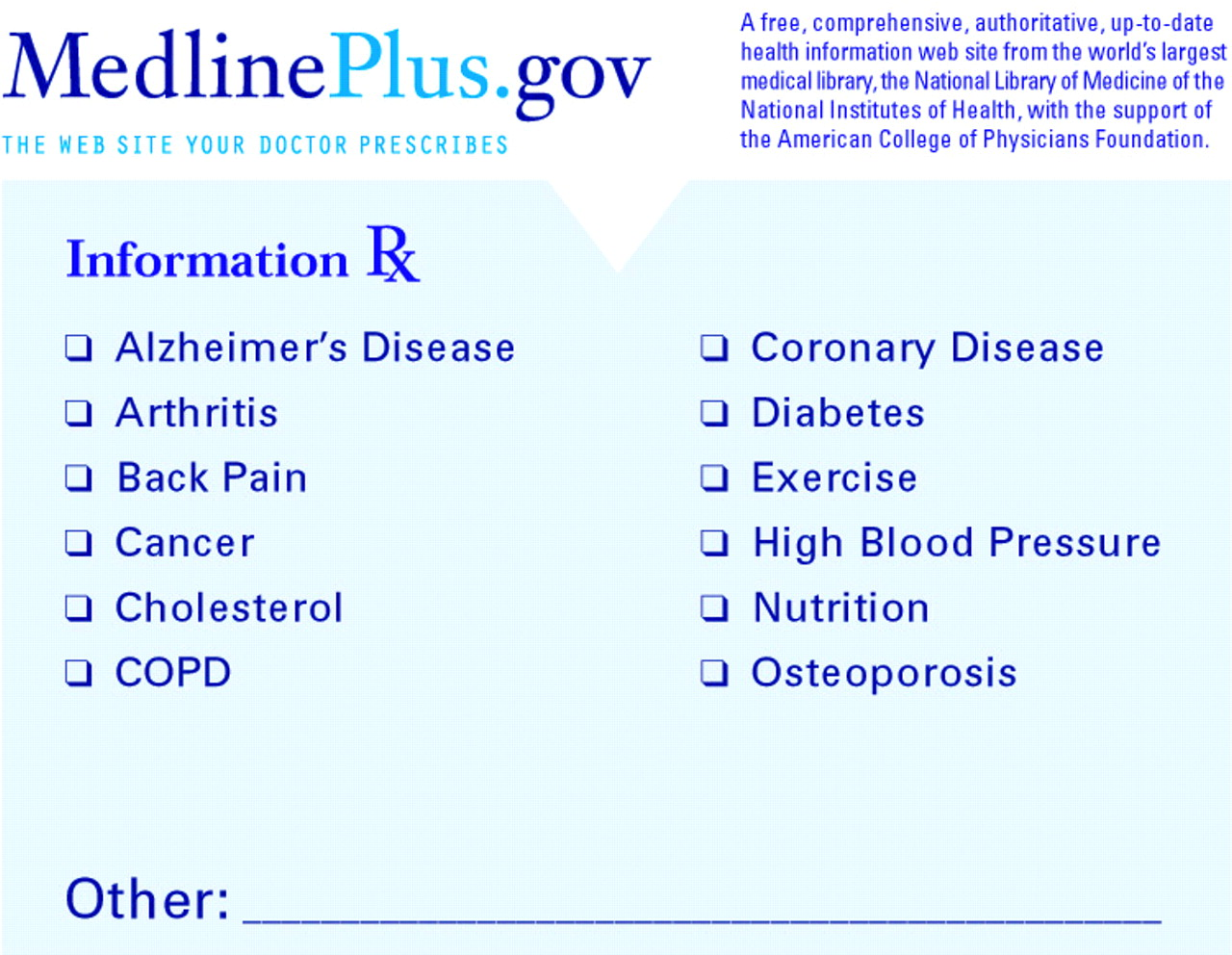
Information prescriptions are one way to signpost patients to high quality,
evidence-based information (

Use of alternative format resources
People now access news and information in a variety of formats, including by email, from websites, on interactive digital TV, in an SMS (Short Message Service) text to their mobile, and downloaded as a podcast. The rate of technological change and uptake of new technologies is rapid. For example, data from the UK Office of National Statistics show that 55% of households had internet access in 2006, compared to 10% in 1999 (Figure 2). In many European countries the use of these technologies is even higher (Figure 2). Yet when patients visit their doctor, information provision will almost invariably follow the pattern of a verbal explanation, occasionally accompanied by a printed patient information leaflet. Alternative formats are accessible and familiar to many patients but rarely used in mainstream practice. However, there are a number of randomized controlled trials that demonstrate the use of different formats to communicate health information to patients, including audio recordings, the internet, CD-Rom, video, and text message (Box 3). 14 There is evidence that these formats are in many cases more effective than traditional health communication: written information can improve health knowledge and information recall, but alternative format resources can improve health knowledge, user satisfaction, self-efficacy and health behaviour. 15
What can health services and organizations do?
Assuring the quality of information
Use of pictograms or pictures alongside written information,
45,
46
medical instrument instructions,
47
and cancer screening information
48
Information prescriptions in paediatrics
10
Personalized information for cancer patients
49
Multimedia programs or games for children with asthma
50,
51
Audio recordings of consultations for general practice patients and
parents of infants in intensive care,
52,
53
and to provide information about prenatal diagnosis and asthma
management.
54,
55
Patient-focused podcasts have not yet been tested in randomized
controlled trials, but are similar to other types of audio recording Use of SMS/text messaging in asthma and diabetes care
56,
57
and smoking cessation
58,
59
DVD/video of information about breast, prostate and colon cancer,
60,
61,
62
informed consent information for intravenous contrast
administration, knee arthroscopy and fracture surgery,
63,
64,
65
pre-test information about HIV testing,
66
pre-operative information about cataract surgery,
67
and decision support for newly diagnosed hypertensive
patients
68
Websites/the internet for migraine, smoking cessation and post-operative
pain management.
69,
70,
71
72

Improving access to information in a range of formats
Quality and access could be further supported by the development of regional or national patient resource libraries, offering patient education materials in a variety of formats. Building on the experience of ‘books on prescription’ 25 and online information prescription projects, 10 resource banks allow information prescriptions to be provided in the format most accessible to the patient. Regional or national schemes could either be accessed directly by patients and health professionals, or as a resource to support the work of similar schemes that have already been successfully organized by patient participation groups in individual general practices.
This type of service would have financial implications for the health service, but there are also costs associated with not providing access to information. For example, Schillinger and colleagues have demonstrated that higher health literacy and physician use of interactive education are associated with better glycaemic control and lower rates of retinopathy in diabetes. 8, 26 Poor health literacy is associated with higher medical costs and use of expensive emergency health services. 4
Addressing the information divide
As the role of information and communication technology in the delivery of healthcare increases, we need to ensure that those without access to new technologies are not unduly disadvantaged. 27, 28 These patients, who are more likely to be older, from ethnic minorities, non-English speaking or from lower socioeconomic groups 29 should be proactively sought by practices and their needs can be met with alternative approaches. 30, 31 As a large program of research supported by the US government shows, the benefits of employing information technology may actually be largest for currently underserved populations. 32, 33 Thus a main research priority should be development of new technology solutions that empower those most in need of empowerment. However, access to technology is not the only factor to consider. Mead et al. found that an expectation that online health information will be useful is a stronger predictor of interest in using online health information than demographic factors. 34 It is plausible that this attitude to internet information will become increasingly widespread as the internet and other technologies are integrated into society.
Alternative sources of health information can address the information needs of disadvantaged groups as well as extending access to information for all. 35 Providing a range of information formats allows information to be tailored to the needs of the consumer, but it should not be assumed that addressing poor health literacy will inevitably reduce health inequalities. 36 Particular attention needs to be paid to the information needs of consumers who do not use the internet or other new technologies, but the causal relationships between socio-economic status, health literacy and health status are far from clear. 37, 38
Conclusions
Both individual health professionals and health services have significant opportunities to improve health communication. Health professionals can actively guide and support patients to access and engage with high quality sources of information, as well as developing strategies to improve their own communication. These strategies are widely recommended, but conclusions about their effectiveness are currently limited by a lack of rigorous evidence. It is clear that, in many circumstances, alternative format resources are an effective and viable alternative to the printed patient information leaflet. The other strategies appear promising, but have not yet been rigorously tested and evaluated.
Footnotes
DECLARATIONS
Footnotes
Acknowledgements
None