






Abstract
Blood pressure control and prevention of hypertension can be achieved by both pharmacological and lifestyle interventions; one important lifestyle intervention is physical activity. Participation in regular physical activity can modestly lower blood pressure by reducing total peripheral resistance; it can also reduce the risk of developing hypertension and improve morbidity and mortality outcomes. Therefore, physical activity is a recommended intervention for the majority of hypertensive or prehypertensive patients. The precise level of physical activity required to lower blood pressure is unknown; however, in the UK, national minimum physical activity guidelines would seem appropriate for most hypertensives. Current patient physical activity levels can be assessed easily using retrospective recall questionnaires; preparticipation screening and exercise modifications for high-risk patients may reduce the risk of adverse events during subsequent exercise; and identification of a patient's willingness to increase physical activity levels may help to tailor physical activity advice. Health professional counselling or advice on physical activity is currently the most effective researched intervention. Its success can be maximized by delivering physical activity advice and counselling multiple times using different health professionals in person or over the telephone and by offering additional written materials. While the most effective methods for increasing physical activity levels in patients are probably still unclear, physical activity is an advisable intervention for the majority of hypertensive patients.
Introduction
Hypertension is one of the most prevalent and significant cardiovascular disease (CVD) risk factors, with the risk of CVD death doubling with each 20 mmHg increase in systolic blood pressure. 1 A propensity to develop essential hypertension with increasing age will be present in a large section of the population, although its development is not inevitable if appropriate lifestyle interventions are instituted. Treating hypertension reduces many associated health risks, often with a dose response; for example with only a small population reduction in systolic blood pressure (2 mmHg) a significant fall in the risk of coronary artery disease (7%) and stroke (10%) has been estimated. 1 In the UK, lifestyle interventions are recommended by the National Institute of Clinical Excellence (NICE) for the majority of hypertensives, either in isolation or as an adjunct to drug therapy; one important lifestyle intervention is physical activity. 2 As well as having a beneficial effect on blood pressure, regular physical activity has many other significant health benefits and is considered as important as a healthy diet and smoking cessation. 3 However, the reductions in blood pressure observed due to physical activity interventions can be modest 4 and the success of hypertension management using physical activity by direct physician intervention is equivocal. The aim of this review is to assess the effect of physical activity on blood pressure and to outline appropriate practical guidelines for physicians to use in the management of essential hypertension using physical activity.
DECLARATIONS
None
None
JB and AF
JB performed the literature review. AF and JB contributed to the writing of this article
Physical activity and blood pressure
Regular physical activity and high cardiovascular fitness in both normotensive and hypertensive individuals can reduce the risk of all-cause mortality (by up to 41% and 51%, respectively) and cardiovascular mortality (by up to 74% and 73%, respectively). 5 Initiating regular physical activity can prevent the development of hypertension; observational epidemiological studies suggest a reduction in the risk of developing hypertension of up to 52% in those who exercise regularly and maintain their cardiovascular fitness. 6
Dynamic endurance exercise initially causes a small drop in systolic blood pressure due to peripheral blood pooling; 7 increased cardiac output follows, a rise typically causing up to 200 mmHg or more with vigorous exercise, the magnitude depending on the duration and intensity of the exercise, 7 and can be more pronounced in hypertensives or those at risk of hypertension. The diastolic pressure response is variable, inasmuch as it may rise slightly, remain the same or fall. 8 During sustained isometric exercise, both systolic and diastolic pressures increase due to occlusion of resistance vessels in contracting peripheral muscles. Following a single bout of exercise, there is a transient drop in systolic blood pressure (postexercise hypotension) of up to 14 mmHg. 8 Postexercise hypotension may last for up to 22 hours depending on the frequency, duration, intensity and type of exercise performed. Shorter high-intensity bouts appear to have a greater postexercise hypotensive effect, particularly in prehypertensives, although longer exercise sessions of lower intensity may be more beneficial in achieving long-term reductions in blood pressure. Moderate resistance training elicits similar reductions in blood pressure. 9
Prevention and management of essential hypertension with physical activity
NICE recommends that lifestyle modifications, including physical activity, be used as a first-line interventions to prevent hypertension and as continued adjuncts to drug therapy. 2 Lifestyle modifications appear to confer only modest reductions in blood pressure (average systolic reduction, 3.1–6.9 mmHg; average diastolic reduction, 2.2–4.9 mmHg) (Table 1), although there are health benefits with even a relatively small (2 mmHg) drop in systolic blood pressure. 1 Initiation of regular physical activity in hypertensives can lead to a sustained reduction in blood pressure by an average of 6.9 mmHg systolic (Table 1); reductions have been similar in resting and ambulatory measurement. 10 This is slightly higher than the reduction of blood pressure in normotensives,4,10 and these effects on blood pressure appear to be independent of body mass or change in body mass. 4 Individual responses to physical activity interventions vary considerably due to differences in adherence as well as factors such as sex and race; 11 however, on average 31% of patients experience a drop of at least 10 mmHg in systolic blood pressure (Table 1).
Magnitude of the reduction in blood pressure in hypertensives following different lifestyle intervention

BP, blood pressure; DBP, diastolic blood pressure; NS, not significant; SBP, systolic blood pressure
Physiological mechanisms underlying blood pressure reduction following physical activity
A reduction in total peripheral vascular resistance (of the order of 7%) explains postexercise hypotension and the chronic reductions in blood pressure observed with regular exercise.
12
They are thought to be due to the following:8,12
Reduced sympathetic nerve activity as well as reduced plasma catecholamines; Increased endothelial responsiveness to vasodilators; Reduced plasma renin activity; Reduced insulin resistance.
Pharmacological compared with physical activity interventions
While the use of physical activity can be an important and effective tool in the management of hypertension, the magnitude of the reduction in blood pressure is potentially far greater with pharmacological interventions. Doses of drugs can be titrated and the addition of different drugs can increase the magnitude of the reduction in blood pressure compared with physical activity; indeed a dose–response relationship between physical activity and blood pressure reduction has yet to be established. The dropout rate in drug trials is also often much lower (typically <10% per year) 13 than for exercise intervention trials where the number needed to treat using primary care physical activity promotion to achieve the minimum physical activity recommendations at 12 months is 12 patients. 14 As a consequence, in order to achieve the magnitude of reduction in blood pressure required for many hypertensive patients, drug therapy is likely to be the most effective tool.
Reducing the risk of CVD and mortality is the ultimate aim of blood pressure control, and there is convincing randomized controlled trial data showing significant reductions in stroke risk in those taking antihypertensive medications. 13 However, with the exception of thiazide diuretics and angiotensin-converting enzyme inhibitors, there is little evidence of any reduction in the risk of all-cause mortality and myocardial infarction in those taking antihypertensive drugs (Table 2). Comparisons of outcomes between drug studies and those investigating the effects of physical activity are difficult because there are no randomized controlled trials investigating the effect of regular physical activity on CVD and mortality. On the other hand, there is strong prospective cohort evidence that participating in regular physical activity can significantly reduce the risk of both all-cause and CVD mortality (Table 2), as well as the risk of many other non-communicable diseases, with very few adverse side-effects.
Mortality and morbidity risk reductions with long-term antihypertensive medication and physical activity
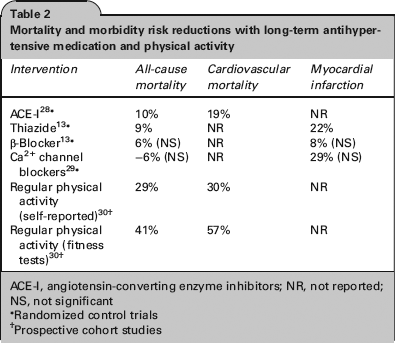
ACE-I, angiotensin-converting enzyme inhibitors; NR, not reported; NS, not significant
Randomized control trials
Prospective cohort studies
The overall health benefits apparent in such studies provide persuasive evidence of the need for physicians to consider physical activity as a treatment intervention in underactive patients. Furthermore, the high prevalence of suboptimal activity in the population at large (between 65% and 95% of adults in the UK, depending on method of measurement) 15 suggests that a large number of patients would benefit from physical activity interventions.
Guidance for physicians managing hypertension with physical activity
Hypertension is managed predominantly by primary care physicians, and the NICE hypertension guidelines indicate that clinicians should ‘ascertain people's diet and exercise patterns because a healthy diet and regular exercise can reduce blood pressure, offer appropriate guidance and written or audiovisual materials to promote lifestyle changes’ as a first-line treatment or drug adjuvant. 13 It is also recommended that exercise is prescribed by physicians to underactive patients as a preventative healthcare intervention; 16 this constitutes the majority of patients. Therefore, it is reasonable to assume that in the majority of primary care consultations, physical activity should be discussed; available data suggest that such discussions occur in less than 30% of cases. 17
The number of physicians using physical activity as an intervention for hypertension management is not known precisely but is likely to be low. This may be because the use of physical activity as a healthcare tool in a consultation can be time consuming, and there may be a lack of understanding on the part of physicians about the most appropriate and safe exercise interventions for many individuals. While each patient should be managed by the physician as an individual, a number of steps can be proposed for physicians considering offering physical activity as a management intervention for hypertension:
Identify the minimum physical activity level required for health benefits; Ascertain the patient's current level of physical activity; Ascertain the patient's willingness to increase their physical activity levels; Preparticipation screening.
Subsequently physical activity interventions can be implemented.
Minimum physical activity levels required for health benefits in hypertensive patients
Several exercise intervention schedules have been studied;9,10 however, consensus on precise minimum and optimal levels of physical activity deemed necessary to have a therapeutic effect on blood pressure is lacking and these are likely to vary from one individual to the next. Aerobic endurance exercise at low to moderate intensities (40–70% VO2 max) 12 appears to be very effective in achieving a significant long-term reduction in blood pressure. Longer exercise durations (30–45 minutes per session) appear more effective at reducing blood pressure than shorter sessions, 18 although accumulated bouts of shorter exercise may be even more effective. It is important that regular exercise be maintained because the training effect on blood pressure is lost after 10 weeks of detraining. 19
The benefits of increasing physical activity levels extend beyond improvement in blood pressure. While physical activity regimens that have been shown to reduce blood pressure are variable, they are broadly similar to the UK Department of Health recommended minimum physical activity guidelines (for adults aged 16–65 years).
20
These guidelines would, therefore, be a suitable goal for hypertensive or prehyperten-sive patients to achieve as a minimum to reduce their blood pressure:
Thirty minutes of moderate intensity aerobic exercise five days per week; Twenty minutes of vigorous intensity aerobic exercise three days per week; or A combination of both.
It is also recommended that physical activity is performed every day and that on two days per week strengthening exercises are performed. Recommendations for older individuals (>65 years old) include more flexibility, balance and strengthening exercises to reduce the risk of falls and increase independence. There is more detailed guidance for exercise beginners and conditioned individuals. These guidelines are the minimum physical activity levels required for significant health outcomes, although the dose– response relationship between physical activity and health risk reductions means that higher levels of physical activity and improved fitness result in better health outcomes. However, a dose–response relationship between physical activity and fall in blood pressure has not been established.
Ascertaining a patient's current level of physical activity
Before any physical activity intervention is considered, it is important to accurately assess the current physical activity status of the patient, including occupational tasks, household chores and exercise. Furthermore, the total volume of physical activity performed is a function of the intensity, duration and frequency of activity, making an accurate assessment difficult. Therefore, a balance between accuracy and practicalities of assessment is required. Physical activity assessment methods available include:
Cardiovascular fitness measurement: The most important determinant of cardiovascular fitness is physical activity, and measurement of the former is more objective than other tools. It is not commonly done in clinical prac tice due to cost, lack of universal use and absence of ‘normal’ values. However, it may have value as a motivational tool to monitor changes, and may also help identify normotensive individuals who have an exaggerated blood pressure response to exercise and are at greater risk of developing hypertension in the future, thereby allowing pre-emptive interventions. Prospective measurements of physical activity: These include the use of accelerometers, ped ometers and diary recordings. These objective measures are often limited in what physical activity they can record. For example, ped ometers would not accurately measure many forms of physical activity such as gardening or swimming. Their use is becoming more widespread in clinical practice, but their effec tiveness has yet to be confirmed.
16
Retrospective self-reported physical activity questionnaires: These are less reliable and are limited by patient recall bias and overestimation. However, they are by far the most commonly used tools for assessing physical activity in clinical practice due to their simpli city and reasonable level of accuracy. They can take less than 30 seconds to complete preconsultation, and can quickly stratify patients between inactive and active.
21
If the patient is already judged to be optimally active, then positive re-inforcement about the benefits of physical activity, regular physical activity assessment and the use of other lifestyle interventions or drugs to control blood pressure are recommended.
Ascertaining a patient's willingness to increase physical activity
There are a number of theoretical behavioural change models used to assess a patient's willingness to change his or her physical activity habits; the most widely used is the transtheoretical model, which outlines stages through which individuals progress when changing their physical activity behaviours:
22
Precontemplation: no intention to increase phys ical activity and unaware of the problem; Contemplation: aware of the problem, thinking about increasing physical activity but no commitment; Preparation: intending to increase physical activity in the next month and may have had previous unsuccessful attempts to increase physical activity; Action: overt behaviour modification (increased physical activity) has begun but lasted less than six months; Maintenance: Patients have been active for more than six months without relapse.
Tailoring advice or intervention to a patient's stage in the transtheoretical model may maximize subsequent increases in physical activity. 22 The most appropriate intervention for a patient in the precontemplation stage may be education about the benefits of exercise. Other lifestyle or pharmacological interventions may be more successful in the short term for these patients.
Those in the action and maintenance stages who meet the minimum physical activity guidelines should receive positive reinforcement and regular follow-up. Patients in the contemplation stage should receive further advice and encouragement about the benefits and risks of exercise in an attempt to move them to the preparation phase and beyond. Those in the action and maintenance stages that do not meet the physical activity guidelines, as well as those at the preparation stage, should undergo preparticipation screening before consideration for physical activity interventions. Potentially the most successful interventions will be in those patients who are beyond the precontemplation phase, although it is important that each patient is treated as an individual, and increasing physical activity levels may not be appropriate for all individuals.
Preparticipation screening
Regular vigorous exercise significantly decreases the risk of cardiovascular events and delays mortality. 3 However, it may trigger a cardiac event in itself if there is underlying CVD, and clearly many hypertensive patients have CVD or significant other cardiovascular risk factors. While the risk of an adverse cardiac event is extremely low (1 in 15,000 to 1 in 50,000) 23 and the benefits far outweigh the risks in general, it would appear prudent for physicians to screen individuals to reduce the risk of an adverse event. Patients can be stratified according to risk (Table 3). It must be recognized that this is risk mitigation not removal, and all patients should be informed of the possible risks and benefits of taking part in physical activity.
Preparticipation stratification of patients when managing hypertension with physical activity 24

BP, blood pressure; ECG, electrocardiogram
An absolute contraindication to exercise is a resting blood pressure of ≥200/115. For those in the third and fourth medical status categories in Table 3 it is advisable to limit very dynamic exercise (>90% VO2 max) and vigorous strength training since left ventricular pressures can reach very high levels (>250 mmHg systolic). 24
There are some antihypertensive drug interactions with exercise that physicians and patients should be aware of and able to manage, even though these drugs are not necessarily contraindi-cated in physical activity:
25
Beta-blockers reduce maximum heart rate resulting in reduced exercise capacity; Diuretics increase the risk of hypotension and hypokalemia; Calcium channel blockers increase the risk of hypotension postexercise.
Physical activity interventions
The best established intervention is health professional counselling or advice on physical activity,14,16 which may include a formal written exercise prescription. 26 There is strong evidence that brief counselling (3–10 minutes) is effective at increasing patient physical activity levels, particularly among middle-aged and older individuals over the short (6–12 weeks) and medium terms(12–52weeks). Significant increases in longerterm (>12 months) activity have also been observed. 14 The majority of successful counselling or advice has been delivered on multiple occasions either in person or over the telephone using different health professionals and has included written materials. 14 A number of other strategies intended to improve the effectiveness of any intervention have also been researched, including the use of behavioural rather than cognitive (motivational) strategies to encourage increased physical activity. 27 However, many physical activity research interventions are still in their infancy, and research in specific populations including different ethnic groups and the very elderly is under-represented. Other interventions include exercise referrals, providing patients with a pedometer to monitor their own physical activity and the use of community-based programmes for walking and cycling, 16 though there is insufficient evidence for their universal use.14,16
Direct evidence of improvements in cardiac risk factors (including blood pressure) following direct physical activity intervention by healthcare professionals is limited; furthermore, a proportion of patients will not adhere to or respond to physical activity interventions. For some patients, other lifestyle and pharmacological interventions will be more appropriate. 2
Conclusion
Preventing the development of hypertension and lowering blood pressure in the established hypertensive are important goals, since these reduce risk of CVD and its associated morbidities and mortality. This can be achieved by pharmacological and lifestyle interventions, including physical activity. Regular physical activity reduces the risk of developing hypertension, can be effective in lowering blood pressure in the established hypertensive and has numerous other important health benefits independent of changes in blood pressure. Consequently, managing hypertension with physical activity is advised for the majority of patients, either as adjuvant therapy or in isolation depending on the blood pressure and the individual patient. Practical steps to aid the physician using physical activity as an intervention in the management of hypertension are outlined in Figure 1. Health professional counselling and advice on physical activity is the best established physical activity intervention. While the most effective methods for increasing physical activity levels in patients in general are still unclear, these are likely to differ from one patient to another and individual tailoring is likely to be more successful than a ‘one size fits all’ prescription. In the future, individualized physical activity interventions, coupled with personalized pharmacotherapies,
31
are likely to produce optimal blood pressure outcomes.
Guidance for the management of patients with hypertension (<200/115) using physical activity as an intervention
Footnotes
Acknowledgements
None