






Abstract
Background
It has been known for some time that the antiretroviral drug, efavirenz (EFV), cross-reacts in urine immunoassays for tetrahydrocannabinol (THC). Because published studies investigating this phenomenon are limited, cross-reactivity information for several immunoassays is lacking. Reports of possible false-positive THC results from clinicians conducting workplace testing prompted us to investigate cross-reactivity for assays frequently employed in our own setting. In light of the potentially deleterious consequences of misclassification, information about EFV cross-reactivity should be included in product information to facilitate interpretation of results and assay selection.
Methods
Random urine samples from 30 patients on EFV therapy were analysed for THC metabolites by two near-testing devices (THC One Step Marijuana and Rapid Response® Drugs of Abuse Test Strips) and two automated immunoassays (Roche Diagnostics Cannabinoids II and Beckman Coulter SYNCHRON® Systems THC2). THC confirmatory testing was performed by gas chromatography-mass spectrometry (GC-MS).
Results
GC-MS failed to detect THC metabolites in any of the samples, as did three of the four immunoassays. However, the Rapid Response® test strips yielded positive results in 28 out of 30 samples, which could be reversed on re-testing after sample pretreatment with glucuronidase.
Conclusions
Our study supports previous findings that interference is attributable to a glucuronidated EFV metabolite. We postulate that cross-reactivity is influenced by the composition of immunogens used to elicit anti-THC antibodies. Since access to such information is restricted, contributions from scientists in the antibody industry may be enlightening.
Introduction
Therapy with efavirenz (EFV) is known to yield false-positive results for tetrahydrocannabinol (THC) by several urine screening immunoassays. This interference has been attributed to EFV 8-glucuronide (EFV-8-G), one of two major urinary metabolites. The other major urinary metabolite, 8-hydroxy-EFV, and the parent drug do not interfere. 1 Given the widespread inclusion of EFV in first-line antiretroviral therapy, the use of THC assays that are subject to EFV interference for workplace testing, is problematic. Not only may employees face punitive measures based on false-positive results, but some may also feel obliged to disclose their human immunodeficiency virus status in order to refute a positive drug test. The aim of our study was to investigate EFV cross-reactivity for immunoassays commonly employed in the workplace and diagnostic laboratories in South Africa. These included two point-of-care tests: Rapid Response® Drugs of Abuse Test Strip (BTNX Inc., Markham, ON, Canada), and THC One Step Marijuana Test Strip (ACON Laboratories, San Diego, CA, USA); and two automated immunoassays: COBAS Integra Cannabinoids II (Roche Diagnostics, Indianapolis, IN, USA), and SYNCHRON® Systems THC2 (Beckman Coulter, Fullerton, CA, USA).
Methods and results
Ethical approval for the study was obtained from the institutional Research Ethics Committee. Random urine samples were collected from 30 adult patients attending the antiretroviral clinic at the Tshwane District Hospital in Pretoria. To increase the likelihood that urinary excretion of EFV metabolites would be adequate, only patients who had been taking 600 mg EFV daily for at least 14 days were selected. Samples were analysed for THC metabolites by the screening immunoassays and confirmed by gas chromatography-mass spectrometry (GC-MS). Using the Rapid Response® assay, 28 out of 30 samples yielded positive results. All results obtained by the other immunoassays were negative. THC metabolite concentrations by GC-MS were undetectable in all samples, confirming false-positive results for the Rapid Response® assay. On re-analysis by the Rapid Response® assay after hydrolysis using β-glucuronidase, positive samples reverted to negative.
Discussion
The fact that deconjugation reverses false-positive THC results supports the hypothesis that interference is due to a glucuronidated EFV metabolite. In the two samples that tested negative from the outset, EFV-8-G concentrations may have been too low to cross-react significantly. Assuming that interference is due to structural similarity between EFV and cannabinoids, the findings of this study raise two interesting questions: (a) why are only some immunoassays affected; and (b) why is the interference particular to the glucuronidated metabolite? The answers may lie with assay-specific characteristics of the anti-THC antibodies. Comparisons of package insert data from 10 assays (Immunoassay package inserts: BTNX Inc. Rapid Response® Drugs of Abuse Test Strip; ACON Laboratories THC One Step Marijuana Test Strip; Roche Diagnostics COBAS Integra 400/700/800 Cannabinoids II; Beckman Coulter SYNCHRON® Systems THC2; Microgenics Corp. CEDIA® Multi Level THC Assay; Immunalysis Corp. Cannabinoids (THCA/CTHC) Direct ELISA Kit; Dade Behring Inc. Syva® Emit® d.a.u.® Cannabinoid 50 ng Assay; Abbott Laboratories AXSYM System Cannabinoids; Biosite Inc. Triage TOX Drug Screen; Alfa Scientific Designs Inc. Instant-View® Marijuana (THC) Urine Cassette Test) for which EFV cross-reactivity information was available (four from this and six from a published study
1
) revealed that interference was independent of host species or whether antibodies were mono- or polyclonal (Table 1). Another determinant of antibody sensitivity and specificity in THC immunoassays is the position of carrier protein linkage. Being low-molecular-weight compounds, cannabinoid haptens (typically 11-nor-Δ9-THC-9-carboxylic acid) require linkage to carrier proteins to produce immunogens for antibody generation.
2,3
Steric hindrance by carrier proteins results in the generation of antibodies directed towards exposed functional groups remote from the site of carrier protein linkage. Linkage to positions C1-, C2- or C5′ elicits antibodies with high selectivity for the cyclohexyl ring, which translates to lower sensitivity to C8- and C11-hydroxylated metabolites and their glucuronides (Figure 1).
3
Conversely, linkage to the cyclohexyl ring generates antibodies with greater cross-reactivity to C8-, C9- and C11-substituted moieties.
2
This concept was taken one step further by Roche Diagnostic Systems with the development of a non-cannabinoid immunogen containing only the benzpyran core.
3
By eliminating the antigenic determinants of the cyclohexyl ring completely, antibodies with two to three times higher cross-reactivity to C8- and C11-hydroxylated metabolites than even the C9-linked immunogens were elicited.
3
Antibodies generated by C8- to C11-linked and benzpyran immunogens therefore offer superior detection for clinical purposes, because THC is extensively metabolized at these positions prior to urinary excretion.
2
Inspection of the cross-reactivity data (albeit incomplete) for the 10 assays in Table 1 reveals that some assays, which are subject to EFV interference, exhibit comparatively lower sensitivities to C8- and C11-hydroxylated metabolites. Our postulate that antibodies used in these assays may have been elicited using immunogens with carrier protein linkage to C1-, C2- or C5′ could not be verified, because vendor and proprietary restrictions prevent access to detailed information about immunogen composition.
Δ9-11-nor-9-carboxytetrahydrocannabinol. Bold arrows indicate published linkage sites for carrier proteins to cannabinoid haptens (from ref.
2
) Comparison of urine screening immunoassays for tetrahydrocannabinol metabolites EIA, enzyme immunoassay; MAI, microparticle agglutination-inhibition; FPIA, fluorescence polarization immunoassay; LFIC, lateral flow immunochromatography; CEDIA, cloned enzyme donor immunoassay; ELISA, enzyme-linked immunosorbent assay; FIA, fluorescence immunoassay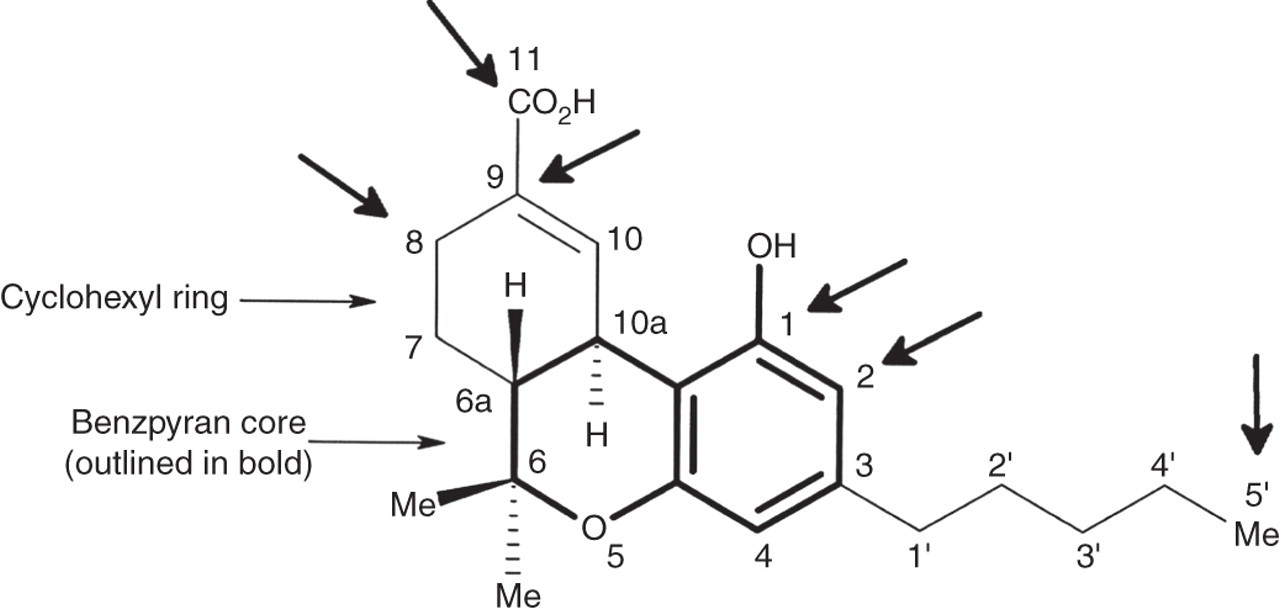
Conclusions
Further elucidation of the mechanisms of EFV interference may require inputs from the antibody industry or the field of molecular modelling. Interestingly, media reports have in recent years described the emergence of EFV abuse in South Africa, whereby crushed tablets are smoked for their psychoactive effects. 4 Whether these effects are mediated by interaction of EFV or its metabolites with the endocannabinoid system is a question for future research into the psychopharmacology of EFV.
DECLARATIONS