






Abstract
Several recent papers have investigated ethylenediaminetetraacetic acid (EDTA) contamination of samples submitted for biochemistry testing and reported rates of up to 0.46%. 1–3 Significant EDTA concentrations have been variously described as >0.1 or ≥0.2 mmol/L. 2,3 High rates of contamination of selected samples (e.g. 24% of samples with K ≥ 6.0 mmol/L had EDTA concentrations >0.1 mmol/L) have led to suggestions that routine measurement of EDTA concentrations is justified. 1,4,5 I describe the prevalence rates for EDTA contamination encountered in our hospital, which demonstrate how phlebotomy practices determine sample quality and thus the institutional need for routine EDTA measurement.
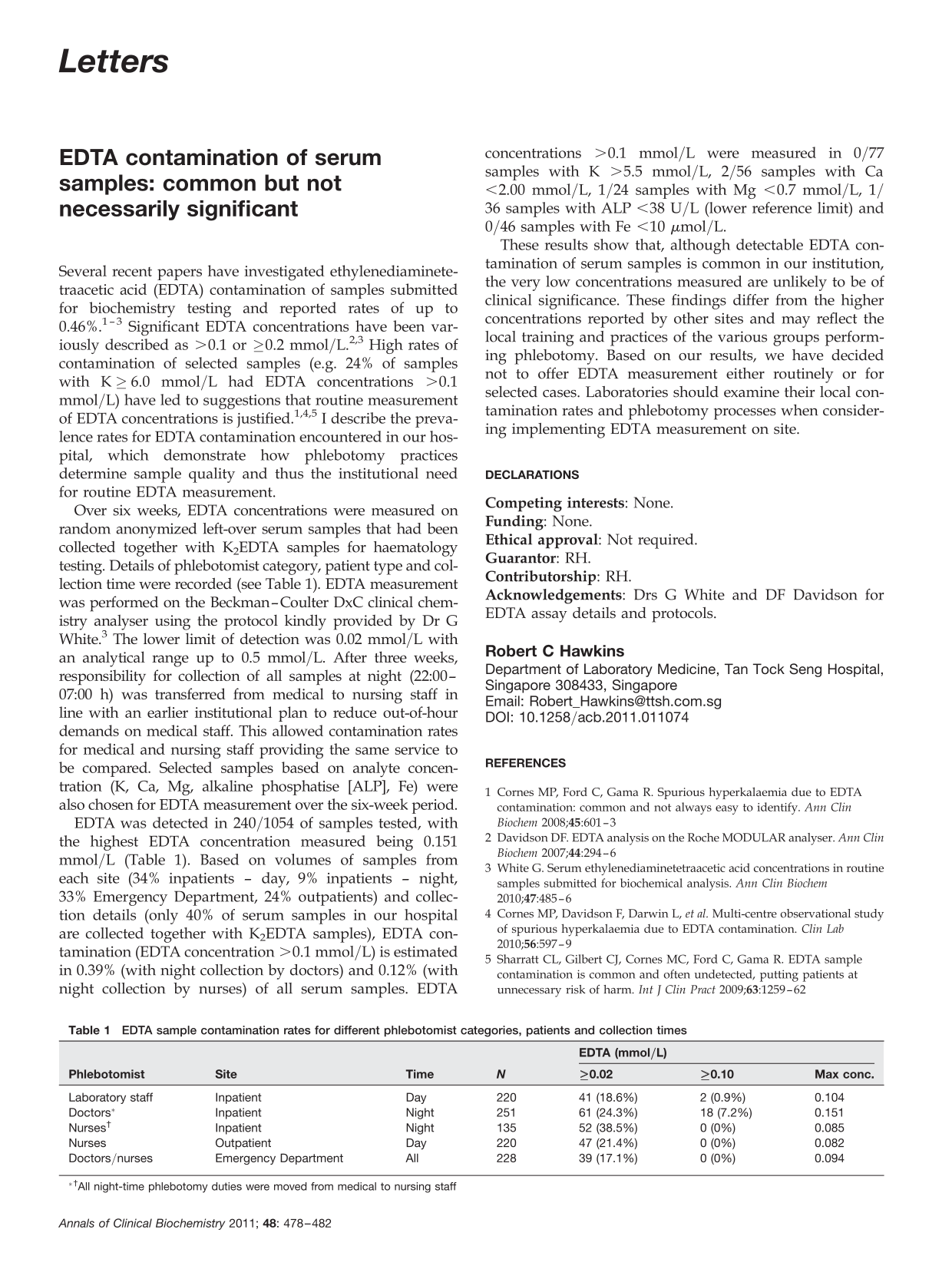
Over six weeks, EDTA concentrations were measured on random anonymized left-over serum samples that had been collected together with K2EDTA samples for haematology testing. Details of phlebotomist category, patient type and collection time were recorded (see Table 1). EDTA measurement was performed on the Beckman–Coulter DxC clinical chemistry analyser using the protocol kindly provided by Dr G White. 3 The lower limit of detection was 0.02 mmol/L with an analytical range up to 0.5 mmol/L. After three weeks, responsibility for collection of all samples at night (22:00–07:00 h) was transferred from medical to nursing staff in line with an earlier institutional plan to reduce out-of-hour demands on medical staff. This allowed contamination rates for medical and nursing staff providing the same service to be compared. Selected samples based on analyte concentration (K, Ca, Mg, alkaline phosphatise [ALP], Fe) were also chosen for EDTA measurement over the six-week period.
EDTA sample contamination rates for different phlebotomist categories, patients and collection times
*†All night-time phlebotomy duties were moved from medical to nursing staff
EDTA was detected in 240/1054 of samples tested, with the highest EDTA concentration measured being 0.151 mmol/L (Table 1). Based on volumes of samples from each site (34% inpatients – day, 9% inpatients – night, 33% Emergency Department, 24% outpatients) and collection details (only 40% of serum samples in our hospital are collected together with K2EDTA samples), EDTA contamination (EDTA concentration >0.1 mmol/L) is estimated in 0.39% (with night collection by doctors) and 0.12% (with night collection by nurses) of all serum samples. EDTA concentrations >0.1 mmol/L were measured in 0/77 samples with K >5.5 mmol/L, 2/56 samples with Ca <2.00 mmol/L, 1/24 samples with Mg <0.7 mmol/L, 1/36 samples with ALP <38 U/L (lower reference limit) and 0/46 samples with Fe <10 μmol/L.
These results show that, although detectable EDTA contamination of serum samples is common in our institution, the very low concentrations measured are unlikely to be of clinical significance. These findings differ from the higher concentrations reported by other sites and may reflect the local training and practices of the various groups performing phlebotomy. Based on our results, we have decided not to offer EDTA measurement either routinely or for selected cases. Laboratories should examine their local contamination rates and phlebotomy processes when considering implementing EDTA measurement on site.
DECLARATIONS