



Abstract
Background
Continuous positive airway pressure (CPAP) therapy is the first-line treatment for obstructive sleep apnea (OSA). However, the low acceptance rate of CPAP remains a challenging clinical issue. This study aimed to determine the factors that influence the acceptance rate of CPAP.
Methods
This retrospective cohort study was conducted at the sleep center of Shuang-Ho Hospital. Initially, 1186 OSA patients who received CPAP therapy between December 2013 and December 2017 were selected, and finally, 1016 patients were analyzed. All patients with OSA received CPAP therapy for at least 1 week, and their acceptance to treatment was subsequently recorded. Outcome measures included patients’ demographic and clinical characteristics (sex, age, BMI, comorbidities, history of smoking, and the medical specialist who prescribed CPAP treatment), polysomnography (PSG) results, and OSA surgical records.
Results
Patients with a lower CPAP acceptance rate were referred from otolaryngologists (acceptance rate of otolaryngology vs. others: 49.6% vs. 56.6%, p = .015), in addition to having a lower apnea–hypopnea index (AHI) (acceptance vs. non-acceptance: 55.83 vs. 40.79, p = .003), rapid eye movement AHI (REM-AHI) (acceptance vs. non-acceptance: 51.21 vs. 44.92, p = .014), and arousal index (acceptance vs. non-acceptance: 36.80 vs. 28.75, p = .011). The multiple logistic regression model showed that patients referred from otolaryngology had a lower CPAP acceptance rate (odds ratio 0.707, p = .0216) even after adjusting for age, sex, BMI, AHI, REM-AHI, arousal index, comorbidities, and smoking status.
Conclusions
Before their initial consultation, patients may already have their preferred treatment of choice, which is strongly linked to the type of medical specialists they visit, and consequently, affects their rate of acceptance to CPAP therapy. Therefore, physicians should provide personalized care to patients by exploring and abiding by their preferred treatment choices.
Background
Obstructive sleep apnea (OSA) is a chronic condition caused by the episodic collapse and obstruction of the upper airway during sleep. The prevalence of OSA syndrome ranges from 3 to 7% among adult men and 2–5% among adult women in the general population [1]. Among OSA patients in the United States, 17% of men and 9% of women are 50‒70 years of age [2]. OSA patients have a higher risk of daytime sleepiness; cardiovascular, neurovascular, and metabolic disturbances; motor vehicle accidents; and decreased psychomotor speed [3–8]; however, many of them remain undiagnosed [9].
Several treatment options are available, including lifestyle changes [10, 11], oral appliance [12], pharmacological treatment [13], surgical treatment [14, 15], and continuous positive airway pressure (CPAP) therapy. CPAP therapy can prevent upper airway collapse and is the first-line treatment for OSA owing to its immediate effects and relatively lower complication rates [16–18]. CPAP reduces daytime sleepiness [19–22], has beneficial effects in cardiovascular and metabolic diseases [23–28], and improves health-related quality of life, mood, and neurocognitive function, especially in subgroups with higher treatment adherence [19, 29].
The efficacy of CPAP therapy is correlated with patients’ adherence [30, 31]. Nevertheless, low acceptance and adherence to CPAP therapy remain challenging issues in clinical practice. According to Yang et al. and Simon-Tuval et al., the acceptance rate of CPAP is approximately 40% [32, 33]. CPAP adherence is often defined as using the therapy for an average of 4 h per night for at least 70% of the nights monitored [34]. Studies have shown that 46–83% of patients are non-adherent to treatment [35, 36]. Further, a systematic review of 82 studies found that CPAP non-adherence affects at least one-third of treated patients and showed that CPAP adherence did not significantly improve in the past 20 years despite efforts in behavioral intervention and patient coaching [37].
Many studies have focused on CPAP adherence and its correlated factors, and have shown inconsistent results with factors including age, sex, race, severity of OSA, severity of symptoms, smoking status, and socioeconomic status [38–46]. However, only a few studies have mentioned factors related to CPAP acceptance [32, 33, 47], and the specialties of doctors who prescribe CPAP treatment are rarely discussed. Achieving shared decision-making depends on building good relationships in clinical encounters, so it is important for physicians to understand patients and share information. Therefore, we aimed to investigate and analyze the factors that cause a lower acceptance rate of CPAP in patients with OSA.
Methods
Data collection and sample
This retrospective cohort study initially included 1186 OSA patients treated with CPAP at least 1 week at Shuang-Ho Hospital (New Taipei City, Taiwan) between December 2013 and December 2017. Patients with symptoms of OSA underwent polysomnography (PSG) at Shuang-Ho Hospital, and those diagnosed with OSA were referred to the hospital's sleep center for CPAP treatment. Apart from otolaryngology, other outpatient departments, including pulmonology, cardiology, neurology, and psychiatry, also referred patients with OSA to the sleep center, and each patient received CPAP treatment for at least 1 week. In addition, patients were instructed on how to use the CPAP device correctly and followed up continuously for at least 3 months via telephone or mobile communication software by the sleep case manager of the sleep center to ensure adherence to the treatment regimen was achieved.
Eligibility criteria included patients aged 20 years or older, a record of CPAP use, and a diagnosis of OSA, which is defined as having an apnea–hypopnea index (AHI) of at least 5, based on the PSG records. Patients were excluded from the study if they were younger than 20 years of age, had an AHI of less than 5, had missing data on PSG records, or were referred from departments with fewer than 10 patient referrals to the sleep center.
The study was conducted in accordance with the guidelines of the Declaration of Helsinki and approved by the Institutional Review Board of Taipei Medical University (IRB Number: N202201092, 2022/4/14 of approval).
Assessment of baseline demographic and clinical characteristics
Patients’ medical history and clinical characteristics were comprehensively reviewed through their admission, outpatient, and surgical records, including their demographic characteristics (age, sex, and BMI), specialties of their referral doctors, smoking status, and presence of baseline comorbidities, including hypertension (HTN), diabetes mellitus (DM), cardiovascular disease (CVD), chronic kidney disease (CKD), hyperlipidemia (HLD), and chronic obstructive pulmonary disease (COPD). Cardiovascular disease was defined as a coronary artery disease or cerebrovascular accident. For patients who did not receive CPAP therapy, we tracked whether they had undergone OSA-related surgeries. OSA-related surgery was defined as uvulopalatopharyngoplasty (UPPP), uvulopalatal flap surgery (UPF), laser-assisted uvulopalatoplasty (LAUP), pharyngoplasty, tonsillectomy, adenoidectomy, septoplasty, submucosal resection of the nose, and submucosal turbinectomy.
Assessment of polysomnography results
PSG was conducted by certified respiratory therapists with at least 1 year of clinical experience. Standard monitoring devices included electroencephalography (EEG), electrooculography (EOG), electrocardiography (ECG), and electromyography (EMG) placed on the chin and bilateral anterior tibialis; position sensors, snore sensors, pulse oximetry, and thermistors to sense nasal and oral airflow; and plethysmography to sense thoracoabdominal movements.
PSG reports included the Epworth Sleepiness Scale (ESS) score, Pittsburgh Sleep Quality Index (PSQI), apnea–hypopnea index (AHI), rapid eye movement AHI (REM-AHI), non-rapid eye movement apnea–hypopnea index (NREM-AHI), sleep efficiency, mean oxygen saturation (mean SAT), mean heart rate (mean HR), arousal index, periodic limb movement index (PLMI), and pressure settings of the CPAP machine (90% pressure).
AHI was calculated as the number of apnea and hypopnea events per hour during sleep. REM-AHI was defined as the AHI during the rapid eye movement period. Sleep efficiency was defined as the ratio of the total sleep time to the total recording time. The 90% pressure was adjusted to eliminate 95% of apneas, hypopneas, and snoring to achieve an oxygen saturation of > 90% and AHI < 5 events/h in patients during REM sleep in a supine position.
Acceptance and non-acceptance
All enrolled patients commenced CPAP therapy for at least 1 week as a test trial. Patients who purchased the CPAP machine were defined as the acceptance group, and those who did not were placed in the non-acceptance group. For those who accepted CPAP, we further documented the date of purchase and for those who did not accept, we recorded the date they returned the CPAP device.
Statistical analyses
Continuous data were presented as mean ± standard deviation (SD) and tested by independent t test. Categorical data were presented as N (%) and tested by Chi-square test or Fisher's exact test. We further performed multivariate logistic regression to evaluate associations between factors chosen by this study and CPAP acceptance. Odds ratio (OR) and 95% confidence intervals (CI) were also calculated. Three models were established. Model 1 was adjusted by age, gender, and BMI. Model 2 was adjusted by covariates in Model 1, plus AHI, REM-AHI, and Arousal Index. Model 3 was adjusted by covariates in Model 2, plus HTN, DM, CVD, HLD, CKD, COPD, and smoking status. P value lower than 0.05 was regarded as statistically significant. Data were analyzed using SAS version 9.4 software (SAS Inc., Cary, NC, USA).
Results
Characteristics of the participants
A total of 1016 patients consisting of 825 men (81.2%) and 191 women (18.8%), mean age of 50.7 years, were enrolled for analysis (Fig. 1). A total of 546 (53.7%) patients accepted CPAP, and the baseline demographic and clinical characteristics of the acceptance group versus the non-acceptance group are shown in Table 1. We found that patients in the non-acceptance group were older (51.62 vs. 49.84, p = 0.031) and had lower body mass index (BMI) (28.54 vs. 29.33, p = 0.011). However, there were no significant differences in the baseline comorbidities between the two groups. Notably, the acceptance rate of CPAP therapy in patients referred by otolaryngologists was 49.6%, which was the lowest among all medical specialties who referred patients for CPAP treatment.

Flow diagram of included patients. OSA obstructive sleep apnea, CPAP continuous positive airway pressure, AHI apnea–hypopnea index. *Specialty referring to < 10 patients: 2 from nephrology, 4 from physical medicine and rehabilitation
Baseline demographic and clinical characteristics of the study participants

Univariate p value: p value without any variable adjustment. Multivariate p value: p value with adjustment of the others variables listed in the table
SD standard deviation, BMI body mass index, no number, ENT otolaryngology, PULMO pulmonology, NEURO neurology, CV cardiology, PSY psychiatry, HTN hypertension, DM diabetes mellitus, CVD cardiovascular disease, HLD hypertension, CKD chronic kidney disease, COPD chronic obstructive pulmonary disease
Baseline polysomnography results of the study participants

Univariate p value: p value without any variable adjustment. Multivariate p value: p value with adjustment of the others variables listed in the table
SD standard deviation, PSQ Pittsburgh Sleep Quality Index, ESS Epworth sleepiness scale, AHI apnea–hypopnea index, REM-AHI apnea–hypopnea index during rapid eye movement sleep, NREM-AHI apnea–hypopnea index during non-rapid eye movement sleep, 90% PRESSURE average pressure measured during 90% of sleep, MEAN SAT mean blood oxygen saturation, MEAN HR mean heart rate, PLM periodic limb movement
Logistic model analysis to calculate the odds ratio of otolaryngology patients accepting CPAP
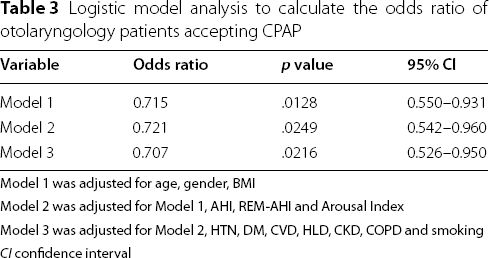
Model 1 was adjusted for age, gender, BMI
Model 2 was adjusted for Model 1, AHI, REM-AHI and Arousal Index
Model 3 was adjusted for Model 2, HTN, DM, CVD, HLD, CKD, COPD and smoking
CI confidence interval
Analysis of otolaryngology versus other departments
Demographic and clinical characteristics of patients from otolaryngology versus other specialties
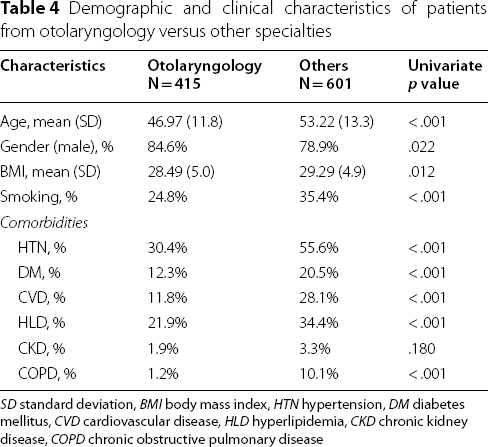
SD standard deviation, BMI body mass index, HTN hypertension, DM diabetes mellitus, CVD cardiovascular disease, HLD hyperlipidemia, CKD chronic kidney disease, COPD chronic obstructive pulmonary disease
Polysomnography results of patients from otolaryngology versus other specialties
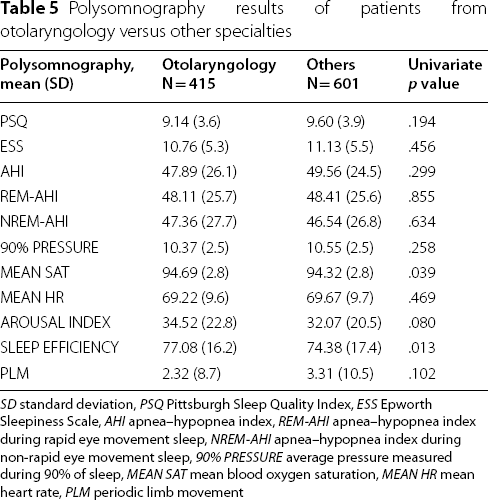
SD standard deviation, PSQ Pittsburgh Sleep Quality Index, ESS Epworth Sleepiness Scale, AHI apnea–hypopnea index, REM-AHI apnea–hypopnea index during rapid eye movement sleep, NREM-AHI apnea–hypopnea index during non-rapid eye movement sleep, 90% PRESSURE average pressure measured during 90% of sleep, MEAN SAT mean blood oxygen saturation, MEAN HR mean heart rate, PLM periodic limb movement
From the analysis of the population accepting CPAP, it was found that patients referred by the otolaryngology department had a higher proportion of seeking surgical intervention compared to other departments. This difference is statistically significant, with percentages of 19.2% versus 7.5%, respectively (p < 0.001).
We further analyzed whether patients underwent OSA surgery after refusing CPAP therapy and discovered that a higher ratio of patients from otolaryngology underwent OSA surgery (20.6% vs. 6.5%, p < 0.001, Fig. 2). Subsequently, we combined the data of patients who underwent CPAP or OSA surgery as receiving treatment for OSA and found no significant difference between the two groups (Fig. 2).

Ratios of accepting CPAP, receiving surgery, and acquiring treatment in otolaryngology patients versus other specialties. CPAP continuous positive airway pressure
Demographic characteristics and polysomnography results of patients receiving surgery after refusing CPAP therapy

SD standard deviation, BMI body mass index, HTN hypertension, DM diabetes mellitus, CVD cardiovascular disease, HLD hyperlipidemia, CKD chronic kidney disease, COPD chronic obstructive pulmonary disease, PSQ Pittsburgh Sleep Quality Index, ESS Epworth Sleepiness Scale, AHI apnea–hypopnea index, REM-AHI apnea–hypopnea index during rapid eye movement sleep, NREM-AHI apnea–hypopnea index during non-rapid eye movement sleep, 90% PRESSURE average pressure measured during 90% of the sleep, MEAN SAT mean blood oxygen saturation, MEAN HR mean heart rate, PLM periodic limb movement
Discussion
The present study showed that OSA patients with lower CPAP acceptance tend to be referred to the sleep center by otolaryngologists and had milder OSA severity (specifically lower AHI, REM-AHI, and arousal index), lower BMI, and older age. After excluding patients who initially visited the otolaryngology department, we found that patients from other specialties exhibited similar trends to the original data (Additional file 1: Table S1 and Table S2).
A total of 53.7% (546/1016) of patients accepted CPAP in the present study, which was substantially higher compared to the 40.1% in Simon et al. (n = 162, mean age 54.9 y/o) and 39.7% in Yang et al. (n = 315, mean age 56.7 y/o). This may be attributed to the younger age (50.7 y/o) of our cohort. Furthermore, instructions and assistance were provided to patients by the case manager of the sleep center via a mobile communication software on the correct use of the device in order to maximize their acceptance of CPAP treatment.
Previous studies have consistently demonstrated that greater OSA severity is associated with higher CPAP adherence [33, 38, 39, 42–44, 46, 48]. However, demographic characteristics, including sex, age, BMI, comorbidities, and smoking, showed inconsistent results [45]. In addition, we found that BMI and age significantly influenced acceptance of CPAP. Several studies have shown that higher ESS scores and more severe OSA symptoms are associated with higher CPAP adherence [33, 39–41, 44, 46]. Our results displayed similar trends but without statistical significance. Moreover, it is noteworthy that comorbidities and PLMI, which have not been discussed in previous studies, did not appear to be significant predictors of acceptance of CPAP.
We further compared the demographic and clinical characteristics of patients referred by otolaryngologists with those of patients referred from other specialties. Patients referred from otolaryngology had a lower BMI, fewer comorbidities, fewer smokers, and more young men; however, the PSG results were similar between the two groups (Tables 4, 5). According to previous studies, OSA severity is highly correlated with CPAP acceptance [33, 38, 39, 42–44, 46, 48]. Nevertheless, our study showed that otolaryngology patients had a lower acceptance of CPAP but demonstrated the same OSA severity as patients from other specialties (Table 5).
Similar to our results, Salas et al. showed that patients referred from otolaryngology had fewer comorbidities, lower BMI, and younger age, except for having the same OSA severity as other specialties [49]. Furthermore, after adjusting for multiple variables that may affect the CPAP acceptance rate, such as age, BMI, AHI, REM-AHI, and arousal index, the OR of CPAP acceptance in patients from otolaryngology was still significantly lower than that in patients from other departments (OR = 0.707, p = 0.0216, Table 3).
Three possible reasons may explain the disparity in patients’ choice of medical specialties for the treatment of OSA: the intention for surgery, surgical risks involved, and knowledge about the treatment.
First, our study showed that patients from otolaryngology who did not accept CPAP showed higher incidences of undergoing surgery afterwards than non-otolaryngology OSA patients (20.6% vs. 6.5%, p < 0.001, Fig. 2). Furthermore, we analyzed the ratio of OSA-related treatments, including CPAP or OSA surgery, and found no significant difference between patients from otolaryngology and those from other departments (p = 0.848, Fig. 2). This may indicate that both groups shared a similar intent for treatment, and a substantial portion of otolaryngology patients who refused CPAP treatment may have undergone surgery. In addition, we analyzed the AHI of the patients who underwent surgery and found no significant difference between the groups (p = 0.308, Table 6). This demonstrates that the two groups had similar indications for OSA surgery. In summary, patients’ intention to undergo surgery may contribute to their preference for otolaryngology clinics when seeking treatment for OSA. Second, our results were consistent with those of Salas et al., which showed that patients from otolaryngology had a lower risk of general anesthesia and surgical treatment [49]. Hence, we infer that patients’ surgical risks may affect their preference for specialties when they seek treatment. Third, previous studies showed that patients’ knowledge and beliefs about the disease affected their adherence to treatment [36, 50, 51]. Gulati et al. [52] pointed out that patients receiving surgery for OSA, compared to those who did not, had a higher ratio of independently doing research for OSA treatment prior to their consultation with the surgeon. This would explain why patients’ knowledge about the variety of treatment options plays a crucial role in their adherence and decision-making, which may also determine their choice of medical specialties.
Patients who visit different departments may have different treatment preferences for OSA. According to the principle of shared decision making [53, 54], increasing patient participation in discussions on treatment options may provide a better therapeutic effect.
Our study has several advantages. First, to the best of our knowledge, this is the first study to investigate the rate of acceptance of CPAP in patients referred by different specialties. Second, our sample size was relatively large (n = 1016) compared to previous studies. Third, we selected a more stringent definition of CPAP acceptance in our study, where “Acceptance” was defined as patients who purchased CPAP machines after their test trial, which is also the same definition adopted by Yang and Simon-Tuval [32, 33]. Compared to Rauscher et al., which only had a 3-day CPAP test trial [47], our definition of CPAP acceptance may better reflect the patients’ actual intent.
This study has several limitations. First, this was a retrospective cohort study; therefore, potential participants were excluded because of missing data, and the baseline data of the otolaryngology versus non-otolaryngology groups may be different. Second, few patients were referred from certain medical specialties. For example, patients from the Department of Psychiatry had a higher acceptance of CPAP compared to other specialties; however, no statistical significance was noted. Lastly, some patients in the non-acceptance group may purchase CPAP via alternative routes; as a result, this may have caused a selection bias. In order to minimize this bias, the medical records of the non-acceptance group were carefully examined during their subsequent visits to the hospital to ensure that no CPAP treatment had been initiated. Moreover, patients from the non-acceptance group were constantly followed up by the case manager of the sleep center regarding their subsequent treatment for OSA, and whether they received treatment elsewhere or if they were using other respiratory devices.
Conclusions
Shared decision making is crucial for achieving therapeutic success in clinical practice. In the sleep center, patients with OSA who initially visited otolaryngology clinics had a lower acceptance rate for CPAP. Therefore, besides adhering to clinical guidelines, physicians should provide individualized care through shared decision-making and identifying patients’ preferred treatment.
Footnotes
Acknowledgements
Not applicable.
Author contributions
Drs. Lin and Wu had full access to all the data in the study and take responsibility for the integrity of the data and the accuracy of the data analysis. CSW: concept and design, statistical analysis, drafting of the manuscript. DHKC: drafting of the manuscript. YK: drafting of the manuscript. CHB: statistical analysis. PYC: administrative, technical, and material support. WTL: administrative, technical, and material support. YCL: concept and design, statistical analysis, acquisition, analysis, or interpretation of data, drafting of the manuscript, administrative, technical, and material support. All authors approved the final version of the manuscript for publication.
Funding
This research received no specific grant from any funding agency in the public, commercial, or not-for-profit sectors.
Availability of data and materials
The datasets analyzed in the current study are available from the corresponding author upon reasonable request.
Declarations
Abbreviations
Springer Nature remains neutral with regard to jurisdictional claims in published maps and institutional affiliations.