




Abstract
With rapid progress in scientific research activities and growing competition for funding resources, it becomes critical to effectively evaluate an individual researcher's annual academic performance, or their cumulative performance within the last 3–5 years. It is particularly important for young independent investigators, and is also useful for funding agencies when determining the productivity and quality of grant awardees. As the funding becomes increasingly limited, having an unbiased method of measuring recent performance of an individual scientist is clearly needed. Here I propose the Z factor, a new and useful way to measure recent academic performance.
Of late, there have been continuous and intensive debates regarding the roles of the impact factor [1–7]. There are many reasons the misuse of the impact factor, sometimes called the ‘impact factor fever’, generates concern. First, the impact factor does not provide any evaluation for the quality of science in the research articles. Although the majority of papers published in high impact journals are generally novel and of highest quality, there are a few ‘bad apples’. Second, the impact factor represents the mean citation rate of papers published in one journal, and it does not represent the citation of the specific article itself. A paper published in a low impact factor journal may end up well cited, while conversely, a paper published in a high impact factor journal may garner very few citations. Despite these limitations, it is still generally agreed upon that it is much harder to publish an article in a journal with an impact factor of greater than 10 than a journal with an impact factor of 1. It is therefore unfair to claim that the impact factor is useless or only doing harm to the academic community.
Considering the increase in scientific activity in recent years, it is important to have objective criteria for evaluating academic performances when considering, for example, new faculty recruitment, annual performance and tenure evaluation, and funding decisions. Unlike commercial businesses, the broad spectrum of academic research activities render effective evaluation by administrators or funding agencies to be rather difficult, especially those who are involved in ‘basic’ research. In most cases, published papers are the only considerations for evaluation. It is important to have a consistent standard to evaluate these papers, as most will not be translated into commercial activities or be awarded with the Noble prize for a few decades to come, if at all. However, it is these ‘basic’ researches that lay the foundations and holds hope for future drug discoveries and treatments of human diseases.
What is the best way to evaluate scientific performance? I still recall one department head claiming that good science in his department was defined by whether he thinks the researcher is doing good science, not by where the faculty member has published papers (including in high impact factor journals), nor by how many papers he or she has published. Although there may be some merit in holding to such a high standard, this would require the department chair, university dean or government funding agency to carefully read and evaluate the individual papers. Considering the increasing number of disciplines in scientific research, this has become almost impossible. And what about the panel of experts? Can we always trust the experts' evaluation? Yes and no. First, it depends on who is sitting on the review board. For example, while the NIH study sections have been seen as the best review system for evaluating scientific proposals, they have also been consistently under criticism for many years. Second, it is impractical for each department to invite experts to review its faculty members annually. It must also be pointed out that it is impossible to remove the human aspect with the use of experts. What happens if a faculty member is a long-term collaborator or a family friend of an expert reviewer? What happens if a faculty member proposes a model that goes against a reviewer's long-held theory? In reality, our decisions are affected by culture, religion, race, friendships and personal interests. Thus, I believe that there is a need for a better measurement that should be used to evaluate a researcher's performance. Here I propose a new index to evaluate the active performance of an individual scientist, and I will explore how such an index can be used in combination with current impact factors and H factors to attain a better assessment of one researcher's productivity.
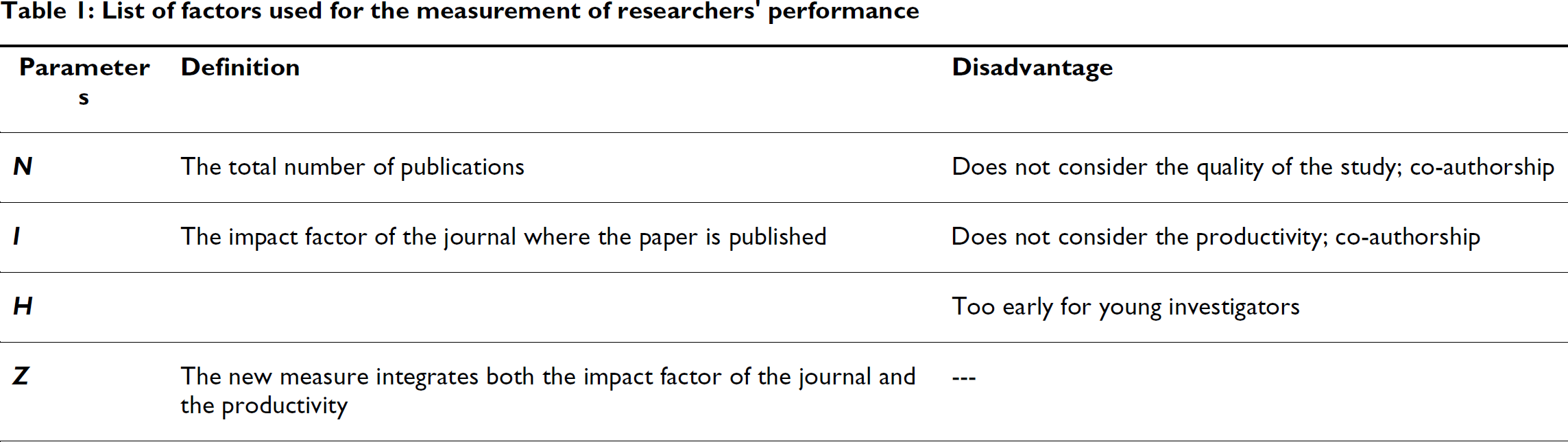
There are currently three major factors that are used to evaluate academic performances: the number of publications, the impact factor of those journals, and the H factor (see Table 1). For the number of publications, it is the number of peer-reviewed research articles that are ordinarily counted. Review articles and meeting abstracts are often put in a separate category since most of them are invited or not reviewed. The journal impact factor is the average number of times the articles from the journal published in the past two years have been cited. The journals with highest impact factors are
List of factors used for the measurement of researchers' performance
Problems to be tackled
Due to space limitations, journals such as
There are three factors that are used to generate the Z score: P, I and N. P is the contribution factor. In cases where the individual is the first/equal author or the corresponding last author, P = 1. In collaborative efforts, P = 0.3 (where one is neither the first nor the last author). P = 1 if the paper specifically notes that there are two equal Corresponding authors. Therefore, it is important for collaborative principle investigators (PIs) to indicate such equal contributions in a paper. Next is I, the impact factor of the journals where they have published within the last year. Since it usually takes 1–3 years for a single paper to be cited, it is impossible to obtain appropriate citations of papers which have only recently been published. Therefore, in order to perform annual evaluations, instead of using the actual and often unavailable citation of the individual papers, the impact factor of the journal where the authors have published in the last year is to be used. For example, for Nature, I = 28.8 in 2007, and for Neuron, I = 13.4. Lastly, N is the total number of papers published within one year.

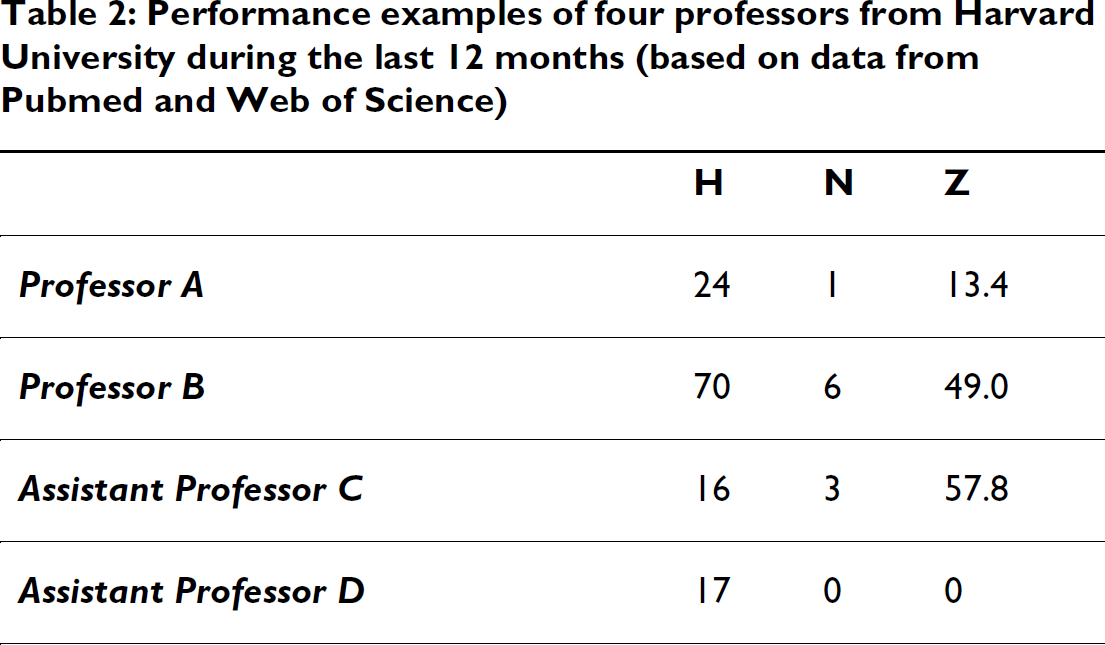
Table 2 contains examples of evaluations of 4 professors from Harvard University (2 full professors and 2 junior assistant professors). For Professor A, in 2007 (with H factor at 24), only one paper has been published in a journal with I = 13.4, and therefore the Z score is 13.4. For Professor B, in 2007 (H = 70), six papers have been published in various journals (I ranges from 2 to 8), and thus the Z score is 49.0. C is a junior assistant professor (with H factor at 16); with three papers published, the Z score is 57.8. Therefore, the Z score will allow comparisons between senior and junior faculty members. This is potentially quite useful, since most funding agencies such as NIH and CIHR do not treat them separately.
Performance examples of four professors from Harvard University during the last 12 months (based on data from Pubmed and Web of Science)
In addition to counting the number of publications, the Z factor gives significant credit to those published in high impact journals. And unlike the H factor, which requires a waiting period of at least 2–3 years after publication to reflect any change, the Z factor can be calculated annually. In my opinion, this method will be very useful in evaluating one's academic achievements annually.
The Z factor can be used in other ways. For example, one can use the Z factor to evaluate a faculty member's achievement in their specific research field over a period of time (say 3–5 years). By using 2 or 3 keyword as defined by him or her as the major focused topics, one can generate a list of published papers. The Z factor based on these papers will give a nice measurement for his or her recent achievement in his research field. This will also help to eliminate possible erroneous accounting of researchers' publications, where their names appear on papers solely for lending the use of unique elements or methodologies to other investigators.
Also, the Z factor can aid in evaluating the research quality or originality of faculty members, notably if one faculty member always needs numerous papers (larger N) to catch up to the same Z score of another faculty member. In those cases, additional scientific review of published papers may be required. More importantly, the Z factor does not bias against those individuals who make basic and fundamental contributions to the established fields. Three papers published in journals such as
In summary, the Z score may serve better than the current methods of assessing achievement, which simply count the number of published papers, those published in high impact factor journals, or merely counting on the assessment from review members.
Competing interests
The author declares that they have no competing interests.
Footnotes
Acknowledgements
I like to thank Professor Jianguo Gu, Xiao-Jiang Li, Bong-Kiun Kaang and Lin Mei for helpful discussions and comments, and Emily England, Susan Kim and Giannina Descalzi for the help with corrections. Professor Min Zhuo is supported by grants from the Canadian Institutes of Health Research (CIHR66975, CIHR84256), the EJLB-CIHR Michael Smith Chair in Neurosciences and Mental Health, and the Canada Research Chair to M. Z.