




Abstract

Introduction
The concept of Industry 4.0 originated around 2011, with a focus on a specific set of technologies within a specific cultural and legal framework to optimize the technologies’ functionality (Aceto et al., 2020). Indeed, Industry 4.0 is based on the concept of cyber-physical systems (CPS), which encompasses three technology pillars: the Internet of Things (IoT), cloud computing, and big data analytics. The introduction of Industry 4.0 created new business models and a new way of working (Alcácer & Cruz-Machado, 2019). To achieve this, integration of three pillars—human-centricity, sustainability, and resilience—emerges as the core principle, representing a higher level of organizational coordination and control across the entire product life cycle (Li, 2017). Such integration unfolds both vertically and horizontally, encompassing all stages of the product’s life cycle and enabled by real-time data exchange (de Sousa Jabbour et al., 2018). This pervasive connectivity reshapes professional roles and career trajectories in engineering and business alike, while simultaneously transforming projects themselves into digitally mediated arenas of coordination, decision-making, and value creation. In particular, projects are increasingly expected to integrate digital technologies across their life cycles and processes, giving rise to hybrid configurations that blend technical, managerial, and analytical capabilities (Jally et al., 2021). In essence, the focus of Industry 4.0 is on technology and how technology improves productivity. However, little emphasis is placed on the impact of Industry 4.0 on the human experience of projects and their broader societal implications.
The emergence of Industry 5.0 addresses this gap. Building upon Industry 4.0’s technological infrastructure, Industry 5.0 reframes industrial and organizational priorities around three interconnected pillars—human-centricity, sustainability, and resilience (Ivanov, 2023; Maddikunta et al., 2022; Ghobakhloo et al., 2023)—thus calling for a renewed understanding of how projects create value through integration of processes, products, and the human dimension (Ordieres-Meré et al., 2023). Industry 5.0 thus introduces a paradigm shift (Ordieres-Meré et al. 2023) that would challenge project management research and practice to rethink how value, collaboration, and technological mediation are conceived. A key aspect of Industry 5.0 is to move toward managing technology by adopting a sociotechnical system perspective (Cimino et al., 2025) emphasizing principles such as values-driven and ethical design and sociotechnical reciprocity between humans and technology (Davis et al., 2014). By doing so, the pillars of Industry 5.0 can be advanced through nontechnical dimensions of organizational life such as culture, collaboration, and people. This represents a departure from traditional management-of-technology approaches that primarily emphasize infrastructure and process optimization (Khosravy et al., 2024; Cillo et al., 2022; Horvat et al., 2025).
These movements challenge the conventional view of projects as fixed delivery systems focused on predefined outputs (Project Management Institute [PMI], 2021), shifting instead toward an understanding of projects as adaptive, evolving entities operating within dynamic sociotechnical environments where both technology and human practices coevolve. The manifesto for project management research echoes this by advocating that projects should be viewed as agents of change, playing a key role in addressing societal issues from their narrow perspective (Locatelli et al., 2023). Within this framing, the emerging notions of project management 5.0 and project manager 5.0 provide a valuable analytical lens for examining how project management itself is being reconfigured under Industry 5.0 conditions. Dani et al. (2025) suggest that these concepts could position projects as adaptive and responsible vehicles for value creation in complex sociotechnical environments.
Industry 5.0 is closely aligned with Society 5.0. as pointed out by Caryannis and Morawaska-Jancelewicz (2022, p. 3445) who suggest that “the concept of Society 5.0 is not a simple chronological continuation or alternative to Industry 4.0 paradigm. Society 5.0 aims to place human beings at the midpoint of innovation, exploiting the impact of technology and industry 4.0 results with the technological to improve quality of life, social responsibility and sustainability.” This also strengthens the view that Industry 5.0 is a paradigm shift with implications for society. Building on the above perspective, Fukuyama (2018), in discussing the emergence of Society 5.0 in Japan, argues that it calls for the systematization of services and projects to function as a “smart bridge between” techno-centric and human-centric perspectives. This bridging role is seen as a mechanism for promoting innovation systems “breaking down organizational walls and promoting open innovation” (Carayannis & Morawaska-Jancelewicz, 2022, p. 3449). The role of projects in promoting open innovation is also important in R&D projects (Barbosa et al., 2021) and to deliver organizational strategies (Trzeciak et al., 2022). However, Bagherzadeh et al. (2021) point out the lack of a project-level perspective of open innovation in businesses. Supporting this de Melo et al. (2021) ask how organizations can use the experience from projects to build organizational capabilities to manage open innovation projects. These ideas linking open innovation to projects carry important implications for both organizations and academia who are engaged in the study and design of innovation systems. Completing this view, Banholzer (2022, 2023) emphasizes that Society 5.0 and Industry 5.0 advance a sociotechnical approach in which technological and social innovations are codeveloped rather than treated as separated domains. For project management research, this convergence foregrounds projects as critical loci where digital technologies, human agency, and organizational learning intersect, thereby reinforcing the relevance of investigating how digitalization reshapes project practices, governance, and value creation (Papadonikolaki et al., 2025; Correani et al., 2020; Lykourentzou et al., 2025).
The focus of this special issue is to examine how projects can be re-understood not merely as delivery mechanisms but as living systems (Miller, 1976; Joslin & Müller, 2015) that embody the pillars of Industry 5.0 that enact the human-centric, sustainable, and resilient pillars of Industry 5.0. These pillars also have implications for the management of the coevolution of technical, environmental, and social systems that have been discussed by transition scholars (Kemp & Rotmans, 2005; Geels & Kemp, 2007). This shift is essential for addressing the challenges and opportunities that the Industry 5.0 paradigm presents to project management research and practice (Geels & Locatelli, 2024). After highlighting the relevance of Industry 5.0 to the project management discipline, we introduce the articles in this special issue, which collectively illustrate how scholars are advancing this new perspective across diverse contexts and methodologies. We then discuss the theoretical lenses and research avenues that can further deepen our emerging understanding of projects as dynamic sociotechnical systems, offering pathways for future inquiry at the intersection of human and technological development. Some areas that would be relevant for future inquiry are about projects in a variety of applications, such as low-carbon transitions (Geels et al., 2017), systems development projects (Doherty & King, 2005), and managing projects in research and development-intensive industries such as pharmaceuticals (Alojairi, 2011)
Why Does Industry 5.0 Matter in Project Management Research?
From Technological Determinism to Sociotechnical Symbiosis
Research focusing on the intersection of Industry 4.0 and project management focused on the demands on project teams (Marnewick & Marnewick, 2020), the reevaluation of human resource practices (Whysall et al., 2019), application in various sectors (Shamim et al., 2017), and the education of project managers (Richert et al., 2016). The focus is primarily on projects as delivery systems, with a specific emphasis on the technology aspect of Industry 4.0 in project management (Marnewick & Marnewick, 2022). Furthermore, project management research focused on specific technologies such as AI (Müller et al., 2024), IoT, and building information modeling (BIM) (Aranda-Mena et al., 2009).
Industry 5.0 opens up new avenues for research where the focus is on (1) technology as part of the sociotechnical system, and (2) technology as an actor and its associated influence on project management practices. Technology can no longer be understood merely as a neutral tool or instrument serving human intentions. Sociotechnical systems theory reframes this view by directing attention to the interdependence between technological and social elements within projects. The research on technology as part of a sociotechnical system has been addressed recently by researchers working on human robot teams in construction projects (Schweber & Harty, 2010) and innovation in energy projects (Van der Waal et al., 2018). Technology also influences project management practices such as the role of nonhuman actors in complex projects (Pollack & Clegg, 2023), projects in science and technology applications (de Almeida et al., 2021), and the growing impact of AI on project management practices (Kiani, 2025), increasing productivity and efficiency (Hossain et al., 2024), decision-making (Pérez et al., 2022), and challenges in integrating AI in agile projects (Dam et al., 2019).
The impact of technology as part of a sociotechnical system has been investigated by applications supporting the three pillars of Industry 5.0, which have an impact on the project and project management–human-centric, sustainability and resilience. Examples of studying technology as part of a social system can be found in research into human-centric technology in project contexts (Ang et al., 2024; Ang et al., 2025; Görsch et al., 2025). The influence of technology in project management projects is discussed in various applications; in information systems projects, (Kromidha, 2017); in construction projects using blockchain (Xu et al., 2025); and in the application of digital twins supporting sustainability in construction and infrastructure projects (Chatzikonstantinidis et al., 2025; Moshood et al., 2025). There is also an increasing interest in the impact of resilience on projects and research in projects (Naderpajouh et al., 2023; Fey & Kock, 2022; Varajão et al., 2023).
Three Key Shifts for Project Management Scholarship
The three pillars introduce a shift in project management scholarship. New knowledge and critical reflection should focus on these pillars, as well as on their interactions.
Expanding the Boundaries of Project Management Research
Industry 5.0 invites project management scholars to rethink and expand the discipline’s traditional boundaries. Beyond emphasizing its pillars, Industry 5.0 foregrounds the need for more interdisciplinary, morally expansive, and forward-looking research agendas. Locatelli et al. (2023) identify themes that make project management research inherently interdisciplinary: governance and institutions, people and behaviors, strategy and performance, innovation and technology, and society and environment. Integrating these themes with Industry 5.0’s pillars of human-centricity, sustainability, and resilience offers a powerful opportunity to extend the discipline’s reach. It calls for new partnerships with fields such as organizational psychology, environmental studies, digital ethics, and systems design, thereby cultivating research capable of addressing complex societal challenges.
Furthermore, Industry 5.0 research enlarges both the scale and the moral scope of project management. Drawing inspiration from Söderlund et al. (2017) on megaprojects, this new paradigm encourages inquiry into the societal, ecological, and technological implications of project work. The evolution of project management scholarship has historically mirrored the trajectories of industrial revolutions (Marnewick & Marnewick, 2021). In that lineage, Industry 5.0 signals a new generation of research that links innovation studies (Davies et al., 2023), organizational design, and digital ethics to human-centric, sustainable, and resilient project practices (BenMahmoud-Jouini, et al., 2025).
Industry 5.0 also invites scholars to reimagine project management as an integrative domain—one capable of addressing complex societal and technological transformations at multiple levels of analysis. This supports the call by project management researchers to work across disciplines and researchers in other fields, while being aware of problems that may arise, to realize the benefits of working with project management researchers (Davies et al., 2018; Locatelli et al., 2023; Bark et al., 2016; Garwood & Poole, 2018). This could also lead to transdisciplinary research (Gooding et al., 2022) in addressing complex issues such as climate change and societal problems (Gaziulusoy et al., 2016; Polk, 2015) keeping our future in perspective (Brown & Harris, 2023)
Presentation of the Articles in This Special Issue
Industry 5.0 research will be best served through a focused, interdisciplinary approach that examines both the rapid advances in technology and the needs of individuals and societies. The seven contributions featured in this special issue address these needs and the progression toward this emergent paradigm. We organize these articles into the following thematic clusters reflecting challenges faced by Industry 5.0 project managers and their organizations: (1) human and social foundations; (2) trust and managerial cognition in sociotechnical systems; and (3) organizational capabilities, governance, and resilience.
The Human and Social Foundations
The first cluster deals with the human and societal–oriented pillars of Industry 5.0, highlighting the importance of human-centricity, where project managers are seen as sensemakers and cultural integrators. In the first article, Santos, Freitas, and Fernandes, in “Beyond Tech: The Human Element in Industry 5.0 Projects,” address the knowledge gap concerning the soft skills required in Industry 5.0 environments. Using survey data and framing their study in Soto et al.’s (2023) construct of social, emotional, and behavioral soft skills and McCrae’s (1999) Big Five personality traits, they identify essential qualities—such as emotional resilience, cooperation, and social engagement—that must define the next-generation project manager. Their findings suggest a redefinition of the project manager’s professional identity, shifting from a role centered on technical control and execution toward one anchored in human-centric leadership, emotional regulation, and the orchestration of social dynamics within digitally enabled project systems. Papadonikolaki and Morgan’s article, “Leading Psychologically Safe Digitally Enabled Project Teams,” draws on sociocognitive and sociocultural theories (Bandura, 2001; Vygotsky, 1978) to articulate the importance of psychological safety in Industry 5.0 settings. Their qualitative study is guided by Soft Systems Methodology (Checkland, 1989) and utilizes interview and focus group data. Their findings thus reframe the project manager role as that of a sociocultural architect, responsible for enabling trust, learning, and voices through the deliberate design of psychologically safe practices within digitally enabled project environments. Both articles in this cluster challenge the reader to reevaluate project management's behavioral and social underpinnings and argue that a project manager’s soft skills are just as critical as their technical capabilities.
Trust and Managerial Cognition in Sociotechnical Systems
This thematic cluster explores the dynamics of trust and managerial cognition within these digitized settings. The integration of advanced technologies such as blockchain and AI is fundamentally altering how decisions are made, how teams work, and how organizations collaborate. It also reveals the need for focused project management research streams on ethics, transparency, and accountability in digital ecosystems. First, Torkanfar, Azar, and McCabe, in “Toward Industry 5.0: A Conceptual Model for Blockchain’s Impact on Interorganizational Trust in Construction Project Management,” draw on Iacobucci and Hibbard’s (1999) trust and commitment constructs, and Wong et al.’s (2008) affective, cognitive, and system-based trust theories to develop a conceptual model containing seven propositions regarding trust in blockchain applications. Their framework shows how blockchain’s properties of decentralization, transparency, and permanence can strengthen system-based trust, a needed precursor to improving affective (emotional) and cognitive (rational) trust. The authors propose that strengthening these trust dimensions will, in turn, foster better institutional governance in the project context. Kögel, Meile, and Canos-Daros’s article, “Who’s Steering Whom and in What Direction: An Experiment on AI Versus Top Management Decision-Making in Projects,” explore hybrid decision-making between humans and AI. Their exploratory study involves a phenomenological analysis of decision cases answered by 37 top managers in the automotive industry. Their findings contribute to an emerging understanding of hybrid decision-making in projects by showing how AI alters sensemaking processes and decision confidence among senior managers, highlighting the need to rethink decision authority and governance arrangements in Industry 5.0 project environments.
Organizational Capabilities, Governance, and Resilience
The last thematic cluster emphasizes the organization's capabilities, governance mechanisms, and resilience in the context of Industry 5.0. Dani, Ke, and Kilani, in their article “The Future of Project Management in Industry 5.0: A Narrative Literature Review,” use Geraldi and Söderlund’s (2018) project studies frameworks as a lens to develop a structured narrative literature review of the emerging Industry 5.0 project management domain of knowledge. They propose two theoretical constructs: project management 5.0 and project manager 5.0. Both reimagine project management as a sociocentric system that integrates technical environments and users’ values and needs to create adaptive, networked, and ethical approaches aligned with Industry 5.0's pillars. In the article, “What is Project Management Productivity?” Anichenko, Pollack, and Crawford translate Industry 5.0 pillars to redefine productivity in project management as a multidimensional, human-centered construct that integrates cognitive, relational, and systemic dimensions of value creation. Drawing on prototype theory and Herzberg’s (1968) motivation model and based on 55 interviews with client-side practitioners in capital-intensive projects, the authors demonstrate that productivity is not reducible to efficiency or output metrics alone. Instead, they propose an adaptive and relational conception of productivity that captures how motivation, judgment, collaboration, and contextual responsiveness collectively sustain performance in complex sociotechnical project environments. The last article, Dacre, dos Santos, Martins, and Dong’s “Industry 5.0 Imperatives and Project- Based Manufacturing: Collaborative Agility as a Translational Capability,” draw on dynamic capabilities theory (Teece et al., 1997) and the resource-based view of the firm (Barney, 1991) to empirically test the mediating effect of collaborative agility on the relationship between a firm’s service-dominated orientation and its sustainable competitive advantage. Their resulting structural model suggests that collaborative agility, particularly the partnership agility dimension, is the key trait for maintaining competitive advantage in Industry 5.0 environments.
Theoretical Lens
By introducing a new paradigm, Industry 5.0 provides opportunities for scholars to embrace theoretical pluralism and develop new ways of theorizing projects as dynamic sociotechnical systems. This prediction is supported by some evidence from project management research, such as megaprojects as sociotechnical transitions (Papadonikolaki & Morgan, 2021; Papadonikolaki et al., 2023), digital twins in construction projects as a sociotechnical system (Abdelmegi et al., 2024), project studies to study sociotechnical transitions (Geels & Locatelli, 2024), and the recent call for papers on the consequences of project work in a digital society (Papadonikolaki et al., 2025
The call for papers that resulted in this special issue urged project management researchers to take advantage of the evolution of Industry 4.0 to widen their horizon of research into areas of focus within Industry 5.0—resilience, sustainability, and human-centricity (Ivanov, 2023)—which is driven by Society 5.0 (Caryannis & Morawska-Jancelewicz, 2022) and urges us to balance technological development with a more human-centered society to address societal issues.
As outlined in the call for papers, Industry 5.0 brings value challenges to the instrumental and technology-driven perspectives that are dominant in project management research to broaden their perspective to understand how human and digital agents cocreate value, legitimacy, and meaning in hybrid contexts requiring theories sensitive to temporal, relational, and processual dynamics (Hernes & Feuls, 2024).
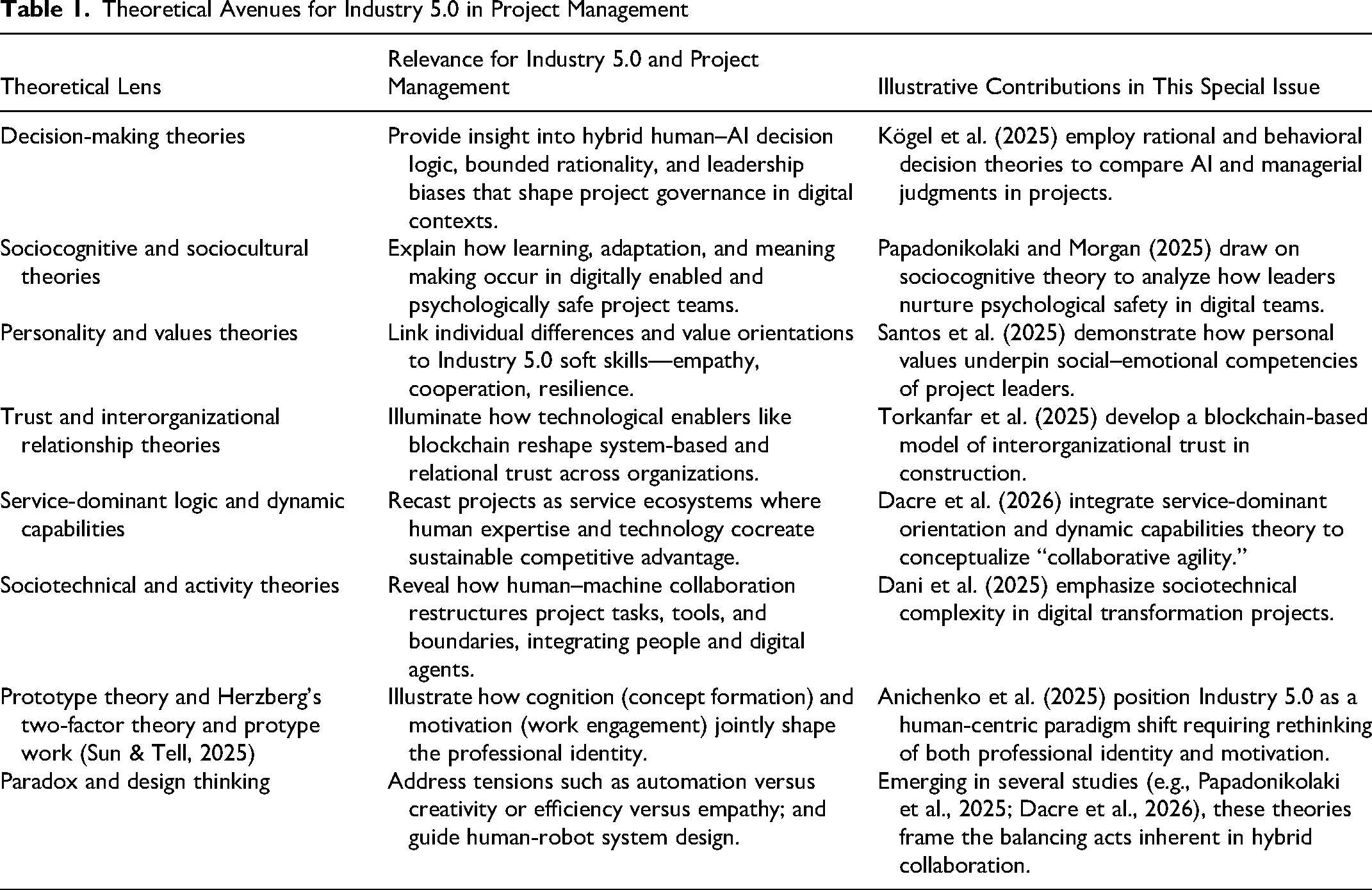
Building on the theoretical lenses highlighted in the call (institutional, sociocognitive, actor–network, sociotechnical, activity, paradox, and design thinking theories) and the articles included in this issue, several promising theoretical avenues emerge. The avenues used in this special issue are described in Table 1.
Theoretical Avenues for Industry 5.0 in Project Management
Emerging Theoretical Avenues Beyond the Special Issue
While the articles in this special issue have explored several theoretical perspectives relevant to project management, other promising frameworks remain underexamined for understanding Industry 5.0.
Although institutional theory has been widely applied in project management research, it has yet to be used to examine the transition toward Industry 5.0. Rorato Fogaça et al. (2025), who investigated the shift from Industry 4.0 to 5.0, argue that Scandinavian institutionalism (Wedlin & Sahlin, 2017) offers a valuable lens for capturing the “dynamic and evolving nature of change” (p. 5). Their study also refers to Latour’s actor-network theory (ANT) to understand how new ideas—such as those underpinning Industry 5.0—are translated and embedded across organizational and project contexts.
Combining institutional and sociotechnical perspectives could further advance our understanding of how human-centric pillars in Industry 5.0 foster environmental, social, and governance (ESG) performance. Ahmed et al. (2023) illustrate how sociotechnical factors influence ESG outcomes, suggesting a pathway for project scholars to explore how Industry 5.0 reshapes sustainable and ethical practices within projects. Relatedly, activity theory provides a framework to examine the economic dimensions of sustainability. Studies such as those of Nair et al. (2024) integrate activity theory, sociotechnical systems, and ANT to analyze human–machine collaboration for sustainable business practices (see Hartmann & Bresnen, 2011).
Another fertile line of inquiry concerns the automation–augmentation paradox, which captures the tensions that emerge when humans and machines collaborate. Raisch and Krakowski (2021) highlight the need for deeper exploration of this paradox in management and organizational studies—an issue that becomes increasingly relevant as AI assumes a more prominent role in project decision-making. Along similar lines, Bozkurt and Gursoy (2025) portray AI as a double-edged sword, representing both opportunity and threat, particularly in risk management contexts.
The human–AI relationship also intersects with the question of resilience. Following the disruptions caused by the COVID-19 pandemic, studies on AI-enabled supply-chain resilience (Ahmed et al., 2023) highlight implications for megaprojects that depend on stable and adaptive value networks. The notion of human-in-the-loop decision systems (Natarajan et al., 2025) underscores the continuing need for human judgment in such AI-mediated contexts. This idea aligns closely with design thinking and systems thinking, which have been applied to Industry 5.0 to promote inclusive and adaptive innovation processes (Dehbozorgi et al., 2024; Liedtka & Locatelli, 2023).
Future Research Directions
As the field of project management enters the age of Industry 5.0, it faces both the promise and the complexity of recentering human values within increasingly intelligent and interconnected technological systems. The selected contributions to this special issue mark important steps toward this agenda, yet they also reveal how much remains theoretically and empirically unexplored. Based on these contributions, several promising directions for future research can be identified—directions that expand project management scholarship toward more human-centric, sustainable, and resilient understandings of organizing.
At the project level, the interaction between individual competencies and digital systems is pivotal yet underexplored. Industry 5.0 urges scholars to move beyond seeing digital tools as efficiency enablers toward understanding how emotional resilience, trust calibration, and ethical judgment intertwine with algorithmic agents (Kögel et al., 2025) in cocreating project value. Projects are now managed with rather than through digital systems, demanding insights from psychology, cognitive science, and human–AI interaction studies to grasp how individuals delegate or reinterpret machine outputs under uncertainty. How do project professionals develop calibrated trust in algorithmic agents under conditions of uncertainty and ambiguity? When machine recommendations conflict with human judgment, how are responsibility, discretion, and ethical reasoning enacted in real-time project decision-making?
At the organizational level, hybrid-team and distributed-intelligence designs raise new questions about project governance. Digital twins, collaborative platforms, and generative AI (GenAI) systems allow collective cognition to extend beyond organizational boundaries (Anthony et al., 2023), blurring distinctions between projects and their context. The articles in this issue collectively highlight the need to reimagine organizing principles, from the hierarchy toward adaptive, networked, and symbiotic arrangements, where human and digital actors share agencies. How can project governance be designed when the agency is distributed across human actors, digital platforms, and generative systems? What organizing principles enable hybrid teams to remain accountable and adaptive when collective cognition extends beyond formal organizational boundaries?
At the societal level, Industry 5.0 foregrounds projects to increasingly operate within ecosystems and ecologies (Grabher, 2002; Thomas, 2025). How these multiactor constellations establish accountability and ensure fairness in algorithmic decision-making represents an unexplored terrain for project studies. These tensions are reflected in the recent work in governance of inter-organizational project networks, which has been gaining attention (Sydow & Braun, 2023). Future research must examine new institutional arrangements that mediate tensions between innovation and responsibility in project planning, execution, and closure. Moreover, Industry 5.0 calls for a shift from efficiency to resilience (Naderpajouh et al., 2023). Projects should be conceived not as temporary coalitions of resources, but as adaptive, learning, and self-organizing entities embedded within broader project ecologies (Paravano et al., 2025). Such a view invites dialogue among project management, systems theory, and sustainability science.
These cross-level dynamics cannot be fully grasped without a temporal and processual perspective. Industry 5.0 projects require scholars to capture how human and machine temporalities intersect and evolve, considering the importance of time, continuity, and change in organizing (Hernes & Feuls, 2024). Digital transformation is not a discrete event but a continuous process of becoming, where technologies, competencies, and institutional expectations coevolve. Methodologically, longitudinal and ethnographic studies are thus essential for understanding how projects evolve over time while maintaining their identity (Mariano & Awazu, 2024). Future research should address how temporal rhythms of individuals, organizations, and society are synchronized through projects and how disruptions in these rhythms (e.g., technology breakthroughs) reshape trajectories of projects learning and adaptation. This call resonates with recent work by Pemsel and Söderlund (2024), who demonstrate how learning and knowledge processes in large-scale transformation projects are temporally entrained at the team level through evidence-based practices. Their notion of knowledge entrainment highlights that learning unfolds through the alignment (and misalignment) of multiple temporalities, particularly in contexts of change. Building on this insight, process studies, narrative methods, and in-situ observations of Industry 5.0 projects could further reveal how hybrid human–digital collaboration is lived and negotiated over time, and how temporal coordination becomes a critical condition for adaptive learning and innovation. How are human and machine temporalities negotiated in projects, and what happens when their rhythms fall out of synchronization? Under what conditions does temporal entrainment enable learning and adaptation, and when does it instead produce rigidity or drift?
Emerging research avenues extend these concerns into the normative and epistemic foundations of project management. The ethics and agency of human–AI collaboration in projects raise fundamental questions about governance such as accountability and decision-making rights. When generative systems codesign solutions, who is responsible for errors, biases, or unintended consequences? Exploring distributed accountability frameworks and ethical auditing mechanisms will be key to maintaining legitimacy and trust in digital governance (Hiremath et al., 2025). Resilience as a governance logic offers another promising direction: viewing projects as adaptive systems that can absorb, reconfigure, and learn from shocks (Boh et al., 2023). This perspective reframes project management not as the control of variance but as the orchestration of dynamic stability—a principle aligned with Industry 5.0’s ethos of sustainability and human–machine complementarity. Sustainability and circularity, in turn, demand integration between project management and life cycle thinking. How can project planning, execution, and closure incorporate Industry 5.0’s shift from linear to regenerative logic that extends a project beyond its conventional boundaries?
Another key research frontier concerns learning architectures. As projects become data intensive, the ability to transform project memory into organizational foresight becomes a distinct source of value. A promising future research stream is how lessons learned can be codified, transferred, and recontextualized across human and machine project actors, and how AI can transform learning processes. Design-based inquiry and experimental methodologies offer the potential to bridge research and practice. Prototypes, simulations, and hybrid intelligence labs can serve as empirical settings to test how human and digital agents cocreate value through projects as discussed in a case study of AI assisting project managers in digital transformation (Endo & Kohda, 2020). The creation of digital artifacts to improve the performance of digital transformation projects (Sun & Tell, 2025) to resolve tensions between projects and their parent organization is also an interesting example of the use of prototypes. How can project learning architectures transform episodic experience into organizational foresight across successive projects? In what ways can design-based experiments reshape how learning is generated, validated, and transferred between human and machine actors?
In conclusion, the move from Industry 4.0 to Industry 5.0 requires project studies to transcend traditional project boundaries. The unexplored terrain lies in the interdependencies between projects and their contexts: how microlevel trust shapes macrolevel governance; how organizational learning architectures sustain societal resilience; and how temporal synchronization across humans and machines redefines project value. To navigate these frontiers, the community should embrace methodological pluralism and cultivate epistemological openness to hybrid forms of knowing. In doing so, scholars can not only theorize but also shape the future of Industry 5.0 projects: projects that are human-centric, resilient, and sustainable by design.
Beyond theoretical advances, these directions also hold practical and pedagogical implications. For practitioners, embracing Industry 5.0 pillars means moving from technology adoption toward creating human-centric and resilient project environments. For educators, these insights suggest new ways to prepare future project professionals—to navigate ethical dilemmas, collaborate with intelligent systems, and lead sustainable transformations. Strengthening the link between research, practice, and education will be essential for developing project capabilities aligned with Industry 5.0 values.
Conclusion
Industry 5.0 reframes project management as a discipline of integration, an ambition that is clearly reflected across the seven contributions in this special issue. Collectively, these articles respond directly to the call for a human-centric, sustainable, and resilient reorientation of project management research by moving beyond technology adoption as an end toward a deeper examination of how projects are conceived, governed, and enacted as sociotechnical systems. In doing so, the contributions illustrate how Industry 5.0 challenges long-standing assumptions about efficiency, control, and instrumental rationality that have dominated project management scholarship since Industry 4.0.
This special issue challenges project scholars to bridge the technical and the social, the cognitive, and the ethical, to design with empathy, manage for resilience, and govern for sustainability. In line with Locatelli et al. (2023), this special issue shows that advancing project studies in the era of Industry 5.0 requires theoretical pluralism, transdisciplinary engagement, and a renewed normative orientation toward societal purpose. Projects are thus repositioned as living laboratories in which human and digital actors coevolve, experiment, and negotiate value creation in ways that are sustainable, responsible, and resilient by design.
In this light, Industry 5.0 research provides fertile ground to explore the role of technology as an actor—a participant that cocreates value, mediates coordination, and redefines control within project environments. The articles in this issue show how digital platforms, AI systems, and data infrastructure mediate coordination, redistribute decision rights, and reconfigure accountability across project, product, and organizational boundaries. This treatment of technology as an actor resonates strongly with mobilizing institutional theory, actor–network theory, and paradox theory to explore legitimacy, power, and responsibility in hybrid human–AI project settings.
Ultimately, Industry 5.0 invites project management research to move beyond static models of control toward integrative theories that connect cognition, emotion, technology, and temporality—positioning projects as living laboratories where human and digital actors coevolve to create sustainable, responsible, and resilient value.
Footnotes
Declaration of Conflicting Interests
The authors declared no potential conflicts of interest with respect to the research, authorship, and/or publication of this article.
Funding
The author received no financial support for the research, authorship, and/or publication of this article.
