




Abstract
Industry 5.0's imperatives of human-centricity, sustainability, and resilience highlight emerging challenges for project-based manufacturing, particularly in balancing customized client requirements with operational efficiency while coordinating diverse stakeholders. Service-oriented approaches offer potential pathways to address these imperatives through collaboration and value cocreation, though it remains unclear how these principles translate into competitive advantage. The critical question is whether implementation mechanisms, specifically adaptive capabilities, are needed to operationalize service-oriented principles in dynamic project environments. This study therefore examines how service-dominant orientation contributes to sustainable competitive advantage through collaborative agility in Brazil's printing industry, a largely project-based manufacturing sector. Using partial least squares structural equation modelling with survey data from 209 organizations, we test whether collaborative agility mediates this relationship. Our results reveal that service-dominant orientation has limited effect on sustainable competitive advantage, but operates entirely through collaborative agility, accounting for 92.9% of the total effect. Among collaborative agility's three dimensions (operational, partnership, and resource agility), partnership agility emerges as the strongest. For project-based organizations navigating Industry 5.0, this suggests that collaborative values deliver results when implemented through agile operational, partnership, and resource management capabilities.
Keywords
Introduction
Industry 5.0 is described as the next phase of industrial evolution, characterized by the integration of human expertise with autonomous systems and an emphasis on sustainable, resilient production (Dacre et al., 2024; Dick et al., 2015). Unlike Industry 4.0’s technology-led efficiency focus, Industry 5.0 prioritizes worker-in-the-loop human-centric design, resilience to systemic disruptions, and sustainability commitments that may involve deliberate efficiency trade-offs (Nahavandi, 2019). For project-based organizations, these priorities imply new approaches to managing temporary endeavors that balance technological capabilities with human expertise (Miterev, 2024).
The transition to Industry 5.0 presents particular challenges for project management in traditional manufacturing sectors. Project-based work requires coordination across diverse stakeholders, customization to client requirements, and responsiveness to evolving specifications while sustaining operational efficiency (Dong et al., 2024). Brazil’s printing industry, a project-based manufacturing sector, illustrates these dynamics: Projects range from custom design to on-demand production runs, each demanding distinct configurations of human expertise, technological resources, and collaborative partnerships. Understanding how such organizations create value amid technological transformation calls for frameworks that account for both relational and adaptive dimensions of project work.
Service-dominant logic (S-D Logic) provides the theoretical foundation for value cocreation, while service-dominant orientation (SDO) is its firm-level operationalization through measurable capabilities (Karpen et al., 2015; Vargo & Lusch, 2016). In project management, service-dominant orientation manifests in practices such as participatory planning, continuous stakeholder consultation, and adaptive governance. However, adopting cocreation principles alone may be insufficient for success in dynamic environments (Hamed, 2023; Indriyani et al., 2025), indicating the need for complementary organizational capabilities that translate a service orientation into adaptive execution.
We propose collaborative agility (CA) as that translation mechanism. Collaborative agility is an organization’s ability to adapt within collaborative networks, encompassing operational agility (rapid process reconfiguration), partnership agility (dynamic alliance management), and resource agility (flexible resource deployment) (Agarwal & Selen, 2009). In project contexts, these capabilities enable teams to adjust compositions, modify methods, and reallocate resources in response to evolving requirements (Eggleton et al., 2021). Conceptually, service dominant orientation expresses a service cocreation orientation (S-D Logic), CA functions as a dynamic capability that translates this orientation into adaptive execution (Teece, 2007), and sustainable competitive advantage (SCA) reflects the resulting competitive position (Barney, 1991).
Although evidence links service-dominant orientation to relational outcomes (Karpen et al., 2015; Vargo & Lusch, 2016) and collaborative agility to adaptive performance (Agarwal & Selen, 2009; Eggleton et al., 2021), their combined influence on sustainable competitive advantage remains underexplored in project-based manufacturing (Blindenbach-Driessen and Van den Ende, 2006; Brady & Davies, 2004; Davies & Brady, 2000; Lindkvist, 2004; Wikström et al., 2010). This gap matters because human-technology interfaces in Industry 5.0 introduce uncertainties that require agile, collaborative responses (Dacre et al., 2024). Addressing it clarifies how relational orientations can be operationalized into sustained competitive outcomes and informs sectors navigating rapid digital and environmental transformation.
We investigate Brazil’s printing industry, a project-based manufacturing sector characterized by temporary organizational structures, high levels of customization, and ongoing technological transition (Jacomossi et al., 2021; Wasserman et al., 2016). Our contributions are threefold: (1) we estimate the direct and indirect effects of service-dominant orientation on sustainable competitive advantage; (2) we test collaborative agility’s mediating role as a second-order construct; and (3) we specify how operational, partnership, and resource agility align with Industry 5.0 imperatives.
Literature Review
Industry 5.0 in Project-Based Manufacturing
Despite increasing agreement on the core imperatives associated with Industry 5.0, the literature indicates continued divergence regarding viable implementation pathways (Ghobakhloo et al., 2023). For instance, technology-focused perspectives emphasize cyber-physical systems and artificial intelligence as enabling mechanisms for human-machine collaboration (Xu et al., 2021), positioning technical infrastructure as the primary implementation challenge. In contrast, organizational research prioritizes cultural transformation and worker empowerment (Nahavandi, 2019), arguing that technological capabilities prove ineffective without corresponding changes in organizational values and management practices. A further perspective emphasizes sustainable business model innovation (Ghobakhloo et al., 2022), contending that Industry 5.0 requires reconceptualization of value creation rather than incremental technological or organizational adjustments (Kaswan et al., 2025; Kumar et al., 2024). These competing logics remain largely unreconciled, with limited empirical evidence demonstrating how organizations integrate human-centricity, resilience, and sustainability objectives simultaneously. Furthermore, project-based manufacturing has received minimal attention in Industry 5.0 literature (Martins et al., 2022), despite temporary organizational structures presenting distinct implementation challenges when compared to continuous production environments (Dacre et al., 2024).
Existing theoretical frameworks exhibit similar fragmentation when applied to Industry 5.0 contexts. Service-oriented approaches explain collaborative value creation and stakeholder engagement (Vargo & Lusch, 2016), but they offer limited guidance on organizational adaptation under environmental volatility or technological disruption. These frameworks assume relatively stable relational contexts, which is problematic given Industry 5.0's emphasis on resilience through rapid reconfiguration (Ivanov, 2023). Conversely, dynamic capabilities perspectives address organizational adaptation and strategic flexibility (Teece, 2007) but inadequately theorize the relational foundations and collaborative mechanisms through which adaptation occurs in stakeholder-intensive environments (Mohammed et al., 2025). Resource-based approaches specify conditions for sustained competitive advantage (Barney, 1991), but they tend to focus on internal resources rather than interorganizational capabilities essential for project-based value creation (Wikström et al., 2010). Each theoretical lens highlights specific dimensions while obscuring others, creating partial theories that account for subsets of phenomena without addressing systemic integration (Winter, 2006).
Project-based manufacturing contexts further expose the limitations of existing theoretical approaches. Temporary organizational structures (Turner & Keegan, 2001) challenge assumptions of stable resource configurations. High customization requirements (Brady & Davies, 2004) complicate standardization mechanisms that are often associated with resilience. Stakeholder complexity (Lindkvist, 2004) extends beyond the dyadic relationships typically considered in service or capability research. Consequently, analyzing Industry 5.0 implementation in project-based manufacturing calls for theoretical perspectives that, in combination, can address relational value creation, adaptive capability development, and sustained competitive performance. Therefore, in the following sections we consider three complementary theoretical lenses that engage with these dimensions to explore their potential integration.
Service-Dominant Logic and Orientation in Project Contexts
Service-dominant orientation is a firm-level capability that operationalizes service-dominant logic principles into organizational practices such as stakeholder engagement, ethical interaction, and empowered value cocreation (Karpen et al., 2015; Vargo & Lusch, 2004). Service-dominant orientation reconceptualizes value creation by positioning service provision and stakeholder collaboration at the center of organizational activity (Vargo & Lusch, 2008). The theoretical foundations of service-dominant orientation rest on several key premises particularly relevant to project-based manufacturing involving physical production processes that create temporal and material constraints absent from pure service exchanges (Wilden & Gudergan, 2017). First, service is defined as the application of specialized competences (knowledge and skills) for the benefit of another entity (Vargo & Lusch, 2008). In project contexts, this translates to viewing project teams as knowledge integrators who combine diverse expertise to create customized solutions, signaling a departure from traditional project management approaches that emphasize predictive planning, hierarchical control, and linear execution. Second, value is always cocreated through interactions between providers and beneficiaries, never delivered unilaterally (Vargo & Lusch, 2016). For project-based manufacturers, this means client involvement extends throughout the project life cycle, from initial specification through to final delivery and evaluation.
In our chosen context, printing projects inherently operate through service-dominant orientation principles due to their customized nature. Each project requires tailored responses to unique client demands, reinforcing the centrality of collaborative value creation (Wilden & Gudergan, 2017). This contrasts with standardized manufacturing where customer interaction is limited to point-of-sale transactions. In the printing industry, projects range from creative design collaborations requiring extensive client consultation to technical production projects demanding precise specification interpretation. These varied project types underpin different levels and forms of value cocreation, making service-dominant orientation capabilities essential for competitive performance.
Recent research however indicates that the implementation of service-dominant orientation requires supportive organizational capabilities to achieve performance outcomes (Hamed, 2023; Indriyani et al., 2025; Wilden & Gudergan, 2017). Hamed reported that service-dominant logic may benefit from complementary dynamic capabilities to translate relational orientations into measurable results (Hamed, 2023). Indriyani et al. (2025) indicated that in turbulent environments, service-dominant orientation may be more effective when accompanied by adaptive capabilities that reduce the risk of strategic inertia. These insights collectively imply that additional organizational capabilities could assist firms in acting upon their service-dominant orientations, particularly in complex project environments where multiple stakeholders, changing requirements, and technological interfaces introduce ongoing uncertainty.
Dynamic Capabilities and Collaborative Agility in Project Networks
Teece (2007) argues that dynamic capabilities represent deliberate organizational routines for modifying operational capabilities, distinguishing them from ordinary capabilities that merely sustain current operations. In project-based organizations, dynamic capabilities manifest through what Brady and Davies (2004) term project capabilities, organizational routines for managing temporary endeavors which are repeatedly deployed across diverse client engagements. Eisenhardt and Martin (2000) characterized dynamic capabilities as specific organizational processes that integrate, reconfigure, gain, and release resources. These capabilities enable firms to sense emerging project opportunities, mobilize appropriate resource configurations, and reconfigure teams and processes as projects evolve (Davies & Brady, 2000).
Collaborative agility extends dynamic capabilities thinking to interorganizational contexts where value creation occurs through network collaboration rather than within firm boundaries (Agarwal & Selen, 2009). This is decomposed into three collaborative agility dimensions: operational agility (rapid process reconfiguration), partnership agility (dynamic alliance management), and resource agility (flexible resource deployment). In project-based manufacturing, operational agility manifests through modular production architectures (Sanchez & Mahoney, 1996) and cellular manufacturing systems that enable rapid workflow reconfiguration (Gunasekaran, 1998; Jacobs et al., 2011). Partnership agility operates through what Petersen et al. (2005) term supplier integration capabilities, such as structured processes for incorporating external expertise into project workflows as requirements emerge. Resource agility builds on concepts of labor flexibility (Atkinson, 1984) and ambidextrous organizations (O’Reilly and Tushman, 2008), enabling the redeployment of human, technological, and knowledge assets across concurrent projects (Sambamurthy et al., 2003). Recent studies have established linkages between dynamic capabilities and competitive performance in manufacturing contexts (Schilke et al., 2018; Teece, 2014), positioning collaborative agility as a measurable construct operating at the intersection of project management and strategic capabilities.
Sustainable Competitive Advantage Through Project Excellence
Within project-based organizations, sustainable competitive advantage emerges through the systematic development of project capabilities that consistently deliver superior outcomes across diverse client engagements (Davies & Brady, 2000). The resource-based view positions sustainable competitive advantage as resulting from resources and capabilities that are valuable, rare, inimitable, and nonsubstitutable (VRIN), with project excellence serving as a manifestation of these organizational attributes in temporary organizational forms (Jugdev & Mathur, 2013). However, project excellence extends beyond individual project success to encompass organizational-level capabilities for consistently delivering superior project outcomes (Cooke-Davies, 2002; Eggleton et al., 2023). These capabilities include project selection and prioritization systems, cross-project learning mechanisms, and standardized but flexible project management methodologies (Brady & Davies, 2004).
The mechanisms through which project capabilities translate into sustained competitive advantage operate through multiple pathways. Knowledge accumulation across projects creates organizational memory that enhances future project performance (Prencipe & Tell, 2001). Relational capital developed through repeated client engagements generates switching costs and preferential access to future projects (Skaates & Tikkanen, 2003). Manufacturing firms achieving sustained competitive advantage through project excellence exhibit higher project success rates measured through schedule adherence, budget compliance, and quality metrics (Salunke et al., 2019). They demonstrate superior capability for managing project complexity through established risk management protocols and stakeholder coordination mechanisms (Maylor & Turner, 2017).
However, Wikström et al. (2010) argued that project-based firms achieve differentiation through solution provision rather than product delivery, though this perspective overlooks how solution capabilities themselves become commoditized over time. Zerjav et al. (2018) proposed cumulative learning effects as a source of competitive positioning, nonetheless their analysis focused primarily on megaprojects where learning transfer mechanisms differ substantially from repetitive smaller scale project environments. As previously noted, project execution excellence may not translate into sustainable advantage if competitors can replicate management systems (Jugdev & Mathur, 2013). Furthermore, the temporary nature of projects challenges traditional sustainability concepts rooted in stable resource configurations (Turner & Keegan, 2001). This suggests that sustainable competitive advantage in project contexts may require capabilities beyond project execution excellence, particularly dynamic capabilities that enable continuous adaptation to changing competitive conditions while maintaining operational efficiency.
Research Model and Hypotheses
The convergence of service-dominant orientation, collaborative agility, and sustainable competitive advantage provides a framework for understanding Industry 5.0 implementation in project contexts. Service-dominant orientation positions value as cocreated between actors (Vargo & Lusch, 2016), reflected in relational and interactive organizational capabilities (Karpen et al., 2012; Karpen et al., 2015). However, without complementary mechanisms, service-dominant orientation can increase complexity without improving performance (Hamed, 2023; Wilden & Gudergan, 2017). Dynamic Capabilities Theory emphasizes sensing, seizing, and reconfiguring as processes underpinning organizational adaptation (Teece, 2007), providing a foundation for understanding how firms modify their operational capabilities (Schilke et al., 2018). Collaborative agility expresses these dynamic capabilities across interorganizational project networks through adaptive coordination, flexible resource deployment, and collaborative responsiveness (Agarwal & Selen, 2009), aligning with Industry 5.0's resilience demands in temporary, customized manufacturing contexts (Dacre et al., 2024; Martins et al., 2022).
The resource-based view (RBV) explains sustainable competitive advantage as arising from valuable, rare, inimitable, and nonsubstitutable resources and capabilities (Barney, 1991). In project contexts, accumulated capabilities translate into sustained performance across discrete engagements (Jugdev & Mathur, 2013; Prencipe & Tell, 2001; Salunke et al., 2019). This integrated framework positions the three perspectives as complementary analytical layers. Service-dominant orientation addresses relational orientation (what organizations value in collaborative value creation), collaborative agility addresses adaptive capability (how organizations sense changes and reconfigure operations), and resource-based view addresses performance outcomes (why certain organizations sustain competitive advantage). Table 1 synthesizes these theoretical perspectives, their alignment with Industry 5.0 imperatives, operational constructs, and hypothesized relationships.
Research Constructs and Industry 5.0 Theory Alignment
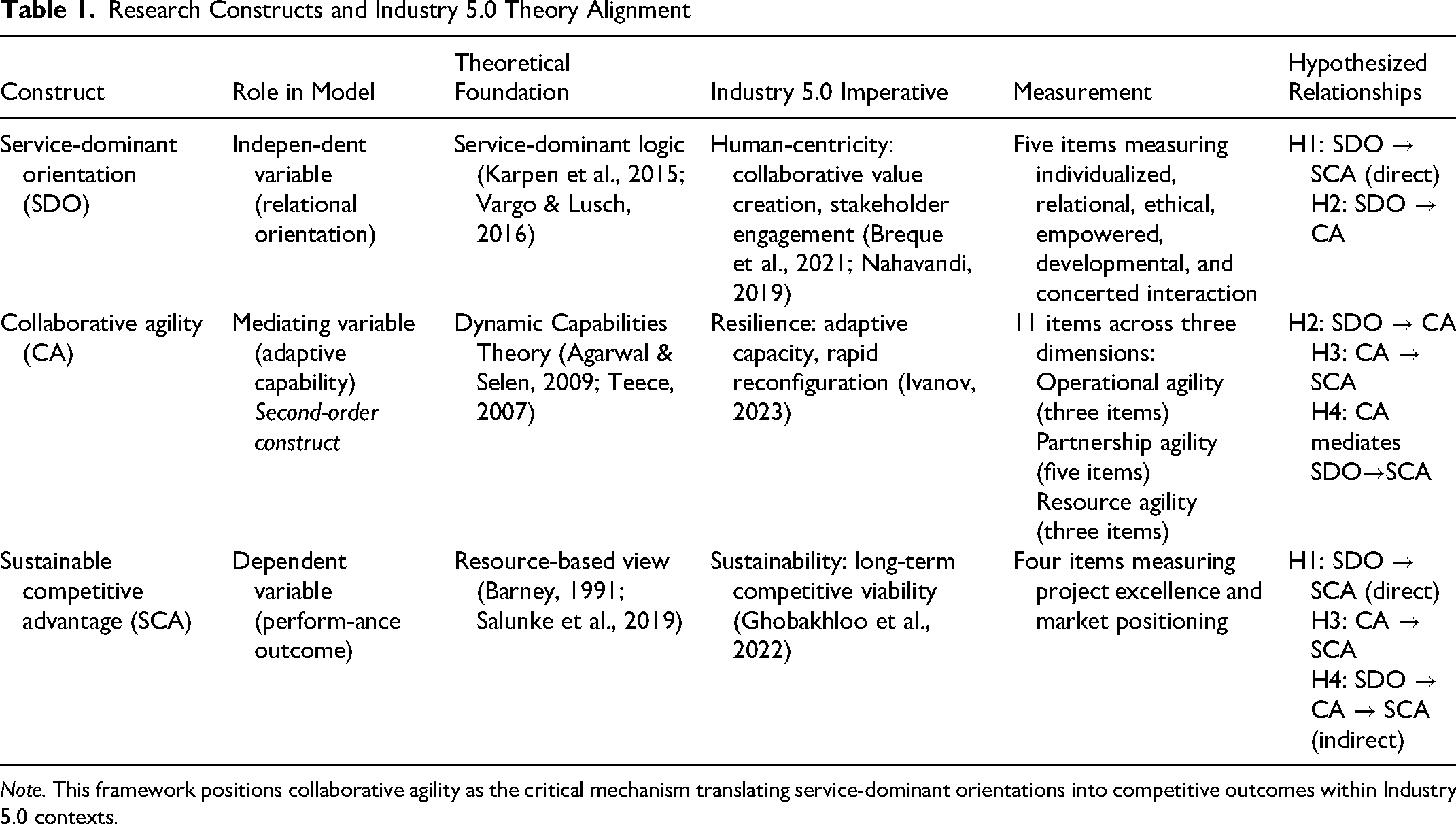
Note. This framework positions collaborative agility as the critical mechanism translating service-dominant orientations into competitive outcomes within Industry 5.0 contexts.
Figure 1 presents the research model depicting these relationships, with collaborative agility conceptualized as a second-order construct comprising operational, partnership, and resource agility dimensions.
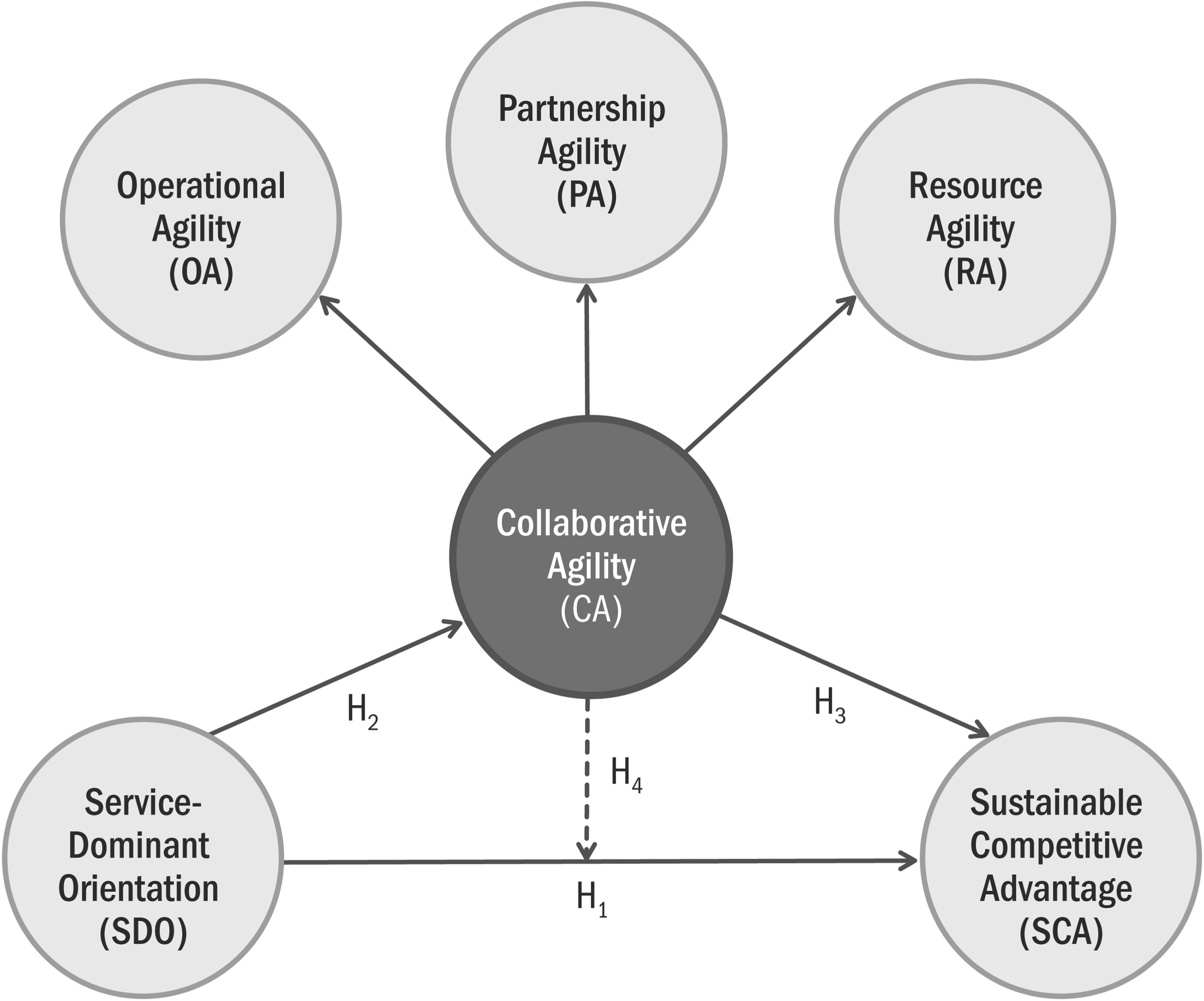
Research model.
Hypothesis 1 Proposes That Service-Dominant Orientation Has a Positive Direct Effect on Sustainable Competitive Advantage
Prior work links customer-centric orientations to performance and dynamic capabilities to advantage, but their interplay in temporary, highly customized project settings remains limited. As such, H1 examines the direct pathway from service-dominant orientation to sustainable competitive advantage. Although service-dominant logic studies often center on service sectors, collaborative value creation may look different when bounded by material production and fixed specifications (Wilden & Gudergan, 2017). Evidence points to cocreation improving innovation in business-to-business contexts (Salunke et al., 2019), while project producers typically balance collaboration with efficiency pressures (Blindenbach-Driessen and Van den Ende, 2006). Testing this link clarifies whether service-dominant orientation yields competitive gains independent of adaptive capabilities.
Hypothesis 2 Proposes That Service-Dominant Orientation Has a Positive Effect on Collaborative Agility
Hypothesis 2 focuses on the capability route. Relational orientations may need operational translation to affect outcomes, since firms that espouse collaboration can still struggle under resource strain or volatile requirements (Hamed, 2023). The service-dominant orientation/ collaborative agility link explores whether service-dominant principles nurture adaptive capabilities as organizations create flexible structures for stakeholder input (Lusch & Nambisan, 2015). Customer-centric cultures often correlate with greater organizational flexibility (Wilden & Gudergan, 2017). In project settings with shifting demands, such orientations may encourage the development of agile response mechanisms.
Hypothesis 3 Proposes That Collaborative Agility Has a Positive Effect on Sustainable Competitive Advantage
Hypothesis 3 assesses whether collaborative agility converts into sustained competitive advantage in these contexts. Manufacturing agility aligns with operational performance (Gunasekaran et al., 2019), but whether this persists where rivals can observe and imitate flexible practices (Jugdev & Thomas, 2002) is uncertain. Project conditions could heighten agility’s value due to customization, or frequent reconfiguration could impede the stabilization required for lasting advantage (Lindkvist, 2004).
Hypothesis 4 Proposes That Collaborative Agility Mediates the Relationship Between Service-Dominant Orientation and Sustainable Competitive Advantage
Finally, H4 advances the central contribution, which is mediation. If service-dominant orientation shapes sustainable competitive advantage mainly through collaborative agility, then service-dominant principles alone are insufficient without adaptive mechanisms. Such a result would align with Industry 5.0’s human-centric agenda, which depends on resilient operational capabilities to realize competitive gains (Ivanov, 2023). A remaining possibility is a strong direct service-dominant orientation/sustainable competitive advantage path, consistent with advantages arising from mechanisms beyond adaptation, such as relationship-specific investments and switching costs (Skaates & Tikkanen, 2003).
In summary, our research model (see Figure 1) proposes that service-dominant orientation influences sustainable competitive advantage both directly (H1) and indirectly through collaborative agility (H2, H3, H4), with collaborative agility serving as a critical mediating mechanism in Industry 5.0 contexts.
Methodology
Research Design
We employed a quantitative design to test the mediating role of collaborative agility in the link between service-dominant orientation and sustainable competitive advantage. A cross-sectional survey was conducted in the Brazilian printing industry using nonprobability convenience sampling through industry associations and professional networks. Nonprobability convenience sampling through industry associations and professional networks was appropriate given the absence of a complete sampling frame and substantial firm heterogeneity, which limits random sampling (Podsakoff et al., 2003). The respondent profile mirrors known industry demographics, supporting representativeness for an exploratory study (Wasserman et al., 2016). We estimated the model using partial least squares structural equation modeling (PLS-SEM), suitable for complex models that combine formative and reflective constructs, modest samples, and potential nonnormality (Hair et al., 2021). The final sample of 209 exceeds recommended PLS-SEM thresholds for models of moderate complexity (Hair et al., 2021).
Project Context
The Brazilian printing industry is a mature yet evolving sector with over 20,000 firms employing roughly 222,000 workers (Wasserman et al., 2016). Since the economic liberalization of the 1990s, the industry has shifted from protected domestic markets to more competitive environments that demand technological modernization and service diversification. Work is organized on a project basis, as each client order constitutes a distinct project with specific design, material, volume, and delivery requirements. Temporary teams comprising designers, prepress technicians, press operators, and finishing specialists are assembled for each project and disband when work is completed (Turner & Keegan, 2001). The scope of work ranges from creative, client-intensive design projects to technically focused production assignments requiring precise adherence to specifications (Jacomossi et al., 2021). This variety combines human creativity with technological capability, placing the sector at the intersection of traditional craftsmanship and digital innovation.
The Brazilian context also presents characteristics relevant to Industry 5.0. In contrast to more highly automated international printing markets, Brazilian firms retain extensive manual involvement due to labor cost structures and demand for customization. Client interaction is iterative throughout production, and specification changes are common. This human-intensive approach, although complex for standardization, aligns with Industry 5.0’s focus on human-technology collaboration (Breque et al., 2021). Environmental complexity further heightens operational challenges: one study identified 126 processes generating 190 residue types across 1,082 sources within a single printing operation (Wasserman et al., 2016). The combinations of inks, solvents, substrates, and finishing methods required across projects contribute to this complexity. Environmental regulations, particularly the National Solid Waste Policy (PNRS), add pressure to maintain sustainable practices without reducing project flexibility.
These conditions, including temporary project structures, human-technology integration, customization, and environmental constraints, provide a suitable context for examining how collaborative capabilities mediate the relationship between service orientations and competitive outcomes.
Instrument Development and Validation
Survey development followed established procedures for cross-cultural adaptation to ensure validity and reliability in the Brazilian context (Malhotra, 2012). Established English-language scales were translated by two academics, reviewed, and back-translated to confirm conceptual equivalence. Translation discrepancies were resolved through team discussion. Academic experts and industry professionals then assessed content validity. Two in-depth interviews with experienced professionals from the Brazilian printing industry were conducted to check item relevance, accuracy, and wording (DeVellis & Thorpe, 2021).
A pilot study collected 21 responses, 16 of which were valid. Feedback led to minor wording revisions in three items to enhance clarity for Brazilian respondents and confirmed an average completion time of 12 to 15 minutes, consistent with guidance for maintaining respondent engagement (DeVellis & Thorpe, 2021). Although modest, the pilot sample was adequate for identifying response issues and refining the instrument in line with established pretesting practice (Malhotra, 2012).
Measurement Scales
The instrument draws on established scales for service-dominant orientation (Karpen et al., 2012), collaborative agility (Agarwal & Selen, 2009), and sustainable competitive advantage (Salunke et al., 2019). Service-dominant orientation and sustainable competitive advantage are specified as reflective constructs, where indicators represent manifestations of the underlying latent variable (Hair et al., 2021). Collaborative agility is modeled as a Type II second-order reflective–formative composite: Operational agility, partnership agility, and resource agility serve as first-order reflective dimensions, which collectively form the higher order construct (Wetzels et al., 2009). This specification captures the systemic nature of collaborative agility, as each dimension contributes uniquely to the construct.
The service-dominant orientation scale originally included 10 items measuring value cocreation and customer-centric practices. Five items were removed during analysis to improve convergent validity, increasing average variance extracted (AVE) from 0.375 to 0.527 in line with PLS-SEM refinement guidance (Hair et al., 2021; Wilden & Gudergan, 2017). Collaborative agility included 12 items across the three dimensions. Partnership agility was reduced from six to five items, improving average variance extracted from 0.649 to 0.702, while operational and resource agility retained all items. Sustainable competitive advantage was drawn from Salunke et al. (2019), who assessed sustained performance outcomes through four items, capturing sustained competitive performance, all of which were retained with acceptable average variance extracted (0.578). Table 2 summarizes dimensions, original and final item counts, and rationale for item removal.
Construct Operationalization and Measurement
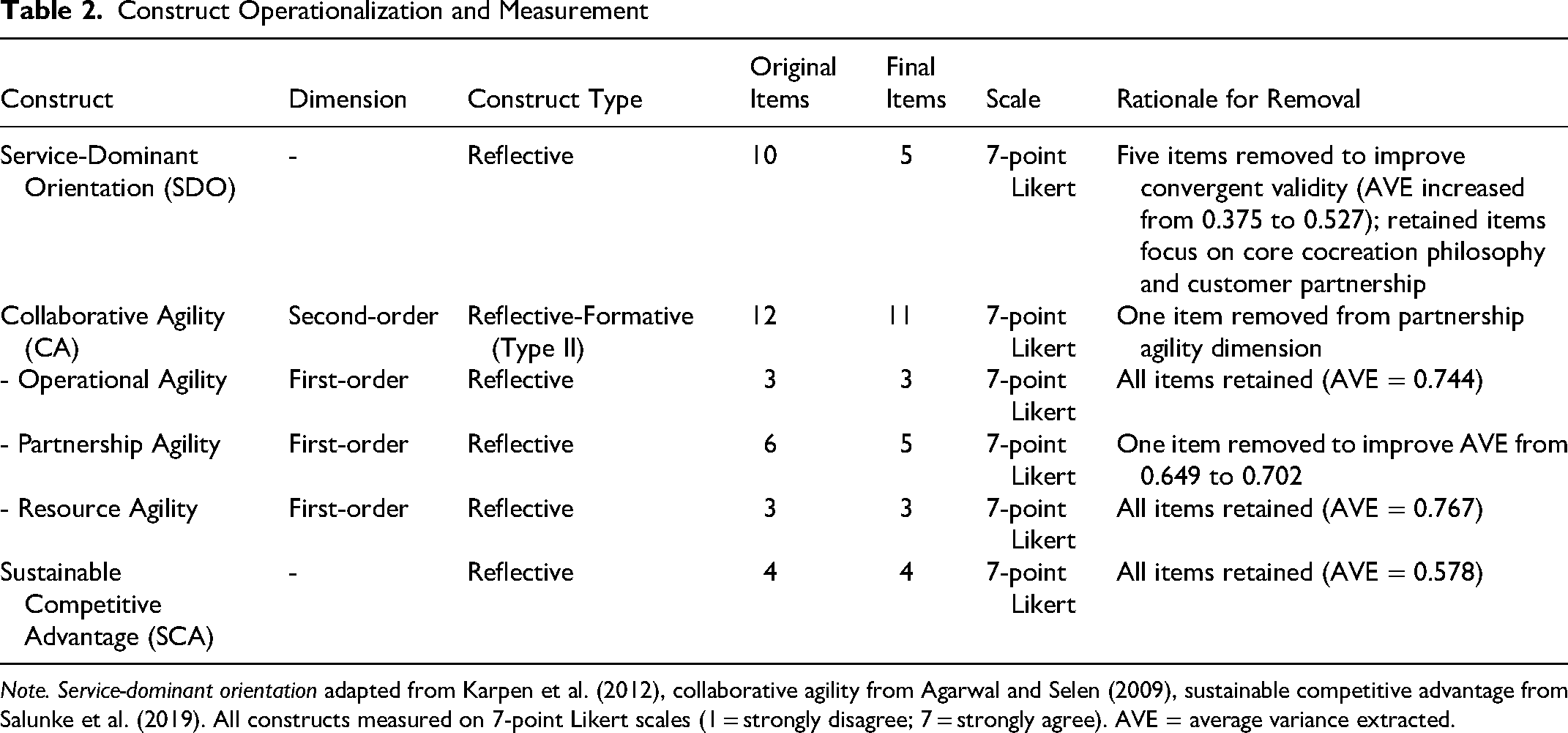
Note. Service-dominant orientation adapted from Karpen et al. (2012), collaborative agility from Agarwal and Selen (2009), sustainable competitive advantage from Salunke et al. (2019). All constructs measured on 7-point Likert scales (1 = strongly disagree; 7 = strongly agree). AVE = average variance extracted.
A control question unrelated to the survey topic was included to identify potentially inattentive responses. Item order was randomized to mitigate response bias in the online survey format (Podsakoff et al., 2003).
Data Collection and Screening
The survey was emailed to 5,168 contacts in the Brazilian graphic printing industry with a description of the study purpose, voluntary participation, and confidentiality. Two reminders were sent, and the timing reflected industry seasonality. A total of 379 responses were received, giving a 7% response rate. Data screening ensured quality before analysis. Four cases not matching the sample criteria were removed. A further 116 surveys with excessive missing data were excluded in line with recommended practice (Podsakoff et al., 2003). Response pattern checks led to the removal of 28 inattentive cases, and outliers were assessed using Mahalanobis distance. The final sample contained 209 valid responses.
Sample characteristics included 46.90% microentrepreneurs (sole owners of companies), 21.50% entrepreneurs with partners, and 20.10% employees of private companies. Experience distribution showed that 31.60% had 11 to 20 years of experience in the graphic printing industry, followed by 21.50% with more than 21 years of experience. Over 50% reported more than 11 years in the sector, suggesting a stable and experienced workforce.
Analytical Strategy
Data analysis followed Hair et al.'s two-stage approach for PLS-SEM using SmartPLS (Version 4.0) software for variance-based structural equation modeling using the partial least squares path modeling method (Hair et al., 2021). Table 3 presents the assessment criteria and threshold values employed in both measurement and structural model evaluation.
PLS-SEM Assessment Criteria and Threshold Values
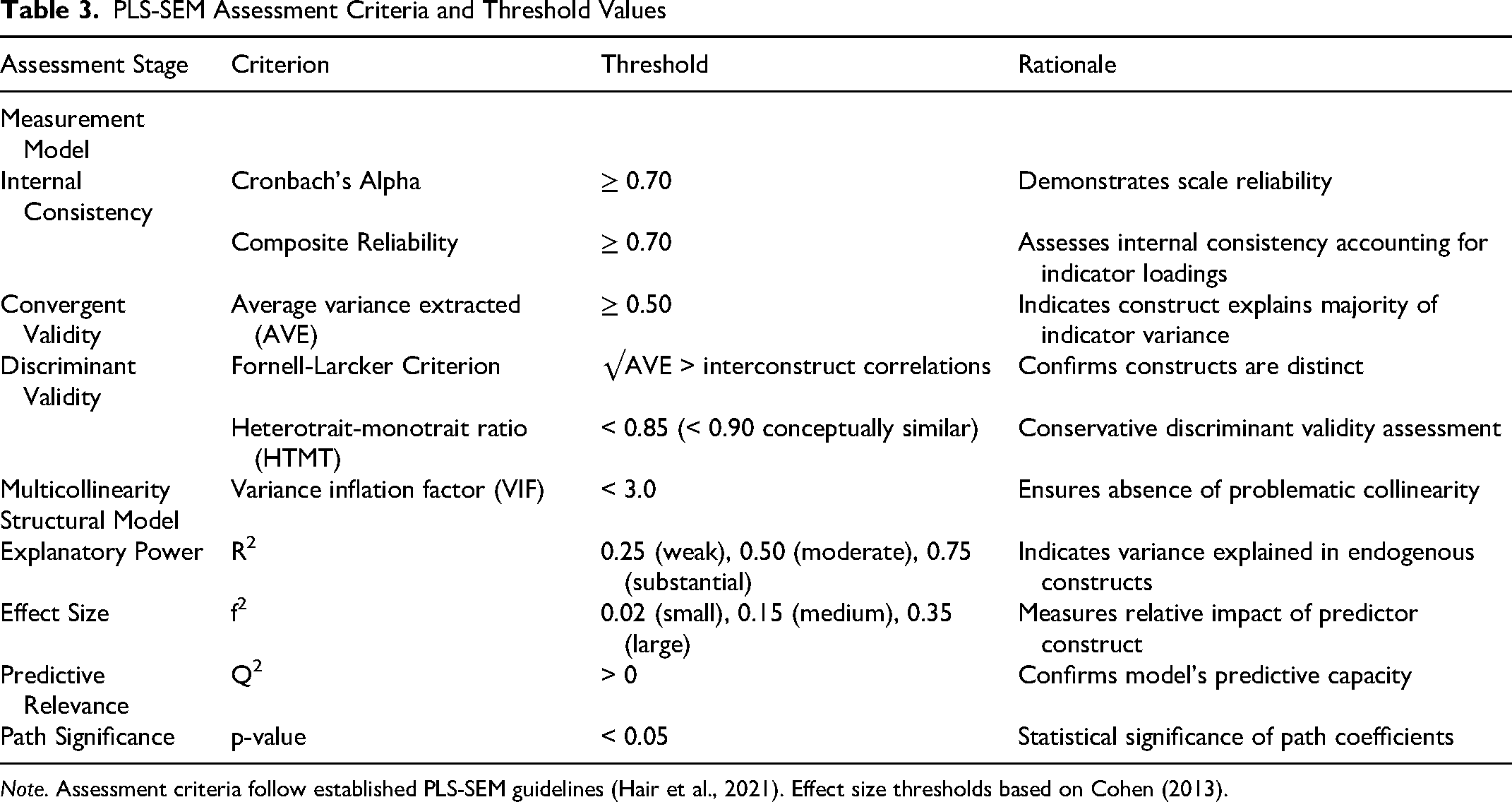
Note. Assessment criteria follow established PLS-SEM guidelines (Hair et al., 2021). Effect size thresholds based on Cohen (2013).
Stage 1 assessed the measurement model. Internal consistency reliability was examined using Cronbach's alpha and composite reliability, with a threshold of 0.70 (Hair et al., 2021). Convergent validity was assessed using average variance extracted values above 0.50. Discriminant validity was confirmed through the Fornell Larcker criterion and the heterotrait monotrait ratio below 0.85. Common method bias was checked using Harman's single-factor test. Stage 2 assessed the structural model to test the hypotheses. Path coefficients were estimated through the PLS algorithm with a path weighting scheme, 300 maximum iterations, and a stop criterion of 10−7. Significance was determined through bootstrapping with 5,000 resamples. Model explanatory power was judged using R2 values, and effect sizes through f2 statistics (Cohen, 2013).
Mediation analysis followed established procedures (Zhao et al., 2010). Direct (c’), indirect (a × b), and total (c) effects of service-dominant orientation on sustainable competitive advantage through collaborative agility were examined. Full mediation is present when the indirect effect is significant and the direct effect is not. Partial mediation applies when both are significant. The variance accounted for (VAF) metric indicates the share of the total effect explained through the mediator, with VAF above 80% signifying full mediation (Hair et al., 2021).
Findings
Measurement Model Evaluation
Prior to hypothesis testing, the measurement model was evaluated to ensure reliability and validity. Initial data screening using Kolmogorov-Smirnov and Shapiro-Wilk tests confirmed nonnormal distribution, supporting the use of PLS-SEM (Hair et al., 2021). The PLS algorithm employed a path weighting scheme with 300 maximum iterations and a stop criterion of 10−7. Bootstrapping with 5,000 resamples generated standard errors and confidence intervals for significance testing.
Internal consistency reliability was confirmed for all first-order reflective constructs, with Cronbach's alpha values ranging from 0.757 to 0.890 and composite reliability from 0.761 to 0.897, exceeding the 0.70 threshold (Hair et al., 2021). Average variance extracted (AVE) values met the 0.50 criterion for all first-order reflective constructs. Service-dominant orientation achieved an AVE of 0.527 after removing five items with low factor loadings (Karpen et al., 2015). Sustainable competitive advantage retained all four items (AVE = 0.578). The three collaborative agility dimensions demonstrated strong convergent validity: operational agility (AVE = 0.744), partnership agility (AVE = 0.702), and resource agility (AVE = 0.767). Discriminant validity was established through the Fornell-Larcker criterion and heterotrait-monotrait ratios below 0.85 (Hair et al., 2021). Table 4 presents measurement model results.
Measurement Model Results
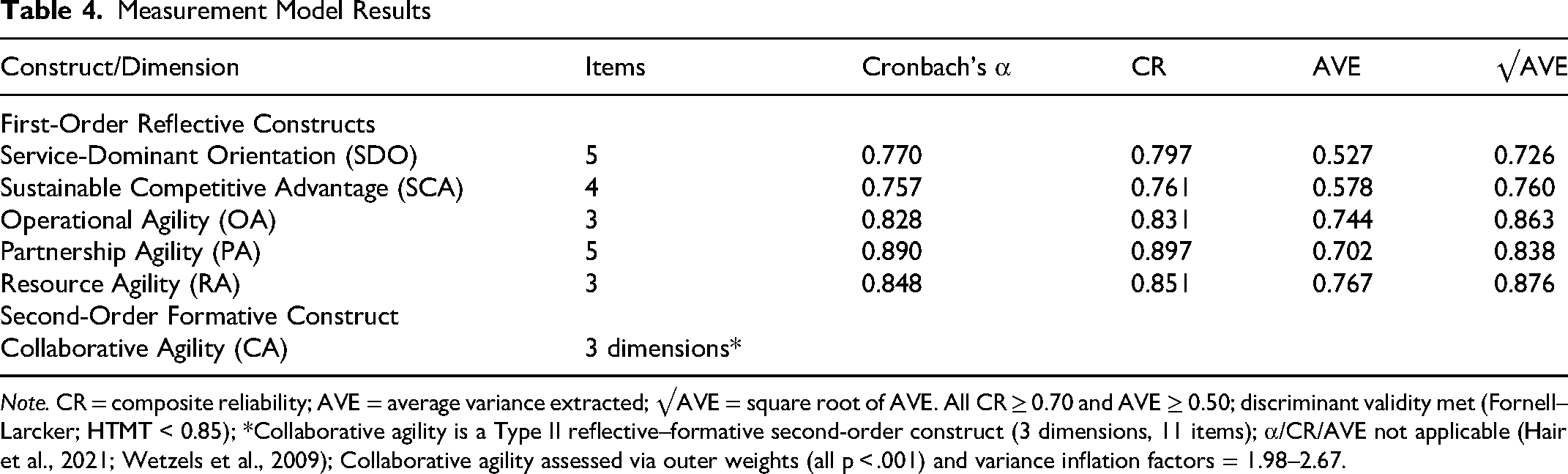
Note. CR = composite reliability; AVE = average variance extracted; √AVE = square root of AVE. All CR ≥ 0.70 and AVE ≥ 0.50; discriminant validity met (Fornell–Larcker; HTMT < 0.85); *Collaborative agility is a Type II reflective–formative second-order construct (3 dimensions, 11 items); α/CR/AVE not applicable (Hair et al., 2021; Wetzels et al., 2009); Collaborative agility assessed via outer weights (all p < .001) and variance inflation factors = 1.98–2.67.
Collaborative agility was modeled as a Type II reflective-formative second-order construct (Wetzels et al., 2009). All three dimensions exhibited statistically significant outer weights (p < .001), and variance inflation factor values remained below 3.0 (range: 1.98 to 2.67), confirming absence of multicollinearity (Hair et al., 2021).
Structural Model Evaluation
Following measurement model validation, the structural model was evaluated to test hypothesized relationships. Figure 2 presents the structural model with standardized path coefficients and R2 values.
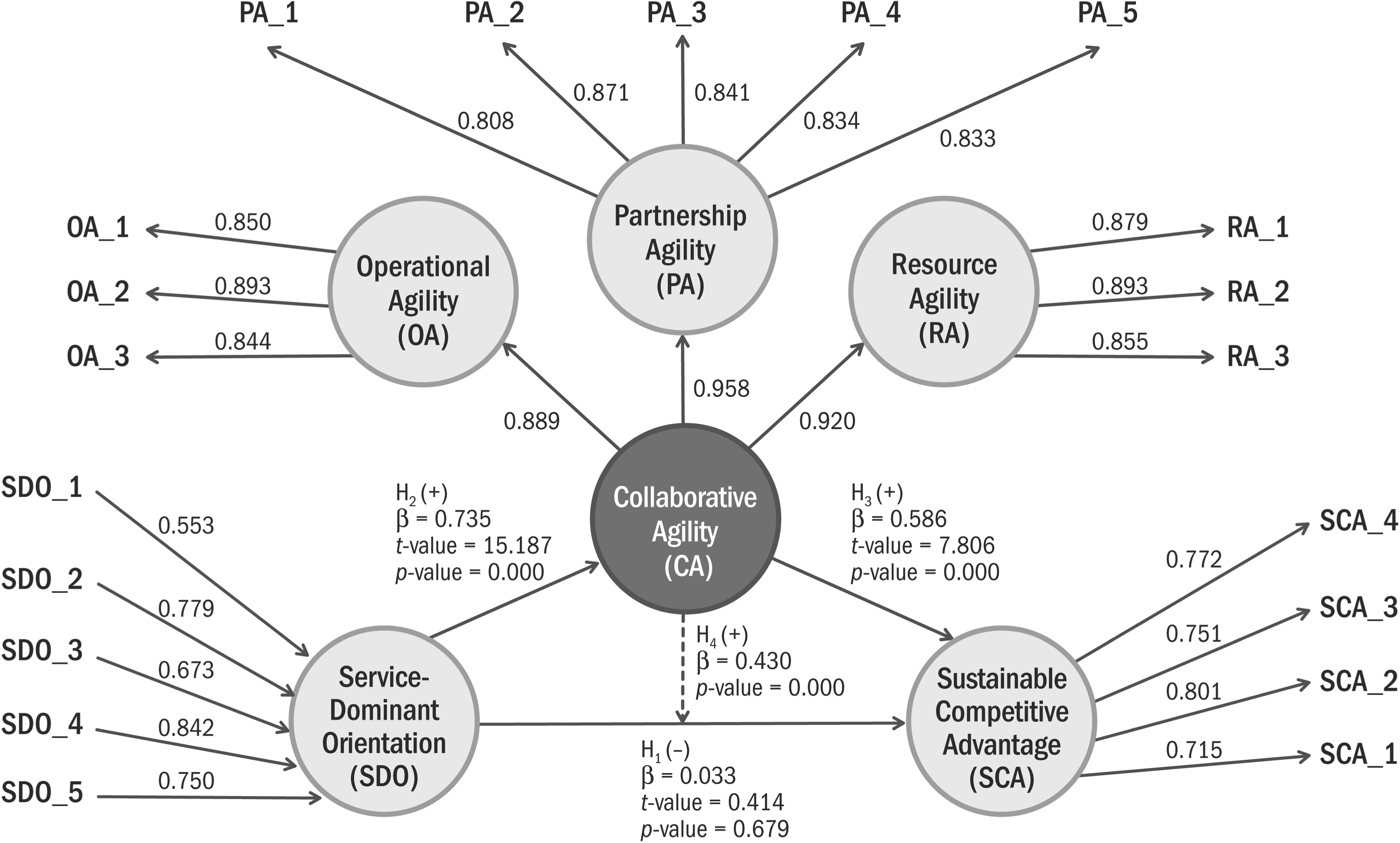
Structural model results with measurement model. 1
The model demonstrated moderate explanatory power. Service-dominant orientation explained 54.0% of variance in collaborative agility (R2 = 0.540), indicating moderate explanatory power (Hair et al., 2021). The model accounted for 37.3% of variance in sustainable competitive advantage (R2 = 0.373), reflecting weak to moderate explanatory capacity. Hypothesis testing revealed mixed support for direct relationships. Hypothesis 1, proposing a direct positive effect of service-dominant orientation on sustainable competitive advantage, was not supported (β = 0.033, t = 0.414, p = 0.679). Hypothesis 2, proposing that service-dominant orientation positively influences collaborative agility, received strong support (β = 0.735, t = 15.187, p < .001). Hypothesis 3, positing that collaborative agility positively affects sustainable competitive advantage, was supported (β = 0.586, t = 7.806, p < .001).
Effect size analysis revealed differential impacts (Cohen, 2013). Service-dominant orientation exhibited a large effect on collaborative agility (f2 = 1.175), while collaborative agility demonstrated a medium effect on sustainable competitive advantage (f2 = 0.252). The direct path from service-dominant orientation to sustainable competitive advantage showed negligible effect size (f2 = 0.001). The pattern of results, significant paths from service-dominant orientation to collaborative agility and from collaborative agility to sustainable competitive advantage, coupled with a nonsignificant direct path from service-dominant orientation to sustainable competitive advantage, indicates potential full mediation. The strong indirect pathway (0.735 × 0.586 = 0.431) compared to the weak direct effect (0.033) suggests that service-dominant orientation influences sustainable competitive advantage primarily through collaborative agility. Table 5 summarizes hypothesis testing results.
Structural Model Results and Hypothesis Testing
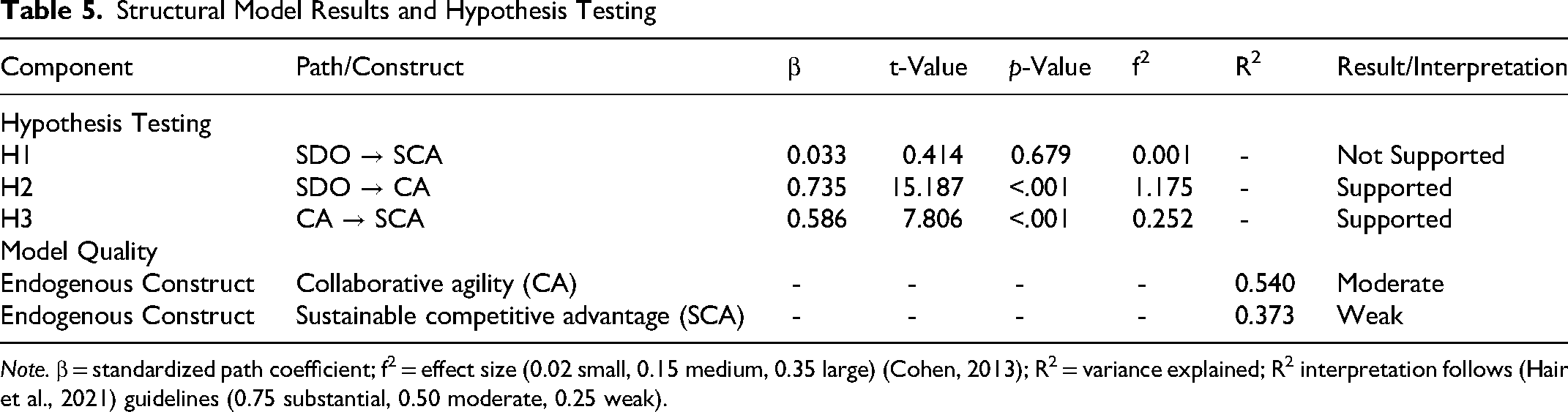
Note. β = standardized path coefficient; f2 = effect size (0.02 small, 0.15 medium, 0.35 large) (Cohen, 2013); R2 = variance explained; R2 interpretation follows (Hair et al., 2021) guidelines (0.75 substantial, 0.50 moderate, 0.25 weak).
Mediation Analysis
The final hypothesis (H4) proposed that collaborative agility mediates the relationship between service-dominant orientation and sustainable competitive advantage. Mediation analysis followed established procedures (Zhao et al., 2010), evaluating direct, indirect, and total effects. Results confirmed full mediation. The direct effect of service-dominant orientation on sustainable competitive advantage was nonsignificant (β = 0.033, p = 0.679), while the indirect effect through collaborative agility was significant (β = 0.431, p < .001). The total effect was 0.464 (0.033 + 0.431). Variance accounted for (VAF) reached 92.9% (0.431 / 0.464), substantially exceeding the 80% threshold for full mediation (Hair et al., 2021). Table 6 presents the complete mediation analysis. These results demonstrate that service-dominant orientation influences sustainable competitive advantage exclusively through collaborative agility rather than through direct mechanisms.
Mediation Analysis Results
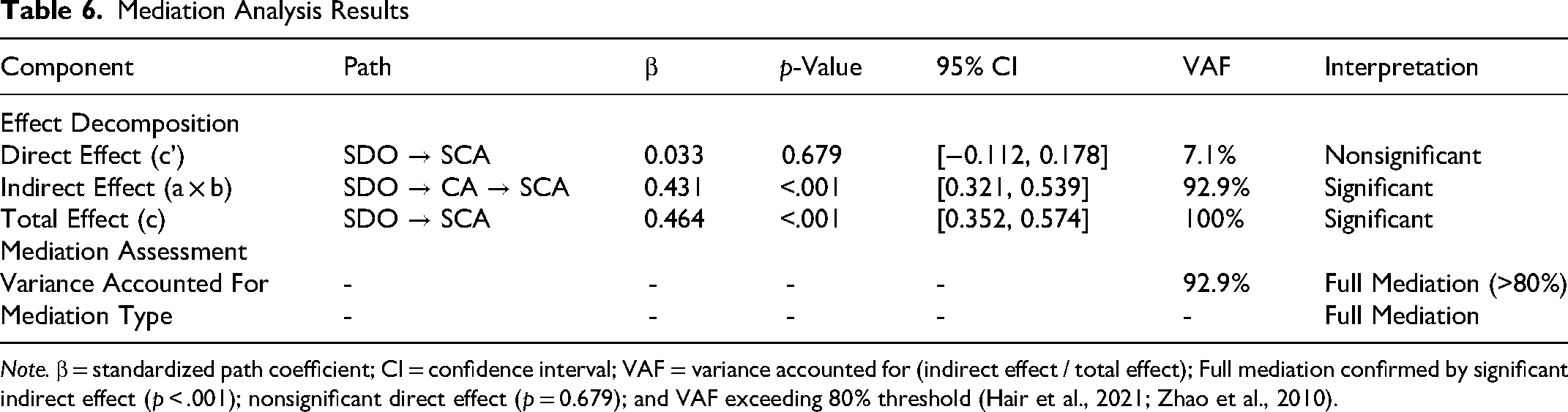
Note. β = standardized path coefficient; CI = confidence interval; VAF = variance accounted for (indirect effect / total effect); Full mediation confirmed by significant indirect effect (p < .001); nonsignificant direct effect (p = 0.679); and VAF exceeding 80% threshold (Hair et al., 2021; Zhao et al., 2010).
Summary of Hypotheses Testing
Table 7 summarizes the results of all hypothesis tests. The analysis revealed that service-dominant orientation does not directly influence sustainable competitive advantage but operates entirely through collaborative agility. This full mediation structure, with 92.9% of the total effect transmitted indirectly, establishes collaborative agility as the primary mechanism linking service-oriented practices to competitive outcomes in project-based manufacturing.
Summary of Hypothesis Testing Results

Note. β = standardized path coefficient; VAF = variance accounted for.
Discussion
Understanding the Absence of Direct Effects
The absence of a direct relationship between service-dominant orientation and sustainable competitive advantage challenges mainstream assumptions in service-dominant logic literature, which typically presumes positive performance outcomes from customer-centric practices (Karpen et al., 2012). This finding reveals a critical boundary condition in project-based manufacturing (Davies & Brady, 2000). Collaborative values alone prove insufficient for competitive advantage since they increase coordination complexity without providing operational mechanisms to manage that complexity.
Three theoretical mechanisms explain this absence. First, capability theory (Winter, 2003) suggests strategic orientations require supporting operational capabilities for value realization. service-dominant orientation functions as a cultural foundation that enables, but does not constitute, competitive advantage. From a resource-based perspective (Barney, 1991), service-dominant orientation lacks the operational specificity needed to meet valuable, rare, inimitable and non-substitutable (VRIN) criteria in isolation. Second, the project-based manufacturing context introduces structural constraints absent from pure service environments. Each project presents unique technical specifications, deadlines, and stakeholder configurations that limit standardized cocreation approaches (Brady & Davies, 2004). Unlike service industries where customer interaction directly creates value, printing involves material transformation processes where excessive client involvement can disrupt production efficiency. This creates a fundamental tension where service-dominant orientation encourages extensive stakeholder engagement, but project constraints demand controlled interaction to maintain operational effectiveness.
The five service-dominant orientation items removed during scale validation predominantly addressed operational customer involvement in production stages. Their elimination improved model fit but shifted the construct toward strategic philosophy rather than operational practice (Hair et al., 2021). This refined measurement may lack the specificity required to capture direct performance mechanisms, suggesting that operational aspects of service orientation require distinct capabilities for implementation.
The Brazilian printing industry highlights these dynamics. Firms operate under 2- to 8-week project cycles with iterative client consultation throughout production (Wasserman et al., 2016). Service-oriented values are necessary for client relationship management, but project delivery depends on adaptive capabilities that translate collaborative intent into executable workflows. This implies that adopting service-dominant principles without developing corresponding operational capabilities represents an incomplete implementation strategy, validating the importance of examining mediating mechanisms through which strategic orientations achieve performance outcomes.
Collaborative Agility as a Translation Mechanism
Collaborative agility constitutes a specific instantiation of dynamic capabilities, distinguished by its interorganizational and project-specific characteristics. Dynamic capabilities theory identifies three core processes. Sensing opportunities, seizing opportunities, and reconfiguring resources (Teece, 2007). Collaborative agility operationalizes these processes across organizational boundaries and temporary project structures. This positions collaborative agility within the dynamic capabilities framework rather than separate from it. Collaborative agility addresses the specific coordination challenges of project-based value creation.
Whereas dynamic capabilities encompass firm-level adaptation mechanisms generally, collaborative agility specifies collaborative adaptation mechanisms operating across project networks. This distinction is important since project-based organizations tend to coordinate capabilities across firm boundaries, which calls for different governance mechanisms compared with those used for internally focused dynamic capabilities (Windeler & Sydow, 2001). Collaborative agility thus represents a boundary-spanning variant of dynamic capabilities adapted to temporary, multistakeholder project contexts.
The translation mechanism operates through three interconnected pathways. First, service-dominant orientation establishes the organizational disposition toward collaborative value creation, developing what can be termed “relational readiness” (Karpen et al., 2015). This cultural foundation creates receptivity to stakeholder input and legitimizes resource commitment to collaborative activities (Vargo & Lusch, 2016). However, relational readiness alone cannot execute projects within time, budget, and technical constraints.
Second, collaborative agility converts relational readiness into operational routines. Operational agility transforms abstract cocreation principles into specific workflow reconfiguration capabilities (Agarwal & Selen, 2009). Partnership agility institutionalizes mechanisms for rapid alliance formation and termination, resolving the tension between collaborative ideals and project-specific resource needs (Schoenherr & Swink, 2015). Resource agility enables flexible asset deployment, operationalizing the service-dominant logic principle of resource integration through concrete allocation mechanisms (Sambamurthy et al., 2003).
Third, these routines generate sustainable competitive advantage through accumulated project capabilities (Brady & Davies, 2004). Each project cycle refines agility routines, creating organizational memory that improves future performance (Prencipe & Tell, 2001). This learning mechanism underpins why collaborative agility's effect on competitive advantage persists while direct service-dominant orientation effects do not materialize. The institutional context within which capabilities develop matters substantially, as agile capability implementation often encounters resistance from established governance frameworks and funding mechanisms (Baxter et al., 2023), reinforcing that collaborative agility functions as more than technical competence, requiring organizational cultural alignment. Collaborative agility provides an adaptive consistency through its systemic integration of operational, partnership, and resource dimensions, enabling organizations to reconcile the apparent contradiction between service-dominant values and manufacturing efficiency imperatives.
Theoretical Significance of the Three Dimensions of Collaborative Agility
The three-dimensional structure of collaborative agility addresses a fundamental theoretical question: Why do project-based organizations require multiple agility types rather than generalized flexibility? The answer rests in the distinct coordination challenges that emerge when temporary organizational structures intersect with interorganizational value creation (Turner & Keegan, 2001).
Each agility dimension addresses a distinct project management challenge that isn’t simply resolved through the others. Operational agility resolves temporal coordination problems, in that projects balance standardization for efficiency with reconfiguration for customization (Eisenhardt & Martin, 2000; Jacobs et al., 2011). This tension may not be addressed through partnership or resource mechanisms alone since it operates at the process architecture level. The dimension enables “modular responsiveness,” maintaining stable capability modules while allowing rapid recombination for project-specific requirements.
Partnership agility addresses interorganizational boundary challenges inherent in project networks where required capabilities exceed any single firm's resources (Windeler & Sydow, 2001). This dimension demonstrated the highest loadings in the measurement model, reflecting project-based manufacturing's structural dependence on temporary alliances. Unlike operational agility's internal process focus, partnership agility governs external relationship dynamics. Specifically, it involves alliance formation, governance adaptation, and termination mechanisms (Dietrich et al., 2010). This external orientation highlights why partnership agility alone may not substitute operational or resource dimensions. Resource agility addresses the allocation coordination problem across concurrent projects competing for finite organizational assets (Brady & Davies, 2004). Unlike operational agility's single-project focus or partnership agility's external orientation, resource agility enables cross-project optimization through fungible skill development and knowledge transfer systems (Prencipe & Tell, 2001).
The second-order formative structure also indicates dimensional complementarity rather than substitutability (Wetzels et al., 2009). High interdimensional correlations suggest codevelopment: Organizations cannot selectively develop one dimension without corresponding advancement in others. Operational reconfiguration depends on resource redeployment capabilities. Partnership formation requires operational systems capable of integrating external contributions. Resource allocation effectiveness depends on partnership governance that clarifies contribution expectations. This systemic interdependence illustrates why competitive advantage emerges from coordinated dimensional development rather than excellence in individual capabilities, aligning with configurational theories of organizational effectiveness (Meyer et al., 1993).
Industry 5.0 Implementation Framework
Our finding provides the foundation for a theoretical framework linking organizational capabilities to Industry 5.0 implementation in project-based manufacturing contexts (Figure 3).
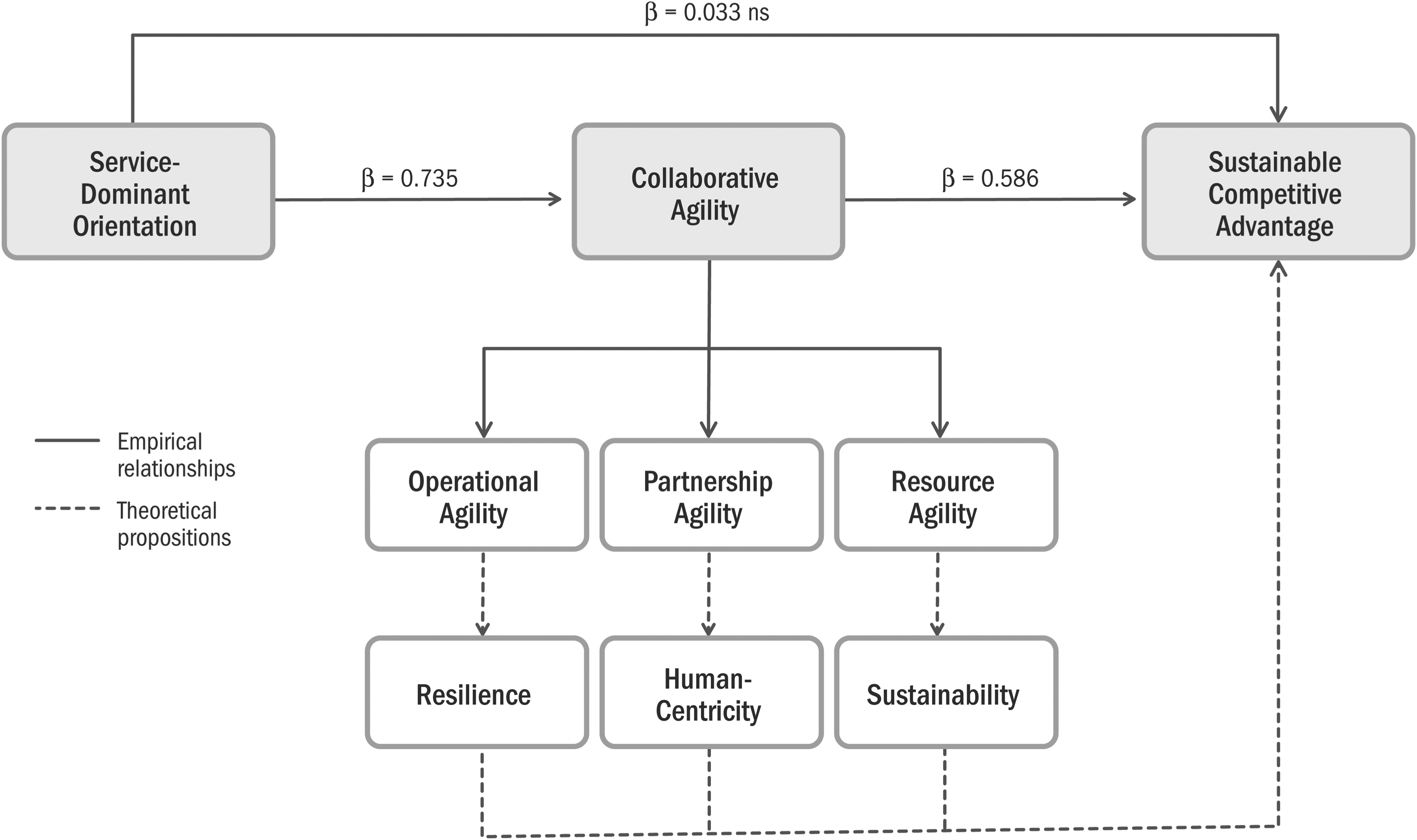
Theoretical framework linking agility capabilities to Industry 5.0.
The framework construction followed a two-stage process combining empirical validation with theoretical extension. Stage 1 comprises the empirically validated structural model (solid lines), including the direct path from service-dominant orientation to sustainable competitive advantage (β = 0.033 not significant), the indirect mediation pathway (service-dominant orientation → collaborative agility → sustainable competitive advantage), and the second-order formative structure (Collaborative agility's three dimensions). These relationships received statistical confirmation through our PLS-SEM analysis.
Stage 2 extends the empirical model through theoretical mapping (dashed lines) connecting collaborative agility dimensions to Industry 5.0 imperatives. This mapping derives from three sources. First, conceptual alignment between dimension characteristics and imperative definitions (Breque et al., 2021). Operational agility's reconfiguration capability corresponds to resilience requirements for systemic disruption response, enabling organizations to maintain project delivery effectiveness amid environmental volatility through adaptive governance and resource flexibility (Dong & Dacre, 2024). Partnership agility's collaborative mechanisms align with human-centricity's stakeholder engagement principles. Resource agility's optimization function supports sustainability's efficiency imperatives. Second, existing literature linking agility types to Industry 5.0 objectives (Dacre et al., 2024; Ivanov, 2023; Martins et al., 2022) provides theoretical precedent for these connections, though not within integrated frameworks. Third, dimensional measurement characteristics informed mapping specificity. Operational agility items emphasize process adaptation (aligning with resilience), partnership agility items focus on collaborative governance (aligning with human-centricity), and resource agility items address efficiency optimization (aligning with sustainability).
The final pathway (Industry 5.0 imperatives → sustainable competitive advantage) represents a theoretical proposition requiring future empirical validation. This path posits that Industry 5.0 imperatives, when operationalized through agility capabilities, contribute to sustained competitive advantage. The framework thus distinguishes validated mechanisms (capability mediation) from proposed extensions (imperative-level performance effects), maintaining empirical-theoretical transparency.
This framework also advances Industry 5.0 theory by specifying the implementation gap, resolving imperative contradictions, and providing testable propositions. For instance, existing literature articulates aspirational objectives (human-centricity, resilience, sustainability) without detailing capability requirements for operationalization (Breque et al., 2021; Xu et al., 2021). In our study, the framework identifies collaborative agility as the missing capability infrastructure enabling imperative translation into practice, addressing identified gaps in Industry 5.0 research regarding operational pathways (Ghobakhloo et al., 2022).
Conclusion
This study addressed the inquiry of how service-dominant orientations translate into competitive advantage in project-based manufacturing, particularly within Industry 5.0 contexts emphasizing human-centricity, resilience, and sustainability. The Brazilian printing industry provided the empirical setting for examining these relationships. The central finding challenges assumptions that customer-centric orientations directly drive competitive performance. Instead, service-dominant orientation requires operational translation through collaborative agility to achieve competitive outcomes.
This complete mediation reveals that relational values, while necessary, prove insufficient without corresponding adaptive capabilities that manage coordination complexity in temporary project structures. Partnership agility is especially important and reflects project-based manufacturing's reliance on interorganizational collaboration. The findings clarify pathways for Industry 5.0 adoption and show how organizational capabilities connect strategic intent with competitive performance in project contexts.
Theoretical Contributions
The research contributes three advances to existing knowledge. First, it demonstrates that service-dominant orientation does not directly influence sustainable competitive advantage in project-based manufacturing. This contradicts assumptions in existing service orientation research (Karpen et al., 2015; Vargo & Lusch, 2016) and establishes that collaborative values require operational capabilities for performance realization. Prior research lacked empirical evidence regarding this relationship in manufacturing contexts, particularly where material production processes constrain stakeholder interaction patterns.
Second, the study validates collaborative agility as a second-order construct comprising three empirically distinct dimensions. Operational agility (process reconfiguration), partnership agility (alliance management), and resource agility (asset deployment). These dimensions address different coordination problems in project networks and function as complementary rather than substitutable capabilities (Agarwal & Selen, 2009). Previous research treated agility generically; this specification enables more precise examination of how project-based organizations adapt to environmental changes.
Third, the framework connecting collaborative agility dimensions to Industry 5.0 imperatives provides a theoretically grounded implementation pathway. Existing Industry 5.0 literature articulates objectives (human-centricity, resilience, sustainability) without specifying organizational capabilities required for operationalization (Breque et al., 2021; Ghobakhloo et al., 2022). The dimensional mapping offers propositions for future research and practical guidance for organizations implementing Industry 5.0 principles.
Practical Implications
For practice, these findings indicate that adopting service-oriented principles without developing collaborative agility capabilities yields limited competitive benefit. Organizations implementing customer-centric practices should prioritize building operational routines that translate collaborative intentions into adaptive project execution. This requires investment in process reconfiguration systems, alliance management capabilities, and cross-project resource coordination mechanisms.
Partnership agility warrants particular attention given its prominence in the empirical model. Organizations should establish framework agreements enabling rapid contractor mobilization while maintaining governance flexibility as project requirements evolve. This differs from traditional supplier relationship management by emphasizing temporary alliance formation and termination capabilities rather than long-term partnership stability.
Industry 5.0 implementation requires capability development aligned with specific imperatives. Organizations pursuing resilience should focus on modular production architectures that enable rapid workflow reconfiguration. Those emphasizing human-centricity need collaborative governance mechanisms that enable selective stakeholder engagement at critical project stages. Sustainability objectives require resource optimization systems that enable personnel and equipment sharing across concurrent projects.
The complementary nature of collaborative agility dimensions suggests organizations cannot selectively develop individual capabilities. Effective implementation requires coordinated advancement across operational, partnership, and resource agility. Organizations should assess current capability levels across all three dimensions and address deficiencies systematically rather than pursuing isolated agility initiatives. This integrated approach enables organizations to balance Industry 5.0's human-centric, resilient, and sustainable objectives while maintaining competitive performance in project-based manufacturing environments.
Limitations
Several limitations qualify our findings. The cross-sectional design precludes causal inference regarding the temporal sequencing of capability development. While the mediation structure implies causal ordering, longitudinal data are required to determine whether collaborative agility dimensions develop simultaneously or sequentially, and whether service-dominant orientation precedes or emerges from agility capabilities.
The Brazilian printing industry context constrains generalizability. This sector features relatively short project cycles (2 to 8 weeks), moderate capital intensity, and regional scope (Wasserman et al., 2016). Industries with longer project horizons (construction, aerospace), higher regulatory burdens (pharmaceuticals), or global operations may require different capability configurations. Manufacturing sectors with higher automation levels or lower customization requirements may exhibit different relationships between service orientation and competitive advantage.
Methodological considerations include the use of nonprobability convenience sampling which introduce potential selection bias. While the final sample (n = 209) exceeds PLS-SEM requirements (Hair et al., 2021), larger samples would enable more detailed model estimation and potentially reveal interaction effects not detected in this analysis. Self-reported perceptual measures, though appropriate for assessing organizational orientations and capabilities, may not fully capture objective performance outcomes or operational practices.
Removing five items from the service-dominant orientation scale improved psychometric properties but shifted measurement toward strategic philosophy rather than operational practices. This refined construct may inadequately capture the full spectrum of service-dominant implementation, particularly customer involvement in production activities. The formative specification of collaborative agility as a second-order construct, while theoretically appropriate, limits direct comparability with studies using alternative measurement approaches.
Future Research Directions
Future research should address these limitations through several avenues. Longitudinal studies examining capability development sequences would clarify whether collaborative agility dimensions emerge simultaneously or sequentially, and whether service-dominant orientation functions as antecedent or consequence of agility development. Such research could employ multiwave panel designs tracking organizations over multiple project cycles.
Cross-sectoral replication in capital-intensive industries (aerospace, pharmaceuticals) or continuous production environments (automotive, electronics) would establish boundary conditions for the framework and identify industry-specific capability requirements. Cross-cultural studies comparing emerging and developed economies would test whether the service orientation–collaborative agility relationship holds across different institutional contexts.
Methodological extensions could strengthen causal inference and ecological validity. Case studies would provide rich detail regarding how organizations develop collaborative agility capabilities and implement Industry 5.0 principles in practice. Mixed-methods approaches combining survey data with objective performance measures (project success rates, financial metrics) would address self-report limitations. Multilevel analyses examining project, organizational, and network-level effects would capture the nested nature of project-based value creation. Finally, empirical testing of the theoretically proposed pathway linking Industry 5.0 imperatives to sustainable competitive advantage represents a priority for validating the complete framework.
