




Abstract
Special purpose vehicles (SPVs) are a form of project organization created for public–private partnership (PPP) projects. SPVs are complex organizational arrangements, relating actors from different institutionally regulative, normative, and cognitive contexts. We abductively analyze interviews with 36 practitioners experienced in managing SPVs using Gioia analysis. We find that SPV design is focused on systems integration, framed by transactional interpretations of contracts. This undercuts the interorganizational integration necessary for SPV design to work more effectively. We find that social and interorganizational integration remain largely overlooked, which is a key reason for PPP infrastructure project failure.
Keywords
Introduction
While significant public value is delivered by project organizations in infrastructure, project failures to meet budgets, timeliness, and scope are notorious. Failure has been attributed to many organizational factors, including project governance and governmentality (Clegg et al., 2002; Pitsis et al., 2014; Müller et al., 2017), project leadership (Pilkienė et al., 2018; Agarwal et al., 2021; Whyte et al., 2022; Whyte et al., 2025), project teams, culture and capability (van Marrewijk, 2007; Pollack & Matous, 2019; Manata et al., 2021; Denicol & Davies, 2022), project manager competencies (Crawford, 2006), different forms of contracts (formal and relational contracts) (Caniëls et al., 2012; Benítez-Ávila et al., 2018; Ke et al., 2019; Nikulina et al., 2022), as well as imputed initial optimism bias (Flyvbjerg & Gardener, 2023; Ika & Pinto, 2025). Failings have also been attributed to problems of omission, errors, and changes in execution (Love et al., 2022). These factors can, of course, be interrelated or individually causal, with an impact on the efficacy of the project organization in delivering its objectives.
The extant research emphasizes individual organizational components and their impact on project delivery, rather than focusing on project organization as an open system, addressing its various interconnected components and tensions. Zani et al. (2024) systematically review organization design in megaprojects. They searched for articles addressing aspects related to design and from a sample of 10,078, they identified 141 articles. However, rather than overall design, these articles were “focused on only one or two capabilities” (Zani et al., 2024, p. 2). The problem with this is that any major infrastructure project organization is an evolving and hybrid form of organization (Denicol et al., 2021), exhibiting a temporary and “liquid” nature (Clegg, 2024). Clegg and Cunha (2019), in relation to organizations, capture the liquid concept as consisting of organizing structures and practices that reflect fluidity, instability, and a short-term nature. Liquid organizations are designed for constant change and rapid adaptation to shifting market and other contingent conditions. One consequence of temporary project organization is that members’ commitment tends to be conditional, and power relations and decision-making diffuse. The latter shift according to rapidly changing project needs; one constant, however, is that risk is contractually allocated as far from finance and as close to individual contractors as the market will allow. Project organization is composed from personnel and materials drawn from multiple organizations contractually seeking to minimize risk to their future value creation, whether financial, material, or symbolic. Design of project organization needs to cope with temporality and liquidity in managing interorganizational relations among those organizations that it contractually entrains to make a future whose accomplishment is inherently risky as a result of being engaged in unpredictable uncertainties threatening individual organization interests. One of the major reasons behind the adoption of public–private partnerships (PPPs) globally (Clegg et al., 2024) is to try and limit public sector financial risk in two dimensions. First, the danger of cost overruns and delays is shifted to the private partner. Second, public debt increases can be avoided by complying with fiscal rules (Mutangili, 2025). The medium for achieving these outcomes is a project organization termed a special purpose vehicle (SPV), a project finance mechanism for isolating and allocating project-specific risks (financial, operational, legal) away from the parent companies (sponsors) by “ring-fencing” these risks through a complex network of contracts (construction contracts, operation agreements, loan agreements, shareholder agreements) (Liu et al., 2022).
A key aspect of SPV financing is the separation of firms sponsoring the project from project delivery (Daube et al., 2008; Esty, 1999, 2004; Müllner, 2017; Gemson & Annamalai, 2015; Liu et al., 2022). The SPV sits at the center of a contract network (Gatti, 2008; Chowdhury & Chen, 2010). PPP financing can link 15 or more parties to the SPV through hundreds or even thousands of contractual arrangements (Esty, 2002, 2003, 2004; Liu et al., 2023). SPVs are a hybrid organizational design that temporarily knot and connect actors, actions, and actants (Lindberg & Czarniawska, 2006). These designs enable project finance to be contributed from a wide range of debt and equity investors, creating a distinct legal and financial entity and complex organizational design, stitching together multiple organizations/stakeholders with high transaction costs (Hart, 2003). Aligning investor and other stakeholder interests within the SPV organization can be problematic (Esty, 2004; Blanc-Brude et al., 2009). 1 One consequence of the centrality of financial arrangements to the design of SPVs is that as transactional arrangements, SPVs attend to system integration through bundling contracts. Such design has an impact on SPVs’ organizational capabilities for delivering projects because risk and capital flows are the overarching consideration in their design, not how they may be more organizationally efficacious. There is a tendency for the parties involved in PPPs to act as silos (Brady & Davies, 2004) to protect their individual interest, a tendency consistent with the findings of a comparative study by van Marrewijk et al. (2008), in one of the few studies that discusses how project cooperation as well as the cultures comprising it can be fostered by design.
Liu et al. (2022) establish that PPPs are primarily considered from a finance perspective, despite the impact of SPV design on PPP performance. A significant gap arises from the lack of consideration of SPV design from an organizational rather than a financially instrumental perspective. Hence, our research question is: How might SPV design be improved beyond being merely a financial instrument? We frame our analysis abductively, by looking at system integration in the SPV and considering the role that its sibling concept, social integration, plays in SPV functioning, modifying the classical sociological terms of system and social integration derived from Lockwood (1964). To inquire into the research question, we collected data through in-depth interviews with 36 senior executive practitioners experienced in managing SPVs globally, in various capacities.
Literature Review
Theoretical Framework: Social and Systems Integration
In a key article, Lockwood (1964) extended discussion of the functional relationship between the different institutional parts of a social system as it was posed in Parsons’ (1951) influential terms. He did so by focusing on social as well as system integration. System integration, as the integration of actions within a social system, refers to the processes by which various elements of a system are organized and coordinated. Social integration concerned the extent to which individuals who were integrated into a system were bound by shared institutional values, norms, and collective conscience, leading to orderly social relations and cooperation through interpersonal bonds. Lockwood’s (1964) concern was with how different structural components of society (e.g., the economy, the political system, the legal system, educational institutions, family structures) interrelated and interconnected. In particular, he was concerned with which of these parts were compatible, mutually supportive, or in conflict, often due to unintended connections and dependencies between institutional orders.
While Lockwood’s (1964) focus was on the societal level of analysis, ours is on the inter-organizational relations among multiple permanent organizations embedded within the SPV as a project organization. In organizational terms, social integration is concerned with the linkages creating interorganizational integration between organizations and the actors representing them. The focus on system integration in project organizing is usually on technical aspects of a system, such as IT. However, system integration can also be thought of as being enacted through legal regulations, economic policies, governance structures, and contracts. In SPVs it is largely through contractual means that integration is achieved. A transactional approach, however, does little to build social integration, “the ties that bind” actors’ relations to one another to achieve organizational cohesion (Lockwood, 1964). Binding is especially important for temporary organizing that is far more fluid and dynamic than that which is more permanent. Lockwood’s (1964) extension of Parsons’ (1951) conceptualization of systems integration to include the institutional parts of a social system forms the theoretical framework for this article. We will argue that the capability of project organization to achieve defined and desired outcomes and deliver social and economic benefits is contingent on both social and system integration. Translating the theory of integration from the social to the project context shifts focus to accomplishing the project integration of different public and private organizations, despite the diverse institutional logics of the private and public sectors in which organizations are embedded. In SPVs the main source of institutional binding is transactional allocation of risks through contracts as processes of system integration.
As documentary devices for achieving system integration, contracts always have to be interpreted. Whether they will be interpreted in identical ways by all interpreters, creating harmonious social integration, is an unlikely sensemaking proposition (Weick, 1995). As fundamentally integrative organizational forms (Liu et al., 2023, 2024), the distinction between system and social integration provides a useful framework to contextualize the extant finance-focused literature on SPVs and move this debate to the social aspects of integration that affect PPP outcomes. In the next section we will consider how SPV system integration is discussed in project management research and explore how knotting and boundary objects affect social integration in SPVs.
System Integration in SPVs
Led by a hybrid project organization SPV, organization actors, actants, and acts connect to form temporary coalitions. In theory, the SPV, as a set of specialized functions of finance, design, construction, operation, and maintenance, achieves system integration through the bundling of a multiplicity of contracts over lengthy periods (Esty, 2002; Liu et al., 2022, 2023). SPVs are a form of “organized impermanence” (Weick, 2009, p. 7). As “temporary systems,” they depend on their embeddedness in permanent contexts of government, finance, and business (Sydow & Windeler, 2020). In contrast to classical bureaucracies (Weber, 1978), employees “are employed on short-term or highly contingent contracts … reducing their commitment and loyalty to organizations” (Clegg & Cunha, 2019, p. 274). They do what is to be done, then move on, a point made early in the development of the project studies field by Stinchcombe (1959). The temporary and fluid nature of project organization delivery presents significant challenges in developing interorganizational integration in SPVs, through other than financial and legal coordination and cooperation between parties (Ring & van de Ven, 1994). Given that once the project is delivered, SPVs can endure for up to 30 years or more, their design as effective organizations requires more than financial instrumentality.
Where multiple organizations and responsibilities are contractually engaged for a temporally limited period, Schütz (1967) and Weick (1995) would argue that contingencies change in meaning with the here-and-now from which they are envisaged. As temporality unfolds, situations change, and so do their definitions. There are multiple opportunities for sequential conflict and negotiation, leading to disputes and costly legal resolution incurring additional transaction costs (Williamson, 1979; Hart & Moore, 1988). Grossman and Hart (1986), Hart and Moore (1990), and Hart (1995) argue that, in practice, contracts cannot specify what is to be done in every possible contingency because every possible contingency cannot be known in advance. SPV delivery processes strive to minimize equity and debt financers’ risk. Considerable emphasis is placed on effective project finance (minimizing risk and maximizing financial returns for investors), as well as budget certainty for public sector agencies (Liu et al., 2024), integrating the institutional framing and allocation of risk.
Social Integration: Boundary Objects and Knotting
SPVs combine multiple organizations inhabiting quite diverse institutional logics of government regulation and commercial competition. Institutional logics refer to the shared beliefs, values, and practices that shape organizational behavior within a particular field (Thornton & Ocasio, 1999). As Lounsbury et al. (2021) argue, when diverse institutional logics meet organizationally, they produce forms of hybridity, as institutional theory attests (Battilana & Dorado, 2010; Pache & Santos, 2010; Pache & Thornton, 2020). SPVs are, by definition, a meeting place for competing institutional logics.
In terms of practice, Söderlund (2011) regards the fundamental organization design issues in integration to be coordination of task complexity and cooperation to overcome conflicting goals and “guileful” transactions, in Williamson’s (1975) phrase. SPVs contain many “boundary objects” (Star & Griesemer, 1989) that act as integrative interfaces between different individuals and/or organizations (Carlile, 2002; Koskinen & Mäkinen, 2009). Boundary objects are devices that enable coordination through connection and delimitation. “(B)oundary objects can be imbued with either positive or negative meanings” (Karaba et al., 2023, p. 2172). Positively, they fulfill a bridging function by supporting information processing and sharing, increasing collaboration (Carlile, 2002), serving to reduce complexity in social exchanges (Petsoulas et al., 2011). Negatively, boundary objects can inhibit information sharing and collaboration by weakening ties and reinforcing boundaries between organizations (Newell & Swan, 2000; Karaba et al., 2023). In complex systems with intersecting institutional logics and limited slack, complex institutional blockages impeding integration can easily arise (Sackett & Lareau, 2023). Much depends on the extent to which logics are knotted together.
The concept of institutional knotting is highly relevant to SPVs, as entities created at the interface of institutions form both the public sector (government agencies) and the private sector (sponsors, financiers, contractors). 2 These entities have respective institutional logics, rules, accountabilities, and objectives, which become knotted within the SPV structure. Lindberg and Czarniawska (2006) refer to institutional knotting as the integrating mechanism that institutionally ties together organizing spanning institutional boundaries. The boundaries to be spanned are multiple, not only between institutional logics but also within them, where different organizations’ members interpret the institutional logic in diverse organizationally interested ways. Institutional knotting describes complex, often problematic, interdependencies and constraints arising when multiple organizations, each operating with distinct institutional logics, rules, norms, and objectives, attempt to collaborate, or when a single organization is subject to multiple, conflicting institutional pressures. Each institution may have its own set of goals and ways of measuring success, which may not be compatible with those of its partners, leading to tensions and difficulties in defining and achieving shared project goals. Knots reflect the result of underlying power struggles between institutional actors. Significant effort and resources can be expended in unraveling these knots—in negotiation, coordination, monitoring, and dispute resolution arising from entangled institutional arrangements. Where multiple institutional logics intertwine, they may align and integrate diverse logics to facilitate organizational action and coherence, or they may engender conflict between different institutional logics.
In project management, the major focus on knotting connections is conceptualized in a technical view of system integration processes, typically defined as “the process of making constituent parts of systems work together” (Whyte & Davies, 2021, p. 237). The processes display “two faces (Hobday et al., 2005). They involve work upstream with the supply chain to integrate subsystems and systems (Gholz et al., 2018) and downstream with operators and end users as systems are delivered” (Whyte & Davies, 2021, p. 33). Whyte and Davies (2021) note that connections involved in managing “diverse knowledge and components … can be intangible” (p. 237), including phenomena such as “incentives and organizational cultures,” “[r]elationship quality,” “cooperation,” and “a more adaptive and processual understanding” (p. 244).
Knotting integration of diverse institutional logics is not always complete or functional. SPV boards and management structures can be major sources of dysfunction. Unclear roles and responsibilities, weak oversight from sponsors, dominance by one sponsor, or entrenched conflicts of interest among directors with divergent objectives (e.g., a construction sponsor wanting higher construction prices vs. an equity sponsor wanting lower overall costs) can lead to conflicts of interest between public and private partners and divergent interests (Hodge & Greve, 2009; Liu et al., 2022, 2024). Esty’s (2004) work on project finance explains how the separation of ownership (sponsors, lenders) from control (SPV management) can lead to managers acting in ways imperfectly aligned with principals’ interests. SPVs sit at the nexus of numerous stakeholders (sponsors, lenders, government bodies, contractors, operators, local communities). Differing objectives, expectations, and risk appetites lead to friction when, for instance, short-term profit motives clash with the long-term operational stability required by lenders or the public sector client (El-Gohary et al., 2006; Liu and Liu, 2017; Liu et al., 2022, 2023).
Integration of ongoing project delivery systems is open to uncertainty, interruptions, and changes in an evolving process of sensemaking. Sensemaking is highly susceptible to improvisational work on the part of the actors doing the organizing (Cunha et al., 2022) as they respond to events, those unanticipated, unaccounted, and unknown unknowns. Events can cause temporally defined and potentially liquid (Clegg, 2024) processes of integration to emerge in which institutional knots can unravel or be cut. Smyth and Edkins (2007) highlight how formal SPV structures need to be complemented by strong relationships to manage inevitable misalignments, in other words, by mechanisms facilitating interorganizational integration.
SPVs are not designed to facilitate interorganizational integration. Unfortunately, SPVs are often shell companies, heavily reliant on seconded staff from sponsor organizations or outsourced expertise, undermining integration. A lack of dedicated expertise, as well as difficulties in knowledge retention and a lack of clear accountability when seconded staff prioritize a parent company's interests (Brookes & Poole, 2004) leads to a lack of integration in the SPV, exacerbated by the everyday interpretations of boundary objects.
Methods and Data Analysis
The literature review identified a general lack of systematic research on project organizational design. PPP design is focused mostly on financial structure and risk management. Due to the lack of systematic and empirical investigation of SPVs as organizational designs, we formulated the research question as: How might SPV design be improved beyond being merely a financial instrument? To address this question, we used qualitative abductive reasoning, focused on understanding project organizational design, informed by nuanced accounts drawn from seasoned practitioners. We chose an abductive approach to grounded theory to define the research problem according to relevancies that emerged from the literature review (Charmaz, 2006). These focused on the problems of interorganizational integration in SPVs. Empirically, the “concepts of reality” (Glaser, 1992, p. 14), articulated by PPP practitioner accounts of practice, provided the link between abductively derived theory and empirically recorded practice.
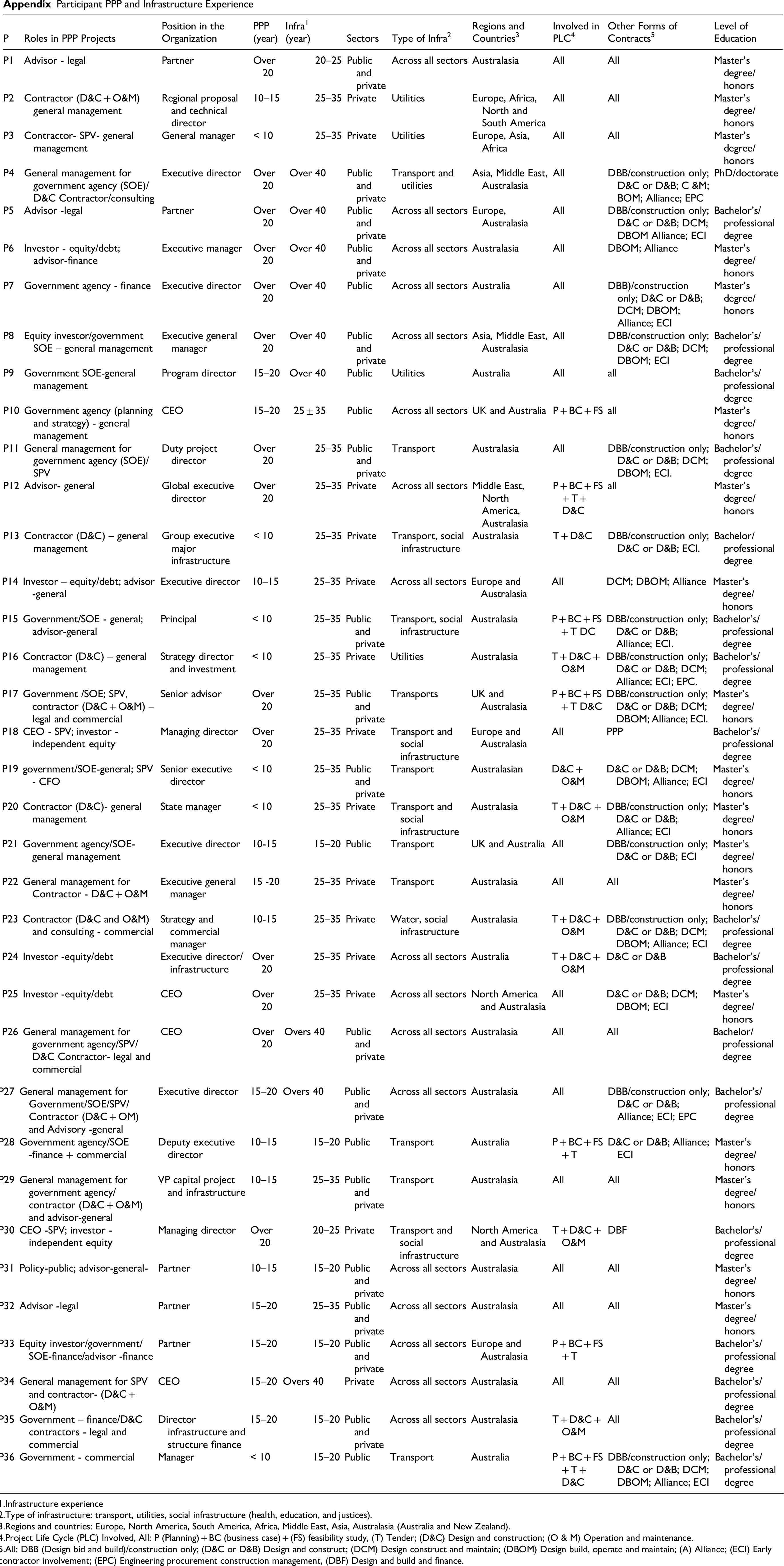
Data was collected from in-depth face-to-face interviews with 36 senior experienced executives (refer to the Appendix at the end of the article for detailed information about the interviewers), using open-ended, nondirective questioning. Thirty-six interviewees were interviewed once, while 10 were interviewed twice, with each interview lasting between 45 minutes and 2 hours, with a total of 46 interviews conducted between October 2018 and October 2019. The audio-recorded data was transcribed, and then NVivo software was used to assist the analysis process. Data analysis followed Gioia et al.’s (2013) systematic approach, developed from the Grounded Theory Method (GTM) of Glaser and Strauss (1967), which we allied with Strauss and Corbin’s (1998) emphasis on abduction. The abductive resources we turned to as we began to make sense of the data were iteratively addressed in the literature review, informed by conversations between an author experienced in SPV practice and an author experienced in theory.
In making the Gioia analysis, a three-step procedure of initial first-order analysis (open coding) was followed by second-order analysis (axial coding). In a third step (selective coding), substantive/theoretical themes (Strauss & Corbin, 1998) were distilled as aggregate dimensions. The first step consisted of identifying the features of the topic denoted by interviewees (Feldman, 1995). This process is both iterative and reflective, involving reading, analyzing, and rereading transcripts in a constant back-and-forth movement between data, codes, and categories. Doing this, using constant comparison (Glaser, 1978), 25 first-order codes (open codes) adhering “faithfully to informant terms” (Gioia et al., 2013, p. 20) were generated. These codes were then arranged tentatively in clusters of similarity and distinction. On the basis of what were now emergent clusters, concepts were grouped with the relations between them leading to theoretical clustering. The research process moved from the subjects’ first-order data to second-order constructs, guided by conceptual meaning achieved through theorizing at the “more abstract, 2nd-order theoretical level of themes, dimensions, and the larger narrative—answering the important question ‘What’s going on here?’ theoretically” (Gioia et al., 2013 p. 16). These constructs resulted in seven concepts (second-order codes or axial codes in the term of Strauss), as the first categories were organized into encompassing thematic categories. The first-order codes and second-order codes were reviewed and examined against the raw data by two authors other than the coder to allow “investigator triangulation” (Flick, 2004, p. 179).
To order interviewees’ quotes narratively can be repetitive and space consuming. Instead, we take some selective but representative quotes and, by ordering them conceptually, provide a synoptic view of key passages (first column in Table 1, i.e., raw data) to support the findings of 25 first-order codes (open codes) (second column in Table 1). Each utterance is assigned a P-code in brackets after the text in the first column. P denotes Practitioner, while the number relates the text to the specific practitioner interviewed. The alphabetic sequences A, B, and so forth, in the left-hand column of Table 1 identify, with each successive evolution, a coherent theme (seven second-order themes—third column of Table 1) abstracted from the raw data. In turn, the alphabetic codes ground the theorization of the aggregate dimensions. In Table 1, the first-order concepts and second-order themes developed from the data are displayed.
The First-Order Concepts and Second-Order Themes Developed from the Raw Data
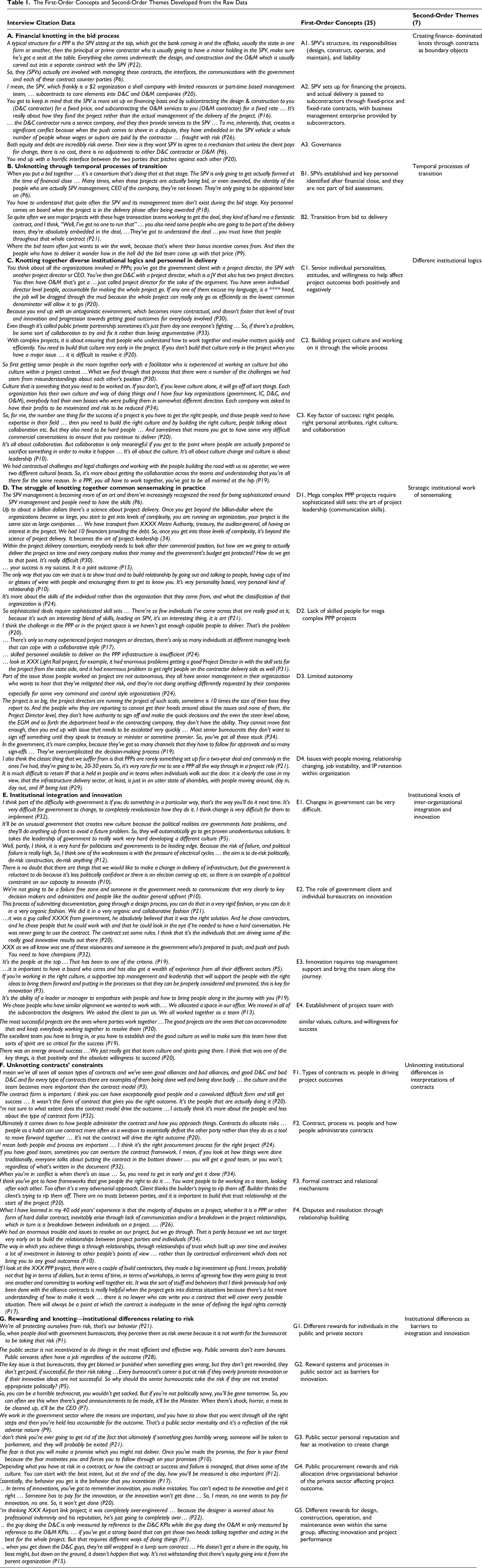
Abstracting from the data, we distinguish between the bid process and the delivery process, as the two significant phases in the processes associated with SPVs. The temporalities that ensue are knotted in various processes that integrate the interorganizational relations involved in the ebbs and flows of project unfolding. A great deal of what transpires in SPVs are consequences of financial strategies designed to minimize risk at the bid stage through its allocation in anticipation of future events unknown.
Findings
First-Order Theme A: Financial Knotting
The statements in Table 1, theme A, denote the way in which, typically, finance-dominated knotting is created. SPV finance is essentially transactional and risk averse. Once the SPV takes over carriage of the project from the bid consortium, the SPV as an independent corporation becomes the responsible entity for project delivery, liable for financial outcomes and performance. The SPV design is intended to achieve objectives including: (1) securing funding to invest in a project; (2) building specific assets within a defined time and budget, as well as managing project-related contracts; (3) operating and maintaining assets to generate cash flow; (4) servicing the debt and distributing dividends for equity investors; and (5) facilitating financial transactions (Liu et al., 2022).
In theory, the project organization SPV should be carefully designed and structured to deliver complex projects which the bid consortium has secured, often costing multibillion dollars. In practice, the SPV is only designed for financing the project, passing responsibility for core deliverables and major risks to design and construction (D&C) and operations and maintenance (O&M) subcontractors through the back-to-back contracts required by project finance; “I mean, the SPV, which frankly is a US$2 organization a shell company with limited resources or part-time based management team … subcontracts to core elements into D&C and O&M companies (P20).” The SPV is largely dependent on the systems and services provided by its subcontractors, secured by hard dollar, fixed contracts for the project delivery and the service provision. As such, a project will always be an ongoing experiment in an open system, liable to disruption of its order as a result of unanticipated events.
First-Order Theme B: Unknotting Bids Through Temporal Processes of Transition
Temporal transitions are central to the processes of SPV project unfolding, especially the differences between what the bid team contracts and what the contracts can deliver. Bids can tangle delivery teams in knots, the untangling of which has a great deal to do with where and how interests are vested in the SPV, as B2 states (see Table 1). During the PPP tender stage, government clients work directly with a bid team which is formed as a consortium from diverse organizations, comprising project sponsors, developers and investors, D&C and O&M contractors, financial advisors/arrangers, as well as technical and legal advisors. Organizational relations are managed by internal nonbinding agreements (e.g., memorandums of understanding [MOUs]). The project company SPV is yet to be established. Key personnel (e.g., CEO) of the SPV are not identified or appointed until the financial close or when the contracts are awarded. Conventionally, government evaluates bids by assessing the price and nonfinancial elements such as team experience, curriculum vitae (CVs), for both main and subcontractors, as well as the track records of the company directly responsible for the project. For PPP projects, government assesses the bid consortium, consisting of subcontractors (D&C and O&M), but signs the contract with the SPV (the main contractor), without assessing its key personnel and management capability, nonetheless, anticipating that the SPV will achieve the agreed results. Although the SPV as an entity is backed up by the parent/sponsor companies of the bid consortium, it is a fully independent corporation separated organizationally and financially from those companies (Liu et al., 2022).
A significant temporal transition occurs between the bid stage and implementation of the project. As events occur, issues for project delivery arise. Contractually, government cannot refer directly to the D&C and O&M companies when issues arise during project delivery as they did during the tender phase. It must deal with the SPV. Smooth transition from project tender to delivery is always challenging. It is this disconnection, as well as the technical and organizational complexity inherent in most PPPs, that introduces additional difficulties for the government in transitioning from dealing with the bid consortium to the SPV. Transition issues are exacerbated because delivery personnel are not usually embedded in the tender process, so any tacit knowledge developed during the bid phase is unlikely to be transferred to the delivery team. Issues also arise from differences between bid and delivery team motivations, with suboptimal results for project delivery. These occur “where the bid team often just wants to win the work, because that's where their bonus incentive comes from. And then the people who have to deliver it wonder how in the hell did the bid team come up with that price (P9).”
First-Order Theme C: Knotting Together Diverse Institutional Logics and Personnel in Delivery
Different interests are knotted in the interpretation of the contacts as boundary objects during the delivery process, distinct from the bid process. The key themes in the data in this section consider the dispositions of the actors involved, stressing the importance of building a non-adversarial project culture of integration between the representatives of the different organizations from diverse institutional logics. The right people and the right culture are consistently argued as vital in achieving interorganizational integration. Otherwise, effective collaboration is unlikely to happen, and the result will be a case of “dog-eat-dog” politics, “because you end up with an antagonistic environment, which becomes more contractual, and doesn't foster that level of trust and innovation and progression towards getting good outcomes for everybody involved.” Fighting, not integration, results among the different organizations involved.
Project culture has different characteristics to culture in permanent organizations, and it can affect the success of project execution. Basic elements of project culture need to be established at a very early stage of a project and worked on constantly throughout the delivery process. Project culture needs to be driven from top management because of cultural complexity. Building project culture requires social symbolic work on organizational, project and personal levels (Lawrence & Phillips, 2019). Rapid and efficient resolution of conflicts and issues need to be achieved, if their effects are not to cascade throughout the project.
First-Order Theme D: The Struggle of Knotting Together Common Sensemaking in Practice
The complexity of managing multibillion-dollar contracts and a complex organization complicates sensemaking in practice. Varying interests are vested at the senior executive level among the SPV board. Some of these might be positive for the project, while others can be negative in terms of “leadership” and turnover of staff. What is good for the project may be accepted at the project level but could be rejected at the executive level of the individual public or private organization. The level of sophistication of the deals actors are charged with enacting at the project or executive level is not always a match to that required to achieve interorganizational integration. Rather than knotting common sensemaking together, sophistication in the project or in the executive levels to which the project actors report can be lacking. There are few really expert project managers with the experience and skills to have mastered the arts of project leadership in managing complexity.
Only limited autonomy is vested in leading the management of complex and multibillion dollars PPP megaprojects, which is one of the reasons why many PPP projects fail. Project directors often lack necessary decision-making authority and line managers in their parent organizations, to whom the project directors report, frequently do not have the ability to understand and make decisions when events arise, due to the complexity and the scale of the project. Decision-making is often escalated to parent organization boards. Delayed, slow decision-making ensues. Therefore, the executive levels outside of the project need to be able to understand the highly liquid nature of the project. “The project is so big, the project directors are running the project of such scale, sometime is 10 times the size of their boss they report to… who they … cannot get their heads around about the issues and none of them, the project director level, they don’t have authority to sign off and make the quick decisions and the even the steer level above, … They cannot move fast enough, then you end up with issue that needs to be escalated very quickly … Most senior bureaucrats, they don’t want to sign off something until they speak to treasury or minister or sometime premier. So, you’ve got all these stuck (P34).”
First-Order Theme E: Institutional Integration and Innovation
Government clients and executive managers play a critical role in project organization for innovation generation and project success. However, government bureaucracies in the public sector are the antithesis of liquid organizations; they are highly routinized, formalized, and standardized. They are configured to report to an apex rather than responding autonomously and flexibly to a changing environment. Moreover, their reflex is to minimize risk and manage budgets, tending to create barriers for innovation. There are many natural impediments for governments to be creative, and one of the factors that makes public sector and government actors nervous is the electoral cycle, the pressure of which is pervasive. The exceptions, those government and public sector actors that do not over-bureaucratize processes, are rare and valued: “it was a guy called XXXX from government, he absolutely believed that it was the right solution. And he chose contractors, and he chose people that he could work with and that he could look in the eye if he needed to have a hard conversation. He was never going to use the contract. The contract set some rules (P20).”
First-Order Theme F: Unknotting Contracts’ Constraints
The previous section dealt with institutional knotting, while this concept deals with how these knots might unravel through the constraints of contracts, if parties choose to use them in this way. Parties in projects can work collaboratively, sharing responsibility for delivery, or use contracts designed to protect parties involved in the projects to enforce parent organization interests. As respondents said: “It wasn't the form of contract that gives you the right outcome. It's the people that are actually doing it (P20). I'm not sure to what extent does the contract model drive the outcome … I actually think it's more about the people and less about the type of contract form (P32).”
First-Order Theme G: Rewarding and Knotting—Institutional Differences Relating to Risk
There can be significant institutional differences between the ways and amounts of reward and remuneration of the different actors in SPVs. There are significant differences between government norms and those of private sector organizations, as well as considerable differences among actors in the latter. In practical terms, these differences are concentrated in different motivations, interests, and aptitudes to risk-taking and innovation between public and private sector actors. Risk and its treatment reside at the heart of the institutional differences between the institutional logics of government and the private sector. In the former, it is best avoided; in the latter, its mastery will be rewarded. In the public sector, risk is seen as something that can be career-ending if not managed properly: “I don't think you're ever going to get rid of the fact that ultimately if something goes horribly wrong, someone will be taken to parliament, and they will probably be exited (P21).”
Within the private sector, there are different rewards for design, construction, operation, and maintenance—even within the same group—affecting innovation and project performance. Fixed-rate contracts lead to risk-averse behaviors that focus on interest-based sectional organizational actions rather than whatever might be best for the project, building a zero-sum mentality into social actions. Each party focuses mostly on their key performance indicators (KPIs). For example, the construction team is employed on fixed time and cost contracts, while the operation and maintenance team receives fixed services fees. These commercial arrangements remove incentives for the teams to work collaboratively because their performance measures differ, whether those two teams come from the same organization or not. Conservative design protects engineering firms and designers from risking their professional indemnity and reputation. If something goes wrong with their design, their professional license, reputation, and professional indemnity insurance are at risk. There is little incentive for designers to be very innovative. Overall, in transactionally dominated relations, minimization of risks is high on the agendas of both government and those on the SPV board. Protecting the finances is the key objective. Innovation is seen as synonymous with risk; hence, innovation should be curtailed as part of the drive to close an inherently open system as much as possible through contractualization of relations. Hence, a conservative risk-averse culture is fostered, premised on transactional interests.
Finally, three third-order abstract concepts (aggregate dimensions as they are termed by Gioia, or selective codes as they are termed by Strauss) resulting from further clustering of the concepts presented in the second-order codes above, provide a deeper characterization of the first-order data in meanings that formed the essential structure of the explanation. First-order codes were then organized into encompassing thematic categories of seven second-order codes (axial codes). The second-order codes, in turn, are subsequently related to three overall aggregate dimensions as seen in Figure 1.
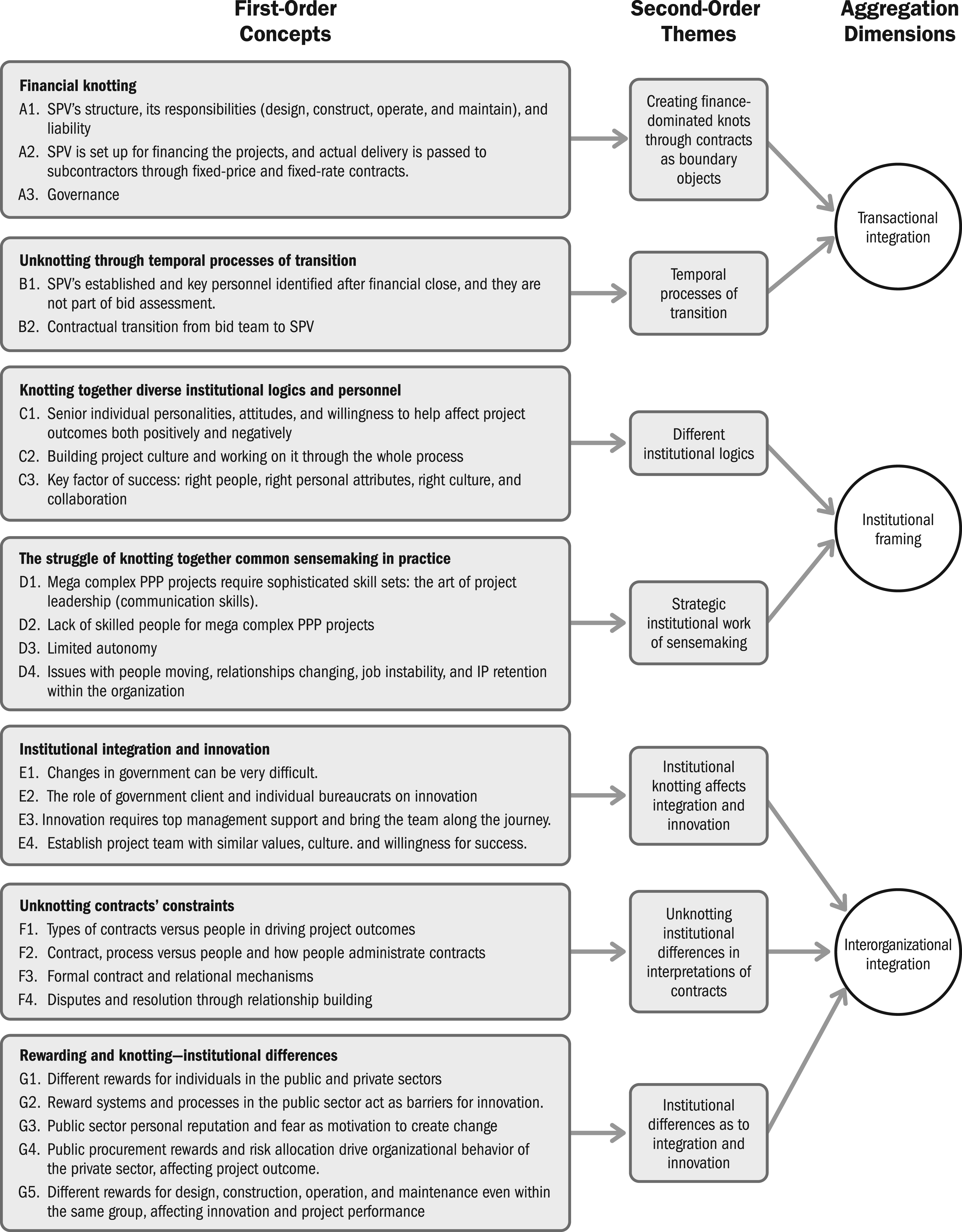
Aggregate elements of SVP project organizing.
Discussion
Transactional Integration
Complex infrastructure project organization is constituted by a multiorganizational knotting. PPPs create a unique SPV temporary project organization structure. Its organizational relations strive to minimize risk in transactions through contract relations. In practice, as respondents iterated, social and relational integration is required to make contractual relations work effectively. The design of the SPV is premised on the requirements of project finance (Liu et al., 2022). As a system integrator, in theory, the SPV should be designed to fulfill organizational functions of control, collaboration, integration, and creativity (Cunha et al., 2022).
In practice, contractual constraints on SPV system integration affect collaborations, typically not enhancing but limiting creativity (Liu et al., 2023). Back-to-back contractual structures require the SPV to pass core business activities and associated risks to D&C and O&M subcontractors, leaving the SPV often little more than a shell company that does not manage day-to-day project delivery activities. Downstream fixed-price D&C and fixed service fee O&M contracts do not facilitate integration between the project delivery and service provision divisions (suborganizations) as there is little incentive for them to collaborate (Liu et al., 2023). The SPV, restricted by stringent contractual provisions, lacks power to integrate D&C and O&M. As the main mechanism governing relationships between key parties, the tight legal contracts’ stipulative definitions are not designed to facilitate collaboration. Although relational governance is important for integration of large complex project delivery through SPVs, almost all PPP contracts lack a “partnership” clause. The project organization SPV is highly constrained organizationally as a result.
The integration of the SPV is premised largely on the contract prepared at tender. The fact that the SPV is formed post-tender means that the bid team neither plays a role in constituting its membership nor a role in the SPV. Interpretation of contracts is influenced by the unfolding of temporal processes and the reward systems of the various actors engaged. While contracts are transactional, the people who enact and administer their processes are a changeable mix over the life of a project. While various interests need to be coordinated and aligned, timely decisions are not in evidence on either the public or private sides of the partnership. The non-contractual elements of trust are frequently lacking in both government and contractual partners because of the centrality of risk for SPV members. Relations are largely transactional rather than system integrative of the different organizations involved.
Institutional Framing in Delivery
Project organization of major PPP projects entails complex interorganizational relations. As Whyte and Davies (2023) observe, where there is a dominant interest in time, cost, and quality at the project level or price at the firm level, integration is hampered by low levels of investment and capabilities. The differences in firm-based reward structures are also contributory factors in diminishing integration, which plays second fiddle to legal framing in allocating financial risk. Public administration’s ethos is premised on regulation. In SPVs, regulation by contracts, in practice, protects financial investors by minimizing financial risk. When institutional knotting unravels, power relations at the board level predominantly strive to protect equity by assigning risk and responsibility transactionally (Liu et al., 2022, 2023).
The accounts analyzed in our study indicate the importance of consideration of the different institutional logics entering into a PPP SPV. Formal contracts link all the different parties to form a transactional system, but they do little to minimize the frictions inherent in processes that contractually integrate diverse interests and risks. Building interorganizational integration is an especially critical process for highly interdependent and complex interorganizational knotting such as SPVs, especially when knots threaten to unravel. While contracts are used as the safeguard to protect parties involved in the project, they can also make projects fail.
SPVs strive to achieve organizational synchronization (Liu et al., 2022) through structuration by contracts (such as back-to-back, fixed price and fee contracts) based on the requirements of project finance for risk management. These contracts, as boundary objects relating diverse actors’ interests, inhibit interorganizational integration because they rely on senior management positions to integrate diverse interests that risk allocations bind transactionally. PPP project organizing is dynamic, conjoining different sensemaking, especially in terms of cost implications and responsibilities, one consequence of which is that contractual interpretations in situ tend not to be “black letter” law, except when relations break down and legal disputation arises.
SPVs are arenas hosting diverse institutional frames. A “considerable amount of institutional entrepreneurship” is required to create coherent and well-developed institutional arrangements and contexts as a “new order” (Biesenthal et al., 2018, p. 49) among disparate organizational and institutional actors when knotting unravels. Conflicts will arise over the course of the project, especially when governments change. Key senior personnel at the board, management, and delivery levels “must learn to change, organize and manage. These agents must be capable of influencing the context in which projects are carried out rather than their agency being determined by these contexts” (Biesenthal et al., 2018, p. 47). Under extremely rigorous contracts, the latter agency prevails to the detriment of interorganizational integration (Liu & Sainati, 2025).
Interorganizational Integration in Delivery
In PPPs, multiple organizations have distinct subcultures associated with horizontal and vertical differentiation, creating complexity and difficulty for interorganizational integration (Beer et al., 1990; Bresnen & Marshall, 2000). As Biesenthal et al. (2018, p. 51) suggest: “All projects are microcosms of cultures … Not only is there a multiplicity of experiencers with a multiplicity of experiences; there are also the unique contexts of the emergent cultures of the present project …”. The nature of project organizing, as people move in and out of various projects implies fluid career paths (Clegg & Cunha, 2019), with SPVs being liquid in terms of personnel turnover. SPVs focus changes at different stages of the project life cycle, as do human resources.
Interorganizational integration is rarely specifically attended to outside of alliancing contracts (Klakegg et al., 2021; Pitsis et al., 2003; Clegg et al., 2002). Project organizations operate as an open and fluid system around a basic architecture of social and technical elements, constrained by political, economic, contractual, financial, and environmental factors. Team members do not “belong” to an SPV but to their host organizations. Short-term or highly contingent contracts and volatility can lead to low commitment and loyalty to the SPV organization (Clegg & Cunha, 2019). Hence, interorganizational integration is critical if the ebb and flow of project temporality is to be managed. The ability of senior key personnel (leaders, board members, and managers) in the project organization to empathize with team members and guide them in collective organizational sensemaking (Weick et al., 2009) is fundamental for developing employees’ solidarity, contributing to productivity and performance.
The capabilities of key personnel are highly significant for SPVs. SPV power relations among different stakeholders are complex and imbalanced (Liu et al., 2022) and do little to create collaborative forms of organization in the face of unseen events. Project financiers, as the source of the key resource of capital, are central in project organization SPV power plays (Liu et al., 2022). The power imbalance that financiers command, through control of capital, can channel many potential issues. The politics of these issues significantly affect collaborative processes (Liu & Sainati, 2025) by being vulnerable to manipulation by those in relatively powerful relational positions (Bajwa et al., 2018). The “difference in relative power” has an “impact on the willingness to resolve conflicts with negotiation,” leading to a tendency to independent pursuit of goals (Bajwa et al., 2018, p. 682). SPV personnel need a willingness to collaborate to resolve conflicts, develop communication, and influence skills and capabilities conducive to building positive, trusting relationships. Key personnel may adopt a collaborative approach and influence integration through building social, cultural, and symbolic capital. To the extent that they do so, it is by minimizing the transactional constraints of the contract structure in practice.
The design of SPVs is overdetermined by contracts to protect capital rather than benefit the project. The main mechanism for the focus on system integration is the complex bundling of contracts. Nonetheless, project actors have vertical relations with parent organizations and horizontal relations with partner companies. Team members within project organization normally have limited contact with senior or line management of their parent organizations and are based on-site, working with many team members from other firms. The on-site decentralized decision-making and delegated financial control of organizational arrangements makes the potential for loose coupling and the advantages afforded by relative autonomy atypical of SPVs. When conflict arises related to changes in contractual details that are heavily policed, SPV autonomy is very limited. In practice, approvals from those to whom they report in the parent organization, who are far less familiar with the project, are required for changes. If the issue is beyond the latter’s authority, it must be escalated to the board and risk committee for approval. Any delay risks financial loss affecting all parties involved. These features of the SPV process lessen interorganizational integration.
Question Arising: How Might the Integration of SPV Organization Design Be Improved?
We asked the question: “How might SPVs organization design be improved?” Our answer discussed knotting transactional with interorganizational integration to configure these components in a coherent way. How this is done is contingent on the characteristics of specific projects, such as level of complexity, uncertainty, and constraints (social, environmental, financial, political, etc.) (Remington & Pollack, 2007). Effective organizing occurs informally, as well as in formal meetings, requiring a balance between hard and soft elements (Crawford & Pollack, 2004) in which there is no clear and stable boundary differentiating organizational activities (Cunha et al., 2022). Project organizations require a design that allows inter-organizational integration to flourish (Cunha et al., 2022), rather than inhibiting it through formally legalizing relations through contract. Formal contracts, as boundary objects, can fulfill a bridging function rather than being roadblocks, inhibiting collaboration between organizations by reinforcing boundaries.
Recent comparative considerations of more and less successful PPP project examples drawn from northern European practices informed by social democratic considerations are particularly helpful in identifying some of the best boundary maintenance practices that facilitate success through interorganizational integration. In Finland, public procurement legislation based on European Union directives is augmented by a realization that “lifecycle contracts as a complex and long-term contractual arrangement require particular emphasis on the co-operation and collaboration of the actors involved” (Vuorinen et al., 2024, p. 129). The legislation aims to guide actors in understanding “each other’s objectives and aims, to align these objectives, and to establish trust, openness, and loyalty” (Vuorinen et al., 2024, p. 129). Collaborative delivery mechanisms, such as project alliances are widely used, sponsored by the Finnish Transport Infrastructure Agency. “This shift in thinking, particularly promoted by the public clients, can also be expected to influence the attitude of actors toward the long-term cooperation required for PPPs. The use of integrated models of delivery and multi-actor contracts have also promoted tighter collaboration and use of integrative practices among the key actors, which, in turn, has decreased the disintegration of construction supply chains seen during the 2000s” (Vuorinen et al., 2024, p. 131).
Complex PPP projects combine diverse interests and institutional logics. System integration is achieved through contractual mechanisms that function as boundary objects related to financial arrangements. The extent to which these boundary objects are “mechanical” or accompanied and buttressed by “organic elements,” in Burns and Stalker’s (1961) terms, is contingent on project particulars. Some contexts, embedded in northern European social democratic norms, show ways of establishing this contingency as an imperative. In its absence, diverse institutional logics have greater difficulty in being knotted together and interorganizational integration suffers as a consequence.
Whether contractual stipulations “freeze” the possibilities of innovation or serve to enhance collaboration depends on how contracts, systems, and processes are configured and managed. When the contract becomes a boundary object for litigation, a toxic culture can result, inhibiting collaboration and integration. Selecting and structuring leadership teams and governance boards focusing on both transactional systems and interorganizational integration to create a collaborative project community, as well as careful selection of professionals when forming project teams through the project life cycle, is fundamental. The clarity brought by a dominant supra-organizational goal for shared value is critical to integrate a plurality of interests (Berti et al., 2021). Using a contract as a weapon to defeat the other party creates a toxic culture. SPVs rely on many other organizations to provide resources and services such as finance, design, construction, operation, and maintenance, while these organizations also depend on SPVs to survive. Designing temporary organizational systems is a dynamic process of design, development, and redesign (Zani et al., 2024). Developing integration across the project ecology is vital.
Conclusion
In this study, SPVs are represented as an interorganizational relation created through institutional knotting. Highly constrained contractual organizing is a distinguishing feature of PPPs. Systems integration is framed by transactional interpretations of contracts. According to the accounts of our interviewees, while contracts frame many aspects of system integration, interorganizational integration is managed less well. It is, perhaps, not surprising that there are many failed infrastructure PPP projects (Wang et al., 2021). Despite PPPs being a major mechanism for project delivery, project organizational studies of their design for inter-organizational integration are relatively sparse, given that delivery outcomes have significant economic and social benefits or costs. An SPV is a complex hybrid organizational form. Its design, and the larger PPP network of interorganizational relationships in which it is embedded, have largely been constructed at the behest of debt and equity interests, neglecting both wider ecosystem interests and benefits. Project organizations require a design that allows interorganizational integration to flourish (Cunha et al., 2022), rather than inhibiting it through formally legalizing relations through contract. Formal contracts, as boundary objects, can fulfill a bridging function rather than being roadblocks, inhibiting collaboration between organizations by reinforcing boundaries. In a nutshell, the absence of this bridging is constantly circled in the actors’ accounts as the problematic feature of SPVs.
Paradoxically, the contractual frameworks designed to create system integration on a transactional basis serve to undercut the interorganizational integration necessary for the design to work more effectively. Remedying this is significant because PPPs are promoted for tackling grand challenges, such as climate change, energy shortages, food, and water issues. Research of SPV project organizational design is significant. Designing an SPV is not only a matter of project finance structure but also interorganizational integration. More attention should be paid to this aspect when considering SPV project organization. Theoretically, the discussion of interorganizational integration in this article could be integrated into discussions of project governmentality (Clegg & Ninan, 2023). Transactional system integration is undoubtedly important but should not be stressed as if it were the case that excellent project management depends simply on the contract; as Whyte and Davis (2021) acknowledge, there is more that is social to processes of integration than is usually implied. One major contribution of this article is to make that social fact explicit.
There are other contributions. The article applied Lockwood’s (1964) significant discussion of social and system integration to project and PPP contexts in which discussion has been dominated by transactional system integration, conceived in either in mechanical, technical terms or those of economic transactions. Social integration has been alluded to by Whyte and Davies (2021) but not discussed explicitly. In this context we introduced the concept of interorganizational integration from organization theory and concepts from social theory, notably that of “liquid organization” (Clegg, 2024). Project organization is not only temporary but liquid as it transitions through time and project phases, such as from bid to delivery, resulting in constant human resources changes as well as social relations forming and reforming within project organization.
Knotting is achieved through contractual documents that we positioned as “boundary objects” (Star & Griesemer, 1989), a term derived from a synthesis between two researchers, one of whom, Griesemer was embedded in the philosophy of science, while Star fused sociological understanding with a focus on science and technology studies and information science. We have followed in their vein in our fusion of sociological and organization approaches to the analysis of a specific type of project management, focusing on its temporality as it is knotted and unknotted between organizational actors and interpretations of these boundary objects in processes of project disintegration/integration. Using these concepts from sociology and organization theory extends understanding of the management of projects though an interdisciplinary lens by seeing them as temporary, liquid flows channeled by contractual documents that can be ties that bind projects in interpretative knots of one kind or another. By adapting social and organization theory for project management research, we have enabled project management scholars to broaden their conversation with other disciplines (Locatelli et al., 2023).
Future research should systematically sample major infrastructure SPV projects that are regarded by national experts as more or less successful. Such framing is important because sampling from either one or the other is hardly representative. Clegg et al. (2024) discuss the importance of interorganizational integration for the success of projects that were expert-nominated as more successful. What is necessary is to research not only the presence of such processes in successful cases but also to discover if they are absent in less successful cases. Based on the research cases reported in Clegg et al. (2024), it would be possible to compile an indicative checklist of indicators of integration and compline data on the extent of their presence or absence across different phases of these major infrastructure SPV projects. Using a national comparative perspective would be essential.
Footnotes

Notes
Author Biographies
Participant PPP and Infrastructure Experience
| P | Roles in PPP Projects | Position in the Organization | PPP |
Infra
1
|
Sectors | Type of Infra 2 | Regions and Countries 3 | Involved in PLC 4 | Other Forms of Contracts 5 | Level of Education |
|---|---|---|---|---|---|---|---|---|---|---|
| P1 | Advisor - legal | Partner | Over 20 | 20–25 | Public and private | Across all sectors | Australasia | All | All | Master’s degree/honors |
| P2 | Contractor (D&C + O&M) general management | Regional proposal and technical director | 10–15 | 25–35 | Private | Utilities | Europe, Africa, North and South America | All | All | Master’s degree/honors |
| P3 | Contractor- SPV- general management | General manager | < 10 | 25–35 | Private | Utilities | Europe, Asia, Africa | All | All | Master’s degree/honors |
| P4 | General management for government agency (SOE)/D&C Contractor/consulting | Executive director | Over 20 | Over 40 | Public and private | Transport and utilities | Asia, Middle East, Australasia | All | DBB/construction only; D&C or D&B; C &M; BOM; Alliance; EPC | PhD/doctorate |
| P5 | Advisor -legal | Partner | Over 20 | Over 40 | Public and private | Across all sectors | Europe, Australasia | All | DBB/construction only; D&C or D&B; DCM; DBOM Alliance; ECI | Bachelor’s/professional degree |
| P6 | Investor - equity/debt; advisor-finance | Executive manager | Over 20 | Over 40 | Public and private | Across all sectors | Australasia | All | DBOM; Alliance | Master’s degree/honors |
| P7 | Government agency - finance | Executive director | Over 20 | Over 40 | Public | Across all sectors | Australia | All | DBB)/construction only; D&C or D&B; DCM; DBOM; Alliance; ECI | Master’s degree/honors |
| P8 | Equity investor/government SOE – general management | Executive general manager | Over 20 | Over 40 | Public and private | Across all sectors | Asia, Middle East, Australasia | All | DBB/construction only; D&C or D&B; DCM; DBOM; ECI | Bachelor’s/professional degree |
| P9 | Government SOE-general management | Program director | 15–20 | Over 40 | Public | Utilities | Australia | All | all | Bachelor’s/professional degree |
| P10 | Government agency (planning and strategy) - general management | CEO | 15–20 | 25 ± 35 | Public | Across all sectors | UK and Australia | P + BC + FS | all | Master’s degree/honors |
| P11 | General management for government agency (SOE)/SPV | Duty project director | Over 20 | 25–35 | Public and private | Transport | Australasia | All | DBB/construction only; D&C or D&B; DCM; DBOM; ECI. | Bachelor’s/professional degree |
| P12 | Advisor- general | Global executive director | Over 20 | 25–35 | Private | Across all sectors | Middle East, North America, Australasia | P + BC + FS + T + D&C | all | Master’s degree/honors |
| P13 | Contractor (D&C) – general management | Group executive major infrastructure | < 10 | 25–35 | Private | Transport, social infrastructure | Australasia | T + D&C | DBB/construction only; D&C or D&B; ECI. | Bachelor/professional degree |
| P14 | Investor – equity/debt; advisor -general | Executive director | 10–15 | 25–35 | Private | Across all sectors | Europe and Australasia | All | DCM; DBOM; Alliance | Master’s degree/honors |
| P15 | Government/SOE - general; advisor-general | Principal | < 10 | 25–35 | Public and private | Transport, social infrastructure | Australasia | P + BC + FS + T DC | DBB/construction only; D&C or D&B; Alliance; ECI. | Bachelor’s/professional degree |
| P16 | Contractor (D&C) – general management | Strategy director and investment | < 10 | 25–35 | Private | Utilities | Australasia | T + D&C + O&M | DBB/construction only; D&C or D&B; DCM; Alliance; ECI; EPC. | Bachelor’s/professional degree |
| P17 | Government /SOE; SPV, contractor (D&C + O&M) – legal and commercial | Senior advisor | Over 20 | 25–35 | Public and private | Transports | UK and Australasia | P + BC + FS + T D&C | DBB/construction only; D&C or D&B; DCM; DBOM; Alliance; ECI. | Master’s degree/honors |
| P18 | CEO - SPV; investor - independent equity | Managing director | Over 20 | 25–35 | Private | Transport and social infrastructure | Europe and Australasia | All | PPP | Bachelor’s/professional degree |
| P19 | government/SOE-general; SPV - CFO | Senior executive director | < 10 | 25–35 | Public and private | Transport | Australasian | D&C + O&M | D&C or D&B; DCM; DBOM; Alliance; ECI | Master’s degree/honors |
| P20 | Contractor (D&C)- general management | State manager | < 10 | 25–35 | Private | Transport and social infrastructure | Australasia | T + D&C + O&M |
DBB/construction only; D&C or D&B; Alliance; ECI | Master’s degree/honors |
| P21 | Government agency/SOE- general management | Executive director | 10-15 | 15–20 | Public | Transport | UK and Australia | All | DBB/construction only; D&C or D&B; ECI | Master’s degree/honors |
| P22 | General management for Contractor - D&C + O&M |
Executive general manager | 15 -20 | 25–35 | Private | Transport | Australasia | All | All | Master’s degree/honors |
| P23 | Contractor (D&C and O&M) and consulting - commercial | Strategy and commercial manager | 10-15 | 25–35 | Private | Water, social infrastructure | Australasia | T + D&C + O&M | DBB/construction only; D&C or D&B; DCM; DBOM; Alliance; ECI | Bachelor’s/professional degree |
| P24 | Investor -equity/debt | Executive director/infrastructure | Over 20 | 25–35 | Private | Across all sectors | Australia | T + D&C + O&M | D&C or D&B | Bachelor’s/professional degree |
| P25 | Investor -equity/debt | CEO | Over 20 | 25–35 | Private | Across all sectors | North America and Australasia | All | D&C or D&B; DCM; DBOM; ECI | Master’s degree/honors |
| P26 | General management for government agency/SPV/D&C Contractor- legal and commercial | CEO | Over 20 | Overs 40 | Public and private | Across all sectors | Australasia | All | All | Bachelor/professional degree |
| P27 | General management for Government/SOE/SPV/Contractor (D&C + OM) and Advisory -general | Executive director | 15–20 | Overs 40 | Public and private | Across all sectors | Australasia | All | DBB/construction only; D&C or D&B; Alliance; ECI; EPC | Bachelor’s/professional degree |
| P28 | Government agency/SOE -finance + commercial | Deputy executive director | 10–15 | 15–20 | Public | Transport | Australia | P + BC + FS + T | D&C or D&B; Alliance; ECI | Master’s degree/honors |
| P29 | General management for government agency/contractor (D&C + O&M) and advisor-general | VP capital project and infrastructure | 10–15 | 25–35 | Public and private | Transport | Australasia | All | All | Master’s degree/honors |
| P30 | CEO -SPV; investor - independent equity | Managing director | Over 20 | 20–25 | Private | Transport and social infrastructure | North America and Australasia | T + D&C + O&M | DBF | Bachelor’s/professional degree |
| P31 | Policy-public; advisor-general- | Partner | 10–15 | 15–20 | Public and private | Across all sectors | Australasia | All | All | Master’s degree/honors |
| P32 | Advisor -legal | Partner | 15–20 | 25–35 | Public and private | Across all sectors | Australasia | All | All | Master’s degree/honors |
| P33 | Equity investor/government/SOE-finance/advisor -finance | Partner | 15–20 | 15–20 | Public and private | Across all sectors | Europe and Australasia | P + BC + FS + T | Bachelor’s/professional degree | |
| P34 | General management for SPV and contractor- (D&C + O&M) | CEO | 15–20 | Overs 40 | Private | Across all sectors | Australasia | All | All | Bachelor’s/professional degree |
| P35 | Government – finance/D&C contractors - legal and commercial | Director infrastructure and structure finance | 15–20 | 15–20 | Public and private | Across all sectors | Australasia | T + D&C + O&M | All | Bachelor’s/professional degree |
| P36 | Government - commercial | Manager | < 10 | 15–20 | Public | Transport | Australia | P + BC + FS + T + D&C | DBB/construction only; D&C or D&B; DCM; DBOM; Alliance; ECI | Bachelor’s/professional degree |
Infrastructure experience
Type of infrastructure: transport, utilities, social infrastructure (health, education, and justices).
Regions and countries: Europe, North America, South America, Africa, Middle East, Asia, Australasia (Australia and New Zealand).
Project Life Cycle (PLC) Involved, All: P (Planning) + BC (business case) + (FS) feasibility study, (T) Tender; (D&C) Design and construction; (O & M) Operation and maintenance.
All: DBB (Design bid and build)/construction only; (D&C or D&B) Design and construct; (DCM) Design construct and maintain; (DBOM) Design build, operate and maintain; (A) Alliance; (ECI) Early contractor involvement; (EPC) Engineering procurement construction management, (DBF) Design and build and finance.