




Abstract
The emergence of Industry 5.0, with its emphasis on human-centric, sustainable, and resilient forms of value creation, underscores the need for a more nuanced understanding of productivity that extends beyond traditional measures of efficiency and output. This study explores what defines project management productivity by analyzing 55 interviews with client-side project management practitioners. Using prototype theory, we identify 21 characteristic cues, categorized as lead and lag indicators, and hygiene and motivator factors. Our findings suggest that productivity is a context-dependent, multidimensional construct. This research contributes to defining and measuring project management productivity within complex organizational settings.
Keywords
Introduction
Current productivity metrics fail to account for the complex and collaborative nature of project work (Bortoluzzi et al., 2018). As organizations shift from the efficiency-driven metrics of Industry 4.0 to the human-centric and sustainability-oriented principles of Industry 5.0 (Barata & Kayser, 2023), this gap becomes increasingly significant. Recent scholarship on Industry 5.0 suggests a redefinition of productivity from automation-driven efficiency to a human-centered construct. Ivanov (2023) defines Industry 5.0 as an integration of resilient, sustainable, and human-centric technologies, organizational concepts, and management principles for designing adaptable and viable value-creation systems. Building on this foundation, this article provides an empirical grounding for how productivity may manifest within an Industry 5.0 context, where productivity cues such as engagement, communication, clarity of direction, decision-making, and collaboration underpin viable project environments. These cues reflect Ivanov’s multilevel framing of Industry 5.0—spanning organizational, technological, and societal domains—and align with the broader Society 5.0 discourse, which positions human-centered innovation as the capacity to deliver sustainable and socially valuable outcomes rather than merely technical efficiency (Carayannis & Morawska-Jancelewicz, 2022).
It would be hard to argue that any project would benefit from being less productive. This desire for increased productivity is evident in the tendency of organizations to base their project management decisions on anticipated productivity improvements (Kier et al., 2023; Blais et al., 2023; Thomas & Mullaly, 2008; Lappe & Sprang, 2014). Productivity is frequently cited as a key success factor in sustainable project management (Martens & Carvalho, 2016), while sustainable practices have been recognized for their potential to improve productivity in projects (Luo et al., 2024). Improvements in productivity can lead to reduced project costs or shortened project duration, allowing organizations to benefit from cost savings associated with shorter time to market. At the business level, project management functions and project management offices (PMOs) are being held to account to measure their productivity as a way of demonstrating performance and improvement (Crawford & Pollack, 2021). However, productivity in the context of project management is far from a simple concept.
Historically, our understanding of productivity is grounded in Industry 2.0 (Taylor, 1911), based on manual, or blue-collar work, where output could be easily measured and optimized through standardized processes. The most common definitions of productivity are grounded in the economic literature, considering productivity to be the ratio of output to input in a system (Caves et al., 1982; Lorsch & Abdou, 1994; Dawe & Dobermann, 1998; Misterek et al., 1992; Sakamoto, 2010; Hanushek & Ettema, 2017). The productivity of manual workers has been studied extensively, and this stream of research has led to improvements in levels of efficiency, quality, and standardization (Taylor, 1911; Drucker, 1999), particularly in areas such as manufacturing.
However, as industries have shifted toward knowledge-driven production and project work, and with the advent of Industry 3.0 (Drucker, 1999), discussion of productivity has increasingly focused on the productivity of knowledge workers, who now represent the largest segment of the workforce in developed countries (Drucker, 2013). While some aspects of project management are amenable to measurement via simple input:output ratios, these measures are only useful for simple and standardized tasks. Most aspects of project management, as opposed to the simple and standardized tasks that project managers might contract on their projects, are less amenable to simple measurement (Kanski & Pizon, 2023). Project management, as a form of knowledge work, is characterized by a high degree of autonomy, unpredictability, novelty, and is primarily concerned with developing and using knowledge (Bosch-Sijtsema et al., 2009; Heerwagen et al., 2004). Productivity in Industry 4.0 shifted focus from how hard individuals work to how efficiently they interact with machines and digital systems to create value. Projects exist in open systems, where relevant inputs may be a matter of navigating a complex context, and outputs may be best considered in terms of relational value and long-term benefit. Given this complexity, how then can we know whether our project management is becoming more or less productive? With an Industry 5.0 lens, how do we understand and measure project management productivity in terms of resilience, innovation, and sustainability.
In this article, we aim to develop an understanding of project management productivity. We start with a tentative definition of project management productivity as a multidimensional construct shaped by both quantifiable metrics (e.g., cost, schedule adherence) and qualitative cues (e.g., engagement, decision-making, clarity of direction). While this initial definition is imprecise, the purpose of the article is to come to an understanding of the concept of productivity, concluding with a definition appropriate for an Industry 5.0 context.
Drawing on prototype theory (Rosch, 1973, 1978), we frame productivity as a concept that is defined by characteristic cues, which better reflect the complex, relational nature of project work. This stands in contrast to linear models such as project maturity frameworks (Fabbro & Tonchia, 2021), which assume standardized pathways to improvement. While maturity models typically evaluate capabilities against predefined benchmarks or levels, our approach recognizes that productivity is context-dependent and may emerge differently across project environments, even in the absence of formalized maturity.
This study is based on individual project practitioners’ perceptions of project management productivity. These practitioners’ perceptions naturally extend to aspects of team and organizational dynamics, discussing the interconnected elements of portfolio, program, project, and project management office activity that impact project management productivity. As such, we adopt an organizational project management perspective (Müller et al., 2019), acknowledging that project management phenomena may be best understood in the context of a broader network of activity across an organization, instead of treating project management as a discrete and closed system. A workable definition of project management productivity should refer to the organizational context in which projects are managed and the various groups that enact their management.
This article draws on data from 55 semistructured interviews with practitioners working on major capital-intensive projects to explore the question: What is project management productivity?
Literature Review
Knowledge Worker Productivity
Existing productivity measures are limited to a predominantly economic or operational perspective, largely based on an input to output ratio and other metrics of efficiency (Lorsch & Abdou, 1994; Dawe & Dobermann, 1998; Misterek et al., 1992; Drucker, 2013; Sakamoto, 2010; Hanushek & Ettema, 2017). There is an enduring debate within the economics literature about the best way to measure productivity (Malmquist, 1953; Caves et al., 1982; Fare et al., 1996). This includes movement from using single metrics for inputs and outputs, to multifactor productivity, and total-factor productivity, which aims to measure all inputs taken together (Dawe & Dobermann, 1998). Productivity measures can account for numbers of workers, time, money, or energy consumed producing results and materials, among others. Examples of outputs can include production volume, sales volume (Sakamoto, 2010), or customers served (Linna et al., 2010). While these metrics are at the center of measuring the productivity of blue-collar work, they are secondary concerns in understanding the productivity of project management. These efficiency-based metrics originate from research on manual—or blue-collar—work but are insufficient for measuring project management as a kind of knowledge work.
In understanding knowledge worker productivity, it is important to distinguish between knowledge work and knowledge management. Knowledge work is a kind of activity. Knowledge workers engage in knowledge work. This contrasts with the knowledge of individuals or organizations, which may be understood in terms of knowledge management. Our focus in this article is on the productivity of knowledge workers in the project environment. Rather than treating knowledge as a static organizational asset to be captured and systematized through managerial tools and frameworks, we adopt a practice-based perspective that highlights the situated, relational, and interpretive nature of knowledge work. Our focus is on project practitioners whose productivity is shaped by their use of conceptual reasoning, creativity, analytical judgment, and interpersonal skill (Newell et al., 2009; Hetemi et al., 2022), rather than by predefined policies, procedures, or output metrics.
We argue that knowledge work is at the heart of the transformation from Industry 4.0 to Industry 5.0. It is central to achieving the values of Industry 5.0, which prioritize sustainability, human-centricity, and resilience (Lovrenčić, 2023). While Industry 4.0 focused on automation, efficiency, and machine-to-machine communication, Industry 5.0 recognizes the irreplaceable cognitive, creative, and ethical contributions of workers (Nahavandi, 2019; Xu et al., 2021). In this context, knowledge workers are essential in shaping more adaptive, responsible, and human-centered systems (Bednar & Welch, 2020; Lovrenčić, 2023). Since much of the work done in projects is knowledge work (Hetemi et al., 2022), defining and measuring productivity in project-based knowledge work is vital to realizing the ambitions of Industry 5.0.
Davenport and Prusak (2000) define knowledge workers as those who create knowledge or those for whom the use of knowledge is central to their work. In this context, knowledge work is defined as creating, applying, sharing, and acquiring knowledge, and is best understood as discretionary behavior, meaning workers choose how to perform based on their own expertise and judgment (Kelloway & Barling, 2000). This definition was further expanded by Davenport (1999) to include individuals with a high level of education or expertise whose work mainly involves the creation, distribution, or application of knowledge. According to Drucker (1999, 2013), productivity of knowledge workers is particularly difficult to measure because it is primarily concerned with not only defining the task but also delivering optimal, if not maximum, quality. He calls for new frameworks and tools that can adequately assess the productivity of knowledge workers, considering the unique demands and outputs of their work.
The challenges of understanding knowledge worker productivity are endemic. Maxwell and Forselius (2000) suggest that the measures of productivity vary depending on the specific field of work. Discussing public sector productivity measures, Linna et al. (2010) comment on the general dissatisfaction with input and output measures, suggesting the need to focus on interpreting value and outcomes. In the context of education productivity, Hanushek and Ettema (2017, p. 167) were challenged by the task of defining relevant inputs and outputs that could be sensibly used as productivity measures: “Not surprisingly, this is a much more difficult task in education than it is in manufacturing.” Abramo and D’Angelo (2014) found that proxy measures might be most effective when measuring researcher productivity, rejecting simple input and output measures.
Khatri et al. (2023) do not examine productivity directly, but their study on hybrid work agility offers useful insights into how knowledge workers respond differently to leadership and knowledge access. Focusing on post-pandemic, hybrid work environments, they show that knowledge-oriented leadership and knowledge acquisition do not affect all workers in the same way. Using a segmentation approach, the authors identify distinct groups of knowledge workers with different patterns of agility. This study highlights that knowledge work is not uniform. How individuals adapt and respond to support systems varies, which has implications for how productivity might be understood in knowledge-intensive project settings.
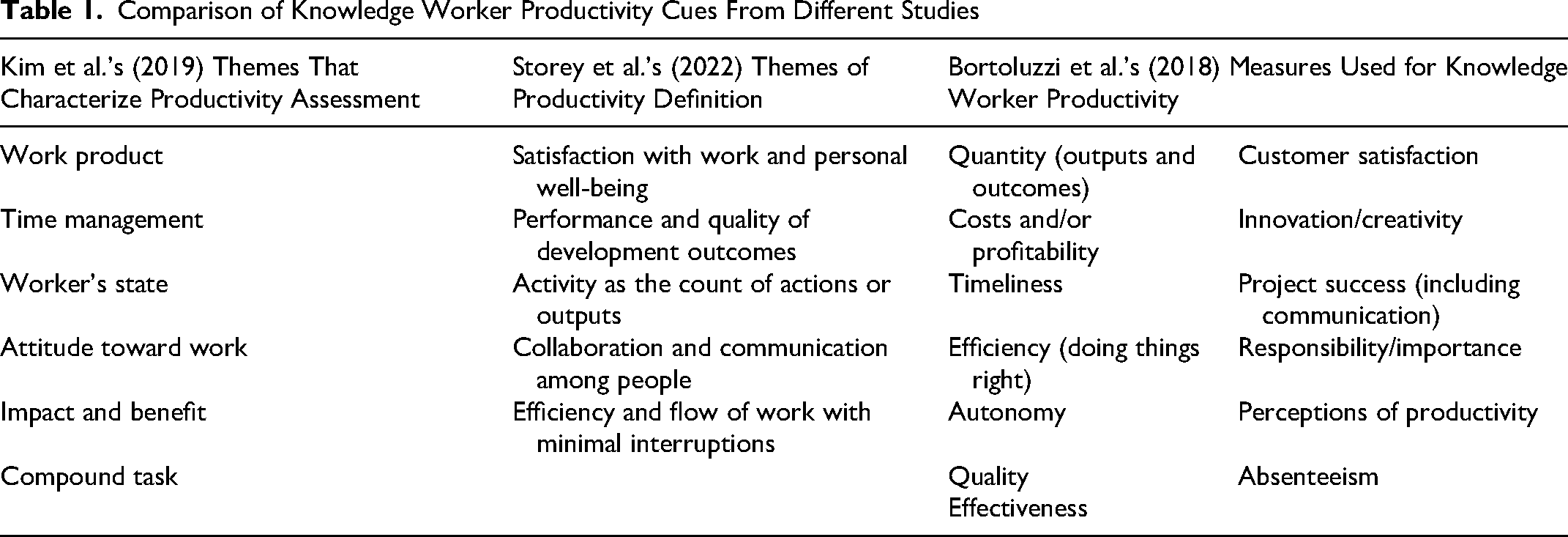
Agile approaches are seen as beneficial for improving productivity in knowledge workers through continuous change and enhanced collaboration (Lindvall et al., 2004; Cardozo et al., 2010), though their effectiveness depends on environmental compatibility (Chow & Cao, 2008; Nerur et al., 2005). In agile open-source settings, Scott et al. (2020) measure productivity using two iteration-based metrics: individual velocity (the sum of completed story points per developer per iteration) and focus factor (the ratio of completed work to total work planned for an iteration). Their analysis of 387 iterations across seven open-source projects shows that high team stability and low developer turnover are closely associated with increased productivity, as reflected in higher velocity scores. Despite existing research on productivity in agile project management, this concept remains poorly defined. As Melo et al. (2013) write: “We found that the concept of productivity in agile projects is not universally defined and differs depending on one’s role and perspective” (p. 6). Consequently, knowledge worker productivity can be a matter of perception as much quantification (Melo et al., 2013). Kim et al. (2019, p. 1) found that knowledge workers “… interleaved multiple facets when assessing their productivity …” In the absence of objectively quantifiable measures, Bortoluzzi et al. (2018) found that self-assessed measures of perceived productivity are widely used and have the flexibility to capture intangible aspects of the concept. Review of aspects of knowledge worker productivity by three different studies reveals the subjectivity in many factors used to measure, or understand, knowledge worker productivity (Table 1).
Comparison of Knowledge Worker Productivity Cues From Different Studies
Industry 5.0 significantly broadens the conceptualization of productivity in knowledge-intensive project environments by shifting away from purely economic and operational metrics toward other considerations including human-centricity, resilience, and sustainability (Ivanov, 2023; Rijwani et al., 2025). Unlike Industry 4.0, which primarily emphasized technological efficiency and optimization of production (Kanski & Pizon, 2023), Industry 5.0 places humans and their collaboration with technology at the center of productivity discussions (Torkanfar et al., 2025; Ivanov, 2023). In project settings, this means productivity is no longer assessed solely by output volume or efficiency ratios but increasingly through the effectiveness of human-centered interactions, team well-being, creative capabilities, and the resilience of project teams to rapidly adapt to unforeseen disruptions (Nahavandi, 2019; Barata & Kayser, 2023). Sustainability considerations, such as energy-efficient project practices and life cycle impact of project outcomes, further reshape productivity assessments to include long-term environmental and societal value rather than short-term economic gains alone. This expanded view aligns productivity measurement in project-based knowledge work with broader organizational and societal outcomes, offering a more holistic, realistic, and nuanced understanding suitable for contemporary project management challenges.
Project Management as Knowledge Work
The challenge of understanding productivity is prominent in project work, where the knowledge-intensive nature of tasks adds an additional layer of complexity to assessing productivity. We extend Davenport's (1999) definition of a knowledge worker to project practitioners, suggesting that project work is a unique form of knowledge work because it is characterized by non-repetitiveness, creativity, intangibility, and is significantly affected by the external environment, including changing demands (Bosch-Sijtsema et al., 2009). Project work also requires a high degree of collaboration, communication, and interaction across diverse fields (Heerwagen et al., 2004). Unlike blue-collar work, where productivity can often be measured by the number of units produced or tasks completed within a given timeframe, project work is inherently variable. The value of project work is based on the ideas generated and the impact on long-term organizational goals (Butler & Murphy, 2011) that do not always translate directly into quantifiable results. Despite the difficulties in measuring some aspects of productivity, measures are necessary for controlling, evaluating, and enhancing processes (Ahmed et al., 2007). While there has been research on some aspects of knowledge worker productivity, there remains a lack of understanding of project management productivity (Bortoluzzi et al., 2018).
While the term “productivity” frequently appears in the project management literature, it is often mentioned as a secondary rather than primary subject of inquiry. For example, productivity is discussed in relation to well-being (Xu & Smyth, 2023), management skills (Anglani et al., 2023), supply chain efficiency (Stefano et al., 2023), and the impact of lean methodologies (Dowson et al., 2024). Productivity is often cited as a justification for reform (Kier et al., 2023) or as a performance indicator (Blais et al., 2023). Studies focusing on the influence of project management on the broader organization often make broad claims about project management’s impact on overall productivity (Cleland, 1984; McHugh & Hogan, 2011), efficiency, effectiveness (Shenhar et al., 2001), and performance (Abbasi & Al-Mharmah, 2000). Other research has empirically explored the relationship between project management and productivity. For example, Thomas and Mullaly (2008) assessed the return on investment from developing project management capabilities. Similarly, Lappe and Sprang (2014) created a model to evaluate whether investment in project management yielded significant returns, identifying a clear link between the costs associated with project management and the resulting benefits. Pollack and Adler (2014) demonstrated a significant long-term improvement in productivity in organizations that invested in project management capabilities. However, there is lack of studies that treat project management productivity as a primary focus of research.
Productivity in software projects has been broadly defined as delivering technically sound, stakeholder-satisfactory solutions at lower costs, primarily by increasing efficiency and avoiding rework (Lindvall et al., 2004). Productivity drivers in this field include strong planning practices, such as requirements engineering and prototyping (Basili et al., 1996; Blackburn et al., 1996; Badampudi et al., 2013), effective project management, suitable software architecture and team size (Cain & McCrindle, 2002), as well as appropriate tooling (Badampudi et al., 2013). Maxwell and Forselius’ (2000) study of software development teams in the insurance and public sectors revealed that productivity in the former was influenced by factors such as requirements volatility, software complexity, and tool usage, while in the latter, productivity was evaluated based on the number of inquiries and customer satisfaction.
The body of research that adopts a team-based perspective is also relevant to understanding project management productivity. Beginning in the 1990s, studies started to focus on soft factors such as team member ambiguity, rotation, and job satisfaction (Lakhanpal, 1993). Group characteristics like cohesiveness, communication effort, and capability were found to be linked to project success. Additionally, aspects such as project duration and team size were associated with increased productivity (Wohlin & Ahlgren, 1995). Chatzoglou and Macaulay (1997) identified that productivity is influenced by the knowledge, persistence, and experience of project members. Hofman et al. (2023) examined the impact of shared leadership on agile team productivity, providing one of the few definitions of project management team productivity. According to Hofman et al. (2023), productivity refers to the amount of work completed by a team over time, including two dimensions: the timeliness and quality of the work performed.
Recent studies in project management highlight the broader organizational outcomes in relation to productivity, such as overall efficiency, effectiveness, and performance, without focusing on understanding what productivity is for project team members. While the impact of project management on organizational productivity is recognized (Pollack & Adler, 2014; Thomas & Mullaly, 2008), the factors that influence project management productivity at individual, team, and organizational function levels remain largely underexplored. Although previous research has identified factors like team cohesiveness, communication, and leadership as crucial to project outputs and outcomes, it has not explicitly linked these factors to productivity, with the exception of Henderson’s (2008) work, which explored the impact of communication competencies on project team productivity. Instead, these elements have been primarily discussed in the context of project performance and success, which are related to but distinct from the productivity of project management. This study seeks to address this gap by exploring the question of what project management productivity is in the context of Industry 5.0.
Theoretical Framework
In seeking to understand project management productivity, we start by acknowledging that the traditional definition of productivity based on the economic input:output ratio is overly simplistic for the kind of knowledge work that is common in project management and insufficient for a perspective based on Industry 5.0. Project management productivity is not a simple concept. To move past simple definitions of productivity, there is a need to problematize the meaning of the term. “There is nothing ordinary about meaning. Words are infamously ambiguous and can be very vague at times” (Carney & Bergh, 2016, p. 486). While it is common to define important terms at the start of an academic article, we instead resist the urge to do so in favor of developing an understanding of the concept in a broader conceptual context. To define productivity at the start of empirical research that explores the concept of productivity would be equivalent to assuming the results of a test before the test has been conducted.
When dealing with complex concepts it may be that “…the actual usage of individual words is too messy, too unpredictable, to be accounted for by definitions” (Wierzbicka, 2014, p. 347). We aim to understand project management productivity and move toward a definition of this concept using prototype theory, a semantic theory that can be used to explore when something can be considered to be a member of a category, or whether it fits within a definition. In this case, we are concerned with identifying the signifiers that indicate project management productivity.
The classical Aristotelian approach to categorization and definition assumes clear category boundaries, and the ability to unambiguously determine whether something is a member of that category or not. While this schema might be adequate for simple concepts, it rapidly breaks down when dealing with abstract concepts. The question “Is this a bird?” is much simpler than “Is this productivity?” Even if we were able to rely on simple input:output productivity measures, there is little way to unambiguously claim when a project management function would be considered productive or not. Even with a single measure, it would be a matter of degree.
From a prototype theory perspective (Rosch, 1973, 1978), categories are formed around category prototypes, exemplars that most clearly exhibit the qualities of that category. Membership of a category is not a matter of simple binary status but is instead based on resemblance to the prototype (Osherson & Smith, 1981). Instances of a category can be judged on a “typicality gradient” based on how similar they are to the prototypical category exemplar (Vervaeke & Green, 1997). One way of conceptualizing this is to picture categories as having a fuzzy boundary width (Lakoff, 1987), making it at times difficult to identify when an atypical example of a subject might be inside or outside a category. From this perspective, we can ask whether an example of project management exhibits the characteristics associated with project management productivity. A project may exhibit characteristics of productivity while simultaneously exhibiting characteristics that suggest a lack of productivity, making simple categorization problematic.
The prototype for a category is the instance of a category that is considered most representative of that category. Taking a simple illustrative example, research has found that robins are more representative of the category “bird” than penguins. Similarly, desk chairs are more representative of the category “chair” than rocking chairs (Lakoff, 1987). However, it is important to note that not all categories can be treated equally (Wierzbicka, 2014). Taxonomical concepts like “bird” may involve clear criteria for membership. Bats are clearly not birds, despite sharing many characteristics. In comparison, collective categories, like “furniture,” do not have clear exclusion criteria, allowing for category membership despite members sharing few common criteria. Ottomans and TV stands are both furniture but share few similarities. In the context of project management, our categories may often have indistinct and fuzzy boundaries. For example, projects and programs, while operationally used as distinct categories, share many common characteristics and few that can be used to unambiguously identify category membership (Pollack & Anichenko, 2021). Similarly, a project can be an instance of a successfully delivered public–private partnership (PPP) project despite not displaying any of the characteristics commonly associated with successful PPP delivery (Biygautane et al., 2019).
Prototypes demonstrate cues that other category members can be compared against (Ito & Gehrt, 2016). Cues are the characteristics that can be used to identify category membership. The more cues a category member displays, the more it will be considered a representative member of a category. Cues do not have to be physical characteristics. They can be other concepts, including abstract concepts, that form part of our understanding of the subject category. For example, while some concepts are not amenable to a simple definition, they may be “definable in terms of a prototypical situation, and a prototypical reaction to it” (Wierzbicka, 2014, p. 359). While seemingly self-referential, concepts are defined in terms of their relationship to other concepts.
This study contributes to project management literature in three substantive ways. First, it advances the conceptualization of project management productivity as a distinct theoretical construct. Whereas traditional models often rely on economic notions of productivity as an input:output ratio, this study problematizes such reductive conceptualizations by emphasizing the complexity, knowledge intensity, and relational characteristics of project-based work, consistent with an Industry 5.0 perspective. In doing so, it responds to calls within the literature to move beyond mechanistic productivity measures and adopt more context-sensitive, multidimensional frameworks that better reflect the realities of contemporary project environments (Thomas & Mullaly, 2008; Pollack & Adler, 2014). Second, by applying prototype theory and Herzberg’s two-factor theory, it develops a cue-based model that integrates both lead/lag and hygiene/motivation factors. Third, the study aligns productivity with the human-centric orientation of Industry 5.0, identifying engagement, collaboration, and communication as critical motivational indicators of project productivity. These dimensions reflect the shift toward leveraging human creativity and relational intelligence within complex sociotechnical systems (Nahavandi, 2019). These insights do not only enrich the theoretical foundations of productivity within project management literature but also offer practical implications for evaluating and enhancing project productivity beyond conventional efficiency measures.
Methodology
To answer the question of what project management productivity is, according to prototype theory, we need to understand the cues that are associated with the concept of project management productivity. Relevant cues could include, but not be limited to, the measures used to assess whether a project could be considered productive. In the context of public sector productivity, Linna et al. (2010) note that the definition of productivity depends on how productivity is measured. However, as Wierzbicka (2014) identifies, cues associated with a prototype could also include contextual issues. In this case, this could include criteria for productivity and factors that contribute to productivity in project management.
Carney and Bergh (2016) identify two methods for how to determine a prototype and membership within a category. One method involves sentence substitution; substituting superordinate words for ordinary words to test whether the ordinary word substitution makes sense or introduces absurdity or ambiguity. This method tests whether an ordinary word could be considered a member of the superordinate category. The second method is Barsalou’s Frames Matrix. This starts with lists of attributes that describe aspects of category members and values that describe types within a category. Both of these methods presuppose an ability to define clear values and attributes cues, either for substitution or cross-referencing. In this research, it was not possible to predefine cues without introducing bias as the concept of project management productivity is significantly more abstract than a category based on physical observation such as birds or furniture. In response, this research adopted an inductive approach to identifying relevant cues based on the Gioia methodology (Gioia et al., 2012) as informed by the grounded theory method (Glaser & Strauss, 1967).
Data Analysis and Cue Categorization
In this study, prototype theory was operationalized through an inductive process that allowed the empirical data, rather than a priori definitions, to determine the attributes of “project management productivity.” Participants were deliberately not provided with an a priori definition, thereby avoiding the imposition of existing framings and enabling participants to articulate their own perceptions of productivity and the factors that influence it. Interview transcripts were coded using the Gioia methodology, with each discrete factor, condition, or metric linked to perceived productivity treated as a candidate cue—a potential attribute of the prototype—consistent with the semantic categorization principle of identifying descriptive features that signal category membership. First-order cues were then examined for conceptual similarity, grouped into second-order themes, and aggregated into four higher-order aggregate dimensions, establishing the semantic architecture of the category. This process thus integrates prototype theory with semantic categorization to construct an empirically grounded, context-sensitive conceptual framework for understanding project management productivity.
To strengthen rigor of our analysis, all cues were derived inductively from participant accounts, with no predefined categorization. Coding was carried out by two researchers, with a subset of transcripts reviewed independently to check consistency and refine the codebook. Inclusion thresholds were applied to ensure cues were relevant across roles and organizations, and coding continued until no new concepts emerged. Agreement was reached through discussion, and category definitions were subsequently reviewed with selected participants to ensure the final framework faithfully represented the meanings conveyed in their accounts.
Participant Selection
The data that was used in this research was collected as part of a piece of contract research, funded by a leading organization in Australia, with the aim of exploring the drivers of productivity in capital-intensive, client-side projects: projects where the project owner has a significant investment in capital assets, and funds projects, which are often reliant on external contractors to build, enhance, or maintain those assets. Participants were sourced from the sponsoring organization and four other major Australian organizations, each of which managed capital-intensive projects where most of the expenditures were allocated to capital rather than operational costs. This provided the opportunity to share findings across five comparable organizations. The projects overseen by these organizations included greenfield development of new facilities and brownfield projects focused on the maintenance and enhancement of existing operational infrastructure and machinery that were integral to their core business. Typically, these organizations undertook planning and design in-house before outsourcing the delivery to external contractors. While the data collection was part of funded research, the question addressed in this article extends beyond the scope of that research project.
Client-side project management in capital-intensive organizations provides a good starting point for investigation of productivity cues. These teams are often asked to justify their value and to measure and improve their productivity in line with other parts of the organization such as mining, manufacturing, or service delivery, where traditional measures of productivity are regularly reported and of interest to shareholders.
The study sample consisted exclusively of client-side project management practitioners working in capital-intensive Australian organizations. These were organizations that owned significant capital assets. Their project management functions were generally concerned with project formulation and management of external organizations contracted to deliver projects to develop and maintain those assets. Participants were selected from a range of projects within their respective organizations and represented various levels of seniority within their teams. Participants were nominated by the research sponsor in each of the five participating organizations and were sourced from teams that had similar levels of longevity, authority differentiation, and skill differentiation (Hollenbeck et al., 2012). The study did not aim to interview a specific number of individuals from any one project team and asked questions about participants’ general experience in project management, not their perceptions of a specific project; rather, the objective was to gather diverse perspectives across capital-intensive, client-side projects. The final sample comprised 55 participants. Of these, 75% were male and 25% were female; 22% held senior or sponsor roles; 44% were project managers; and 34% were in other project team roles.
The sample limits the generalizability of the findings in two main ways. First, the perspectives captured may reflect sector-specific priorities, constraints, and performance cues shaped by large-scale, resource-intensive project contexts. These may differ markedly from those in service-oriented small and medium-sized enterprises or noncapital-intensive sectors. Focusing on client-side project management introduces an emphasis that may limit transferability to contractor project management productivity. The work undertaken in client-side project management in these capital-intensive organizations involved varying levels of the design of the project before contracting, contractor management, and transition to business as usual. This was typically set within a broader context of a portfolio of projects, facilitated by project management functions. While many of these activities would translate to contractor project management, it is acknowledged that contractors may have a greater proportion of work that is more easily standardized and quantified, such as blue-collar labor. Second, cultural and regulatory factors within the Australian context may influence how productivity is defined and assessed, potentially limiting generalizability in markedly different cultural or organizational settings. As such, while the findings offer depth and relevance within the studied domain, caution is warranted when extrapolating them to other industries, geographies, or delivery-side contexts. This study’s purpose was therefore not to achieve statistical generalizability but to develop analytical generalization through theory building (Eisenhardt, 1989).
Data Collection
Data were collected through semistructured interviews conducted via videoconferencing platforms (Zoom or Webex) between May and September 2021 in Australia. The interviews focused on project productivity, encompassing questions on how participants defined, described, and measured productivity in their organization’s projects. Participants were asked to describe instances where they perceived their productivity, or that of their team, to be higher or lower than usual, and to identify the factors contributing to these variations. Notably, participants were not provided with a predefined definition of “project management productivity” and were instead encouraged to articulate their understanding of the concept in their own terms. This was a deliberate choice on the part of the researchers to avoid introducing bias.
This study draws on individuals’ perceptions of project management productivity, though it is acknowledged that the open-ended nature of the interviews also led to discussions on individual and organizational productivity, and the relationship between project management productivity, program management, portfolio management, and project management office functions. The interviews, which lasted between 45 and 60 minutes, were attended by at least one researcher, with two researchers present for most of the interviews. All interviews were recorded, transcribed, and the responses were de-identified to ensure confidentiality. Data analysis was conducted using ATLAS.ti, a qualitative data analysis software that facilitated the organization, coding, and interpretation of the data. The software enabled the researchers to systematically code the interview transcripts, identify key themes, and explore the relationships between different codes.
Findings
Capital-intensive projects present a unique productivity challenge due to their large scale, high cost, long durations, and reliance on both specialized expertise and advanced technologies. These environments often involve fragmented teams, complex stakeholder arrangements, and tightly interwoven technical and organizational systems. As Sony and Naik (2020) argue, systems of this nature resemble sociotechnical constructs, where productivity arises not solely from technical efficiency but from the quality of interaction between people, infrastructure, processes, technology, and organizational goals. In such contexts, which typify characteristics of Industry 5.0, treating productivity as a linear, input:output relationship fails to capture its emergent, relational nature.
Cues of Project Management Productivity
The consensus among participants was that evaluating the productivity of project management functions, particularly in relation to white-collar, knowledge-based work, is neither simple nor straightforward. In contrast, assessing blue-collar productivity, such as calculating the number of cubic meters of concrete laid or bricks per hour, was perceived as relatively simple. Many participants had measures or benchmarks to assess the productivity of repetitive, standardized, or trade-related tasks, often used to monitor contractor work. However, when it came to evaluating the productivity of project management employees as knowledge workers, or at the team or functional level, there were few clear, direct examples of how productivity was measured. These difficulties in measuring project management productivity were a recurring theme in participants across all organizational levels involved in the study: “… it becomes very difficult. Because in projects, we very rarely do the same thing, the same project twice. Yep. So, you know, measuring how well you did this time versus last time, is never as straightforward as it might seem. Because there's always reasons or changes or differences that that are hard to, to kind of come to terms with.” (A1_005PM) “But no, we never ever measured the productivity of a project manager. Now we knew our good ones and we'd load them up with more work. The better you work, the harder you had to work. And that's a whole new level once you get into the organization I'm in now. But certainly nothing was ever formalized.” (A3_004PM)
Cues Associated With Project Management Productivity
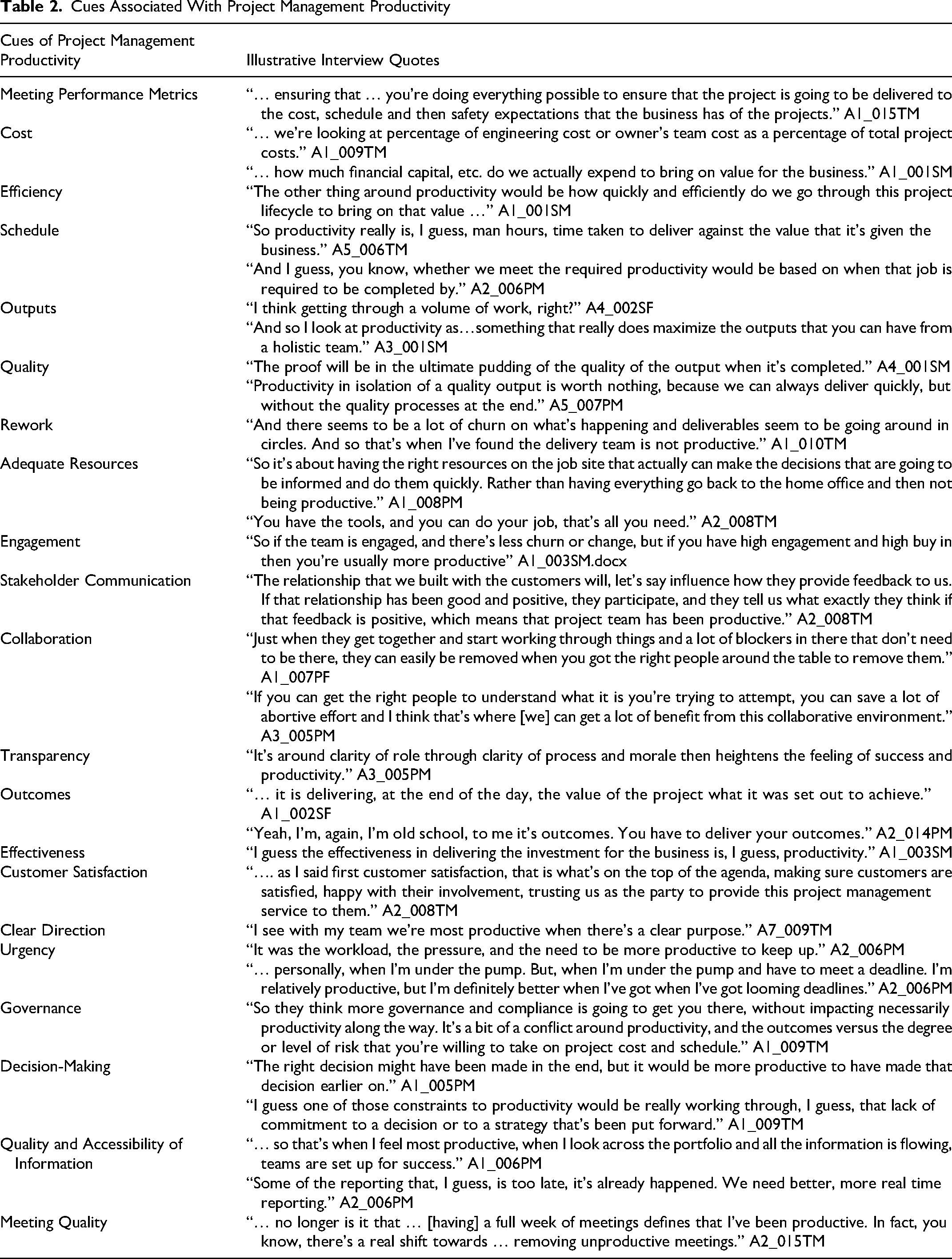
Following Gioia et al. (2012), the 21 cues were considered our first-order data, our open codes. They were grouped as seven second-order themes and four aggregate dimensions, as shown in Figure 1. The second-order themes and aggregate dimensions are used to structure the discussion in the following sections. Figure 1 illustrates the full data structure, demonstrating how first-order concepts were systematically organized into second-order themes and aggregate dimensions that define the multidimensional model of project management productivity.
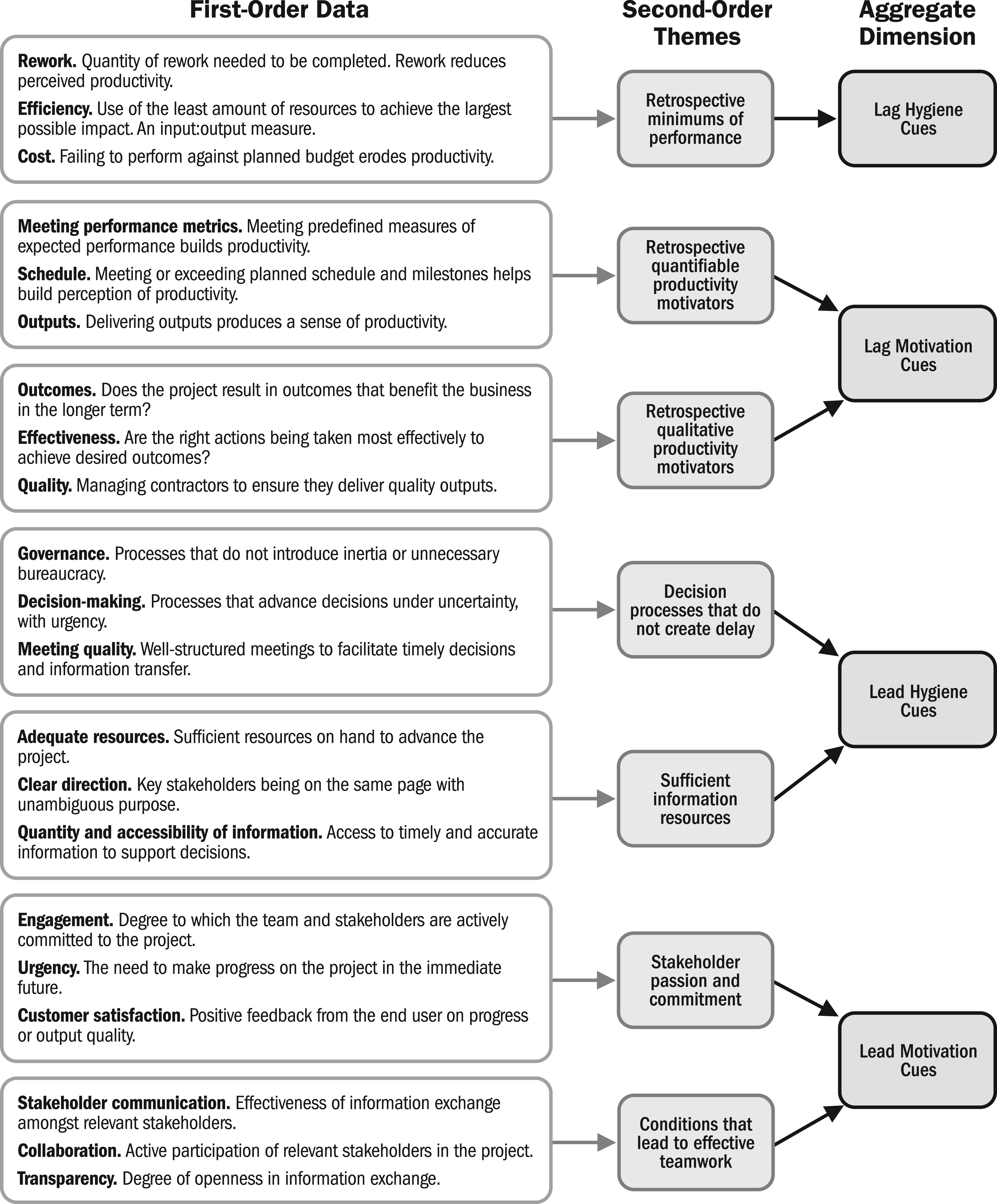
First-order data and second-order themes.
Themes of Project Management Productivity
In the next section, we discuss each of the second-order themes that emerged from the data. These cues provide insight into how productivity is understood in the context of project management, incorporating but also extending far past simple input:output ratios.
Retrospective Minimums of Productivity
Meeting the project budget and minimizing cost blowouts emerged as two of the primary indicators of productivity in our sample of participants engaged in capital-intensive projects (A2_014PM). The emphasis was on exploring tactics to reduce overheads (A4_004SM). At the portfolio level, cost provided a central metric for tracking productivity trends for the project management function. For project teams, cost as a measure of productivity was understood in terms of full-time employees versus the complexity of the projects they were managing (A4_002SF). Cost could also be used as a measure of individual project manager productivity. In this case, it was used as an interpretative metric for evaluating the volume of work that an individual could manage productively, used to understand the dollar value of projects that an individual should be able to individually manage (A3_005PM).
Efficiency was also strongly associated with productivity in the interviewees’ responses, with interviewees often using the terms interchangeably. Well-established project efficiency measures were cited, including capital efficiency ratios, internal rates of return, and net present value (A1_001SM). Return on investment could be quantified when increases in revenue were directly tied to specific project efforts, although this was not always feasible (A5_006TM). Efficiency, as discussed, was closest to the traditional input:output definitions of productivity: delivering outputs using the minimum of resources, as fast as possible. At the project level, productivity was defined as “how efficiently you’re developing those deliverables” (A1_013 T). However, this became more complex at the portfolio or project management office level, where more nebulous concepts such as the strategic optimization of the portfolio were introduced (A6_002SF). Interestingly, both cost and efficiency were seen as benchmarks to meet but not necessarily to exceed. For example, delivery at significantly reduced cost was an indicator of poor estimation, leading to inefficient resource allocation across the portfolio, reducing portfolio productivity. Higher levels of productivity were associated with meeting, not beating, cost and efficiency estimated.
Similarly, the need to do redo work that had been fully or partially finished was seen as a negative impact on project management productivity. Rework was seen as a waste of money (A1_005PM). The contracting model (A1_014TM), poor internal decision-making and review processes (A6_013TF), and incomplete scoping (A1_005PM) were all seen as sources of rework during delivery. Each of these areas—cost, efficiency, and rework—provided indicators of project management productivity, but in each case the cues were retrospective, indicating factors that could reduce the productivity of the project management function if poorly managed, but did not necessarily improve productivity past a benchmark.
Retrospective Quantifiable Productivity Motivators
The single cue most commonly associated with productivity in capital-intensive project contexts was the ability to predictably deliver outcomes to time and cost measures to service business strategy (A1_004PF, A3_002PM, A6_002SF). Performance-related metrics included efficiency, costs, schedule, outputs, quality, rework, and adequate resources. Predictability in meeting performance metrics emerged as a core value. Predictability was recognized as essential in organizational forecasting, with potentially career-limiting repercussions for individual project managers who failed to meet predictability margins (A6_001SM, A8_001SM).
Project management functions were consistently considered to be schedule driven (A6_012TM). The schedule served as a boundary object, providing a common reference point, defining the relationships between the actors. Schedule was considered a key cost driver, with the relationship between labor hours and the project duration being a key measure of productivity (A5_006TM). For individuals, time also played a role in measuring productivity in the client role, particularly in terms of the client’s contribution to hindering or facilitating contractor progress, for example, timeliness of client responses to contractor queries (A3_003PM).
Productivity was also understood in terms of the outputs delivered, or the completion of work packages (A2_006PM), in terms of tracking and ticking off deliverables (A1_018TF); although it was also noted that while tracking deliverables gave a sense of productivity, it did not necessarily tell the complete story in terms of progress toward outcomes (A8_014TM). It was a metric that can be relatively meaningless without available benchmarks, which are only possible to develop when similar deliverables are regularly produced. While some interviewees noted their organizations tracked throughput on a daily or weekly basis as a measure of productivity (A2_006PM), others were less focused on day-to-day output measurement, preferring to track deliverables at milestones (A5_014PM, A5_016TM).
Predictability of meeting performance metrics, delivering to or before schedule milestones, and tracking outputs all provided retrospective measures of productivity. However, unlike cost, efficiency, and rework, these measures were seen as positive indicators of productivity. More outputs, faster delivery, and greater predictability were all considered to lead to higher levels of productivity.
Retrospective Qualitative Productivity Motivators
Interviewees emphasized that the project management function of an organization is productive if it delivers beneficial business outcomes (A2_015TM, A5_009SM), including smooth transfer of project outcomes to business as usual (A5_014PM). The term “outcomes” was broadly used to refer to various aspects, such as social value, risk reduction, and shareholder value (A7_003SM, A1_005PM, A2_005PM), which might not be readily quantifiable or exclusively linked to a single project due to contextual factors. Interviewees noted that outcome achievement may not be visible at the project level and may only become apparent after project closure (A6_005PM, A2_005PM) as the capabilities a project has delivered to the organization make an impact on the business (A5_002TM).
Productivity was also understood in terms of effectiveness. At the portfolio level, this was considered in terms of selecting and delivering the projects that provided a return on investment while balancing safety, risk, reputation, and sustainability objectives. Interviewees defined project management productivity as linking organizational objectives to project progress (A2_008TM) and picking solutions that are most appropriate for the business problem (A8_012TM). The “rightness” of project selection was identified as a key factor in project selection. Similarly, at the project level, productivity was also understood in terms of the nebulous concept of doing the “right” things to deliver value and outcomes (A5_015TF), explicitly identifying that productivity was more about effectiveness than simply meeting time and cost metrics (A6_003SM). Comments related to the quality of outputs gave a similar perspective (A2_006PM), challenging whether sole reliance on quantitative measures can provide a complete understanding of productivity in project management.
Decision Processes That Do Not Create Delay
A variety of cues related to information and authorization processes were identified that had the potential to negatively impact upon productivity, including governance mechanisms, decision-making, and the quality of meetings. Interviewees described issues associated with approvals requiring multiple levels of sign-off, which significantly reduced productivity by adding effort and causing delays. There is a notable relationship between risk aversion and the desire for predictability. Leadership in capital-intensive projects was reported to often strive to avoid surprises by investing considerable effort up front to find solutions that provide the best return on investment and extensive planning and estimation to increase predictability (A7_003SM, A4_001SM). Interviewees were from large organizations, showing a tension between the organizational priority to manage and minimize risk, bureaucratic inertia, and the project priority to accelerate productive delivery (A1_015TM). Many interviewees commented on an increase in governance in their project functions in an attempt to reduce risk, which had come at the cost of project management productivity (A4_001SM).
Slow and poor decision-making was strongly associated with productivity loss. An excessive number of decision points, late decisions, and decisions lacking commitment were found to have a strong negative impact on project productivity (A7_012TM, A1_009TM). Participants highlighted the need to improve productivity by making decisions based on sufficient, though sometimes incomplete, information instead of waiting for complete certainty (A7_005PM), an attitude to risk acceptance which may be related to a sense of decision urgency (A6_004PF) and acknowledgment that acting on incomplete information may result in some decisions being wrong (A4_003SM). However, progressing at risk was not seen as a panacea to productivity, as revisiting decisions was noted as severely impacting perceived project management productivity (A8_009TM).
The perception of productivity was also impacted by the quality of meetings. While one interviewee associated meeting quality with productivity improvement, by far the majority commented on the negative implications of meeting quality. Poorly structured meetings that lack clear purpose or take longer than necessary can undermine productivity by reducing the time available for productive work, leading to stress and lowered morale, which further reduces productivity (A3_006SM, A6_017TF, A7_011TF, A5_006TM). Decision, information, and authorization processes were generally discussed as aspects that could reduce productivity if managed poorly.
Sufficient Resources
Productivity, regardless of the metrics used, is tied to the availability of adequate resources, including information resources. While adequate resourcing is essential for productivity, it is not always the case that increasing resources will necessarily lead to productivity gains. In fact, projects can suffer from inefficiencies if over-resourced (A5_014PM). Resource adequacy includes ensuring the availability of individuals with decision-making authority (A7_008PM), requisite expertise, and specialized knowledge, while also safeguarding that key resources are not overly dispersed or preoccupied with competing priorities (A8_012TM, A5_009SM), or simply having enough competent project management staff to manage the work required (A2_001SF).
Information quality and accessibility were seen as key enablers of productivity, shaping how quickly and accurately teams could make decisions. They needed support by well-configured information systems, which resulted in less time wasted looking for data and decision-making based on real-time insights (A3_006SM). This included documentation of internal processes, increasing process standardization and rapid onboarding (A3_007PM). Productivity suffered when contractors used incompatible platforms, forcing manual rework to integrate data with client systems (A4_001SM). Reliable information was also viewed as essential for measuring productivity itself.
Here, we also treat clarity of direction as an information resource. Teams were described as being more focused and motivated when goals were clearly defined and collectively understood (A6_007PF, A2_010PM, A6_013TF). In contrast, ambiguity, shifting priorities, or unclear objectives often led to delays, frustration, and disengagement. One participant noted that productivity peaked when teams shared a clear understanding of the value they were delivering and why it mattered (A5_005PM). Others described noticeable drops in productivity when there was confusion or doubt about the project’s future, such as when the next approval gate appeared unlikely. In those situations, people would disengage entirely from productive work (A6_014TM). Inability of leadership to provide a clear direction, misalignment at the leadership level, or frequent changes in focus were linked to team demotivation and lower productivity (A1_003SM, A8_013TF). A lack of clarity, especially in uncertain or ambiguous environments, was seen as a significant barrier. As one interviewee put it, most people struggle to stay productive without a stable reference point for what they are meant to achieve (A2_013PF). Insufficient resources were generally discussed as aspects that could reduce productivity if unavailable.
Stakeholder Passion and Commitment
The passion of stakeholders, the urgency of their commitment to the project, and their satisfaction with progress can all increase the productivity of a project management team. For example, the project schedule plays a greater role than only being a timeline or sequence of tasks to achieve. It functioned as a shared reference point and a motivational tool. Milestones created pressure that created urgency and drove people to deliver (A5_013SF, A1_013TF), increasing productivity. It was commonly identified that productivity often ramped up as deadlines approached (A6_013TF, A8_011TF), while periods without time pressure saw a corresponding dip in focus and output (A6_011TF). However, some participants noted that schedule pressure can be counterproductive for certain individuals, requiring more management effort and support (A7_010TM). Assigning the right people to high-pressure tasks was seen as essential to keeping productivity up under tight deadlines.
Employee engagement was discussed as an indirect but important influence on productivity. While hard to measure directly, interviewees believed that morale and team cohesion contributed to a more productive environment. When staff felt part of the team and identified with goals, productivity tended to rise, even if this wasn’t always formally captured (A5_004PF).
Similarly, customer satisfaction was identified as something that motivated productivity. However, this was only identified in cases where the project function delivered outputs to external or operational business units. This was particularly relevant for organizations that provided services directly to end users. In these contexts, customer trust and satisfaction were central indicators of whether the project team was delivering value (A2_008TM). However, in cases where the project team was delivering a project internally, customer satisfaction wasn’t considered a key productivity measure. This suggests that the relevance of this metric is tied to how closely the project function operates as a service provider within the broader organization.
Conditions That Lead to Effective Teamwork
Aspects of internal team conditions were also associated with the productivity of the project management team. Open communication with internal clients was crucial for delivering the right project without unnecessary rework. Early conversations helped confirm the actual business value of an initiative and avoid late-stage surprises. Lack of up-front validation could lead to significant investment in work that ultimately didn’t meet evolving client needs (A6_004PF), reducing the sense of productivity. At the same time, internal clients could hinder productivity by making late changes, adding complexity and scope creep. Consistent, transparent communication throughout delivery was considered key to staying on track (A2_016TF). Strong external relationships also made a difference. One participant emphasized the need to mention being able to quickly resolve issues with key stakeholders simply by leveraging existing relationships (A2_005PM), reinforcing the importance of social capital in overcoming external delays.
The level of collaboration across technical, commercial, and delivery streams had a clear impact on productivity. Interviewees pointed out that if different workstreams move at different speeds, teams can fall out of sync, reducing overall productivity (A4_002SF). A collaborative approach, particularly close engagement with clients and stakeholders across all project phases, was consistently linked to improved productivity (A6_004PF). While co-location and face-to-face meetings were not always necessary, they were often seen as beneficial for strengthening team connection and accelerating delivery (A3_003PM; A8_014TM).
Transparency was referred to as both as a measure and a driver of productivity. It was linked to psychological safety, or the extent to which people felt safe raising issues early without negative consequences (A2_005PM). In transparent teams, problems were addressed sooner, helping avoid rework and delay. Participants noted that transparency also supported more realistic project planning, allowing less padding in estimates and reducing the need for large contingencies (A6_012TM). Strong transparency between the client and contractor was also seen as a signal of an effective and productive client team. It enabled clearer conversations when client-side delays occurred, offering a practical way to flag and address underperformance (A4_001SM).
Discussion
In project management research, discussion of productivity has tended to be largely superficial, often treated as an assumed outcome of effective practice rather than a construct subjected to direct theorization or empirical inquiry. Only a small number of studies have taken productivity as a central area of inquiry. Thomas and Mullaly (2008) and Pollack and Adler (2014) provide notable exceptions, but both frame their analyses in terms of project management’s contribution to organizational productivity, rather than focusing on project management productivity as a distinct concept.
This study aimed to develop an understanding of what project management productivity is, based on the ways in which productivity is discussed by practitioners. In responding to prompts during the open-ended interviews, interviewees discussed productivity by moving freely between concepts that could be variously classified as measures of productivity, conditions that contribute to productivity, project success criteria, and critical success factors. From a prototype theory perspective (Rosch, 1978; Lakoff, 1987), a concept is defined by the other concepts, or cues, most commonly associated with it. Prototypical “project management productivity” would be that which demonstrates as many of these cues as possible. From this perspective, limiting a definition of project management productivity to, for example, only those cues that could be called measures of productivity would only present part of the picture.
In analyzing the 21 cues identified in the literature, it was possible to conceptually group these into seven second-order themes and four aggregate dimensions (see Table 2 and Figure 1). At the level of aggregate dimensions, two distinguishing dichotomies become apparent that provide differentiation between the cues: hygiene and motivator cues; and lead and lag cues.
Hygiene and Motivator Cues
The first characteristic can be explained in terms of Herzberg’s two-factor theory (Herzberg et al., 1959) that posits there are two broad categories of factors that affect worker motivation: motivating factors that increase motivation, and hygiene facts that can decrease motivation by their absence. The differentiation between these two types of cues has implications for the management actions that can be taken to improve project management productivity.
The two-factor theory has been used in project management studies to explain why compensation is not a factor that motivates employees (Seiler et al., 2012), the role of job security in motivation (Dwivedula & Bredillet, 2010), and project manager performance (Pheng & Chuan, 2006). It has been used to explain the role of perceived knowledge growth on cross-project learning (Zhao et al., 2022) and the role of human resource development and training on motivation (Tabassi et al., 2012). While the Two-Factor Theory is usually directly associated with motivation, it has also been linked to workplace satisfaction in project management (Martin & Benson, 2021) and has been used as the basis for deriving productivity factors that could be potentially influenced by cultural diversity (Kim et al., 2015). Other studies outside the context of project management research have also directly associated the Two-Factor Theory with productivity (Bexheti & Bexheti, 2016; Ogbo et al., 2017).
Review of the interviewees’ accounts of the cues associated with project management productivity at the aggregate level revealed a distinct separation between hygiene cues could reduce productivity by their absence but would provide significantly diminishing returns if invested in past a benchmark level. For example, the need to perform rework reduced perceived productivity, but the absence of rework did not increase the sense of productivity. Delivering a project significantly above or below budgeted estimates reduced the perceived project management productivity, while delivering the project to budget did not increase the sense of productivity. If a project manager delivered a project to budget, they were not considered to be more productive, just to be doing their job. In contrast, other productivity cues clearly increased productivity through their presence, and investment in them could increase project management productivity. For example, delivering ahead of schedule was described as something that increased the sense of productivity within the project management team, as were cues such as delivering outputs, engagement, and collaboration.
Lead and Lag Cues
The second way of distinguishing between cues at the level of the aggerate dimensions related to cue temporality, namely whether the cues could be considered lead or lag indicators of productivity. In the context of general productivity measurement, discussion of lead and lag indicators is focused on broader macroeconomic issues (Matos et al., 2025; Brault & Khan, 2020). Within the realm of project management research, discussion of lead and lag indicators has tended to focus on project management tools and techniques, such as the ability of scheduling tools to incorporate lead and lag indicators into estimation (Akram et al., 2024; Hebert & Deckro, 2011; Weist, 1981), earned value analysis (Howes, 2000), or risk management (Ahmed et al., 2007). While not previously explored in detail, differentiating between lead and lag cues has implications for the management actions that can be taken to measure project management productivity.
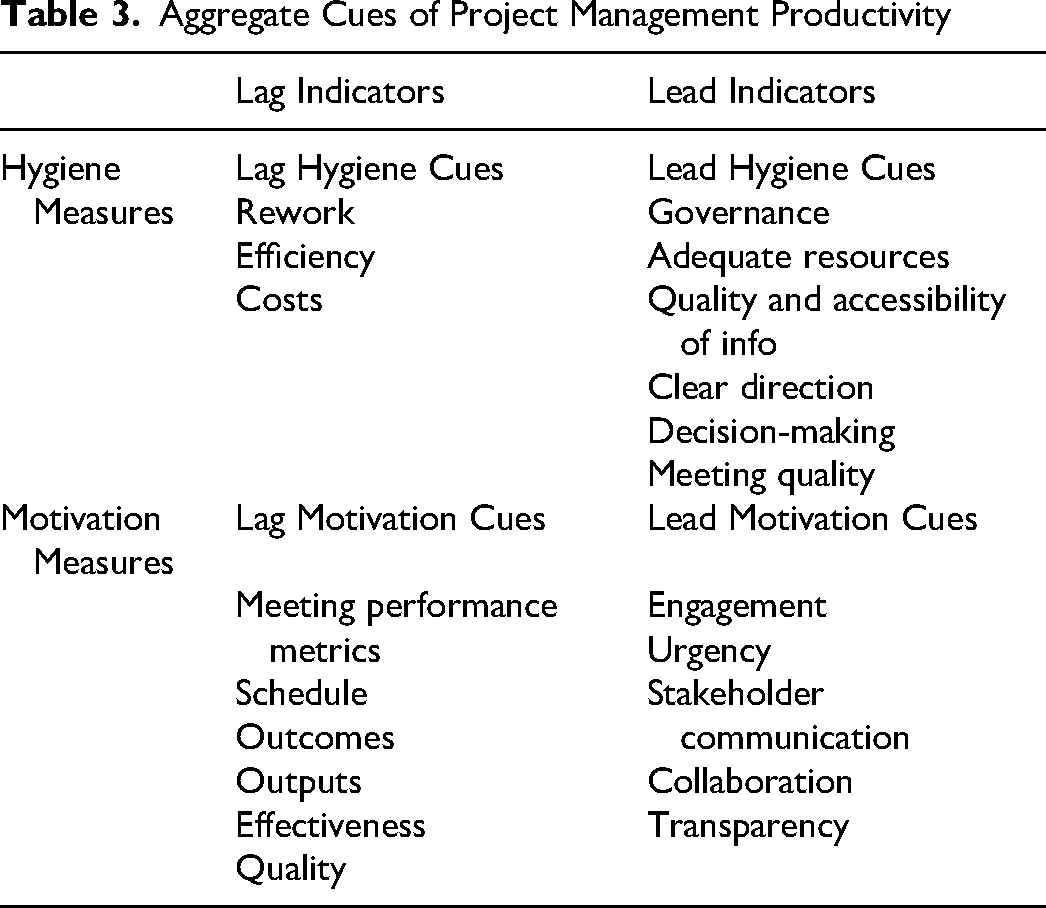
For example, measurement of the project budget or schedule can only provide an indication of whether the project has been managed productively up to the point where the measurement is made. While we might mount a reasonable, inductive argument that past schedule performance implies future performance, it remains a lag indicator. In contrast, other cues signal aspects of the context in which a project management team might be more productive. For example, adequate resources can allow future tasks to be completed efficiently. Effective governance processes or efficient meeting practices can contribute to a context in which a team can work effectively in the future. The categorization of productivity cues according to these aggregate characteristics has been arranged as a 2 × 2 matrix, as presented in Table 3.
Aggregate Cues of Project Management Productivity
While it might be desirable to define project management productivity via a brief and pithy sentence or two, the range, variety, and varying qualities of the cues associated with project management productivity defy a simple definition. A more nuanced understanding of the concept should acknowledge that the concept of project management productivity is itself defined by its association with other concepts. The concept is best understood from both a rearward and a forward-facing perspective, acknowledging that while productivity can be measured, it is also phenomenon to be subjectively experienced.
Project management productivity is defined by both lead and lag indicators. Projects have been managed productively when delivered ahead of schedule, and when output quality and delivery have allowed for outcomes that exceed expectations of effectiveness, while experiencing a minimum of rework or cost variance from estimates. We can have confidence that projects will be delivered productively when engagement, urgency, communication, collaboration, and commitment are developed, while minimizing inefficiencies due to poor decision, information, and authorization processes or insufficient resourcing.
Implications for Project Productivity Measurement
In many of the interviews, it quickly became clear that few participants were actively measuring the productivity of their project management teams. Being on the client side of project management, many were able to report on how they were measuring their contractors’ productivity, as these measures were often embodied in contract documentation. This may suggest potential differences in client and contractor productivity cues, but this remains an area of future research. Client-side project management teams often lacked the ability to describe their own productivity, raising questions of how they were to understand change in their performance over time.
Those respondents who did have some picture of productivity largely relied on lag indicators, and these were predominantly limited to time and cost measures. While these respondents measured time and cost, in interviews they discussed project management productivity as a much broader concept, suggesting an awareness that their approach to managing project productivity was limited. An explanation for this narrow approach to measurement rests in convenience and the costs of data collection. Those were the data available, so those were the data they used.
For those interested in building measurement of productivity into their project management functions, we suggest an approach that uses Table 3 as a starting point. It is important to understand not just whether projects have been managed productively, but also whether the conditions are in place to allow project teams to work productively in the future. Those interested in initiating work to develop project management productivity can also gain insight from this research. Viewing these findings in terms of the two-factor theory suggests the need for careful consideration of where investment in productivity development is made. While it is important to ensure hygiene factors are above a benchmark where they are causing productivity loss, past that point there may be diminishing returns in further development investment.
In designing productivity measures that a project management office could use to monitor and improve productivity, it is important that measures of project management productivity should include aspects from all four quadrants of Table 3, covering lead, lag, hygiene, and motivation measures. Exclusively focusing on convenient lag indicators will only provide an understanding of whether a function was previously productive. Measures will need to include consideration of lead indicators to develop an understanding of whether team conditions are conducive to future productivity. Separating hygiene and motivation factors will also help direct investment in productivity development, as while hygiene factors may reduce productivity, there are likely to be diminishing returns in investing in them past a locally determined point.
Conclusion
This research offers a conceptualization of project management productivity, grounded in the experience of project practitioners working in capital-intensive projects. It challenges the adequacy of traditional input:output measures and reframes productivity as a multidimensional construct best understood through prototype theory. Rather than being captured by a single metric, project management productivity is affected by the presence or absence of characteristic cues. These cues span four domains conceptualized across two key dichotomies: (1) whether a cue functions as a hygiene factor that can limit productivity or as a motivator that drives productivity; and (2) whether a cue operates as a lag indicator, describing past performance, or a lead indicator, signaling the conditions for future productivity. Productivity, in this context, is not merely a retrospective assessment but also a set of conditions that shape future productivity. It is both something that can be measured, and something that can be experienced, and emerges through the recurrent presence of characteristic cues across these four interrelated domains.
We define project management productivity by both lead and lag indicators. Project management productivity is a concept that is measured in terms of achieved performance metrics such as schedule, budget, and efficiency, which reveal past productivity. It is experienced in terms of the feeling of productivity that comes from urgency and completing deliverables, and facilitated by processes and behaviors such as collaboration, communication, governance, and adequacy of resources.
This conceptualization has practical applications. First, organizations seeking to evaluate or improve project management productivity should avoid relying solely on quantifiable lag indicators such as cost and schedule. While necessary for governance and reporting, these are insufficient on their own. Practitioners should also ask whether they are creating the conditions in which teams can be productive, attending to both performance outputs and the qualitative enablers of those outputs. In line with Industry 5.0, productivity improvement depends as much on human and organizational factors as on technological capability, recognizing people as active contributors rather than passive system components (Nahavandi, 2019; Ivanov, 2023; Sony & Naik, 2020). Second, the findings caution against over-measurement and overengineering. Rather than tracking every available cue, organizations should ensure balanced coverage across the different indicators that we have identified in this study, monitoring both outcomes and the contexts in which those outcomes are achieved. This is particularly relevant when integrating AI and digital platforms into productivity management. Instead of over-quantification, dashboards and performance systems should incorporate human-centered cues (e.g., engagement, transparency, collaboration, communication) to support more meaningful, resilient, and sustainable project practices consistent with Industry 5.0 principles (Ivanov, 2023). Third, project management productivity is not a formula; it is formed, recognized, and enacted through the recurring presence of particular cues in the project context. Recognizing the interplay between human judgment, collaboration, and technological systems enables a more flexible and contextually grounded approach to understanding and improving productivity in projects.
