




Abstract
This article investigates how actors in an interorganizational construction project engage in ambidextrous tensions related to digital transformation. The purpose is to understand how the overarching tension of exploration–exploitation manifests in practice and how actors navigate it. Based on a longitudinal qualitative case study with retrospective elements, six nested tensions shaped by institutional and temporal factors are identified. It shows how actors navigate these through distinct mindsets, resulting in heterogeneous practices and a fragmented digital landscape. The study concludes that digital ambidexterity is a situated practice, highlighting the importance of aligning mindsets.
Keywords
Introduction
Project actors in the architecture, engineering, and construction (AEC) industry are increasingly struggling with the complexities and challenges of digital transformation (Chen et al., 2024; Chowdhury et al., 2024; Eriqat et al., 2024). While new digital technologies promise enhanced efficiency and innovation (Bosch-Sijtsema et al., 2021), their implementation often creates tensions as they collide with embedded institutional logics that promote short-term gains and a strong project focus (Winch, 1998; Rowlinson, 2007; Jacobsson et al., 2017). This article explores a central tension in these transformation efforts, that of exploration–exploitation. Framed through the lens of ambidexterity, this tension is particularly pronounced in interorganizational, project-based settings, such as construction, where fragmentation, conflicting goals, and temporality complicate strategic alignment and innovation efforts (Jacobsson et al., 2017; Eriqat et al., 2024; Ahlstöm, 2024; Sun & Tell, 2025). Described in more theoretical terms, the focus is on the challenges of navigating ambidextrous tensions related to digital transformation in an interorganizational context.
As such, the research builds on the notion of ambidexterity and interrelated ambidextrous tensions, a well-established framework that, over the years, has attracted extensive interest in the domain of organization theory (Turner et al., 2013; Petro et al., 2019; Chakma et al., 2024; Kassotaki, 2022). While research on ambidexterity initially focused on learning processes (March, 1991), it has been extended to include various types of innovation processes, both outside (Birkinshaw & Gupta, 2013) and within the AEC context (Liu & Leitner, 2012; Eriksson & Szentes, 2017). Still, when applying the concepts of ambidexterity and ambidextrous tensions to the phenomenon of digital transformation, and specifically digital transformation in an interorganizational project-based context, studies are rare yet sought after (Musrepova et al., 2023; Hoessler & Carbon, 2022; Sun & Tell, 2025).
Building around the idea of “digital ambidexterity,” defined as the organizational capability to successfully enable the exploration and exploitation of digital technologies, the study aims to understand how the overarching tension of exploration–exploitation is manifested and how project actors navigate it in an interorganizational context. Such a focus not only constitutes a gap in existing literature (Hoessler & Carbon, 2022), but, given the institutional logics and temporal constraints inherent in this context (Winch, 1998; Jacobsson et al., 2017; Ahlstöm, 2024), understanding how actors navigate ambidextrous tensions related to digital transformation is both theoretically and practically important (Musrepova et al., 2023; Sun & Tell, 2025). Additionally, a better understanding of the manifestation of ambidextrous tensions among various actors might improve the potential adoption trajectory of new technologies in the industry (Bosch-Sijtsema et al., 2021).
Empirically, the article builds on a longitudinal, partly retrospective, qualitative case study of an interorganizational construction project with a total investment of SEK430 million (approximately €40 million). The study focuses on six key actors, with Skanska as the main contractor. The project is located in Jönköping, Sweden, and includes a new hotel building that connects an older, partly heritage-protected, industrial complex with a more contemporary commercial area. In the context of a mid-size Swedish town, it is considered a large construction project.
Based on public case data, project documents, and 15 in-depth interviews with representatives from the involved key actors, the analysis is process oriented and focused on the project's evolution (from 2011 until its completion in late 2022) and, in that, how the exploration–exploitation tension manifested among the actors, and how the key actors navigated, or tried to navigate, this tension. The article shows how the overarching tension translates into various nested, and for each actor unique, tensions embedded in the institutional and temporal context. Navigating these thus becomes a situated practice where the actors’ navigating mindsets steer them in different directions, causing a fragmented digital landscape. To cope with this fragmentation, the study highlights the importance of aligning mindsets.
Background
According to Roman mythology, Janus, the god of transitions and duality, had two faces—one looking forward into the future and the other looking backward at the past (World History Encyclopedia, 2025). Project actors in the AEC industry could benefit from trying to copy Janus’s ability; even they would benefit from having the ability to focus on both stability and change simultaneously (Braun et al., 2025). On the one hand, they need to continuously improve efficiency in their project operations to increase revenue and profit margins in the short term. On the other hand, in a constantly evolving world, they must be forward-looking, able to spot opportunities from technical innovations, invest in them, and implement strategic changes for the long term.
From many years of research, it is well established that the ability to engage in these competing demands is critical to maintaining competitiveness and profitability in both the short and long term (Gibson & Birkinshaw, 2004; Siren et al., 2012; Kassotaki, 2022). Moreover, it has also been shown that severe risks are associated with focusing too little or too much on just one or the other (Raisch & Birkinshaw, 2008). By focusing too much on the present and only engaging in incremental improvements and short-term efficiency, firms risk getting stuck in old patterns and being outcompeted if the market changes and if competitors develop their operations and offerings (Raisch & Birkinshaw, 2008). There are numerous examples where Kodak might be the most (in)famous due to its claimed failure to anticipate market changes and adapt to the arrival of digital cameras (Lucas & Goh, 2009). Conversely, with too much focus on the future and innovation, companies risk being burdened by high development costs without leading to financial benefits. At the turn of the millennium, many dot-com start-ups met this fate, investing massive amounts in technological innovation without being able to reap the rewards before they went bankrupt. A striking example is e-commerce company Boo.com, which, at one point, spent about US$4 million a week on technological innovation while generating only US$100,000 in revenue (Lindstedt, 2001). More recently, the Swedish company Northvolt, which attempted to pioneer and manufacture lithium-ion batteries with a low carbon footprint, met a similar fate (Northvolt, 2025; The New York Times, 2025).
Even though the examples above represent extreme cases, all types of companies face the same fundamental challenge. That is, they need to navigate the exploitation of existing opportunities and the exploration of new ones, which has become particularly relevant in the wake of emerging digital technologies (Magnusson et al., 2021a, 2021b; Hoessler & Carbon, 2022). In organizational theory, this challenge is known as an ambidextrous tension, and the ability to manage it is known as ambidexterity (which means two-handedness).
Ambidextrous Tensions
At the core of ambidextrous tensions lies a set of competing demands, originally those between exploration and exploitation (Duncan, 1976). March (1991) initially linked this tension to knowledge management and the ability to both utilize existing knowledge and leverage new knowledge creation. However, over the years, studies have shown that this tension can take alternative forms, as it can be nested, meaning that the overarching competing demand can manifest itself as or cause other competing demands and tensions to surface (Andriopoulos & Lewis, 2009). Building on this, it can be argued that ambidextrous tensions are an example of paradoxical tensions (Papachroni et al., 2015). As such, all ambidextrous tensions can be understood as paradoxes, even if not all paradoxes constitute ambidextrous tensions (Andriopoulos & Lewis, 2009; Papachroni et al., 2015). This broader lens of paradoxes, or paradox theory, has allowed previous research to explore the underlying structure of ambidextrous tensions, how they emerge, and how organizations can engage with them (Smith & Lewis, 2011; Papachroni et al., 2015).
Apart from being nested, a key insight from paradox theory is that tensions are not always immediately visible. Studies have shown that they can be both latent (i.e., unnoticed or unarticulated) and salient (Smith & Lewis, 2011). This means that competing demands, such as exploration and exploitation (and the subsequent tensions they may cause), may exist in the background, unnoticed. However, when triggered by, for example, contextual shifts or critical events, they become salient, meaning that they are made sense of and prompt actors to respond (Smith & Tushman, 2005; Smith & Lewis, 2011; Carmine & Smith, 2021). Previous research has shown that actors’ responses can vary. They may suppress the need to engage in, or act indifferent to, the competing demand; they may engage in one or the other demand separately; or they may try to embrace both demands simultaneously (Jarzabkowski et al., 2013). Additionally, the literature on ambidextrous tensions proposes several managerial strategies, or mechanisms, for engaging in tensions when they become salient, either through separation, embracement, or a combination thereof (Turner et al., 2013).
Dealing with Ambidextrous Tensions
Two common managerial strategies or mechanisms focused on separation are structural and temporal (Turner et al., 2013; Petro et al., 2019). Structural separation implies that competing demands are separated and handled in different parts of the organization, and temporal separation implies that the demands are split over time (Turner et al., 2013). Thus, for structural separation, exploration would be managed in one part of the organization, and exploitation in another part, or sequentially in the case of temporal separation (Turner et al., 2013). While both strategies are feasible in the mentioned context, research has shown that they do not come without challenges. Structural separation can cause challenges related to the subsequent need to transfer knowledge or solutions from the line organization to projects or between projects (Prencipe & Tell, 2001; Mallet & Salerno, 2025), and the extensive testing and development in dedicated projects (common in the case of temporal separation) is shown to be challenging due to low margins and unclear return on investments (Eriqat et al., 2024).
Two additional strategies or mechanisms, focused on embracing tensions, or a combination of separating and embracing, are contextual and domain ambidexterity. Contextual ambidexterity involves creating an environment that empowers employees to be adaptive and use their personal judgment in responding to competing demands (Birkinshaw & Gibson, 2004; Havermans et al., 2015). Such a strategy tends to place high demands on employees and has been shown to be challenging to implement with existing business models and incentive systems in interorganizational settings (Lavikka et al., 2015). The second strategy, which involves a combination of separating and embracing (i.e., domain ambidexterity), entails engaging outside domain expertise to engage in ambidexterity demands (Lavie et al., 2010).
While these four strategies have been shown to be relevant to understanding organizations’ strategic intents (Turner et al., 2013), they are not adequate to (alone) capture situated and emergent responses to ambidextrous tensions, particularly in an interorganizational context and related to digital technologies. The main reasons are that, in such a multi-actor environment, the strategic intent varies among actors (Eriksson, 2013), and that a categorization of actions in relation to these mechanisms can only be done ex post (Birkinshaw & Gibson, 2004). Consequently, although these strategies help explain what actors intend to do, they do not capture emergent responses. Moreover, the need to understand emergent actions and their rationale is particularly relevant in the context of digitalization and digital transformation, since it has long been known that the adoption and use of digital technologies are shaped by bottom-up practice as much as they are a result of an intended strategy (Ciborra, 1992; Ciborra & Hanseth, 1998). Additionally, research has shown that, regardless of the intended strategy “implemented,” depending on how actors respond and engage in the tensions, vicious or virtuous cycles can develop, implying that, if vicious, exploitation efforts will drive out exploration or vice versa (Tushman & O’Reilly, 1996; Smith & Lewis, 2011). Thus, to complement these intended strategies/mechanisms, it is relevant to explore how to conceptualize and understand emergent practices.
Emergent Practices to Navigate Ambidextrous Tensions in Digital Transformation
As mentioned above, studies of ambidexterity have, over the years, been carried out with many different focuses, such as organizational learning, innovation, design, and strategic management (Raisch & Birkinshaw, 2008; O'Reilly & Tushman, 2013), where “ambidexterity for digital transformation” has been less studied, especially in relation to interorganizational project-based contexts (Werder & Heckmann, 2019). In fact, despite increasing interest in ambidexterity in realms of the AEC industry and interorganizational project-based contexts (see, e.g., Eriksson & Szentes, 2017; Petro et al., 2019; Sun et al., 2020; Kamal et al., 2023; Braun et al., 2025; Sun & Tell 2025), there are only a handful of studies that have focused on tensions or ambidexterity practices related to digitalization or digital transformation in interorganizational project-based contexts (Hoessler & Carbon, 2022; Musrepova et al., 2023; Sun & Tell, 2025; Simard & Aubry, 2025). Accordingly, it is necessary to draw on insights from other contexts to establish a basis for understanding emergent practices.
Magnusson et al. (2021a, 2021b), who were among the first to introduce the notion of “digital ambidexterity,” argued, based on Benner and Tushman (2003), for two distinguishable approaches (or logics) of engaging in digital technologies, based on efficiency-seeking versus innovation-seeking. According to the authors, the former involves the pursuit of automation and the reduction of manual labor, and the latter involves broader process innovation and changed value propositions, both with digital technologies as the means (Magnusson et al., 2021a). Bringing these two approaches to the interorganizational project-based setting of the AEC industry, it resonates with previous studies on innovation and digitalization that, in different ways, show how the institutional environment tends to promote more efficiency-seeking than innovation-seeking practices (Rowlinson, 2007; Bygballe & Ingemansson, 2014; Jacobsson et al., 2017; Ahlström, 2024). There are several explanations given for this “skewedness,” often related to the interorganizational project-based logic.
For example, efficiency-seeking has been related to the fact that most value creation happens in time- and resource-constrained projects (Bygballe & Ingemansson, 2014), where line organizations function as support to the project operations with limited power over the everyday practice, particularly when it comes to how digital technologies are to be used in projects (Jacobsson & Linderoth, 2010). This project-based logic implies that firms tend to look more toward the immediate benefits for specific projects than what benefits can come in the long term (Eriksson, 2013), thus establishing an implicit logic that promotes the idea that what is best for the single project is best for the organization (Jacobsson et al., 2017). Consequently, the deployment of digital technologies that are useful “here and now” and that are well-aligned with the project-based logic are prioritized over the exploration of new digital technologies (Jacobsson & Linderoth, 2010).
Moreover, established incentive structures (such as piece-rate wages) are also suggested to impact the motivation to engage in new digital exploration (Jacobsson & Linderoth, 2010; Jacobsson et al., 2017). Also, an increased customer orientation has led to an emphasis on exploitation through the external network (Bygballe & Ingemansson, 2014), and the project-based mode of organizing has proven to entail difficulties in transferring experiences, knowledge, and innovations between projects and from the project to the line organization (Prencipe & Tell, 2001; Ahlstöm, 2024; Mallet & Salerno, 2025), placing constraints on the innovation-seeking practices that exist. This, combined with high application costs (Liu et al., 2015) and low project margins, further affects the willingness to take risks and explore new digital innovations (Linderoth et al., 2018).
Consequently, while Magnusson et al. (2021a) point to the tension between the efficiency-seeking and innovation-seeking approaches in engaging in digital technologies, which clearly resonates with existing studies on innovation and digitalization in the AEC context, the traditional tension in ambidexterity research, as described initially, has been between utilizing existing resources and leveraging new ones (Duncan, 1976; March, 1991; Turner et al., 2013). Consequently, when it comes to ambidextrous tensions related to digital technologies, there seem to be two complementary dimensions that, if combined, result in four probable “type-practices.” Thus, efficiency-seeking can be achieved with both existing and new technologies, and likewise, innovation-seeking (see Table 1). The two dimensions thus distinguish between the means (new or existing technologies) and goals (efficiency or innovation) (Birkinshaw & Gibson, 2004).
Four Type-Practices

As outlined in the table, an efficiency-seeking approach using new technologies would involve a practice of adopting novel digital tools to streamline operations, though with limited ambition for innovation. In contrast, efficiency-seeking with existing technologies reflects a practice where actors rely on proven tools to, for example, increase control and optimize performance. On the other end of the spectrum, an innovation-seeking approach with new technologies involves actively pursuing novel digital solutions to transform projects, processes, or delivery methods. Meanwhile, an innovation-seeking approach using existing technologies involves creatively repurposing existing tools and technologies for new and innovative purposes. In the subsequent analysis and discussion, we intend to use this distinction to reflect on actors’ actual practices.
Method
To increase the understanding of how the overarching ambidextrous tension in digital transformation manifests and how project actors navigate it, conducting a case study of a large construction project in central Jönköping, Sweden, was deemed appropriate, as it allowed for an in-depth understanding of actors’ practices. The studied project represents an investment of approximately SEK430 million, over about four years, with Skanska as the main contractor. The data collection and subsequent analysis were based on documents and interviews focused on the six key actors. In collecting the data, a process-oriented work-based approach was adopted (Langley, 1999), which is a suitable way to understand how the project practice evolved over time and, in doing so, to try to understand how and why things were done the way they were. Respondents were identified by first mapping all involved actors; thereafter, interviewing the three actors initially involved, and prompting these to recommend additional respondents with detailed knowledge of the project process, who were thereafter contacted and interviewed. As such, the selection process mimics that of a snowball sampling technique, which is characterized by networking and referral (Parker et al., 2019). A total of 15 in-depth semistructured interviews were undertaken with representatives from six of the involved actors. Additionally, the project was followed in real time over three years (2021–2023), based on public documents and reporting in local media. However, since retrospective data were also needed to understand the project in its totality, publicly available case data (such as press releases and public documents from the municipality) and project documentation provided by the respondents, both during and after interviews, were included. All in all, the data covers the course of events from 2011 to the time of project completion (end of 2022).
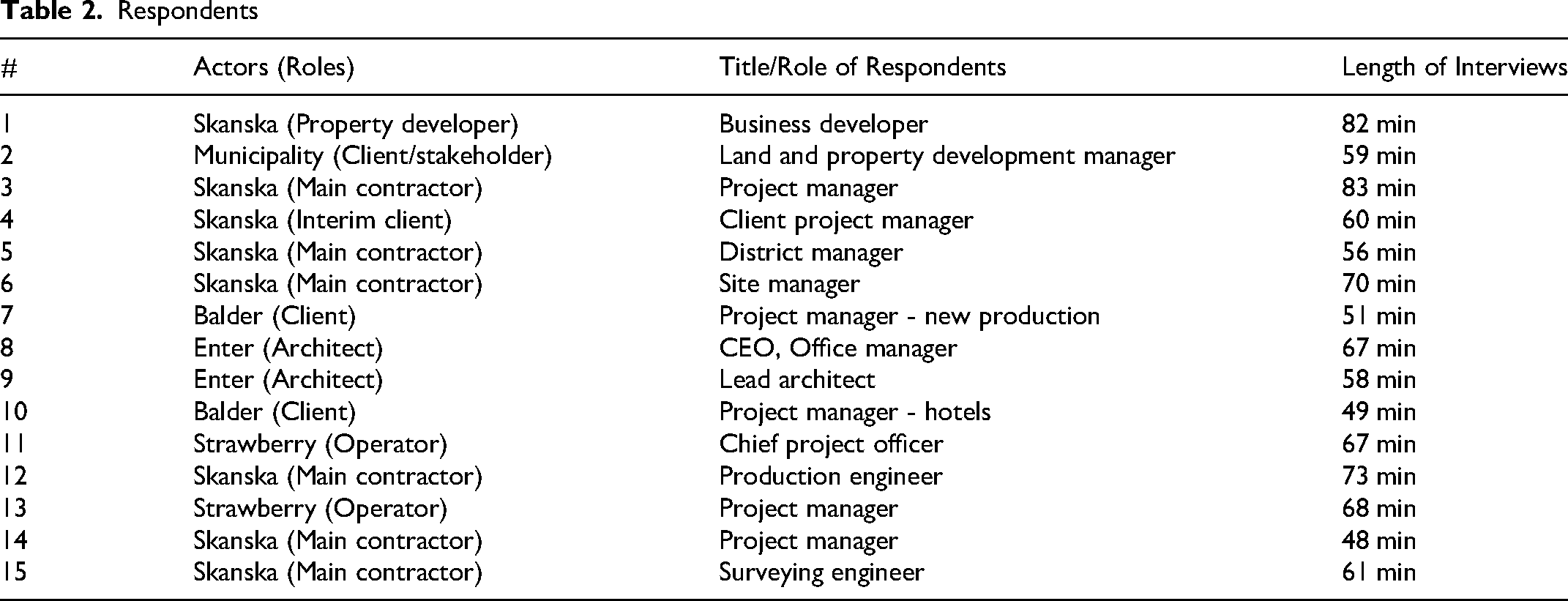
Interviews varied between 48 minutes and 83 minutes and were held face-to-face, with a few online exceptions to accommodate respondent requests. In total, the interviews amounted to more than 15 hours (see Table 2). To understand the evolution of the project process in-depth, interview questions were structured chronologically and covered key representatives of the main actors involved, such as the municipality, the main contractor, the architectural firms involved, the client (long-term owner), and the future operator of the hotel. The data collection process adhered to the General Data Protection Regulation (GDPR) and the demands of informed consent. All interviews were recorded and transcribed verbatim.
Respondents
The analysis of collected data was undertaken in three integrated steps. First, a process-oriented map and description of the project process were developed, covering the main events from 2011 until the project's completion. Such mapping is shown to be suitable for creating an initial understanding of how things evolved over time and why they evolved the way they did (Van de Ven & Huber, 1990). The primary data used in this step were the interviews with key actors. To minimize the risk of post-rationalization bias, public documents and written documentation provided by respondents were used to support/validate descriptions and specific dates/events in a triangulation manner. This process mapping later served as a basis for the overall case narrative.
As a second step, all interviews were inductively analyzed to understand the manifestation of ambidextrous tensions and the responses of the actors. In this, we searched for tensions that influenced actors’ engagement in digital technologies without them necessarily representing a one-to-one relationship to exploration–exploitation. The process resembles that of inductive pattern coding, as we tried to identify both descriptive and explanatory factors (Thomas, 2006). The coding was done for each of the actor groups separately, focusing on both which ambidextrous tensions the actors faced (descriptive) and how the actors made sense and responded to these tensions (explanatory). Identified tensions were reviewed and named. In this process, the theoretical conceptualization of what constitutes (nested) ambidextrous tensions and that actors make sense of them (as they become salient) is to be considered a “sensitizing concept” as it functioned “as an analytic lens or interpretive mechanism throughout the process” (Bowen, 2006, p. 2). Described another way; while approaching the interviews inductively, the conceptual framework helped us in zooming in on the various tensions and understanding the navigating mindsets and subsequent responses of each project actor.
As a third step, we mapped the actors’ responses to the various tensions in relation to the “type-practices” deduced in the background (see Table 1). Having mapped the actual practices of actors, we followed the trajectories of each practice. That is, whether actors changed their practices over time and/or engaged in more than one practice simultaneously, thus being ambidextrous.
Taken together, the three steps allowed us to understand how the overarching tension manifested itself, how actors made sense of nested tensions, why they acted as they did, and how practices (in some cases) changed over time. Finally, a two-part, process-oriented case description was developed, highlighting both the overall process and each actor’s role within it. For an overview of the nested tensions, navigating mindsets, and emergent practices, see the summary table in the Results section. The trajectories of each actor’s practices are discussed in a quadrant model in the Discussion section.
From a Match Factory to a Posh Hotel
In Q3 of 2011, the municipality of Jönköping initiated the revitalization of an old, centrally located, industrial area called “Tändsticksområdet” (Eng. “the Matchstick area”). Their long-term ambition was to transform the declining area through the construction of a new multistory hotel, connecting the old parts with a more contemporary commercial area called “Västra Centrum.” The initiative marked the start of what would become the project “Gradienten,” the building of a high-profile hotel integrated with existing old brick buildings on the shore of Vättern, Sweden’s second-largest lake—a site that was later discovered to bring some unique challenges. Given that the Matchstick area was (and is) a partly heritage-protected historical environment that dates back to 1848 (JKPG, 2025), the project needed to be developed with care and respect for the existing buildings.
By 2014, after several less successful attempts to get the project off the ground, the municipality of Jönköping tried to attract both local and national property developers by launching an open “architectural competition.” The main rationale was, as expressed by a representative from the municipality, to find a concept that would represent an “innovative solution, and that would be well adapted to the cultural environment” (Land and property development manager, Municipality). About a handful of proposals entered the competition.
Together with the Gothenburg-based architectural firm Enter Arkitektur, the property development branch of Skanska Sweden produced a proposal that clinched victory in Q2 of 2015. Their winning proposal blended elements of traditional brick architecture with a sleek, modern glass facade, promising to seamlessly, as “a gradient,” integrate the old with the new. Hence, the project name: “Gradienten.”
In addition to the building being well adapted to the area (integrating new and old), Skanska provided what was seen as an attractive and innovative setup for ensuring that the project would happen: “… they were transparent from the beginning, saying that they would not be the long-term property owner. Making it clear that sometime during the process, they would divest the entire property and the project as well. Then it became clear to us that they would not start construction until they had contracts with both a property owner and operator” (Land and property development manager, Municipality).
In the interview with the business developer at Skanska who oversaw the proposal process, it was confirmed that this setup was a common practice to generate a stable revenue for the company: “… that’s how it works […] we’re basically always selling the projects.”
Following these intentions, in October 2017, Skanska further solidified the project's being by securing an agreement with Nordic Choice Hotels (today Strawberry) to be the future tenant and operate the hotel upon completion (Strawberry, 2017). The business developer explains: “I started with the hotel operator […] to find out the interest. To understand what the specific customer or tenant needs. It can vary. […] We competed for an opportunity, came up with a proposal, won it, and then I went out and tried to find a buyer. But the tenant comes first, because otherwise I had nothing to sell” (Business developer, Skanska).
In other words, securing the tenant (and future operator) underscored the project’s appeal, making it possible to sell.
In February 2018, Skanska subsequently decided to sell the hotel to Balder Fastigheter. In the press release Balder sent out on 9 February 2018, they wrote: “Balder has acquired the hotel project Gradienten to be built in central Jönköping for approximately SEK430 million. The seller is Skanska. The project includes an 18-story hotel with 229 rooms, conference facilities, and a restaurant. Construction is scheduled to start in the first quarter of 2018. Nordic Choice Hotels has signed a 20-year lease for the operation of the hotel after completion.” (Balder, 2018).
With this, Skanska resolved the financial “hen-or-egg” situation of needing to find a long-term owner to attract a good hotel operator or vice versa. The underground garage, to be built in connection with the new hotel building, was, however, sold to the municipality’s real estate company as it was expected to be publicly available. “Just as we were going to sell the building, we were going to sell the garage; otherwise, we would not have started the project” (Business developer, Skanska).
With the tenants, operator, and long-term owner secured, the construction could be kicked off in Q2 of 2018, with the contractor branch of Skanska Sweden as the main contractor and Skanska Project Development as the interim client. As such, and despite having sold the prospective hotel to Balder, Skanska acted as both the client and main contractor during the design and construction phases. During the latter part of the design phase, the interactions with the municipality also intensified. As explained by one of the respondents: “… we negotiated and discussed how to finalize the land transfer agreement. Even if they had received a provision regarding a land allocation under certain conditions, we needed to agree on who would take responsibility for, for example, the renovation of existing facilities. We needed to discuss the price of this, and who would implement what when it came to the public facilities, etc.” (Land and property development manager, Municipality).
Over the ensuing year, the project underwent careful planning and preparation, adopting a concurrent engineering approach, with various actors and subcontractors contributing their expertise to bring the hotel to life. Enter Arkitektur continued as the lead architect for the project, collaborating with Mood Architecture, which was working on behalf of Nordic Choice (Strawberry) to oversee the hotel’s interior design. The demarcation between the two architectural firms was based on functionality. “Everything that’s in the building is the tenant’s responsibility. So, if you turn the building over, shake it, it falls out, Choice will have to fix it themselves” (Business developer, Skanska). However, in a later interview, one of the architects explained that it was not as easy as it might sound. The respondent said “it took a lot of time” to coordinate between the two firms (CEO, Office Manager, Architect).
The construction phase, spanning from 2018 to 2022, initially witnessed good progress. However, about six months into the project, during the excavation of the old site, unexpected challenges arose. First, minor movement was detected in the old heritage brick buildings. Later, when the sheet piling began, larger cracks emerged. This prompted the actors to engage in explorative activities, involving new subcontractors with special competencies, and “…try out different scenarios on how we should proceed” (Site manager, Skanska). Additionally, during the process of finding a new piling method, the surveyor stated that he had to develop very detailed 3D models to a level that had never been done before to support the structural engineers. Without these 3D models, it would have taken a significantly longer time to develop a solution. As he expressed it, “… of course, it could have been done, but it would have been an awful lot more work” (Surveyor, Skanska).
Another incident early in the construction phase that stalled the project was the discovery of an old (hidden) well filled with phosphorus that self-ignited when coming into contact with air. As described by one of the respondents: “…we were sitting there […] in a meeting and then someone came in and said that ‘there's a fire in the pit out heré […] I thought: ‘You are not serious’. […] I went out and looked. It was like sparklers sizzling in the water […] one guy called the fire department. And they almost referred him to the psychiatric emergency room – someone calls and says there's a fire in the water” (Business developer, Skanska).
Like the first incident, this one also stalled the process and forced the actors to change the trajectory.
Thus, both incidents prompted the project actors to act innovatively, and fortunately, solutions were found, albeit at the cost of extensive project delays. As explained by the site manager, “…before the shaft was fully completed, a year and a half had passed. No, a year, sorry. The total delay was a year and a half” (Site manager, Skanska). Also, at the end of the first year of construction (in February 2020), the world was struck by the COVID-19 pandemic, with its far-reaching consequences. As with most other operations, this implied supply chain challenges and the development of new digital meeting practices that persisted even after the pandemic restrictions were eased. When the project manager at Skanska reflects on this, he concludes that it turned out better than expected, even if it became clear that “some belonged to the old school,” referring to the initial resistance among those who preferred face-to-face meetings and paper drawings. Moreover, the pandemic also caused some challenges due to travel restrictions and some subcontractors not being Swedish, “but coming from Lithuania, and […] Latvia” (Project manager, Skanska).
In total, the unexpected events prolonged the project by approximately one and a half years compared to the original projection. However, in Q3 of 2022, an important milestone was reached, as Balder formally assumed ownership of the completed hotel. This transition marked the culmination of the process, and on 1 September 2022, Quality Hotel Match celebrated its grand opening and inauguration, marking the end of the project. And as the saying goes, “every cloud has a silver lining.” Due to the incidents and delays, the hotel was able to avoid opening during the pandemic, which, according to the operator, was very positive for their operations.
Actors’ Engagement
As the above case narrative illustrates, the level of actors’ engagement varied from 2011 until the project's completion in 2022. In the following section, we will provide an extended narrative of each actor’s engagement in the project process, covering how the overarching tension manifested itself for each actor and how they navigated it.
The Municipality (Stakeholder and Initial Client)
As mentioned above, the municipality, as the initial client, had minimal formal requirements and did not impose any demands on the use of digital technologies in the design phase, as they wanted to ensure everyone was on board. A respondent at the municipality involved in the design phase stated that it was important that the different proposals were presented in a similar way to make project suggestions comparable: “… we want projects to be presented in similar ways so that we can look at the proposal […] and not have to compare apples and oranges […] but more what is being presented on the site. A top priority in the land allocation process is to judge how a project can create some value and fit in with the immediate local environment.”
The respondent continues: “… of course everyone must meet the minimum requirement, for us to include it in the evaluation […] which is the situation plan and sketches of floor plan, and how it adapts to the surrounding environment and things like that. […] Beyond that, they could come here with a physical model, a sketch, or whatever” (Land and property development manager, Municipality).
Later in the interview, the same respondent reflects a bit about the fact that a lot has happened when it comes to digitalization since the whole process started, and states: “If it had been today, I think it would have been more interesting for us [referring to the use of 3D modeling]. Especially in a project like this, where you impose on an existing environment. […] To see, ‘what does it look like from there’. If you stand there, ‘how is the height experienced’, to sort of make sure we get the best proposal that meets the wishes we have for the place. Still, I dońt think that it would have been a requirement” (Land and property development manager, Municipality).
The respondent concludes by explaining that placing such requirements or demands would have risked being discouraging, as, for example, BIM models and advanced rendering require a lot of effort at such an early stage. Thus, there would be a risk of losing out on good ideas, something the municipality did not want to happen, especially since they had tried for several years to get the project off the ground.
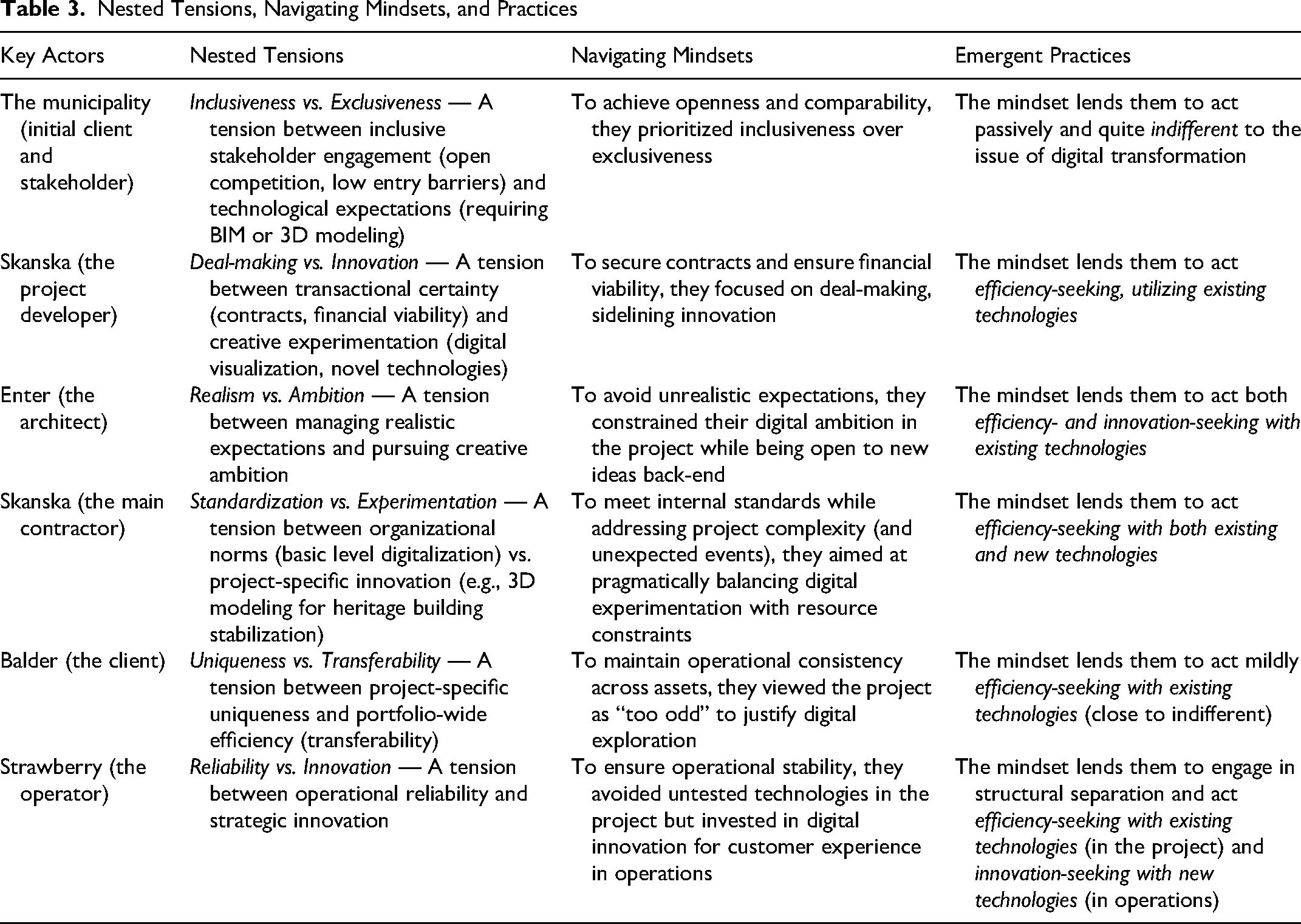
Consequently, the municipality navigated the nested tension of inclusiveness and exclusiveness, opting for inclusiveness and low entry barriers in the architectural competition. This choice was shaped by a desire to “finally get the project off the ground” after previous failed attempts, failures that made the tension salient. By avoiding digital requirements such as 3D modeling, they thought they would increase the likelihood of attracting a compelling proposal and securing a committed developer. While they acknowledged that digital tools could have added value, especially in visualizing the integration with the heritage environment, their navigating mindset suppressed exploration in favor of comparability and broad participation. This mindset, embedded in both embedded experiences (i.e., previous failures) and temporal urgency, led them to act in ways that made them largely indifferent to digital transformation at this stage of the project.
Skanska (the Project Developer)
From the project developers’ point of view, the use of digital technologies played a vital role in visualizing the project, particularly in relation to the aforementioned architectural competition. More specifically, in collaboration with the architect, drones were used to visualize the views from the hotel rooms, which, at the time, was a novel application for them, even if not very innovative. As the project developer described it, “… look here, you'll see something cool […] This is what it looks like from this floor, with the bed, and windows overlooking the lake” (Business developer, Skanska). In this sense, it can be claimed that Skanska project development reaped benefits from exploiting existing digital technologies, even if engaging in something that, for them, was new. Still, apart from this example, it was not seen as a critical resource to reach their goal: striking a deal and delivering a profitable project. In fact, Skanska project development seemed relatively uninterested in the role new digital technologies could play. As expressed by the business developer, “… it is the contract that is the selling point. That’s what the deal is based on” (Business developer, Skanska). Being pressed on whether the technological development over the last 10 years has changed this, the business developer answers: “Sure, technology has developed quickly. But I don't think it matters. I don't feel it anyway; that there would be any difference. It is still about finding a good land plot, the right product, speaking for the product, and getting the customer to feel confident in us, or me […], and that this is an opportunity. It's the same as before” (Business developer, Skanska).
Clearly, the deal-making was perceived as being at odds with innovative digital technologies, where the business developer primarily opted for transactional certainty.
Consequently, in their role as the project developer, Skanska navigated the nested tension of deal-making and innovation, where the need to secure contracts and ensure financial viability took precedence over digital experimentation. This tension was inherently salient due to Skanska’s business model, which relied on an established approach for generating and selling projects to sustain demand for its production unit. As the business developer explained, “… that’s how it works […] we’re basically always selling the projects,” and “… it is the contract that is the selling point. That’s what the deal is based on.” Also, the developer emphasized that technological advancements had not changed their approach. This mindset, rooted in transactional certainty, led them to act in ways consistent with an efficiency-seeking practice utilizing existing technologies. Moreover, since Skanska acted as its own client during the design and construction phases, the usual dynamic, where the client places pressure on the contractor to innovate, was absent. This further reduced the incentive to explore novel technologies, reinforcing a pragmatic and commercially driven approach to project development.
Enter (the Architect)
In contrast to the project developer, the architect expressed both interest and demonstrated a high level of confidence in the role that digital technologies could play in the project. The above-mentioned use of drones was also the architect’s idea, even though it benefited Skanska (project development). Still, in an interview, the lead architect described how they avoided making too photorealistic visualizations (despite having the capacity) because of the risk that it might create unrealistic expectations of the final product. In other words, they wanted to avoid a situation where customers and stakeholders would get inflated expectations of what the building would look like and then get disappointed if it did not meet those expectations in the end. At the same time, the architect stressed that they could do much more by using digital tools when involved in projects, but the problem is that they don’t want to be “running too far ahead of” the other project actors who cannot reap the benefits (Lead Architect, Enter).
Later in the process, a BIM model was developed primarily to be used for collision controls. Another architect explains: “In this project, we were supposed to draw in 3D to be able to coordinate with other consultants so that there were no conflicts. And Skanska had a digitalization manager […] who held coordination meetings where we went through points in the model. Once everyone had started drawing and got something together, the model was coordinated, and we went through it. Where do we clash? Who does what and so on? […] But there were no requirements that we be able to extract information from the model or be able to make calculations or anything like that” (CEO, Office Manager, Enter).
Hence, despite a model being developed, it was relatively modestly used. The architect's strategic intent can be described as a vague type of structural and temporal separation where new ideas are developed in the line organizations but (only) implemented if they fit with the expectations/competence level of other involved actors.
In essence, Enter navigated the nested tension of realism and ambition, shaped more by institutional context than by technical limitations or their ability. Although they demonstrated high competence in digital technologies, initiating the use of drones for visualizing hotel views and developing a BIM model for coordination, they deliberately avoided the photorealistic renderings to prevent inflated expectations. This tension became salient due to previous experiences and a wariness to not “run too far ahead” of other actors. Their navigating mindset, rooted in social and communicative concerns, led them to primarily act in ways consistent with an efficiency-seeking practice using existing technologies. However, because of the structural and temporal separation, they were able to, in the line organization, act more innovation-seeking. Although speculative, had they stretched their digital ambitions further (which they had the capacity to do), it might have motivated other actors to engage more deeply with new digital technologies.
Skanska (the Main Contractor)
While the project development branch of Skanska illustrated limited digital engagement, the contractor branch had a standardized system with different levels for using digital technologies. The so-called “basic level” is compulsory for all projects. However, a production engineer at the contractor stated that what was considered a basic level in 2018 is now something different: “Every year we have tougher and tougher requirements on what constitutes the basic level” (Production engineer, Skanska). Requirements that were at a high level in 2018 were at the basic level at the time of the interview (in late 2023). The production engineer further stated that there are local variations in the use of digital technologies. In Gradienten, BIM 360 was used for internal quality controls, which was a new application in the district, as subcontractors also did their quality controls through the system. The way of working was appreciated, and the production engineer was supported by both the site manager and contract manager in implementing the (at the time) new way of working. However, the production engineer states that, in the previous project that he was working on, it was much harder to convince everyone of the new way of working. Thus, the main contractor engaged in a mix of temporal separation and contextual ambidexterity. Employees were actively encouraged to try new digital tools in the project, and sometimes, specific projects are even pinpointed as “test beds” of new technologies. But, as the production engineer states, “you cannot be short of staff or run into the kind of problems Gradienten had […] if you want to be able to explore the use of new digital technologies” (Production engineer, Skanska), referring to the incidents that caused significant delays. They need to be pragmatic. Therefore, as a surveying engineer concludes, “It is in really large projects that you can drive technological development,” because there are always more resources (Surveying engineer, Skanska).
Another respondent also stated that the use of digital tools in projects has evolved over time. He claims that working “analogically,” as was common before, today feels like the “Stone Age” (Production engineer, Skanska). At the same time, the respondent explains that being innovative in projects like Gradienten or other commercial projects does not make much sense for them, because projects are too different, making it difficult to engage in temporal separation and exploit innovations in other projects. However, in the bulk of their projects (which are housing projects), they try to be innovative, because projects are more similar, and innovations are easier to exploit.
As such, Skanska’s contractor branch navigated the nested tension of standardization and experimentation, balancing organizational norms with project-specific innovation needs. This tension became salient during the construction phase, when unexpected challenges, such as structural movement in heritage buildings and the discovery of a phosphorus-filled well, necessitated creative problem-solving and the use of new, advanced digital tools. Their navigating mindset was pragmatic and shaped by resource constraints and project complexity, leading them to act in ways consistent with an efficiency-seeking practice using both new and existing technologies, which they argued was a common approach in project operations where cost and time pressures dominate.
Balder (the Client)
With the municipality having no expectations or demands on the use of digital technologies, the project developer exploiting some existing benefits, the architect holding back on their ambitions, and the main contractor entering the project at a “basic level,” one might expect the client to be the actor who places demands on the project. But this was not the case.
As a property owner of 63 hotels in Sweden, adding another hotel to the stock was not seen as a major thing. The project manager for new production explains: “Once they had signed a lease with Choice and everything was ready, they came to us and wanted to sell the project […] turnkey. […] Then we accepted it, and took, what can I say, a monitoring role to ensure that what Choice and Skanska had then agreed on would be implemented.” (Project manager—new production, Balder).
He further explains that, while they see themselves as having a monitoring role, they “try to renegotiate things that they know create long-term problems.” The monitoring is done from a property management perspective, only interfering with the process when identifying things that may lead to increased operational costs. He says, “… neither Skanska nor Choice brings this perspective […] Then you need to piece together these three different driving forces and get them to meet somewhat in the middle” (Project manager—new production, Balder).
The monitoring role taken is confirmed by both the property development and contractor branches of Skanska. On a direct question as to whether Balder had any specific demands and/or opinions about the level of technical use or exploration of new digital technologies, the (interim) client project manager at Skanska responded, “No, Balder has been very laid back, if you ask me.” On a similar question, the contractor’s project manager responded, “I didn't have much contact with Balder. They participated in some planning meetings” (Project manager, Skanska).
Consequently, Balder navigated the nested tension of uniqueness and transferability and adopted a passive monitoring role, shaped by their focus on portfolio-wide efficiency. The tension became salient due to the project's lack of transferability and the already heterogeneous nature of Balder’s real estate portfolio, which made it difficult to see any strategic value in exploring digital innovations that couldn’t be scaled across assets. Simply put, the project was considered “too odd” to enable transferability. As the project manager explained, they primarily intervened to renegotiate aspects that might cause long-term operational issues, rather than driving innovation. Like Skanska’s project developer role, Balder’s stance challenges the common assumption that clients should pressure contractors to innovate. In this case, this dynamic was clearly absent. As a result, their engagement was close to indifferent but can be described as a “mild” efficiency-seeking practice using existing technologies, reinforcing a low digital ambition across the project.
Strawberry (the Operator)
As introduced in the general case narrative, Strawberry became involved as the future operator in Q3 of 2017. In contrast to the client (Balder), the operator took a more active role in the design phase. One of the project managers at the operator explains, they need: “lots of decisions from us, because we want to be involved and influence everything from logistics, how the flows should look, in terms of both entrances for both customers and staff, and the garbage rooms, and all those functions, the commercial kitchen, how it should look and what is needed there, and then of course all the surfaces, how it should physically look with everything from walls and floors and colors and wallpaper” (Project manager, Strawberry).
That said, the operator had a somewhat divided and operationally focused strategy regarding the exploration and exploitation of digital technologies.
On the one hand, for digital tools connected to control of, for example, HVAC systems, the respondent states that they do not choose any applications that are not tested and verified in practice, and when it came to utilizing the 3D model, they were not involved. Also, as in all projects, there was a demarcation list “where it is also clear who invests, who pays, or who is responsible if something breaks” (Project manager, Strawberry). This implies that most of what has to do with basic functionality and production of the building is not the operator’s responsibility.
However, on the other hand, when it comes to working with customers and customer data, lots of resources are spent on developing digital applications for analyzing customer data to enhance customer satisfaction and make operations more efficient. They even have a dedicated unit for this: “We have a large unit called eBerry that works with technical development and technical solutions for our hotels. It can be anything from cleaning robots to a new mobile key […] that we work with” (Project manager, Strawberry).
Consequently, Strawberry faced the nested tension of reliability and innovation and navigated this by structurally separating strategic innovation efforts from involvement in the construction project. This tension became salient due to their need to ensure operational reliability in a complex, multi-actor setting, where they avoided untested technologies for building systems. As such, they engaged in both demands in different parts of the organization. They invested heavily in digital transformation within their core operations, while remaining cautious and efficiency-focused in the project. This led to an engagement in dual practices: efficiency-seeking with existing technologies in the project and innovation-seeking with new technologies in operations, highlighting a domain-specific approach.
Tensions, Navigating Mindsets, and Emerging Practices
The findings reveal that this ambidextrous tension in the project manifested itself as various nested tensions embedded in the institutional and temporal context of each actor. Six nested tensions were identified, one uniquely related to each of the key actors, prompting various responses in their engagement with digital technologies. Table 3 summarizes the nested tensions, each actor’s navigating mindset, and the subsequent emerging practices.
Nested Tensions, Navigating Mindsets, and Practices
From a Strategic Capability to a Situated Practice
In this study, we set out to understand the navigation of ambidextrous tensions related to digital transformation in an interorganizational context. The results show that the actors do not simply engage in or embrace exploration or exploitation but instead navigate various nested tensions (see Table 3 for a summary). These nested tensions, unique to each actor, are embedded in the institutional and temporal structures of the specific context. Furthermore, when actors make sense of the nested tensions, they do that in relation to specific navigating mindsets, prompting them to act in different ways. It is thus possible to conceptualize “digital ambidexterity” as a situated practice, meaning that responses to ambidextrous tensions are not universal but emerge from actors’ interpretations of tensions within the specific institutional and temporal context.
As outlined in the background and summarized in Table 1, acknowledging the two complementary dimensions of means (existing vs. new technologies) and goals (innovation-seeking vs. efficiency-seeking) makes it possible to differentiate among four different “type-practices.” As such, these dimensions provide a useful basis to categorize actors’ responses, clarifying how their navigating mindsets lead them in different directions. However, the results suggest that actors’ practices are not static, but that actors can simultaneously engage in or shift between the four practices, depending on context and constraints. To illustrate this, we have integrated the practice trajectories within the typology, capturing shifts and overlaps over time without imposing a linear sequence (see Figure 1).
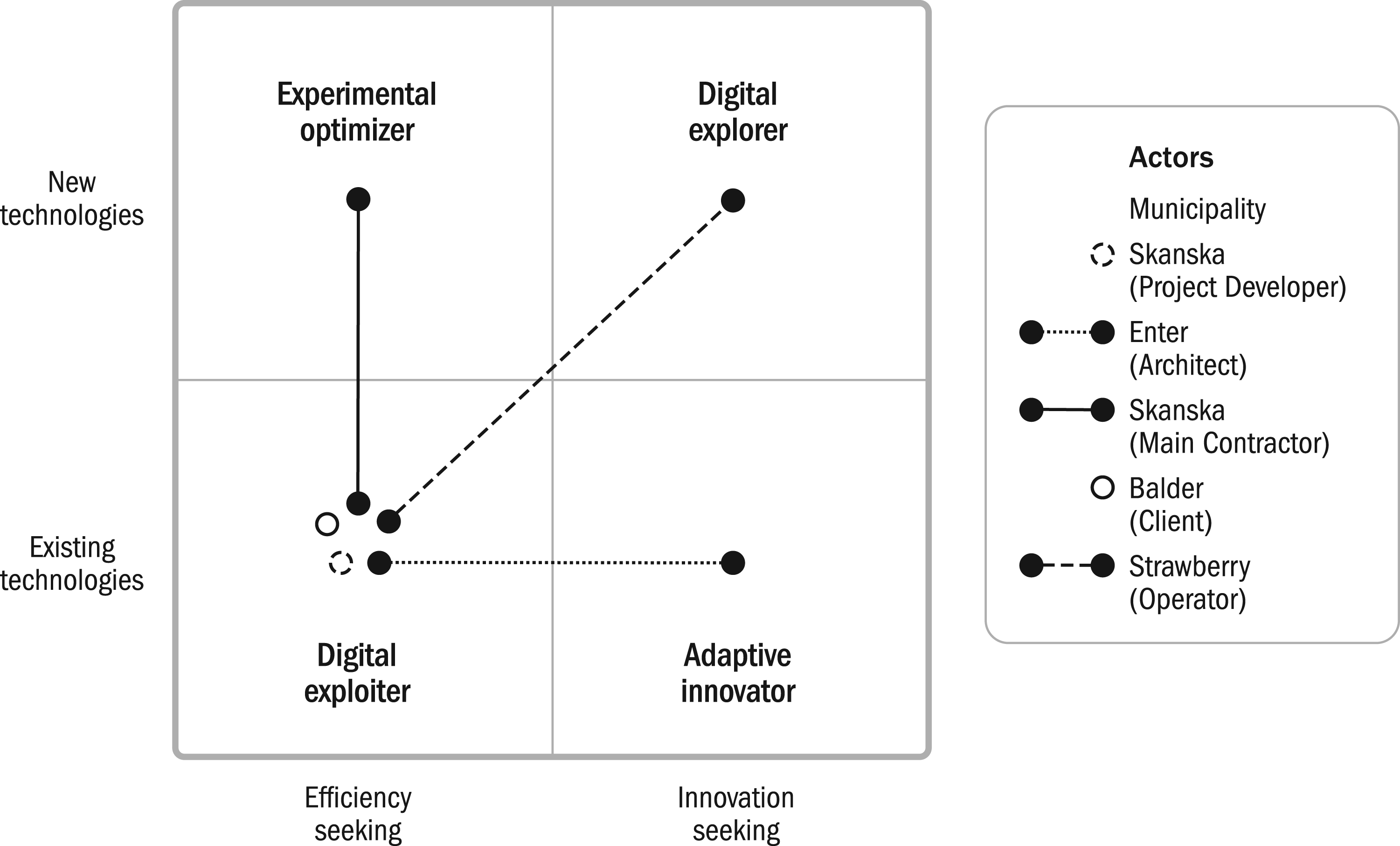
A quadrant model of practices and their trajectories.
As illustrated in Figure 1, apart from the municipality, which, due to its navigating mindset, indirectly suppressed the need to engage in any digital exploration or exploitation, all actors engaged in efficiency-seeking practices using existing technologies (in the figure, referred to as a “Digital exploiter practice”). While the project developer (Skanska) and the client (Balder) seemed to uphold this practice throughout the project process, the three other actors either embraced a complementary innovation-seeking approach or at least engaged in exploiting new digital technologies; thus acting ambidextrously. For example, even if social and communicative concerns constrained the architect’s digital ambitions, they engaged in structural separation to pursue both efficiency-seeking and innovation-seeking practices, alternating between what we describe as “Digital exploiter practices” and “Adaptive innovator practices.” Similarly, while the main contractor’s navigating mindset was pragmatic and shaped by resource availability and project complexity/size, they alternated between acting as a “Digital exploiter” and an “Experimental optimizer.” The latter, in response to critical events. Finally, the operators’ (Strawberry) navigating mindset was domain-specific, seeking structural separation between the project and their core operations, which allowed them to act as both a “Digital exploiter” in the project and a “Digital explorer” in their core operations.
Hence, while prior research has conceptualized digital ambidexterity as either a strategic choice or an organizational capability (e.g., Magnusson et al., 2021a; Magnusson et al., 2021b; Hoessler & Carbon, 2022), our findings thus suggest that it is more accurately understood as a situated and fragmented practice, dependent on the context and navigation mindsets of each actor. For example, the municipality’s avoidance of digital requirements was not a strategic choice, but a consequence of acting inclusively. Similarly, the fact that the architect constrained their digital creativity was not because of a lack of ambition or interest, but because of contextual circumstances. As such, this resembles the finding by Papachroni et al. (2016), who showed that actors’ involvement depends on the various interpretations they make of tensions. Ambidexterity mechanisms/strategies were not systematically (or “strategically”) deployed, but practices rather emerged in response to the various actors’ roles and the project dynamics. As such, the study aligns with previous findings of nested tensions being situated and formed by navigating mindsets (cf. Smith & Tushman, 2005) but contributes to a deeper understanding of why it is so hard to engage in digital ambidexterity in an interorganizational project-based context. Thus, the study contributes to the recently identified challenges of digital transformation in this context (e.g., Eriqat et al., 2024; Chowdhury et al., 2024).
Viewing digital ambidexterity as a situated practice also explains why misalignment of navigating mindsets occurs across actors. For instance, the municipality’s avoidance of digital requirements during the architectural competition was shaped by previous failed attempts and temporal urgency, illustrating how situatedness influences navigation. Similarly, the architect’s decision to avoid photorealistic renderings, despite technical capability, reflects a situated response to social concerns about unrealistic expectations. Consequently, as illustrated in Figure 1, the unfoldment of the project leads to a fragmented digital landscape. As such, the findings suggest that enabling digital ambidexterity in an interorganizational construction project context requires more than individual actor initiatives or strategies, as misaligned mindsets hinder collective innovation and the exploration of project-related digital technologies. The misalignment of navigating mindsets among actors can also be contrasted with the common assumption that a way to improve innovation in this setting is to improve clients’ procurement skills and have clients increase their demands for exploration (e.g., Brandon & Lu, 2009; Filho, 2025). The presented case is clearly at odds with these assumptions in terms of both its fragmentation and the fact that it is unclear who the “real” client is. During the project process, four clients with different goals and logics can be identified. The municipality (as the original client and landowner), which sold the land to Skanska Project Development (the interim client), who, after they won the “architectural competition” and promised the municipality to deliver a hotel that would fulfill the municipality's vision, contracted Strawberry (as the operating client), and sold the project to Balder (the client and long-term owner). If accepting the common assumption that the client should increase their demands for exploration, one might ask: for which client does it make sense to try to increase demands to align logics? In the case of Gradienten, it does not seem to make any sense for any of the clients.
Theoretical Contributions
This study contributes to the literature on interorganizational ambidexterity and digital transformation by reconceptualizing digital ambidexterity not as a stable organizational capability, but as a situated and fragmented practice shaped by contextual constraints and actor-specific navigating mindsets. By identifying six nested tensions unique to each key actor, the study extends ambidexterity research focused on digital transformation by demonstrating how the “overarching” exploration–exploitation tension is manifested in practice and how actors respond. The quadrant model developed in this study offers a novel typology of “type-practices,” integrating the dimensions of means (existing vs. new technologies) and goals (efficiency-seeking vs. innovation-seeking). This typology enables a more nuanced understanding of how digital transformation is navigated in project-based interorganizational settings. Furthermore, the study challenges the assumption that client-driven procurement strategies alone can foster innovation, highlighting instead the importance of aligning navigating mindsets across actors to avoid fragmented digital landscapes and enable collective innovation.
Conclusions
Based on the study, it can be concluded that the overarching tension between exploration and exploitation that actors in interorganizational project-based settings face when engaging in digital transformation manifests in nested tensions unique to each actor. These nested tensions are embedded in the institutional and temporal structures of the specific context. Engaging in these tensions thus becomes a situated practice where the actors’ respective navigating mindsets guide them in different directions, causing a fragmented digital landscape where everyone is looking out for “their own best interests” with little focus on what would be the “best thing” for the project. The quadrant model provided a useful basis for categorizing actor practices. However, the empirical data show that actors shift between practices depending on constraints and contexts, and that they, at best, act ambidextrously in isolation. Importantly, the study challenges the common assumption that improved client procurement skills alone can drive digital innovation in interorganizational project-based settings such as construction. The presence of multiple clients with divergent navigating mindsets made it impossible to develop a unified digital ambition. This fragmentation underscores the importance of aligning the navigating mindsets. For project actors, this means fostering shared digital goals early in the project life cycle, clarifying roles and expectations around innovation, and creating mechanisms for cross-actor learning and coordination. For researchers, the findings open up opportunities for further studies of how ambidexterity unfolds in interorganizational settings and how navigating mindsets can be shaped or aligned, taking the starting point in digital ambidexterity as a situated practice.
Footnotes
Declaration of Conflicting Interests
The author(s) declared no potential conflicts of interest with respect to the research, authorship, and/or publication of this article.
Funding
The author(s) disclosed receipt of the following financial support for the research, authorship, and/or publication of this article: This research was supported by Formas, a Swedish Research Council for Sustainable Development [Dnr: 2021-00298], and Jönköpings läns byggmästareförening through the co-funded research project “Digital ambidexterity in project-based organizations: The art of balancing short-term profitability and long-term competitiveness.”
Author Biographies
 . He can be contacted at mattias.jacobsson@umu.se