




Abstract
Organizational design is composed of structure, the artifact, and coordination, the action. Existing organizational design literature lacks coherence, resulting in models that overlook the importance of coordination as an organizational design issue, which intensifies in megaprojects. We explore the roles of clients when designing megaproject organizations, identifying four coordination roles: (1) meta-organizer, (2) gatekeeper, (3) interface manager, and (4) mediator. These roles align with management levels (strategic, tactical, operational), corresponding to megaproject phases and organizational design development. The conceptual framework contributes to the organizational design literature by providing a systems-wide view and enriching the understanding of the multilevel coordination roles of clients.
Keywords
Introduction
Megaprojects deliver large-scale assets often involving (1) substantial investment (more than US$1 billion); (2) long design and construction schedules (over five years); (3) long lifetimes (beyond 50 years); (4) large societal impact; and (5), advanced and innovative technologies (Brunet & Cohendet, 2022; Bruzelius et al., 2002; Denicol et al., 2020; Flyvbjerg et al., 2014; Molenaar, 2005; Turner, 2009; van Marrewijk et al., 2008). Megaprojects are planned and delivered by an array of organizations distinguished by the internal versus the external boundary. The internal organization is known as the client organization, which is usually the contracting authority responsible for setting the right group of capabilities (i.e., isolated or combined elements such as knowledge, experience, skills and resources; Dosi et al., 2000; Teece et al., 1997; Winter, 2003) and coordinating them throughout the megaproject life cycle. The supply chain and other contributors form the external level.
The organizational design field has been providing methods and tools to structure and coordinate organizations. Organizational design is defined by Burton and Obel (2018, p. 2) as “the fit between structure and coordination. Structure is to break a big purpose or problem into smaller problems and units. The result is a set of tasks that have to be performed. The coordination is managing these smaller problems, units, and tasks into a whole so that they fit together to achieve an overall purpose.” Traditional organizational research, such as that from Mintzberg (1989) and other authors (e.g., Ensign, 1998; Gandora, 1997), also adopted a similar perspective by stating that an organization is composed of two fundamental requirements: division of labor (structure design) and coordination.
Aubry and Lavoie-Tremblay (2018) also distinguish two parts of organizational design: the thing, the design of the artifact, incorporating the formal structure, and the process, the emergent interchangeability of capabilities managed through coordination roles. Based on the understanding of organizational design as the structure (the thing, the artifact) and the coordination (the process, the development), megaprojects can perform their organizational design in two steps: first, acquiring or developing organizational capabilities to build up the structure of the client organization; and second, integrating these capabilities throughout coordination to make the organization work as a unified system rather than isolated parts. Regarding the first step, organizational capabilities are acquired or developed in an organizational-specific way (Leiringer & Zhang, 2021). When acquired, these capabilities are directly or indirectly hired from the market, known as interorganizational capabilities, placed at the external boundary of the client organization. When developed, the capabilities are shaped and executed in-house, known as intraorganizational capabilities, and placed at the internal boundary of the client organization (Eriksson & Kadefors, 2017). Regarding the second step, the client organization has to glue this set of capabilities together, as a whole system, and closely follow the constant changes involved in megaproject development. This second step relates to the coordination of the megaproject organizational system and is the focus of this work.
Traditional studies of organizational design suggest that as complexity increases in organizations, more sophisticated mechanisms of coordination are required (Galbraith, 1977; Lawrence & Lorsch, 1967; Thomason, 1966). Megaprojects are regarded as highly complex, with multiple social and technical interactions that cannot be predicted (Daniel & Daniel, 2019), therefore they need well-established coordination roles. Different coordination roles are required at different levels of the megaproject to match its design dynamism, which is associated with the natural development of the asset. For example, Bechky (2006) shows how coordination can vary from standardized, hierarchical, and routine-based to informal mechanisms such as mutual adjustment. Crowston (1997) and Malone et al. (1999) state that the coordinator is responsible for managing dependencies among elements and that there are different types of dependencies such as among capabilities (e.g., governance and stakeholder management; Iacono et al., 2012) and inside capabilities (procedures and routines; Beckett, 2003). Davies et al. (2009) and Davies and Mackenzie (2014) reinforce the dependence among subgroups, stating that organizations involved in megaprojects should work jointly to achieve the levels of integration and coordination required.
Extant literature on organizational design has evolved from a production perspective to a management approach, amplifying fragmentation with similar terms and definitions used interchangeably. Nonetheless, there are many models to choose from when designing the organization, inspired by different theories. Such fragmentation is reflected in the reporting of organizational design elements and coordination roles. For example, Iacono et al. (2012) relate two organizations in the rail industry sector (TEST and Firema) acting as coordinators to multiple organizations. Both organizations participated in the organizing, governing, and managing of the latent intra- and internetwork. Iacono et al. (2012) highlight how not only the organizational design can be unique but also the coordination, solving one-off challenges. In contrast, Beckett (2003) approaches coordination at a different level, observing that many operational activities are interrelated, and decisions need to be made before one is finished and the other begins. His solution is to rely on a knowledge system, reflected in the coordination among work packages. Fernandes et al. (2018) adopt a general and systemic perspective and present the implications for coordination in the 2016 Rio Olympics, when the organizational design changed over time to accomplish specific phases, moving from a bureaucratic organization to an organic organization. Such a change was accompanied by variations in the role of the coordination, from a vertical and authoritarian approach to a more horizontal and flexible perspective.
Based on previous organizational design models (e.g., Galbraith, 2009; Mintzberg, 1989; Nadler et al., 2011), coordination roles are not framed as an organizational design problem but rather as an exclusive and unique component of the organization. Consequently, coordination loses cohesion with the structure part of the organizational design and jeopardizes the megaproject evolution. Moreover, this problem leads to a lack of consensus on who should be playing each role since there is no distinction between coordination roles and management levels. Based on these challenges, we explore the following research question:
What are the coordination roles of clients when designing megaproject organizations?
The article is divided into six sections, as follows: the Introduction, providing a general frame of megaprojects, organizational design and coordination, culminating at the research gap and the aim of the article; Literature Review, presenting the organizational design background, clarification of different terms, definitions and nomenclatures, and summarizing existing organizational design models; Research Question, presenting the question that guided this research; Conceptual Framework, with the four coordination roles for designing megaproject organizations and their distribution through the management levels and the megaproject phases; Discussion, where we further discuss the coordination against permanent and temporary models and theoretical lenses; and Conclusion, with a summary of the work and perspectives for future research.
Literature Review
Organizational Design Background
Organizational design has been recognized as an important aspect of organizational strategy to enhance delivery and gain competitive advantage (Chandler, 1992). Initially, organizations were designed to solve workflows, define job specifications, and meet the demand for standardized products. They were focused on the optimal fit between structure and division of tasks to provide a stable and predictable process under varying levels of uncertainty (Galbraith, 1977). Organizational design would comprise mainly formal aspects, such as the management of resources, in congruency with the market and customers’ demands (Mintzberg, 1989). Influenced to a great degree by congruency theory (Nadler & Tushman, 1980), the organizational design literature developed several models to describe key components that constitute organizations (Burns & Stalker, 2011; Galbraith, 1977; Lawrence & Lorsch, 1967; Mintzberg, 1989; Perrow, 1967). For example, the Star Model (Galbraith, 1977, 2002, 2009), which highlights strategy, structure, process, people, and rewards, and the 7S Model (Pascale & Athos, 1981; Waterman et al., 1980), which underlines strategy, structure, system, style, skills, staff, and shared values. These models accentuate intraorganizational aspects in an attempt to explain the differences in organizational forms and their performance. A key assumption is that organizations can vary significantly in their design, building upon different levels of these factors. However, this research stream does not relate to interorganizational aspects such as informal and contextual factors (e.g., network relationships and time in history). Moreover, it promotes a static view of organizational design, neglecting the temporality and dynamics of projects (Bakker et al., 2016; Söderlund et al., 2014).
To address these issues, academics have turned to other theoretical backgrounds, significantly evolving the organizational design stream beyond intraorganizational design challenges to interorganizational collaboration patterns and an actor-centric approach (Gulati et al., 2012). Contingency studies (Lawrence & Lorsch, 1967) introduce the idea that internal organizational arrangements are designed to deal with the external environment. The organization is segmented into different units (e.g., design, engineering, production, marketing) with specialized knowledge to deal with specific situations from outside. The organization will achieve its goals by integration and collaborative work. On the other hand, configuration theory questions this fragmented approach, stating that decisions should be made by having a systemic view of the organization in which it is possible to see its interdependencies (Meyer et al., 1993). However, neither theory can explain some highly complex and dynamic organizational forms such as temporary organizations or project-based firms (Hobday, 2000; Lundin & Söderholm, 2013). The complementarity perspective, inspired by these new forms of organization, shifts the focus to understanding organizational changes (Whittington et al., 1999); it offers an approach of patterns of organizational practices and how they fit in particular business strategies. The complexity perspective has supplemented the picture of external influences by emphasizing the nonlinear causes–consequences in everyday organizational situations where social aspects are prevalent (Clegg, 2000). From the complexity point of view, organizational design is understood as a larger social phenomenon, with several unpredictable variables leading to create, shape, and execute the organizational design (Seidl & Whittington, 2014).
Through this evolution, organizational design moves from a strict formal, internal, and fragmented approach to a more flexible and frequently changing notion of organizational design (Bakker et al., 2016). The project management domain has gradually advanced knowledge, building upon organizational theory to include nontraditional types of organizations such as the temporary organization forms (e.g., virtual organizations and megaprojects). To illustrate the growing interest in the topic, Bakker (2010) performed a systematic review about temporary organizations in which the main challenges have been to coordinate interfaces in the intra- and interorganizational boundaries. New forms of organizing allowed academics to recognize and analyze more abstract factors. Such factors continuously influence the organizational design since early works, involving: internal and external uncertainty (Galbraith, 1977; Thompson, 1967), triggers of change (Burns & Stalker, 2011; Gareis, 2010); institutional traditions, norms, values (Simard et al., 2018), complexity (Daniel & Daniel, 2019); and individual behaviors and social networks (Oubrich et al., 2021; Prasad & Tanase, 2021). Organizational design is understood as both the structure (the thing), comprising the materiality of it, such as organizational charts and physical spaces; and as the active process of design (the designing)—a reflexive exercise by which organizational design is performed and constantly reconfigured (Aubry & Lavoie-Tremblay, 2018; Bakker et al., 2016; Simard et al., 2018). Despite progress in the organizational design literature, little is known in the context of megaprojects. More specifically, the process part is reflected in coordination activities, which is neglected in a more systemic perspective.
Nomenclatures, Terms, and Definitions
Organizational design definitions have evolved along with the history of the organizational design literature. Definitions related to industrial production usually treat organizational design as the structure or architecture of the division of tasks and its coordination. The main idea is to reduce complexity by distributing the right number of tasks into stages (e.g., work packages) and making them work in concert. To illustrate, Miller and Friesen (1984; as cited in Greenwood and Miller, 2010, p. 78) define organizational design as “the structures of accountability and responsibility used to develop and implement strategies, human resource practices, and information and business processes that activate those structures.” To Simon (1967), organizational design exists to achieve organizational goals and enables a path on which information flow can move.
More recent research recognizes organizational design as social constructs, where people create relationships between different activities and the roles, responsibilities, and authorities to conduct the different tasks. From this perspective, organizational design also involves communication, leadership, culture, incentives, routines, and procedures (Burton et al., 2006; Rowland & Parry, 2009). Greenwood and Miller (2010) move away from a deterministic definition and propose a comprehensive view, stating that organizational design drives the way strategies are formulated and determines whether and how they can be implemented. Organizational design is the vehicle by which firms recognize the need for adaptation, determine its course, and put change into effect. It is the framework that enables and allows collective behavior to occur.
The merging of both points of view—organization as a task structure and organization as a social construct—separates the organizational design definitions into two (Simard et al., 2018): (1) the formal organization—or the material part—as “the fixed set of rules, procedures, and structures for coordinating and controlling activities” and; (2) the informal organization—the social part—as “the emergent patterns of individual behavior and interactions among individuals, norms, values, and beliefs that underlie such behaviors and interactions” (McEvily et al., 2014, p. 300).
The advancement of organizational design has allowed acknowledgment of the formal (material) organization, the informal (social) organization, and the interchangeability between both, following the evolution of a product or project that is constantly changing, as it develops (i.e., both the thing and the process) (Aubry & Lavoie-Tremblay, 2018). Organizations are understood as complex systems, involving dynamic and open boundaries, called intra- and interorganizational boundaries, connected through coordination roles at different levels. MacCormack et al.’s (2012) definition of organizational design as explicit efforts to improve organizations, focusing on emerging fits rather than studying equilibrium after the organization is designed is most aligned with more recent approaches. The organizational design process assumes that parts of the organization play an active role in designing the organization but also the organizational design form itself, as managers respond to pressures of the environment and decisions are made. Miterev et al. (2017) complement MacCormack et al.’s (2012) perspective by analyzing different organizational forms derived from the options of design strategies according to their external and internal contingencies.
Yet, such diversity of understanding in organizational design provides a wide range of words used to refer to organizational design, usually more related to the artifact or the action. Common terms in the artifact domain are “organization configuration” (e.g., Ennen & Richter, 2010; Mosca et al., 2021; Turner & Miterev, 2019), “organization structure” (e.g., Bakker, 2010; Chandler, 1992; Galbraith, 1977; Miles et al., 1978; Miterev et al., 2017) “organization arrangements” (e.g., Burton & Obel, 2018; MacCormack et al., 2012; Miterev et al., 2020), and “organizational architecture” (e.g., Aubry & Lavoie-Tremblay, 2018; Browning, 2001; Nadler et al., 2011). Common terms in the action domain are “organization forms” (e.g., Ford & Randolph, 1992; MacCormack et al., 2012; Miterev et al., 2017, 2020; Mosca et al., 2021), “organizational culture” (e.g., Elsbach & Stigliani, 2018; Ford & Randolph, 1992), and “organizational networks” (Giustiniano & D’Alise, 2015; Gulati et al., 2012).
Existing Organizational Design Models
Megaprojects have a mix of characteristics driven by different types of organizations. A megaproject is argued to be a temporary organization (Dille et al., 2018; Flyvbjerg, 2017; Flyvbjerg et al., 2014), however, with a lifespan long enough to also be considered a permanent organization (Brookes et al., 2017; Sato & Chagas, 2014). The presence of permanent organizations involved with and within the megaproject organization contributes to its permanent characteristic (e.g., Denicol & Davies, 2022; Sydow et al., 2004), whereas the constant change of suppliers reinforces its temporary nature. Megaprojects can also be understood as a core structure of professionals, with varying types of peripheral organizations constantly changing (Mesa et al., 2020). Consequently, megaprojects do not fit into previous models of organization design such as the Star Model (Galbraith, 2009), Organizational Configurational Model (Mintzberg, 1989), and the 7S Model (Waterman et al., 1980). These models were developed to permanent organizations, in which a basic structure is settled to handle manufactured products or deal with changes in specific conditions, for example, when a new technology is going to be implemented in the production process, highlighting the weakness of dealing with complex organizations. The permanent organizational models are focused on describing and guiding the organizational design to attend determined conditions. Permanent organizational models propose a diagnosis for the organization, where the current state of internal elements is analyzed and enables an alignment with the organizational goals. Organizational design transformations are represented as a scheduled situation that happens one step at a time, with a clear path of beginning, middle, and end, “largely choreographed and controlled” (Graetz & Smith, 2010, p. 150). On the other hand, change models, hereby stated as temporary organization models, are usually related to transformations in the production/service process, where the organization goes through major changes to incorporate new demands from the market and needs assistance to understand the variables influencing these changes (Burke & Litwin, 1992; Nadler et al., 2011). The following are examples of the most cited models, from both the permanent and temporary streams, respectively:
Permanent organization models: 7S Design Model (Waterman et al., 1980); Star Model (Galbraith, 2009); Organizational Configuration Model (Mintzberg, 1989); and Weisbord’s Six Box Model (Weisbord, 1978) (see models in the Appendix at the end of the article). Temporary organization models: Transformational Model (Centre of Organization Design [COD], 1995); Congruence Model (Nadler et al., 2011); Burke-Litwin Change Model (Burke & Litwin, 1992) (see models in the Appendix).
The majority of available frameworks are related to permanent organizations, including automotive companies, banks, consulting firms, cultural centers, penitentiaries, among others, with a stable and long-lasting core structure. The aforementioned permanent models, despite slightly different approaches, follow similar thinking when related to organizational design. In different ways, they all address structural configurations (for example, structure and strategy) related to functional features (for example, people, culture, operations), sharing similar issues such as not simultaneously or systematically considering the boundaries between intra- and interorganizational levels, losing the connections between the organization and its external environment. In addition, they rely on historical data of similar entities to design the organization. The strong focus is on the content, rather than the process. Megaprojects are one of a kind and often depend on the creation of a unique organization. Deliberate mimetism, reported by Dimaggio and Powell (1983) in project-based organizations, refers to copying and adapting practices among organizations from the same field. Megaprojects, despite being connected by the civil engineering domain, are shaped by different contexts, such as railways, airports, stadiums, and so forth, where there is no similar entity with a long-lasting historical database to rely on (Esposito et al., 2021). Such models miss the temporality and dynamism present in megaprojects, not offering an effective way to deal with the emergent events that often happen in the delivery phase. When a megaproject is being constructed, sometimes quick adaptions are necessary in the organizational design to cope with the unpredictability. Meanwhile, temporary organization models are treated as open systems, where change happens in a one-way flow or in cyclic loops (Nadler et al., 2011; Burke & Litwin, 1992). Temporary organization models usually reinforce the benefits from volunteering, spontaneous networks, and personal relationships (Jiang et al., 2019; Śladowski et al., 2019). These models are focused on handling the variables that trigger changes, instead of treating the change as a natural evolution of the organization; therefore, they provide no guidance to the design of the megaproject organization or on how to operate during the transformation.
Research Question
Based on the traditional organizational design literature, there are different ways to categorize the two different extremes of organizing. Characteristics such as the nature of the organization, the boundaries established, and the models developed are usually represented as isolated or combined. While on the one hand there is an association between permanent organizations with static structures, formal relations, and a focus on internal adjustments (i.e., intraorganizational capabilities, levels, networks); on the other hand, there is an association among temporary organizations, dynamic processes, and relations with the external environment (i.e., interorganizational capabilities, levels, networks). This division is reflected in the models used to represent the organizational design (see “Existing Organizational Design Models” section). Table 1 shows the terms commonly used to describe, or usually associated with, each part or understanding of the two different ways of organizing. We also use Aubry and Lavoie-Tremblay’s (2018) definition of organizational design as an action and an artifact to divide these perspectives.
Terms Commonly Used to Describe, or Associated With, Permanent and Temporary Organizations
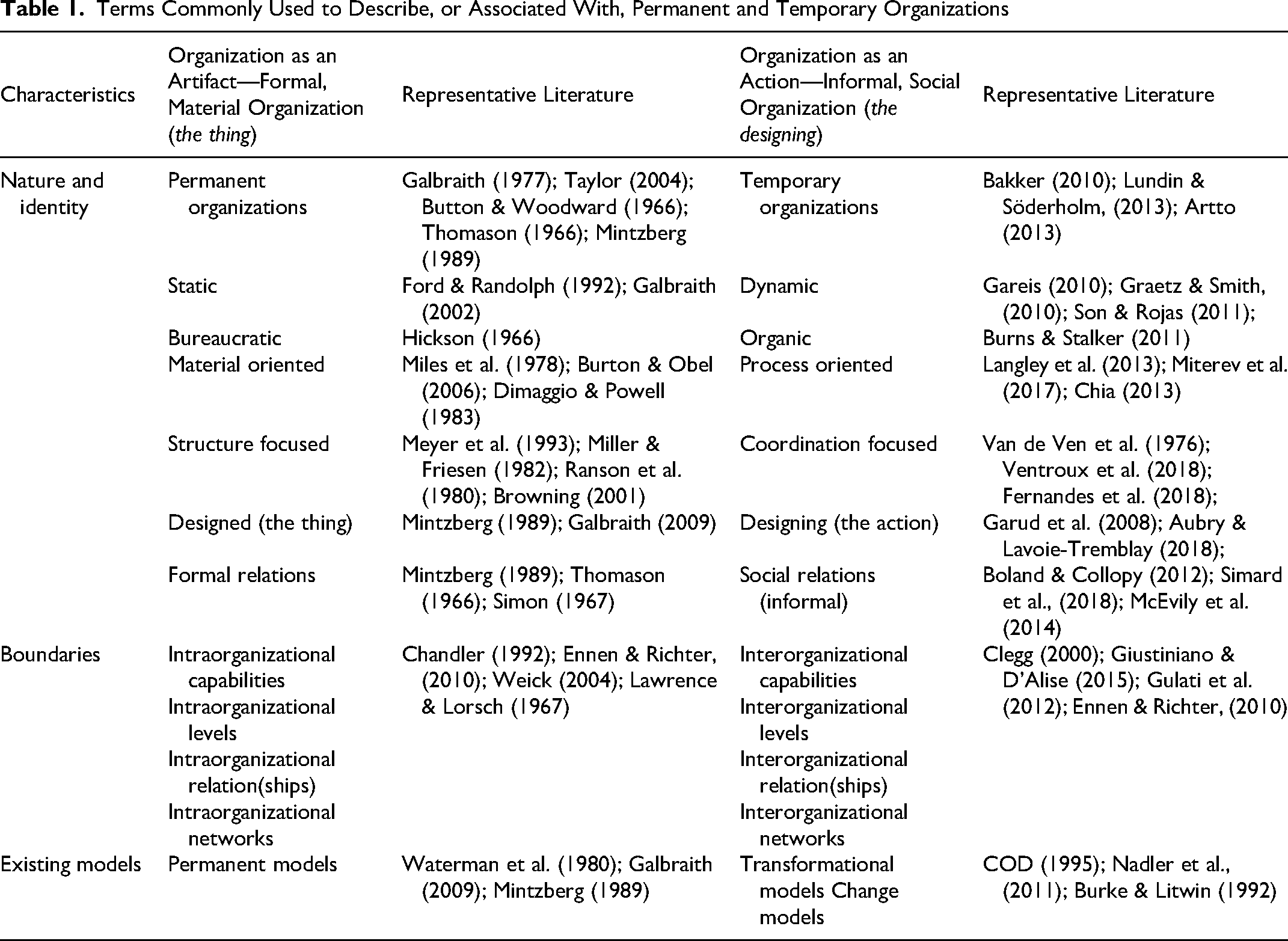
Following organizational design evolution through history, as the organizational design came to include more complex systems (such as megaprojects), the terms on the left side of Table 1 started to be mixed and used jointly with the terms on the right side of Table 1. Examples of the mixture between the two sides of Table 1 include exchanges between internal and external levels (Denicol et al., 2021), structure as not a rigid configuration but rather a photography of the moment (Gareis, 2010; Aubry & Lavoie-Tremblay, 2018), and formal relations being complemented by spontaneous social interactions (Fernandes et al., 2018). In this new perspective, the internal organization adopts a more temporary nature, one that is constantly changing (e.g., different composition of managers for different phases of megaprojects), whereas the external world is more permanent, as the organizations supplying resources are usually fitted in the traditional forms.
In this emergent way of organizational design, the coordination appears as a bridge between the two sides (i.e., artifact and action), promoting the constant alignment between design and process, often related to the constant remapping of organizational design in megaprojects. Yet, coordination has not been explored as the connecting link for the structure of the organization but as an isolated element of it. More specifically, coordination in megaprojects lacks in depth, not having a comprehensive view. Typically, coordination is addressed in distinct levels and at different moments. From the compilation of studies in organizational design and megaprojects, evidence shows that coordination is in fact embedded in the organizational design and needs more attention at the level of the client organization (Fernandes et al., 2018; Iacono et al., 2021; Davies et al., 2009). The client organization is typically a new temporary organization, formed by a commission of heterogenous organizations, responsible for top-level decisions regarding the organizational structure and evolution, integration of stakeholders (i.e., intra- and interlevel integration), workflow, communication channels, and mediation of conflicts.
This conceptual article unifies the fragmented organizational design literature and reconciles different, and sometimes conflicting, understandings of organizational design. We argue that this clarification will help in the evolution of the coordination roles, as coordination roles are treated as an organizational design commitment at different levels of the megaproject. Therefore, the research question that arises from this discussion is as follows:
What are the coordination roles of clients when designing megaproject organizations?
Conceptual Framework
Coordination Roles of Client Organizations in Megaprojects
Coordination is present at different levels of the organization and in different phases of the megaproject. In order to discuss the different roles of coordination when designing the megaproject organization, it is necessary to depict the structure of megaproject client organizations. The intraorganizational level is referred to the client organization, also called the central or focal organization, which works as the contracting authority and is often complemented by delivery partners (Denicol et al., 2021). These are not necessarily homogeneous organizations; instead, the client organization is formed by different units and departments coming from different institutions and firms that have different interests in and expectations of the project (Bakker et al., 2008). Most commonly, they are composed of members of the permanent organizations from where the megaproject came (e.g., a railway megaproject organization will include members from the local/national transport institution), aggregated by other public and private organizations that can add up organizational capabilities to deliver the outcome. They are also referred to member organizations, partners, or alliances (Priego-Roche et al., 2016). Client organizations hold the power to make intra- and interdecisions, establishing both an internal structure and specific mechanisms to procure complementary capabilities. The supply chain and other external stakeholders are referred to the interorganizational level, collectively (contractually or not) responsible for delivering a specific outcome (Lundrigan et al., 2014).
For example, the client organization for Crossrail in London was a new entity called Crossrail Limited, which was formed by two governmental bodies acting as the sponsors (Department for Transport – DfT, and Transport of London – TfL). Crossrail Limited was the contracting authority and in charge of building the internal capabilities of the client organization, which was responsible for the coordination of the supply chain and wider stakeholders, considered external from the client organization (Denicol et al., 2021).
The megaproject client organization will determine the appropriate relationship structure that best matches their organizational goals and context by choosing which capabilities will be developed in-house and which will be hired from the market. This is a context-dependent choice, which will be either a result of a top-down policy decision or will emerge as the result of a bottom-up evolutionary process. Yet, the capabilities are not exclusively developed at the intra- or interorganizational level; they are a continuum that evolves over time, to some degree handled intra and inter, rather than two separate dimensions. Even capabilities that are predominantly intra (e.g., project management) will need to relate with outside parties, for example, to manage external organizations or contract with external consultants. The coordination role is required to set up the right set of capabilities from the beginning, organizing them accordingly in the levels and phases of the megaproject. Moreover, the coordinator must constantly monitor and adjust such choices and the work being performed, enabling the mediation of occasional conflicts. Considering specific megaproject levels or phases in isolation is to miss complementarities and dependencies between the different capabilities and therefore omit influential and creative contributions to the organizational design literature. This is a current challenge identified in the literature, where two sides of the organization are often characterized by separate functions that do not communicate (Erbil et al., 2013; Hartmann, 2006). Consequently, coordination is often left to handle higher levels of complexity and solve organizational design problems.
Coordination is defined as “integrating or linking together different parts of an organization to accomplish a collective set of tasks” (Ven et al., 1976, p. 322). According to Mintzberg (1989, p. 101), coordination mechanisms are “the most basic elements of structure” in organizations. Aligned with the literature discussed thus far, we reinforce Simon’s (1996) perspective that the integration of effort, in other words, coordination, is one of the main problems involving organizational design and Burton and Obel’s (2018) statement of an effective organizational design as the perfect fit between structure and coordination. The megaproject domain reinforces the client organization as a central coordinating entity (Denicol et al., 2021; Eren, 2019; Hu et al., 2016; Rolstadås et al., 2014), which is reflected in the four major strategic coordination roles identified in this work. This happens because the client organization is involved from the very beginning in the organizational design of the megaproject and therefore in a central position to see the whole life of the asset, from development to operations (Pauget & Wald, 2013). Therefore, the intraorganizational team seems to favor coordination, management, and strategic activities, whereas the interorganizational level is often set out to more technical or standardized outputs. Aligned with Fernandes et al. (2018), there is usually a centralized structure that plans, strategizes, and organizes the work, and then there are decentralized structures to deliver. Indeed, by definition, the structure of megaprojects will create the need for such a centralized approach to coordinate the internal adjustments and external supply chain. By dividing the organizational design into two levels (intra and inter), the objective is to provide clarity of actions and structures that would be implemented internally or to deal with organizations outside the core client team. To this end, we suggest four coordination roles for the client organization as follows:
Next, we provide a practical example of the four roles application, taken from empirical papers on megaprojects: Davies et al. (2009) show the client organization of Heathrow Terminal 5 (i.e., British Airports Authority [BAA]) acting as the meta-organizer by assessing internal organizational capabilities to deliver the asset and searching for few external capabilities to promote innovation. On the other hand, Denicol et al. (2021) show other megaprojects, such as Crossrail, Thames Tideway Tunnel, and High Speed Two, also acting as a meta-organizer, opting to hire external knowledge from the market and assemble the organizational puzzle. It was part of their responsibility to choose which capabilities were needed and when and who was going to deliver them. Note that they had the understanding of the organization as a whole, which is characteristic of the meta-organizer role. Muruganandan et al. (2022) also describe the Crossrail case, and report on a balance between stability and change as various interdependent systems evolve with varying degrees of maturity, meaning that the client is responsible for the evolution of the capabilities along the life cycles of megaprojects. This verification of capabilities in specific moments also relies on the meta-organizer role.
Once the organization was settled, the megaproject clients reported on by Denicol et al. (2021) (Crossrail, Thames Tideway Tunnel, and High Speed Two) started to act as gatekeepers, managing the interchangeability of external stakeholders. These megaproject clients were a shield between the internal and external organization, helping to coordinate all tier 1 contractors. In the Heathrow Terminal 5 megaproject, Davies et al. (2009) also report how the client was continuously learning, evaluating, and periodically changing routines to deal with changing conditions and keep different project teams, responsible for different work packages, integrated. At this point, BAA was playing the interface manager role, internalizing the project management function, and managing the interface in lower tiers of the supply chain. As part of their role, the client incorporated principles, structures, and procedures to reduce task variety and therefore facilitate the transition between work packages.
Lastly, many examples in those works show the client acting as a mediator in different points in time, from beginning to end. The knowledge of the whole system allowed the client to take the conflicts to a higher level of strategy. For example, Heathrow T5 implemented the T5 Agreement in which BAA would cope with extra expenses and therefore release contractors and lower levels of the supply chain to commit to teamwork. In the Crossrail case (Muruganandan et al., 2022), the client organized the Integrated Program Team to promote collaboration among the program partner, delivery partner, and wider network of suppliers. In addition, as a mediator, the client also aims to spur innovation. For example, Eriksson and Kadefors (2017) report on a model developed by the Swedish Transport Administration (STA)—the megaproject client of a rail tunnel—to encourage reflection and creativity from consultants, who should consider more alternatives before selecting design solutions.
Understanding that the design of the client organization and the coordination choices are not independent is of particular relevance to organizational designers and strategists. Once an organizational design is chosen, the coordination choices are limited to achieve a good fit. Although Burton and Obel (2018) argue that designing the coordination has a different time perspective than designing the structure, our article shows that the two activities are defined and develop together. Fernandes et al. (2018) state that coordination mechanisms change in response not only to changes in environmental conditions, but also in response to changes in the organization itself. These different coordination roles often run in parallel and may work together to achieve project targets.
Figure 1 proposes two distinct layers for the coordination roles. The first layer is related to the structure or design of the organization, showing the four coordinators acting in their roles and how they interact at the different levels. The meta-organizer puts together the capabilities and effectively designs the megaproject organizational system. The gatekeeper acts on the vertical level, managing the resources between intra- and interorganizational boundaries. The interface manager acts on the horizontal level, looking into interfaces between work packages. Last, the mediator acts within different subgroups, solving conflicts, promoting changes, and supporting innovation. In practice, the four roles are constantly interacting, for example, the meta-organizer might be doing the re-design of the organization while coordinating the exchanges with the supply chain.
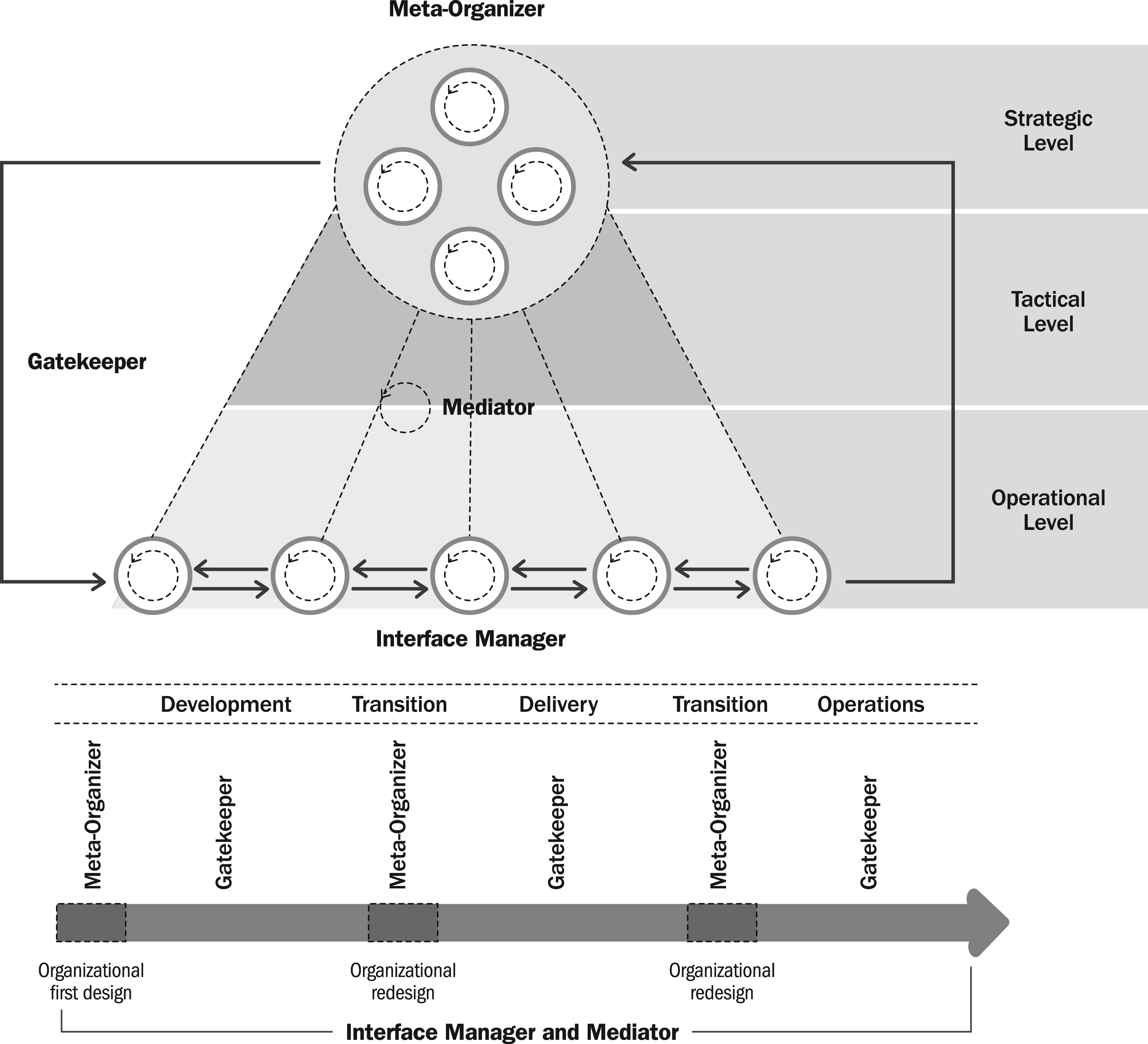
Coordination roles in megaproject organizations integrating intra- and interorganizational levels through time.
The second layer in Figure 1 is related to the four coordination roles spread throughout the megaproject’s phases, which correspond to formal and informal organizational design and redesign, which emerges as organizational development. In the first design of the megaproject organization and during the transition phases (from development to delivery and from delivery to operations), major design and redesigns are needed, which means that the meta-organizer is activated. The meta-organizer has the system-wide view, and therefore develops coordination activities related to integrating and unifying the different capabilities, taking into account more complex issues such as supply chain availability and power relations. Thus, to deal with smaller redesigns that happen during organizational development, the gatekeeper role comes into play, since these smaller redesigns are typically related to changes between the boundaries of the organization (for example, changing suppliers or new ways to perform some simple operations). Therefore, during organizational development, the gatekeeper coordinates the interchangeability among intra- and interorganizational levels. Those are the most prominent moments in which the meta-organizer and gatekeeper act; however, both roles might be participating in the organizational design in different times than those proposed, depending on the conditions and challenges faced by the megaproject organization. Considering the client organization is playing the four roles, there might be some overlapping in who is doing what; the difference depends on the activities performed and the scale of magnitude in the decisions being made. The interface manager is more related to operational issues, whereas the mediator is related to individual aspects. Both situations (operational issues and individual aspects) are constantly emerging in any phase of the megaproject; for this reason, the interface manager and the mediator should be playing their roles during the whole life cycle of the megaproject.
The Management Levels for the Four Coordination Roles
The organizational design is a mix of artifacts and processes, where the client organization performs more than one role in parallel moments, as well as in different phases. The system is not static—it evolves dynamically and temporally over time, which reflects in the coordination to similarly adapt. The core objective of the study is to create more visibility and granularity about the actions and interfaces among coordination roles of the client organization, providing understanding on how to adapt considering the evolution of the project. To achieve an effective solution, the coordinator roles can be sorted into three management levels (see Figure 1):
Strategic level: This level corresponds to the senior leadership of the client organization, which includes the top management team (Mintzberg, 1994). At this level, decision-making, and organizational design strategies are carried out. The strategic level works with a low number of routines and programs and a high amount of uncertainty and intertwined of elements (Chiavenato, 2006; Mintzberg, 1994). Organizational design decisions cascade to other levels of the megaproject, resulting in changes in the operational process. The role of the meta-organizer is placed at this level, managing influences that the external and internal environments reflect on the organization. The structure of the organizational design is formed at this level and factored into many smaller decisions, through a loop process of diagnoses, searching, and selecting. Tactical level: This level is considered a level of exchange between the strategic level (top management—managers, general directors) and the operational level (executors—contractors, ground workers). This level focuses on organizational components such as capabilities responsible for the network of necessary and available resources for operational (routine) activities (Mintzberg, 1989). The role of the gatekeeper is placed at this level, coordinating decisions on an ad hoc basis that reflects organizational design development over time. The gatekeeper bridges the changes that are escalated up the hierarchy for resolution or descend down the hierarchy for alignment. At this level, the organization’s management policies are transformed into action (Chiavenato, 2006). Operational level: This level is also called the technical level and is linked to the execution of routine tasks. At this level, the interface manager acts on the horizontal organization, aiming to conduct operations efficiently. The operational level creates conditions for the adequate performance of the company’s daily work (Oliveira, 2019) for each specific activity of the organizational structure. The operational level has an immediate vision, where processes are typically programmed and executed quickly. The mediator role is intangible, similar to soft skills of individuals and expected to be present throughout the megaproject life cycle; it relies on personal relationships, for example, stewardship behavior, personality, and volunteer networks (Ma et al., 2021).
Discussion
A Continuum Among Coordination Roles
Despite the relevance of the coordination roles when designing organizations, permanent organizational models do not approach coordination as an integral part of the designing process. For example, the 7S Design Model, one of the most commonly used organizational design models (Waterman et al., 1980), emphasizes seven key elements, all starting with the letter S (i.e., strategy, structure, systems, skills, staff, style, shared values) and its interactions, to evaluate the effectiveness of the organization. The greater the seven elements are balanced and aligned together as a whole, the greater the organization is effective—as opposed to one isolated element working effectively or only in relation to another element. We propose that the integration among elements could be made through coordination mechanisms. From a strategic perspective, if higher levels of the company are responsible for the coordination in different levels, some of the elements cited in the 7S model, such as shared values, would not be seen as a distinct element, but rather part of the coordination routine. This would reflect in less unnecessary complexity to handle and less interface elements as points of conflict. Jay Galbraith’s Star Model is another example. The Star Model is intended to influence the behavior of professionals through a series of design policies controlled by management (Galbraith, 2009). The design policies fall into five categories: strategy (direction), structure (power), process (information), rewards (motivation), and people (skills and mindset). These five categories are graphically represented as the end of a star, all connected through lines. In the Star Model, coordination is not one of the five elements, and it is implicitly and broadly approached without the specifics necessary when designing an organization. Moreover, we see the coordination as an element that would be present in the middle of the star, setting up and managing the other elements through different roles.
In both models, some elements are embedded in the coordination. If we compare these models with the one suggested for megaprojects in this article, the meta-organizer would handle structure, strategy, and skills; the gatekeeper and interface manager would deal with staff and process; and the mediator would handle people, style, and shared values. Besides lowering the complexity to design the organization, placing the coordination as a link among elements would amplify the control over the company and benefit the exchange with the external environment—a topic not emphasized in both models. Similarly, Weisbord’s Six Box Model (1978) is a diagnostic tool aiming to understand relationships and create balance in organizational elements. The six organizational elements distributed in “boxes” (purposes, structure, relationships, rewards, leadership and helpful mechanisms) adopts a cyclic approach, instead of ordered interrelated elements. Different from the Star Model and 7S Model, the Six Box Model considers external aspects of the organization. However, the model lacks on understanding the interdependencies and integration between the “boxes”, which should be done through the different coordination roles.
If we explore the temporary organization models, the Transformational Model (Centre for Organizational Design, 1995) aims to guide top managers through redesigns. This model is composed of two variables and six elements that form an organization. The variables are the environment (input) and the results (output), whereas the elements are strategy, core process, structure, system, culture, and leadership. The model concentrates on the human factors of performance, providing a better understanding of how people respond to change. Although individual behavior is a fundamental part of achieving good coordination (e.g., leadership skills), this is only one level of coordination, which does not work if not in conjunction with the strategic and tactical levels. Again, coordination encompasses some of the elements cited in the Transformational Model such as culture and leadership. In this model, the environment is a variable influencing the other six elements of the structure, and we propose that coordination could work as a mechanism to balance such inconsistences and deliver efficient results. The lack of attention about coordination in the Transformational Model only emphasizes the one-way flow represented in the model. During transformations, coordination is responsible for interactions among elements and allows the iterative and cyclic process necessary for the evolution of the organizational design to new conditions. Another example is the Congruence Model (Nadler & Tushman, 1980), which is based on the proposition that successful changes are determined by the congruence of four elements: work, people, structure, and culture. Following the open-system approach, Nadler and Tushman (1980) state that the organization constantly interacts with its environment, which works as an input to shape strategies and elements that are crucial for the transformational process. These elements are task (specific work activities); individuals (knowledge, skills, needs, and expectations); formal organizational arrangements (structures, processes, and methods); and informal organization (values, beliefs, and behaviors) (Palmer & Dunford, 2008). The outputs from the transformation are exchanged for new inputs in a feedback loop (Hendrickson, 2022). The integration among all the elements is done by communication and information flow. Following a similar analysis as the Transformational Model, the Congruence Model relies only on one level of coordination—more based on individual skills (e.g., communication)—to integrate different elements. During changes in megaprojects, more coordination roles are in place to guarantee the revision and adaptation of the organizational design. The relationship between the individual and strategy happens through different levels of coordination, each one playing a different role, largely neglected in the abovementioned models.
In models from both permanent and temporary organizations, the importance of the coordination roles to the organizational design is not explicit; sometimes they overlap and lack differentiation for management levels. Although all the models state the relevance of balance, integration, and interaction among different elements of the organizational design, no clear guidance is given on how to do that. Conversely, the traditional previous literature in organizational design, such as the work of Burton and Obel (2018) and Mintzberg (1989), places coordination as an essential part of the organization designed. They treat coordination as a mechanism to conduct work and maintain delivery standards. Coordination is an administrative component. For example, Mintzberg (1989) suggests five coordination mechanisms: mutual adjustments, direct supervision, standardization of work process, standardization of outputs, and standardization of skills. Galbraith (1977) claims that organizations use rules and programs, hierarchical referral, and planning, which could be translated into coordination mechanisms. Such approaches are, in fact, effective for the organization designed, rather than for designing the organization. Moreover, considering the megaproject context, when the organization designed (artifact) is being overridden for the designing (action), this approach might lose its action base—the structure where such mechanisms are put in place. Therefore, in this work, coordination is taken as a provision to link autonomous, yet dependent, systems together. The four coordination roles (meta-organizer, gatekeeper, interface manager, and mediator) ensure that the intra- and interorganizational levels of the megaproject organization function as a single integrated unit.
Previous literature also defends that coordination mechanisms are somewhat replaceable and that, under specific conditions, an organization will favor one coordination mechanism over another (Mintzberg, 1989). This seems to be valid in permanent and stable environments; however, when designing megaproject organizations, the four coordination roles coexist and are dependent on one another. The absence of one role will promote a lag in the process of activities. Decisions made in one level constrain the next set of decisions. This idea is aligned with Mintzberg (1989), who suggests that an organization should rely on a mix of coordination mechanisms, spread throughout the levels of the company. He complements the idea, stating that the real-time roles of the manager, more related to individual skills, such as negotiating and handling disturbances, are more important at lower levels in the hierarchy. Yet, Freek et al. (2016) add that time is different for temporary and permanent organizations and this affects the coordination and formal hierarchical structure. Such differentiation is based on the boundaries of intra- and interorganizational levels, where coordination is an essential piece. Di Maddaloni and Davis (2018) also emphasize the time differences among megaprojects (temporary) and permanent organizations, where pressures of the environment (e.g., local communities) result in different coordination requirements when compared to permanent organizations. The clear definition of coordination roles spread into management levels proposed in this article follows such understanding to help distinguish those who are part of the internal organization and those who are part of the external organization. Understanding where the organizational design boundaries are situated is an important part of the organizational design, because strategy connects the organization and its environment. Through coordination roles, the structure of the organization (the organization designed) can maintain the pace of change, being responsive to the environment without being disruptive to the megaproject.
Inspired by the work of Aubry and Lavoie-Tremblay (2018), we state that the organizational design is a dynamic and cyclical aspect of the organization. On the one hand, there is the (static) structure, the artifact, which provides useful information about tasks and teams; on the other hand, there is the action, the coordination, holding power, and communication relationships, which are not usually present on documents of the organization. However, both sides blend and coexist in a symbiotic way. The formal structure orders the direction of the informal structure, and the informal structure shapes the formal structure. Coordination in megaprojects is a regulated-overlapping system that systematically and explicitly controls flows of materials, information, and processes.
Propositions to Coordination Roles in Megaprojects
The static and dynamic structures in megaproject organizations are two ends of the continuum. Organizations that rely mostly on the static structure achieve coordination in a more formal and regulated way, whereas the dynamic perspective adopts a more flexible coordination. In the first form, based on congruency theory, coordination roles were not mentioned, but evolved along with the history of organizational design to play a crucial role in megaprojects and other sophisticated forms of organization. In contingency theory, coordination grows in relevance when aligning internal elements. The complementarity perspective emphasizes that individuals or teams have different strengths and competences, and effective coordination involves capitalizing on these differences to enhance overall performance. In complexity theory, coordination often arises spontaneously from the interactions and feedback loops among the system’s components rather than being centrally planned or controlled. In this article, we suggest that relying primarily on the static side (congruency/contingency approach) will result in an overly bureaucratic and perhaps outdated way of coordinating, whereas relying too much on the dynamic side, following a complexity perspective, will result in a chaotic environment. Therefore, organizational design in megaprojects needs both static and dynamic views to cope with the changing environment. The static perspective brings rules and regulations to coordination, translated into standardization and formalization of behaviors. Meanwhile, the dynamic perspective allows an innovative and adaptative approach necessary for the survival of the megaproject. Based on the framework proposed in this article, aligned with the mix of theories influencing the knowledge on organizational design, some general propositions related to coordination roles can be assumed for megaprojects:
The megaproject client organization should promote constructive and collaborative coordination among different levels of the organization and through the megaproject life cycle. This reflects in integrating rules and procedures with knowledge and experience from intra- and interorganizational levels. The megaproject client organization should be responsible for designing the organization (meta-organizer role) but also for the continuous adjustment and redefinition of organizational elements during the organization development (gatekeeper role). The megaproject client organization acts as a network structure of control, authority, and communication, aligning contractual relationships stated by the strategic level with informal relationships (e.g., mutual adjustments), derived from the community of interest at the individual level (interface manager and mediator role).
The organizational design literature on megaprojects suggests that other theoretical lenses can be adopted in the designing process of megaproject organizations. The different theories have an impact on how these coordination roles are played. Organizational theory, for example, adopts a systemic perspective and supports coordination to integrate structure with the functioning of the organization, which relates to the current understanding of a mix between formal and informal organization. Institutional theory proposes coordination as a link to respond to pressures between the external environment (social and cultural) and the internal organization, resembling contingency theory. In the same way, stakeholder theory also suggests coordination as a connecting link between the external (inter) and internal (intra) organization, however, with a focus on managing stakeholders’ interests to create value in the organizational design. Agency theory and organizational behavior theory adopt an individual perspective, where mediation skills and behavior control are understood as part of the coordination job, which in turn echoes complexity theory.
Based on the literature review and on the organizational design models discussed previously, such theories lead to the understanding of the organization as an interacting, dynamic, and permeable system. We converge the distinct perspectives and develop the knowledge beyond the understanding of coordination as a higher-level concept, enriching the literature that, in some instances, neglects to unpack the structures and the specifics of the actions that managers need to take to coordinate complex megaprojects over time. Our framework provides clarity of roles and responsibilities to the body of literature that argues for static versus dynamic approaches. We contribute by shedding light on specific roles of coordination, when relating it to organizational design and attribute a specific entity that should be responsible for it, rather than leave such roles for organizations that neither have the authority nor the competence to do so. Moreover, by specifying the four roles at different levels and different times during the megaproject we make visible its existence and clarify many ambiguities, confusion, and overlapping of activities in such organization. Therefore, our framework is different from the existing body of literature as it enriches the understanding and visualization of levels and roles to inform megaproject managers and policy makers about their strategic decisions, that will unlock effectiveness, collaboration, and value. Additionally, our framework highlights the coordination roles necessary to address the structural complexity and fragmentation of megaprojects.
Conclusion
In megaprojects, little is known about how to design such complex organizational systems. Extant literature regarding organizational design is fragmented and overlapping, creating confusion to enable further theoretical and practical contributions. There is a lack of synthesis, and literature reviews have been approaching specific topics without a clear view of organizations. Indeed, this limitation influences the understanding of megaproject organizations, which share similarities with both permanent and temporary organizations. Therefore, this research explores different definitions, terms, and nomenclatures drawn from different theories to position organizational design under a comprehensive framework. Inspired by influential studies such as those of Aubry and Lavoie-Tremblay (2018), Burton and Obel (2018), and Mintzberg (1989), we acknowledge the organizational design as a mix of two elements: structure and coordination. The structure is understood as a set of organizational elements, internal and external, placed together in the right order and at the right time. The coordination is seen as the action, the living part of the organizational design, precisely responsible for putting together and managing the structure. Therefore, we turn our focus to the coordination roles necessary to design megaproject organizations, addressing the following research question:
What are the coordination roles of clients when designing megaproject organizations?
We present a conceptual framework identifying four coordination roles of clients to design megaproject organizations at different management levels: the meta-organizer, at the strategic level, responsible for the design decisions, looking at the system as a whole through time; the gatekeeper, at the tactical level, integrating the intra- and interorganizational resources and responsible for the interchangeability between them; the interface manager, at the operational level, working on the exchange of work packages and guiding operational resolutions; and the mediator, at the individual level, present in all dimensions of the organization to solve conflict, spur innovation, and maintain motivation. We compare traditional models from the literature with our framework and conclude that coordination has not been sufficiently emphasized. In fact, these models treat coordination as replaceable by other mechanisms such as standardization. We suggest that in megaprojects, coordination roles are dependent and should coexist during the megaproject life cycle. We provide a framework that enhances our understanding of the coordination roles and where they should happen, how they interact, and the different nuances of coordination over time in the client organization.
Different contexts and strategies lead to different organizational designs. All models discussed thus far show that organizations go through similar problems; however, they can achieve significantly different solutions. No best or correct organizational design exists, and what works in specific situations will constantly change. Organizational development, coordination roles, and phases acknowledge such transformation and give organizations opportunities to adapt in light of uncertainty. Yet, other theories can be explored when designing megaproject organizations, which will influence how coordination roles are enacted. The economic perspective, for instance, has a considerable impact on megaproject organizational design, and future research might explore theories, such as Transaction Cost Economics or Agency Theory, to enrich the organizational design from different and complementary perspectives. Megaprojects have also been evolving in the digitalization era, and organizational design in megaprojects would benefit from the implications of digitalization to the coordination roles. This is a conceptual article that unpacks the coordination role in megaprojects, therefore helping client organizations to understand their multiple roles, providing insights to better manage the intra- and interorganizational boundaries, and ultimately unlocking improvements to the entire megaproject system. We encourage further investigations to provide empirical evidence on how these four roles behave, interact, and evolve in megaprojects to validate and refine the proposed coordination roles. In addition, we recognize that the framework applicability might vary. The focus is primarily on the client; however, the roles of other stakeholders or collaborative parties should be further explored when interacting with the megaproject.
