




Abstract
The governance of projects is often treated operationally, as project portfolio management. Project portfolio governance is more strategic and continuous than project portfolio management, but its various approaches are weakly understood. This study explores project portfolio governance in innovative companies. The resulting framework characterizes governance approaches in terms of the authority given to portfolio actors and the rhythm of using governance practices. Differences among the delegated, regulated, and consultative governance approaches appear to stem from the industry clock speed, innovation portfolio type, and organizational context. This study differentiates project portfolio governance approaches as part of organizational project management governance.
Introduction
Project portfolio governance is an organization’s way of overseeing its investments in projects at the strategic level (Martinsuo, 2023). It is considered the external view of project governance (Ahola et al., 2014) and can also be called the governance of projects (Müller & Lecoeuvre, 2014; Riis et al., 2019) when it is specifically limited to certain project portfolios. While studies explicitly focusing on project portfolio governance are rare (Martinsuo, 2023; Mosavi, 2014), the governance of projects is receiving increasing attention (Müller & Lecoeuvre, 2014; Müller et al., 2014, 2015; Müller et al., 2016). Companies experience a practical need to differentiate between portfolio oversight (strategic guidance from the top levels of the organization) and project portfolio management (operative screening and project decisions within the portfolio). Müller et al. (2019) also differentiate project portfolio management from organizational project management (OPM) governance, which is an organization’s way of directing and controlling the totality of projects and holding managers accountable for the projects’ performance.
This article focuses on project portfolio governance through portfolio actors directing, deciding, and monitoring the project portfolio. Senior managers are often considered in their strategic and decisive roles, including the structuring and selection of portfolios (Beringer et al., 2012) and the termination of projects (Unger et al., 2012). Some studies examine project portfolio coordinators and top managers in parallel (Jonas et al., 2013). Managers cooperate in steering groups or management boards to offer direction and choose a portfolio (Beringer et al., 2012, 2013). Portfolio steering committees may have other tasks in addition to decision-making, and Mosavi (2014) reports that steering committees have three roles in portfolio governance: communication and consolidation, negotiation, and decision-making. He proposes that these roles are tied with the working rhythm of the steering committee.
This study is motivated by the need to understand the governance layer in project portfolios and thus complement the operational aspects of project portfolio management. We want to pay our respect to Ralf Müller’s broad achievements in project governance and organizational project management and direct attention to project portfolio governance specifically. The purpose is to explore the portfolio-related actors’ project portfolio governance approaches in various contexts. We will cover both individuals and groups involved in project portfolio governance. The main research question is: How, through what kinds of approaches, do companies govern their project portfolios? We use the general term approach to denote the distribution of responsibilities and use of practices as part of project portfolio governance. Thereby, our idea of governance embeds both things and people, while sometimes people are considered separately in terms of governmentality (Müller et al., 2019). The study is limited to innovation project portfolios (technology, product, service, and software development).
We report a multiple-case study of three innovative companies, each with at least two project portfolios. The key contributions stem from the discovery of apparent differences between the companies in their project portfolio governance approaches. While governance practices tend to be similar across organizations, we report on a framework that differentiates the approaches in the authority given to portfolio actors and the rhythm of using governance practices. The findings reveal that governance committees largely operate under a fixed rhythm that differs between organizations, whereas individual managers take up governance tasks in an ad hoc manner embedded within the organization’s governance rhythm. The findings offer new evidence regarding project portfolio governance and reveal the interplay between governance committees and individuals in building continuity and maintaining an industry-matching rhythm for project portfolios. These contributions enrich the discussion concerning the OPM governance layer (Müller et al., 2019) in the multilayered conceptualization of project organizing.
Next, we review the previous literature on project portfolio governance and summarize the current state of knowledge about its responsibilities and practices to point out the need for further research. Then, we introduce the research design and material regarding three innovative companies with two or more innovation-related project portfolios. The results section is built on these three cases, each of which has a unique approach to project portfolio governance. As a cross-case summary, we explicate a framework that differentiates project portfolio governance approaches based on the centralization versus the decentralization of authority and a slow versus a fast rhythm. We discuss potential explanations for the differentiation among delegated, regulated, consultative, and autonomous governance approaches and develop four propositions to drive further research. Finally, the key contributions and practical implications are offered, along with a consideration of the validity limitations and avenues for future research.
Literature Review
Governance of Projects in Organizational Project Management
The organizational project management (OPM) approach specifies whether a multiproject approach is generally adopted in an organization. In the general OPM model, project portfolios are particularly central to the OPM governance layer and the business integration layer (Müller et al., 2019). While the business integration layer concerns operative project portfolio management (i.e., selecting, balancing, controlling, and coordinating the projects in the portfolio), the OPM governance layer draws attention to the organization’s overall approach to directing, steering, and controlling the project portfolios and thus fulfilling the organization’s objectives and meeting stakeholder needs (Müller et al., 2019). This study concentrates on the OPM governance layer.
In the external view of project governance (Ahola et al., 2014) and the governance of projects (Müller & Lecoeuvre, 2014; Riis et al., 2019), the attention is directed at the organization’s relationship with and oversight of its projects. The organization’s interest is to ensure optimal resource use and the successful implementation of the projects in a way that is in line with strategic objectives (Ahola et al., 2014) and to harvest value from projects (Riis et al., 2019). Flexibility is needed in structures and interactions to achieve effectiveness in project selection and efficient project execution (Müller et al., 2014, 2015).
The governance of projects involves project portfolios, that is, groups of projects that are oriented toward the same strategic objectives and managed under the same management umbrella. Here, we will use the term project portfolio governance to denote the organization’s oversight of its project portfolios, as in, “overseeing and approving the framework, functions, and processes to provide guidance and decision-making for project portfolios” (Project Management Institute [PMI], 2016, p. 5). Riis et al. (2019) introduce various links between the parent organization and its projects as part of the governance of projects, but they do not define or explain project portfolio governance conceptually. Martinsuo (2023) draws attention to the governance regime, governing actors, and alternative modes of governance as key components of portfolio and program governance. She emphasizes that each organization must specify the governance approach, so it fits the organization’s culture and context, but her conceptual study does not offer detailed examples of how this happens. Mosavi (2014) discusses project portfolio governance in terms of the interrelationship between individuals, bodies, roles and responsibilities, decision-making processes, and other governance elements at the project portfolio level. In this study, following the previous discussion and general organizational enablers of governance (Müller et al., 2014, 2015), we direct our attention to the responsibilities, intertwined with the level of authorization of the actors participating, and practices and their rhythm in project portfolio governance.
Responsibilities and Authority in Project Portfolio Governance
Due to the inherent complexity of innovation project portfolios, project portfolio governance may involve several actors from many different hierarchical levels who have various functions within an organization, including middle managers (Behrens et al., 2014; Blomquist & Müller, 2006), senior managers (Beringer et al., 2012; Unger et al., 2012), and other potential actors participating in the portfolio steering committees (Christiansen & Varnes, 2008; Mosavi, 2014). Although previous studies have identified various actors involved in portfolio governance and their corresponding responsibilities (Beringer et al., 2012; Unger et al., 2012; Behrens et al., 2014; Blomquist & Müller, 2006; Koh & Crawford, 2012; Mosavi, 2014), empirical studies of how, by whom, and for whom authority is granted in portfolio governance have been scarce (Müller et al., 2016; Müller et al., 2014; Too & Weaver, 2014).
Some studies reveal the general responsibilities of such actors in the context of project portfolio governance. According to Too and Weaver (2014), a company’s board is responsible for designing the governance system, monitoring the performance of the management system, and the governance of the organization. Beringer et al. (2012) highlight the important role of senior managers due to their involvement in structuring the project portfolio and, as proposed by Unger et al. (2012), these actors also take part in decisions related to the termination of projects.
In addition to the company’s board and senior managers, studies often highlight the crucial role of portfolio steering committees and frequent portfolio review meetings (Mosavi, 2014; Müller et al., 2019; Müller et al., 2014). These committees act as key decision-making bodies that are responsible for portfolio design and oversight (Christiansen & Varnes, 2008; Mosavi, 2014), as well as supporting senior managers in portfolio reconfiguration to ensure strategic alignment (Beringer et al., 2012; Beringer et al., 2013; Unger et al., 2012). Such strategic alignment assurance may occur, for example, by roadmapping, project selection and allocation (i.e., top-down), or by making decisions on the project level using, for example, stage-gate approaches (i.e., bottom-up) (Müller et al., 2019).
The actors may differ in how they handle their portfolio governance responsibilities. According to Mosavi (2014), steering committees may adopt one of three roles with a corresponding portfolio-review rhythm: the consolidating and communicating role, with frequent, brief status checks to ensure alignment with decisions made outside of the steering meetings; the negotiating role, with semifrequent and medium-length meetings to discuss various issues; and lastly, the decision-making role, with low-frequency but long-duration workshops with the intention of making long-term, strategic plans regarding the portfolios.
As Mosavi’s (2014) three roles on the part of steering committees indicate, not all negotiations and decisions are necessarily made during the formal steering committee meetings (Christiansen & Varnes, 2008; Jerbrant & Karrbom Gustavsson, 2013). After all, the governance framework defined by the board is then implemented by managers at different levels of the organization (Too & Weaver, 2014), and managers may need to make improvised decisions outside of the official steering forums to respond to quickly changing circumstances (Christiansen & Varnes, 2008; Jerbrant & Karrbom Gustavsson, 2013; Korhonen et al., 2014).
Steering committees and portfolio directors may delegate some governance tasks to portfolio management teams, such as criteria definition for project selection, review, and termination; strategic alignment–assurance processes, and feedback loops for the governing body (Too & Weaver, 2014). Portfolio managers may also be involved with the prioritization of projects and resource management (Koh & Crawford, 2012).
The extent of portfolio management teams’ authority related to portfolio governance may be linked to governmentality. Liberal and neoliberal approaches, as opposed to an authoritative approach, allow portfolio managers to make decisions relatively independently (Müller et al., 2019). In fact, actors with a higher level of authorization tend to hold greater responsibility, making authorization granted by the governance system tightly linked with the responsibilities of a specific portfolio actor. As concluded by Müller et al. (2014) in the context of project governance, the organizational enablers for governmentality are “the development of mindful individuals with the willingness and capability to take on authority and responsibility for the governance of the project related business in an organization.” (Müller et al., 2014, p. 1317) Building on this, Müller et al. (2016) argued that sovereignty, referring to the authority in governance, is one of the key principles in the governance of projects.
Such sovereignty entails three different roles that may be given to the project manager by the governance system (Müller et al., 2016): (1) employee, which refers to simply fulfilling the assigned tasks as prescribed; (2) manager, where the actor has been granted some level of authority to make decisions in a risk-averse manner; and (3) entrepreneur, where they have been authorized to make fairly autonomous decisions on a project for which they are wholly responsible. In this article, we extend this concept of authority in project governance to the portfolio level by studying the nature of authority and responsibilities of various actors in project portfolio governance.
Müller et al. (2016) propose two complementary perspectives on governance: agency theory, driven by control, and stewardship theory, driven by trust. There is a need for more elaborate evidence regarding how, by whom, and for whom authority is given to the various actors involved in project portfolio governance. Previous empirical studies have not explicitly investigated whether the authority of the actors at different hierarchy levels is linked to the characteristics of a company and/or portfolio(s) such as project type, innovation type, the length of development cycles, and the frequency of portfolio steering meetings. Further analysis of the authorization of actors with different governance practices is needed.
Practices in Project Portfolio Governance
One thread of research conversation directs attention to the everyday reality of project management, in other words, what people actually do besides what is specified in official guidelines (Cicmil et al., 2006). Such research concerns the lived experiences and actions, behaviors, and decisions of individuals and groups involved in projects and project-oriented organizations, in their unique social settings (Blomquist et al., 2010; Cicmil et al., 2006). It has also appeared in research on rethinking project management and projects-as-practice (Svejvig & Andersen, 2015). The practice perspective (following especially Bourdieau, 1990; Schatzki et al., 2001) builds on the idea that individuals work as part of some systems and structures (such as organizations with norms and rules of project management). When they behave, they both reproduce those systems and structures and cause variance in them. In this view, practices are (repeatable) patterns of thought and behavior included in the organizational systems and structures. Sometimes the concept of praxis is used to refer to what people actually do when they act and behave in circumstances (Blomquist et al., 2010). Even if organizations may have formalized systems and structures, such as those for project and portfolio management, the practice view implies that individuals have agency in how they perform and act (Vuorinen & Martinsuo, 2018). This would mean that individuals may use practices differently in different contexts and circumstances, and thereby also change the organizational systems and structures (Giddens, 1984). Also, project governance research has recently acknowledged the practice-turn as a positive shift in conceptualizing governance (Brunet, 2019; Song et al., 2022), but practice-based perspectives remain underrepresented and have been proposed for further research in project portfolio studies (Clegg et al., 2018; Martinsuo, 2013; Martinsuo et al., 2020).
In this study, practices are defined as established actions that actors use to implement their project portfolio governance task. The actors may be individuals or groups, and they are authorized to perform these practices either formally (through their official job position or mandate from upper management) or informally (through emerging circumstances that require a response action). In other words, practices are seen to cover both the action and the authorization granted for the corresponding actor. In this study, the focus is on the oversight actions specifically concerning project portfolio governance.
As project portfolios should always stem from the organization’s high-level strategy, portfolio directing and design is driven by the organization’s top management, typically through portfolio steering committees (Christiansen & Varnes, 2008; Mosavi, 2014). This also involves the definition of the two factors in portfolio design: the frequency and duration of portfolio steering meetings and the performance of the committee (Mosavi, 2014). As Urhahn and Spieth (2014) conclude, portfolio innovativeness is promoted by the explicitness and formality of portfolio management processes and also, partially, by a higher portfolio review frequency.
The frequency and duration of the portfolio steering meetings, which are agreed to in the portfolio design phase, will have a direct impact on portfolio reviews. Portfolio oversight typically occurs at the steering-group level (Christiansen & Varnes, 2008; Mosavi, 2014), where the committee’s objective is to obtain a coherent view of the portfolio’s projects and their performance. Although some studies have recognized the dependency between portfolio review frequency and context (Bechtel et al., 2023; Mosavi, 2014; Urhahn & Spieth, 2014), the empirical evidence on the contextual drivers impacting portfolio governance rhythm has been scarce. McDonough and Spital (2003) have proposed the lead time of development, the types of projects, and the dynamics of the industry as contextual factors to be considered when determining the appropriate portfolio review frequency. Müller et al. (2008) also recognized project type and external and internal dynamics as context variables and additionally suggested industry, geography, and governance type as factors influencing project portfolio control and management.
Mosavi (2014) suggested a tight linkage between a steering group’s role and the rhythm of portfolio review, as long review intervals and meeting lengths, with a decision-making role, have been proposed for larger companies and short review intervals and meeting lengths, with a communication and consolidating role, were suggested for medium to large companies. In the same study, a negotiation role, with medium review intervals and meeting lengths, was proposed for small companies. As per this categorization of roles, the portfolio review rhythm, consisting of review frequency and duration, seems to also be an important factor in determining the role of a steering committee, and an appropriate rhythm may be linked, for example, to the size of the organization. (Mosavi, 2014) However, the results of empirical studies on portfolio review practices in various contexts have been in conflict, and therefore, the understanding of how the portfolio and company characteristics impact the selection of a context-appropriate review cycle is still rather limited. In addition, it is not fully clear whether each portfolio within one organization would benefit from individual review cycles based on portfolio characteristics.
During portfolio oversight, a need for portfolio reconfiguration may arise. Such reconfiguration and its authorization among portfolio actors, as well as how project portfolio governance occurs over time, are still poorly understood. Portfolio managers may be authorized to make some reconfiguration decisions independently (Too & Weaver, 2014), but strategic decisions may require the steering board’s approval. There is a need for more empirical research into how such decisions are authorized in project portfolio governance.
The literature review on project portfolio governance reveals that project portfolio governance approach can be covered through two key themes: (1) responsibilities and authorization of the actors involved in project portfolio governance, and (2) their corresponding practices, including the rhythm with which the practices are used. In order to answer our initial research question: “How, through what kinds of approaches, do companies govern their project portfolios?” we selected innovative companies with varying characteristics for empirical exploration.
Research Method
Research Design and Cases
We considered a qualitative multiple-case study to be a suitable research design for our exploration of portfolio actors’ project portfolio governance in various contexts. Because case studies allow researchers to investigate a focal phenomenon in its real-life context (Yin, 2009), we wanted to investigate alternative approaches to project portfolio governance. In light of Martinsuo’s (2023) future research proposal, the investigation of alternative portfolio governance approaches in their specific contexts may yield revelatory information about the diversity of governance regimes, constellations of governance actors, and governance modes.
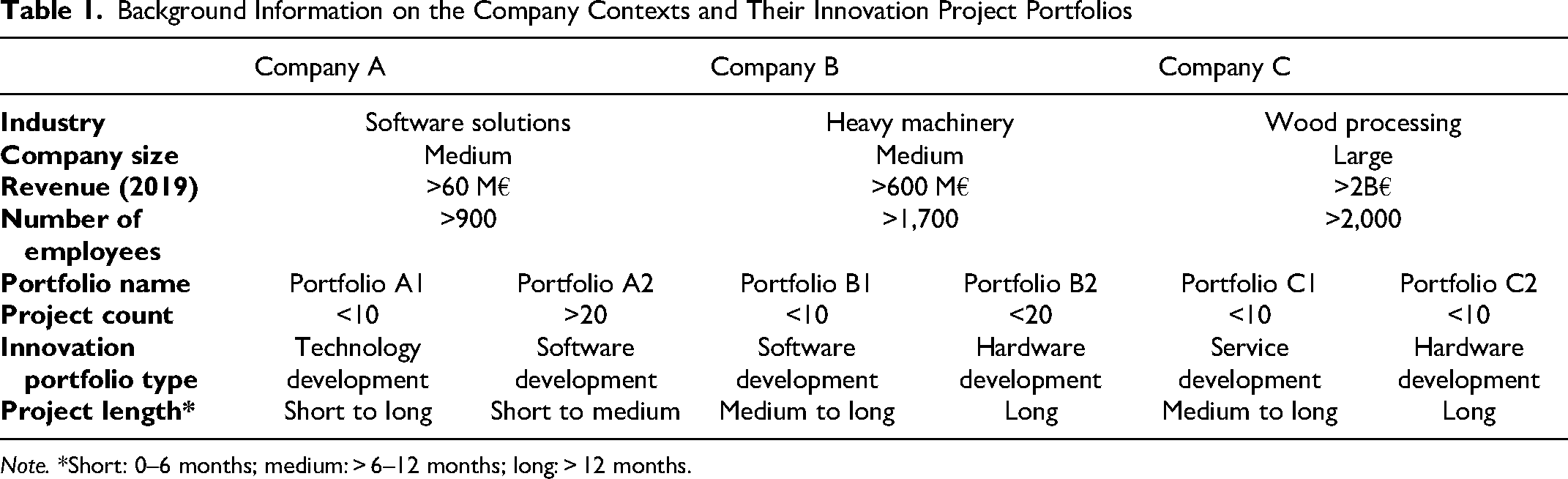
We carried out a multiple-case study with three companies that operate internationally in business-to-business markets (software, mobile work machines, and wood processing), have two or more innovation project portfolios, and prioritize innovation and growth in their strategies. Here, a case is a company’s approach to (i.e., way of handling) project portfolio governance. We sought highly innovative companies with one or more innovation portfolios, a dynamic business context, and active engagement in projects of research and development. We wanted to include companies of different sizes, in different industries, and with different types of offerings and project portfolios. We purposely avoided very small companies, which would not have significant innovation project portfolios, and very large companies, which would have too complex or too many innovation project portfolios. With these criteria in mind, we gained access to five suitable companies, each with its headquarters located in Finland. While we collected data from all these companies, three appeared to be particularly useful for the purposes of this study and we named them Companies A, B, and C for the purpose of this article. Table 1 summarizes background information on the companies, their project portfolios, and the types of innovation pursued in the projects.
Background Information on the Company Contexts and Their Innovation Project Portfolios
Note. *Short: 0–6 months; medium: > 6–12 months; long: > 12 months.
Company A is a fairly young software company that provides a platform for data processing and optimization for business customers. The company has been growing rapidly, especially during the past few years. Company A manages two medium-sized innovation project portfolios, which are differentiated by innovation type (longer term technology development versus shorter term software development). Both portfolios are guided by roadmaps, in which the projects are plotted on a timeline based on their planned delivery sequences. The project length varies from a few weeks to even years, depending on the complexity of the project.
Company B has operated in the heavy machinery industry for some decades. The company’s product offering consists of hardware and industrial services, as well as software solutions integrated into heavy machinery. Company B manages two medium-sized innovation project portfolios, which are differentiated by offering type (hardware development versus software development). In Company B, the portfolios are also guided by roadmaps. As developing cutting-edge heavy machinery may take multiple years to complete, the typical project length is longer compared to that for Company A.
Company C is larger than the other two companies and it has a long history operating in the forest industry in renewable wood-based materials. While it has some other project portfolios in its business units, this study concentrates on the two main innovation project portfolios that are governed centrally at the corporate level. Company C has divided its project portfolios into hardware and service development. The company industry evolves slowly, and projects tend to be medium length to long.
Data Collection
Semistructured interviews were chosen as the primary data-collection method. The interview outline included the following main themes: the interviewee’s position and background, company innovations and strategy, project portfolios and managing them, portfolio governance practices and their rhythm, the business environment, stakeholders and responsibilities in project portfolio management, uncertainties and managing them, recent examples of reconfiguring the project portfolio, and development needs. The thematic outline was followed in all interviews, but it also allowed for flexibility, enabling the interviewees to share their experiences in an open-ended manner, as well as prompting them with more detailed questions when needed. Some secondary data, such as the internet sites of the case companies, were utilized to support the collected interview data.
In each of the companies, we first contacted a director in charge of innovation portfolio governance to request further contacts with key informants who would have first-hand knowledge about project portfolio governance. Thereby, we sought the most knowledgeable individuals concerning the innovation project portfolios of the companies and their governance practices, which limited the search scope to a very small number of people in the companies. Consequently, 11 semistructured interviews were conducted with 12 people (Company A: n = 5; Company B: n = 3; Company C: n = 4). The interviewees were R&D directors; managers of product management, technology, or research; project managers; and other senior experts. All participants were positioned at the managerial level and engaged in innovation activities within the company. The low number of interviewees is explained by the scope of the companies’ research and development activities. All interviews were conducted via remote connections, and they lasted from 50 minutes to 96 minutes, with an average of 61 minutes. They were audio recorded, and the recordings were transcribed.
Data Analysis
A thematic analysis was used on the empirical interview data, as it is applicable for both using extant frameworks and allowing inductive approaches (Braun & Clark, 2006). We utilized both inductive and deductive coding, as this combination allowed us to simultaneously use theoretically derived themes and identify themes emerging from the experiences of interviewees, without being restricted to existing theoretical constructs.
The themes and categories used in coding the data are presented in Table 2. First, all actors taking part in project portfolio management and/or governance were identified from the data, inductively, to embrace the contextuality (i.e., company-specific approaches) of project portfolio governance. The identified actors were then divided into two categories: groups (i.e., entities with more than one person, including a company’s board, management group, steering committees) and individuals (a person in a specific job position involved in project portfolio practices). As all of the organizations used different titles for governance-related groups, such as the portfolio steering committee and individuals, such as the portfolio manager, the more detailed labeling of groups and individuals will follow that used in each organization.
Categories Utilized in Data Analysis
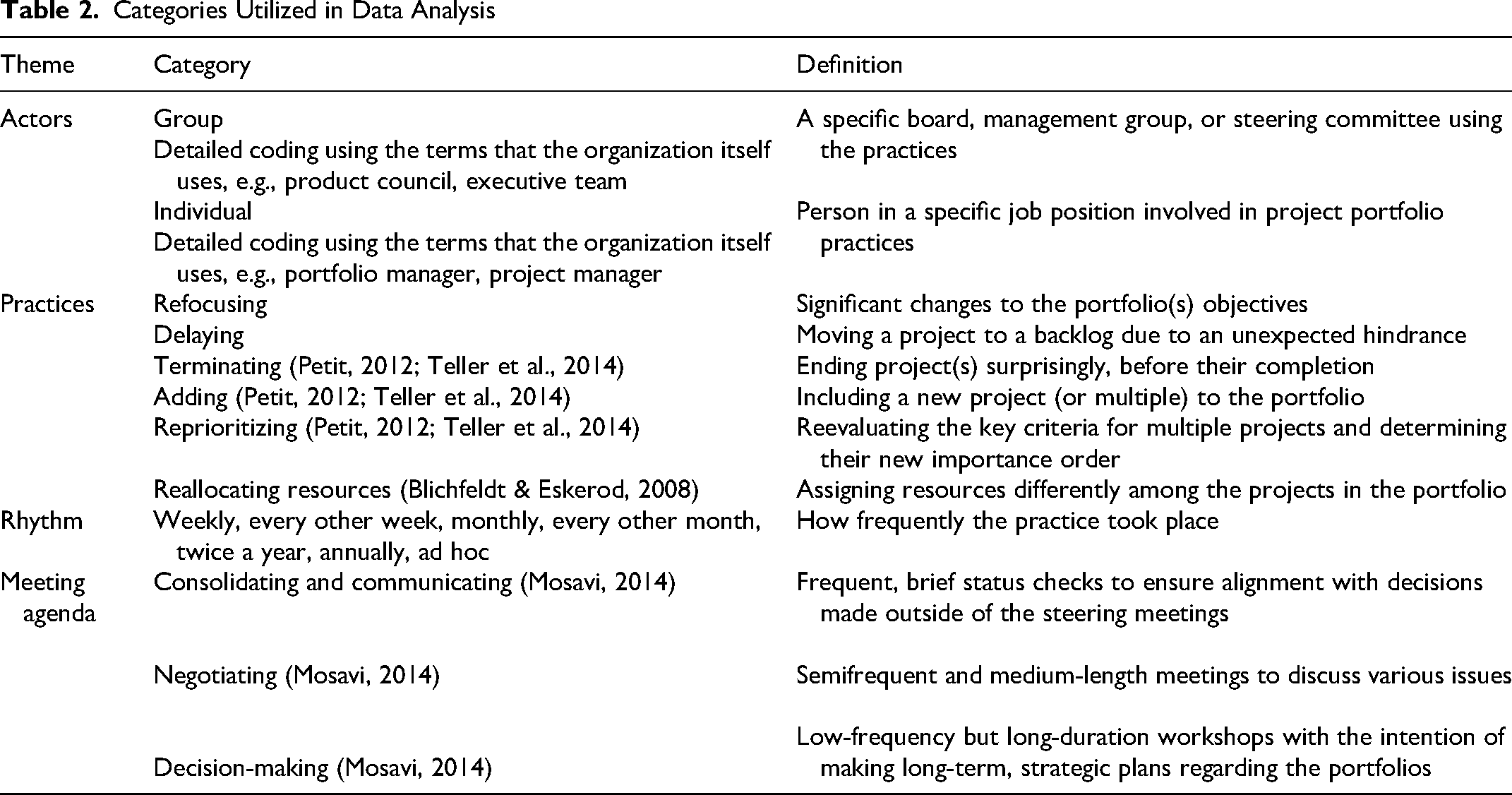
After identifying the key actors from the interview data, their practices in project portfolio governance were mapped by coding all actions with an impact on the portfolio(s) that the group or individual was authorized to take. These practices were categorized by utilizing both pre-existing categories deductively (terminating, adding, and reprioritizing portfolio components [Petit, 2012; Teller et al., 2014] and reallocation of resources [Blichfeldt & Eskerod, 2008]); as well as adding on these categories inductively when new practices emerged (refocusing and delaying). In this study, refocusing implies major adjustments in the innovation project portfolio(s) objectives. Delaying means moving a project to a backlog rather than acting on it in the present moment; this might be necessary, for example, when a certain roadblock, such as unavailable resources, would hinder the progress of a project.
Consequently, the rhythm of the mentioned practice was coded inductively based on all mentioned measures of time: weekly, every other week, monthly, every other month, twice a year, annually, or ad hoc. Here, ad hoc refers to a rhythm that cannot be explicitly specified; that is, the practice simply takes place whenever seen necessary. As this study does not only concern the steering committees but also various other groups and individuals and their practices both in and outside of formal meetings, rhythm was treated by the frequency attribute only; that is, how often such practices are performed, and not by duration, that is, how long such practices last. Where certain rhythms were quite clearly agreed upon among the interviewees, the analysis relied, at times, on a singular observation (i.e., only one interviewee stating the practice and frequency related to a specific group or individual).
The meeting agenda was coded only for the groups involved in project portfolio governance. In order to link our study to the existing theoretical framework on the roles of steering groups presented by Mosavi (2014), a deductive approach was used (Saunders et al., 2016). Contrary to Mosavi’s (2014) term role, which reflects a fairly permanent property or task of the committees, we concentrated on the purpose and nature of the events; that is, meetings where the committees convened. Thereby, we also acknowledged that the same committee might have multiple different meeting agendas. If the meeting of a group was described by the interviewees as involving status checks and decisions had already been made before the meeting by the involved individuals, the meeting agenda was defined as consolidating and communicating. If, in turn, the group attendees gathered to discuss various proposals, with the aim of reaching a decision on the matter during the meeting, the meeting agenda was categorized as negotiating. Finally, if the meeting was used to decide on strategic, long-term plans for the portfolios, the agenda was classified as decision-making.
During the case-specific coding and analysis of the data, it became evident that the companies differed from one another in their overall approach to project portfolio governance, specifically in terms of the authorized responsibilities for governance practices and the rhythm with which those practices took place. Certain differences were also noticed within each case between the approaches to the various project portfolios. Therefore, we will first report the case-specific findings and their illustrative interview quotes to reveal each pattern of authority and rhythm consistently. When we contrasted findings across the cases, we noticed an evident difference between the cases in terms of how centralized versus decentralized the portfolio actors’ authority was, as well as how slow versus fast the portfolio governance rhythm was. We use these terms in highlighting the main character of each case’s project portfolio governance approach. After the case-specific narratives, we summarize the cross-case analysis in a matrix framework that portrays the companies’ various approaches to project portfolio governance.
Results
Decentralized Authority and Rapid Rhythm in Company A’s Project Portfolio Governance
At Company A, change is the only constant. As the industry clock speed is fast, this rapidly growing company aims to meet demands and compete with other vendors with innovative software solutions. Due to a dynamic environment with various uncertainties, the company has aimed to find the perfect balance between formalized portfolio governance and flexibility. As one of the interviewees explains: “As we’ve been growing quite rapidly, we’ve tried to design more structured governance mechanisms and processes [for innovation portfolios]. At the same time, we don’t want to forget that we need to be able to react quickly: a formalized process should not be the reason that we cannot do something in an agile manner. Perhaps due to our quick growth and start-up background, we’re still able to be quick on our feet when necessary.”
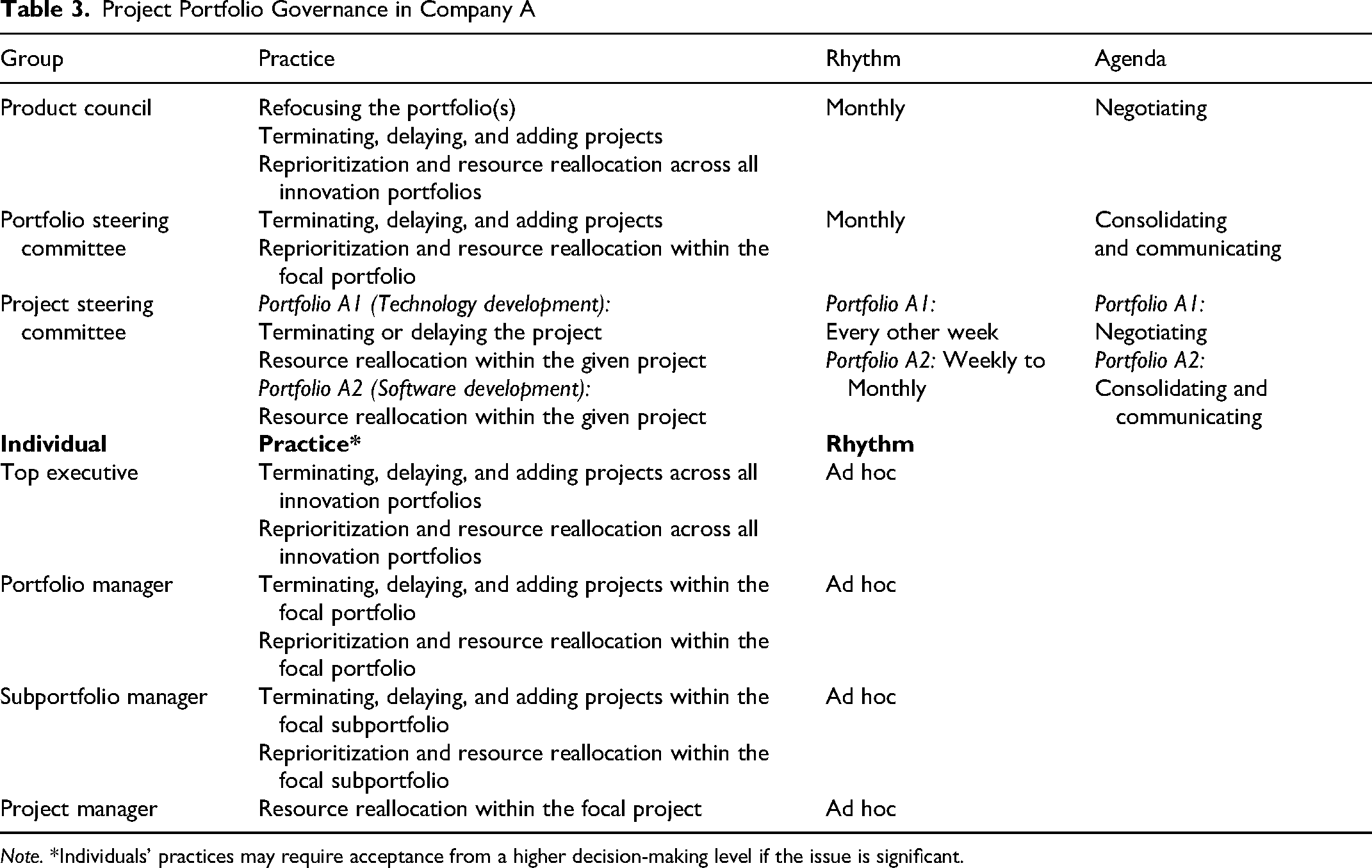
The various groups and individuals involved in project portfolio governance have certain authorized practices, as reported in Table 3. The groups tend to gather based on a predetermined rhythm and have a typical agenda. According to all the interviewees, the product council holds the most decision-making power in project portfolio governance and oversees both portfolios. The practices for the product council include refocusing the portfolio (e.g., in a case of a changing business strategy); terminating, delaying, adding, or reprioritizing projects; and resource reallocation. The product council consists of portfolio managers and top executives, including, for example, the chief product officer (CPO), chief technology officer (CTO), and director of product strategy management. Due to the quickly changing environment, the governance rhythm is very frequent, with monthly meetings at even the highest level of portfolio hierarchy.
Project Portfolio Governance in Company A
Note. *Individuals’ practices may require acceptance from a higher decision-making level if the issue is significant.
In the product council, all relevant issues related to both portfolios are discussed to ensure transparency and alignment with the strategy. The agenda of this monthly meeting tends to involve negotiating, in which the product council members share their proposals with other attendees. This is described by one the interviewees as follows: “We [the product council members] are the ones who present our proposals that we have prepared prior to the meeting. We share the reasoning and facts we have gathered regarding the proposal, and then, we discuss and think together about whether or not we want to make the decision.”
Another interviewee, on the other hand, argues that the product council rarely makes changes to the portfolio but is still authorized to do so when necessary: “We typically don’t make any changes [in the product council] but, rather, review the portfolios as a whole and see if something has come up. If we need to start something significant, then those decisions can be made in this forum. We might, for example, decide that we need to change a team’s focus to another direction to make things move forward faster.”
Both portfolios also have their own, independent portfolio steering committees that gather monthly. The participants in these steering committees differ slightly between the two portfolios but typically include the corresponding portfolio manager, product managers, and team leaders, the latter two of which can be classified as subportfolio managers. Unlike the product council, these meetings tend to have a consolidating and communicating agenda, with the attendees having performed some assessments and made decisions already outside the formal forum. The agenda is explained by one of the interviewees involved with Portfolio A1 as follows: “Once a month, we go through all of the new project ideas and review how all of the current projects are performing. Then, we reprioritize our backlog based on discussions that our [subportfolio managers] have had regarding the potential profits and costs for each project…. So, there’s a formal structure, but the decisions are still quite subjective and based on what we feel…. For [Portfolio A2], we are able to calculate better estimates, but for [Portfolio A1], it is more uncertain.” Although the portfolio steering meetings are authorized to take action at the portfolio level relatively freely, strategic portfolio refocusing should only occur at the level of the product council or even higher, at the level of the executive team.
Project steering committees involve project managers and members and, at times, subportfolio managers or even portfolio managers, depending on the size of the project. The project steering committees are authorized differently between the two portfolios, and the frequency of meetings also differs. The project steering committees for Portfolio A1, where the innovation type is technology development with often uncertain outcomes, are authorized to even terminate unsuccessful projects independently, and it may require a negotiating agenda to reach a common conclusion in this regard. In the software development–focused Portfolio A2, especially in terms of large projects, the project steering committees are not authorized as widely. Instead, all major decisions related to potential project termination and even project progression to another stage must be approved by the product council. Due to their status-check characteristics and frequent rhythm, the project steering meetings in Portfolio A2 can be classified as having a consolidating and communicating agenda.
At Company A, a communicating and consolidating agenda seems to be the most typical agenda of the portfolio-related groups. This reflects relatively decentralized authorization: to ensure quick responses to various uncertainties, individuals are quite widely authorized to make decisions outside of the formal portfolio and project meetings. However, the practices depend on the significance of the issue in question. To a certain extent, project managers are authorized to reallocate resources within the focal project; subportfolio managers may choose to terminate, delay, add, or reprioritize projects; and portfolio managers are authorized to follow similar practices at the portfolio level. However, if an issue is significant, it must be escalated to a higher level. The CPO at Company A describes the escalation path as follows: “If it is a small, everyday type of a decision or something that the [project or subportfolio manager] is able to solve on their own, then they make the decision independently. Or, if it’s a bit of a larger issue, then they ask the portfolio manager. If it’s a significant issue, it comes to me.”
Another interviewee described the decision-making hierarchy as follows, also highlighting the role of the CPO: “We’ve wanted to maintain relatively autonomous decision-making among product managers on the matters they are responsible for to avoid unnecessary bureaucracy. We (the senior managers) then offer our support for these decisions and ensure transparency to the higher levels of the organization, including the CPO. For example, if a portfolio component is removed, it’s quite a significant decision…. So our CPO has to be involved in such decisions. This logic also applies to new additions to the portfolio.”
At times, the involvement of other top executives may also be required, including the CTO and/or CEO, especially if the issue at hand is urgent, large scale, and/or related to the strategic alignment of the portfolio. The empirical data show some ambiguity regarding how responsibilities have been granted in terms of uncertainty management. Authority in portfolio governance is not always explicitly granted; rather, it may naturally evolve into a certain form if no clear mandates are provided by top executives.
Steering Group–Centered Authority and Slow Rhythm in Company B’s Project Portfolio Governance
At Company B, the industry clock speed is slower as compared to the rapidly shifting software industry, but innovative heavy-machinery technology is vital in maintaining competitive advantage and market success. As in Company A, project portfolio governance is demonstrated by many actors in Company B. Table 4 displays these key groups and individuals, as well as their corresponding practices, rhythm, and meeting agenda related to portfolio governance.
Project Portfolio Governance in Company B
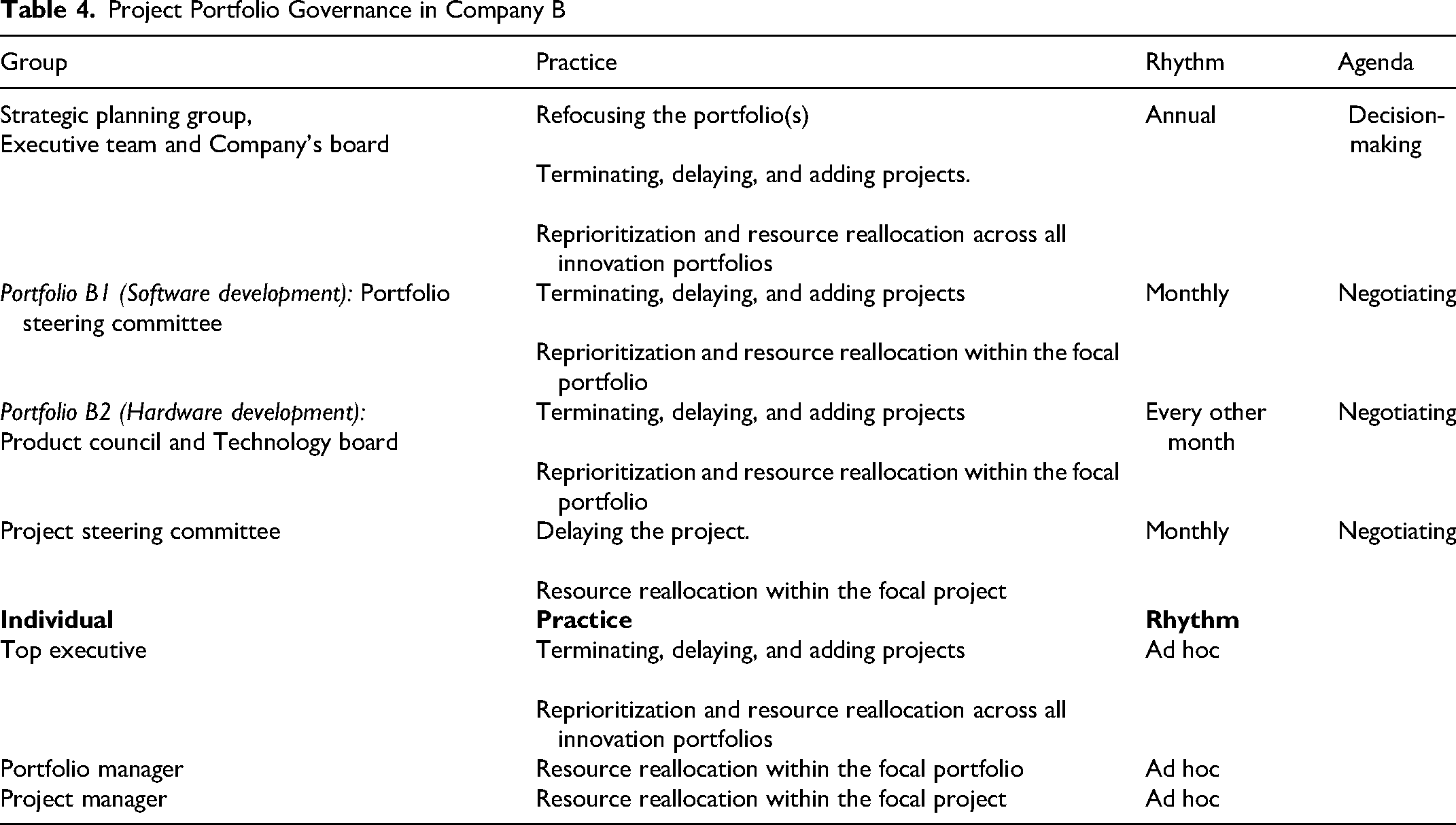
The governance of the two portfolios differs in terms of steering rhythm and the number of forums involved. For Portfolio B1, where the innovation portfolio type is software development with typically shorter project cycles compared to hardware development–centered Portfolio B2, the key decision-making forum is a portfolio steering group that gathers on a monthly basis, which involves top executives, including the CEO and other managers. The authorization for this group is relatively wide, and the decision-making hierarchy quite clear, as an interviewee explains: “Of course, the CEO is the one who can make the final decisions if needed, but if it’s a large, new product-development project, the budget may require acceptance from the board. So, this kind of a formal governance model is followed. But when it comes to ordinary decision-making, then I would say that most issues can be handled quite smoothly by the chair of the board, so formal voting or something like that is rarely needed.”
As for Portfolio B2 focusing on hardware development with typically longer project cycles, there is not only one steering group but two distinct forums practicing innovation portfolio governance: the product council and the technology board. The key decision maker for Portfolio B2 is the product council, which involves almost the entire executive team, including the CTO and CEO, sales representatives, and portfolio managers. It gathers every other month to discuss topical issues. One of the interviewees described the agenda of the product council as follows: “Previously, we used to go through the status of all ongoing projects and new project proposals, but we have now shifted [the agenda] to focus only on the issues that require a decision…. We decide on new projects and tackle potentially significant challenges…. Such challenges can be related to resources, priorities between the portfolio components, and/or delays in the planned schedule.”
As the product council’s typical agenda revolves around deciding various issues and the meetings occur semifrequently, it can be classified as a negotiating agenda.
The technology board, which also convenes every other month, gathers just prior to the product council. This board does not involve top executives, but the attendees include portfolio managers and other product managers. The main agenda for this meeting is to select and prepare research proposals for the product council. This process is explained by an interviewee as follows: “Before [the product council], the technology board gathers to assess research proposals […]. When the assessment is ready, we summarize the results and then give our proposal [to the product council] on whether it could have potential for further productization or if we should still let some time pass before moving it forward.”
Additionally, Company B organizes annual strategic planning groups, in which all short- and long-term projects are reviewed and, ultimately, plotted in one portfolio and organized on a timeline ranging from the present day to 10 years into the future. Such strategic planning occurs annually for both Portfolios B1 and B2. These meetings involve a large group of people, including top executives; portfolio, product, and project managers; and team leads. The agenda can be classified as decision-making. Such annual strategic refocusing of the portfolio, however, also requires formal acceptance by both the executive team and the company’s board.
Within both portfolios at Company B, innovation projects with more than five people have their own project steering groups. These project steering meetings typically include project and product managers and, at times, portfolio managers. The steering meetings tend to be held monthly, and the agenda is based on the monitoring of project status and, consequently, resource allocation decisions. When asked if the project steering groups are authorized to make such significant decisions independently, an interviewee explained as follows: “Yes, that can be the case. Surely, the decision will be informed by the product council, and it might be that the decision has to be run through there, but yes, typically, the project steering group is quite powerful and can make such decisions.”
At Company B, individual actors, such as portfolio and project managers, are not as widely authorized to make portfolio-level decisions as at Company A. Due to this, the portfolio and project steering committees tend to have a negotiating agenda, in which actions are broadly negotiated and then ultimately decided as a group. At times, however, individuals, especially top executives, can also make some decisions, for example, regarding resource reallocations, if an urgent issue arises.
Even though the governance rhythm, with annual strategic refocusing, is slower at Company B as compared to Company A, both small and large uncertainties may force the company to deviate from the typical meeting rhythm and make ad hoc changes to the portfolio. The director of R&D and technology has recognized this need well during the chaos caused by the COVID-19 pandemic, as he explains: “We have a huge number of projects, even a bit too many. In that sense, this spring and COVID-19 were a good time to pause and seek focus again. We should remember that during the good times as well, that we should sit down for a bit and review the things in the portfolio.”
Centralized Authority and Steady Rhythm in Company C’s Project Portfolio Governance
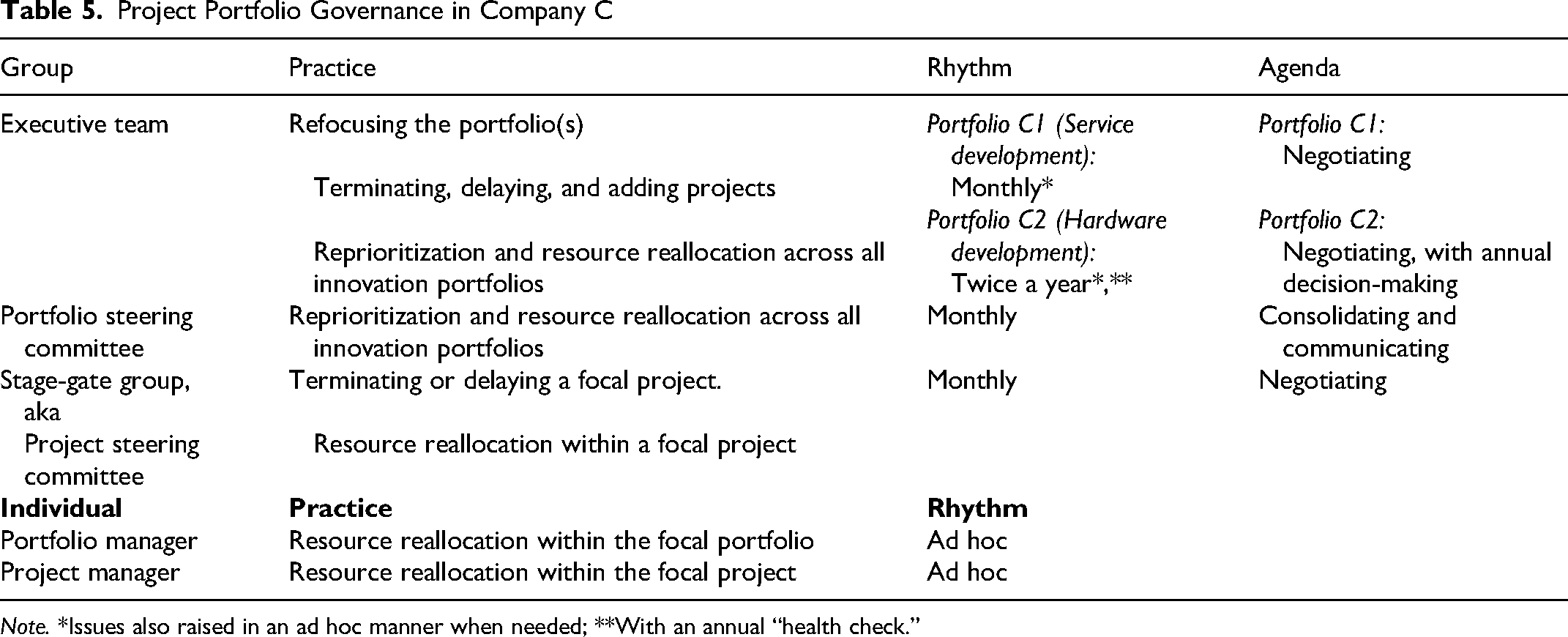
Even though Company C competes in the relatively conservative wood-processing industry, it has reached a significant market position through innovative, customer-oriented processed wood products. The groups and individuals involved in innovation portfolio governance at Company C and the corresponding practices, rhythm, and agendas are presented in Table 5.
Project Portfolio Governance in Company C
Note. *Issues also raised in an ad hoc manner when needed; **With an annual “health check.”
At Company C, the empirical data highlight the importance of the executive team in project portfolio governance: not only does the executive team have the most decision-making power in terms of innovation portfolios, but nearly all decisions must be approved by this group. Due to this centralized authority, many portfolio-level practices are limited to the level of the executive team. For example, adding projects to the existing ortfolios is very strictly governed. According to the portfolio manager of Portfolio C1, only the executive team is allowed to begin an innovation project at Company C: “We have a company policy that truly project-based development initiatives can only be kick-started by the executive team. This is due to us wanting to ensure that each initiative is evaluated using the same criteria and that each innovation project will serve our company strategy.”
Additionally, the same process owner highlights the fact that there are no informal pet projects at Company C floating outside of the formal portfolio governance practices. Such strictly limited authority differs from the findings derived from Companies A and B, and it may stem from the companies’ size difference.
As in Company B, the governance rhythm in Company C differs between the two innovation portfolios. The service development–centered Portfolio C1—with often shorter project durations compared to Portfolio C2—follows a faster governance rhythm, with monthly meetings. Whereas the hardware development–centered Portfolio C2 is reviewed at the executive-team level twice a year. Although the rhythm for Portfolio C2 is significantly slower as compared to that of Portfolio C1, portfolio-related topics may be raised to the executive team in an ad hoc manner outside the formal governance rhythm if needed. This is explained by the portfolio manager of Portfolio C2 as follows: “Issues with even slight significance will be raised to the executive team as independent topics, and we also present an overview of the portfolio to them from time to time. For example, I present my portfolio (Portfolio C2) to the executive team twice a year.”
As significant decisions do not have to wait until the next scheduled meeting with the executive team, the governance rhythm is, in fact, quite fast, even for Portfolio C2.
For Portfolio C2, one of the portfolio reviews presented to the executive team is especially comprehensive and referred to as a “health check,” with a long-term, strategic decision-making agenda for the entire portfolio. Otherwise, as all key decisions can only be made by the executive team during these formal meetings, the agenda for the portfolio meetings at this level seem to be negotiating.
Despite having two innovation portfolios, Company C only organizes one portfolio steering meeting. Although this meeting is focused on Portfolio C1, the portfolio manager of Portfolio C2 is also involved, as he explains: “We have a bit of a one-sided way to steer [the innovation portfolios]…. We have a monthly steering meeting for the service portfolio (Portfolio C1), where I’m also involved as the manager of Portfolio C2. So, in that meeting, we also cover the other portfolio (Portfolio C2).”
The portfolio steering meeting acts as an important forum in which to share information between the two innovation portfolios. The agenda is consolidating and communicating. All issues requiring negotiation and decision-making are then brought to the executive team when necessary.
Despite the executive team–centered decision-making, the project steering committees at Company C still play an important role due to the project gate decisions that are made monthly. These meetings may therefore end in terminating or delaying a project when necessary. Additionally, a portfolio steering committee gathers monthly. Then, issues related to prioritization and resource allocation in both portfolios are discussed, with a consolidating and communicating agenda. Resource reallocation decisions are also made informally by portfolio and project managers, but otherwise, portfolio-level decision-making is quite strictly limited to the executive team.
The interviews at Company C did not reveal any practices for individual top executives. This seems to highlight the centralized, group-driven decision-making practiced at Company C. Individuals, even at the highest hierarchical level, are not authorized to make decisions regarding innovation portfolios outside of formal meetings.
Cross-Case Synthesis
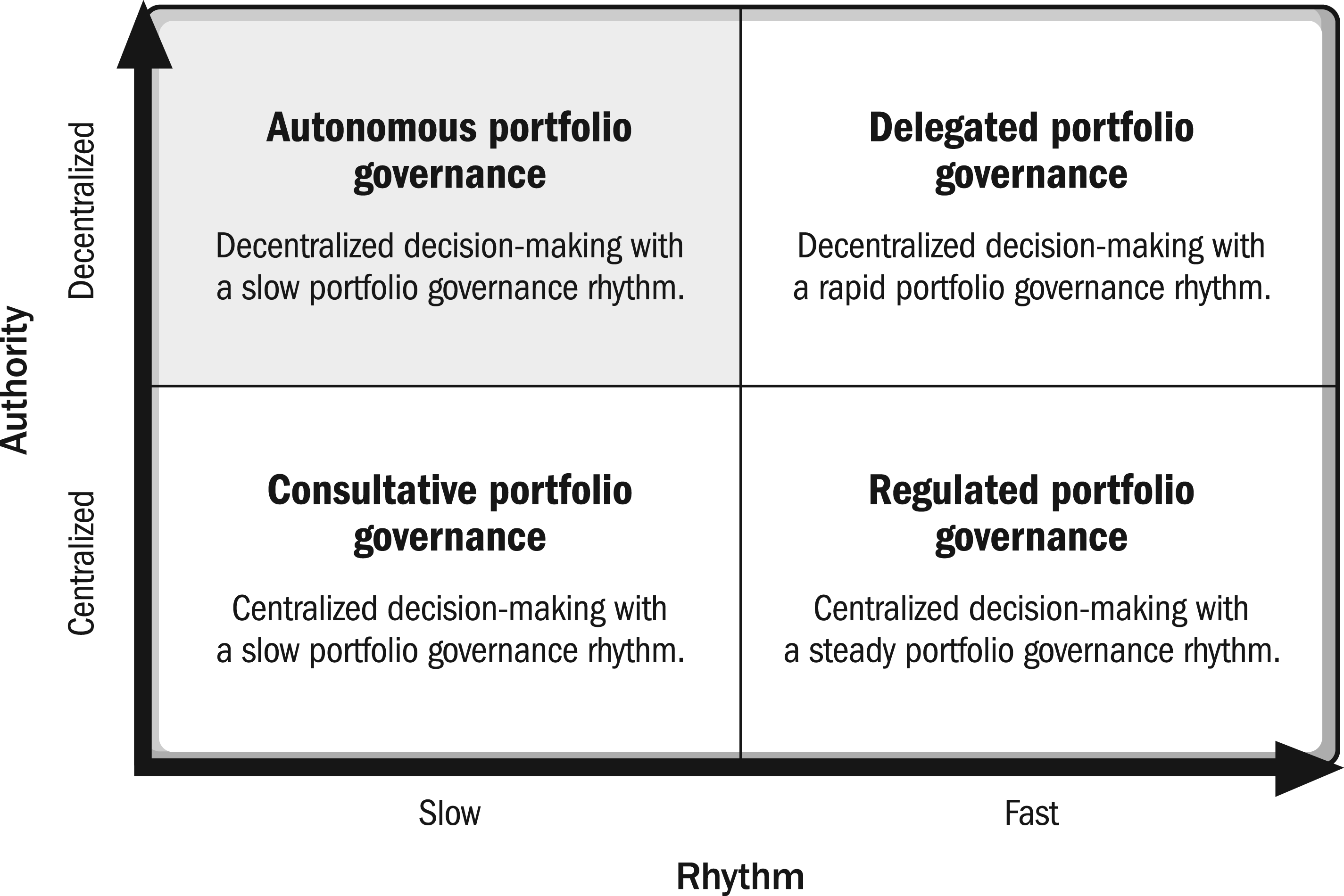
The three companies’ approaches to project portfolio governance reveal alternative patterns in terms of the distribution of authority and the various rhythms of using governance practices. Figure 1 displays four categories of project portfolio governance, which we label autonomous, delegated, consultative, and regulated portfolio governance. Our findings demonstrate the use of different project portfolio governance approaches depending on the type of industry and innovation portfolio, lending support to observations within the company concerning product development processes (MacCormack et al., 2012), but showing differences both between companies and within-company portfolios specifically at the OPM layer. While our study did not reveal autonomous portfolio governance (highlighted with gray color), we acknowledge its potential existence in other organizations.
Cross-case synthesis of the patterns of project portfolio governance.
Delegated portfolio governance, as in Company A, is characterized by decentralized authority and a fast rhythm. This governance type can enable fast responses to various uncertainties and, therefore, can represent a flexible alternative for centralized and slow-paced portfolio governance. As individuals are authorized to make decisions independently, the portfolio steering meetings tend to have a consolidating and communicating agenda. However, such a governance approach may be time-consuming due to the frequent portfolio review meetings. Decentralized authority may cause inconsistent decision-making due to subjective decisions being made by many individuals. Company A represents a medium-sized, innovative company operating in the fast-paced software industry, with a relatively flat hierarchy, in which the delegated portfolio governance approach matches the fast-paced innovation portfolio types (technology and software development) and industry requirements.
Consultative portfolio governance, as in Company B, is group oriented in authorization, and the governance rhythm is relatively slow. This governance type is perhaps not as demanding as delegated and regulated governance types due to the slower meeting rhythm. This group-oriented decision-making may be a way to ensure more coherent and transparent decision-making as compared to more decentralized alternatives. However, centralized authority and slow rhythm may lead to slower decision-making, as steering meetings tend to have negotiating or decision-making agendas and individuals are not able to react to uncertainties quickly and flexibly outside the formal meetings. Company B, for example, is categorically a large company, but on the medium end of the size spectrum, in which the negotiation-oriented governance approach and differentiation of rhythms between the two portfolios with different innovation types (software and hardware development), offer a compromise; one that can function at various innovation speeds, in the form of a consultative portfolio governance approach.
Regulated portfolio governance, as in Company C’s Portfolio C1, is characterized by centralized authority and a relatively fast governance rhythm. Here, nearly all portfolio-level decisions must be approved by a certain group, for example, the executive team. Due to this centralization, the key decision-making body must also meet relatively frequently, as no decisions can be made outside these formal meetings. This governance type may be the clearest way to organize project portfolio governance, as the responsibilities and decision-making hierarchy are formally defined in strict regulations. The fast rhythm may make the governance quite time-consuming, the centralized decision-making may reduce the flexibility of the organization, and the steering meetings tend to have negotiating or decision-making agendas. Company C is a large organization operating in a conservative industry with clear hierarchical levels, and its service development–centered Portfolio C1 shows examples of regulated governance, with monthly meetings and centralized authority. For hardware development–centered Portfolio C2, however, the rhythm is slower, and therefore, the governance type leans toward consultative portfolio governance. Due to this finding, it is important to note that a single company may fall into multiple categories in Figure 1 if governance is practiced differently across portfolios.
Discussion
This study pursued additional knowledge about the OPM governance layer of organizations, specifically knowledge about various organizations’ project portfolio governance. We asked: How, through what kinds of approaches, do companies govern their project portfolios? Previous research has already pointed out governance regimes and actors as important dimensions of project portfolio governance (Martinsuo, 2023), and differentiated between the governance of things and governmentality concerning the people involved in the governance task (Müller et al., 2019). This study acknowledged that people and things (i.e., projects) are bound together through the practices of portfolio governance. The empirical research was motivated by the need to observe governance responsibilities and practices in various contexts.
As key results, we showed that the case companies used similar kinds of practices in governing their project portfolios but differed from one another in the authority and rhythm involved in using those practices, reflecting a contextual pattern of differences both within and between companies that resembles differences found in within-company product development processes (MacCormack et al., 2012). A framework was designed that combined authority and rhythm and revealed delegated, regulated, consultative, and autonomous approaches to project portfolio governance. We will first discuss the findings in light of the earlier research on responsibilities and practices in project portfolio governance to develop propositions and then consider what the findings imply for OPM governance generally.
Authority and Rhythm Differentiating Project Portfolio Governance
The findings of this study reveal the versatility of authority distribution and task division between groups and individuals. This study complements the previous literature by recognizing the vitality of portfolio steering committees and frequent portfolio meetings (Mosavi, 2014; Müller et al., 2019; Müller et al., 2014), offers empirical evidence regarding the selective versus comprehensive inclusion of various portfolio actors in project portfolio governance (Martinsuo, 2023), but also builds on previous research investigating how individual managers contribute to project portfolio governance via improvised decision-making practiced outside the formal portfolio steering meetings (Christiansen & Varnes, 2008; Jerbrant & Karrbom Gustavsson, 2013; Korhonen et al., 2014). Additionally, this study offers new findings on the contextual nature of project portfolio governance: companies differing in terms of size, industry, and their culture of involving lower-level managers in decisions may choose different approaches regarding how groups and individuals are authorized in project portfolio governance.
According to Mosavi (2014), the three roles of portfolio steering groups—consolidating and communicating, negotiating, and decision-making—are dependent on meeting frequency and duration. However, we argue that governance groups may have various agendas and the role is not fixed to just a certain agenda. This study proposes a link between the level of authority and the meeting agenda of a portfolio steering group: when authority is decentralized, the portfolio steering meetings tend to lean toward a consolidating-and-communicating agenda, whereas centralized authority often requires a negotiating or decision-making agenda. That is, decentralized authority enables individuals to make portfolio-level decisions, even outside the formal meeting structure. The findings add to earlier research in that portfolio committees seem to have multiple simultaneous roles and project portfolio governance also occurs outside of official meetings, showing evidence of sovereignty at the OPM and group level and adding to project-level authority research (Müller et al., 2016). As studies have linked quick responses to changing environments with the success of portfolio management (Bechtel et al., 2023), giving portfolio managers and teams more decision-making power in their daily operations might provide a competitive advantage as compared to authoritative governmentality, with its high-power distance and low portfolio-review frequencies. Based on this consideration, we derive the following proposition:
This study reveals the alternative rhythms of project portfolio governance across companies, thereby building a connection from governance to time and rhythm-related management research (Blagoev et al., 2023; Kunisch et al., 2017; Perlow et al., 2002; Turner & Rindova, 2018; Zhang et al., 2023). In particular, the findings draw attention to the differences in repetitiveness (Kunisch et al., 2017; Zhang et al., 2023), temporal patterning (Turner & Rindova, 2018), temporal structures and their dynamics (Blagoev et al., 2023), and processual dynamics (Kunisch et al., 2017) of practices, and their possible dependence on the speed of the context (Perlow et al., 2002), specifically by showing evidence from the implementation of project portfolio governance in different companies. The case companies had completely different rhythms of project portfolio governance, potentially stemming from their differing product types (extent of hardware versus software intensity), product development life cycles (medium versus long), and industry clock speeds. As project portfolio governance is a central concern for top managers, its rhythm could be considered as strategic (Zhang et al., 2023).
In particular, the results build on and complement previous literature that has recognized the link between the appropriate portfolio-steering rhythm and contextual attributes such as company size (Bechtel et al., 2023; McDonough & Spital, 2003; Mosavi, 2014; Müller et al., 2008; Urhahn & Spieth, 2014). Based on the empirical data, the involvement of groups enlarges, and individuals’ role diminishes when the governance pattern resembles either consultative or regulated approaches, as opposed to autonomous or delegated alternatives. The results also reveal that companies with a slow governance rhythm tend to have a centralized, group-driven portfolio governance approach, whereas a fast governance rhythm follows from a decentralized approach, in which individuals are widely authorized. We thereby offer new knowledge about the temporal patterns of project portfolio governance, which have not been covered previously, and offer the following proposition:
This study shows how the rhythm and authority distribution differs between companies regarding their project portfolio governance approaches. The results reveal various patterns in terms of how companies organize project portfolio governance regarding authority and rhythm: autonomous, delegated, consultative, and regulated. The findings deviate from the earlier notion of liberal, neoliberal, and authoritative governmentality (Müller et al., 2016; Müller et al., 2019) by revealing groups’ and individuals’ varying agency across the momentary governance agendas and by highlighting the inseparability of authority from the organization’s governance routine, represented by the governance rhythm that seems to depend on the industry rhythm, portfolio type, and maturity of portfolio management.
Because different companies follow different patterns of project portfolio governance, this study reveals a linkage between the context and the chosen governance rhythm and authority distribution. For example, larger organizations may benefit from centralized project portfolio governance with a moderate portfolio governance rhythm to ensure consistent decision-making, whereas medium-sized organizations operating in a fast-paced industry may choose to follow a decentralized authority and have a fast portfolio governance rhythm to enhance agility. These results therefore complement Martinsuo’s (2023) findings and offer empirical evidence regarding the importance of specifying a governance approach that is in alignment with the organization’s culture and context. Therefore, we propose the following:
While MacCormack et al. (2012) discovered emergent, agile, and efficient product development processes for handling projects in the different business contexts (start-up, growth, maturity) of the same company, our findings complement this idea by revealing and characterizing the different portfolio-level governance approaches also within companies. For example, tangible and intangible portfolios and portfolios with different temporal orientations may benefit from different portfolio governance rhythms due to their differing project life cycles. The findings, thereby, offer nuanced evidence regarding the contextuality and context-dependent requirements of project portfolios (Martinsuo & Geraldi, 2020) within the same organization. This implies a need to acknowledge the coexistence of multiple project portfolios, especially in future research on large companies’ portfolio governance. Therefore, we propose the following:
Project Portfolio Governance as a Part of Organizational Project Management
In this study, we focused on organizations’ approaches to guiding their project portfolios toward strategic objectives to complement the dominant concentration on more operational project portfolio management. As such, this study adds to the OPM governance layer (Müller et al., 2019) and governance-of-projects research (Müller & Lecoeuvre, 2014; Riis et al., 2019) by revealing the repertory of practices available for governing project portfolios. While we did not consciously examine the financial and resource investments that the parent organizations made in their project portfolios, we showed the practices that managers used to make or withdraw such investments and that continuously integrate the portfolios into the parent organization. Specifically, various portfolio actors used their individual and collective authority by refocusing, reprioritizing, and reallocating resources in the portfolio and by terminating projects, delaying projects, and adding projects to the portfolio. As the practices as such do not differentiate companies from one another, the more defining features of the project-portfolio-governance approach are the authority granted regarding the practices and the rhythm used in handling them. These findings help develop Martinsuo’s (2023) idea of governance regime and actors and, especially, centralization and inclusion as important, differentiating dimensions of portfolio governance mode.
Our findings portray project portfolio governance as a continuous process that should not necessarily be conceptualized as separate, consequent phases. Rather, it repeats its subtasks with varying rhythms and will potentially benefit from forthcoming research specifically focusing on temporal structures, patterns, and dynamics (Blagoev et al., 2023; Kunisch et al., 2017; Perlow et al., 2002; Turner & Rindova, 2018; Zhang et al., 2023). Despite the cross-sectional empirical research setting, we revealed interviewees’ experiences with road mapping to order projects on a timeline and using certain governance practices in the same meetings repeatedly over time. Project portfolio governance, as the organization’s chosen approach to top managers’ oversight of the portfolios, is thereby portrayed as a temporal continuum, with the practice repertory being used variably, depending on the situation.
Conclusions
This study has built on, paid respect to, and supplemented Ralf Müller’s and his coauthors’ powerful and rich theorizing on project governance and OPM. As an overarching contribution, this study specifies the project portfolio governance task at the OPM governance layer as a combination of practices, authority, and rhythm. More specifically, four contributions are offered. First, we offered evidence of governance practices at the OPM governance layer, which is often neglected when attention is centered on project portfolio management at the operative level. Where OPM governance becomes particularly relevant in large companies with multiple project portfolios, already organizations with just two project portfolios will benefit from a careful consideration of their approaches to project portfolio governance. Second, the study provides a framework for project portfolio governance approaches, portraying the versatility of different authority and rhythm patterns. Specifically, the study of three companies revealed differences among the delegated, regulated, and consultative project portfolio governance patterns, which may stem from the industry rhythm, the innovation portfolio type, and the included projects. The autonomous portfolio governance approach remains to be examined via empirical research. Third, we drew attention to the division of responsibility between individuals and governance groups, specifically concerning their complementarity in project portfolio governance. If governance-related groups, such as steering committees, are tied to an agreed-upon rhythm, individual managers complement this rhythm by using governance practices in an ad hoc, nonroutine manner. The context-dependent governance approaches remind us how important the interplay between governing committees and individuals is in developing an appropriate rhythm and building continuity for each project portfolio. Finally, our study portrays project portfolio governance rhythm as one strategic rhythm in an organization, offering specific temporal structures and dynamics and connecting the organization with its institutional context. Temporal considerations will offer a novel perspective for forthcoming research on managing project portfolios.
For practitioners and managers, this study offers ways to assess and develop a project portfolio governance approach so it aligns with the industry context and portfolio type. The framework could eventually be developed into a practical tool with which to assess a company’s governance approach systematically. Knowledge about the current governance approach could be helpful in assessing why certain practices are not suitable for a specific portfolio context. The repertory of governance practices will be useful for top managers when they consider the division of responsibilities between steering groups and individual managers. Large organizations that have multiple project portfolios will benefit from differentiating their portfolio governance approaches depending on the specific nature and business context of each portfolio.
This study has certain validity limitations stemming from the choice of the research approach, cases, and informants. Multiple-case studies investigate chosen analysis units. In this study, the unit of analysis is the focal companies’ approaches to project portfolio governance in their real-life contexts. This choice limits the transferability of the findings. We purposely chose highly innovative multiportfolio companies of different sizes and industries and focused on R&D portfolios to ensure sufficient similarity in the project context but demonstrate variety in governance approaches. These choices may limit the transferability to highly innovative contexts and suggest that project portfolio governance approaches could be different in less innovative contexts. The choice of cases was influenced by the search criteria summarized in the method section and the availability and voluntariness of the company contacts during the study. We approached companies that were within our reach in one country and ended the search after receiving positive responses. There may be a success bias in the chosen companies; companies with significant R&D challenges may not have volunteered for this kind of a study but might have offered different results. While we collected interview data from two additional companies, the three chosen companies were deemed sufficient and suitable for the research task in terms of the variety and richness of the interview data.
The interviewees were chosen from among managers and directors involved in innovation project portfolios at various levels. In the smaller companies, Companies A and B, there would not have been many others who could have been interviewed on these topics, particularly at the level of directors; whereas in Company C, more interviews might have been possible across various business units. However, we feel that the experiences of the chosen interviewees are equally representative as those of others. Furthermore, the thematic coding approach (partly deductive, partly inductive) includes potential validity concerns of excluding some pertinent issues that are not featured in existing frameworks. We have attempted to mitigate such concerns through allowing some extent of inductiveness also when using an initially deductive framework (i.e., allowing new categories to emerge, especially concerning practices) and through reading the data several times and discussing among authors while coding the data (to avoid negligence of relevant content). We are aware that thematic interviewing and coding do not always reveal all aspects of a phenomenon, and our study gives ideas for acknowledging aspects of authority and rhythm with more detail in future research.
This study opens several pathways for future research, specifically concentrating on the governance layers of project organizing. The framework concerning authority and rhythm in project portfolio governance could be developed further and tested with other types of project portfolios and in less innovative contexts. The division of authority between groups and individuals in project portfolio governance could be investigated further to identify how it appears in different contexts and help develop the toolbox of project portfolio governance. Concerning the rhythm of using governance practices, it would be important to inspect the duration and regularity of both individuals’ and committees’ portfolio governance practices besides frequency, adopt longitudinal research designs, observe the governance practices used in the actual work environments, and follow up on the patterns that appear within the daily lives of organizations. Among Martinsuo’s (2023) dimensions of governance modes, external outreach and formalization were not analyzed in this study, which may stem from the themes covered in the interview outline. They could be included in future research purposely. Furthermore, the lens of governmentality could be adopted to further investigate authority and the perspectives of individuals and groups as a part of project portfolio governance.
Footnotes
Acknowledgments
Tampere University of Technology support foundation funded the data collection for this study, and we gratefully acknowledge this funding support. We thank the participating companies for enabling this study. Roosa Anttila collected the data for the company C, and we thank her for her kind support and earlier data analyses. We also thank the Center for Research on Project and Service Business (CROPS) at Tampere University for the constructive atmosphere and support during the early phases of this study. The editor and reviewers offered helpful, constructive feedback that both challenged and inspired us, and we appreciate this support greatly.
