




Abstract
Public–private partnerships (PPPs) have been promoted as achieving value for money in government projects through innovation. Private investment, contract bundling, and transferring risk to the private sector are regarded as incentives creating innovation. Data collected on PPPs through in-depth interviews with 36 senior practitioners are analyzed by applying a transdisciplinary theoretical approach and grounded theory. The relation between PPPs and innovation is systematically addressed. PPP models provide an environment for innovation precontract award but limit risk, thus inhibiting post-contract innovation. A framework illustrating the complex relations of different elements of PPPs and their effects on innovation is presented.
Keywords
Introduction
Public–private partnerships (PPPs) are institutional arrangements for “cooperation between public and private parties in the planning, construction, and/or exploitation of infrastructure facilities in which they share or reallocate risks, costs, benefits, resources, and responsibilities” (Koppenjaan, 2005, p. 137). PPPs create hybrid institutional vehicles, called Special Purpose Vehicles (SPVs), that connect a constellation of public and private interest(s) (Weber, 1978) to finance, build, and subsequently operate public infrastructure facilities and deliver services, in response to the “fiscal difficulties of modern governments” (Biygutane, 2022, p. 64). Globally, governments have adopted PPPs or, as they are sometimes known, private finance initiatives (PFIs) as procurement policy and delivery models to “capitalize on the organizational capabilities and resources offered by private entrepreneurs” (Quelin et al., 2019, p. 831).
One reason advanced for the adoption of PPPs is that they foster innovation. The Forty Seventh Report by the House of Commons 1998, suggests that innovation that public sectors could not otherwise attain can be facilitated through PPPs, stating that “… the exploitation of private sector innovation is critical to the success of the PFI in delivering improved value for money …” (Paragraph 26). Innovation is one of the most common keywords associated with PPPs in the academic literature (Ma et al., 2019). In practice, The World Bank argues that significant benefits arise from private sector innovation in PPP contracting that improve public sector outcomes (The World Bank, 2022; see also Barlow & Koberle-Gaiser, 2009; Caloffi et al., 2017; Edler & Georghiou, 2007; Edquist & Zabala-Iturriagagoitia, 2012; Parrado & Reynaers, 2020; Roumboutsos & Saussier, 2014; Schoeni, 2018; Kuchina-Musina & Morris, 2022).
The positive case for PPPs has been made from several disciplinary perspectives. It is recognized that PPPs entail high transaction costs (Xiong et al., 2022) but that by involving the private sector, innovation and diminished public sector risk occur as trade-offs (Leiringer, 2006). Financial incentives associated with PPP residual control rights or ownership of assets are assumed to motivate privately financed ventures to search for innovation that increases efficiency, reduces costs, and maximizes financial returns (Bennett & Iossa, 2006; Iossa & Martimort, 2015; Hart, 2003). Hoppe and Schmitz (2013, p. 70) comment that PPPs are “all about incentives.” Maltin (2019) reports private investment playing a major role in globally planned infrastructure funding, essential to tackling grand challenges (Xiong et al., 2020).
Not all discussion is positive, despite assumptions made in many early “government documents as well as in academic literature” (Steijn et al., 2011, p. 1237) that PPPs deliver efficiency and value for money as well as innovation. Some spectacular failures (Davies, 2018; Wearden, 2018), particularly in the United Kingdom, confirm that PPPs are controversial (Ke, 2014) or as an earlier comment stated, a “Faustian bargain” (Flinders, 2005, p. 215). Despite the connections made between innovation and PPPs, of the 175 PPP-related research papers published in the Project Management Journal® and the International Journal of Project Management between 1997 and 2023, only 91 mention innovation and these do so in passing rather than in sustained focus. Lember et al. (2019) searched the Web of Science, resulting in 26 studies of innovation and infrastructure PPPs but found “very little evidence … to support the claim that innovation was a pervasive and inherent quality of infrastructure PPPs. Little is still known about which specific mechanisms enable, determine, or inhibit innovation in PPP” (p. 375). Past reviews of PPP literature (Eaton et al., 2006; Russell et al., 2006; Barlow & Koberle-Gaiser, 2008; Winch, 2012) emphasize that the relationship between PPPs and innovation is unclear. Himmel and Siemiatcki’s (2017, p. 746) research showed “little empirical evidence documenting how much or what types of innovation are realized through the public–private partnership procurement process,” whereas Wang et al. (2018) argued that PPP contracting does not guarantee innovation. More recently, Ma et al.’s (2023) systematic literature review identifies the need for future research into PPP innovation and financial mechanisms.
There is an evident gap in the literature about the relationship between PPPs and innovation, leading to the research question that propelled this research: How do PPPs affect innovation? To address this, we present an overview of the literature on innovation in the infrastructure industry, exploring how PPPs can deliver technical, organizational, and management innovation (Birkinshaw et al., 2008) and the role that project finance and other incentives play in PPP innovation. We then outline methods used for data collection and analysis, then move to the discussion and conclusions.
Innovation in the Infrastructure Sector
Infrastructure development involves unique project delivery by a networked, project-based temporary assemblage of organizational actors (Keegan & Turner, 2002; Leiringer, 2006). Multiple firms participate in design, manufacturing, installation, and operation, often resulting in suboptimizing fragmented processes (Dille et al., 2018; Gottlieb et al., 2020). Firms usually focus on specific tasks contracted, intent on maximizing profit rather than the global benefit of the entire project (Liu & Liu, 2017). Hence, integrating different organizational actors into infrastructure innovation is critical (Blayse & Manley, 2004; Davies & Mackenzie, 2014; Davies et al., 2019). Appropriate choice of contractual arrangements and procurement models relates to integration (Blayse & Manley, 2004; Cicmil & Marshall, 2005; Mitropoulos & Tatum, 2000; Rahmani et al., 2022). Effective integration of the supply chain is argued to lead to technological development and improvement in infrastructure delivery (Bygballe & Ingemansson, 2014; Cigolini et al., 2022; Kumaraswamy & Dulaimi, 2001). Integration is best served by incremental innovation (Clegg et al., 2002) through modularity and scalability, rather than in unique projects (Flyvbjerg & Gardener, 2023). The exercise of authoritative control over activities and collaboration between parties (Kroo et al., 2021) and within supply chains is regarded as essential to integration. Few interorganizational or long-term adaptations of supply chains occur beyond the scope of individual projects, hence their characterization by loose coupling (Bäckstrand & Fredriksson, 2022; Dubois & Gadde, 2002).
Infrastructure delivery is a “multidisciplinary activity spanning multiple organisations” (Badi & Pryke 2015, p. 412), temporary and permanent organizations working in contractual concert for specific project objectives and periods of time (Cantarelli & Genovese, 2021; Han et al., 2018; Worsnop et al., 2016). Organizational interdependence is framed through governance relations that are dissolved on project completion, constraining social integration and resulting organizational independence. Infrastructure projects are characterized by “technical interdependence and organisational independence” (Dubois & Gadde, 2002, p. 627). Technical interdependence tends to lead to tighter coupling in project delivery processes, whereas organizational independence tends to make project parties’ coupling looser (Worsnop et al., 2016). A potential paradox arises between technically tighter system integration and organizationally looser social integration (Lockwood, 1964; Archer, 1996). Interorganizational project innovation derives from long-term collaborative socially integrative working relationships (Bygballe & Ingemansson, 2014; Hughes et al., 2010; Taylor & Levitt, 2007; Ozorhon, 2012), resulting in “sharing of critical resources” that “facilitates knowledge transfer” (Hardy et al., 2003, p. 321). Partnering builds trust (Taylor & Levitt, 2007) and encourages knowledge flows that potentially lead to innovation (Kumaraswamy & Dulaimi, 2001; Blayse & Manley, 2004; Bjørkeng et al., 2009).
Procurement based on explicitly designed collaboration seeks to foster both system and social integration, encouraging teamwork across organizational boundaries (Bresnen & Marshall, 2000; Blayse & Manley, 2004; Clegg et al., 2002; Mitropoulos & Tatum, 2000). Alliancing arrangements focused on relational governance strive to establish deep collaborative relationships conducive to enhanced social integration between partners from an early stage (Clegg et al., 2002; Pitsis et al., 2003; Klakegg et al., 2021). Against these strategies, collaborating organizations’ different corporate governance codes, firm ownerships, corporate finance structures, and organizational and management structures constrain social integration (Belloc, 2012). Collaboration and innovation are discouraged by the weak temporal and relational stability of project networks (Rutten et al., 2009; Taylor & Levitt, 2007). The more organizational boundaries there are to integrate, the more negotiations are needed to involve multiple parties (Afuah, 2001), leading to loose coupling that inhibits hierarchical coordination and organizational learning (Saukko et al., 2020). One-off contractual arrangements limit negotiation of cost and benefit distribution across a project coalition, potentially restricting innovation further (Dubois & Gadde, 2002). It is because PPPs frame public procurement (Edquist et al., 2015) through collaborative interactions (Ke et al., 2019; Torfing, 2019) among contractors that they are more likely to be innovative, according to Callens et al. (2022). The key governance factors framing innovation potential include project finance, the control of transactional revenue rights, and their relation to organizational and contractual design, all of which are structured prior to contractor collaboration, which we will review in turn.
Public–Private Partnerships
Project Finance
Project finance in this article is focusing on finance invested by private entities, the case in most developed countries, rather than public entity financing, such as state-owned enterprises, which is more typical of China. To manage and finance the projects being developed, SPVs are created as a distinct legal body financed by highly leveraged loans funded by project cash flows generated through the contract period (Esty, 2004; Finnerty, 2013). Establishing such ventures entails high transaction costs (Xiong et al., 2022) in terms of time spent structuring the vehicle. Extensive due diligence, planning, multiparty contract negotiations, monitoring, and renegotiations, as well as relationship-specific investments incur additional costs (Demirag et al., 2011; Esty, 2003, 2004; Finnerty, 2013; Müllner, 2017; Pinto, 2017; Sainati et al., 2017). Multiple interests and objectives need to be enrolled and conjoined (Demirag et al., 2011; Caldwell et al., 2017; Liu et al., 2022). Upfront costs for equity partners in SPVs are high, whereas downstream revenues accrue far into the future when the infrastructure is active.
The Economics of PPPs
In contrast to traditional procurement approaches that create
Quality improvements during construction reduce the overall costs of subsequent long-term operation. Theoretically, PPPs encourage private parties to invest in innovation by considering the whole life cycle (Bennett & Iossa, 2006; de Bettignies & Ross, 2004; Dewatripont & Legros, 2005; Hart, 2003; Hoppe & Schmitz, 2013; Iossa & Martimort, 2015). However, the type of ownership and operation matter. Asset ownership at the end of the contract period may provide an incentive to innovate, but if ownership is transferred back to the public sectors, as in build-operate-transfer (BOT), the incentive for innovation is reduced. An option to negotiate payment of compensation or consideration of the asset’s residual value at the end of the contract based on mutual benefits might also deliver investment incentives for innovation (Dewatripont & Legros, 2005; Bennett & Iossa, 2006). Despite contracts being seen as a major risk factor for innovation, according to a metareview of 159 articles dealing with PPPs (Rybnicek et al., 2020), contractual bundling of ownership or property rights are considered by Iossa and Martimort (2015, p. 8) as “higher power incentives” for innovation.
SPV Organizational Design
SPVs as Integrators and Quasi-Permanent Corporations
In terms of organizational design, contract bundling of different phases of the project to overcome fragmentation is vested in an SPV as a (system) integrator (Liu et al., 2022; Steijn et al., 2011). In theory, a PPP project is a long-term business venture providing stable and predictable collaborative environments allowing contractors to capture intellectual property and knowledge externalities (de Valence, 2010; Roumboutsos & Saussier, 2014). From a classical transactions cost perspective, an SPV reduces incentives for opportunism (Williamson, 1979) through supply chain vertical integration (Williamson, 1985; Grossman & Hart, 1986; Hart & Moore, 1990). SPVs are a quasi-hierarchy embodying contractual relations in complex multifirm organizational consortia, enabling “the contractor to take a long-term approach to the project” (Iossa & Martimort, 2015, p. 23). Project-based processes are invariably discontinuous, unique, and nonroutine. Feedback loops form and then break, making knowledge capture problematic and limiting opportunities for process improvement, standardization, and innovation at the project and firm levels (Gann & Salter, 2000). Theoretically, PPP project organizational learning and feedback loops enable knowledge accumulation and continuous improvement, facilitating innovation and improved outcomes. Although founded as temporary, these consortia may evolve into longer lasting corporate structures because of their “reputational and learning curve advantages in preserving stability where opportunities exist for similar projects” (Daniels & Trebilcock, 2000, p. 97).
Partnership and Collaboration
From the management studies perspective, PPPs are a formalized management structure for collaboration (Kwak et al., 2014; Cantarelli & Genovese, 2021) as well as a legal scheme (Blayse & Manley, 2004) assumed to forge synergies among public and private actors (Callens et al., 2022; Daniels & Trebilcock, 2000; Parrado & Reynaers, 2020). PPPs embrace different forms of public and private sector collaboration (Dunn-Cavelty & Suter, 2009). How partnership is constituted affects PPPs’ long-term operation innovation. When shared goals and synergy are focused (Lonsdale, 2007) through relational governance mechanisms, true partnership occurs, sometimes referred to as alliancing (Clegg et al., 2002; Pitsis et al., 2003; Klakegg et al., 2021), in contrast to narrow partnership (Reynaers & De Graaf, 2014; Weihe, 2008) based on formal economic transactions. An alliancing perspective strives for social integration of the SPV, stressing the importance of project culture in securing innovative outcomes (Clegg et al., 2002; Pitsis et al., 2003; Klakegg et al., 2021). A narrow partnership emphasizes “tight specification of outputs in long-term legal contracts” (Hodge & Greve, 2007, p. 547). From this perspective, PPPs serve as a “means for principal and agent to leverage each other’s resources” (Savitch, 1998, p. 177).
The Influence of Performance-Based Specifications
Project specifications, focused either on inputs or performance, influence innovation. Input specifications typically detail design, materials, configurations, and processes required to achieve desired project objectives, leaving little room for innovation. Performance-based specifications have been regarded as an effective driver of infrastructure innovation (Blayse & Manley, 2004; Kumaraswamy & Dulaimi, 2001; Leiringer, 2006; Tawiah & Russell, 2008; Javed et al., 2013; Parrado & Reynaers, 2020). The scope for innovation is related to some input factors being left open.
Method
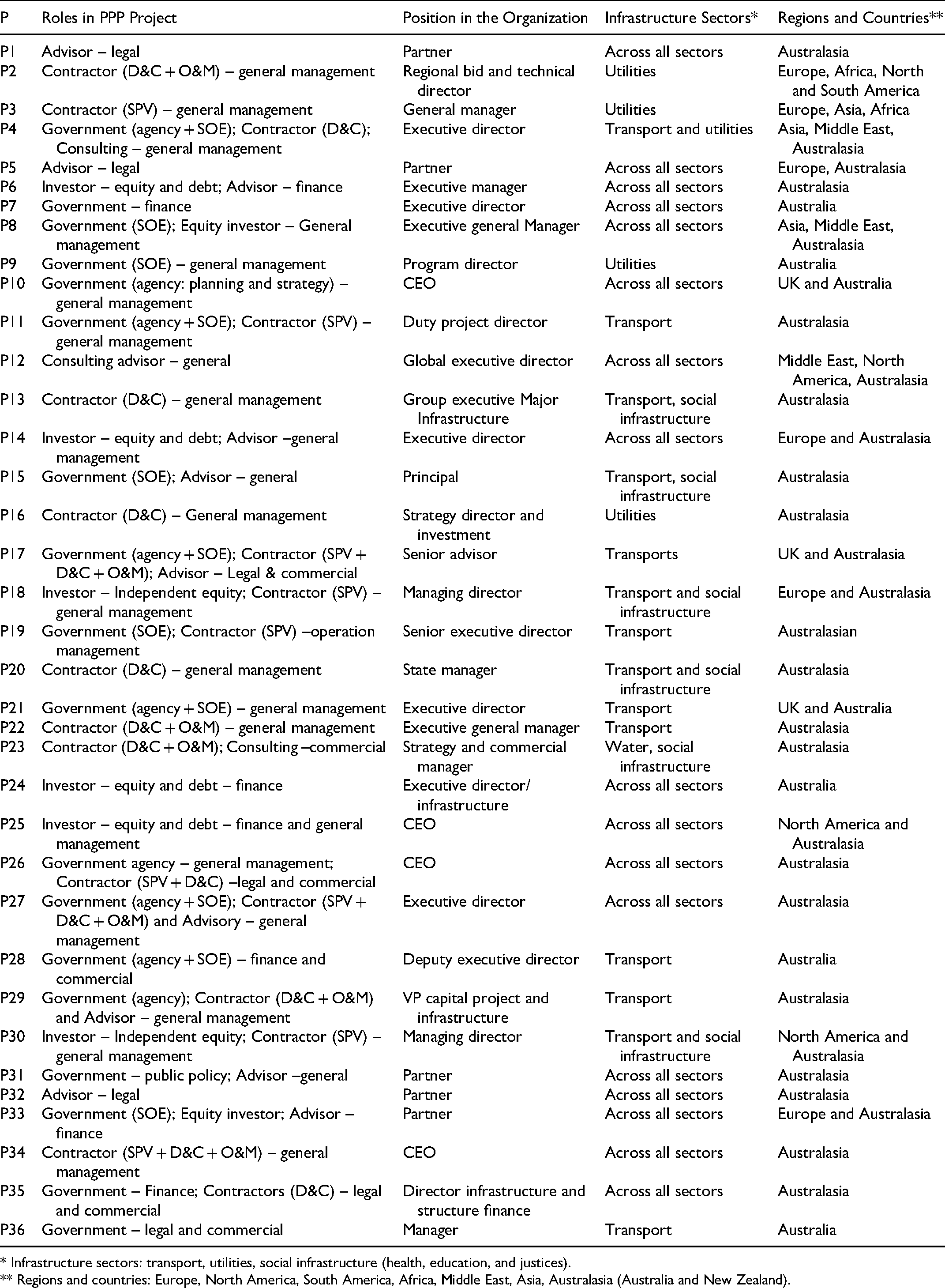
The literature review identified a lack of research that has explored the often-assumed relationship between PPPs and innovation. Due to the lack of systematic and empirical investigation of the incentives for innovation embedded in PPPs, we formulate this research question: How do PPPs affect innovation? It is this open question that determines the exploratory nature of this study. An exploratory and qualitative research framework, using an interpretive methodology based on grounded approaches (Strauss, 1987), was used to collect and thematically analyze accounts. An exploratory study is useful for the researchers to take a broad look at the problem and clarify their understanding (Saunders et al., 2009). Grounded theory (GT) enables researchers to discover what is going on in social process by focusing on “concepts of reality” (Glaser, 1992, p. 14) and searching for “true meaning” (Glaser, 1992, p. 55), with “the purpose of generating concepts and their relationship that explain, account for, and interpret the variation in behavior in substantive area understudy” (Glaser, 1992, p. 19). Data collection was derived from open-ended, nondirective interviews with 36 senior Australian-based PPP experts; it is their accounts that provide the data for the analysis, many with international experience (see demographic details in the Appendix at the end of the article). Where quoting from participant interviews, the speakers will be identified as P1 through P36. Table 1 summarizes the participants’ roles and experience.
Participants’ Roles and Experience
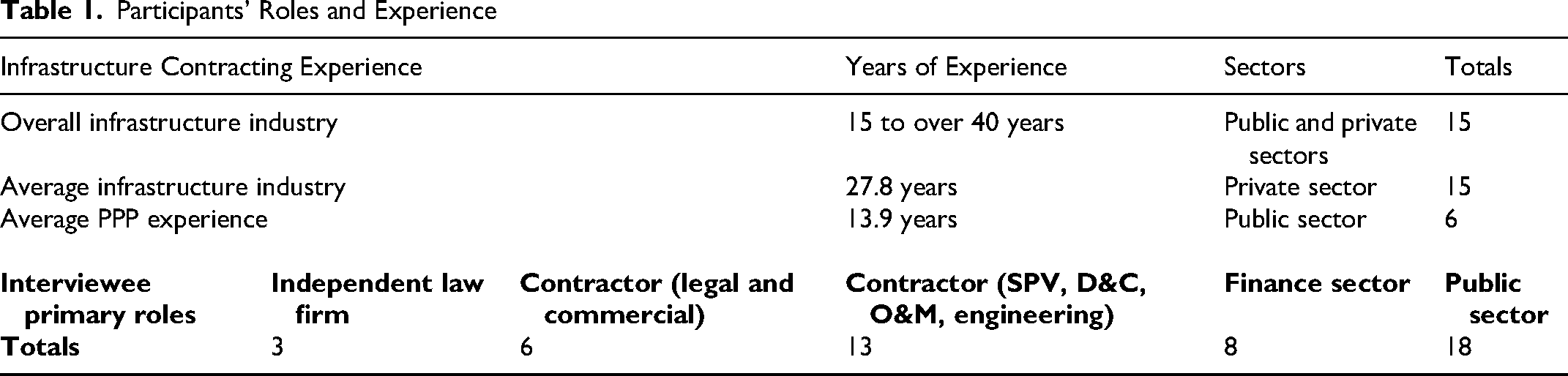
The interviews sought to tap into interviewees’ framing, understanding, and experience of PPPs and innovation, beginning by asking: “Could you tell me a little bit about your experience in general and your PPP’s experience?” This was followed with questions such as: “Could you tell me more about XXX project? Or what is your view about that XXX project? Or why do you think that happened?” These questions plumbed participants’ sensemaking of their experiences across multiple projects, addressing consistent aspects of PPPs rather than specific cases. Interviews ranged from 45 minutes to two hours with a total of 3,595 minutes of audio recordings. Data collection and analysis were concurrent with constant comparison, leading to conceptual saturation (Glaser & Strauss, 1967).
Fieldwork occurred concurrently with a literature review, with each informing the other. Different disciplines (project finance, economics, project management, and organization studies) provided theoretical framing, with fieldwork revealing relevant literatures to search. As Glaser (1992) suggests, literature review and constant comparison of data are mutually generative of concepts. Data analysis follows Gioia et al.’s (2013) approach. Initial open coding of data generated 25 first-order descriptive codes/concepts based on the participants’ responses (Gioia et al., 2013). Through thematic and semantic content analysis of the 25 first-order categories, similarities and differences were sought (Gioia et al., 2013), leading to eight second-order themes relevant to the research question posed in this article. An “investigator triangulation” (Flick, 2004, p. 179) was carried out during data analysis between authors to validate the codes. We use eight second-order themes to organize these findings in the following section and the four aggregate dimensions to structure the discussion section.
Findings
PPP Bid Process Encourages Innovation
Financiers/investors are normally the dominant party in PPP consortia given that they control capital, the essential resource for kick-starting projects. One respondent advised: “PPPs involve different parties—the developer, the equity, the banks (financial advisor and debt arranger), who arrange both equity and debt, the legal guys, the design, construction, and operation companies … Usually, the developer links up everybody; the financial advisor or developers structure the deal, but the banks, the debt team, is generally the strongest part of the consortium … So, there’s a hierarchy within the consortium of PPPs” (P4).
PPP financiers rigorously interrogate and challenge proposed bid outcomes, considering whole of life costs and project economics, seeking opportunities to reduce cost and increase revenue. “They are interrogating design, construction, operations, maintenance, and the functionality of that facility, the structures and sources of finance, interrogating what else can we use this facility for …” (P8). Financiers ask: “Well, how can I commercialize that opportunity? How can I take it from being a problem and create an opportunity out of it? (P18). A finance perspective pervades the process of bid development: “It’s the financiers that really drive the process …. They’d challenge the architects around the layout, the constructors about different materials used … they were pretty hard-nosed about things” (P23).
The emphasis on financial return motivates investors to think about innovation returning additional revenue, such as developments in a project precinct, colocating facilities, or adjacent services that can generate third-party revenue. PPP projects can act as a catalyst for investors to generate indirect revenue through the project and the public sector asset, making the project a resource that investors leverage. “With the PPPs, I think there is a great deal of innovation of the precinct, the innovation of the land to create third-party revenue” (P14). Facilities innovated included childcare (P14), swimming pools (P31) in schools, as well as clinics and patient facilities in hospitals (P8).
A multidisciplinary bid team of complementary skills and resources work creatively together at the bid stage. “PPPs are good at producing innovation in the precontract stage because they involve a competitive tender and are bringing together a multitude of parties in a whole of life environment. They do have the ability to generate innovations and efficiencies that other modes of delivery don’t have” (P5). Examples include “additional floors built onto court buildings” to allow for expansion (P31) and “freed up public space for the entertainment district and theaters … and [they can] generate innovation that has delivered a greater societal outcome …” (P12). While the diversity of bid teams contributes to the creativity of the tender, it was also clear from the interviewees’ responses that they were united by a common purpose during the bid phase. “Well, it’s about winning. Everyone is incentivized to win the project” (P30). Motivation to win the bid creates high levels of collaboration among diverse parties, facilitating team integration and innovation.
Financial Constraints on Radical Innovation
Only proven technical innovations tend to be adopted in PPPs. Given the highly leveraged, no-recourse nature of PPP debt finance, little financial protection exists for investors from additional risks. “… as an equity investor we … are not investing in a venture capital sort of way to test and develop new technologies” (P25). “It’s not a startup mentality. It’s not an innovation hub. It's all about proven technology” (P18).
Financiers demand either a high ratio of equity contribution or increase their interest rate to safeguard investments. “Riskier projects typically mean you can raise less debt. It means a bigger equity component” (P30). The result is higher capital costs for the project, resulting in a less competitive bid. PPPs do not facilitate radical technical innovation if only because there can be no project without capital, whose providers tend to be risk averse. Some interviewees qualified the apparent aversion of PPPs to innovation, noting innovation occurring related to the framing of financial, commercial, or managerial matters. “I think areas of innovation in PPPs is the financing of the project, the taxation, the structures that the private sector can use to reduce the tax on the project” (P4). An example of innovation on a prison project saw contractors rewarded for “lower rates of prisoners re-offending” as a social benefit (P8). Commercial innovation that reduces potential risk is more acceptable than technological innovation, which has an unknown risk quotient. “The objective of this commercial innovation is to… make the lender comfortable enough to issue the lowest possible interest rate” (P2).
Areas of innovation that do relate to the construction and operation of an asset occur through “some innovative uses of equipment, materials, and the manpower on the site” (P7), or “innovative ways of structuring pay scales incentivizing employees and new ways of training” (P34). These are incremental improvements that tend to focus on low-risk cost reduction in operation. “I think where innovation comes into play is if you can de-risk your project by spending money on better technology, which is going to give you a better assessment of the performance of the asset; doing something cheaper and getting the same performance outcome … it’s all about minimizing risks and reduce the costs” (P30).
Contract Design Limits Innovation
Innovation propensity varies with project phases; it becomes more difficult after financial close. Two main contract-related factors affect innovation during the delivery stage. First, the design and construction (D&C) contract is typically fixed price, whereas operation and maintenance (O&M) contracts are based on fixed service payments. D&C and O&M contractors strive to maximize their distinct profit margins in a way that often diminishes innovative and collaborative behavior during the bid. “So, by the nature of contracts, they’re not incentivized to coordinate and cooperate with the other party” (P15). Collaboration can break down as parties pursue sometimes contradictory ends. “They [D&C and O&M contractors] run into a conflict and the clauses are fairly tight, so there is a barrier for cooperation and integration” (P7). Ineffective conflict resolution mechanisms create an environment inimical to whole of life innovation. Second, the back-to-back contracting structure allows financiers to pass on risks from public clients through the SPV to D&C and O&M contractors. “So private finance, the equity and debt, they don’t want to take risk, almost no risks. They always want to pass risk on to the D&C or O&M contractor. They are not interested in funding innovation” (P34).
Innovative ideas do not easily obtain approval. PPP financiers are wary of the risks of change. “Innovation is associated with changes and risks … The banks won’t approve unless they’ve got absolute certainty about the risk associated with that change. There is lots of interrogation, due diligence, it is costly and time consuming …” (P8). Negotiating contractual change is difficult: “you’ve actually got to get consent from all the parties, and it is not an easy process” (P3). The key question is whether returns will outweigh implementation costs.
Little incentive exists for any party to approve innovation that does not benefit them. For example, “on the debt side, they get fixed return, [there is] no incentive for them to agree to any change” (P6). “Whereas once it enters into the contract, government has no incentive in helping the private sector to be more innovative to reduce contractors’ costs and making more money” (P1). Neither the cost nor the lack of incentive for change encourage innovation in PPPs, so strategies stick to contracted scope and requirements, avoiding variations. “There’s a view ‘build what you bid because change is bad.’ The moment you change something, you start creating risk and losing money. So, that’s just de-risking and proceeding forward” (P18).
Contract Design Reduces PPP Incentives to Innovate
Asset ownership or residual control rights, in principle, create an incentive to innovate. However, SPVs have an operating contract rather than asset ownership and residual control rights; they need to obtain approval for contract modifications. “What their ownership relates to isn’t the asset per se, it’s the contract … If they [SPVs] were going to modify how that contract was going to be operated, they’d have to get the approval or consent from all parties, so they don’t have ownership of the assets that they invested” (P6). While economic modeling predicts asset residual value having an impact on innovation during transfer, in practice, terminal asset net present value is generally treated as zero. Little incentive arises to innovate to increase the value of the asset, as contractors do not receive benefit from such investment. “Most of the PPP contracts don't involve a negotiation around residual value payments at the end of contract. Usually, all the assets are transferred to government for no cost at the end …” (P33).
Innovation may be desirable during the operational phase of a PPP to increase competitive advantage for future PPP bids rather than profit in the current PPP. An innovative technology may be implemented at the contractor’s expense to prove its efficacy for future projects. As one interviewee noted: “… you might implement your innovation only when it is the right time to preserve your competitive advantage … including the exclusivity for the extension of the contract. If without any possibility for the renewal of the contract, we would consider implementing this innovation to prove it while they are still operating under the first PPP contract without disclosing to externals to make it available and proven for the next PPP project” (P2).
Finance Limits SPV Agency for Autonomy
SPVs have independent project governance and administrative responsibilities for delivering PPP projects. “Basically, the SPV is responsible for implementing the transaction, executing design, construction, maintenance contracts, etcetera” (P6). As part of this process, SPVs need to manage communications between the client and contractors. However, SPVs are rarely structured and staffed at the board and project management levels to facilitate these aspects, often being lightly resourced SPV mailbox companies to reduce overheads when bidding. Back-to-back contracts give PPP financiers assurance that SPVs will pass all risks to contractors. “Project finance leads (sic) that all the SPV is doing, passing everything on (to other parties) like a mailbox so it’s not really adding any value” (P27). SPV agency is further reduced by PPP finance to ensure risks not considered during the bid phase do not arise post-contract. “In PPPs, project financiers put in place a restrictive covenant that ensures that the project company [the SPV] is basically unable to change their business practices other than what’s enshrined in their contracts. And it’s a way for lenders to actually protect themselves against the risks” (P6). In consequence, SPVs have no autonomy to innovate.
Finance Limits SPV Integration and Partnership
In theory, PPPs facilitate integration between D&C and O&M contractors through contract bundling, encouraging cost-saving synergies. Multiple interviewees commented that the SPV should be an integrator, bringing the various parties together: “Part of the SPV role is to make sure there is good integration between D&C and O&M” (P30). However, it was clear that this was rarely achieved. In practice, project finance reduces the effectiveness of contract bundling as an integrative mechanism, while the organization structure favored by project finance provides SPVs with little capability to manage as an integrator. There was a consensus that with current SPV organizational structure and management practice, integration is difficult to achieve, negatively affecting innovation.
Project finance also affects other dynamics. Despite the term partnership being central to PPP projects, interviewees describe an organization bearing little resemblance to a partnership or alliance model. Alliance models typically involve a pain–gain share, where the parties work together to address unexpected risks and share in realized benefits. Such uncertainty represents risk to PPP financiers. One interviewee commented that “It’s very difficult for alliance to happen under the PPPs because the banks won’t sign off unless they’ve got the contract absolutely locked in” (P34). Another summarized: “PPPs require certainty, a fixed price, time contract. Whereas an alliance … can be very risky to the financiers, it wouldn’t be accepted by them, real partnership can be difficult in PPPs” (P29). The requirements of project finance make it difficult to implement true partnership in practice, with profound impacts on innovation.
Performance Specifications and Payment Schemes Limit Innovation
Specifications that focus on project outcomes are thought to provide an opportunity for contractors to innovate unique value propositions in the bid. “In my experience, the opportunity for innovation is at its greatest when the specification is as open as possible, and where the client’s brief is as output-based as possible” (P18). Interviewees commented, however, that outcome-focused specifications are the exception rather than the norm. Most PPP performance specifications were highly prescriptive, resulting in less innovation than might be assumed theoretically: “We still see many performance specs that were too narrowly defined with particular solutions that really constrain innovation” (P12).
In addition, abatement regimes associated with performance payment mechanisms enable the project client to reduce payments if services provided by the SPV do not meet key performance indicators (KPIs) defined in the contract. No additional payment or rewards typically accrue if the services exceed these KPIs. Payment mechanisms are geared to performance specifications at the lowest possible cost rather than value creation. A user-pays system might entail a form of profit sharing but it will be capped, preventing the contractor from making large profits. Under the service provision arrangement, there will be a maximum monthly payment for the service. “If the service is substandard, there will be an abetment. But there’s no upside for the service provider for providing better than required service and being innovative around that, they still just get their maximum monthly service payment. So, there is no incentive to do better than expected” (P1).
Paradoxical Effects of Long-Term Contracts on Innovation
PPPs are long-term contractual relations providing an environment that, paradoxically, both encourages and discourages innovation. The long duration of the contract provides opportunities for deep relationships to form and close understanding to develop between partners. “It [a long-term contract] helps to build the relationship. You can get the best outcome if you’re learning how each other works and it can only happen through long-term partnership” (P18). Stronger relationships reduce transaction costs while building trust that develops over time, enhancing collaboration and information transfer across the divide between D&C and O&M contractors.
The SPV can provide a vehicle to capture knowledge that is difficult to acquire in more fragmented forms of contracting. One interviewee reported: “We bring the origination team [D&C] and the asset management team [O&M] into a room for lesson learning from time to time … We’ve learned a huge amount from that feedback loop, literally the asset management team represent to us the biggest issues and some of which we could never have contemplated and some of which we screwed up and it’s really very valuable to get that feedback” (P18). However, the long-term nature of PPP contracts also hampers innovation through legally stipulated certainty and inflexibility.
Certainty is defined by imposing constraints on actions; these reduce innovation. In addition, contractors assured of cash flow without any threat of competition have reduced pressure to innovate. “Certainty is a recipe to kill innovation in infrastructure because there are no challenges for them … Dynamic efficiency can only be achieved when the market explores the uncertainty … So contractual certainty and risk aversion reflected in long-term contracts can come at a considerable cost over the long term” (P14). Another participant commented, “Effective collaboration and competition is essential to unlocking innovation. … often in the process PPP long-term contract, we are losing the benefit of competition” (P29).
Discussion
The relationships between embedded elements of PPPs and innovation are displayed in Figure 1. The second dimensional elements affect innovation both directly and indirectly, as well as positively and negatively, resulting in complexity, inconsistency, and contradiction. The aggregate dimensions discussed are constructed from theorizing the second-order elements narratively.
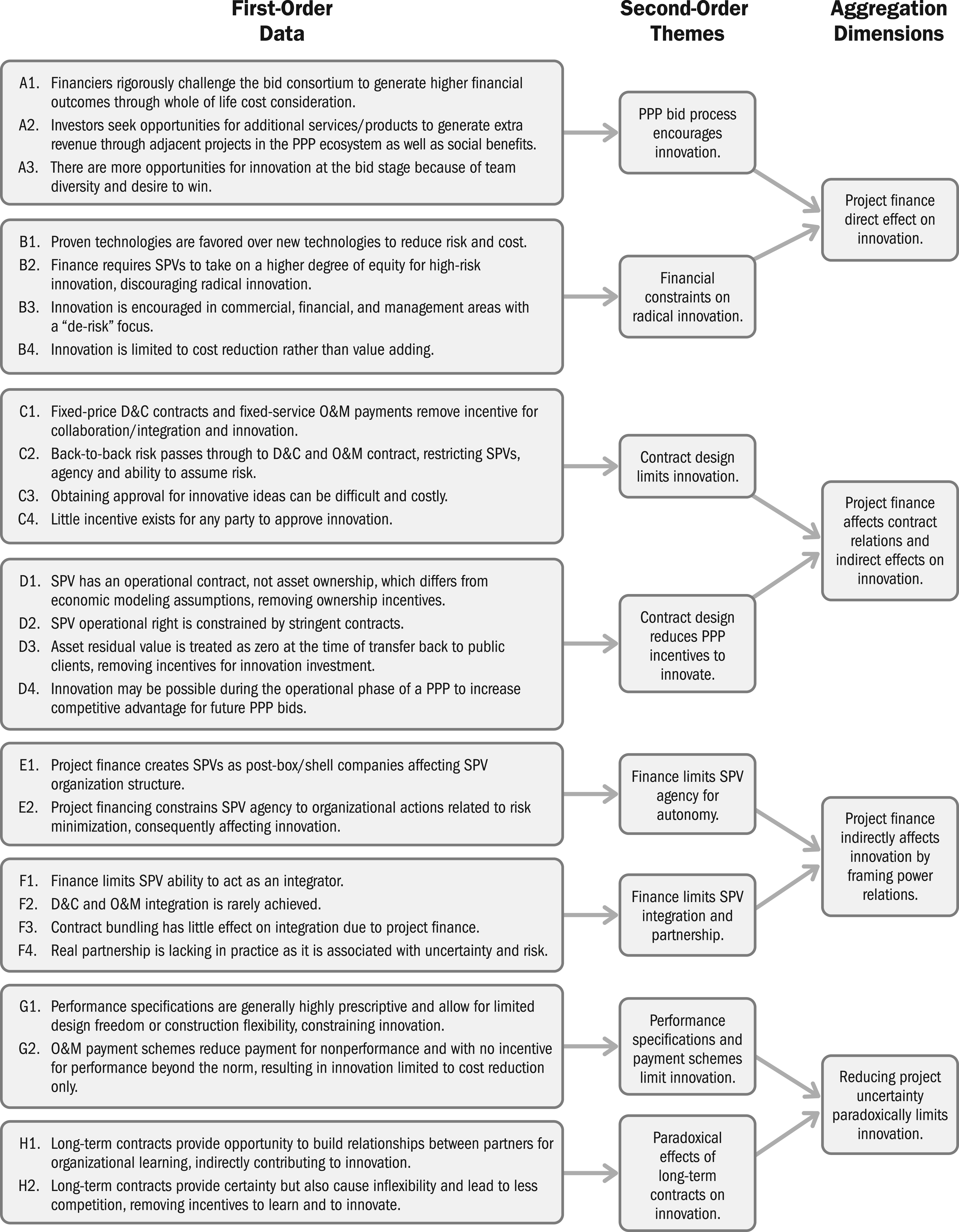
Aggregate dimensions limiting innovation.
Project Finance’s Direct Effects on Innovation
Prior to contract award, through assembling a bid team with assured financial capability and expertise, PPPs can generate innovation that brings economic benefits for the private sector (e.g., third-party revenue) as well as social benefits for the public (e.g., lower rates of prisoners re-offending for prison PPPs). Long-term project financial feasibility is critical for public infrastructure to deliver social and economic value. Financiers, as part of the bid team, oversee proposed project solutions with a focus on financial optimization of the project by challenging design, construction, and operation/maintenance to balance technical solutions, risks, economic benefits, and whole of life costs. They frame the limits and potential for project innovation, by defining its boundary conditions. Financiers strive to maximize efficiency gains by innovating solutions that lock in as little risk as possible. Paradoxically, what creates innovation prior to the project being undertaken limits innovation during project delivery by building in inflexibility and risk aversion. The bid team members share the goal of winning the project—a common pursuit of a successful outcome in a competitive environment and a task that facilitates team integration and innovation, which dissipates after the bid is won and delivery team formation occurs.
Innovation in PPPs tends to be an incremental, low-risk endeavor favoring options presenting a high probability of success, creating benefits that can be internalized or directly appropriated over the duration of the contract. Hence, technical innovation in PPPs tends to rely on proven technologies (e.g., adopting driverless trains). Innovations focus on cost reductions, both in developing design and performing O&M tasks rather than being value adding, such as the initial adoption of new materials, equipment, or processes minimizing projected operation and maintenance costs. This is consistent with economic models that predict innovation in PPPs being associated with positive externalities and a reduction in operating costs (Hart, 2003; Dewatripont & Legros, 2005; Roumboutsos & Saussier, 2014). PPP innovations also favor investments that create additional services or products that generate extra revenue as well as systems optimizing managerial and organizational efficiency.
Finance arrangements act as barriers to high-risk innovation in PPPs (Leiringer, 2006; Mazzucato, 2013; Roumboutsos & Saussier, 2014). Innovations must be paid for out of revenue generated from the project, the only source of debt repayments and return on equity. Any initiative causing revenue uncertainty, such as an unproven technology or process, is discouraged. If a technology might be perceived as higher risk, a higher ratio of equity will be required as well as a higher interest rate for the loan. Revenue uncertainty will also create greater due diligence and legal and commercial costs, leading to further costs for the project. Therefore, equity providers steer clear of substantial risk-taking, reducing motivation for high-risk innovation.
PPP project finance, unlike venture capital, does not strive for breakthrough technological innovation. Project finance, as debt finance, stands at the opposite end of capital structuring to venture capital as equity finance (Esty, 2002) for disruptive innovation. Debt financing limits radical technical innovation in PPPs. Without considering the financing structure and differentiating types of innovation, one might misinterpret why PPPs do not support radical innovation. Project finance directly affects how, when, and what types of innovation can be adopted in PPPs as well as having an indirect impact on innovation through other elements embedded in PPPs, as discussed next.
Project Finance and Contract Relations’ Indirect Innovation Effects
The back-to-back contractual structure required by project finance demands the SPV pass all deliverables and associated risks to other parties. This restricts SPV agency to manage integration during the delivery stages. In addition, while downstream D&C and O&M fixed-price contracts limit uncertainty, they do not facilitate integration and partnership as there is no incentive for collaboration. Each party strives to maximize benefits at the expense of the other in a zero-sum game. Individual organizational actors’ agency tends to hoard rather than share capacities to act. Financiers maintain control over SPVs by imposing stringent contractual provisions (Esty, 2003; Müllner, 2017). These constrain the SPV from making any changes without approval, whether in project scope and delivery or technical and administrative aspects. SPVs strictly follow what is enshrined in contracts to maximize certainty. The inflexibility of contracts makes change difficult, complicated, and challenging, inevitably discouraging innovation. The approval process for variations can be time-consuming and involve high costs for extensive due diligence and contract negotiation. Key covenants underwrite finances’ control over risk and uncertainty in the SPV. In addition, debt providers do not gain benefits from innovation because their returns are based on fixed interest rates. Hence, there is little incentive for them to encourage variations, which is also the case with government clients. Equity providers gain a return from innovation only if it is successful, while always bearing the individualized risk of innovation failure and loss of their initial investment.
Where ownership is by a firm, private parties can implement innovation unilaterally. By contrast, under public ownership (traditional procurement), innovation has to be negotiated between the private actor and the public client (Bennett & Iossa, 2006). Hart’s (2003) model operationalizes incentives for positive investment that arise from ownership-property rights and contract bundling (Teo, 2017). The ownership of the infrastructure asset confers rights to make residual management decisions that are not specified in the contract, for example, the right to control how to build and operate the asset as well as the right to claim residual profits from these management decisions. The SPV “… during the contract period has the power to decide (and veto) whether any given innovative activity can be implemented” (Bennett & Iossa, 2006, p. 2146).
In practice, SPVs own not the asset but operation rights within a limited contract duration. The government grants the SPV investment, construction, and infrastructure operating rights over a project that the government ultimately owns. SPVs can only make residual management decisions according to rules stated in the contracts. Strict covenants provide financiers with control over SPV decision rights. Economic models applied to PPPs, such as Hart’s (2003), do not take these financial factors into consideration. When the contract expires, operation rights will be automatically transferred to the government for zero asset residual value or no payment of compensation, consequently removing the SPV’s ex ante investment innovation incentives. Therefore, asset ownership as an incentive is largely suppressed by project finance. The assumptions adopted in economic behavior modeling are not reflected in PPP practice.
Project Finance Indirectly Affects Innovation by Framing Power Relations
Integration, a critical factor for innovation in a fragmented industry, involves “the merging of different disciplines or organizations with different goals, needs and cultures into a cohesive and mutually supporting unit … to achieve common attainable project goals” (Baiden et al., 2006, p. 14). It entails a process of multifirm coalition at multiple levels. While PPP contract bundling provides a mechanism for integration, integration does not occur automatically. An integrator, exercising strong management controls, is required to make this happen. In practice, the SPV structure, as a shell company or mailbox, as practitioners often term it, lacks sufficient board governance, management, or project delivery capability to be able “to achieve coherence within a network for both technological and organisational synchronisation” (Liu et al., 2022, p. 729).
Synergy between different parties in a collaboration promises to generate better outcomes for all; however, some forms, such as an alliance, lead to uncertainty and potential risk for private financiers. In practice, partnership in a PPP is premised on finance framing the financial, contractual, and organizational relations to privilege certainty by detailed separation and specification of powers. Infrastructure PPPs are defined through tight legal contracts governing relationships between public clients and SPVs, as well as between financiers and SPVs. Both public clients and private finance partners have tight control over SPVs at different levels, introducing agency problems for SPVs (Dewatripont & Legros, 2005). Although the public client is at a distance from the SPV, in practice they are dependent on the SPV for data and information pertaining to its progress; there is a separation of powers and a situation of resource dependency. The framing of data primarily attends to the needs of finance capital because these are the powers whose mobilization of bias (Schattschneider, 1960) frames the reporting process. There is little that resembles a truly collaborative partnership within most infrastructure PPPs (Scharle, 2002) that typically emphasize the contract over collaboration, affecting innovation (Parrado & Reynaers, 2020). Lack of partnerships focused on collaboration and integration in the SPV and heavy reliance on formal contract governance control makes multiorganizational PPP project innovation difficult. The SPV simply lacks the power and specifications to innovate.
Reducing Project Uncertainty Paradoxically Limits Innovation
Performance-based specifications, in theory, can provide SPVs/contractors with the flexibility to generate innovative solutions in design, construction, and operation. In practice, performance specifications are often prescriptive and narrowly defined to reduce uncertainty. Callens et al. (2022) identify design freedom as a necessary condition for innovation in PPPs. Leiringer (2006, p. 304) finds that: “… design freedom … is frequently brought forward as a positive aspect of the PPP arrangement … in practice, [there is] little more chance to design away from the traditional standards and norms than there would be on any other type of project,” a finding with which our findings are consistent. Payment mechanisms and incentive structures only encourage private parties to invest in innovations directly affecting cost reduction, whereas innovations in value adding are impeded (Roumboutsos & Saussier, 2014). Performance-based specification and payment mechanisms limit innovation.
Long-term contracts have both a positive and negative impact on innovation. They provide certainty and stability for establishing deep collaboration relationships between different partners, compared to traditional project organization. Such collaborative relations facilitate innovation and enhance process improvements through tighter coupling among teams drawn from different firms. However, enhanced certainty can produce a lack of challenge when it is tightly constrained by contract; moreover, the assurances that long-term contracts offer diminish a competitive ethos. Contractors and SPVs adopt contractually constrained behaviors as the norm in specific PPPs, leading to missed innovation opportunities. Long-term contracts create relative inflexibity that has a negative impact on innovation.
Effects on the Innovation of Complex Relations Among Different Elements in PPPs
Project finance has many implications for innovation and project performance. The effects on innovation of different elements (either individually or jointly) embedded in PPPs are inconsistent, complex, and dynamic. Figure 2 provides a framework for understanding innovation in PPPs based on our findings.
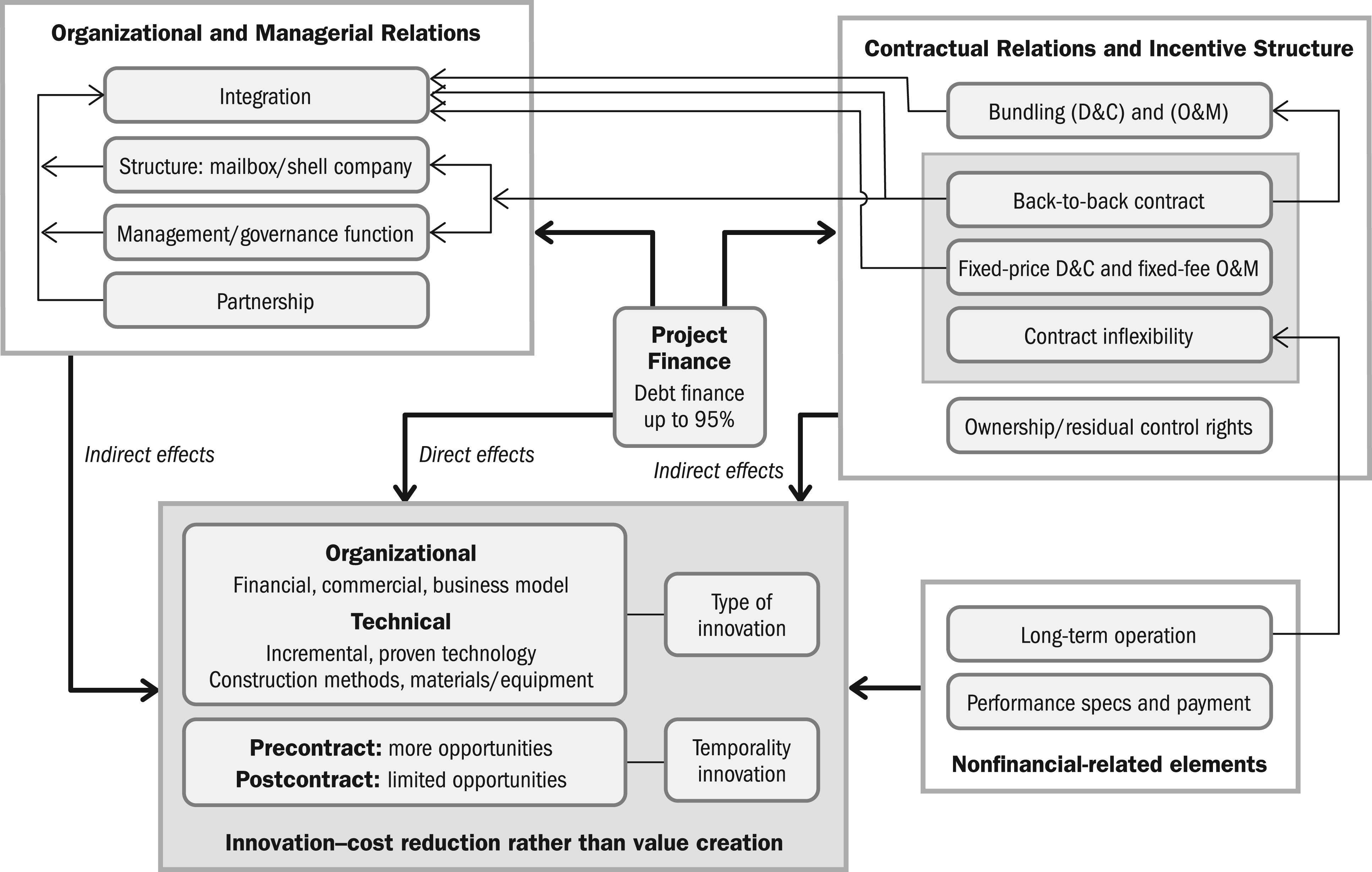
Complex relations of different elements embedded in PPPs on innovation
Project finance is the central element directly affecting how, when, and what type of innovation occurs in practice. PPPs do not encourage new breakthrough technical innovation. They are a good model for innovation in the bid stage but an inhibitor post award, the essential temporal phase in relation to innovation. There are indirect effects of project finance on innovation, influencing SPV organization as well as contractual relations and incentives. Demanding contracts be structured back-to-back with a fixed price defines an SPV’s organizational structure and restricts its risk-taking and integration of D&C and O&M contractors, limiting the agency of their management and governance functions.
In addition, the effectiveness of contract bundling mechanisms is restricted by project finance arrangements. Private finance partners bear the risk with little interest in any innovation that might diminish returns in their part of the contractual bundle, which segregates separately specified powers, contractually defined. Innovations in PPPs will most likely occur in establishing financial, commercial, and organizational design in the early temporal phases of the project. Subsequently, there is only scope for limited incremental technology innovation. Partnership is limited by finances’ endeavors to reduce uncertainty. Finance controls the possibility of making contract changes after the contract is sealed to minimize risk. As a result, incentives for innovation are limited. Overall, different elements of project finance, SPVs’ organizational and contractual relations, and embedded incentives interact in complex relations with multiple and joint cascading effects. Given the way that PPP finance frames practice, asset ownership-residual control rights are not effective incentives for innovation, contrary to economic models. Performance-based specifications and payment limit innovation largely to cost reduction rather than value creation.
It is the primacy of capital and its lenders that leads to a temporal phasing of innovation as most likely to occur in the bid and the establishment phases of the SPV as financiers focus on isolating risks and minimizing uncertainties. They do so by creating a stand-alone and independent SPV whose contracts demand SPVs pass risks from government clients on to subcontractors (Liu et al., 2022). Financiers strive to achieve a risk-free SPV in which risks cannot be reverted to them (Demirel et al., 2022), because PPPs as high leverage, nonrecourse or limited recourse finance structures impose extinction risks on lenders for nonperforming projects (Müllner, 2017; Liu et al., 2022). The logic of project finance makes sense of risk management strategies that seek to eliminate, reduce, or curtail risk exposure. Innovation, by its very nature, risks unknown outcomes that might lead to further delays and budget blowouts (Davies et al., 2009; Cantarelli & Genovese, 2021), key risks that financiers seek to avoid (Liu et al., 2022). In addition, innovation requires variation from standard practice. Variation requires agency; contractual specifications strive to limit agency as much as possible to minimize risk.
Achieving a risk-free state comes with enhanced transaction costs. The benefits from risk mitigation for infrastructure investment can offset higher transaction costs (Esty, 2003, 2004). Highly leveraged debt finance can segregate risks inherent in the project, based on the strength of cash flows, as well as protect project sponsors or parent firms from financial distress in a failing project (Esty, 2004; Müllner, 2017; Demirel et al., 2022). Risk segregation creates a separation and tight specification of powers as financial leverage serves as a hedging mechanism for sponsors to mitigate their risk (Byoun et al., 2013). Project finance that enables investors to externalize uncertainties and risks by contracting these to other parties to safeguard their investment return, entails increased transaction costs (Demirel et al., 2022). Hence, while creating the SPV as a form of economic organization for supply chain vertical integration does not reduce transaction costs (Coase, 1937; Williamson, 1981, 1985), it does mitigate risk.
The typical arrangements of SPVs certainly reduce uncertainty, and there is substantial organization theory literature that sees the whole point of organization as being the reduction of uncertainty from Thompson’s (1987) contingency framework onward; Patanakul (2023) provides an up-to-date review. Recent literature on innovation (see Seidl et al.’s 2019 contributions) stresses the importance of open systems and integrated cocreation for innovation, rather than quasi-closed systems with very little opportunity for integration and cocreation.
Conclusion
In theory, SPV project organizations achieve integration and encourage innovation, leading to subsequent increases in efficiency, enhancing project quality, and reducing whole-life project costs through contract bundling, long-term partnerships, private finance, and performance-based specifications and payment mechanisms. The reality, our evidence suggests, is that the structuring of SPVs provides opportunity for innovation in the preliminary stages of the project but creates little material innovation throughout the whole life. The agency of the SPV is limited by design. Whatever organizational learning occurs that leads to innovation is limited, largely because of project finances’ dominance of contractual framing. The dominant role of project finance in framing PPPs limits opportunities for innovation in the subsequent phases of infrastructure project delivery.
This research contributes to theory and practice related to the impact of PPP contracting on innovation in infrastructure projects. We found that project finance has a significant direct and indirect effect on innovation in both positive and negative ways. These results challenge economic behavior models (e.g., Hart, 2003), which have predicted that innovation in PPPs is motivated by possession of residual control rights. However, they have not taken project finance factor into consideration. We also provide reasoning that vertical integration in PPP SPVs leads to higher transaction costs, contrary to the expectations of economics of organizations’ literature (e.g., Coase, 1937; Williamson, 1981, 1985). In this research we adopted a transdisciplinary perspective, drawing on the literature from project finance, economics, project management, and organization studies, giving a holistic perspective that would not have been possible from a single disciplinary view. The research findings contribute to an area that has largely been neglected by previous research. The framework presented in this article provides a detailed depiction of innovation in PPPs and lays a foundation for propositions that could be tested in future research. In the context of PPPs, it is sufficient to conclude that previous theory elided practice and practice has disavowed theory.
Footnotes
Declaration of Conflicting Interests
The author(s) declared no potential conflicts of interest with respect to the research, authorship, and/or publication of this article.
Funding
The author(s) received no financial support for the research, authorship, and/or publication of this article.

Author Biographies
Detailed Information of Interviewees
| P | Roles in PPP Project | Position in the Organization | Infrastructure Sectors* | Regions and Countries** |
|---|---|---|---|---|
| P1 | Advisor – legal | Partner | Across all sectors | Australasia |
| P2 | Contractor (D&C + O&M) – general management | Regional bid and technical director | Utilities | Europe, Africa, North and South America |
| P3 | Contractor (SPV) – general management | General manager | Utilities | Europe, Asia, Africa |
| P4 | Government (agency + SOE); Contractor (D&C); Consulting – general management | Executive director | Transport and utilities | Asia, Middle East, Australasia |
| P5 | Advisor – legal | Partner | Across all sectors | Europe, Australasia |
| P6 | Investor – equity and debt; Advisor – finance | Executive manager | Across all sectors | Australasia |
| P7 | Government – finance | Executive director | Across all sectors | Australia |
| P8 | Government (SOE); Equity investor – General management | Executive general Manager | Across all sectors | Asia, Middle East, Australasia |
| P9 | Government (SOE) – general management | Program director | Utilities | Australia |
| P10 | Government (agency: planning and strategy) – general management | CEO | Across all sectors | UK and Australia |
| P11 | Government (agency + SOE); Contractor (SPV) – general management | Duty project director | Transport | Australasia |
| P12 | Consulting advisor – general | Global executive director | Across all sectors | Middle East, North America, Australasia |
| P13 | Contractor (D&C) – general management | Group executive Major Infrastructure | Transport, social infrastructure | Australasia |
| P14 | Investor – equity and debt; Advisor –general management | Executive director | Across all sectors | Europe and Australasia |
| P15 | Government (SOE); Advisor – general | Principal | Transport, social infrastructure | Australasia |
| P16 | Contractor (D&C) – General management | Strategy director and investment | Utilities | Australasia |
| P17 | Government (agency + SOE); Contractor (SPV + D&C + O&M); Advisor – Legal & commercial | Senior advisor | Transports | UK and Australasia |
| P18 | Investor – Independent equity; Contractor (SPV) – general management | Managing director | Transport and social infrastructure | Europe and Australasia |
| P19 | Government (SOE); Contractor (SPV) –operation management | Senior executive director | Transport | Australasian |
| P20 | Contractor (D&C) – general management | State manager | Transport and social infrastructure | Australasia |
| P21 | Government (agency + SOE) – general management | Executive director | Transport | UK and Australia |
| P22 | Contractor (D&C + O&M) – general management | Executive general manager | Transport | Australasia |
| P23 | Contractor (D&C + O&M); Consulting –commercial | Strategy and commercial manager | Water, social infrastructure | Australasia |
| P24 | Investor – equity and debt – finance | Executive director/infrastructure | Across all sectors | Australia |
| P25 | Investor – equity and debt – finance and general management | CEO | Across all sectors | North America and Australasia |
| P26 | Government agency – general management; Contractor (SPV + D&C) –legal and commercial | CEO | Across all sectors | Australasia |
| P27 | Government (agency + SOE); Contractor (SPV + D&C + O&M) and Advisory – general management | Executive director | Across all sectors | Australasia |
| P28 | Government (agency + SOE) – finance and commercial | Deputy executive director | Transport | Australia |
| P29 | Government (agency); Contractor (D&C + O&M) and Advisor – general management | VP capital project and infrastructure | Transport | Australasia |
| P30 | Investor – Independent equity; Contractor (SPV) – general management | Managing director | Transport and social infrastructure | North America and Australasia |
| P31 | Government – public policy; Advisor –general | Partner | Across all sectors | Australasia |
| P32 | Advisor – legal | Partner | Across all sectors | Australasia |
| P33 | Government (SOE); Equity investor; Advisor – finance | Partner | Across all sectors | Europe and Australasia |
| P34 | Contractor (SPV + D&C + O&M) – general management | CEO | Across all sectors | Australasia |
| P35 | Government – Finance; Contractors (D&C) – legal and commercial | Director infrastructure and structure finance | Across all sectors | Australasia |
| P36 | Government – legal and commercial | Manager | Transport | Australia |
* Infrastructure sectors: transport, utilities, social infrastructure (health, education, and justices).
** Regions and countries: Europe, North America, South America, Africa, Middle East, Asia, Australasia (Australia and New Zealand).