




Abstract
This article seeks to advance the current debate on the role of ignorance in the management of large projects by mobilizing insights from recent literature on the interplay between temporary projects and permanent contexts. Instead of examining how ignorance shapes the success or failure of isolated projects, we intend to examine how ignorance is addressed and framed within these projects and their wider environment and how this framing shapes the practices of planning and managing projects. The usefulness of the proposed framework is gauged with two empirical vignettes that elucidate different perspectives on ignorance in recent, German, large construction projects.
“… The thing we wanted built was Utzon’s Opera House, not some botch up of it. And that Opera House costs that amount of money—approximately—and would from the beginning have cost that amount of money, only nobody knew it then… If these facts had been known to begin with, the Opera House would probably never have been built. And the fact that it wasn‘t known, and that clients and public were completely misled by the first so-called estimate, was one of the unusual circumstances that made this miracle possible” (Ove Arup, in Hall, 1982, p. 558).
Introduction: Hirschman Versus Flyvbjerg: Next Round?
The Sydney Opera House is probably the most prominent example among the “great planning disasters” that Peter Hall (1982) portrays in his respective book. And the initial quote by Ove Arup nicely summarizes the ambivalence that is inherent in such disasters. Naivety and ignorance, it seems, can afford miracles, even if they produce disastrous effects in terms of conventional performance indicators of project management.
This ambivalence has been the subject of an astonishingly ferocious debate in project management research (e.g., Anheier, 2016; Flyvbjerg, 2014, 2016, 2017; Flyvbjerg & Sunstein, 2016; Ika, 2018; Ika et al., 2022). At stake is the role of ignorance in the planning and implementation of large projects. The issue around which the debate revolves is Albert Hirschman’s (1967) “principle of the hiding hand,” which Hirschman had coined, in an earlier and possibly more “revelatory” fashion, as the “theory of providential ignorance” (Alacevich, 2014, p. 157). This ignorance, Hirschman argues, leads us to believe that we can control the future (what we actually cannot). The ignorance is, however, providential as it enables us to wade into projects we otherwise would not have started. Once underway with a project, we are compelled to develop solutions to problems that we would not have developed if we had been aware of the adversities beforehand (see also Kreiner, 2020). This positive assessment of ignorance has drawn fierce critique, in particular from Bent Flyvbjerg. In essence, Flyvbjerg accuses Hirschman of providing an academic justification for irresponsible behavior (“planning fallacy”) and thereby fostering project failures (Flyvbjerg, 2016).
More recently, two contributions have sought to offer a more conciliatory tone. In the first, Kreiner (2020) tries to disentangle the conflicting positions. Flyvbjerg and Hirschman, Kreiner (2020) maintains, build on “conflicting notions of a project” (p. 404) that are both legitimate but “incommensurable” (p. 406). On one side, “projects as leaps into a designed future” in which a “preexisting design” is simply implemented; on the other, “projects as pursuit” in which the actual implementation is a process sui generis, pushed ahead through “experimentation” and “discovery” (Kreiner, 2020, p. 405). Based on this distinction, the author makes the case for taking Hirschman’s “insight and wisdom” as an “inspiration” for project management research. Framing “projects as pursuit” reveals what is actually going on in projects and thereby enables project stakeholders to confront the uncertainty inherent in every venture.
The second contribution, by Ika et al. (2022), advances in the opposite direction by trying to reconcile the conflicting positions. According to these authors, it is indeterminate whether the biases produced by ignorance cause project success or project failure. They therefore plead for a pragmatist “project behavior principle” (p. 3323) that allows to accommodate the tensions and paradoxes characteristic for projects. Such a principle “would be risk savvy as it can assist people to understand when to trust their guts, use statistical analysis or learned rules of thumb and better handle the project scope, complexity, risk, uncertainty and management along with surprises down the road” (p. 3320). According to this principle, then, both Flyvbjerg’s “planning fallacy” and Hirschman’s “hiding hand” would “prevail” (p. 3320).
On the one hand, we concur with an assertion that both positions share. Regardless of whether they try to disentangle or consolidate Flyvbjerg’s and Hirschman’s positions, both commend Hirschman as an insightful and inspiring “early rethinker” in project management (Ika & Söderlund, 2016). It is particularly valuable that the authors thereby advocate a broadened interpretation of rationality (Brunsson, 1982) as well as a deliberate embracing (instead of elimination) of complexity and uncertainty in projects.
On the other hand, we find that both positions suffer from two crucial flaws that afflict the entire debate on planning fallacies and hiding hands in project management. First of all, the notion of ignorance remains underspecified. The pertinent discussion is confined to aspects project stakeholders do not know before deciding to start a project, and about whether the fact that they do not know these aspects is beneficial or detrimental for the project outcome. Such a limited understanding fails to consider “the marked differences in the specific forms, degrees, and functions of ignorance” (Moore & Tumin, 1949, p. 788) that a growing pertinent literature seeks to systematize. Moreover, these marked differences also affect decision-making processes in diverse ways, as recent work in organization and management studies elucidates (e.g., Bakken & Wiik, 2018; Roberts, 2013).
Second, the discussion seems to be still caught up in an atomistic understanding of projects as relational and temporal “islands” (Engwall, 2003). Take, for instance, Kreiner’s idea of Hirschman’s hiding hand as a “metaphor for our ability […] to remain able to be surprised when history repeats itself” (Kreiner, 2020, p. 401, emphasis added). This idea echoes an understanding of projects as recurring but as (precisely by the hiding hand) strictly isolated ventures that are launched again (and again) in an innocent fashion, oblivious to experience gained in previous projects. This atomistic conception reveals a notion of projects that apposite research of the last decades deliberately sought to overcome by foregrounding the interdependencies between temporary projects and a more permanent organizational, relational, and institutional context (see, for example, Bakker, 2010; Davies & Brady, 2000; Engwall, 2003; Grabher, 2002a, 2002b, 2004b; Stjerne & Svejenova, 2016).
With this article, we seek to engage with both the underspecified notion of ignorance as well as the atomistic conception of temporary organizing. Our intention is to probe the role of ignorance in large projects, and the various strategies and practices of framing and coping with this ignorance. In addition, we seek to widen the horizon of our analysis of ignorance beyond single projects. In a way, we both broaden the debate around Hirschman’s “hiding hand” and, in fact, turn it inside out. Instead of juxtaposing the hiding hand’s beneficial and detrimental impacts on one project, we intend to examine how ignorance is framed within these projects and their wider ecologies, and how the diverse modes of framing shape the ways project professionals seek to cope with the ignorance they face. In essence, our intention is to systematically distinguish modes of coping with ignorance in the various spheres of the relational space that extends beyond the individual project, and that transfers knowledge and experience from project to project. In conceptual terms, we refer to this relational space as “project ecology” (Grabher, 2002a, 2002b, 2004b; Grabher & Ibert, 2011).
This is primarily a conceptual article, complemented with two empirical vignettes. The theoretical argument is developed in three steps. First, in order to frame the notion of ignorance, we seek to leverage insights from the rich literature that conceives ignorance “as a regular feature in decision-making” (Gross & McGoey, 2015a, p. 4) to advance our understanding of project management (for an overview, see Gross & McGoey, 2015b). In particular, we synopsize the literature into a typology of three distinct types of ignorance in decision-making processes. Second, we outline three different modes of coping with ignorance in project management that, in turn, reveal different understandings of what we do not know. Ignorance can be assessed (1) as a problem that has to be abolished (e.g., Flyvbjerg, 2011); (2) as a fact to be accepted and to be prepared for (e.g., Amin, 2013; Anderson, 2010); or (3) as a strategic opportunity that can be reflexively applied (Grabher, 2004b). Third, we develop the concept of project ecologies further by employing recent findings on the interdependencies between large projects and their wider organizational, relational, and institutional context (e.g., Grabher & Thiel, 2015; Granqvist & Gustafsson, 2016; Sydow & Windeler, 2020; Thiel et al., 2021a; Thiel & Grabher, 2015; Tukiainen & Granqvist, 2016). In order to differentiate the spheres in which ignorance is addressed and coped with, we draw on and modify Grabher and Thiel’s (2015) work on “trajectories of learning.” These include the project trajectory, the career trajectory, and the field trajectory.
The empirical vignettes are derived from two different sources. One is public reports related to institutional responses to planning failures and underperformance in large projects in Germany. For example, a special report written by a commission set up by the German Federal Ministry of Transport and Construction on the management of large infrastructure projects (BMVDI, 2015) and the report of the Parliamentary Commission established to enquire into the planning failures around Hamburg’s new Elbphilharmonie (Bürgerschaft, 2014). The second source is interview material from case study research of innovation processes in large construction projects in Germany (Thiel et al., 2021b). The vignettes’ analysis of this material focuses on how the authors of the respective reports and the interviewed project professionals address and seek to cope with ignorance in the planning and management of projects. In a concluding section, we synthesize the conceptual arguments with the additional insights that the empirical vignettes provide.
Framing Ignorance in Project Ecologies: Advancing a Conceptual Template
Ignorance as Theoretical Conundrum
Over the last 30 years or so, a comprehensive body of literature on ignorance has been amassed. The academic quest for grasping the essence of what we do not know eventually culminated in the recent publication of the Routledge International Handbook of Ignorance Studies (Gross & McGoey, 2015b). The compendium’s aspiration was to map the field and to divulge the diversity of existing approaches to the meaning, social function, and use of ignorance (Smithson, 2015).
Notwithstanding all of these achievements, scholars still sense an “uneasiness when it comes to the study of ignorance” (Bakken & Wiik, 2018, p. 1110, emphasis added). The attempts to come to terms with this uneasiness are reflected, in particular, in the ways scholars conceptualize the delicate relation between ignorance and knowledge. Bakken and Wiik (2018, p. 1110), for instance, propose to conceive of ignorance as the “shadow of knowledge.” Although shadows, of course, are in a subordinate relation vis-à-vis the object that casts them, this relation is not as straightforward as it appears at first glance. On the contrary, the shadow role of ignorance more or less corresponds with Popper’s (2004, p. 28) elaboration of the relation between knowledge and ignorance in which the awareness of the latter grows, in a sense, as a corollary of the growth of the former: The more we learn about the world, and the deeper our learning, the more conscious, specific, and articulate will be our knowledge of what we do not know, our knowledge of our ignorance. For this, indeed, is the main source of our ignorance – the fact that our knowledge can be only finite, while our ignorance must necessarily be infinite. (Popper, 2004, p. 28)
Our attempt to conceptualize ignorance in the context of project management, more specifically, seeks to leverage two key insights from the relevant literature. First there is a fundamental “grammatical distinction” between the “passive voice […] (being ignorant of something)” and the “active voice […] (ignoring something)” (Smithson, 2015, p. 387). Ignorance, hence, can simply be passively experienced, but it can also be actively engendered. Second, “ignorance needs to be understood and theorized as a regular feature in decision-making” (Gross & McGoey, 2015a, p. 4, emphasis added). “Organizations are decision-making systems” (Bakken & Wiik, 2018, p. 1115; see also Ahrne & Brunsson, 2011), and decisions always have to embrace aspects decision makers do not know, in one way or another.
Building on these two insights, we propose a typology based on the role of ignorance as an element of decision-making (Table 1). The role and function of ignorance therefore derive from what decisions are actually about. We can produce ignorance by actively deciding to ignore, forget, or render something unknowable for others; alternatively, we can know that there is something we do not know, and we can deliberately decide how to deal with our ignorance. Finally, there can be something we do not know that we do not know, and we can decide to take the unknown ignorance into account (or not).
A Typology of Ignorance as an Element of Decision-Making
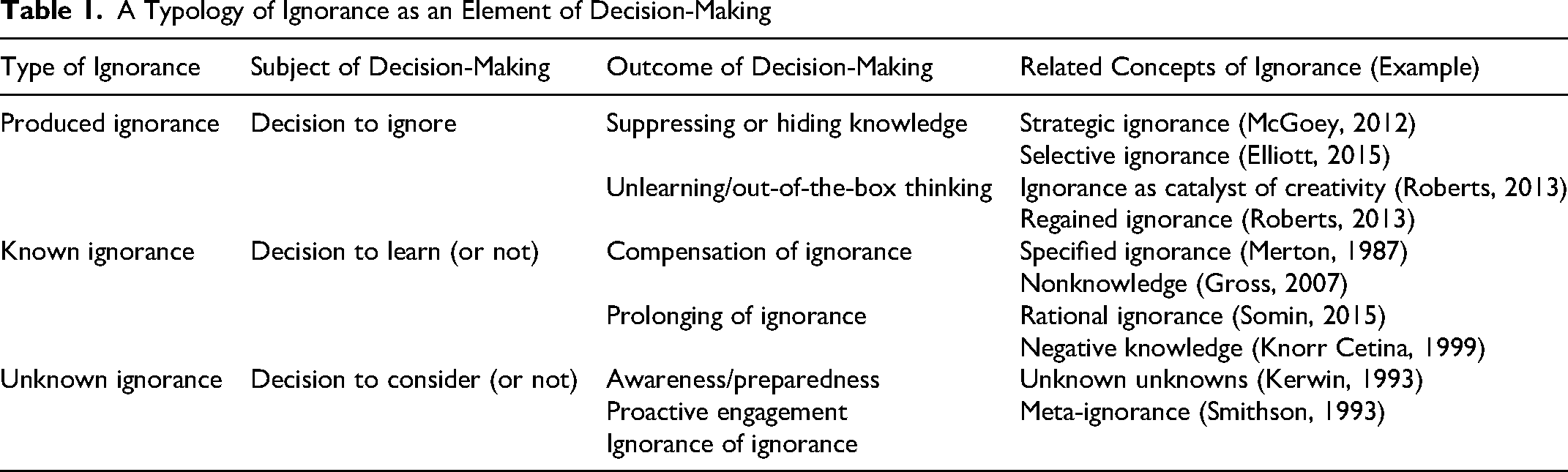
Depending on what decisions are about, there are different options of how to decide. Produced ignorance relates to what in Robert’s (2013, 2015a, 2015b) taxonomy of ignorance originates “from suppressing knowledge,” for instance for “strategic” (McGoey, 2012) reasons, “commercial or ideological objectives” (Gross & McGoey, 2015a, p. 3), or due to any other biases. Flyvbjerg’s (2011, p. 328) notion of “strategic misrepresentation,” as one of the “root causes” of project failure, exemplifies such a produced ignorance. Producing ignorance can also imply “regaining [it] through forgetting and unlearning” (Roberts, 2015b, p. 115) when existing knowledge obstructs the adaptation to changing circumstances and/or the introduction of novel tools, strategies, and practices. A variant of such “managed unlearning” (Holan & Phillips, 2004, p. 1606) is the deliberate introduction of ignorant newcomers into organizations that help challenge incumbent routines (Grabher, 2004b, p. 1496; Roberts, 2013, p. 221).
As regards known ignorance, in other words, an identified lack of knowledge, the decision is about whether or not to compensate this deficit through a type of learning that resonates with Merton’s (1987) conception of knowledge generation in science. This conception holds that ignorance has to be “specified” in order to identify what has to be learned. A decision not to compensate a lack of knowledge can follow two different rationales. First, noncompensation could be the result of a cost-benefit trade-off. The acquisition of knowledge is assessed as not worth the effort in light of an organization’s strategy or of its core competencies (Roberts, 2013, p. 222). Some authors (e.g., Somin, 2015) refer to this deliberate maintenance of ignorance as “rational ignorance.” Second, sustaining a lack of knowledge is part of organizational “information-filtering” (Bakken & Wiik, 2018, p. 1117), a necessary condition for making decisions at all. Such systematic screening out of certain knowledge even holds for the practice of scientific knowledge generation, as Knorr Cetina (1999, p. 46) elucidates in her analysis of the role of “negative knowledge” in scientific research.
Unknown ignorance is “true terra incognita” (Kerwin, 1993, p. 179), and it, by definition, cannot be taken into systematic consideration. Nevertheless, it is possible to accept that “unknown unknowns“ (p. 178) exist, and to allocate resources in expecting possible “surprises” (Gross, 2010) that unknown ignorance can engender. Unknown ignorance resonates with Beckert’s (2021, p. 2) idea of how organizations, inevitably, have to come to terms with the future: the “not-yet knowable.”
In order to identify unknown unknowns, Roberts (2013, p. 220, emphasis added) points out that “they are sought out through broad research activity rather than focused investigations, with no guarantee that they will be uncovered.” Beckert (2021, p. 2) stresses the role of “imagined futures” (Beckert, 2016) as a proactive strategy to deal with the not-yet knowable. However, organizations also may not care about potential unknowns at all—either deliberately or simply due to naivety.
These different types of ignorance, of course, are neither isolated nor static (Gross, 2007). Most obviously, unknown ignorance turns into known ignorance (or into knowledge) once it surfaces. Revelation may however also be suppressed when it is inconsistent with existing priorities and interests (produced ignorance).
Dealing With the Conundrum in Project Management
How do these types of ignorance shape decision-making in projects and project management? And how do project professionals seek to cope with all those aspects that they do not know when launching projects? Projects are, by definition, temporary organizations (Bakker, 2010; Lundin & Söderholm, 1995), and their predetermined termination obviously also impacts the ways in which ignorance is addressed. Projects per se could be considered as an organizational means to curtail ignorance about a determinate period within the future, through the prespecification of key project parameters. Their finiteness exemplifies the notion of “linear” time that renders the project time span a “predictable and plannable” episode “cut out” of the “continuous time flow” (Lundin & Söderholm, 1995, p. 450, emphasis added). The conventional textbook prescriptions for project planning and management reiterate, time and again, the imperative to efficiently plan work packages against a “countdown clock time” (Lundin et al., 2001). And yet, predictability typically remains elusive. Although projects are defined through their prespecified termination, not even the most comprehensive planning procedures are able to factor out the contingencies and uncertainties that unfold during the performance of projects (Kreiner, 2020, p. 405). Despite their temporary limitation, then, a project fundamentally remains “an emergent social process of becoming” (Buchan & Simpson, 2020, p. 38, original emphasis).
In his reading of the Hirschman-versus-Flyvbjerg controversy, Kreiner (2020, p. 404) reiterates these “conflicting notions” of projects as either predictable episodes or processes of becoming as “leaps into a designed future” or “as pursuits.” This juxtaposition between rigidly planned episodes and open processes of becoming also resonates with the dichotomy between “more traditional” (Lenfle, 2016, p. 47) and “novel projects” (Loch et al., 2006) or “exploratory projects” (Lenfle, 2016) for which conventional techniques of project planning and management are inappropriate.
We diverge from this proposition that different roles of ignorance in project management are either the result of different understandings of projects or reflect the distinctive features of different types of projects. Rather, our approach toward conceiving of ignorance, and the various modes of coping with it, is shaped by the different understandings of ignorance and their interferences with decision-making. More specifically, we extract three positions from the relevant project literature that signify distinct understandings and framings of ignorance, with regard to its role in decision-making. The three positions are laid out in Table 2.
Modes of Coping with Ignorance in Projects
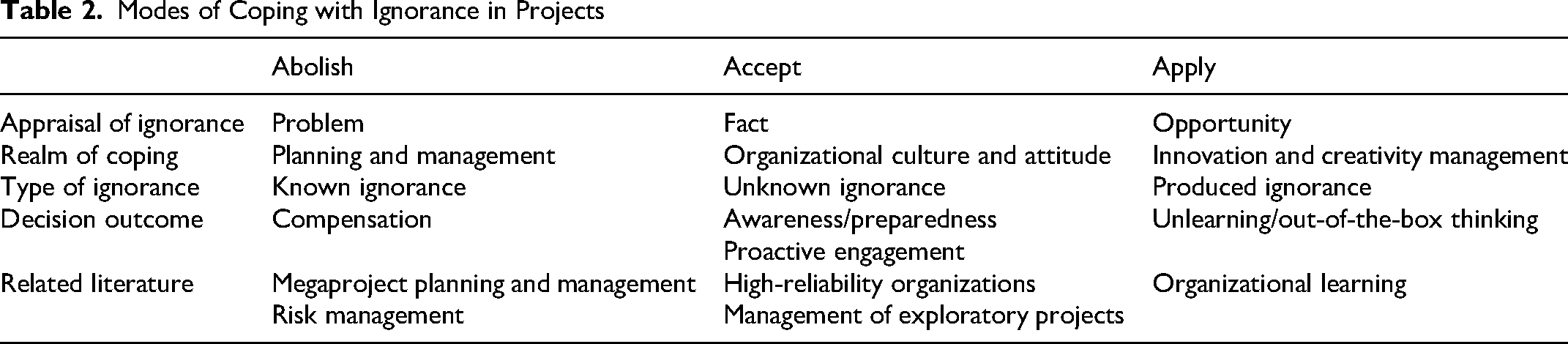
The first position (exemplifying known ignorance) echoes the fundamental critique of Hirschman’s principle by Flyvbjerg and his colleagues (2014, 2016, 2017; Flyvbjerg & Sunstein, 2016). Ascribing ignorance as a valuable contribution to project planning, as Flyvbjerg vigorously denounces, amounts to nothing less than to eulogize the irresponsible behavior that, of all things, incorporates the very “root causes of underperformance” (Flyvbjerg, 2011, p. 323). Ignorance, in Flyvbjerg’s (2009) view, thereby supports the “survival of the unfittest” since those projects will most likely be realized that are planned in the least professional manner. Ignorance, hence, is a fundamental threat and, consequently, has to be abolished. For this purpose, project professionals have to specify what they do not know and have to be at great pains to compensate their lack of knowledge, either by acquiring this knowledge or by transforming ignorance about possible future events into calculable risks (Loch et al., 2006, p. 2). Coping with ignorance, then, implies the need to put more emphasis on the front end of the project cycle by enhancing the planning effort, and leveraging the “external view” (Flyvbjerg, 2008) from reference projects to broaden the knowledge base.
The second position (embodying unknown ignorance) conveys skepticism as to whether eliminating ignorance is possible at all. Particularly large projects are complex systems rife with high degrees of uncertainty (Miller & Lessard, 2001) and are fraught with “unknown unknowns” (e.g., Ramasesh & Browning, 2014). In other words, large projects embody unknown ignorance that cannot be anticipated and abolished at all, but that, rather plainly, has to be accepted as a matter of fact. Two literatures are particularly instructive with regard to coping with unknown unknowns. First, research on High Reliability Organizations (e.g., Weick, 1987; Weick et al., 2008) proposes strategies that prevent minor incidents from cascading into major disasters (Perrow, 2011) in complex technical systems like, for example, air-traffic control or nuclear power plants. Rather than employing “conventional learning processes” (Weick et al., 2008, p. 54) in which new practices are sedimented into organizational routines, High Reliability Organizations cultivate a sense of “preparedness” (Amin, 2013, p. 141; Anderson, 2010) and “mindfulness” (Weick et al., 2008). This cognitive alertness helps “to uncover assumptions people take for granted, trace out new implications of old assumptions, and identify latent organizational flaws” (p. 54). Accepting ignorance in complex systems raises the awareness that “things can go wrong” (Grabher & Thiel, 2014) and, by implication, reduces the likelihood that things actually go wrong. Second, the work on novel and exploratory projects advocates a more proactive engagement with the “not-yet knowable” (Beckert, 2021, p. 2) that is inherent in innovative ventures. Loch et al. (2006), for example, exemplify two modes of such proactive engagement by differentiating between trial-and-error learning, on the one hand, and selectionism, in other words, the advancement of multiple parallel trials in order to be able to select the best way to advance, on the other.
The third basic position with regard to coping with the unknown in projects (echoing produced ignorance) conceives of ignorance as an opportunity that can be reflexively produced—and strategically applied. This position builds on Grabher’s (2004b, p. 1493) distinction between a “cumulative” and a “disruptive learning mode.” The cumulative mode mirrors the classic pattern of organizational learning, in other words, the accumulation of knowledge, experience and capabilities, and their sedimentation into organizational routines. In the disruptive mode, the “imperative of originality minimizes the scope for repeatable solutions” (Grabher, 2004b, p. 1493). Disruptive learning, in essence, aims at a deliberate forgetting of what has been learned before in order to remain open to new practices, strategies, and solutions. This learning mode is also supported by “learning by switching,” in which established, relational configurations are deliberately suspended to diffuse knowledge—as a sort of forced organizational amnesia (e.g., Dornisch, 2002, p. 310).
Spheres of Coping With Ignorance in Project Ecologies
But what about the role of ignorance and the modes of coping with it beyond the boundaries of the individual project? Project management research, routinely, conceives of the relation between temporary projects and their organizational, relational, and institutional contexts as a clear-cut division of labor, epitomized by the duality of “learning in projects, remembering in networks” (Grabher, 2004a, p. 99). As a consequence, scholarly work has put the emphasis on knowledge, tools, and techniques that are applicable in future ventures, as well as on the channels through which these learning elements can be carried forward into the future. These include within project-based organizations, as reusable “project capabilities” (Davies & Brady, 2000, p. 932); as “project lineage” (Midler, 2013), within product development trajectories in manufacturing firms; along career trajectories, as individual “experience accumulation” (Swan & Scarbrough, 2010, p. 340); or through the supply network, as “wakes of innovation” (Boland Jr. et al., 2007). Taken together, extant work on the relation between temporary projects and their contexts primarily emphasizes the dispersed nature of these contexts and focuses on the selective diffusion of knowledge in light of this dispersion.
The notion of the “project ecology” (e.g., Grabher, 2002a, 2002b, 2004b; Grabher & Ibert, 2011) offers a way to grasp this dispersed context. The concept differentiates the primarily relational space in which the duality of learning and remembering plays out into distinct social layers (Grabher & Ibert, 2011, p. 176). These involve the project team, the firm, and the interpersonal and interorganizational relations in which team members and related firms are embedded. Mobilization and diffusion of knowledge occur precisely from, and into, these layers, respectively.
Kreiner’s (2020, p. 451) reading of Hirschman’s hiding hand as “our ability […] to remain able to be surprised” turns the idea of learning and remembering that is at the heart of the project ecology upside down. In a way, the author offers a way of coping with ignorance by simply maintaining it. The hiding hand helps us to avoid learning from the problems that we encounter when planning and implementing large projects. Kreiner (2020), in fact, offers a fascinating idea about the psychological prerequisites of embarking on new ventures and the productive dimension of the “optimism bias” (Flyvbjerg, 2011). His idea, however, falls short when it comes to understanding the processes of accumulating knowledge and experience that unfold between projects and in the interrelation between temporary projects and their more permanent organizational, relational, and institutional contexts.
We aim at pushing beyond the primarily instrumental focus on knowledge generation, as the key outcome, and knowledge diffusion, as the key challenge of project organizations. Rather than limiting our focus on knowledge, we seek to extend our perspectives into negative experiences, reputation effects, and collaborative structures as well as ‘war stories’ that circulate in project ecologies from project to project (Dreher & Thiel, 2022; Grabher & Thiel, 2015; Manning, 2017). In addition, we widen the analytical lens in order to perceive the architecture of project ecologies not only in (primarily) relational terms, but also to take the role of the institutional environment and organizational fields, respectively, into explicit consideration (Grabher & Thiel, 2015; Thiel et al., 2021a; Thiel & Grabher, 2015; Sydow & Söderlund, 2023 Tukiainen & Granqvist, 2016). Sydow and Windeler (2020) compellingly make the case for a “multilevel approach” (including fields) to understand the delicate balancing of the temporary and the permanent as inherent features of project organizing. Crucially, by attending to the “field” level, the analysis is able to grasp nonrelational elements and dynamics (i.e., field dynamics) within project ecologies.
Such a broadened perspective, we maintain, enriches our views of the ways and channels of how ignorance is dealt with in, and permeates through, project ecologies. By drawing on Grabher and Thiel’s (2015) earlier conception, we differentiate between “trajectories of learning” that unfold within the actual project, via the experience accumulation of individual professionals within their careers; and within organizational fields that provide the cognitive, normative, and regulatory foundations of projects (DiMaggio & Powell, 1983; Scott, 1995).
In the project trajectory, learning to cope with ignorance would imply the development of a specific organizational culture and a governance structure that both support attentiveness in the face of unanticipated problems, and transparency when it comes to confronting these issues. Against the background of the temporary nature of interorganizational collaboration and the notorious volatility of temporary employment relations (Grabher & Thiel, 2015), nurturing a distinctive project culture is a formidable challenge. But then again, at least large projects evolve over a sufficiently long time span that engenders a unique identity (Brookes et al., 2017) that, typically, is bolstered through heightened media attention.
Career trajectories, in other words, the learning paths of individuals along their professional biographies, are regarded as the most effective channels through which experiences, knowledge, and capabilities are conveyed from project to project (Swan & Scarbrough, 2010). At the same time, this individualization of experience accumulation compounds the diffuse nature of learning processes in project ecologies. What is more, the career trajectories are not only “repositories of knowledge” (Sydow et al., 2004) but also manifestations of reputation that is a powerful lever for individual career advancement (e.g., Arthur et al., 2001). Hiring professionals with experience gained in comparable, previous ventures benefits overall learning by mobilizing implicit and context-dependent knowledge (Bresnen et al., 2003). Examples of this knowledge would be “where the mistakes lie” and how problems would have to be addressed (Grabher & Thiel, 2015, p. 331). Individual experience, then, can enhance overall mindfulness toward possible unknowns. Although individuals are in fact prime carriers of experience, permanent organizations, of course, also play an important role as “pools” of such experience and as “nodes” in career trajectories (Grabher & Thiel, 2015, p. 332).
More systematic inquiries into the problems that surfaced, and their potential solutions, have in the more recent past been mounted on the field level, which is also the key arena for converting experience into general recommendations and amendments of regulations. This process typically is triggered by media reports or professional disputes about failures in the planning and execution of projects that culminated in delays, budget overruns, or functional shortcomings (Thiel et al., 2021a). In the United Kingdom, for instance, two industry reports that lamented the modernization deficit in the British construction industry were of particular importance for advocating specific initiatives and programs to increase productivity and competitiveness (Egan, 1998; Latham, 1994). It was exactly these reports that provided the templates for organizing the contractual relations and nurturing the collaborative culture in one of the biggest megaprojects of the last decades in the United Kingdom: the 2012 Olympics construction program (Davies & Mackenzie, 2014). Learning from past experience also incorporated regulatory changes, such as the introduction of compulsory contingency funds and reference class-forecasting methods for public infrastructure investments by the United Kingdom Treasury, in order to mitigate the impact of optimism bias (Flyvbjerg, 2008; HM Treasury, 2003).
Coping With Ignorance in Project Ecologies: Two Vignettes From Large Construction Projects in Germany
The Research Context
Our two empirical vignettes draw, first, on material that was produced as a result of the public outrage about dramatic cost escalations and delayed realizations of large construction projects in Germany (cf. Kostka & Fiedler, 2016b). In particular, we study two prominent ventures, the new Berlin-Brandenburg airport (BER) (Fiedler & Wendler, 2016) and Hamburg’s Elbphilharmonie (Fiedler & Schuster, 2016). The disastrous development of the airport—culminating in the cancellation of an opening ceremony four weeks ahead of the fixed date in summer 2012—had triggered “devastating criticism and mockery by the media and the public” (Kostka & Fiedler, 2016a, p. 3). As a reaction, the responsible federal ministry set up an expert commission tasked with analyzing the causes of the mere endless series of drastic failures in the planning and management of large projects in Germany, and to derive respective recommendations to avoid such failures in the future (BMVDI, 2015). The ministry complemented this report with an action plan and guidelines (BMVDI, 2018) that provided concrete advice for each phase in the project cycle, including templates for documentation and reporting. In the Elbphilharmonie case, the massive cost escalations and delays chiefly had repercussions in the realm of urban governance. A parliamentary inquiry committee was set up to identify the causes of delays and ill-defined accountabilities (Bürgerschaft, 2014). Parallel to this political process, Hamburg’s City Administration produced a report on “cost-stable construction” that was to serve as a guideline for the management of future public construction projects in Hamburg (Bürgerschaft, 2012). The first vignette summarizes the essence of these reports with regard to recommendations on how to cope with ignorance in large projects.
Second, parallel to the public debate on large projects in Germany, we were involved in an in-depth empirical study of six large construction projects in Germany. Two were framed as ventures of iconic architecture; two aimed at providing advanced engineering solutions for infrastructures; and two projects that targeted both architectural and engineering challenges, in other words, a central train station and a new metro line that included artistic components in the design of the stations. Our respective research project aimed at identifying contributions of these projects to innovations in the construction industry. All in all, we conducted interviews with 85 professionals who were involved in the planning and implementation of these projects in different positions within the project ecology (Fahnenmüller & Thiel, 2021). We revisited the interview data and searched for evidence of how project professionals dealt with ignorance in their everyday practice of planning and implementing projects.
The Public Debate: Ignorance as a Problem
Since the more recent record of large projects in Germany reads like an ever-extending chronicle of spectacular project disasters, it hardly comes as a surprise that the respective government and professional status reports framed ignorance as an obstacle. The expert commission report (BMVDI, 2015, p. 14), for instance, places a strong emphasis on how information is gathered and processed at the front end of the project cycle, that is, in the planning phase. Overall, the experts identified both limited information and insufficient efforts to broaden the knowledge base as key sources of errors. These errors extended from an insufficient establishment of the project owner’s requirements and expectations, through the lack of a precise and up-to-date cost database as well as of dependable feasibility studies, to the established practice of commencing construction work before execution planning documents had been finalized. In addition, the absence of a collaborative and trustful culture and of effective control and communication procedures on German construction sites precludes that the deficiencies of the planning phase are compensated for during the implementation phase.
The commission’s suggestions, therefore, comprise two main elements: (1) a more consistent and resolute employment of a comprehensive planning apparatus, including the systematic management of risks; and (2) the introduction of a collaborative and transparent project culture. These suggestions are specified in Guidelines for Large Projects (BMVDI, 2018) that provide detailed instructions for the management of the different sequences of an idealized project cycle as well as concrete management tools ready for use, such as, for example, templates for contracts, checklists, and exemplary reports. The respective public commission, further on, emphatically pleads for an accelerated adoption of building information modeling (BIM) technologies in order to enhance the knowledge base at the front end through the development of digital prototypes, among others. In the political realm, this digitalization focus is prominently featured, as the specific emphasis in the foreword of the responsible minister attests to “Modern building means building digitally first, and in reality, second” (BMVDI, 2015, p. 5).
Hamburg’s report on cost stability (Bürgerschaft, 2012) is a more administrative document requested by the local audit office and conceived as a directive for the city administration. Besides lamenting the ill-defined roles and responsibilities, as well as a lack of professional expertise in public construction projects, the report focuses almost exclusively on a more consistent application of techniques of cost calculation, cost control, and the management of cost-related risks. Yet again, public efforts center on reducing ignorance (about cost) before and during the realization of a construction project. The 640-page report of the parliamentary committee on the Elbphilharmonie (Bürgerschaft, 2014) reiterates this cost management focus, but also stresses the key role of dysfunctional governance structures and the lack of public control (Fiedler & Schuster, 2016).
Taken together, in the sphere of professional recommendations and regulations, the Flyvbjergian admonition that ignorance constitutes a problem that has to be abolished prevails. Based on the experiences of cost escalations and project delays, experts and regulators demand clear assignment of roles and responsibilities as well as a consistent use of existing planning instruments, or even deployment of new ones, in order to reduce uncertainties.
The Practitioners’ View: Varieties of Ignorance
That planning instruments have to be applied in a consistent fashion and roles and responsibilities have to be clarified is, of course, common sense among those professionals involved in the planning and management of large projects. And yet, they allude to a critical difference between the textbook best practice and the actual enactment of everyday practices, particularly when it comes to the implementation of exploratory and nonstandard solutions: Plan first, build second. […] This is simply theory […] but if you stick strictly to this theory, we would have had to develop this [solution] in a R&D project first before we would have been able to say ‘now we have the criteria and now we can call for a tender.’ […] We would have had to have three years’ more time for planning (project manager, public owner organization).
As a consequence, the personal experience that would enable project stakeholders—and project owners in particular—to master unavoidable contingencies and to leverage the tacit dimensions of project knowledge moved to center stage. The latter dimensions comprise, for instance, information about which construction firms are reliable cooperation partners or have real-world crisis management experience (project manager, public administration). In a sense, project practitioners portrayed their main activity as responding to unexpected occurrences since project trajectories develop an “endogenous dynamic of indispensable problem-solving” (Thiel et al., 2021a, p. 75). Being prepared to accept the potential occurrence of unexpected events and to cope with repercussions by leaving their own comfort zone (by tackling ignorance in unfamiliar knowledge domains) is, in fact, regarded as a key asset of project professionals.
As our findings revealed, particularly the public project owners habitually underestimate the knowledge sources that enable appropriate responses to unpredictable, endogenous project dynamics. In the case of the Elbphilharmonie Hamburg, for instance, the city administration initially calculated the personnel resources needed to establish the requirements and expectations of users (i.e., the promoters of musical performances) to not more than a half-time position in the Department of Culture (civil servant, public administration). Studies that explicitly seek to unravel the complex causalities of failure in the recent German flagship projects, BER and Elbphilharmonie, corroborate these findings (Fiedler & Schuster, 2016; Fiedler & Wendler, 2016).
Particularly when it comes to iconic architectures and the design innovations that these architectures entail, we also found instances of reflexively applying ignorance. Most of such cases involved practices of unlearning, or, at least of disregarding established routines. It’s important to start new things […] with openness, but also with a certain naivety […]. While experiences are important […] at some point they are also a limitation (project architect, architectural firm).
But this is precisely the engineer’s task […] to go to the limits and then to decide: Now I depart from the prescriptions (construction engineer, engineering consultancy).
Ignorance is applied in an even more deliberate fashion when large construction projects, in particular those with a specific focus on design, are regarded as vehicles of distinction for their sponsors and owners, regardless of private firms (Sklair & Gherardi, 2012) or public administrations (e.g., Novy & Peters, 2013). In the case of Hamburg, the city’s aspiration to build a world-class concert hall as an iconic building exemplifies this logic of distinction. This is what Elbphilharmonie achieved. The building has set a benchmark, as a large project that supported the marketing of the city, similar to the Sydney Opera House (architecture expert).
This ambition to stand out on an international stage, lures decision makers into ignoring existing knowledge and experience, in particular negative experiences. Against the background of the “euphoria” (project manager, public owner organization) to be part of an extraordinary and prestigious venture, critical questions about project risks appeared as defeatism; the “sublimes of megaproject management,” in Flyvbjerg’s (2014, p. xvi) words.
Conclusion: Beyond Antagonisms
The chief intention of our article was to intervene in the Flyvbjerg-Hirschman debate by addressing two shortcomings: an underspecification of ignorance and a decontextualized understanding of projects. First, our systematic differentiation of distinct modes of coping with ignorance exemplify specific apprehensions of what we don’t know. Ignorance can, then, be framed as a problem, as a fact, or even as an opportunity. Second, we identified three “trajectories of learning” (Grabher & Thiel, 2015) that channel the transfer and filtering of ignorance through the “project ecology” (Grabher, 2004b; Grabher & Ibert, 2011). They are the project trajectory, the career trajectory, and the field trajectory. We complemented these conceptual ideas with empirical vignettes from an analysis of several policy reports produced in the wake of spectacular project disasters and from an in-depth empirical study of large construction projects, both in Germany.
The empirical vignettes were also intended to evince the usefulness (as well as the limitations) of the proposed analytical framework. The evidence confirms that neither different “notions” (Kreiner, 2020) nor different “types” (Loch et al., 2006; Lenfle, 2016) of projects determine how we cope with ignorance. Rather, it is our (diverse) ways of framing ignorance that determine how we cope with what we do not know. Moreover, the differentiation of three “trajectories of learning” extended the perspective onto coping with ignorance across projects: the project trajectory related to learning in the light of unforeseen events and circumstances; the career trajectory along which particularly implicit and context-dependent knowledge is accumulated; and, finally, the field trajectory involving the examination of the causes of project failures and the explicit articulation of recommendations.
In addition to gauging the applicability of the proposed analytical framework, the empirical spotlights yield three further insights. First, specific modes of coping with ignorance tend to correspond with certain trajectories of learning. Most obviously, the abolish ignorance mode and the field learning trajectory are positively correlated. In the institutional sphere of publicly waged disputes and official recommendations and regulations, ignorance, as a rule, is exclusively framed as a problem. Consequently, deepening and broadening the knowledge base as well as the consistent application of tools and techniques to eliminate unknowns (or, at least, to transform them into manageable risks) become chief imperatives. In contrast, the analysis of the project and the career trajectories suggests a more pragmatic stance of project professionals vis-à-vis their ignorance. While they embody the professional ethos of conscientiously employing tried-and-proven practices, practitioners stress the contingency of planning efforts and the ability to be prepared for unforeseen events as chief requirements in their everyday practice. The accumulation of individual experience and a supportive learning culture within the project organizations are crucial for meeting these requirements.
These insights also coincide with Bresnen et al.’s (2003, p. 163) findings on process innovations that “what is learned is often tacit, intangible, and context-dependent.” The findings also corroborate Grabher and Thiel’s (2015, p. 335) conclusions from the London Olympics Program that the codification of lessons learned primarily benefitted those actors who had been actively involved and therefore not only relied on the codified material. Taken together, our vignettes reveal strikingly different perceptions of ignorance in the institutional sphere (on the field level), on the one hand, and in the actual professional practice (on the project level), on the other.
The second general conclusion concerns the way project professionals deal with ignorance they are aware of. Whether or not they seek to fill a knowledge void is often subject to a delicate calculation of the time and effort necessary on the one hand, and the expected benefits of reducing ignorance, on the other. Although maintaining ignorance is a deliberate and routinely employed approach in practice, project management thus far has failed to systematically examine this conventional mode of dealing with ignorance.
A third and final point, that deserves further scrutiny, pertains to the strategic way of coping with ignorance. For iconic projects with explicit design ambitions, leveraging ignorance seems pertinent. In particular for architects, deliberate forgetting is part of their professional self-understanding and a vitally important precondition for creative originality. Moreover, for project owners preoccupied with the creation of a historical legacy, deliberately ignoring knowledge and experience can boost their commitment to launch such an iconic venture. For Flyvbjerg (2011, p. 323), these attitudes are nothing short of the “root causes of underperformance” resulting from “optimism bias” and “strategic misrepresentation.” For others, as the introductory quote from Ove Arup elucidates, these attitudes “make miracles possible.”
Footnotes
Acknowledgments
We would like to thank the participants in the 38th EGOS Colloquium, Vienna 2022, “Sub-Theme 39: Learning from Imperfect Projects” for their comments on an earlier version of this article, as well as two anonymous reviewers for their thoughtful and encouraging comments.
Declaration of Conflicting Interests
The author(s) declared no potential conflicts of interest with respect to the research, authorship, and/or publication of this article.
Funding
The author(s) disclosed receipt of the following financial support for the research, authorship, and/or publication of this article: The article builds on empirical research in the context of the project “Large-scale Projects as Innovation Drivers in the Construction Industry,” funded by the Ministry of Science of the Free and Hanseatic City of Hamburg, project number LFF-FV-56.
