




Abstract
This article analyzes codesign practices within a series of innovation projects that have diverse stakeholders, initially ill-defined goals, and subjective success measures. Following a practitioner inquiry approach, we draw on practice theory to analyze data and artifacts from 68 educational codesign projects shaped through new forms of collaborative working. The article examines project management principles by analyzing codesign practices and explores the interrelationship of practice and the project site. Contributions include an enriched conception of project management ontologies and a set of principles that identify practitioner mindsets and approaches that are valuable in managing innovation projects.
Keywords
Introduction
The project management literature frequently views principles as one-size-fits-all phenomena with limited, if any, conceptualization on what a principle means (e.g., Varajão et al., 2022). This approach, we argue, can be precarious because principles can encapsulate and signify multiple, sometimes contrasting, meanings and ontological stances. For example, principles as dimensions (Silvius et al., 2017), principles as possibilities (Sergi, 2012), and principles as alternatives to tools (Olechowski et al., 2016) view the concept from a variety of perspectives. While differing in perspective, these stances go beyond a one-size-fits-all approach to principles to expand on and demonstrate different ways of doing project management.
One of the most pressing issues facing the field of project management currently is how to best achieve project objectives in terms of cost, schedule, and quality parameters in projects with highly innovative or subjective deliverables. These projects contain inherent uncertainty regarding how to best proceed for optimized outcomes. New project approaches are being examined that cater to complexity, subjectivity, and innovation, with more emphasis on emergent, design-based, and collaborative practices over highly prescriptive or structured approaches (Cicmil & Hodgson, 2006; Lenfle, 2016; Lippe & vom Brocke, 2016; Winter et al., 2006). This interest in new project approaches is occurring in tandem with the shift toward a more expansive and dynamic conceptualization of project management principles.
There is a view that the traditional principles of project management may be major contributors of failure (Hodgson & Cicmil, 2006) and that new ontological perspectives are necessary to assist us in new understandings of how to approach project management (Sergi, 2012). Recently there has been discussion of project management regarding practices (Blomquist et al., 2010; Buchan & Simpson, 2020; Kalogeropoulos, et al., 2020), design (Lenfle, 2016; Mahmoud-Jouini et al., 2016), and subjectivity (Huff, 2016). At the same time, there have been repeated calls that a more diverse body of research is needed, with a refocus of project studies to include greater emphasis on reflection on practice (e.g., Cicmil et al., 2006; Geraldi & Söderlund, 2018). Looking further into the future, Walker and Lloyd-Walker (2019) argue that over the next two decades project management will be further shaped through new forms of collaborative working. These developments are underpinned by advances in technology, stronger attention to ethics and values, and increased expectations of the capabilities of project managers. This is leading to an increasing understanding that the alignment of project management principles with the needs of innovation projects requires further consideration (e.g., Lippe & vom Brocke, 2016). This approach could focus on creativity and generating consensus on new ideas, underpinned by collaborative practices among diverse project stakeholders (e.g., Enninga & van der Lugt, 2016).
In this article, we investigate codesign practices as emerging and disruptive phenomena in order to understand overarching principles for guiding project management in innovative contexts. Codesign involves active and collaborative participation from a diverse set of stakeholders (Manzini, 2015) who work together on project management and development. The focus of codesign is on practicing, where the ‘ing’ represents a shift of focus from abstract ideas, as in design thinking, to doing design with others (Cantore, 2018). This approach provides opportunities to challenge and reimagine conventional principles and theories about project management. Furthermore, the article contributes to efforts to clarify ontological questions about project management principles by deriving and discussing a specific set of principles for guiding innovation projects that are characterized by adaptation, contextualization, and collaboration.
This article seeks to extend understandings of project management principles by examining practices in 68 large and multifaceted educational projects in innovative contexts. Codesign is the primary approach to planning, implementing, and evaluating the projects. These projects involve a high degree of complexity and are inherently collaborative and subjective. Applying an analytic methodology grounded in practice theory (Mahon et al., 2017) and practitioner inquiry (Wall, 2018), we focus on the project site and unpack codesign practices that can assist us with reshaping principles of project management. While our focus is on examining educational innovation projects, we argue that the principles elicited highlight possibilities and areas for attention for managing innovation projects in other sectors.
Our research question is: How can we contribute to project management principles by examining codesign practices in innovative contexts? We respond to this research question by analyzing the project management practices in our codesign projects. After examining the conceptual foundations of contemporary project management ontologies and approaches, we will provide an overview of codesign and practice theory. This will be followed by a description of the study’s methodology and the site we examined. Our findings will elucidate codesign practices using the lens of practice theory, leading to a discussion of how these findings can contribute to project management principles and be leveraged in other innovation projects.
Theoretical Framework
In this section, we present the theoretical underpinnings that inform this study. Inspired by practice theory and practitioner inquiry, this article aims to deepen understanding of project management principles by examining codesign practices and highlighting their connections to project management research in innovative contexts. Prior to aligning codesign and practice theory with project management, we will first consider project management ontologies and the nature of innovation projects.
Ontological Perspective on Project Management Principles
In innovation projects, Huff (2016) argues that “ontologically and epistemologically, what happens and what can be known about the future cannot be predicted.… Rather than looking for stable and objectively defined entities and relationships, it therefore makes sense to focus on process” (p. 19). The mindset of practitioners and scholars is moving toward approaching projects as a process of becoming rather as being (Packendorff et al., 2014; Sergi, 2012). Projects, traditionally viewed as a series of preplanned, prescribed, and controlled phases, are increasingly recognized in relation to dealing with human interactions, transformations, and changes (Blomquist et al., 2010; Cicmil, et al., 2006). We build on this understanding through unpacking this disruption, to examine our own practices and take advantage of ontological possibilities (Gershon, 2016). Ontological views allow us to examine sociocultural dimensions that exist in the social world and assumptions about the form and nature of that social reality (Lawson, 2019).
Salovaara et al. (2020) discuss the project-as-practice approach, which criticizes project management as being rather positivistic and failing to recognize messy, ambiguous, fragmented, and context-situated practices. This aligns with the work by Cicmil and Hodgson (2006), which views projects less as objects and more as evolving, living, and emerging phenomena that manifest through activities, events, and interactions. Ontological views profoundly shape how people involved in the projects live, act, and relate to others. Project management principles can be considered as being composed not solely of coordinated human activities, but also integrating the scope of stakeholders’ engagement, which is underpinned by their views, values, and practices. Cooke-Davies (2002) calls it the “people side” of the principles, which contributes to the success of project practitioners.
We take a stance that principles influence the quality of project management. In alignment with Koskela (2017), Hodgson and Cicmil (2006), and Winter et al. (2006), we consider project management principles as fundamental catalysts for ontological possibilities and changes that impact future practices of project management. Principles serve less as simple descriptions or prescriptions of the world and more as value guides for project practices that apply to individuals, organizations, and societies (Roden et al., 2017). As overarching catalysts in perpetual emergence (Sergi, 2012), they influence, but do not determine, future practices. In certain instances, principles can remain submerged and undeclared while still having an impact on project management practices (Sergi, 2012). In other circumstances, traditionally prescriptive principles can contradict implicit, inherent principles and paradoxically appear undesirable, irrational, or lead to their own “undoing” (Virine & Trumper, 2016). In light of these complexities, we argue that principles are more intricate and living phenomena.
Innovation projects, which often have uncertain (Lenfle, 2016) or subjective (Huff, 2016) goals and may involve a limited control paradigm (Mahmoud-Jouini et al., 2016), are a particular focus for the reconsideration of the more traditionally structured principles of project management (Midler et al., 2016; Winter et al., 2006). These projects require project managers to adapt their application of principles to fit the needs of the project as they are at the time (Enninga & van der Lugt, 2016; Lippe & vom Brocke, 2016). Rather than following more linear, step-by-step project phases, some authors have argued for more emphasis on an adaptive and emerging understanding of the project goals and how to get there (Lenfle, 2016), design processes and perspectives (Mahmoud-Jouini et al., 2016), creativity, generating consensus, and guiding group dynamics (Enninga & van der Lugt, 2016; Lippe & vom Brocke, 2016). Under this perspective, risk management needs to not only consider the project constraints of time, cost, and quality (Enninga & van der Lugt, 2016) but also have the capacity to embrace a large degree of uncertainty and respond to an emerging understanding of risks (Lenfle, 2016).
Design(-ing) and Codesign(-ing)
Design-thinking paradigms and approaches are receiving increasing attention as a catalyst for fundamentally redefining project management principles (Knight et al., 2020; Liedtka, 2018; Mahmoud-Jouini et al., 2016). Design thinking encourages divergent thinking (Bason & Austin, 2019), prioritizes people rather than technologies or tools (Zeivots et al., 2021), and can unleash people’s full creative energies by radically improving processes for managers and innovation teams (Liedtka, 2018). The design-thinking process has evolved in different directions as a set of methodologies and material practices, and one of them, codesign, is gaining increasing recognition. Codesign is the collective part of the design process, and has emerged in response to the collaboration, management, and communication problems that often arise during design in highly collaborative and often multidisciplinary teams (Kleinsmann & Valkenburg, 2008). Codesign is a mindset, an approach with a set of distinct principles and practices (Manzini, 2015), and a novel methodology that requires active and collaborative participation of all stakeholders (Berger et al., 2005). Codesign is defined as “a practice where people collaborate or connect their knowledge, skills, and resources in order to carry out a design task” (Zamenopoulos & Alexiou, 2018, p. 10). These people are often experts in their areas or experts of their experiences but are not necessarily trained as designers (Steen et al., 2011). This approach is known for “changing the roles of the designer, the researcher, and the person formerly known as the ‘user’” (Sanders & Stappers, 2008, p. 5).
Codesign comprises diverse approaches that range from research oriented (e.g., applied ethnography) to design oriented with different levels of stakeholder participation (e.g., participatory design) (Sanders & Stappers, 2008). Codesign benefits can include enhanced stakeholder motivation, professional development, and learning that results from the engagement in the process (Wilson et al., 2021). Codesign is also believed to improve project outcomes in the long term and enhance idea generation, service delivery, and project management per se (Blomkamp, 2018). There is evidence that codesign leads to more innovative ideas that address the needs of the users (Steen et al., 2011).
Codesign in Educational Projects
One type of innovation projects are educational projects that aim to transform teaching and learning as they involve many of the issues raised in the literature of innovation project management. They often have diverse stakeholders, emergent and subjective goals, and quality criteria that may not be fully understood until after they are implemented with students. At the same time, educational projects within higher education are still heavily constrained by costs, schedule, and a complex quality regime, which includes comprehensive quality assurance processes and regulations defined by the institution, government, and potential accrediting bodies. Unlike purely exploratory projects (e.g., Lenfle, 2008), however, educational projects need to produce a ‘product’ in order to be successful, for example, providing an educational service to students. It is not sufficient to only contribute to the body of knowledge for use in future projects. To deal with this, educational projects are increasingly being positioned as design projects that place people (e.g., students and teachers) at the center of the process (O’Donnell & Schultz, 2020), with emerging interest in codesign approaches (Wilson et al., 2021).
Codesign in higher education is underpinned by shared interest in supporting student learning. It is a strategic, collaborative approach to implementing change in which a broad set of actors, including teachers, students, researchers, developers, alumni, industry partners, and other professionals, engage to support educational processes (Wilson et al., 2021). In educational reform projects, “codesign begins with a goal of creating some kind of innovation that seeks to advance an educational goal” (Penuel et al., 2007, p. 53). The codesign process often starts with an event, such as a workshop, that brings together stakeholders to build common understanding, promote a shared sense of the key challenges, and construct metrics of success that are appropriate for the specific context. Codesign projects in educational institutions must be timed to fit the teaching cycle and the availability of the project stakeholders, including educators and students (Penuel et al., 2007). We argue that codesign is critical in higher education because different perspectives and expertise are essential to design increasingly challenging innovation projects in a rapidly changing world.
To sum up, this article reimagines project management principles by examining codesign practices in innovative contexts. Codesign foregrounds collaborative and emergent practices that are often de-emphasized in traditional project management. Exploring codesigning projects in detail can assist with reimagining project management principles.
Methodology
The design process and methodology were underpinned by a combination of practitioner inquiry (Cochran-Smith & Donnell, 2006) and practice theory (Mahon et al., 2017). This approach helped us investigate and make sense of codesign and its associated practices as contributing to the core of collective activity that composes project management principles. We will now introduce practitioner inquiry, practice theory, and present the project site, where we discuss our ontological and epistemological assumptions.
Practitioner Inquiry
There are two broad standpoints toward practitioner inquiry (Wall, 2018). As an epistemological stance, practitioner inquiry is a way of understanding the world (Cochran-Smith & Donnell, 2006). On the other hand, practitioner inquiry as a project is a shared process of investigation driven by more tangible structures and organizations (Wall, 2018). We view practitioner inquiry “as a verb, rather than a noun” (Gilchrist, 2018, p. 7). This stance highlights ‘happening-ness’ where practices emerge through ‘doings,’ ‘sayings,’ and ‘relatings’ (discussed in detail in the next section), which develop simultaneously in relation to each other (Kemmis, 2010). We utilize practitioner inquiry as a strategic shared process of investigation and knowledge creation concerning the research question and consider the relationship between knowledge and practice as complex and nonlinear. According to this approach, knowledge about a site is generated from within rather than from outside looking in (Cochran-Smith & Donnell, 2006). Practitioner inquiry relies on a culture of collaboration and sharing of practice and insights (Gilchrist, 2018). In this way, we aim to break down the silos that form in the absence of sustained professional dialogue. Reporting research findings in practitioner inquiry is akin to “a traveler’s guide rather than a map or an encyclopedia entry” (Brown, 1996, p. 268). The self and the situation the researcher is reflecting on are mutually formative.
Practice Theory
We underpin our understanding of project management by applying the practice theory and, more specifically, the mindset of doings, sayings, and relatings (Kemmis, 2022). Kemmis (2018) describes practices as “a form of human action in history, in which particular activities (doings) are comprehensible in terms of particular ideas and talk (sayings); and when the people involved are distributed in particular kinds of relationships (relatings); and when this combination of sayings, doings, and relatings ‘hangs together’ in the project of the practice” (pp. 2–3). This approach construes practices as forms of socially established cooperative human activities that mesh with material objects critical to all projects (Kemmis, 2022; Wilkinson & Kemmis, 2015).
Drawing on the practice theory, we frequently use the verb form of project activities (e.g., project managing) to shift the meaning away from a static and set view on organizations and managers. The employment of verbs assists our inquiry ontologically by emphasizing the evolving and dynamic sets of codesign practices (Wilkinson et al., 2013).
Practices do not occur in a vacuum (Wilkinson, 2021). Practice theory argues that the site is to be apprehended as the context that surrounds practices, and as that “prefigures, enables, and/or constrains (but does not determine) the conditions” of practices (p. 345). Wilkinson (2021) states that sites matter ontologically. In this article we draw on the notion of site ontologies (Schatzki, 2002) to examine how our site matters when studying codesign practices that contribute to project management principles. According to the theory of practice architectures (Kemmis, 2022), practices are enabled and constrained by three kinds of arrangements within a site: material-economic (e.g., objects and their layouts over time—doings); cultural-discursive (e.g., ideas, languages, and specialist discourses—sayings); and social-political (e.g., forms of relationships between people—relatings). These arrangements form ‘practice architectures,’ hang together, and are harnessed in a coherent way within practices.
Project Site
“Business Co-Design” is a multidisciplinary educational innovation unit at a leading business school in Australia. Underpinned by a five-year strategic initiative, Connected Learning at Scale (CLaS) (Wilson et al., 2021; Bryant, 2022), the unit aims to bring a paradigm shift around student engagement with learning, and transform teaching and learning practices in large subjects. Codesign is the main strategy, approach, and philosophy that underpins and drives this initiative. The CLaS initiative has been set up as a program of work involving a series of projects through which the educational codesign is undertaken.
An educational developer is assigned as the project lead and curriculum design expert to a CLaS project, typically a subject in the business school. The role of educational developers, often seen as ‘brokers’ and ‘bridge-builders,’ positions them strategically within their institution in collaboration with leaders at different levels (Sugrue et al., 2018). In addition to educational developers, the projects include an academic from the subject, usually the current subject coordinator, and a learning designer. While these team members form the core roles in the codesign projects, a variety of other stakeholders are involved at various stages: inter alia media specialists, educational technologists, industry partners, and students. These stakeholders are considered partners in the codesign process, which aligns with many of the codesign case studies reported in the literature (Wilson et al., 2021).
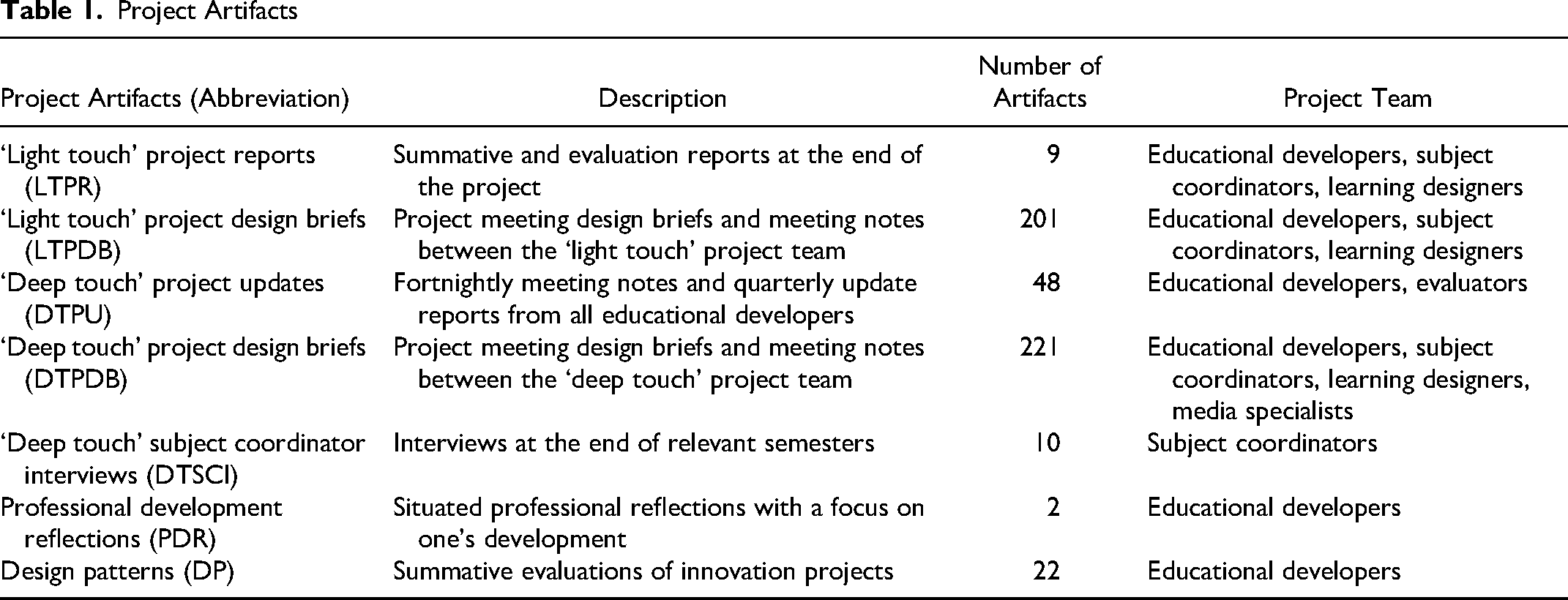
As educational developers and projects leads, the three authors collectively have managed 68 educational innovation projects in the past two years. Each project represented a modification and transformation process of a distinct subject (for example, global business) that involved a project team. The projects ranged from short-term (1–6 months) to long-term (1–2 years) work. The complexity and scale of the projects determined the project label, which Business Co-Design often termed as ‘light touch’ (Wardak et al., 2021b) and ‘deep touch’ projects. For example, a ‘light touch’ project typically involved several educational innovations over a few months that included, but were not limited to, upgrading the learning management system, content video recordings, pedagogical changes, often around student engagement, and educational technologies. ‘Deep touch’ projects were more complex initiatives that comprised targeted and iterative educational interventions, which were implemented in up to two years. ‘Deep touch’ projects often included a substantial development and leverage of resources (e.g., high-quality educational videos, digital templates), services (student-centered design, pedagogical innovations, evidence-based solutions), and technologies (collaborative tools, digital solutions, communication). Across the projects we used iterative reflections (e.g., fortnightly project lead meetings and monthly evaluation meetings) and design patterns (Goodyear, 2015) as a formalized method to capture our practices as well as an informal way to understand and challenge our ways of managing projects.
Traditional modes of data selection and analysis do not apply to practitioner inquiry. Certain strands of data were selected, not to reduce complexity but to tell a narrative that helped the researchers in making sense of the project site retroactively (Brown, 1996). The scope of this article focused on an examination of the 68 codesign projects (and associated artifacts) representing light and deep touch projects in which the authors were involved. Data analysis in practitioner inquiry is accomplished through uniting thinking with action through reflection (Brown, 1996). The way data is described by the three practitioners in this article is itself a form of data. We reflected on our data in three phases: (1) individually selected strands of data and artifacts by focusing on codesign practices and what these practices are composed of, for example, their distinctive (doings, sayings, and relatings) arrangements; (2) collectively shared, interrogated, and reflected on these arrangements and how they related to the research inquiry; and (3) examined common arrangements and agreed on the key recurring themes that illuminated the codesign practices contributing to project management principles. These phases are anchored in practitioner inquiry and practice theory. While practitioner inquiry legitimizes research within work-based contexts, practice architecture provides the instruments, for example, the use of verbs, collaborative practice sharing, and site ontologies, for addressing the inquiry’s foci and scope. In this sense, the two approaches are complementary. Table 1 summarizes the projects, their type, associated artifacts, and involved stakeholders.
Project Artifacts
Findings
This section is based on a review of codesign projects in Business Co-Design in the past two years. We examined practices of 68 educational projects, which we managed and led as educational developers. We investigated doings, sayings, and relatings of these projects and captured the emerging codesign patterns that can contribute to wider project management practice. Complementing practitioner inquiry approach with practice architecture, which is concerned with collective rather than individual experiences, enabled us to conduct a broad exploration of distinct narratives. Through iterative reflections, we found three themes or narratives to illuminate the key codesign practices: (1) designing mindset is ubiquitous in codesign projects, (2) codesign project practices are influenced by the site, and (3) codesign projects influence the site beyond the project scope.
Designing Mindset Is Ubiquitous in Codesign Projects
Project stakeholders in our dataset engaged with various design practices to navigate codesign activities, people, and time lines. Designing was rarely implemented in stages with a set start and end point. Instead, design was leveraged more as a practical mindset, which underpinned the project development, implementation, and sustainability. This mindset emerged as a collaborative, fluid, and action-oriented pattern embodied in project meetings, communication channels, and actions. Codesign was about challenging power imbalance in design decision-making, and this set it apart from traditional design-thinking approaches.
We will now examine a Connect:In workshop, an intentional initiative to connect stakeholders during the onset of a new project phase, which was integral in multiple ‘deep touch’ projects. Originally, the Connect:In workshop was introduced to bring together different stakeholders (inter alia coordinators, students, industry partners, alumni, educational developers, and learning designers) to gather preliminary feedback and data for the design of a subject/project. This rich data would then be collected and used to underpin the initiation of the project activities and meetings (‘deep touch’ project design briefs [DTPDB]–educational developers). This approach was seen as an optional CLaS design pattern (Goodyear, 2015) for codesign projects in the first year (design patterns [DP]–educational developers). However, the use and format of Connect:In workshops have since evolved and transcended to address the growing needs of divergent projects and stakeholders. One of the main tenets of codesign is that it can take place at any point across the design and development process. In alignment with this tenet, four recent projects delivered Connect:In workshops in the middle or at the end of the project (‘deep touch’ project updates [DTPU]–educational developers). This is quite different from the original intent to facilitate the workshop at the beginning of the project. Another shift observed more recently was the purpose of Connect:In workshops. In one instance, we brought together a panel of practitioners from the faculty to discuss the pros and cons of introducing two technology platforms: Microsoft Teams and WeChat (LTSCI–educational developers). In this case the purpose was less about connecting the codesign team and more on connecting the knowledge and practices. In two other instances, the workshops aimed to evaluate key project interventions at the end of the project and consequently agreeing on the future design and changes (DTPU, ‘deep touch’ subject coordinator interviews [DTSCI]–educational developers, subject coordinators). Here, the shift away from the original Connect:In workshop is even more noticeable: the workshop occurred at the end of the project and the purpose was significantly different. We argue that the Connect:In workshop is an example of practices, which originally was composed and leveraged as a one-off project launch; however, eventually its time line, purpose, and thus design activities changed and became something that was valued in the specific codesign project context.
A further shift was evident in the emerging approach to, and a mindset of, designing. A recent Connect:In workshop of a ‘deep touch’ project was delivered to jointly launch two projects and “to connect the new team, working experiences, design processes, strategies, and values” (professional development reflections [PDR]–educational developer 2). Both projects were in the same discipline and scheduled to commence in the following year. The Connect:In was a three-hour workshop involving a range of designing techniques: lighter activities to connect the team (e.g., blue sky thinking, brainstorming, sharing experiences), and deeper activities to initiate the subject designing at a macrolevel (e.g., aligning learning outcomes with emerging ideas, pedagogical strategies, and activities). The two subject coordinators were impressed by the initial Connect:In workshop and invited the team to continue working in this format: “this way of working has been thought provoking and beneficial, and proposed to continue working in this format… from now on” (DTPDB, PDR–educational developer 2). Stakeholders’ satisfaction with the designing activities and immediate outcomes was a catalyst to alter the structure of future meetings. The project team maintained this meeting structure for the following seven months (DTPU–educational developers) to discuss project updates as well as to codesign in situ. In this case the design(ing) mindset was an integral part of the codesign meetings.
Leveraging the design(-ing) mindset underpinned what stakeholders said and did as well as how they related to codesign projects. Across projects we noted the scale at which codesigning prioritized relationships. This commonly was present in practices, such as building trust, sharing goals, dealing with issues together, and influencing future design (DTSCI, ‘light touch’ project reports [LTPR], DTPU–educational developers, learning designers, subject coordinators). Although project stakeholders were familiar with their roles at the faculty level, for example, subject coordinator, educational developer, the codesign project teams needed to (re)negotiate their roles along with responsibilities and expectations for the codesign project (DTPU–educational developers). The roles in codesign projects were often emerging, overlapping, and complementing one another, depending on the needs and tasks. Educational developers across several projects extended their roles. For example, in one Connect:In workshop, an educational developer reflects: “I was a facilitator and a participant of the workshop” (PDR–educational developer 2).
Building the designing mindset as a regular practice was pivotal to connect project stakeholders. Our data indicated that “codesign can be a risky process, especially if it involves people who have not worked together before” (PDR–educational developer 2), and thus it was important to handle these risks in a timely manner. Sharing project responsibilities and addressing challenges influenced the relationship building and development through ongoing negotiations. Designing often required organized and targeted multiplicity of actions when the need arose. For example, regular project evaluation influenced the evolving project goals and practices (DTPU–evaluators). Evaluation considered, and was responsive to, the perspectives of academic partners (e.g., interviews with subject coordinators [DTSCI–subject coordinators], focus groups with tutors), students (student interviews, student focus groups), and project team members (e.g., professional development reflections [PDR–educational developers]).
Design processes took time. The projects that prioritized empathy, responsively valued stakeholders’ perspectives, and set clear, flexible expectations appeared to experience closer connections between stakeholders. Early activities, such as Connect:In workshops, often “provid[ed] a space to align expectations and working practices” (PDR–educational developer 2).
The Connect:In workshop captured the complexities relating to structure, timing, and purpose of designing activities. The practices that were originally designed for a set purpose and time appeared to effectively address the needs and challenges in other projects’ stages. Here, codesign encourages purposing, which shifts away from a fixed narrative and toward incorporating all voices, contrary to conventional management practices in which an organization's desired future is determined at the outset by its purpose (Cantore, 2018). Consequently, we argue that the designing mindset in codesign projects can be ubiquitous rather than associated with specific stages or activities.
Codesign Project Practices are Influenced by the Site
Tailoring approaches to emerging project situations has been core to how our projects have been executed over the past two years. This section examines how our project practices were shaped by the practice architectures within the project sites. Our approaches have not only been tailored to the emerging needs of each subject project but have also been influenced by the resources embedded in the project architectures and our emerging understanding of codesign within this project. The codesign practices in each project were routinely adapted to fit the characteristics of that site at that time. This can be described through what Geraldi and Söderland (2018) classify as the mesolevel (examining how the projects are configured to shape the resources available to support achievement of the project objectives and organizational needs), and the microlevel (the codesign practices within the subprojects, e.g., how the doings, sayings, and relatings are enacted to drive the project forward).
Starting with the mesolevel, we have examined how the configuration of the projects has shaped some of the practices that were enacted and, in some cases, provided additional opportunities. Initially the CLaS program was envisaged to cover nine subjects, however this has expanded to more than 80 subjects with three main project structures adopted (LTPR, DTPU–educational developers): (1) the ‘deep-touch’ approach of codesigning subjects for multiple semesters; (2) a variation on ‘deep-touch’ for seven loosely bounded group of new ‘capstone’ subjects, which have similar characteristics and project schedules (capstones are subjects at the end of a degree in which students integrate and consolidate the knowledge and skills they have previously learned in the degree); and (3) the contrasting ‘light touch’ approach in which a larger number of subjects (e.g., 12–30 subjects) are worked on in a much shorter time frame (1–6 months). These changes have been made in response to emerging institutional needs and understandings of the site.
New knowledge that is created through the process of codesign influences decision-making and alters the flow of power (Cantore, 2018). The reconfiguration of the projects for the capstones and ‘light touch’ resulted in certain project practices being enabled and constrained in different ways to the other ‘deep touch’ codesign projects. The seven capstone projects have been run concurrently with a common set of capstone design parameters, which has allowed implementation of three cross-project collaborative planning and sharing workshops (DTPU, DTPDB–educational developers, subject coordinators, learning designers). In these workshops, members of the capstone subject project teams came together for sharing (e.g., project progress, issues, solutions, and ways of working), identifying opportunities for efficiency through development of common assets and practices, and inviting other institutional stakeholders into discussions (including people from work-integrated learning, external partnerships, assessment and assurance of learning experts, and media production).
The ‘light touch’ projects also took advantage of common time lines to develop practices that operated across multiple subject developments (LTPR–educational developers). These projects worked in several rounds (11–34 projects per round; three rounds so far) over a few months prior to the start of a teaching semester. Relative to the ‘deep touch’ projects, each ‘light touch’ project team had access to the same skillset training and resources (academic/discipline, educational development, learning design, and media production); however, the projects were scoped with an expectation that team members would commit less time to each subject, and there was less emphasis on student involvement. This meant that a condensed codesign approach was required, with a high degree of customization for each subject due to variations in objectives.
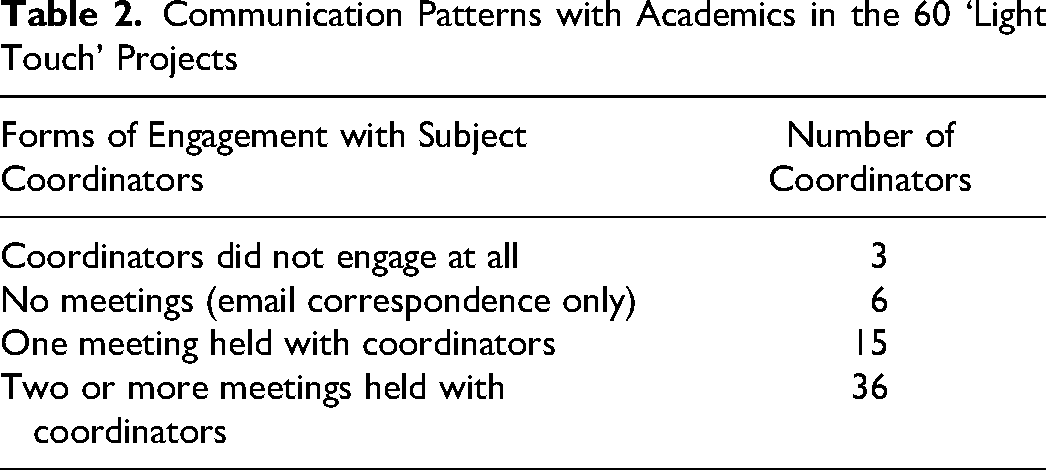
Examination of the microlevel of analysis has identified further ways in which our project practices were shaped by the site. An initial example is tailoring of practices according to our academic partners’ preferred ways of working and availability. For example, the final reports (LTPR–educational developers) from the ‘light touch’ projects showed how flexible the relationships have been. Across the 60 subjects we engaged with, we tailored how we meet and communicate with the academic partner according to their needs and preferred approaches (Table 2). This also impacted what we could discuss and how in-depth we went into design conversations and development.
Communication Patterns with Academics in the 60 ‘Light Touch’ Projects
Within the ‘light touch’ projects, there were some activities that were highly customized to our emerging understanding of the challenges and goals in specific subjects (LTPR, ‘light touch’ project design briefs [LTPDB]–educational developers, subject coordinators, learning designers). These included one-on-one consultations, showcases of educational innovations and technology tools, literature scans, subject-specific developments, and technology pilots. The project evaluation with the academics confirmed the value of these customizations, for example, the one-on-one consultations afforded advice on a variety of topics and issues, including use of videos, technology tools, assessment, and subject structure.
At the same time, a common set of core resources and activities were available for all academics participating in the ‘light touch’ projects (LTPDB–educational developers, subject coordinators, learning designers). These included a series of introductory and professional development workshops, an educational developer, and a learning designer supported by a media production team, a CLaS development checklist, Canvas Learning Management System templates, and online support and community spaces. These could still be used flexibly by the academics, for example, the CLaS development checklist provided a list of ideas for teaching and learning focus areas (such as improving lecture-recording quality and chunking content with active learning) and was used by some academics to select what they wanted to implement in their subjects while also giving them new ideas of what they could do.
Looking more broadly across the entire CLaS project, we have identified a diverse set of examples where the doings, sayings, and relatings in the subject projects have varied according to a specific situation within that project (LTPR, DTPU, DTPDB, PDR–educational developers, subject coordinators, learning designers). For example, the expertise, attitudes, and interests of the project team members influenced what goals and challenges were recognized and prioritized, what solutions were seen to be viable to adopt in that subject, and the distribution of leadership and ownership across the project team. The project artifacts and other scaffolds that were available at that time (including development checklists, quality assurance processes, welcome packs, introductory workshops, and end-of-project handover resources) also influenced the form of project practice. These artifacts and scaffolds were developed iteratively so later projects had access to more resources, which led to more efficient processes and smoother transitions into and out of the projects. Staff turnover and whether the academics and teaching team had ongoing roles with the subject in future semesters had implications on sustainability and how end-of-project academic training and handover were conducted.
The design interventions that were implemented in each project were shaped by a range of influences. The learning outcomes, disciplinary knowledge, and skills of each subject influenced the selection of teaching methods, as different pedagogical approaches made sense and had empirical support for their efficacy. Another influence was the characteristics of the students within that subject, as the student cohorts had varied patterns of educational, career, linguistic, and cultural backgrounds. The variance in student cohorts was particularly contrasting across undergraduate and postgraduate programs and across specializations such as marketing and business analytics. Designs were also shaped by the availability of educational technology tools and systems, and what stage of the system life cycle these were at (e.g., pilot versus nearing retirement).
It is also relevant to note that the project flexibility and customization had limits, with preset parameters on the scope and schedule of each ‘light touch’ engagement. Exception processes have been put in place to handle subjects that had needs outside these parameters, for example, applications with management approval could be made to cater for academics who are unexpectedly not available during the allocated time period or require additional learning design resourcing.
Codesign Projects Influence the Site Beyond the Project Scope
While design thinking revolves around a deep understanding of the needs of the people we design for, codesign is about building their capacity. It focuses on stakeholder learning and development so skills and capacity for innovation can be transferred well beyond the scope of the project and provide broader benefits to the site. This aspect can also be explored from the meso- and microlevels. Starting from the microlevel, weekly meetings among the educational developer, learning designer, and subject coordinator revolved around student-centered pedagogical approaches to curriculum design and how they can be implemented in the specific context of the subject using a variety of educational technologies. Evaluation interviews with the subject coordinators indicated that engagement with the codesign process and the regular meetings impacted their teaching practices. They reported implementing strategies that they learned from engaging with CLaS codesign projects and how they were later transferred to other subjects they taught. A subject coordinator for a large accounting subject with over 1,300 students stated that engaging with the codesign process helped them develop more “student-focused” approaches because they learned about “the module approach rather than just the recorded lectures” (DTSCI, subject coordinator 1). Another coordinator of the same subject stated that engaging with the codesign process was also an affirmation that they have “been doing some really, really good things in another” subject (DTSCI, subject coordinator 2).
At a mesolevel, previous engagement in the codesign process enabled one business discipline to implement the CLaS objectives in the design of a new subject without the need for going through the ‘deep touch’ development process with Business Co-Design. Another perspective of how codesigning is coupled to the site (i.e., is influenced by the site while also reshaping the site) is how, over time, we introduced and refined project scaffolds that support and help shape the codesign practices. Many scaffolds helped project teams with forming effective codesign relationships in the early stages, such as overview of the CLaS objectives, visual graph of team-member roles and responsibilities, and overview of key project activities such as the Connect:In workshop and evaluation. Still other scaffolds related to increasing efficiency of recurring activities (e.g., media style guides, production processes, learning design brief document templates). While these resources were available to all projects, they were optional and customizable allowing a negotiated and tailored approach and thus better fitting the needs of each codesign project. For example, educational developers tailored the ‘welcome pack’ for each new project, and evaluation plans were adjusted to fit the individual subject progress and research plans. Another example of a flexible scaffold was the checklist, which was used for generating agreement on the key foci for the subject development in ‘deep-touch’ and ‘light-touch’ subjects.
In addition to capacity building, codesign is about mutual learning. Sharing and reflection was an iterative process of design, development, and evaluation, which influenced the site. We learned new ways of relating by sharing knowings and doings with other team members. Each ‘deep touch’ subject/project in the CLaS initiative was assigned to a small codesign team consisting of an educational developer, a learning designer, a media developer, and an evaluation researcher. Each member of this codesign team assumed the ownership of their own tasks, which involved collaborating and reporting back to the four broad teams of educational developers, learning designers, media team, and evaluation. The nature of the codesign projects necessitated the sharing of know-how among the members of their multidisciplinary project team. For example, in a subject on creativity and analytics in business, the educational developer introduced object-based learning, which required students to visit the local on-campus museum (Wardak et al., 2021a). The subject required collaboration between the project team and a range of stakeholders, including the wider teaching team and the museum's academic curators. The development of new processes, strategies, tools, technologies, pedagogical approaches, and their associated philosophical underpinning created shared sociomaterial practices that were iteratively refined and leveraged by other subjects in the faculty. This peripheral spread of innovation meant that the project had an impact beyond its scope.
Reimagining Project Management Principles Through Codesign Practices
In this section we outline a series of principles for adopting codesign approaches within project managing. These principles were developed by reviewing findings and identifying patterns within our codesign practices that drew attention to ontological issues and forms of practice that are useful to consider when managing innovation projects. These principles are not intended to be prescriptive, but rather emphasize possible mindsets and conceptualizations of activity for project practitioners. While the focus of these principles is on projects involving codesign, we argue that they can inspire valuable ways of thinking and acting within other collaborative innovation projects. The principles focus on project managing as an emergent activity that is enacted through human-centered interaction and transformations, which is seen to be a core characteristic of innovation projects in general (Blomquist et al., 2010; Cicmil, et al., 2006).
Codesign, Practice, and Ontology
Principle 1: Looking at the intersection of codesigning and practices forms a valuable ontological mindset of project management in innovative contexts. Building on the project-as-practice approach, we note that shifting ontologies continues to highlight different aspects of project management, which supports the idea of projects as complex human enterprises. Being a catalyst for project practices, codesign prioritizes verbs that ‘hang together’ (Kemmis, 2022) and, consequently, enable and constrain project approaches and processes. Examining practices through verbs, which we coin ‘verbism,’ offers sociocultural and design-oriented opportunities to capture the doings, sayings, and relatings through which project managing in innovative contexts takes place.
Codesigning can enable a blending of project managing with the practices of the stakeholders, so the designs produced through the project are guided by ‘project management’ grounded within practitioner practice. Ontologically, this is neither a dedicated project that sits outside of normal organizational operations nor ongoing business-as-usual operations. Instead, it is a strategically resourced effort that seeks to improve quality from within the ongoing practices.
Designing and Learning-Oriented Mindset
Principle 2: A designing mindset should prioritize learning-oriented approaches, which are valuable for project managing with ill-structured goals, diverse stakeholders, and subjective measures of success. This mindset can be encouraged by ontologically considering projects in innovative contexts through codesign practices. Project managers and other team members who take a learning-oriented mindset will be able to maintain receptiveness to emerging understandings, design issues, and opportunities. This form of learning is described as professional becoming (Hager et al., 2012), where project stakeholders and practices change, evolve, and become (Gherardi, 2012). This mindset assists with not only facilitating codesign within innovation projects but also aligns with a focus on continuous professional development and learning.
Learning-oriented mindsets and professional becoming appear to be underrepresented within the field of project management (Hodgson & Cicmil, 2006). This study acknowledges the need to continuously build one’s own and shared principles and capacity in innovation projects. This applies to the project team, broader stakeholders, as well as the project artifacts and scaffolds. We concur with Enninga and van der Lugt (2016) that one of the imperatives for managing collaborative innovation projects is to develop team capability and consensus. In our projects this was done through development of codesign scaffolds that were improved over several iterations, and perhaps more importantly through sharing our experiences within and across the project teams.
Project-Site Interplay
Principle 3: Projects occur within contextualized sites, and project managing should involve consideration about both shaping and being shaped by these sites. The sites provide sociomaterial resources, and projects are undertaken by acting through these resources. Put differently, project practices are enabled and constrained by the practice architectures of the site and, over time, these practice architectures can be influenced and further developed to afford new ways for the projects in innovative contexts to progress. The resources that form the practice architecture can be understood within a site by considering the specific doings, sayings, and relatings that can be performed in a given project at that time.
Our analysis highlighted diverse ways in which our project practices were influenced and tailored to the project sites. For example, our doings were shaped by the allocation of team resources and availability of educational technology tools, sayings were shaped by the discipline knowledge within different subjects, and relatings were shaped by the size and assignment of roles within each subject academic team. At the same time, our practices have evolved as our understandings of how to do codesign have improved, new tools introduced, and additional project scaffolds have been developed. It is critical to recognize that projects can modify or contribute to the practice architecture. This is particularly relevant in situations where the understandings of the stakeholders are still developing and in longer projects, which allow the introduction of new ways of working that were initially infeasible.
Relatings
Principle 4: The role of relatings offers a fundamental lens on viewing project management as shared, social, and connected practices. Development of traditional projects often prioritizes a set of actions (doings) and orienting words (sayings) and, often unintentionally, leaves histories of relationships among people, groups, and organizations (relatings) less elaborated. Projects with complex, uncertain, and ill-structured problems may struggle to leverage doings and sayings without a link to relatings. Although doings, sayings, and relatings assisted the team with understanding codesigning practices, the scale of their importance differed. We noted that the clearer were the relatings in projects, the clearer were doings and sayings. Being complex social-political arrangements, relatings comprise social-cultural matters that allow (or constrain) trialing new social connection practices in innovative contexts. For example, it is important to provide means that allow quality codesign practices to emerge by providing project stakeholders with safe social spaces where they can learn, adopt, and become. We earlier discussed Connect:In workshops as an example of such social connection space where project stakeholders have time and space to relate. We also note that the use of the branch of practice theory championed by Kemmis (2022) allows a balanced analysis of project doings, sayings, and relatings.
Distributed Practices
Principle 5: Distributed practices are essential codesign project arrangements, which should contribute to a broader understanding of highly collaborative project management initiatives in innovative contexts. These typically involve collaborative practices, which comprise ‘co’ verbs, for example, coproducing, coleading, and co-owning. The distributed practice phenomenon at some level has been discussed in studies on distributed leadership, management, inter- and intrapersonal leadership (Müller et al., 2022; Müller et al., 2017); however, we argue that the integration of ‘verbism’ provides opportunities to discern codesigning practices as more than solely collaborative working with others. For example, we discussed Connect:In workshops as a space where project stakeholders are not only seen as being in the project, but importantly having a project. To have a social (project management) environment means to be in a situation in which one’s activities “are [meaningfully] associated with others” (Dewey, 1916, p. 15).
Implications and Conclusions
Examining codesigning within innovation projects through the lens of practice theory has allowed a reimagination of project managing. Five principles have been described to highlight and guide aspects of project managing practice in the following areas: (1) codesign, practice, and ontology; (2) designing and learning-oriented mindsets; (3) project-site interplay; (4) relatings; and (5) distributed practices.
Following a practitioner inquiry approach, we sought to identify the connections between project management theory and our own practice. We argue that these principles offer new ontological opportunities to consider and harness emergent, fluid, and collaborative practices of project managing.
Importantly, this article contributes to deepening understanding of how project management principles can be framed to guide practice in innovative and emergent projects, in which traditional principles may offer less utility (Hodgson & Cicmil, 2006). Sergi (2012) argues that when projects are seen as becoming rather than being, greater attention is directed to the activities of project management as they unfold in situation. Following this, ‘prescriptions’ in project management should be adapted to each context rather than simply considered as best practice. The principles derived in this article instantiate this ontological shift by providing guidance on valuable ways of thinking and acting when managing innovation projects that are characterized by emergence and collaboration.
The examination of our own practice responds to calls by Cicmil et al. (2006) and Geraldi and Söderlund (2018) for more research that illustrates and reflects on how projects are enacted. The article provides rich descriptions of practices as they occur in situ and assists others to consider how they might adapt and leverage these approaches to better match the characteristics of their projects and sites. The application of Kemmis’ (2022) practice theory to frame the analysis is novel within project management literature and allowed foregrounding of the doings, sayings, and relatings that constitute project managing practices and the site arrangements through which these take place. This helped us frame the principles from a project-as-practice perspective to highlight the importance of emergent understandings, the site, relations, and how project activity is distributed.
The analysis and reflection of our practice, and the principles distilled from this, support and extend prior literature on managing innovation projects. The educational projects we examined were a form of innovation project. In our context, design processes and mindsets were central to progressing the projects with greater flexibility than linear project phases and stage gates allowed (Lenfle, 2016; Mahmoud-Jouini et al., 2016). Furthermore, project managing required the creative alignment of approaches with the emerging goals and needs (Enninga & van der Lugt, 2016; Lippe & vom Brocke, 2016). Some of these goals were subjective and related to people’s values and personal experiences (Huff, 2016).
In addition, our projects had an emphasis on generating consensus and guiding group dynamics across a diversity of stakeholders and agendas (Enninga & van der Lugt, 2016; Lippe & vom Brocke, 2016). We have extended ideas of collaboration in projects to draw attention to the distribution of project managing practices across the project teams. Distributed practices are a core aspect of codesign and also provide ontological opportunities to examine and design more flexible team structures in other forms of highly collaborative projects, for example, projects that are managed from ‘weak’ (Lippe & vom Brocke, 2016), decentered (Reich & Lizier, 2023), and socialized (Whyte et al., 2022) management positions. Furthermore, the codesign practices examined in this article demonstrate a way of blending projects into existing stakeholder practices, so stakeholders can cocontribute and coparticipate in a project rather than just be present in one. In our context, this facilitated stakeholder buy-in and sustainability of project outcomes.
We do not claim that codesign is a viable approach for all projects, but instead seek to highlight aspects of project managing that are more evident in codesign and may deepen consideration of possibilities and options in other project approaches. We encourage researchers and practitioners to consider how these principles may influence project managing in other project contexts, and how the principles derived from codesign in this article correspond to principles associated with other practice-oriented project managing approaches. Future research in project management can explore the extent to which project management principles link to codesign practices that are inclusive, participative, value lived experience, and empower stakeholders.
Footnotes
Declaration of Conflicting Interests
The author(s) declared no potential conflicts of interest with respect to the research, authorship, and/or publication of this article.
Funding
The author(s) received no financial support for the research, authorship, and/or publication of this article.
