




Abstract
This article maps the contributions project scholars can make in management journals. Research on projects cuts across disciplinary boundaries, with scholars working in institutions with different norms, epistemologies, rewards, and selection environments. But this diversity can make it hard to know where to publish. We hope our map of the publication landscape—the “V diagram”—will help project scholars better understand and respect one another’s diverse contributions and make conversations across the field flourish.
Introduction
This thoughtlet outlines a new way of thinking about the types of contributions project scholars make within the wider world of management journals. We distill our thinking into a framework that outlines a stylized universe of possible contributions to knowledge that might be made, ranging from “grand theory” through to the “minor working hypotheses of everyday life” (Glaser & Strauss, 1967), which we map back to journal missions. Research on projects cuts across disciplinary boundaries with scholars working in a variety of institutions with different norms, epistemologies, rewards, and selection environments. This diversity makes project studies an exciting field to be in. Few other fields have such an expansive universe of possible conversations to join, ranging from the philosophical and theoretical through to the empirical and practical. However, this very diversity can make it hard to know where to publish as well as generate difficulty understanding, appreciating, and valuing the contributions made to knowledge across the field. We hope that by making explicit the otherwise “hidden curriculum” motivating why and where project scholars strive to publish their research, we might help project scholars better understand and respect one another’s diverse contributions and enable the broader field to thrive.
Mapping the Publication Landscape
Over the past decade, Andrew Davies has been developing a map of the publication landscape, illustrated by a “V-shaped” diagram (see Figure 1). This map was designed to help his doctoral students understand the universe of possible contributions they might make to knowledge and how these contributions mapped back to the world of journals publishing research on projects. He was surprised by how much these students, and later more senior colleagues, valued having a map of this landscape—a reaction that suggested he might be on to something useful. The map was appreciated not only because it helped scholars make sense of the trade-offs involved in publishing research, but because it offered a lens to better understand the often confusing, sometimes contradictory, occasionally frightening publication advice offered by colleagues (e.g., “your work is only valuable if you publish in a highly ranked management journal” or “you can’t contribute to project management by publishing in highly ranked management journals”). After discussing the ideas over many years with Sam MacAulay, Sam invited Andrew to present the idea to a symposium on publishing project management research organized by the University of Technology Sydney (UTS) in November 2018. Since then, both authors have moved on to work at other institutions, which encouraged them to think once more about where and why to publish their research. We then brought this experience together to refine the “V Diagram” and write the current article. Illustrated by our observations of key publications in the field and own research, the map of the project publication landscape identifies the portfolio of possible contributions a scholar (and higher levels of analysis, e.g., department, field, etc.) can make by publishing articles in various academic and professional journals.
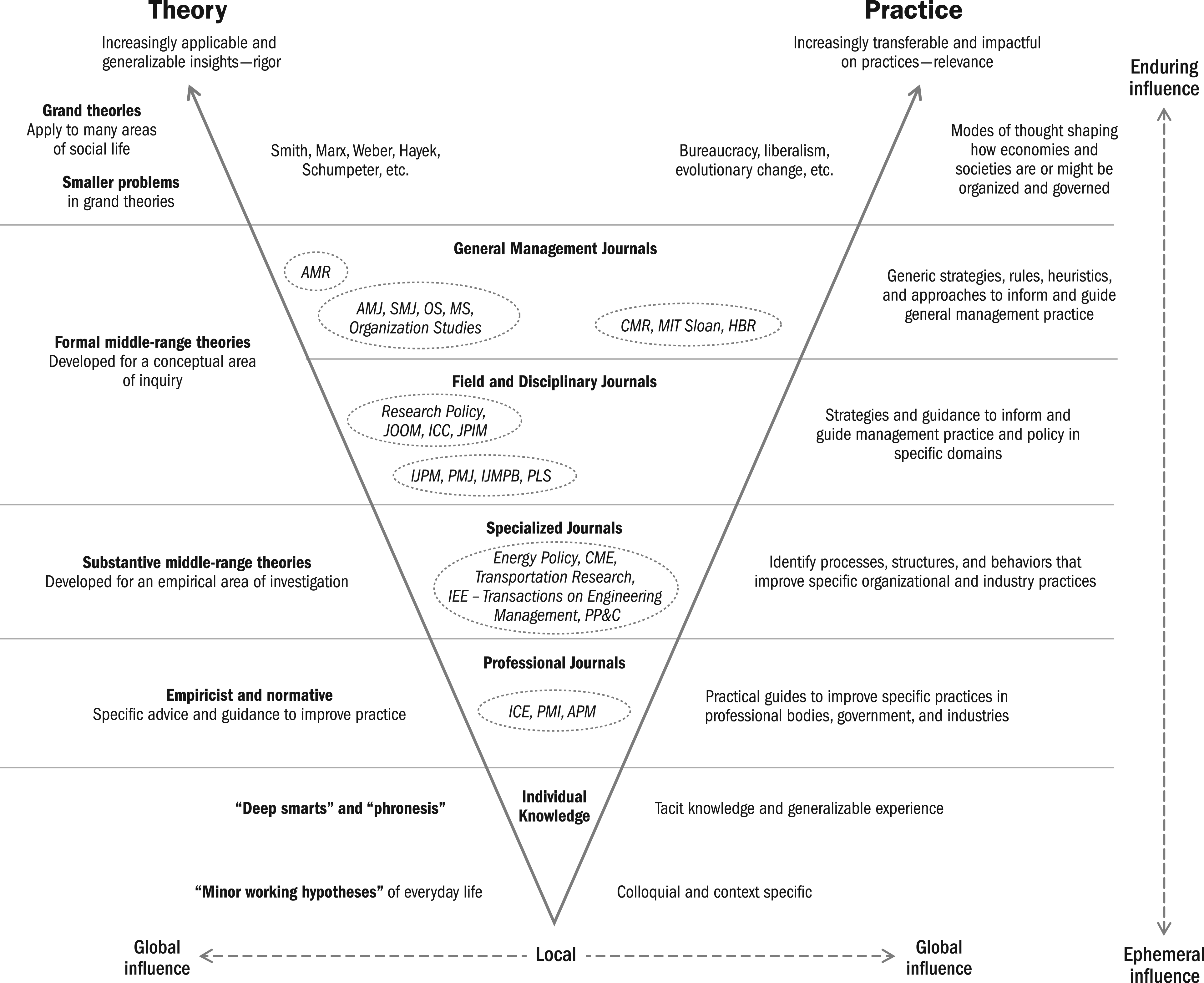
The publication landscape.
The variety of journals in the publication landscape is demarcated by two dimensions: one identifies the increasing theoretical significance and the other the practical reach of the research. The vertical direction of the arrow on the left side of the publication landscape depicts the increasing degree of theoretical orientation of different journals. 1 The arrow on the right side shows how research can have an increasing impact on practice in a variety of settings, organizations, and industries. Journals that emphasize the importance of theoretical novelty tend to value conceptual “rigor” on the left side, whereas those that demand that research is transferable to practice tend to emphasize practical “relevance” on the right side. Some journals seek to find a balance between rigor and relevance by requiring research to be substantially novel while impacting significantly on practice. We use these dimensions to create what we describe as a publication landscape shown in Figure 1 which is illustrated by some of the journals discussed below. The dotted arrows characterize the impact that knowledge can have and the degree to which it persists over time.
From Grand Theory to Practical Wisdom
Some theoretical contributions are more generalizable and applicable to a variety of contexts than others. To give an indication of the depth and extent of a theoretical contribution, those located higher up the left side of the publication map are considered more generalizable. Grand theories developed by classical scholars and world-renowned intellectuals that apply to many areas of social life appear at the top of the theoretical dimension, whereas “minor hypotheses of everyday life” (Glaser & Strauss,1967) and individual knowledge are located at the bottom. Some of the grand narratives that have created entire worldviews and shaped our thinking about how society is or might be organized include Adam Smith’s division of labor, Karl Marx’s theory of capital accumulation, Friedrich Hayek’s free market, and Joseph Schumpeter’s creative destruction.
While very few scholars develop entirely new paradigms with a far-reaching impact that fundamentally changes how we think about and organize the world around us, many do work on smaller problems within grand theories where they challenge and extend existing propositions, develop new theory, and provide new empirical evidence to support a particular line of thought. The sociologist Anthony Giddens, for example, developed his theory of structuration (Giddens, 1986), which is frequently used by management scholars (e.g., Feldman & Pentland, 2003), by critically engaging with leading 19th-century and 20th- century social theorists such as Comte, Marx, Weber, Durkheim, Habermas, and Bourdieu.
It is also important to recognize the value of individual knowledge in the bottom section of the publication landscape. There is a considerable difference, however, between an individual’s colloquial knowledge with little or no applicability beyond a specific localized context and the wisdom that some individuals acquire over many years through their professional development, tacit knowledge, and practical experience. Whereas individual knowledge is often highly localized in application, more experienced managers may have far-reaching influence across projects and organizations in an industry. Sometimes called “deep smarts” (Leonard-Barton & Swap, 2005) or “phronesis” (Flyvbjerg & Gardner, 2023), such practical wisdom enables leaders of projects and organizations to understand what needs to be done and how to do it. Under the right conditions, the intuitive judgment of experts is highly reliable. Occasionally, the tacit knowledge and experience of experts are codified and used to inform practice in many project organizations and contexts. 2
Publishing Middle-Range Theory
The middle two levels down are formal and substantive “middle-range theories” (Glaser & Strauss, 1967; see also Merton, 1968). This is where scholars publish most of their theoretical research on projects in management journals.
Formal middle-range theories are developed for a conceptual area of inquiry and applicable to a wide variety of contexts. A formal theoretical contribution may fill a gap in prior knowledge or challenge existing assumptions (Alvesson & Sandberg, 2013), leading to new conceptual insights, frameworks, or novel theories. This is where the most significant theoretical contributions in management research are located, ranging from entire theories for understanding the organization and management of firms and industries to smaller contributions within a given theory. Edith Penrose (1959), for example, developed a theory of firm growth, which laid the foundations for the hugely influential resource-based view (Barney, 1991) and dynamic capabilities (Teece et al., 1997) perspectives on innovation and strategy. Richard Nelson and Sidney Winter (1982) established an evolutionary view of economic change, which inspired a generation of management scholars to study the variation, selection, and retention of organizational routines. Lundin and Söderholm (1995), in one of the most frequently cited and groundbreaking theoretical articles on projects, conceived projects as temporary organizations, a contribution that can be thought of at this level.
General management journals situated on the left side of the formal middle-range theory category include a range of so-called “big tent” journals (e.g., Academy of Management Review [AMR], Academy of Management Journal [AMJ], Administrative Science Quarterly [ASQ], Strategic Management Journal [SMJ], Organization Science [OS], and Management Science [MS]). They are deemed to be general management because none of these journals is tied to a particular sub-discipline such as technology and innovation management, entrepreneurship, or operations management. 3 While some of big tent journals are purely conceptual (e.g., AMR), most seek to publish articles that contribute to knowledge by extending, testing, or building theory based on strong empirical data with significant implications for managerial practice (e.g., AMJ and OS). Publishing in these journals entails a concomitant investment to keep abreast of a broad and fast-moving research frontier. Scholars need to be acquainted not just with the published research, but also the latest thinking about specific theoretical conversations going on in various domains, which involves attending affiliated conferences, symposia, and workshops.
Although leading management scholars have long emphasized that projects are a flexible, dynamic, and post-bureaucratic form of organization for dealing with uncertainty and rapidly changing conditions (e.g., Mintzberg, 1979; Kellogg et al., 2006; Edmondson, 2012; Obstfeld, 2012), we have seen only a few articles in big tent journals where projects take center stage in the theoretical contribution (see also, Locatelli et al., 2023). Research on projects that does get published in these journals is highly valued, because such articles can shape our thinking about the subject and have a profound influence on the wider management discipline such as the articles in Management Science by Shenhar (2001) and Pich et al. (2002). However, research published in these journals typically treats projects as a setting (e.g., they are often discussed in the methods section of articles) from which to build or test theory. Ross and Staw’s (1986) article in ASQ is a good, early example of how to build a theory (escalation of commitment) applicable to many contexts through an in-depth analysis of a single project (Expo 86 in Vancouver). While Organization Studies is not universally considered to have as broad a purview when it comes to contributions to management, it does aim at middle-range theory and has a strong track record of publishing research on projects, including important articles (e.g., Van Marrewijk et al., 2016) and two special issues on the topic (Sydow et al., 2004; Bakker et al., 2016).
At the level below—but still within the broad category of formal middle-range theories—are journals more narrowly tied to a particular field that occasionally publish important research on projects, 4 such as innovation studies (e.g., Research Policy, Journal of Product Innovation Management [JPIM], and Industrial and Corporate Change [ICC]) or a particular subdiscipline of general management such as operations management (e.g., Journal of Operations Management [JOOM]). The Journal of Operations Management created a new department for “Innovation and Project Management” in 2019 in recognition of the growing importance of project management and one of its neighboring disciplines (Mishra & Browning, 2020).
Most research on projects is published in journals focusing on the development of project management as a discipline such as IJPM, PMJ, International Journal of Managing Projects in Business (IJMPB), and Project Leadership and Society (PLS). Over the past decade, research published in project management journals has aimed to make theoretical contributions to the project management literature and most articles published, while important for advancement of the discipline, do not usually seek to generalize beyond an application to projects and project-based organizations and industries. In the case of PMJ, for example, there has been a deliberate strategy to move the journal toward the theory side of the publication landscape (Müller & Klein, 2018), no longer sending out purely empirical contributions for review, and prioritizing the publication of research that is theoretically motivated and methodologically robust.
Changes such as these signal a growing interest in efforts to engage across disciplines and build knowledge that generalizes beyond the discipline of project management. Most recently, scholars have proposed a manifesto for project management research that argues that the discipline could be significantly enhanced by building stronger connections with overlapping and cognate disciplines in management, social sciences, and engineering (Locatelli et al., 2023). Some scholars go further, encouraging researchers to shift attention from project management as a discipline to focus on the multidisciplinary field of “project studies” (Geraldi & Söderlund, 2018). By importing and cross-fertilizing ideas, frameworks, and concepts from other disciplines (e.g., innovation studies and institutional theory) (Davies et al., 2018; Davies et al., 2023; Biesenthal et al., 2018), project studies researchers might build theories both specific to projects and temporary organizations and more widely generalizable to other organizations, contexts, and the grand challenges (e.g., climate change and the next pandemic) facing societies in the 21st century.
Journals focused on addressing a specific field, rather than a particular discipline, are typically multidisciplinary in scope. For example, Research Policy is a multidisciplinary journal in the field known as “innovation studies.” Journals tied to a discipline, by contrast, tend to be more confined to a particular domain of knowledge (e.g., Journal of Operations Management). While most of these journals value contributions to broadly generalizable theory, they also welcome contributions that improve our understanding of a new empirical domain with strong practical implications for management and policy such as research on project-based organizations published in Research Policy (Hobday, 2000; Gann & Salter, 2000; Manning, 2018; Lobo & Whyte, 2017; Tee et al., 2018; Lenfle & Söderlund, 2022).
Substantive middle-range theories—at the next level down in the publication landscape—are developed for an empirical area of investigation (Glaser & Strauss, 1967), and the boundary between a theoretical and practical empirical contribution starts to become increasingly blurry and indistinct. For example, Energy Policy is not defined in terms of a subdiscipline or field, but rather as a journal that is focused on a particularly empirical domain: the policy implications of energy supply and use from their economic, social, planning, and environmental aspects. Some journals in this category focus on research with implications for practice in a particular discipline. For example, Production Planning & Control (PP&C) clarifies that it publishes research that addresses industrial needs and guides the activities of managers in all industries, and that it is not an appropriate journal for theoretical papers in operations research. Other journals are more explicit about encouraging contributions from multiple disciplines to advance knowledge about a specific empirical domain. For example, IEEE Transactions on Engineering Management publishes research on projects across engineering organizations, Journal of Management in Engineering has articles on project management in civil engineering, and Construction Management and Economics (CME) publishes research from a variety of disciplines to develop theoretical, methodological, and empirical advances in our understanding of the management and economics of the construction industry and built environment. A large body of research on the management and policy implications of projects in specific industries appears in specialized journals such as CME, PP&C, IEEE Transactions on Engineering Management, and Energy Policy (e.g., Sainati et al., 2019).
Publishing for Practitioner Audiences
Professional journals are located at the next level down. While these peer-reviewed journals may be connected to a particular discipline (e.g., civil engineering, architecture, or materials science) or professional practice (e.g., project management), they have no explicit interest in contributing to theory and are usually defined by their association with a particular institution, such as the Institution of Civil Engineers (ICE), or professional bodies such as the Association for Project Management (APM). For example, the APM publishes the quarterly Project Journal, which is widely read by UK project management practitioners. Professional journals are focused on publishing research and lessons learned about significant practices, technologies, policies, and impactful case studies available in an accessible format to be read by professional practitioners and highly specialized researchers.
The increasing degree of practical impact is illustrated by the vertical arrow on the right side of the publication landscape. As we have seen, professional journals are entirely practical in orientation, and substantive field journals tend to value the practical implications of the research for a particular empirical setting as much as any conceptual development of the subject. In recent years, journals, such as PMJ and IJPM, have shifted from a more substantive agenda (e.g., describing project management bodies of knowledge or new tools and techniques) to place greater emphasis on the theoretical contribution of research.
The clearest distinction between theoretically motivated and practitioner-oriented journals applies to the formal middle-range theory category of journals. As indicated on the right side of the publication landscape, some management journals—such as Harvard Business Review (HBR), MIT Sloan Management Review (MIT Sloan), and California Management Review (CMR)—are explicitly focused on publishing research to keep managers informed about the latest developments and change how organizations do things. Often, theoretically motivated articles published in big tent journals (on the left side of the publication landscape) are translated into an accessible format to inform practice (on the right side of the publication landscape). Ross and Staw’s (1986) work in ASQ on escalating commitment discussed earlier, for example, was redeveloped for HBR to reach a large audience of practitioners. Successfully translating this work is often challenging because you need to have knowledge about not just the conversations going on in academia but also those happening in practice. For example, compare the different conversations on managing R&D projects discussed in Ross et al.’s (2018) article in Strategic Entrepreneurship Journal with Ross and Fisch’s (2018) translation article in MIT Sloan. Projects aren’t even mentioned in the MIT Sloan paper, because the focus has been elevated to strategic decision-making.
Research in practitioner journals is translated, often with the assistance of specialized editors, into interesting, relevant, and accessible language for practicing managers and other professionals. However, there are important differences between this category of journals, as indicated in Figure 1. HBR is located on the right side (close to practice) because it is singularly focused on disseminating knowledge to a large audience of practitioners. For example, HBR recently devoted almost an entire issue to the rise of the “project economy” and the impact of project management on management practice (Nieto-Rodriguez, 2021). In contrast, CMR is located slightly to the left (closer to theory) as it publishes theoretically informed, peer-reviewed research aimed at academics but with implications for practitioners (e.g., Gil & Beckman, 2009). MIT Sloan sits somewhere between the two. MIT Sloan also publishes peer-reviewed research but is perhaps more focused than CMR on influencing and changing management practice.
Publishing a Portfolio
Thinking about the contributions our research makes as a portfolio of publications that exist on the publication landscape has not only helped us make sense of our own work but has improved our ability to communicate our aims to others. To illustrate how this works for projects, we briefly discuss our research on London’s project to build the “Elizabeth Line” urban railway project (“Crossrail”), which opened for service in 2022. Our research with Crossrail enabled us to make contributions via publication in almost all areas of the landscape, including general management practice, middle-range, specialized and professional journals. Interestingly, although the research was not designed to lead to a publication in one of the general management journals, it did reveal an insight into unconventional ways of protecting innovations that went on to help inspire a theory published in one of these journals (Sharapov & MacAulay, 2022).
Our research on Crossrail and some of London’s other large infrastructure projects appeared as an article on simple rules for innovation in large, complex projects in MIT Sloan (Davies et al., 2017). Guided by an editorial strategy, articles in MIT Sloan are carefully segmented depending on the reach and transferability of research, ranging from ideas with universal applicability to more specialized contexts (e.g., megaprojects). It is, therefore, important to be cognizant of how to frame research on projects when preparing submissions for such a broad audience. We had an interesting and illuminating email dialogue with the editors concerning the purpose and length of our article, which taught us a lot about how the editors thought about the contribution being made by project management. Originally, we submitted what was to be a full-length, 5,000-word article with the word “megaprojects” in the title, which was accepted for publication. After a peer-review process, however, the editor came back and agreed to publish a short research article of around 2,000 words, because they had decided that an article on megaprojects would not be sufficiently interesting for a large proportion of their readership. After some negotiation, we finally reached a compromise on a 3,000-word article on the basis that we change the title and one or two sentences to address not “megaprojects” but rather “large, complex projects,” which the editor believed would resonate more strongly with a larger number of their readers.
While the MIT Sloan article was developed to maximize the breadth of impact our research had, our other articles on Crossrail were designed to target more specialized audiences. We found that PMJ was an incredibly valuable journal to inform project management scholars about our action research with Crossrail. Coauthored with two practitioners on Crossrail, the article describes the research undertaken to cocreate the world’s first innovation program for a megaproject (Davies et al., 2014). The resulting framework for studying windows of opportunity for innovation in megaprojects is frequently used for executive education teaching and practice. Our article in Transportation Research Part A: Policy and Practice was written to build a bridge with a neighboring field of scholars interested in the empirical domain of railway transportation (Dodgson et al., 2015). Our article in Proceedings of the Institution of Civil Engineers: Civil Engineering was written with and for practitioners involved in UK infrastructure projects, rather than an academic audience. It systematically explains how we set up the Crossrail innovation strategy, which has been used by managers of other major infrastructure projects establishing their own innovation programs (DeBarro et al., 2015).
In contrast to these deliberately designed contributions to knowledge, the theory article published in AMR by Sharapov and MacAulay (2022) was more emergent. Sharapov and MacAulay had commenced work on their theory while MacAulay was in the field at Crossrail. While there, MacAulay learned of a tunnel boring machine (TBM) being launched behind a curtain to obscure the process innovation used. The curtain enabled the TBM to be launched without revealing the process innovation to rivals who might be observing the site. As Sharapov and MacAulay’s explanation for how inventors could use design choices to isolate their innovations from imitation became increasingly generalized, this story and the project context became unimportant to the final article. However, the story shows how one can take an empirical observation from within that same project setting and generalize it to a broad audience of management scholars.
Final Thoughts
We recognize that scholars’ disciplinary backgrounds, personal ambitions, motivations, norms, values, and the incentives of their current institutional affiliations play key roles in determining where they publish research on projects. What makes the situation even more complicated is that some scholars—as both authors have done—will work in various institutions and may even switch back and forth over time from disciplinary focus in project management to general management or another neighboring field (e.g., innovation studies). We have found that researchers often know a great deal about one area of the publication landscape but much less about the contributions being made in other areas. We hope that our map of the publication landscape enables scholars to better appreciate the distinct contributions other researchers seek to make and what drives them to do so. With this understanding in place, we hope to see new conversations across the field flourish.
Footnotes
Acknowledgments
We thank Giorgio Locatelli, Ralf Müller, and Stewart Clegg for their comments and suggestions on an earlier version of this thoughtlet. Previous versions of the publication landscape were discussed at length with Andrew Davies’s doctoral students at UCL and in research seminars at UCL, UTS, University of Sussex Business School, BI Norwegian Business School, and the University of Queensland. Professor Davies acknowledges the generous support of University of Queensland’s Sustainable Infrastructure Research Hub Visiting Academic Fellows Program.
Declaration of Conflicting Interests
The author(s) declared no potential conflicts of interest with respect to the research, authorship, and/or publication of this article.
Funding
The author(s) received no financial support for the research, authorship, and/or publication of this article.
