




Abstract
Social procurement can increase social sustainability by creating employment for marginalized people. This article investigates how project organizations perceive and handle the resources from and relationships with their main contractors and clients when implementing social procurement. Analyzing 20 semistructured interviews with actors working in Swedish construction projects, the findings show how resources are lacking and relationships are tenuous, but also that the innovative capacity of actors at the project level, in a bottom-up fashion, can overcome some of these issues. This article shows how sustainability initiatives are difficult to implement in projects, and what strategies actors use to cope.
Keywords
Introduction
The imperatives of sustainability can in many ways be contradictory to those of projects, as projects are temporary and sustainability is, by definition, long-lasting (Huemann & Silvius, 2017; Sabini & Alderman, 2021). Until recently, the literature on sustainability has often been separated from the literature on project management, which indicates that sustainability and project management should now be considered as more connected both in practice and in research (Aarseth et al., 2017; Goel et al., 2020). To that end, Huemann and Silvius (2017) call for more studies on integrating sustainability concepts into project management processes, and Aarseth et al. (2017) urge further research on strategies to increase project sustainability—especially for complex projects with strong institutional forces such as in the construction sector (Dubois & Gadde, 2002).
The separation between project management and sustainability is especially noticeable when it comes to social sustainability (Goel et al., 2020; Huemann & Silvius, 2017; Sabini et al., 2019). From a project perspective, social sustainability has not been as extensively addressed as the other pillars of sustainability (environmental and financial) and therefore needs more attention (Wang et al., 2018). Understanding the role of social sustainability in projects contributes to a wider understanding of sustainability in general.
An empirical phenomenon that combines social sustainability and project management in a complex environment is social procurement in construction projects. Social procurement can be defined as “the acquisition of a range of assets and services, with the aim of intentionally creating social outcomes” (Furneaux & Barraket, 2014, p. 269) and is a way for organizations to use their purchasing power to achieve social goals and values that lie outside their normal procurement objectives (Barraket et al., 2016; Raiden et al., 2019). Social procurement includes practices that aim to increase social value. Examples of such value-creating activities includes practices, such as buying from local, small and medium-sized enterprises and minority-owned businesses; ensuring health and safety and fair working conditions; and employment of marginalized groups (Lind & Mjörnell, 2015; Loosemore, 2016; Raiden et al., 2019). In practice, social procurement activities aimed at the employment of vulnerable groups has been one of the main priorities of social procurement (McCrudden, 2004; Raiden et al., 2019; Troje, 2020). A reason for why the main practical operationalization of social procurement has been employment creation is because it can be used as a tool to mitigate the negative effects of major societal issues like mass migration, fiscal constraints, and increasing segregation (Barraket et al., 2016). Employment creation is thus a very important aspect of social procurement, which can provide insight into wider society-level social sustainability challenges and be a way to practically increase social sustainability in a project environment. Therefore, social procurement used in an employment-generating capacity is the specific empirical phenomenon in focus in this article. In an effort to integrate research on social sustainability and project management, this article explores social procurement in Swedish construction projects. The question posed in this article is: How do project organizations perceive and handle the resources from, and relationships with, their main contractors and clients when implementing social procurement?
The article builds on a qualitative interview study of three Swedish construction and maintenance projects that used social procurement to create employment opportunities for disadvantaged people, and focuses on the project-level actors who work with social procurement in addition to their usual construction and facilities maintenance tasks. The article begins with a presentation of the previous research on social procurement. Then literature pertaining to project management, which is used to analyze the findings, is presented. The reviewed project management literature focuses especially on research pertaining to resources, relationships, and strategies to increase sustainability and overcome problems in the project environment. Then follows the method section, which provides background on how the study was designed and conducted, and how the project management literature was chosen and used. Then, the findings from the study are presented, followed by the discussion and concluding remarks.
Frame of Reference
Basics of Social Procurement
Social procurement is being increasingly used worldwide, but has not yet developed into an institutionalized practice (Barraket et al., 2016; Troje & Andersson, 2020). Social procurement is used in many countries, such as the United Kingdom and Australia, and another country that has increasingly used social procurement in the last five years is Sweden. Sweden has mainly used social procurement to reduce the social exclusion and unemployment of people who are young, have disabilities, or are newly immigrated. This usually entails offering internships to these target groups as they are often underrepresented and stigmatized in the labor market (Lind & Mjörnell, 2015).
Historically, the construction sector is one of the main sectors where social procurement has been used, due to its close ties with communities and where people work and live. Therefore, the sector is widely seen as suitable for social procurement to create employment (Almamoud & Dolhoi, 2015; Lind & Mjörnell, 2015). With that said, social procurement is still relatively unexamined theoretically and empirically (Barraket et al., 2016; Loosemore, 2016; Raiden et al., 2019). As such, despite social procurement having the potential to create social value for organizations and society, such as providing a new workforce and mitigating unemployment and social exclusion, the idea of using it to generate employment is still novel in Sweden (and many other countries), so there is no best practice. Organizations in the construction sector are experimenting with different methods to implement social procurement employment initiatives, but these are in need of further development (Raiden et al., 2019; Troje & Andersson, 2020).
Social Procurement in Projects
One aspect of this field that needs more attention is the relationships among the organizations that work together with social procurement in projects. There are three main types of organizations involved in the implementation of social procurement: (1) the client that adds a social dimension to their procurement (permanent organization); (2) the main contractor company that tenders for and pledges to fulfill the contract and the social criteria (permanent organization); and (3) the project-level organization (employees of the main contractor, client representatives, subcontractors, and so forth, working on an operational project level) that completes the project and implements social procurement practices (temporary organization). The client and main contractor therefore have a large role to play in organizing, steering, and allocating resources so social procurement can be implemented on the project level.
In a project environment where multiple organizations must come together and collaborate, there can be tensions among them. The project organization is dependent on its main contractor and client in order to fulfill project goals, for example, securing the proper resources, staff, time, and knowledge (Jensen et al., 2006). This is especially true for projects using social procurement, where practices are not institutionalized or widely known, and there is a lack of clarity over how the different types of organizations will collaborate and work with social procurement (Barraket et al., 2016; Loosemore et al., 2019; Troje & Anderson, 2020). By studying the empirical phenomenon of social procurement, the relationship project organizations have with their main contractor and client can be better understood, and insight can be gained into the wider context of project management. It is also important to investigate social procurement to ensure that it produces the maximum social value possible, which is currently not the case.
When it comes to construction projects, the characteristics and organization of the sector are not always conducive to implementing socially sustainable initiatives like social procurement. Whereas construction is largely characterized by standardization and efficiency in time, cost, and scope (Dubois & Gadde, 2002), social procurement embeds institutional logics focused on social value unrelated to the end product (i.e., the actual building) and lies outside of contractors’ area of expertise (Erridge, 2007; Loosemore, 2016; Murphy & Eadie, 2019). The lack of understanding of how the sector can effectively contribute to social procurement is problematic. Future construction tendering will very likely use social procurement for projects, and considerations like employment requirements are especially important due to the construction sector’s vast employment expanse (Loosemore, 2016). Therefore, an examination of how actors organize and work with social procurement is important for organizations, sectors, and societies wanting to increase social sustainability.
Implementing social procurement to generate employment requires multiple organizations to come together and collaborate in new ways, which has consequences for their practices and relationships. Although previous research on social procurement used in an employment-generating capacity shows that social procurement has the potential to increase trust, collaboration, and knowledge sharing between organizations, trust and collaboration are often not prioritized in practice, which in turn can diminish social value (Erridge, 2007; Barraket et al., 2016; Troje & Gluch, 2020). Furthermore, social procurement is not seen as a core business. It is perceived to require more resources from projects and lacks government support (Erridge, 2007; Eadie & Rafferty, 2014; Loosemore, 2016; Murphy & Eadie, 2019).
Objectives Guiding the Study
As mentioned in the introduction, the purpose of the article is to investigate how project organizations perceive the resources from and relationships with their main contractors and clients when implementing social procurement. Based on what we already know about social procurement, in order to fulfill this purpose, the article has the following objectives:
To understand how resource provisions from their main contractors and clients impact project organizations’ work with social procurement. To understand how relationships with their main contractors and clients impact project organizations’ work with social procurement. To understand the strategies project-level actors use to handle their work with social procurement, cope with constraints in resources and relationships, and increase social sustainability in projects.
It is important to investigate social procurement from a project perspective for several reasons. First, although literature that studies (social) sustainability and project management has increased in the last 10 to 15 years (Huemann & Silvius, 2017), the research field is under development and deserves more attention as it is still fragmented. This is especially true in terms of the social dimension of sustainability and project management, where several authors have made calls for more research (Aarseth et al., 2017; Goel et al., 2020; Huemann & Silvius, 2017; Sabini et al., 2019). Second, research on social procurement is still emerging, and social procurement practices are not yet widely institutionalized, thereby suggesting a need for further investigation (Barraket et al., 2016; Raiden et al., 2019; Troje & Andersson, 2020). Last, social procurement is an emerging social practice in Sweden, and this study enables a real-time view of how an up-and-coming social practice can be integrated into a project setting. This study also includes a bottom-up perspective of what this means for the actors at the project level. This can, in turn, create a better base on which to build an effective and efficient practice that increases social sustainability—something that has been called for in previous research (Goel et al., 2020). So, considering what we know about social procurement implementation in projects, and the fact that (social) sustainability and project management has long been a fragmented field of study, reviewing the literature on project management is helpful.
Project Management and Sustainability
This article focuses on social sustainability in a project management context. Therefore, reviewing literature on project management is important in order to (1) understand and contrast the empirical findings of the study, (2) elevate the empirical results to a more conceptual and theoretical plane, and (3) make wider contributions and anchor into the wider research debate on (social) sustainability and project management.
This section outlines literature on (1) sustainability from a project management perspective, (2) the resources necessary for projects to fulfill project goals (such as implementing sustainable concepts like social procurement), (3) the relationships projects have with their clients and main contractors that dictate the resources provided to the project and influence implementation practices, and (4) the strategies projects can use to overcome shortcomings in resources and relationships and to implement sustainable practices (such as social procurement). The section finishes with a brief summary of the literature that is used to analyze the empirical findings.
Sustainability From a Project Management Perspective
In their literature review, Sabini et al. (2019) identify three research streams and contributions to sustainable project management: (1) why sustainability is valuable and adopted into projects, (2) the characteristics of sustainable project management and how sustainability impacts traditional project practices, and (3) how sustainability can be achieved and embedded within project practices. This article mainly contributes to the second and third research streams. Project management plays an important part in increasing sustainability, where both the project life cycle and the life cycle of the end product must be considered. This means that there is a distinction between projects delivered using sustainable project practices, and projects that deliver a sustainable end product (Huemann & Silvius, 2017). This article focuses on the former, in other words, sustainable project practices in the form of social procurement for employment creation.
Working with sustainability in a project context can be very complex. Sustainability is multifaceted and embeds different (and sometimes conflicting) objectives and interdependencies between actors at different levels (Sabini et al., 2019). Zuofa and Ochieng (2016) report that construction project actors perceive sustainability as costly and that knowledge and support on how to implement sustainability in construction projects are lacking. Implementation of sustainability in project practices may also require organizations to change their core values and routines, including decision-making, competencies needed, motivation, trade-offs between objectives, and balancing long-term perspectives (Sabini et al., 2019).
With that said, Herazo et al. (2012) assert that working with sustainability in projects can bridge the gap between the strategic and operational levels of construction projects, as well as increase knowledge management and collaboration between them. This means that there is considerable potential to create social value between the actors in the project environment, but it is important to investigate how this can be done in practice. Studying the resources, relationships, and strategies of project actors is one way of better understanding the practical application of sustainability in a project context.
Resources in Projects
Project organizing can be described as organizations and/or individuals coming together to deliver a certain outcome (Winch, 2014), with the client bringing financial resources and the main contractor bringing managerial and technical skills. Projects are often dependent on clients and main contractors to provide resources, such as trust, time, money, or knowledge (Jensen et al., 2006), with the knowledge and experience of key individuals within the client organization and main contractor being especially important. Having a shared arena for exchanging knowledge and experience enables project members to feel informed and facilitates integrating practices into projects (Pettersen Buvik & Rolfsen, 2015). Artifacts, such as documents, routines, and effective knowledge-transfer practices, are thereby important resources for projects (Wei & Miraglia, 2017).
It is common for resources in projects to be limited and this causes tensions for the project actors. Sabini and Alderman (2021), in their study on how project managers experience tensions between different sustainability goals, find that organizational factors like financial constraints, as well as a lack of knowledge and institutional support, are barriers toward more sustainable practices. A lack of human resources is also a major problem for projects, as workers are usually stretched over several projects, leading to work overload. It could also be that the organization is bad at managing their human resources (Winch, 2014). In general, more attention needs to be paid to social sustainability for workers in projects (Goel et al., 2020).
Because projects are created in relation to other actors in or near the project environment, projects become embedded in and dependent on their environment, as well as on the other projects and permanent organizations there. As such, projects can be understood by considering the relationships between the different actors and the resources they provide (Jensen et al., 2006), which is discussed next.
Relationships Between the Project, Main Contractor, and Client
Resources can function as a mediator for relationships between actors in the project context. For example, experience is a resource in projects (Engwall, 2003; Walker, 2015) and the extent to which the client is involved in the project depends on its previous experience. This means that experience is both a resource and a signifier for the relationship between projects and their clients. Experienced clients will likely maintain a close presence, as they have personnel that are used to coordinating between the client and project (Walker, 2015). Previous interactions and experiences are one way to build trust in relationships in a project setting. For example, having prior knowledge and experience within project teams makes team members’ roles clear and enables open communication (Pettersen Buvik & Rolfsen, 2015). In practice, one major problem with relationships in project management is that the client is often reduced to only buying a service, rather than being a strategic actor (Winch, 2014).
The relationship between clients and projects is often disconnected in the construction sector, partly due to its decentralized organizational structure (Dubois & Gadde, 2002) where information is inefficiently disseminated through different levels and organizations (Fulford & Standing, 2014). In such a decentralized context, it is not uncommon for the objectives of the client, contractor, project organization, and work teams to differ, so creating shared objectives is an important part of project management (Walker, 2015). Information should be standardized across organizations, but this can be difficult as organizations in the sector have diverse practices and arm’s length relationships (Fulford & Standing, 2014).
Meng (2012) reports that relationship management is a strategic approach within project management and that close relationships lead to good project performance. He identifies 10 factors that are important for managing relationships in a construction project context: mutual objectives, sharing pain and gain, trust, a culture of no blame, joint working, communication, problem-solving, risk allocation, performance measurement, and continuous improvement. A deterioration in the relationship can lead to problems in construction projects such as cost and time overruns and quality issues (Meng, 2012). Working in projects also means starting colleague relationships from scratch, as project workers are new for every project. This can decrease motivation for individual workers and the lack of prior relationships reduces efficiency (Packendorff, 2002). The literature thus shows that resources and relationships are important in a project environment, but that both resources and relationships are not always ideal. In such instances, project actors may have to use different strategies to overcome constraints in resources and relationships and develop strategies to implement sustainable concepts. This is discussed next.
Strategies to Overcome Resource and Relationship Constraints and Increase Sustainability in Projects
The dependence on relationships with other organizations, the fight for resources, and the influence of other organizations make the project environment uncertain and unclear as to how the project team should accomplish its tasks. This rings especially true for social procurement, which is a novel practice without standardized or formalized routines (Barraket et al., 2016; Troje & Andersson, 2020). Jensen et al. (2006) call this situation interactional uncertainty and propose a model for analyzing relationships between projects and actors, where interactional uncertainty has two dimensions: vertical uncertainty and horizontal uncertainty. Vertical uncertainty relates to the hierarchical conditions for project management such as funding, planning, and control. Contradictory demands from clients or other organizations in the project environment can increase vertical uncertainty. Horizontal uncertainty relates to the collaboration and relationships the project team must develop with other actors, and it increases if the project is very dependent on other actors’ resources.
There are different ways in which actors can deal with uncertainty and constraints regarding resources and relationships. Bresnen et al. (2004) assert that actors who promote new working practices in projects try to standardize them, whereas actors affected by new practices try to reconstruct and negotiate their meaning when deciding which ones they want to adapt, adopt, or reject. These decisions are, however, dependent on the resources available in the project. Structural factors like established practices, distributed work practices, and short-term task performance that trumps long-term learning, further impact the dissemination of new practices and the strategies actors use to cope with uncertainty (Bresnen et al., 2004).
Because actors in project organizations often struggle with resource constraints and tenuous relationships, this negatively impacts sustainability initiatives, such as social procurement, which require more resources and close collaboration among project organizations, main contractors, and clients (Troje & Andersson, 2020). A framework by Aarseth et al. (2017) explains how actors can practically work with sustainability in a more effective way, which thereby serves as a way to mitigate the problems of resource constraints and tenuous relationships. In a systematic literature review, Aarseth et al. (2017) highlight eight strategies, where the first three are adopted by the project organization, the following two are adopted by the project host (i.e., the municipality/client), and the remaining three are adopted by both the project organization and project host (Figure 1). These strategies are: (1) Setting sustainability goals and aligning these with overall project or business strategies and concerns. (2) Developing sustainable supplier practices and providing support to actors in the project so they can implement such practices. (3) Actively emphasizing sustainability early on when developing the project design, documents, and assessment tools. (4) Developing sustainability policies, norms, regulations, and guidelines to support sustainability at the project level. (5) Influencing the sustainability of project practices through the use of standardized practices, systems, or technical tools such as environmental management protocols or prefabrication. (6) Including actors (e.g., local stakeholders) in the project to promote sustainability, participate in decision-making, and set agreed targets and goals. (7) Developing sustainability competencies among project managers, local government employees, and the general public through formal training programs. (8) Considering sustainability in the project portfolio, where sustainability is a key factor in choosing what projects to fund and conduct.
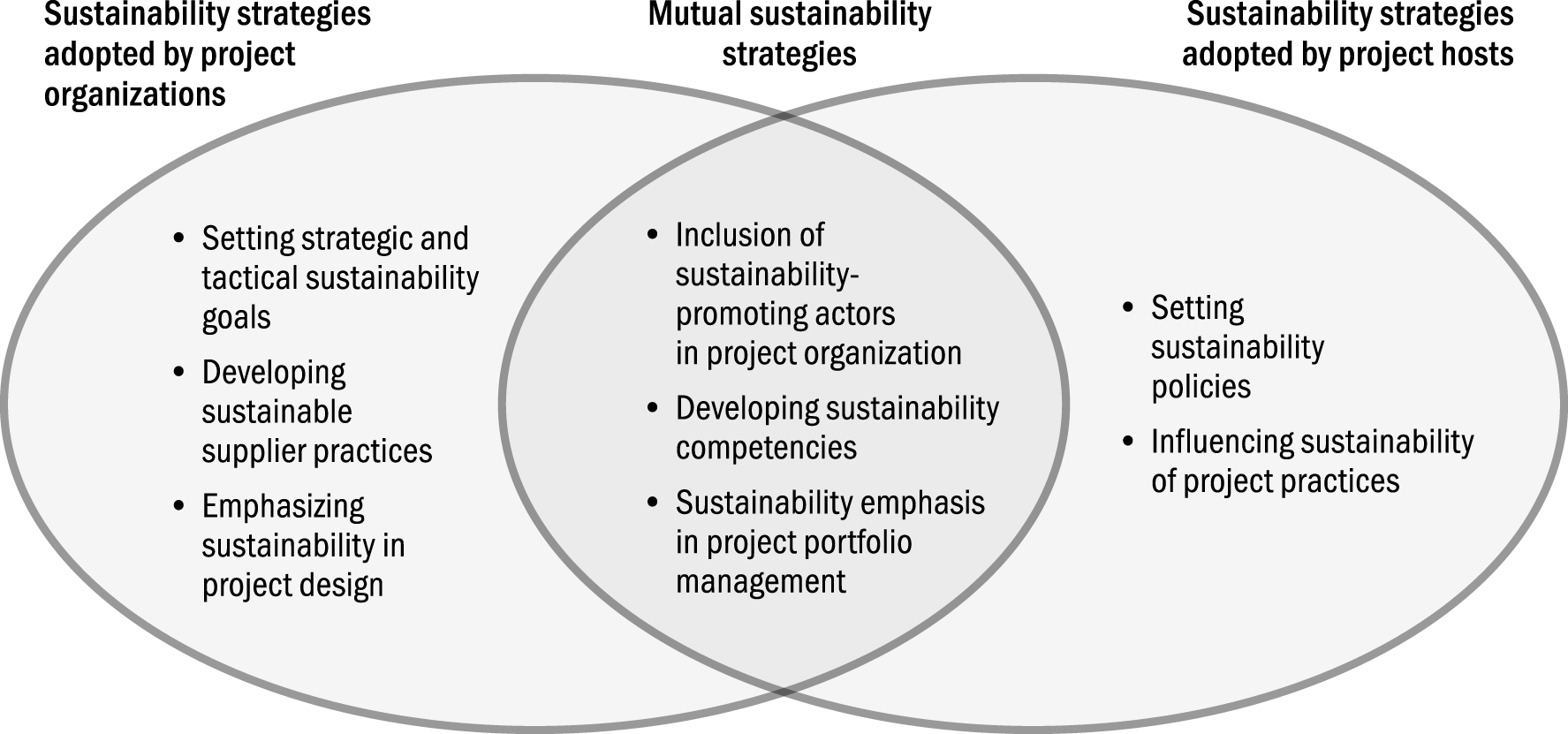
Visual representation of Aarseth et al.’s (2017) framework for how project organizations can increase sustainability in a project context.
Summary of the Project Management Literature Used for Analyzing the Empirical Findings
Project management research shows the importance of sufficient resources and close relationships and how these are interconnected. Relationships can provide resources, and the way relationships are managed depends on the level of resources at hand (Jensen et al., 2006). There is thus a recursive connection between resources and relationships in a project setting. Due to the impact resource and relationship constraints have on project actors, and the uncertainty that this can produce, also looking at strategies actors use to overcome shortcomings in resources and relationships and Aarseth et al.’s (2017) sustainability framework is important to understand and conceptualize how actors deal with social procurement. Together, the literature on project management and how projects are impacted by resources, relationships, and the strategies actors use, compose the viewpoint through which the empirical findings are understood, contrasted, and elevated to a more theoretical plane.
Method
Study Design
The aim of the study was to investigate how social procurement works in construction projects for those at the project level who implement it daily in addition to their ordinary work. At the time of the data collection, no specific literature to use as a framework through which to understand the empirical data had been chosen. The study was explorative, inductive, and open-ended, although the project context was implicitly embedded in the study as this is the context the study addresses. Literature on project management was thus later added after an inductive, thematic analysis to elevate the empirical findings to a more theoretical and conceptual plane (see more on this later in this section). An inductive approach was necessary to avoid missing the interesting areas of enquiry that come up when studying a novel and relatively unexplored phenomenon (Edmondson & McManus, 2007) like social procurement.
A qualitative research approach was chosen because it is useful to study social relations and capture the actions, perceptions, and intricacies of daily work life (Silverman, 2013). This means that the study was empirically driven rather than designed to fill a gap in the research literature. It also means that the research question presented in this article was not precisely stipulated at the beginning of the study. Instead, a more open-ended general inquiry (Alvesson & Kärreman, 2007) of what is going on in projects implementing social procurement guided the study. When analyzing the data, it became clear that there was something interesting to say about projects implementing social procurement, especially in terms of the resources from, and relationships with, the main contractor and client, and what actors on the project level did to cope with the difficulties arising from working with social procurement. This led to a focused analysis on resources, relationships, and strategies in relation to social procurement, which then later on also provided the structure of the Findings section as well as guided the literature review of project management research. The literature on project management was added after an inductive and empirically driven thematic analysis, as a framework through which the empirical findings could be understood (see more following in this section).
Project and Interviewee Selection and Interview Design
The study included interviews with people working in three construction projects implementing social procurement practices (specifically internships for marginalized people) to increase the projects’ social sustainability and social value output. The projects are not compared to each other, but used as examples of how individual actors in projects perceive their own work within social procurement.
The three projects included in the study were selected for three main reasons. First, they differed in character. One project was a tenant-owned housing company cooperative that was building new apartments. The second was a municipality building a new preschool. The third was an integration initiative by a group of public housing companies that, as a type of internal client, demanded the maintenance departments of their subsidiary companies take in interns. The three projects therefore had different types of clients and were building or maintaining different types of properties, thereby representing a more comprehensive view of social procurement implementation in Sweden. Second, the projects had all advertised a prominent social sustainability agenda, so it was interesting to study whether things worked out as intended at the project level. Last, the projects were also chosen because they were ongoing (and therefore did not have to be studied in retrospect) and access was granted to conduct interviews with project members. Conducting interviews in three different projects functioned as a type of triangulation of the results (Denzin, 2009) and, despite not intending to compare the three projects, the accounts of the interviewees were all very similar, which supported the validity of the results.
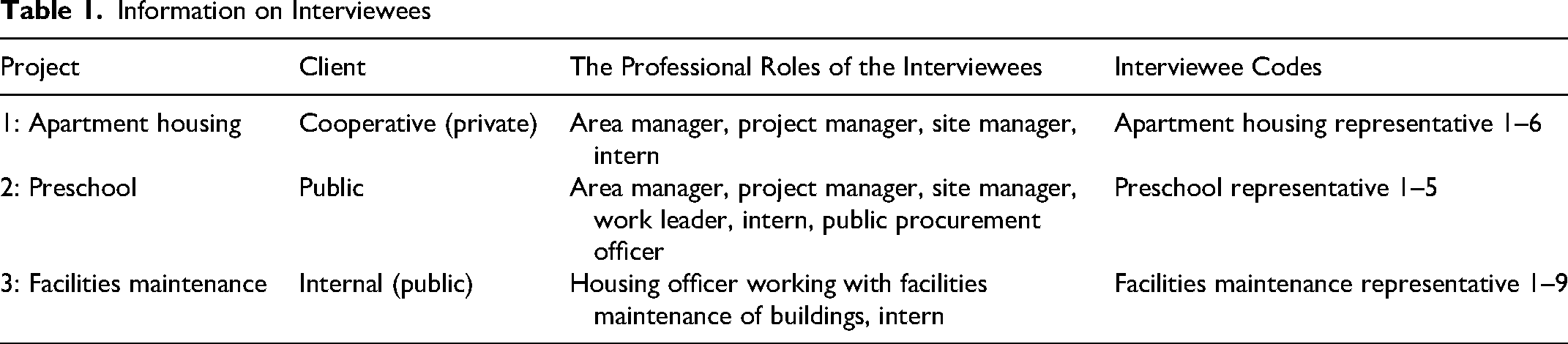
A total of 20 practitioners working in the projects were interviewed. The interviewees from the first and second projects worked either with production on-site or for the main contractor or client at the project level. Interviewees from the third project worked with facilities maintenance in subsidiary housing companies as part of the integration project. The interviewees were chosen because they all worked operatively, rather than strategically, with social procurement. Because practice formation and institutionalization of social procurement practices are weak in many countries (Barraket et al., 2016; Raiden et al., 2019), studying the daily work of operative actors was important. Information about the interviewees is listed in Table 1, and all interviewees were given a personal, anonymous code.
Information on Interviewees
The interviewees were identified with the help of managers working for the contractor in the first and second projects, and by managers of the public housing group in the third project. The sampling strategy focused on interviewees who had experience in working at the project level with social procurement interns. A majority of the interviewees were working in construction or facilities maintenance and supervising (or at least working closely with) the interns in the project organization. Some interviewees were formally employed by the main contractor’s central office but were stationed in the project to provide support, whereas others represented the client and worked closely with the project on a regular basis. The point was thus to highlight the experiences of those working operatively with social procurement on the project level.
It was important to capture these actors’ experiences, as the interns targeted in social procurement implementation in Sweden provides an added complexity on top of working with a new sustainability practice like social procurement. Although the construction sector has a long history of taking in apprentices, they typically have a construction background with training in their respective crafts. What makes the interns taken in via social procurement different is that the interns often lack construction training and experience and may have special needs unlike typical construction workers. Many of the interns from the target group (unemployed immigrants, young people, or people with disabilities) are excluded from the labor market. Immigrants may have undocumented and/or inconsistent schooling, speak very poor Swedish, and lack basic knowledge of Swedish society and work culture. Unemployed youths may lack high school diplomas and work experience. People with disabilities can be excluded either because they have physical disabilities making it difficult and unsafe to be in certain work environments (like construction sites), or have mental disabilities, such as burnout, making them sensitive to new work environments. In Sweden, immigrants are the most common target group receiving internships.
The interviews were focused on how the actors perceived working with social procurement, what it meant for their daily working life and interorganizational relationships, and what worked well and less well when implementing social procurement and dealing with the interns. The interviews were thus very actor- and practice-centered, and the interview questions were empirically, not deductively, derived. The project perspective was implicitly embedded in the interview guide as this was the context in which all of the interviewees were working. The questions in the interview guide were focused on the individual experiences, feelings, ideas, and understandings of the interviewees. The interview guide included (but were not limited to) questions such as:
How has the work with social procurement impacted your daily work? Do you have to work differently than before? What did you think/feel when you were tasked with working with social procurement, for example, as a supervisor? Has your role changed as a result of your new responsibilities working with the interns? What is your motivation for implementing social procurement? What do you see as the main barriers? Do you have the appropriate expertise and resources to work with social procurement? Did you receive any training for your new responsibilities? What is your relationship with your main contractor and client in regards to social procurement? Do you get sufficient support to conduct your work?
The interviews were semistructured (Kvale, 2007) to enable flexibility and allow the interviewees to talk about what they felt was most important. The interview guide was supplemented by follow-up questions and clarifying questions to ensure that the interviewees’ narratives were fully captured. The interviews each lasted approximately 60 to 90 minutes and were held in person at the interviewees’ place of work.
Data Analysis and the Relationship Between the Empirical Data and Theory
In line with the explorative study design, the data analysis method was inductive and inspired by two main analysis methods: the thematic analysis laid out by Braun and Clarke (2006) and the Gioia method (Gioia et al., 2013). The thematic analysis was used because it is a central method for analyzing qualitative data that can be used to identify, describe, and organize unexpected themes and rich, detailed data patterns. The coding process was also inspired by the Gioia method, which is an inductive coding method that can be used to elevate empirical codes to a more theoretical level through multiple coding rounds, by moving from an inductive analysis to a more abductive analysis that also incorporates theory. When all of the interviews were finished, there was no specific framework through which to analyze the empirical findings in place, besides the fact that the study was intended to focus on actors and their practices.
The thematic analysis first entailed becoming familiar with the data by transcribing the interviews verbatim and uploading the transcriptions in the software program NVivo Version 1.5 to enable a more systematic sorting of the data. NVivo facilitated taking excerpts from the interviews to be sorted into different categories/folders, and that could be altered and added to in the software. The software was useful to search for certain words or phrases in the data material, to see how many excerpts were in one category, as well as adding notes to the excerpts or categories. While the software was helpful in giving an overview of the data, it did not aid in the actual coding.
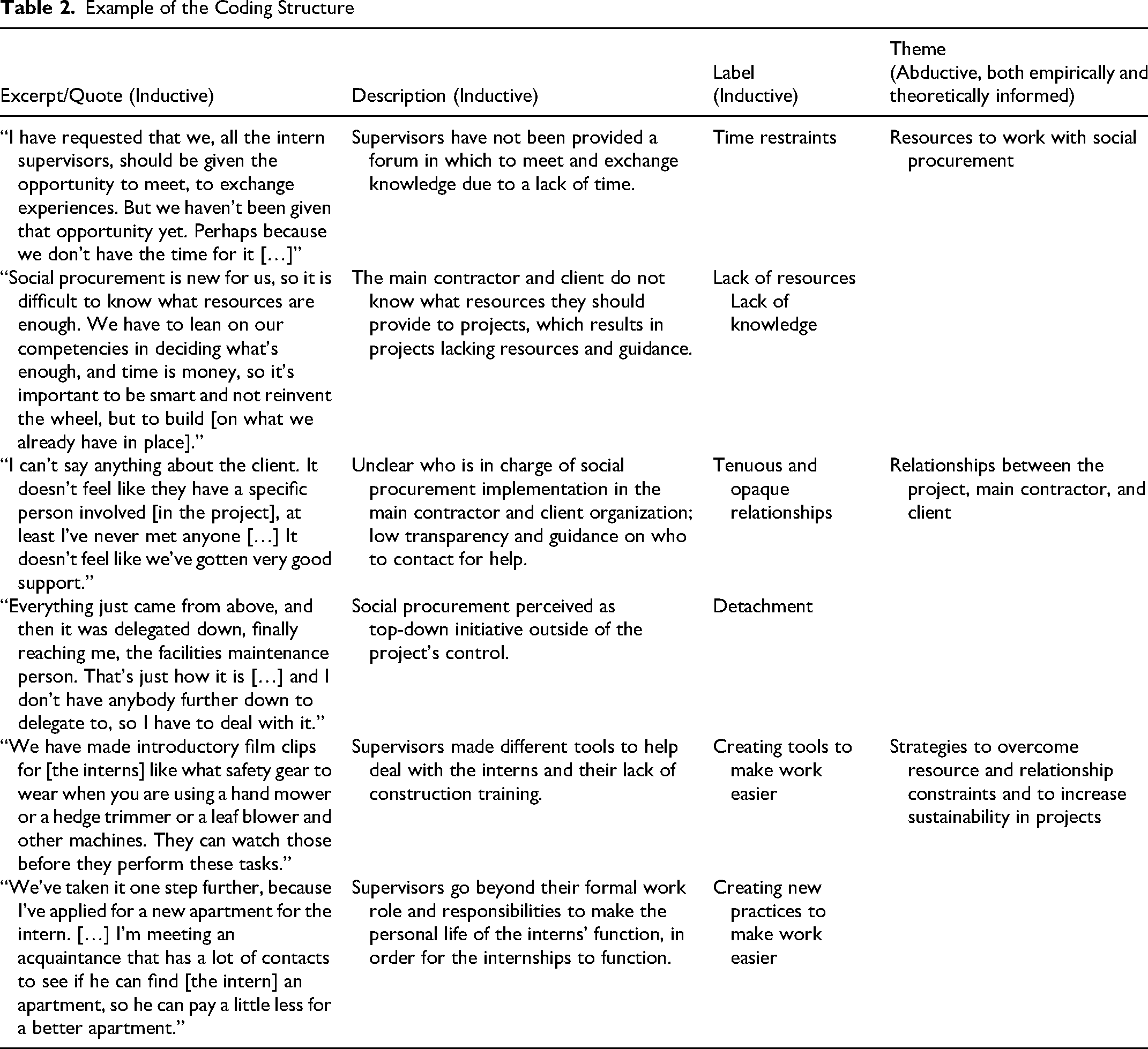
After the interviews had been transcribed and read through, it became clear that there were tensions between those working with social procurement at the project level and their main contractor and client (see examples in Table 2 and the Findings section). This guided the next coding round, which increasingly focused on the interviewees’ relationships with their main contractor and client, as well as the resources provided to support the work with the interns. The strategies that individual actors at the project level used to cope with uncertainty in the project environment and to deal with social procurement were also extracted. The codes were initially given short descriptions to contextualize them, and then more general labels to succinctly summarize the main point of each code.
Example of the Coding Structure
Up to this point, the coding had been based on the empirical data and inductively analyzed without much input from the literature. Braun and Clarke (2006) suggest that in an inductive thematic analysis it is pertinent to not engage with literature too early on to ensure that the analytical field of vision does not become too narrow. After the codes had been labeled, more aggregated themes became discernible. It was at this point that the analysis became more abductive and a review of project management literature began, focusing on resources, relationships, and strategies. By moving toward a more abductive analysis, a more focused identification and refinement of the themes was possible, which helped to aggregate the inductive labels to more theoretically informed themes. The purpose of making the analysis more abductive and adding a theoretical component was to understand, contrast, and elevate the empirical, inductive themes to a more conceptual level, to be able to discuss the results in a wider academic context, and to help put more general labels on what was found in the data. The theory thus connected the initially very empirical and inductive results to the wider academic debate.
The abductive analysis meant moving back and forth between the empirical data and the literature in an iterative manner (Dubois & Gadde, 2002), through which the findings and the literature on project management grew together and mutually reinforced each other (Van Maanen et al., 2007). The abductive approach of moving between empirical data and theory can expand the understanding of both, as empirical data cannot be fully understood without theory, and vice versa. By identifying something interesting in the data that was difficult to understand (Alvesson & Kärreman, 2007), moving to theory helped find explanations, while the data provided nuance to what was said in previous research. This back and forth thus helped explain the empirical findings while also elaborating on, adding to, and nuancing what had been found in previous research on project management (Dubois & Gadde, 2002).
The abductive analysis led to a refinement of the themes. This coding process, which unfolded in several stages, built rigor into the inductive data analysis by maintaining an openness to new knowledge (Gioia et al., 2013). The abductive stages of the analysis were thus a continuous and iterative process in which both the theory and empirical data evolved simultaneously, and the data were not forced to fit into preconceived theoretical categories (Dubois & Gadde, 2002; Van Maanen et al., 2007). The process was iterative, nonlinear, interpretive, and intuitive.
Ultimately, the themes reached a point where no more refinement was useful, resulting in three main themes (resources, relationships, and strategies) that structure the literature review of project management research, the Findings, and the Discussion. The three final themes were thus an abductive amalgamation of the empirical data and theory. Table 2 provides an example of the coding process. As resources and relationships are closely interrelated concepts within project management, the distinction between the codes was not always clear cut, and some overlap was therefore inevitable.
The literature review of project management was thus guided by the empirical findings from the interviews and subsequent inductive labels identified in the empirical data, which pointed to which project perspectives and concepts that were important in order to understand social procurement. The interviews and labels produced in the inductive analysis helped identify keywords that were used for the literature review search (project management, projects, construction projects, social sustainability, sustainability, resources, relationships, coping, strategies). The literature review was conducted in academic journal databases and the web search engine Google Scholar. The literature review search provided multiple sources that were reviewed and included in the abductive analysis if they related to the identified inductive labels. The literature search was complemented by doing backward and forward snowballing. This was done by going through reference lists of already identified relevant articles, as well as looking at citations of those articles (Jalali & Wohlin, 2012).
Empirical Findings
Resources to Work with Social Procurement in Projects
The interviewees described their work taking in social procurement interns as difficult due to resource constraints. Many interviewees, especially those working as supervisors of the interns, felt as though they were unprepared and got no training at all for these new responsibilities. Instead, they were expected to deal with the interns’ special circumstances (e.g., their lack of construction training) simply because they were experienced in the sector. One way to build such competence would have been for supervisors to share their experiences and knowledge with each other, but the interviewees explained that there was no regular forum in which to do this, despite their desire for one. In the facilities management project, there were opportunities for supervisors to exchange ideas and knowledge, but these were few and far between, and turnout was often poor, for example, due to inconvenient scheduling. Meetings were often scheduled during times when the interviewees had other obligations relating to their normal work tasks, meaning that it was difficult for them to prioritize meetings related to social procurement: “I have requested that we, all the intern supervisors, should be given the opportunity to meet, to exchange experiences. But we haven’t been given that opportunity yet. Perhaps because we don’t have the time for it […] We need to sit down in peace and quiet and talk about what we think and find some best practices. It’s important that the organization knows what we think, what has worked well. But [the main contractor] has not enabled that, unfortunately.” (Facilities maintenance representative 4)
The lack of time, resources, and forums to exchange knowledge resulted in many interviewees feeling like the main contractor and client were not very interested in the work with social procurement. According to the interviewees who represented clients, the main reason for the lack of resources was that the clients did not know what structures and practices needed to be put in place to make the implementation run smoothly. Much like those working on the contractor side of the project, those working in the project for the main contractor and client had to cope with a lack of resources, especially in terms of the time spent supporting the projects. The lack of time was said to diminish the client’s presence in the projects: “Social procurement is new for us, so it is difficult to know what resources are enough. We have to lean on our competencies in deciding what’s enough, and time is money, so it’s important to be smart and not reinvent the wheel, but to build [on what we already have in place]. We have to work more clearly in the next project and take the time to reflect about how things have gone here… and what the effects of that were in relation to the time we spent. It has taken a lot of time from us.” (Apartment housing representative 4)
The lack of resources at the company level adversely impacted access to resources at the project level. In addition, the clients’ lack of knowledge created problems for those working in the projects, who were dependent on their main contractor and client for guidance. The lack of resources and knowledge became a recurring talking point in the interviews, and the interviewees representing the main contractor or client were often aware of their shortcomings and tried to make amends on behalf of their organization: “We have chosen to have low demands, because we don’t know if we can live up to them. If we don’t have the internal structure, the demands can become too steep, and I know [the contractor] felt like they didn’t get enough support from the municipality.” (Preschool representative 5)
The interviewees believed learning by doing and sharing knowledge could mitigate some of the problems caused by limited support. However, the situation often became ‘the blind leading the blind,’ as knowledge of how to organize social procurement practices was lacking both at the company level and project level. So, despite the ambition of learning from project to project, and despite information sharing and knowledge transfer being deemed important by the interviewees, in practice it was often uneven, informal, and not routinized. As such, the organizations rarely planned for knowledge sharing or formalization: “After each project, we make a little report about what we have achieved, with good and bad experiences. We try to capture as much knowledge as we can during the project’s duration. But then, just because something doesn’t work, it doesn’t mean that we should quit this whole endeavor. We have to fine-tune it and come at it from a different angle. But it is far from a self-playing piano.” (Apartment housing representative 2)
The informality of information sharing, lack of knowledge, and lack of resources created tensions in the project environment and were said to diminish the legitimacy of the social procurement initiative. Lack of guidance, time, and resources made some interviewees question the long-term commitment to social procurement. Despite being generally very positive toward creating employment for marginalized people, many of the interviewees felt social procurement was a poorly thought-out initiative that they had to handle on their own.
Relationships Between the Project, Main Contractor, and Client when Implementing Social Procurement
The scant resources allotted to the projects were mirrored in the relationship with the main contractor and client, and the interviewees from the projects described how they felt detached from their main contractor and client and had to solve problems on their own. These relationships were described as tenuous and opaque, and many of the interviewees were unsure who was responsible for social procurement in the main contractor or client organization: “I can’t say anything about the client. It doesn’t feel like they have a specific person involved [in the project], at least I’ve never met anyone […] It doesn’t feel like we’ve gotten very good support.” (Preschool representative 4)
Many of the interviewees, especially those representing the client and main contractor, claimed they wanted to shape the work with social procurement together, and that this was why practices were under development and informal. However, some interviewees said the client added social procurement clauses to the contract at the last minute, leaving the projects to handle the aftermath. In effect, the interviewees saw a lack of planning and participation in the project from the main contractor and client, not an opportunity for cocreation: “There has been a lot of engagement, but, in the beginning, there was also a lot of frustration that we didn’t know how to practically go about it. And when the client decided to use social procurement employment clauses, they also didn’t know, so instead they found some text that they just ‘copy/pasted’ and threw in the contract, thinking they’re doing a good job. But they’re not seeing the consequences of the demands they made.” (Preschool representative 1)
Despite that clients and main contractors wanted to cocreate social procurement practices with the project level, the project-level interviewees described how they had little possibility to affect the model for implementing social procurement, and that the model was delivered in a top-down manner. Some interviewees said they did not want to seem like they were nagging by questioning the model. This lack of influence was said to further diminish the commitment to social procurement, or, as a somewhat exasperated supervisor said: “Everything just came from above, and then it was delegated down, finally reaching me, the facilities maintenance person. That’s just how it is […] and I don’t have anybody further down to delegate to, so I have to deal with it.” (Facilities maintenance representative 7)
The interviewees who worked as supervisors of the interns explained that, much like the relationships with their main contractor and client, the relationships with their interns were also tenuous—at least from a longitudinal perspective. For example, the interviewees expressed a wish to meet the interns before they started to help prepare themselves and the interns for the internships. This would have made first introductions easier and provided an opportunity for the interns to fully grasp what they would be working with. After the internships were over, the supervisors were seldom informed about what had happened to their intern, for example, if they had received employment somewhere, started studying, or went back to unemployment. In general, the interviewees expressed concerns over whether their efforts had any long-term positive effects: “If this is supposed to be a long-term commitment, maybe it should be better anchored in the whole organization, so you actually know what is going on and what the results from our efforts are […] We work very closely together. I’m with the interns all the time, so I think it would be interesting to [know what happens to them after the internships have ended], to know if this leads somewhere […] Working with this has been diffuse and difficult, a lot of things just sort of happened.” (Facilities maintenance representative 3)
The lack of continuity in the relationships with their interns made the supervisors’ efforts seem less important, and made the goal of using social procurement unclear. Many interviewees highlighted a lack of shared objectives with the client, or rather, that those working in the projects were unaware what the objectives were or what the client wanted to achieve with social procurement. Due to an unclear shared objective, practices also became informal and unclear: “I think it’s really important that [the main contractor] decides what the purpose of social procurement is, what we [in the projects] should help with […] We have to have a clearer assignment, otherwise social procurement becomes lost […] Instead, it’s now become more about supporting individual supervisors, so they don’t lose motivation. We have to ensure that we actually get things done […] The largest issue is to get some clarity and simplicity.” (Facilities maintenance representative 6)
The lack of shared objectives and informal practice formation led to frustration, and the interviewees felt it negatively impacted the quality of the internships. They all had a desire to create a good work environment for the interns in which they could learn and grow. According to the interviewees, to achieve such an environment and make social procurement something substantial, relationships and collaboration have to work, and all organizations involved in social procurement implementation—not just the project—have to be committed: “Both of us [client and contractor] must commit 100%. It shouldn’t only be one of us who drives this issue […] We must have a shared view in the project, with our client, so you speak the same language and want the same things. Otherwise, we haven’t succeeded together. The central issue is to have communication and agree on a common goal of what we want to achieve.” (Apartment housing representative 2)
Overall, it is clear that the resources from and relationships with main contractors and clients were deficient. For social procurement to be implemented in a sustainable way (both for project actors and the interns), clients must ensure that the project is suitable for implementing social procurement in terms of time, scope, and scale. Clients must also ensure that there are appropriate unemployed people available to hire, help obtain access to these people, and contribute guidance for how the contract requirements are to be fulfilled. Finally, clients must be clear on what expectations they have on the project, and continually follow up and provide steering to see if the requirements are being fulfilled as intended. The main contractor must ensure that there are enough resources and time for supervisors to handle their new responsibilities, ensure that staff gets the appropriate training, and ensure that routines and knowledge are formalized and documented. The main contractor must also be there to guide the project so both the bottom line of the project (that the project is finished on time and on budget) and the social requirements of the project are fulfilled.
Clients and main contractors are thus responsible for having a close, good relationship with the project to help manage the implementation of social procurement practices, and for ensuring that the project gets enough resources to be able to implement social procurement practices. However, it is clear from the interviewees that there were many tensions between the actors working on the project level and their main contractor and client. The interviewees felt sufficient resources were not provided, lines of communication with the main contractor and client were weak, that the project was detached from the main contractor and client, and that the project had little influence on practices related to the implementation of social procurement.
Strategies to Overcome Resource and Relationship Constraints and Increase Sustainability in Projects Through Social Procurement
To overcome the lack of resources from, and weak relationships with, the main contractor and client and to be able to produce social value, some interviewees showed innovative capacity in terms of creating new tools or practices to facilitate the internships. For example, one interviewee put together a pamphlet about the social procurement process of their organization, another created a feedback form to see what he as a supervisor could improve for the next round of interns, and another recorded informational film clips about different work tasks: “We have made introductory film clips for [the interns], like what safety gear to wear when you are using a hand mower or a hedge trimmer or a leaf blower and other machines. They can watch those before they perform these tasks.” (Facilities maintenance representative 2)
In addition to creating new tools, the interviewees described how they had created new practices to meet their new responsibilities, like helping the interns read private emails, answer calls from welfare services, showing them how to pay bills, finding them new housing, and so forth. Despite the stress of having less time to finish their normal work, many of the interviewees got personally involved in the interns’ personal lives, because they felt it was a necessary addition to their supervisory role: “We’ve taken it one step further, because I’ve applied for a new apartment for the intern. He rents a small apartment in a bad neighborhood, paying too much. That doesn’t sit right with me—it goes against my pride to let him do that. So now I’ve applied to a housing company for an apartment for him, and I’m meeting an acquaintance that has a lot of contacts to see if he can find [the intern] an apartment, so he can pay a little less for a better apartment.” (Preschool representative 3)
This above and beyond work was done to make the interns’ private lives function better, because, if their personal lives did not work, the internships were negatively affected. Many interviewees described how much of their work was focused on integrating the interns into wider society rather than teaching them useful work skills, which created problems. Overall, they deemed the interns to be unprepared for the work they were expected to do, because they had not been informed about the nature of the work they would be performing in their internships, or what would happen after the internships ended: “I would like to see them when they are in school, so we get to put a face to them, and they get to put a face to us. They would already have an idea what they are going to work with.” (Facilities maintenance representative 4)
Many interviewees said the interns thought the internship would transition into a permanent position, although this was rarely the case. This problem was further aggravated by the lack of continuity for the supervisors, who were not able to meet the interns before or after the internships. Those supervising the interns at the project level then faced considerable changes to their work life, and the relationships with their main contractor and client unexpectedly became a prominent issue for them to tackle.
Discussion
In this section, the findings from the study are analyzed through the framework of project management literature, focusing on increasing sustainability in projects, as well as resources, relationships, and strategies to cope with the uncertainty and constraints of the project environment.
Resources to Work with Social Procurement in Projects
Projects rely on clients and main contractors for resources such as money, knowledge, trust, and time (Jensen et al., 2006). In the case of social procurement, knowledge and time are particularly scarce. The interviewees described how they lacked training in how to work with the interns, who themselves often lacked any experience in construction or facility maintenance. The lack of training for both supervisors and interns is a missed opportunity, because Aarseth et al. (2017) assert that training is an important strategy for increasing sustainability in projects. Clients and main contractors also lacked the necessary knowledge and resources to implement social procurement. If training efforts had been standardized, this could have provided projects, main contractors, and clients with sufficient knowledge to implement social procurement and work with the interns, as well as provided more value for the interns who would have learned more practical work skills.
There was also a lack of time in terms of interviewees handling the interns and helping them in their personal life on top of their normal work tasks. The stress caused by this was similar to the issue with overload problems (Winch, 2014), where added stress illustrates a lack of social sustainability for workers in projects, as emphasized by Goel et al. (2020). This is ironic considering how social procurement is meant to increase social sustainability. In practice, social procurement may increase social sustainability for organizations that may get new employees and for interns who may gain employment, but it can actually decrease it for supervisors, whose work situations became increasingly unsustainable.
Lack of knowledge of how to implement social procurement may be the largest resource constraint found in this study, and is something other studies have also highlighted as a problem for sustainable project management in general (Sabini & Alderman, 2021). Having artifacts, such as documents and routines and effective knowledge-transfer practices, as well as a forum for exchanging knowledge and experiences is key. It makes members feel informed and facilitates the integration of new practices (Pettersen Buvik & Rolfsen, 2015; Wei & Miraglia, 2017). Such artifacts and forums were not provided to the projects studied in this article, which meant that creating the formalized practices that increase sustainability in projects became difficult (Aarseth et al., 2017). Instead, practices relating to social procurement, especially in terms of knowledge sharing, were very informal. This informality and lack of knowledge resulted in added vertical uncertainty for the supervisors (Jensen et al., 2006). Therefore, routinizing practices and formalizing knowledge about social procurement practices could help legitimize social procurement and increase social sustainability in projects, both in terms of positive employment outcomes for interns and improving the working lives of supervisors, who then would be dealing with less interactional uncertainty (Jensen et al., 2006).
Finally, the lack of knowledge is clearly connected to the lack of experience, and previous research emphasizes how projects are very dependent on the experience of key project members and clients (Engwall, 2003; Walker, 2015). Experience can thus be an important resource and, in this study, it was clear that the lack of experience among both main contractors and clients negatively affected the actors working at the project level and their ability to implement social procurement. The issues with resource constraints laid a foundation for weak relationships (Walker, 2015), which is discussed next.
Relationships Between Projects, Main Contractors, and Clients When Implementing Social Procurement
Winch (2014) claims that research often portrays clients as nonstrategic actors and, from the findings of this study, this seems to be true also in practice. The clients and main contractors in this study were said to have a detached relationship with their projects and did not provide much in the way of managerial skills (Winch, 2014). The clients lacked a clear plan for social procurement implementation—something that Aarseth et al. (2017) say is important for sustainability creation in projects. Previous research suggests that having prior knowledge and experience within project teams makes role expectations clearer (Pettersen Buvik & Rolfsen, 2015). This was exemplified by the lack of coordinating roles and responsibility allocation (Walker, 2015) between the different organizations working with social procurement. The fact that the clients failed to create clear guidelines, responsibility, and resource allocation suggests that Aarseth et al.’s (2017) strategy of developing policies, norms, and guidelines to support sustainability at the project level is a strategy that is not being fully utilized.
Another likely reason for the generally tenuous relationships between clients and projects is that each project is temporary and starts as a clean slate, where workers have to form new relationships with new colleagues in every new project, which negatively impacts continuity (Packendorff, 2002). This study adds to these findings by showing how a lack of long-term relationships between the actors at the project level and their interns also decreased motivation. Not knowing what happened to their interns after the internships ended made many supervisors demotivated and doubt the objective of social procurement. Lack of continuity is also an example of how the temporal dimension (Sabini & Alderman, 2021) of social procurement and projects can be misaligned; projects are temporary, as are the employment they create and the continuity with the interns. Because the sector is reliant on project-level actors to implement social procurement, a lack of motivation could be detrimental to a wider dissemination of social procurement practices and social sustainability in general. The temporality of projects is something that main contractors and clients, which are permanent organizations, must be able to handle if they want the effects of social procurement to have any chance of becoming sustainable over time. Otherwise, the risk is that the efforts spent on social procurement only goes as far as the project’s boundaries, which is a missed opportunity to contribute to increased, long-term social sustainability in the sector.
The feeling of detachment between the clients and projects in this study was aggravated by the lack of shared objectives. Although it is common for objectives to differ between clients, contractors, and project organizations (Dubois & Gadde, 2002), aligning objectives is an important part of project management (Walker, 2015), and the interviewees in this study expressed similar views. However, in the case of social procurement, divergent objectives did not seem to be the problem, but rather that the objectives of the client and main contractor were themselves unclear or unknown. Social procurement sometimes felt like a last-minute idea that was thrown into the project, which created uncertainties that the project-level actors were left to deal with on their own. The lack of shared objectives and proper planning for social procurement was a missed opportunity to increase sustainability at the project level (Aarseth et al., 2017) and further led to an informality of communication and practice formation. Good experiences were not systematically documented, which in turn diminished learning and knowledge transfer between projects (Packendorff, 2002; Fulford & Standing, 2014; Winch, 2014).
It is clear that organizations that wish to implement social procurement as an institutionalized practice must pay attention to the relationships between projects, main contractors, and clients. Especially important are the factors Meng (2012) identifies (e.g., mutual objectives, joint working, and communication), and when these do not work well in practice, they can potentially lead to project time and cost overruns. Weak relationships and the lack of support and resources may ultimately undermine opportunities for organizations to cocreate social value, where instead it is created only through the local efforts of actors working closely with the interns. This could decrease wider dissemination of social procurement practices, and thereby diminish social sustainability for the construction sector as a whole. There are, however, some strategies actors can use to mitigate these problems, as is discussed next.
Strategies to Overcome Uncertainty, Resource and Relationship Constraints, and Increase Sustainability in Projects Through Social Procurement
It is clear that project actors implementing social procurement and working closely with interns have to cope with a great deal of interactional uncertainty (Jensen et al., 2006). The project-level actors lacked resources for sharing knowledge, time to complete their new work tasks, and thereby continuity in their relationships with their interns, which contributed to vertical uncertainty in terms of poor planning and unclear routines. At the same time, the project-level actors had tenuous and detached relationships with their client and main contractor, which contributed to horizontal uncertainty. Much like there is a recursive connection between lack of resources and tenuous relationships, there seems to be a recursive connection between vertical and horizontal uncertainty. If there would have been proper planning and routines in place for the project, vertical uncertainty would have been lower, which would make projects less dependent on continuous support from the main contractors and client. That, in turn, would have decreased horizontal uncertainty. Vice versa, if the relationships between projects and main contractors would have been closer, horizontal uncertainty would be lower, which in turn would make it easier to establish formalized routines, making the level of vertical uncertainty lower.
All of these issues thus contributed to a situation of interactional uncertainty for the actors at the project level (Jensen et al., 2006). Despite the lack of resources and support, the interviewees showed innovative capacity and found ways to overcome both vertical and horizontal uncertainty, creating new tools and above and beyond practices. These new, localized practices could be seen as a type of strategy to deal with the uncertainty and constraints in the project environment. Aarseth et al. (2017) mention developing supplier practices, standardized practices, and technical tools using a more top-down approach, but the local practices created by individual actors at the project level require a more bottom-up approach. These types of practices, created to cope with new complex work situations, provide more nuance to the strategies used to increase sustainability in projects.
Bresnen et al. (2004) explain how project actors affected by new practices (e.g., social procurement) try to reconstruct and negotiate the meaning of the new practices. The above and beyond work the interviewees engaged in could be an example of them reconstructing their own practices in order to accommodate social procurement.
Summarizing the findings of this study using Aarseth et al.’s (2017) framework, there are a number of strategies that stand out in this context, both in terms of those that were applied and those that were not applied, signaling missed opportunities for sustainability creation: (1) Sustainability goals were not misaligned with other business objectives, but were either missing or had no known purpose. (2) The clients did not formulate supplier practices clearly for the projects. Instead, practices were created locally by individual actors at the project level from the bottom up. This finding widens the scope of strategies that can be used to increase sustainability in a project context and avoid uncertainty (Jensen et al., 2006). (3) Social procurement was not properly planned for in the early design phase and was, in some cases, added to the project at the last minute. (4) The clients often failed to create clear guidelines, responsibilities, and resource allocation to enable social procurement work at the project level. (5) The clients often failed to influence project practices through the use of different standardized practices, systems, or technical tools, which were generally missing. (6) This study focused only on actors at the project level and therefore did not take other stakeholders into account. However, some clients have a support organization that helps to implement social procurement in projects, mostly in terms of the recruitment of the interns, so there are actually some efforts being made by clients to include local (labor market) stakeholders in their projects. (7) There was little possibility to develop sustainability competencies through formal training programs, and few interviewees got any formal training for their new role as supervisors of the interns. (8) Last, this study has not addressed the question of whether projects are generally suitable for social procurement. However, as social procurement becomes more common, it will likely become an important aspect for clients to think about which projects are appropriate for social procurement implementation. It will be important to ensure that the resources spent on social procurement produce the maximum social value output possible, and are not just thrown in at the last minute as described by the interviewees in this article.
Addressing these shortcomings presents an opportunity for organizations to increase social sustainability in their projects through social procurement. By mindfully implementing these strategies and changing project practices, social sustainability can be increased for organizations, interns, and wider society alike. The fact that many of these strategies are not currently used is likely due to the novelty and complexity of social procurement in construction projects, but it might very well become commonplace in the future if the benefits of social procurement can be demonstrated.
Contributions
This article empirically exemplifies, contextualizes, and nuances how sustainability initiatives (in this case, social procurement for employment creation) are difficult to implement in a project context. It provides an interpretive and detailed view of the tensions that can arise between projects and main contractors and clients when working with sustainability. Social procurement has purposes that go beyond individual projects, namely: (1) helping unemployed people obtain employment, (2) providing organizations with increased capacity and a new pool of possible employees, (3) creating new tax income sources for governments as unemployed people no longer rely on welfare, and (4) reducing inequality and stigma for disadvantaged groups. So, although many of the challenges facing social procurement are not unique in a project context, its wider scope and society-level relevance makes it important to study. The study makes contributions to project management research, social procurement research, and procurement research in general, and for practice.
Contributions to Project Management Research
The study contributes more insight and nuance to project management research dealing with sustainability. First, Aarseth et al.’s (2017) framework highlights some specific challenges of a sustainability initiative like social procurement. At the same time, the framework also points to several untested strategies project actors could use to overcome these challenges and increase social sustainability.
Second, the study shows how project-level actors create new above and beyond and local, bottom-up practices and restructure their work roles to be able to implement a sustainability initiative like social procurement. Insight into these specific practices provides a rich understanding of the work life of actors on the project level who work with implementing sustainability initiatives alongside their ordinary work tasks. The localized bottom-up practices performed by the project-level actors also added an interesting new strategy that was purposively, albeit ad hoc and out of necessity, created to handle social procurement implementation. These new practices were useful in mitigating resource and relationship constraints, overcoming vertical and horizontal uncertainty, coping with ambiguous practices (Jensen et al., 2006), and enabling social sustainability creation at the project level.
Third, although previous research (Herazo et al., 2012) claims that working with sustainability can increase collaboration and bridge the gap between strategic and operational levels of projects, this study highlights how working with sustainability can potentially enlarge, or at the very least expose, gaps between hierarchical project levels and collaboration failures.
Fourth, it is interesting how social procurement, which is meant to increase social sustainability, can also lead to outcomes where social sustainability actually decreases for project actors—especially those working as supervisors of the interns. While social sustainability can increase for the interns, and by extension, wider society, it can also decrease for the actors on the project level who suffer from higher stress levels.
Last, the interconnectedness of resources, relationships, and strategies are clearly visible in this study, where there is a reciprocal relationship among the three aspects. Resources are allotted when relationships are strong and close, and relationships are stronger when resources are plentiful. When this interdependency fails, strategies to overcome constraints and to be able to work with sustainable practices must be created. However, creating such practices is difficult when there are scarce resources and tenuous relationships. This situation in turn puts more stress and pressure on project-level actors to show ingenuity to be able to handle their daily work life, thereby decreasing the social sustainability the project is supposed to create. The question then becomes: How is it possible to increase social sustainability in projects without trade-offs in terms of stress for workers or more costly projects?
Contributions to Social Procurement Research and Procurement Research in General
The findings of this article also add to social procurement research. The article provides rich empirical details of what it means to work with social procurement in projects. Also, applying a project management perspective on social procurement adds a theoretical contribution to the research field of social procurement and anchors it to a wider research debate. This is important as social procurement has been relatively unexamined empirically and theoretically (Barraket et al., 2016; Loosemore, 2016; Raiden et al., 2019). The microperspective on social procurement sheds light on the everyday struggles of individual actors. The article shows how it was not divergent goals that created complexity (Walker, 2015), but rather that the goals were unclear in the first place. Previous research (Erridge, 2007; Barraket et al., 2016; Troje & Gluch, 2020) asserts that social procurement can lead to deeper collaboration between actors and organizations, but that it is difficult to achieve in practice. This study corroborates this but adds insight as to why it is difficult. The study highlights the lack of factors, such as formalized routines, informal knowledge transfer, shared and known objectives, and experience among main contractors and clients, which created uncertainty for actors working with social procurement at the project level.
In terms of procurement research in general, Goel et al. (2020) suggest that future research should investigate current levels of social considerations in procurement processes, and identify the leadership roles and competencies needed to implement social sustainability in projects. This article does not answer these questions specifically, but it does take a first step toward identifying some areas where these aspects are lacking.
Contributions to Practice
First, besides providing a theoretical perspective on social procurement in a project management context that can be used by practitioners to get an aggregated view and increased understanding of their work life, this article pinpoints specific areas where clients and main contractors must rethink their lack of resources and support to projects. The strategies suggested by Aarseth et al. (2017) are currently underutilized, but provide good indications on where to start.
Second, the article also shows how individual actors in projects became demotivated by the lack of continuity with interns, the lack of acknowledgment from their main contractor, and the inability to affect the model for implementing social procurement. These issues will be important to address moving forward.
Last, much social procurement research focuses on the United Kingdom and Australia, which are two countries at the forefront of social procurement application. The findings of this article are likely applicable in these countries and others like them, despite differences in governing systems, political views, and culture. Social procurement is a concept relevant for every country, because no country is free from unemployment, stigmatization, and segregation of disadvantaged groups. These are common and enduring problems to which social procurement can provide a solution. Therefore, the findings of this article provide insight to other organizations, industries, and countries that wish to engage more with social procurement and increase social sustainability.
Concluding Remarks
The purpose of this article was to investigate how project organizations perceive and handle the resources from, and relationships with, main contractors and clients when implementing social procurement. Literature on project management that is focused on resources and relationships between projects, clients, and main contractors, and the strategies actors use to increase sustainability in projects and overcome uncertainty and constraints in the project environment, provide a stance from which to understand social procurement in practice. The study illustrates how resources are lacking and relationships are tenuous, but also how the innovative capacity from actors at the project level, in a bottom-up fashion, can overcome some of these issues. It is clear that social sustainability in a project context is difficult, yet possible to achieve, but that it requires conscious efforts from clients and main contractors to produce the maximum social value possible.
Limitations and Future Research
This article has limitations in terms of its geographical scope and the projects studied. Future research should study social procurement implementation in other project-based industries and geographical contexts to provide greater nuance to the research literature. It could also look further into how other sustainability policies are implemented to widen the knowledge of sustainability creation in a project context. More studies are needed on how to manage, store, and transfer social sustainability knowledge from temporary projects to permanent organizations, as the temporal nature of projects makes knowledge transfer and retention difficult (Packendorff, 2002; Fulford & Standing, 2014; Pettersen Buvik & Rolfsen, 2015). In addition, future studies could investigate what happen to the interns after the internships have ended, if they have more skills and are more employable, and what long-term impact social procurement has had on their careers.
Footnotes
Acknowledgments
This work was supported by Svenska Forskningsrådet Formas. An earlier version of this research was presented and published in the proceedings of the 36th Annual Association of Researchers in Construction Management (ARCOM) Conference, 7–8 September 2020, United Kingdom.
Declaration of Conflicting Interests
The author(s) declared no potential conflicts of interest with respect to the research, authorship, and/or publication of this article.
Funding
The author(s) received no financial support for the research, authorship, and/or publication of this article.
