




Abstract
Recently, scholars have called for a focus on subjective aspects of risk management as a suitable lens for understanding how it functions. In line with this lens, this study focuses on project actors’ viewpoints on risk management in the context of construction projects to provide novel insights in risk management. Drawing on Renn's model and following a Q methodology, we identify four risk management approaches among asset managers and project managers working at the Dutch Schiphol Airport. The action-oriented and future-oriented viewpoints are dominant, while the expert input and stakeholder-centric viewpoints are in the minority. Our findings extend the risk management debate by showing that (1) there are various approaches to risk management that have been identified independently from the formal risk management; (2) these approaches cannot be explained by a project actor's role or objective within the project; and (3) that project actors have a dominant focus on managing complexity-induced risks at the expense of managing other types of risks.
Introduction
Risk management in projects—traditionally governed by a formalistic, one-size-fits-all approach when managing quantifiable risks—often falls flat in managing project risks (Kutsch et al., 2014; Panthi et al., 2009). Formal risk management within projects often lacks substantial results, since this one-size-fits-all approach does not match the nature of the various risks projects are confronted with (Serpella et al., 2014). Scholars have therefore criticized this approach, remarking that there are various types of risk entailing specific approaches (DeMeyer et al., 2002). To advance the debate on risk management, scholars have called for a focus on actors’ subjective perspectives of risks to get a better understanding of the management of these risks within projects (Chapman, 2019; Panthi et al., 2009; Sanderson, 2012; Xia et al., 2018). Some contend that little is known about how risks and the ways to approach them are individually perceived by project actors (Xia et al., 2017). Subsequently, scholars following this new strand of literature have shown that (1) risks can be considered a subjective construct (DeMarco & Lister, 2013; Molenaar, 2005); (2) risk management acts upon obvious risks for the project owner but neglects less obvious risks, which can significantly affect project performance (Kutsch et al., 2014); and (3) the way the project decides on its risk management influences the way risks are addressed in practice (Guo et al., 2014; Haq et al., 2018). Therefore, to deepen our understanding of risk management in projects, it is crucial to know how project actors view project risks and how they would approach them (Ward & Chapman, 2003; Xia et al., 2018).
This article aims to delve into the subjective aspects of risk management by identifying perspectives on it that are based on the viewpoints of project actors. It sees a perspective on risk management as a cluster of individual viewpoints on how projects should prioritize their risk management resources. Perspectives on risk management are closely related to earlier project management studies that focus on risk management approaches. Scholars of risk management approaches have already shown that approaches are often more diverse in practice than is formally depicted (e.g., Arnold et al., 2011; Koppenjan et al., 2011; Osipova & Eriksson, 2013). Both lines of research focus on the ways in which risk management is actually performed within a project. A more explicit and contextualized understanding of the ways in which risk management is perceived in practice is required to make better decisions in the process up to and during the implementation of formal risk management (Drouin et al., 2012). We add to the risk management literature by making subjective aspects of risk management explicit through Renn's risk management model and by deploying a Q methodology (Stephenson, 1935). Q methodology is gaining recognition in policy research and project studies because of its strength in analyzing the viewpoints of actors in a structured fashion (Cuppen et al., 2016).
Based on the discussion above, the central question in this article is: What perspectives do project actors hold in managing risks in projects? To answer this question we conducted a qualitative study, based on a combination of a Q methodology (Stephenson, 1935) and 36 interviews in a terminal construction project at Schiphol Airport. We particularly examine the viewpoints of asset managers and project managers on risk management. Previous research suggests that the position and objective of project actors influence the way they view risk management (Hillson, 2019; Krane et al., 2012; Zhao et al., 2016). Asset managers are responsible for the maintenance and quality of the assets after completion (Deadman, 2010), while project managers are responsible for the delivery of assets in accordance with time, cost, and quality standards (Atkinson, 1999). Given these differences in responsibility, we expect different perspectives on risk management among asset managers and project managers. Additionally, these perspectives are examined within the context of underground risks. Underground risks are a notable example of a set of risks not merely understood through quantifiable outcomes. The underground harbors unquantifiable and less obvious risks due to its innate invisibility (Gupta, 2018). The invisibility of the underground may result in a lack of accurate information on locations of cables, pipelines (Vilventhan & Kalidindi, 2016), and underground objects (olde Scholtenhuis et al., 2016). While risks may be seen as known chances of occurrence of known (unwanted) effects, some risks involve uncertainty, which is the unknown chances of the occurrence of unknown effects (Ward & Chapman, 2003). The authors therefore expect the project actors’ perspectives on managing underground risks to acknowledge the underground's uncertain nature.
Our study discerns two dominant perspectives on risk management—action-oriented and future-oriented—and two minority perspectives—expert input and a stakeholder-centric view. These findings contribute to our understanding of projects and risk management (Bryde & Volm, 2009; Khattak et al., 2019; Lehtiranta, 2014; Liu & Yuliani, 2016) by (1) acknowledging the various perspectives on risk management in practice that are independent from the formal risk management approach; (2) showing that the various perspectives on risk management cannot be explained by a project actor's role or objective within the project; and (3) revealing that project actors are focused on managing complexity-induced risks at the expense of other types of risk.
The article is structured as follows. We first conceptualize the variety of risk management approaches within a project, and we indicate that this variety of approaches in practice can hamper the implementation of risk management. We then introduce Renn’s (2008) model of risk management, which connects risks of complexity, uncertainty, and ambiguity to management instruments, and theorize about the strategic viewpoints of asset managers and project managers on risk management. Next, we discuss the Q methodology and explain the process of analysis. In the findings section, we present the two dominant and two minority viewpoints regarding subsurface risks at Schiphol Airport. Finally, we discuss the findings in the context of the theoretical frame and reflect upon their theoretical and practical implications.
Theoretical Outline
The Variety of Risk Management Approaches Within Projects
Information that leads to the identification of risks is at the core of project risk management (Perminova et al., 2008; Wang et al., 2016a). Risks in project management literature are described as “tolerated or unintended consequences of purposeful human action which may occur that violate something that humans value” (Kasperson, 2017, p. 28), which in this context means the realization of a project. Projects conduct risk analyses to identify, classify, and remedy risks (Zhi, 1995; Zou et al., 2007). This results in the adoption of a formal risk management approach often described as the implementation of a strategic viewpoint(s) through a selection of measures that have been chosen to avoid, minimize, mitigate, and offset project risks (van Der Vegt, 2019). Previous research has questioned the effectiveness of risk management for projects (Hillson & Murray-Webster, 2007; Mullaly, 2006). Scholars suggest that the ineffectiveness of a project's risk management is in part due to the lack of an inclusive risk management approach that encompasses the information from different viewpoints of project actors in handling those risks (Brady & Davies, 2014; Xu & Moon, 2014).
Within projects, various risk management approaches toward project risks coexist (Bryde & Volm, 2009; Krane et al., 2012; Zhao et al., 2016). This shows that risks that have been identified within the project can be of concern for some actors while neglected by others who are preoccupied with other risks. Risks, therefore, are in the eye of the beholder. It is the project manager's job to bring together the divergent views on the project's risks and formulate a risk management approach that justly includes the divergent views of risk (Lehtiranta, 2014). However, Loosemore (2011) indicates that project managers in construction projects are ill-equipped in utilizing the various individual viewpoints on risks. To be able to utilize various viewpoints, managers are facilitated if these viewpoints can be made explicit. Hence, building on Renn’s (2008) typology of risks, we developed a theoretical framework that allows us to distinguish various perspectives on risks.
Types of Risks, Management Instruments, and Risk Management Approaches
To capture the variety of viewpoints that can be bundled into discernable perspectives on risk management in projects, we build upon the well-known categorization of risk types in the literature in terms of complexity, uncertainty, and ambiguity. A considerable body of literature on these categories exists, describing the risks within policies and projects (e.g., Hagen & Park, 2013; Klijn & Koppenjan, 2016; Miller & Salkind, 2002; Pich et al., 2002; Van Staveren, 2018). Renn (2008) subsequently develops this categorization into a model that specifies three types of “risk management challenges and corresponding strategies” (p. 188). She argues that this model facilitates the process that leads toward risk management through an analytic-deliberative process that connects the challenges of the risks and the strategies to solve them. This categorization is loosely applied within policy studies about publicly controversial projects, such as the construction of bridges and tunnels (Schweizer et al., 2016) or nuclear power plants (Kroger, 2004). Within these policy studies, the categorization is shown to foster discussion among practitioners about the mitigation of risks within a public setting (Aven & Renn, 2010). It provides a rigorous language that allows key decision makers to make better decisions on the risk management of a project (Clark, 2001). In this article we employ Renn's model (2008) as a framework for prescribing the range of perspectives on managing project risks. We will now discuss in detail the three types of risks and corresponding risk management instruments that Renn distinguishes (see Table 1).
Renn's Risk Management Model (Renn, 2008, p. 188)
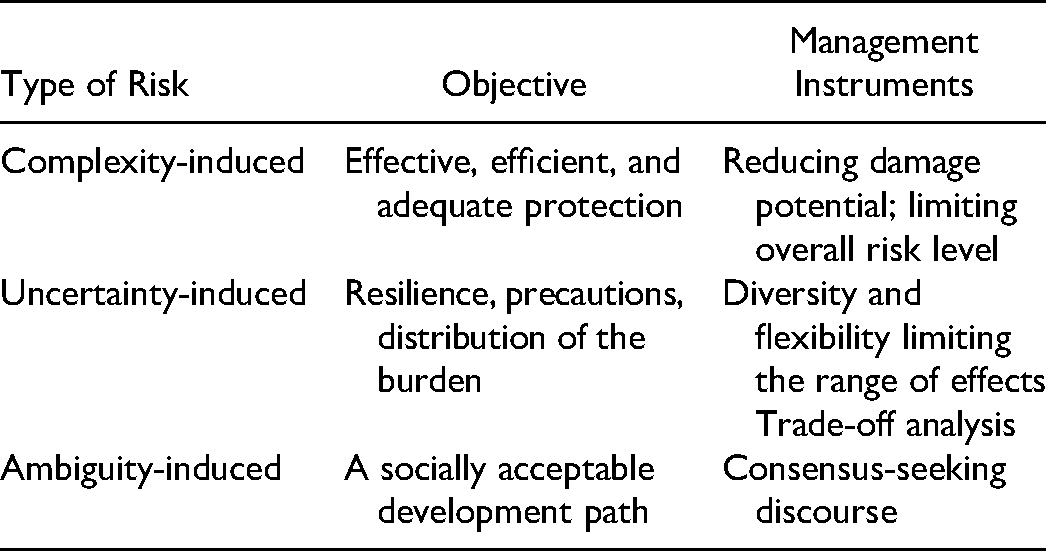
First, complexity-induced risks are characterized by a multitude of potential causes. A complex risk has many known factors that influence the risky outcome. The causal relationships form a web of multifaceted relationships between the risk and the factors that vector in on the outcome.
Second, uncertainty-induced risks are, in essence, risks that are not future facts. This type of risk cannot be mitigated by solely conducting a scientific assessment; it is uncertain if the specific risk will emerge at all. Risks—by definition—come as a relative surprise and it would have been difficult to respond on it a priori the event.
Third and final, there are risks in projects that relate to ambiguity. Ambiguity means that there are different legitimate viewpoints about the course of action of a project, whether there are consequent adverse effects on the project, and whether these risks are tolerable or not. Ambiguity has to do with the different values within a project. A conflict in values can cause adverse situations within the project, and thus a risk. These three risk categories can overlap (Van Asselt & Renn, 2011). For example, the construction of a nuclear facility in relative proximity to a residential area is complex due to its many technical components, uncertainty concerning the neighborhood, and ambiguity as to the various (political) perceptions regarding the production of nuclear energy (Lofstedt, 1996).
Renn (2008) goes further by connecting the three types of risks to different management instruments. If we apply this to our field of underground risks we see that complexity-induced risks require management instruments such as the unraveling of utility maps (Stoter et al., 2004), 4D mapping (Döner et al., 2011; olde Scholtenhuis et al., 2016), or subsurface utility engineering systems (Rogers, 2009). The output of these instruments can only be understood by experts.
The management instruments of uncertainty-induced risks aim to take extra precaution and create resilience to allow for project setbacks to happen. As uncertainty-induced risks are not fully known or knowable, experts are not always equipped to manage them. Therefore, management instruments that are focused on mitigating uncertainty are not predicated on the input of experts but are based on techniques that allow for flexibility in the construction process and from there arrive to satisfactory solutions.
According to Renn (2018), instruments to manage ambiguity-induced risks are centered on conflict resolution and value trade-off. This type of risk requires tools to reflect upon actors’ underlying values and worldviews to reach a satisfactory outcome. For example, Vilventhan and Kalidindi (2016) argue that facilitating a dialogue during coordinative meetings with stakeholders is important for reducing delay. The goal of this management instrument is to eventually reach a consensus about the prioritization of the risks. In short, we interpret the prioritization of specific management instruments as a reflection of the risk management approach.
By using Renn's broad and generic categorizations, we are likely to (1) find relevant perspectives beyond our specific field or application, and (2) be able to identify various perspectives of project actors in construction projects. In the next subsection, we therefore formulate two assumptions with regard to the type of risk management we expect to correspond with underground risks in construction projects.
The Application of Renn's Model to Underground Risks in Construction Projects
As has been reported in the literature, underground risks are an important factor for delay and cost overrun within construction projects (Ghosh & Jintanapakanont, 2004). Unforeseen events in the subsurface are frequent and recurring (Hayes & McDermott, 2018) due to an increased engagement with subsurface space for harboring utilities (Curiel-Esparza et al., 2004; Hooimeijer & Maring, 2018). For example, infrastructural construction projects are subject to geotechnical forces such as seismic and hydrologic effects (Barry, 2016). Given the nature of these invisible and unforeseeable risks, we argue that risks are not so much complexity-induced, but more likely uncertainty-induced. These are “unknown knowns” or even “unknown unknowns:” risks of which the likelihood of occurrence is uncertain, as are in some cases the effects and their causes. This requires a different type of risk management.
We argue here that asset managers and project managers—due to their roles in construction projects—have distinct perspectives on how to manage underground risks. Asset managers manage the selection, maintenance, inspection, and renewal of physical assets. In the purview of construction projects, asset managers are the representatives of the utilities and end users. The quality of the assets needs to be optimal to ensure the utilities’ smooth transportation, such as in the cases of water or electricity. Asset managers tend to think more long term because of maintenance tasks and the responsibility to repair damages to their assets (Deadman, 2010). From this stance, the asset manager's perspective on risk management may be focused on the risks related to improving the quality of the work, and building the assets in such a way that it poses no risks for future maintenance (Kelly et al., 2014; Mohseni, 2003). In contrast, project managers are perhaps less interested in the future and more interested in the realization of the project within time, scope, and budget (Atkinson, 1999). They focus on their project's requirements and tend to look less at the value of the project beyond the project (Virine & Trumper, 2016). Their perspective on risk management is designed to manage risks during the project execution that hamper the accomplishment of project requirements (Turner & Müller, 2004).
Since asset managers and project managers might have different perspectives on risk management to underground risks in a project, we assume that these risks are ambiguous by nature. These are not only uncertainty-induced, but—given the divergent views on their nature and how they should be dealt with—they are also ambiguous and require a corresponding type of management. This raises the question as to what extent different views can be identified—within construction projects with underground risks—that (1) acknowledge the uncertainty- and ambiguity-induced nature of these risks, and therefore (2) suggest corresponding management tools.
In the next section we will explain how—combining Renn's model with a Q methodology—we formulated statements to identify the viewpoints of asset managers and project managers regarding the way subsoil risks should be managed.
Methodology
Q Methodology and Respondents
The core of the methodology is a Q methodology, which is a systematic approach toward studying subjectivity among multiple actors (Brown, 1993). Q methodology correlates people's viewpoints, instead of test items, and uses a factor analysis to identify underlying structures based on the correlations (Dickinson et al., 2014; Steelman & Maguire, 1999; Stephenson, 1935).
The Q methodology proceeds in the following way: Respondents are presented a set of statements, known as a Q-set, about various instruments for managing underground risks and then asked to rank the statements in order to see how much a respondent agrees with the statement. By ranking the statements this way, the respondents reveal their subjective viewpoints and personal profiles accordingly (Brouwer, 1999; Smith, 2001). This method allows respondents to form their viewpoint holistically, with a high level of qualitative detail (Brouwer, 1999; Watts & Stenner, 2014). The Q methodology eventually uncovers perspectives by statistically clustering respondents’ viewpoints based on similarities in ranking. The pool with the largest number of respondents determines how widespread a perspective is. Consequently, majority and minority perspectives can be uncovered using this methodology (Herrington & Coogan, 2011; Maxwell, 2000). In our study, the results are used to disclose an unanticipated array of perspectives on risk management toward underground risks, fully independent of an assigned role.
A Q-sort of 25 to 75 respondents is advised to be of sufficient weight to statistically extrapolate different perspectives (Brown, 1980). Too many respondents can foster complexity and subtle nuances can be missed (Watts & Stenner, 2005). In our study, the sample size of 36 respondents is considered large enough for conducting a statistical analysis. These respondents were selected from three different departments within Schiphol Airport working on various construction projects: 26 respondents are project managers or related to project management tasks, and 10 respondents are asset managers or related to these tasks. Respondents were sampled through a snowball technique (Biernacki & Waldorf, 1981). This technique risks a homogeneous sample through a subjective selection of respondents (Browne, 2005). Therefore, we also selected respondents based on their managerial position and their working experience with the underground.
Q-Sort: Constructing the Concourse
A total of 21 statements (S1…S21) were formulated, representing a concourse of all the relevant aspects of ways to manage underground risks. A concourse is the development of statements that together represent a demarcated topic; in this case, perspectives on risk management of underground risks. This concourse is based on Renn's risk model (Renn, 2008), which prescribes the range of management instruments that in constellation with each other form a risk management approach. Thus, perspectives on risk management are operationalized by Renn's model. The specific formulation of the statements—positing the management instruments of underground risks—were based on exploratory conversations prior to the Q study, as recommended by Watts and Stenner (2014). Defining the concourse was done by (1) conducting exploratory interviews and attending meetings with project actors to get a general sense of the topics that are discussed during subsurface projects, and (2) using Renn's risk model to capture the scope of the issues raised during the exploratory fieldwork.
In total, 21 statements were constructed, representing the three types of risks; meaning that each type of risk was captured in seven statements (see Table 2). The statements needed to represent the theoretical concepts of risk but also needed to evoke familiarity for the respondents. The goal was to describe the statement in such a way that it reflects “ordinary conversations, commentary and discourse of everyday life (Brown, 1993, p. 94).” This way, respondents can relate best to the statements and understand the meaning behind the statement. Each statement describes a management instrument that is related to a specific type of risk. A pilot study of two respondents was conducted to make sure that the right statements would be picked and whether other statements needed to be included to ensure that the statements covered the concourse (Watts & Stenner, 2014). Two statements were swapped after the pilot, which enhanced the trustworthiness of the study (Bowen, 2006). Because this is a topic where people have strong opinions, we made the Q-sort as steep as possible for the 21 statements (see Figure 1 for an illustration of a Q-sort).
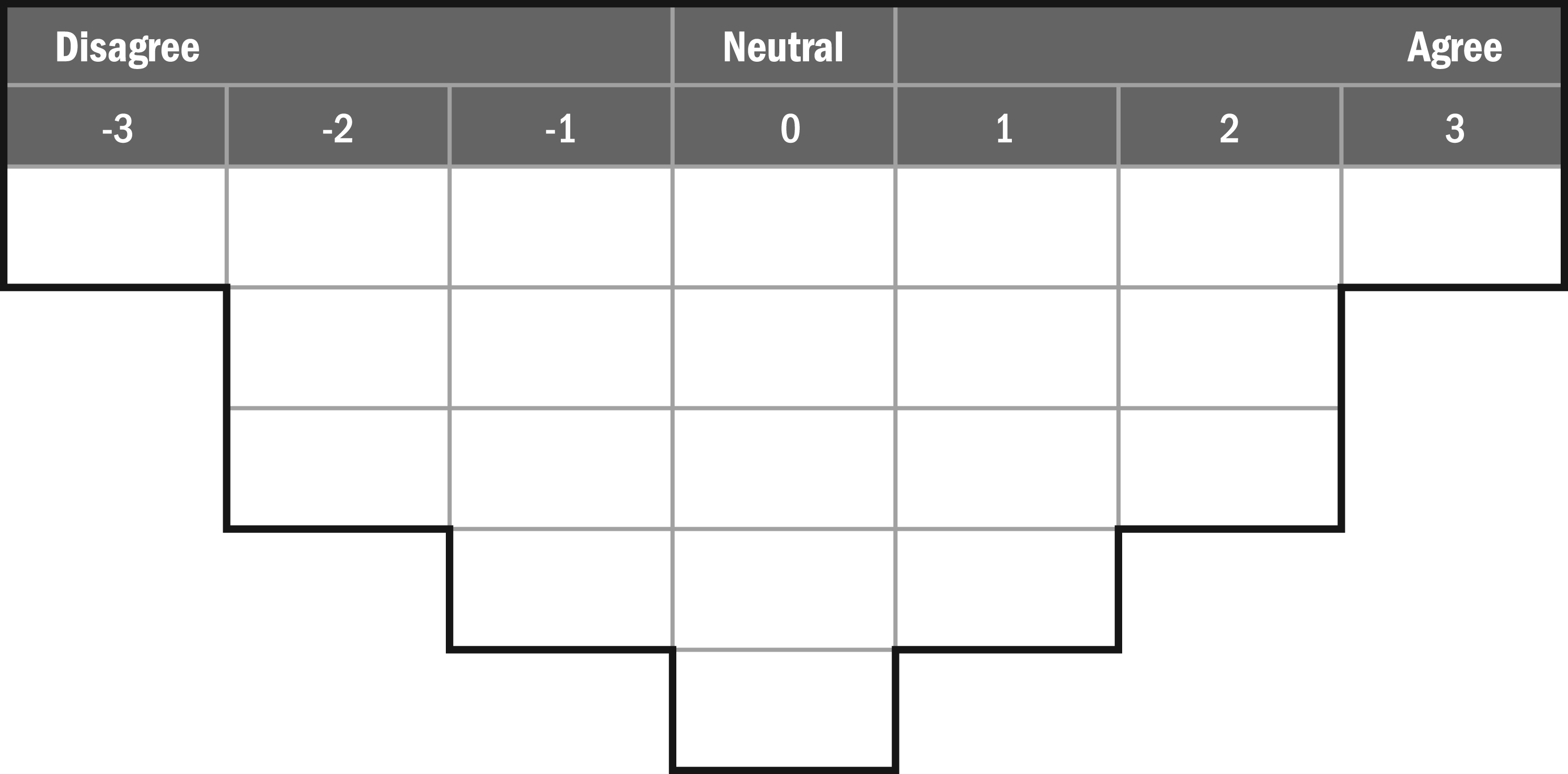
Steepness of Q-sort.
The Statements in Relation to the Perspectives on Risk Management
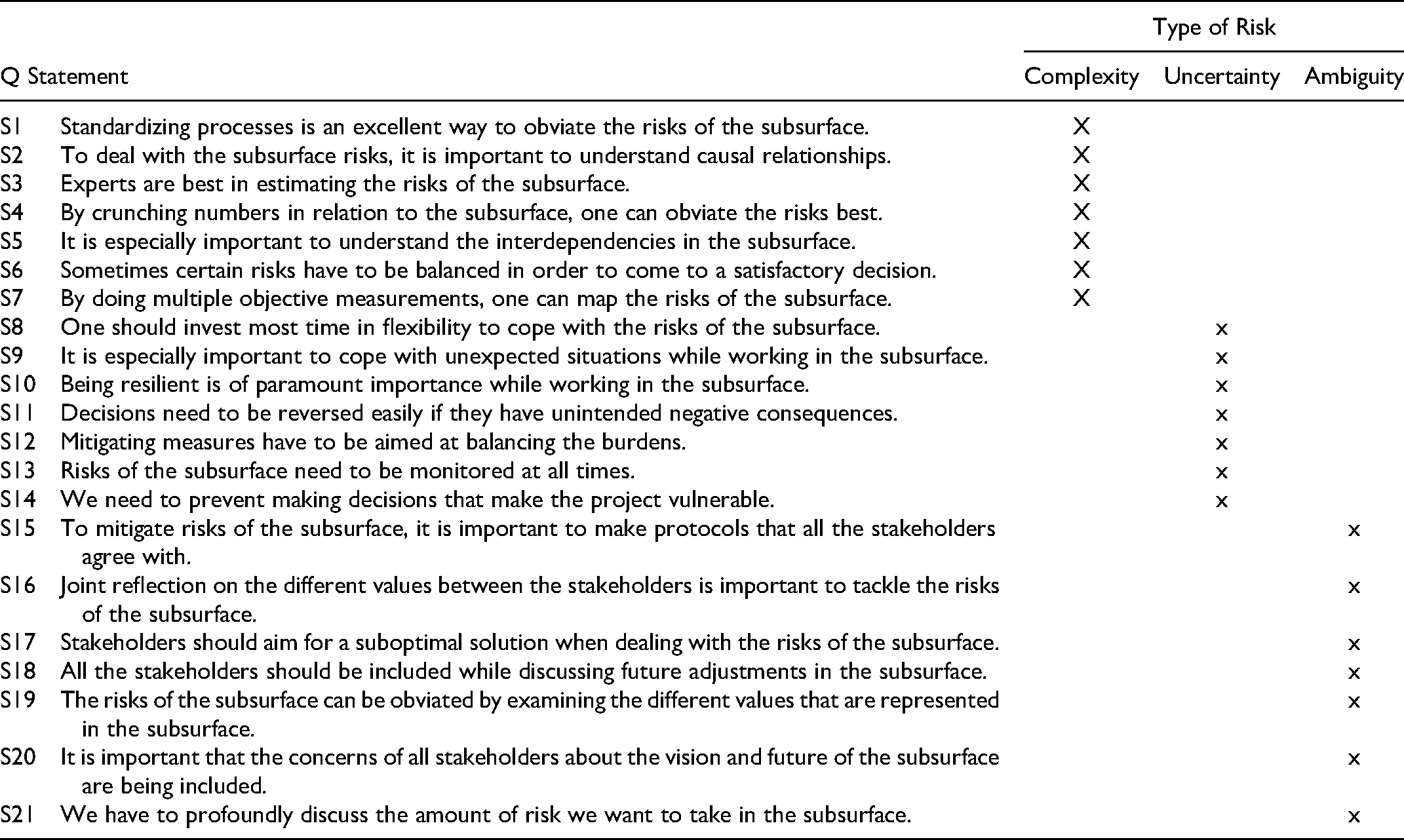
Analyzing a Q-Sort
It took every respondent approximately 30 minutes to finalize the sorting process. After the sorting process, respondents were interviewed for another 30 minutes. The key questions they were asked were as follows:
Why did you agree most with the statements at + 3? Why did you disagree most with the statements at − 3? Are there thoughts or ideas that you missed when doing the sort? Are there any other statements you would include? Are there any other thoughts you would like to share?
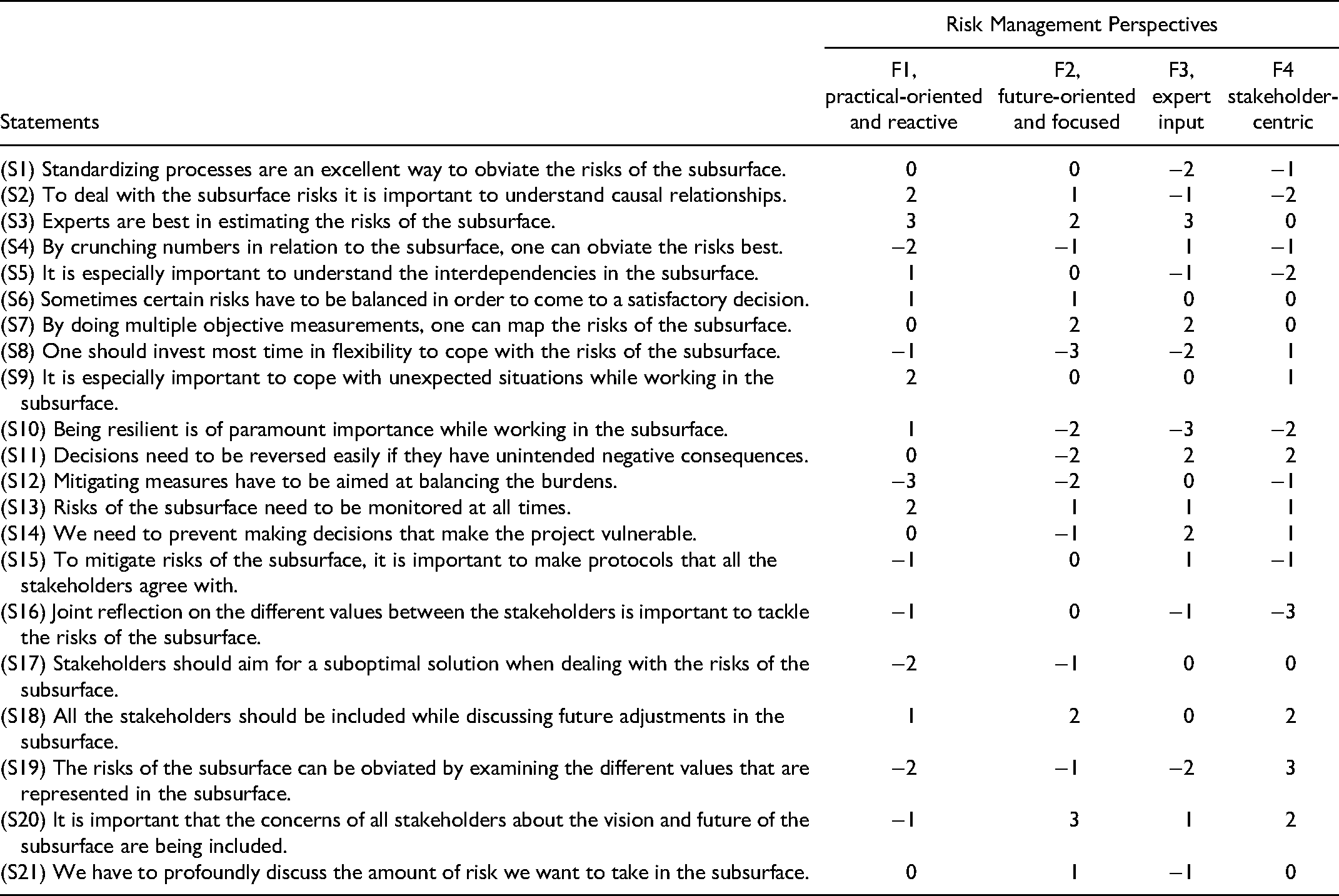
The sorting data were analyzed with the software package Ken-Q Methodology. This is a free-to-use, web-based application that allows researchers to upload the ranking of the Q-sort. In the analysis, we used a centroid factor analysis with seven extractions, which is customary (Brown, 1980; Watts & Stenner, 2014). To assess the relevance of the factors, we adopted two criteria: Kaiser-Guttman's criterion to retain the factors in the analysis with a value higher than 1 (Kaiser, 1958), and the criterion to only retain those factors in the analysis that had two or more respondents loaded significantly on the factor (Watts & Stenner, 2014). Out of the seven extractions, we could keep four factors into the analysis for factor rotation. For the sake of the robustness of the data, we also extracted eight extractions, but this did not change the eventual outcome of four significant factors. The four factors are clusters of respondents that ranked the statements statistically similar. Thus, four perspectives could be discerned from the output. See the Appendix at the end of the article for the factors and loadings per factor.
Our data showed the emergence of four perspectives on risk management, which together explained 49% of the total variance. This is sufficiently above the 35% to 40% threshold generally recommended. A total of 25 respondents loaded significantly on the factors (see Table 3). The factors show high to very high reliability (average reliability coefficient = 0.8, composite reliability > 0.9 for two factors and > for the other two).
Two Dominant Viewpoints and Two Minority Viewpoints and Factor Loadings Generated With Varimax Method; Significant Loadings Are Indicated With * (p < .05)
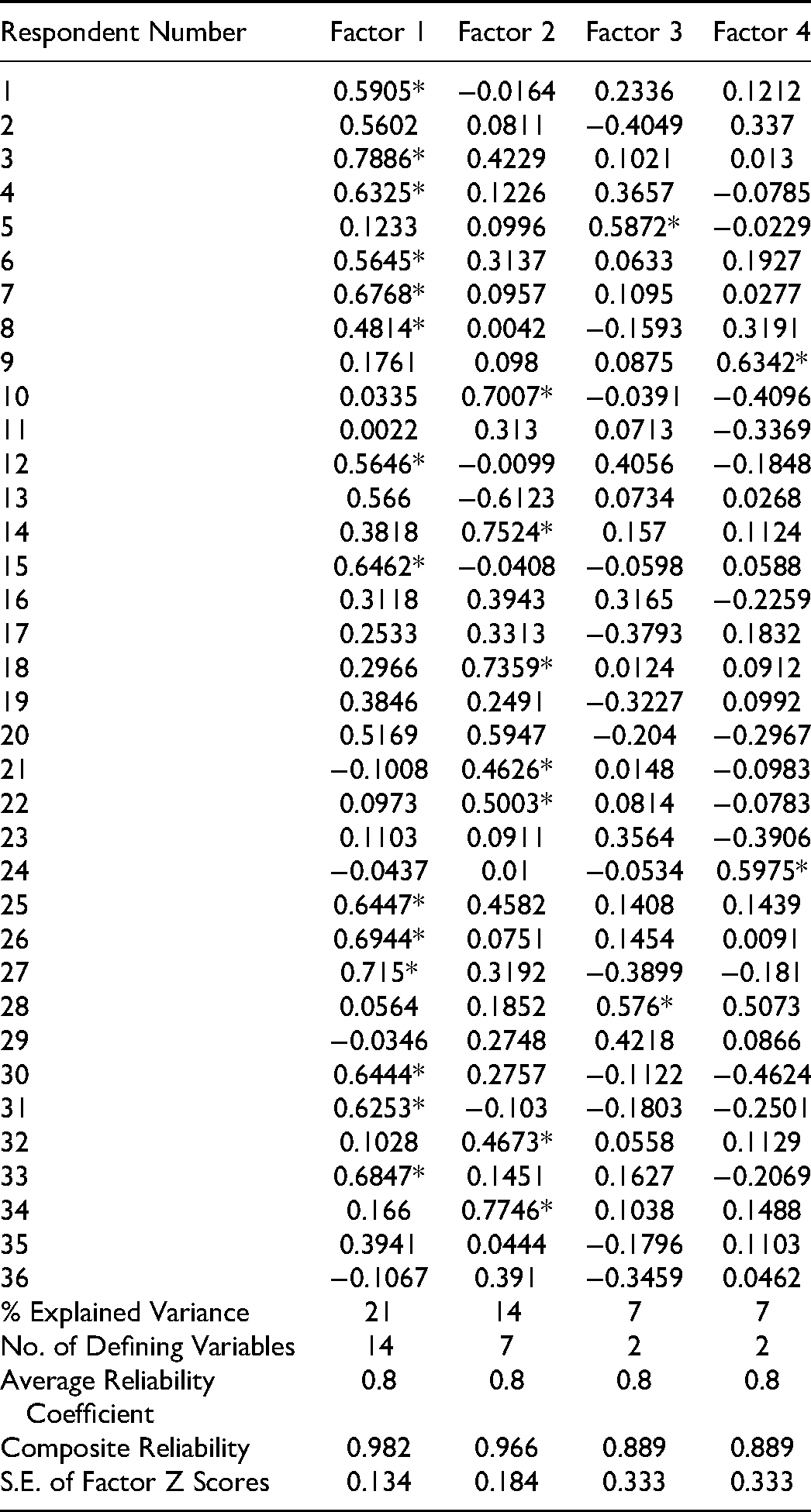
To interpret the software output, which clustered viewpoints together, the interviews had to provide meaning to the clustering. This was done by open-coding the interviews, and subsequently identifying similarities of sensemaking between the respondents who loaded significantly on their specific factor. The labeling and interpretation of the factors were therefore based on connecting the codes of respondents who loaded on the same factor, and obtaining a collective meaning possessed by these respondents in relation to the factor. Analyzing the factors in this way assured that the factor labels were recognizable to the respondents. This was to ensure that the respondents identified themselves with the results. We subsequently reflected on the results with two respondents to discuss the interpretation of the findings. These discussions did not alter the interpretation of the findings.
Findings
The study identified two dominant and two minority perspectives to underground risks at Schiphol. The two dominant perspectives are labeled as action-oriented and future-oriented, and the minority perspectives are identified as expert input and stakeholder-centric. These four perspectives provide an overview of all the perspectives on risk management of the population of asset and project managers in Schiphol. Following, the four perspectives are discussed in detail.
Dominant Perspectives: An Action-Oriented Perspective on Risk Management
This first perspective on risk management was shared among seven project managers from Capital Programme, two project managers from the project department, and five asset managers. In total, 14 people loaded on this factor.
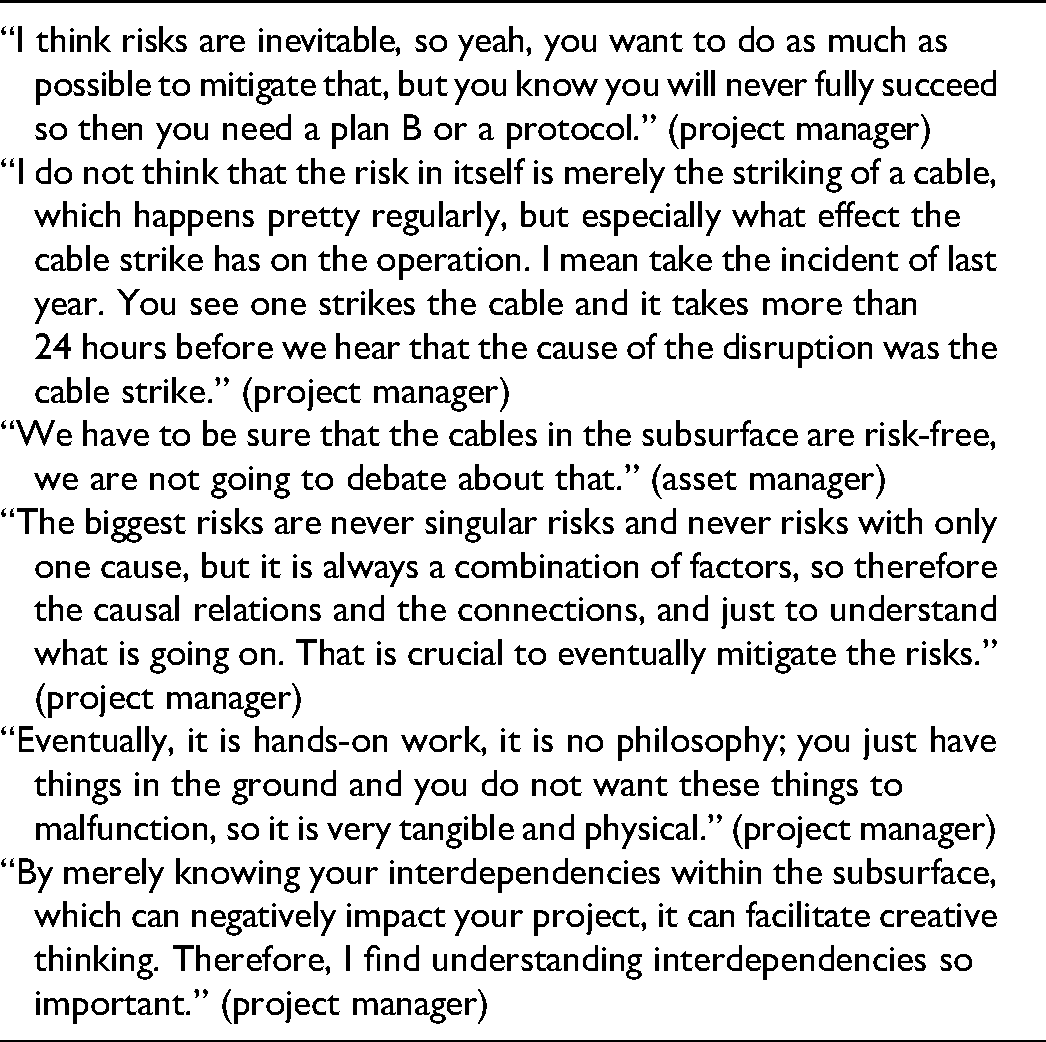
This perspective is characterized by focusing on the physical nature of risks within the underground. Risks are deemed purely physical. The risks reside within the underground, for example, in the form of contaminated soil or unknown cables and pipelines. As one project manager argued: “You have to work hands-on; it is not a philosophy, there are just things in the ground and you do not want to damage them.” This perspective is “down to earth.” The single most important focus of the project is the continuation of airport operations. The complexity lies in risks that are not pinpointed to one cause. Instead, there are interdependencies within the underground, making it difficult to manage the risks sufficiently. One project manager surveyed said, “If you unexpectedly hit a cable, you just do not know what is going to happen exactly. Sometimes you do not know what the function and consequences are of a cable; that makes it complex.” From this perspective, the best way to manage these types of risks is through utility experts (S3). The utility experts can inform the project about important risks in the subsurface (S2 and S5).
There was a stark recognition that the project was working on an airport, meaning that airport operations were not to be hampered by project activities. One asset manager stated that “the airport process is leading in everything we do.” Therefore, project managers should always be wary of the uncertainties that reside within the subsurface, such as unknown cables (S9), and should consequently monitor the project's environment carefully (S13). One project manager argued that “if you are working in the subsurface, you cannot always put things in stone”; it is important to react to what happens on the site. If it turns out that digging in the soil is causing problems, project management should have a plan B. This plan should be based on the best knowledge available that results in steering the project away from danger. Having a plan B creates flexibility for the project during its process.
This perspective argues that project stakeholders merely complicate the realization of the project, which is not desirable. Since project managers are familiar with a variety of stakeholders having a stake in the underground at Schiphol, they were hesitant to allow all the stakeholders to participate in the project's decision-making processes (S17, 19). From their viewpoint, other stakeholders should understand Schiphol's desire to finish this project. The project should take means into its own hands. It should not be distracted by too many stakeholders who might hamper the process (S16). If stakeholders experience burdens due to the project, they should be compensated in some way (S12). However, as one project manager warned, “We cannot satisfy every stakeholder; sometimes you win some, sometimes you lose some.”
The results led to the conclusion that this perspective on risk management is mostly aimed at complexity-induced risks, but also stresses the importance of managing uncertainty-induced risks (see Table 4).
Illustrative Quotes for the Action-Oriented Perspective on Risk Management
Dominant Perspective: A Future-Oriented Perspective on Risk Management
This second perspective is significantly loaded by three project managers from the project organization, two from the project department, and two managers from the asset management department.
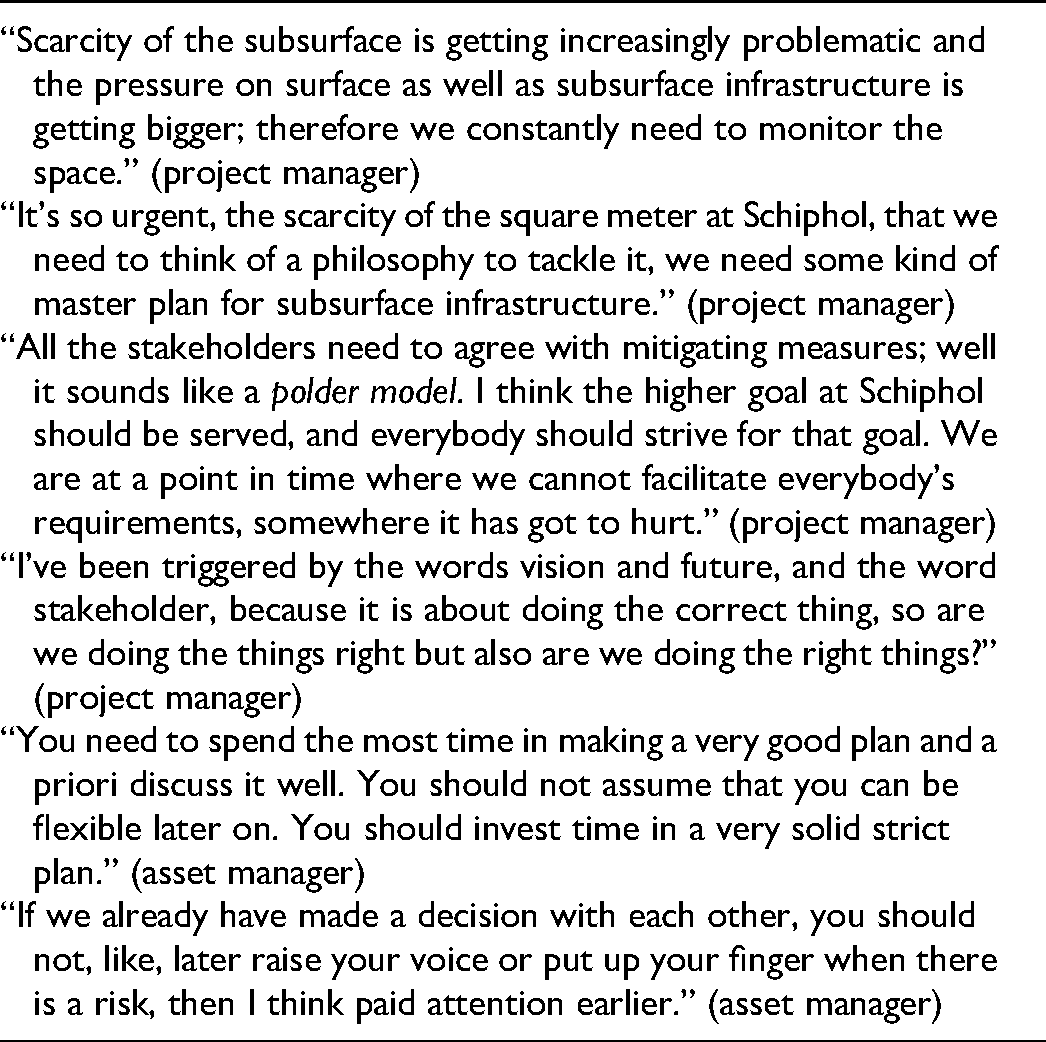
The central theme of this perspective highlights the increasingly urgent scarcity of the underground. From this perspective, management is urged to consider how the project fits in a broader vision about the use of the underground. Because new construction projects have increasing problems with fitting their construction vis-à-vis other projects on the “post stamp of Schiphol,” according to one asset manager, it is important to “make claims for underground space,” as a project manager stated. An underlying risk in this context is that project management might not do the right thing, and the Schiphol project department needs to make underground utility adjustments in future projects. To “do the right thing,” as one project manager said, projects need a clear vision to tap into (S20). Therefore, it is paramount that an underground master plan, which includes certain claims on the underground space, is produced. This approach implies that, at this moment, Schiphol does not yet have a master plan, but that one should be developed to manage these risks.
This risk management approach aims for a bigger role for asset managers “to determine a vision for the state of the underground,” as one project manager explained. Asset managers are irreplaceable in determining the right strategy for the underground. In proposing changes to the underground, asset managers need to be included to know if the project is doing the right thing. They can provide suggestions about the future of the underground to key decision makers in the project.
Furthermore, as projects make detailed decisions, objective data are important to mitigate the multitude of claims that could be made by the various Schiphol stakeholders, such as KLM or hotel branches (S7). During the development of a project management plan, intended steps should be thoroughly discussed, and asset managers play an important role in making the consequences for the underground transparent. At the start, the burdens are discussed and the risks are identified (S12), but when decisions have been made, asset managers should follow the course of the project. One asset manager argued, “If it's correct we already discussed our direction, if someone then suddenly says we should do this, well that station has been passed.” It means that the project should not be too flexible in managing risks because it may result in a deviation from the original plans (S8). In this perspective on risk management, deviation from an original plan is not desirable because the project (manager) might lose control of the process. If unintended consequences do surface, the project manager needs to hold to their course as much as possible (S10). Overall, this perspective on risk management predominantly takes aim at a combination of complexity-induced and ambiguity-induced risks (see Table 5).
Illustrative Quotes for the Future-Oriented Perspective on Risk Management
Minority Perspective: An Expert Input Perspective
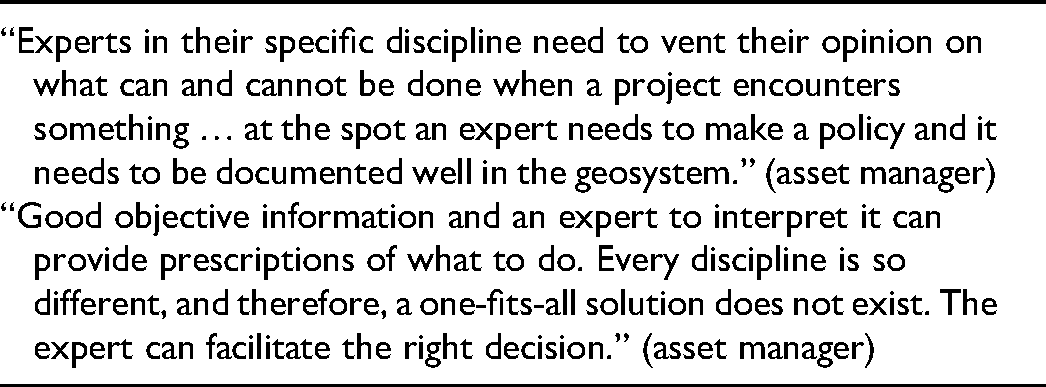
Two asset managers are significantly loading on this perspective. From this perspective on risk management, risks are complex in nature and experts are the prime actors to manage these underground risks. This perspective argues that underground risks are too specific to be easily understood and therefore experts should estimate the best risk management approach for the situation (S3). Experts facilitate objective information because they can read and interpret the data in the right way and can put it in the system correctly (S7). Resilience and flexibility within the project are unnecessary (S8 and S10) if utility experts can participate in the project. The utility experts can judge the situation and act accordingly. This even means that experts can help formulate a risk management plan that is suitable for practice. Accordingly, resilience and flexibility within risk management are considered acts of weakness because they expose the ignorance of project managers about underground risks.
To make good decisions within a project about underground risks, adherents of this approach encourage the inclusion of utility experts in the decision-making process. Project managers ought to incorporate the expertise of the asset managers in the decision-making process. One asset manager's reasoning in this regard goes as follows: If projects are working in the airport, they work for the airport. Therefore, the project works for the airport, and if utility experts—who feel like they are representing the airport—identify risks, “we should be able to say that we are going to bring the project to a halt.” It shows that utility experts do not necessarily have the level of influence to bring the project to a halt, but they believe they should be part of the project decision-making to avoid decisions being made that could hurt the airport. Because underground risks are too complex to comprehend for the project management, a utility expert should be part of the risk management. In this perspective on risk management, utility experts gain more responsibility, and it should therefore be possible to reverse project decisions that are made by nonexperts (in terms of the underground) if a utility expert deems it necessary (S11 and S14). To standardize processes within a project is logical, but it is futile when it comes to managing underground risks that appear during a project on a daily basis (S1). The results demonstrate a perspective on risk management that concentrates on complexity-induced risks (see Table 6).
Illustrative Quotes for the Expert Input Perspective on Risk Management
Minority Perspective on Risk Management: Stakeholder-Centric Perspective
This perspective is shared by one project manager and one asset manager. This viewpoint identifies the ambiguity of the underground as the dominant risk at Schiphol.
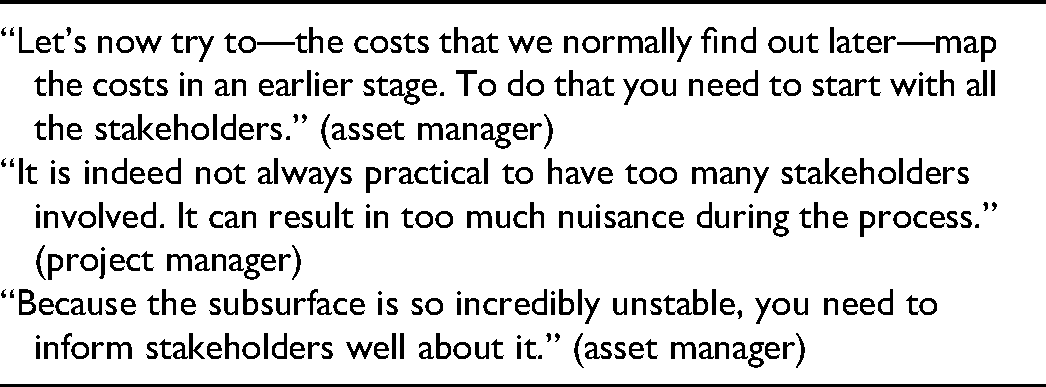
Underground interests are generally not easily revealed at Schiphol. Due to a lack of insight into the underground, such interests become obscured. Therefore, the project cannot know exactly who is at risk within the project. This perspective on risk management therefore argues that risk management should focus on informing all necessary stakeholders at the beginning of the project so that the variety of values within the subsurface become apparent (S19). Including many stakeholders in the early stages facilitates a better estimation of the costs for the different stakeholders of the project. Stakeholders in this perspective should be given an important role in the project because it is important that they have an influence on decision-making. They should, for example, be able to reverse decisions by which they would otherwise be negatively affected (S11).
This perspective does recognize, however, that too many stakeholders may also not be efficient. Therefore, stakeholders should focus their efforts on the early stages of the project, and thereafter fulfill a monitoring (S13) and advisory role. In sum, this perspective on risk management especially manages ambiguity-induced risks (see Table 7).
Illustrative Quotes for the Stakeholder-Centric Perspective on Risk Management
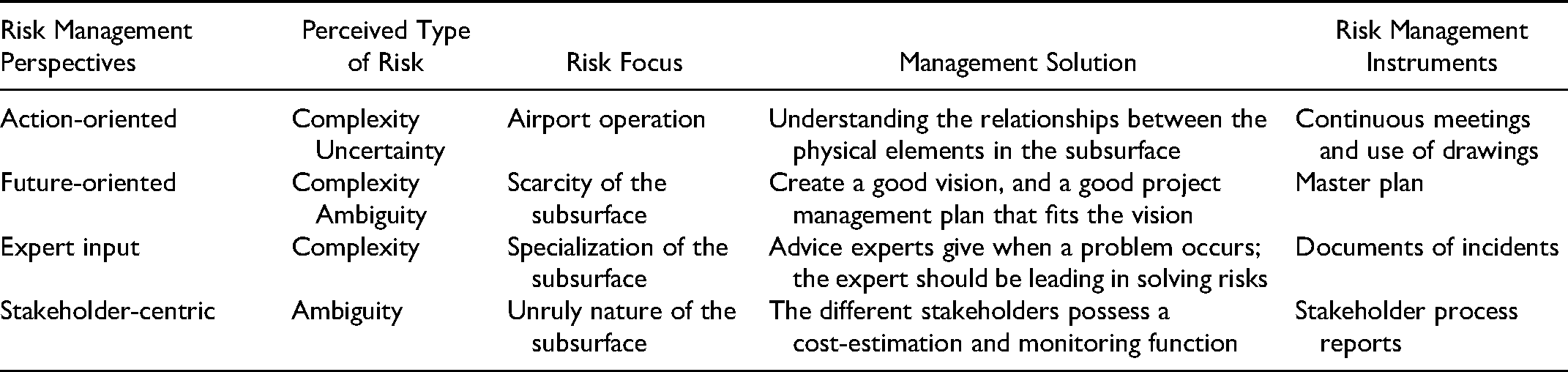
Based upon the findings presented above, we come to a summarizing of the different perspectives (see Table 8).
Four Risk Management Perspectives Toward Managing Underground Risks
Discussion
This article identified asset and project managers’ perspectives on risk management in the context of underground risks within construction projects. We studied the (past) experiences of asset and project managers working on construction projects at Schiphol Airport. Building on Renn's risk management model, the Q methodology proved to be instrumental in identifying various and overlapping viewpoints on risk management that existed among the project actors. The findings revealed four perspectives on risk management, from which we discerned two to be dominant. The first dominant perspective on risk management is action-oriented, focusing mostly on complex and partly uncertain risks. The second dominant risk management approach is future-oriented, directing its efforts toward a combination of complexity and ambiguity-induced risks. Furthermore, two minority perspectives on risk management were found. One minority perspective on risk management is expert input, which stresses the importance of experts to understand complexity-induced risks. The final minority perspective is stakeholder-centric, emphasizing efforts to manage ambiguous risks. These perspectives show that project actors perceive underground risks predominantly as complexity-induced. Although some perspectives do acknowledge the existence of other types of risks, these perspectives mostly address other types of risk by utilizing management instruments that are complexity-based. These findings contribute to our understanding of risk management in project studies in diverse ways.
Various Viewpoints on Risk Management
Previous research has shown various risk management approaches exist within projects (Johansen et al., 2014; Wang et al., 2016b). Our study reveals that there are also various viewpoints on risk management based on the perceptions of project actors, who are grouped within four risk management perspectives. These perspectives can have diverging—and perhaps even conflicting—ideas and preferences on how underground risks should be managed in projects. In Schiphol projects, the perspectives on risk management that we identify coexist alongside the formal risk management approach(es) that have been adopted within the projects. These perspectives were neither acknowledged, nor made explicit, and may not have been observed by actors. This is in line with Xia et al. (2017) who postulate the lack of focus on subjective perspectives within projects. It remains to be seen how these perspectives relate to a formal risk management approach developed within a project. Nonetheless, risk-related differences between project actors cannot be neglected, because project actors—together with their subjective judgment—are indispensable in perceiving, assessing, and dealing with risks in projects (Taroun, 2014; Wang et al., 2016b).
Another implication of this finding regarding the presence of various perspectives on risk management is the possibility that these perspectives might have influenced their behavior and subsequently might have hampered the implementation of the formal risk management of the project. Besides confusion, the unnoticed multitude of perspectives on risk management may also lead to frustration and resistance, especially when minority viewpoints are not heard or ignored, as argued by Chapman (2019).
Overlapping Viewpoints on Risk Management
Our findings do not confirm our initial expectation based on risk management literature (Bryde & Volm, 2009; Hillson, 2019; Liu & Yuliani, 2016), namely that a project actor's role or objective is directly related to their viewpoint on risk management. Project actors show a great deal of overlap in their perspectives on risk management. This might suggest that the majority of project actors do not necessarily perceive risks according to their positions or objectives. This observation stands out since it has been theorized that a risk management approach stems from one's individual social structure, in other words, interests and roles (Archer, 1995; Hillson, 2019). An explanation for our observation could be that these findings are a result of the authors’ adoption of Renn's categorizations. The level of abstraction in this categorization is high, implying that actors may see different risks depending on their position or role (e.g., asset managers seeing underground risks, while project managers seeing risks in terms of time and budget), while they share the same perspective as identified within our study and also share a bias toward complexity-induced risks. A possible explanation of project actors’ shared focus on complexity may be the disciplinary background of many project actors (Bakhtari, 1995; Gröschl & Barrows, 2003), often consisting of an engineering background with a strong orientation toward substance or a project management orientation toward controlling risks (Kunda, 2009). The dominance of complexity-induced risk perceptions may also be associated with the reflexes of project actors to claim a special position and enhance their relevance within a project on the basis of their unique expertise in a certain aspect of complexity. Both explanations could demonstrate a bias toward a complexity-induced approach rather than an adaptive or process-oriented one.
The general focus on complexity-induced risks is in contrast with our initial expectation. We expected that the perspectives of project actors would be more uncertainty-focused—or even ambiguity-focused—based on the nature of the materiality that needed to be managed. Although project actors did, to a certain extent, heed uncertain and ambiguous risks by identifying risks as such, they were not able to connect these risks to appropriate management tools. This finding is in line with Leijten (2017) who shows that risk management mostly deploys complexity-related tools, and to a lesser degree, uncertainty-related tools, to manage construction projects.
These findings suggest that it is of crucial importance to explore, acknowledge, and discuss the different risk management approaches present among project actors in order to tackle the plurality of risks that a project can be confronted with.
Conclusions
In this study, by conducting a Q methodology that was based on Renn's risk model (2008), we identified various perspectives on risk management. We found four perspectives on risk management: two dominant perspectives—action-oriented and future-oriented viewpoints—and two minority perspectives—expert input and stakeholder-centric—among asset managers and project managers at Schiphol Airport. Our findings contribute to project studies by advancing insight into the subjective aspects of risk management in projects, as called for by scholars (Chapman, 2019; Xia et al., 2018). We especially see three theoretical contributions. First, we show that in addition to formally implemented risk management approaches, there also exist various perspectives on risk management. Because this observation has not been acknowledged before within project studies, new avenues for research could examine the ways in which such perspectives on risk management might influence the implementation process of formal risk management approaches. Second, the various perspectives on risk management cannot be explained by a project actor's role or objective within the project, as suggested in previous project studies. While it may be true for concrete risks that project actors’ perspectives on risk management are related to their roles and objectives, this is not true if risks are described in more abstract terms, such as in Renn's typology. The perspectives we have identified in our study show that viewpoints may overlap, and preferences gear toward certain perspectives on risk management. This result may encourage scholars to explore the ways in which perceptions change on the management of risks, depending on the way in which risks are conceptualized. Third, by applying Renn's model, we found that project actors’ risk management approaches were predominantly focused on complexity-induced risks instead of uncertainty and ambiguity-related risks. This observation could be indicative for other projects as well, considering the tendency of project actors to focus on project control. Further research might seek to expand on the ways in which viewpoints shape the behavior of project actors and influence the management of risks in projects.
Furthermore, in practice, project actors who have different roles and objectives can have overlapping viewpoints on risk management. This yields a practical contribution to the field. Our findings show that the various perspectives on risk management are mostly focused on a specific category of risk. Therefore, we suggest that project managers engage in a dialogue with experts at the start of a project to align their possible different viewpoints on risk management. This is in line with earlier suggestions by Chapman (compare Chapman, 2019). The overlapping perspectives provide opportunities for bridging these possible differences. Such an approach would help project managers to obtain a full picture of possible risks in the project. These managers need to be aware of the potential bias concerning complexity-induced risks by allowing voices concerned with ambiguity and uncertainty to be considered in the decision-making process. Other scholars have advised to include dissenting or minority views of experts in decision-making on a management level to improve its efficacy (De Dreu et al., 2008; Nijstad et al., 2014). It is therefore important that various types of risks are addressed and not merely the “obvious” ones (Kutsch et al., 2014).
Although the analysis of viewpoints on risk management was guided by the generic categorization of Renn's model, which allowed for theoretical generalization (see Yin, 2017), the results cannot simply be generalized to a wider public of asset managers and project managers, or actors in different project contexts. Other types of projects with different “material” conditions or governance settings might influence the way in which project actors perceive risks and risk management (compare Biersteker et al., 2021). Taken together, an important topical direction for future research involves other types of risks and project governance in examining the subjective aspects of risk management.
Lastly, contemporary scholars focus on the upside of risks—or opportunities—as a theoretical counterpart of risks in managing projects (Hillson, 2019; Johanson & Vahlne, 2006). This strand of literature advocates managing the opportunities that reside within projects. As this study shows, the focus on the viewpoints on risk management and the use of Q methodology may be a fruitful way to identify and capitalize upon the opportunities that actors see within projects when dealing with risks.
Footnotes
Declaration of Conflicting Interests
The author(s) declared no potential conflicts of interest with respect to the research, authorship, and/or publication of this article.
Funding
The author(s) disclosed receipt of the following financial support for the research, authorship, and/or publication of this article: This work was supported by the Nederlandse Organisatie voor Wetenschappelijk Onderzoek (grant number 439.16.805).
Author Biographies

Appendix
Q-set risk perspectives to the subsurface: Factor scores for the statements. S1–S7 are complexity-induced risks, S8–14 are uncertainty-induced risks, and S15–S21 are ambiguity-induced risks.
| Risk Management Perspectives | ||||
|---|---|---|---|---|
| Statements | F1, practical-oriented and reactive | F2, future-oriented and focused | F3, expert input | F4 stakeholder- centric |
| (S1) Standardizing processes are an excellent way to obviate the risks of the subsurface. | 0 | 0 | −2 | −1 |
| (S2) To deal with the subsurface risks it is important to understand causal relationships. | 2 | 1 | −1 | −2 |
| (S3) Experts are best in estimating the risks of the subsurface. | 3 | 2 | 3 | 0 |
| (S4) By crunching numbers in relation to the subsurface, one can obviate the risks best. | −2 | −1 | 1 | −1 |
| (S5) It is especially important to understand the interdependencies in the subsurface. | 1 | 0 | −1 | −2 |
| (S6) Sometimes certain risks have to be balanced in order to come to a satisfactory decision. | 1 | 1 | 0 | 0 |
| (S7) By doing multiple objective measurements, one can map the risks of the subsurface. | 0 | 2 | 2 | 0 |
| (S8) One should invest most time in flexibility to cope with the risks of the subsurface. | −1 | −3 | −2 | 1 |
| (S9) It is especially important to cope with unexpected situations while working in the subsurface. | 2 | 0 | 0 | 1 |
| (S10) Being resilient is of paramount importance while working in the subsurface. | 1 | −2 | −3 | −2 |
| (S11) Decisions need to be reversed easily if they have unintended negative consequences. | 0 | −2 | 2 | 2 |
| (S12) Mitigating measures have to be aimed at balancing the burdens. | −3 | −2 | 0 | −1 |
| (S13) Risks of the subsurface need to be monitored at all times. | 2 | 1 | 1 | 1 |
| (S14) We need to prevent making decisions that make the project vulnerable. | 0 | −1 | 2 | 1 |
| (S15) To mitigate risks of the subsurface, it is important to make protocols that all the stakeholders agree with. | −1 | 0 | 1 | −1 |
| (S16) Joint reflection on the different values between the stakeholders is important to tackle the risks of the subsurface. | −1 | 0 | −1 | −3 |
| (S17) Stakeholders should aim for a suboptimal solution when dealing with the risks of the subsurface. | −2 | −1 | 0 | 0 |
| (S18) All the stakeholders should be included while discussing future adjustments in the subsurface. | 1 | 2 | 0 | 2 |
| (S19) The risks of the subsurface can be obviated by examining the different values that are represented in the subsurface. | −2 | −1 | −2 | 3 |
| (S20) It is important that the concerns of all stakeholders about the vision and future of the subsurface are being included. | −1 | 3 | 1 | 2 |
| (S21) We have to profoundly discuss the amount of risk we want to take in the subsurface. | 0 | 1 | −1 | 0 |