




Abstract
The limitations of complexity theorizing in project studies are traced back to simplistic and reductionist theorizing strategies. This article offers pragmatist recommendations to develop strong theorizing strategies organized in a triad: orders of theorizing (degree of recursiveness of the theorizing process), levels of theorizing (interactions between micro, meso, and macro loci of analysis), and the integration between orders and levels brought together in a recursive relationship of co-construction. We offer four main contributions to complexity theorizing in project studies: pragmatism is useful, deeper attention should be paid to theorizing across levels, third-order theorizing is needed, and complexifying terminology is required.
Keywords
“Though this be madness, yet there is method in’t.” 1
Introduction
This article argues that the failures of complexity theorizing in project studies (Bakhshi et al., 2016; Kiridena & Sense, 2016), as an epitome of organization and management studies (Tourish, 2019; Tsoukas, 2017), can be traced back to simplistic and reductionist (Jackson, 2019) theorizing strategies. Most scholars “acknowledge the complexity of the world but deny it in [their] theorizing” (Tsoukas, 2017, p. 135), thereby simplifying both their theorizing and their theories and disappointing practitioners with regard to applicability. In other words, the theorizations (Corley & Gioia, 2011) of complexity fail to exhibit the requisite complexity needed to satisfactorily address the dual hurdles of academic rigor and practitioner relevance. For example, Shenhar and Dvir’s (2007) widely cited conceptualization of complexity is mainly static and does not easily account for emergence (Bentahar & Ika, 2019).
Too often, in order to cope with the challenge of theorizing complexity, scholars tend to borrow hand-me-down theories (Wood et al., 2018), especially from the hard sciences (Oswick et al., 2011), and impose these as analogies and metaphors onto organizational (e.g., Uotila, 2015) or project settings (e.g., Bjorvatn & Wald, 2018). This borrowing strategy, when it is not based on a careful methodological assessment, may lead to a lack of theoretical validity (Ketokivi et al., 2017). For instance, in his critical review of the use of complexity theories in leadership studies, Tourish (2019) argues that due to insufficient theorizing sophistication, many scholars of complexity leadership still “offer a theory of complex organizations led by non-complex leaders who establish themselves by relatively non-complex means.” (p. 219). Project complexity research, we argue, is no exception.
Such lack of theoretical sophistication is generated by dualistic theorizing, which more often than not seeks to provide “a clear-cut and decisive contrast, a well-defined boundary, and no overlap between categories” of complexity theories (Farjoun et al., 2015, p. 1800). For instance, the customary distinction between hard and soft approaches to systems thinking in both organization and management studies (Checkland, 2000) and project studies (Pollack, 2007) opposes a view where complexity is out there to be objectively observed and possibly managed (Baccarini, 1996; Senge, 2006), and another where the complexity resides in the mind of the observer to be made sense of (Cooke-Davies et al., 2007; Tsoukas & Hatch, 2001) but not managed in a mechanistic way (Geraldi, 2009; Jackson, 2019). However, as Casti (1994) notes, complexity is “a joint property of the system and its interaction with another system, most often an observer and/or controller” (p. 269). Thus, we contend, any theorizing strategy that ignores the interactions between the (hard) system and the (soft) observer is bound to generate inadequate theories.
Against this backdrop, this article aims to build on Tsoukas’s (2017) invitation to complexify theorizing and focuses on exploring theorizing strategies for complexity theory in project studies, rather than the detailed contents and categories of one theory or the other. This reframing away from the categories toward the process of categorizing is enabled by a pragmatist approach (Dewey, 1986; James, 1950; Mead, 2006; Peirce, 1992), with a focus on the action and meaning of theorizing as a social process of inquiry through which theories are transformed, adapted, abandoned, or reinvented (Lorino, 2018). Therefore, the research question this article seeks to answer is: “How can a pragmatist approach enable improved theorizing strategies for complexity theory in project studies?”
The article proceeds as follows: We begin with a brief account of the dualistic challenge that confronts complexity theorizing in project studies. We then provide a brief overview of pragmatism as an antidualistic method of inquiry. From this foundation, we develop our theorizing strategies along two main and interrelated categorizing processes of theory-building: orders of theorizing, which deal with the degree of recursiveness of the theorizing process and levels of theorizing, which deals with the interactions between levels of analysis (micro, meso, macro). 2 Finally, we discuss our findings and draw implications for theorizing strategies for complexity theory and pragmatism in project studies.
Complexity Theorizing in Project Studies: A Dualistic Challenge
Complexity has become an integral part of the researcher’s lexicon in the philosophy of science since the eighteenth century (Vico, 1708), in social sciences since the 1940s (Pias, 2003), and in organization and management studies (OMS) since the 1960s (Simon, 1962). Over the past 20 years, the continuing interest in complexity in OMS appears to have been fueled by scholars’ dissatisfaction with the persistent and problematic issues they experience with the dominant reductionist worldview (Allen et al., 2011); the idea that organizations work like machines that may be decomposed into parts, which in turn can be managed in a piecemeal way (Jackson, 2019). This frustration has prompted the need for a new mindset, which has propelled the emergence of the “complexity” worldview: the idea that the organization is essentially interconnected, includes forms and patterns that are shaped by history and context, and ultimately emphasizes things that emerge, flow, develop, grow, and change (Boulton et al., 2015).
In project studies—the scholarly context of this article—things are similar albeit different. In the two and one half decades since project scholars became acquainted with complexity (Baccarini, 1996), there has been a remarkable interest in this topic (e.g., Bentahar & Ika, 2019; Brady & Davies, 2014; Padalkar & Gopinath, 2016). Thus, inroads have been made in understanding complexity, taking up Williams’s (2005) initiative to grasp, shape, and respond to the complexity of the “lived experience” of managing projects (e.g., Geraldi et al., 2011; Maylor & Turner, 2017). However, whether they take it as a boon or a bane, project scholars, like their OMS counterparts, still lament the challenges of complexity research (Bakhshi et al., 2016). Notably, ambiguity appears to shroud complexity research in project settings (Bjorvatn & Wald, 2018; Kiridena & Sense, 2016). Certainly, considering the different theoretical perspectives that abound in the literature (Bakhshi et al., 2016; Geraldi et al., 2011), it is not “surprising that a scholarly area that embraces complexity and messiness would then also be complex and messy” (Eacott, 2018, p. 38).
Such ambiguity is, for example, captured through two common dualistic categorizations of complexity theories in project studies: respectively, the complexity of projects versus the complexity in projects and first-order versus second-order theories. The complexity of versus complexity in categorization is dominant in project studies and includes two categories of theories. The first is the more concrete and practitioner-focused complexity of projects, which represents the lived experience of project managers, considers complexity as the independent variable, and diligently seeks to map the characteristics of complex projects and gain understanding of how individuals and organizations respond to complexity (e.g., Bentahar & Ika, 2019; Maylor & Turner, 2017). The second concerns the more abstract and theory-driven complexity in projects, which builds on insights from complexity science, investigates projects through various lenses, and diligently attempts to apply these abstract insights to managing projects (e.g., Saynisch, 2010a, 2010b).
The other categorization is rather less dominant but concerns the distinction between first-order and second-order categories of theories (Tsoukas, 2017; Tywoniak & Bredillet, 2017). First-order, objective, or hard complexity, refers to the “given” or “out there” intrinsic property or characteristic of the system that is observer-independent (e.g., Baccarini, 1996; Geraldi et al., 2011). Second-order, interpretive, or soft complexity, shifts the focus to agency or those that describe the system as complex (e.g., Cooke-Davies et al., 2007). Thus, in true dualistic thinking, project scholars may be forced to choose between the complexity of versus complexity in and the first-order versus second-order categorizations of complexity theories as if there is no overlap whatsoever between the two (Sonenshein, 2016). As noted earlier, complexity emerges from the interactions between two interrelated categorizing processes: the system and the observer (Casti, 1994), so contemplating only one necessarily impoverishes theorizing. Likewise, as Floricel et al. (2016) argue about the theoretical categories of complexity of and in, project research has been “hindered” by “the inability to connect [these] two relevant streams of research” (p. 1360).
This article does not seek to show how the categorizations of complexity of versus complexity in and first-order versus second-order may be bridged. Rather, we take a pragmatist perspective, which construes the aforementioned categories as interrelated, continuous, and reconciliable dichotomies (Dewey, 1986; James, 1950; Mead, 2006; Peirce, 1992). Notably, pragmatists seek “to acknowledge, rather than reduce, the complexity of the world” (Ansell & Boin, 2019, p. 1088) and “what some observers may treat as a contradiction, Pragmatists recognize as an opportunity for subtle theorizing” (Farjoun et al., 2015, p. 1790). Fueled by doubts about the current state of complexity theory building and the pragmatist overarching belief that a “true” theory is in fact “useful” (Peirce, 1992), we aim to enrich the variety of understandings of complexity and spur a new wave of complexity theorizing in project studies. In the next section, we outline the key principles from pragmatism that inform our inquiry into theorizing strategies for complexity theory.
Pragmatism as an Approach to Developing Theorizing Strategies for Complexity Theory
Rooted in the original ideas of a group of American social philosophers and thinkers (Dewey, 1986; James, 1950; Mead, 2006; Peirce, 1992), whom Menand (2001) calls pragmatists, pragmatism can be defined as:
A problem-solving philosophy that is both analytical and prescriptive. It consists of a set of core ideas or “principles” which include a rich and behaviorally plausible model of human nature, an emphasis on the interplay of action and meaning, a strong distrust of dualisms (“means versus ends”, “theory versus practice”) and an appreciation of recursive influences; it highlights process, time, events, and transactional relations without neglecting structures and entities (Farjoun et al., 2015, p. 1788).
This article focuses on how a pragmatist approach can assist in developing theorizing strategies for complexity theory in project studies. It does not aim to provide an all-encompassing review of the literature on pragamatism; rather, it draws on relevant and recent contributions about pragmatism in organization theory (e.g., Farjoun et al., 2015; Lorino, 2018) to highlight key principles that inspire our work.
The Quest for Useful Solutions
Pragmatism proffers a conception of philosophy that holds a particular view of truth and cherishes and enriches practical action particularly in the face of complexity, uncertainty, and change. For pragmatists, what really counts is not some sort of unquestionable truth but belief in and commitment to practical action (Dewey, 1986; Peirce, 1992) in order to offer useful solutions to an existential problem or motive. This challenge is akin to “a threat to resources” or something that “must be done to pursue action or even to survive as an individual or as an organization” (Lorino, 2018, p. 110). Thus, “Pragmatists argued that what people believe to be true is what they find to be useful” (Farjoun et al., 2015, p. 1791). However, this bias toward usefulness does not entail that pragmatism is simplistic. In fact, pragmatists comprehend human nature “as inherently holistic, social, relational, complex, and temporal. Pragmatists view individuals as plural and paradoxical: they have multiple and often contradictory selves; they are capable of both following rules and doubting or questioning them” (Farjoun et al., 2015, p. 1790).
Triadic Thinking and Mode of Inquiry
The holistic and relational stance of pragmatism avoids either/or or dualistic views that pervade much of traditional organization theory. A good example is the opposition of agency and structure 3 or complexity in versus complexity of. Rather, pragmatism, as a behaviorally plausible problem solving philosophy, seeks to offer a third way between polar opposites “by relating them to a mediating third element, which produces an emphasis on triadic relationships” (Farjoun et al., 2015, p. 1790).
Operationally, pragmatism rests on a triad of habit, emotion, and deliberation brought together in a recursive relationship in an inquiry. Habit—seen as a source of problem-solving capacity and the central part of the triad—could be defined as learned behavior or “dispositions to act in certain ways on certain conditions” (Peirce, 1992, pp. 540–550). Emotions, released when tensions occur between habits or between habits and the changing environment, “provide the motivational basis for creativity and innovation.” Deliberation, finalizing the triad, “is deployed to make a choice when habits or emotions conflict or are insufficient to deal with complex or novel situations” (Farjoun et al., 2015, p. 1791).
The pragmatist inquiry may be triggered by doubt. As Peirce (1992) writes, “the irritation of doubt causes a struggle to attain a state of belief. I shall term this struggle ‘inquiry’” (p. 114). Likewise, the inquiry may be driven by an existential motive in an indeterminate situation, which questions habits and “becomes problematic in the very process of being subjected to inquiry” (Dewey, 1986, p. 111). After all, habits are not truth (Peirce, 1998, p. 419).
Unity of Action and Thought
Pragmatism does not stress either action or thought but instead proffers their unity. In other words, much like belief and habit, action-taking and meaning-making are part of the same process—“the process of thought and action, active thought and meaning-making action” (Lorino, 2018, p. 263)—and thus cannot be separated (Dewey, 1986; Peirce, 1992). For pragmatists, a mediating sign (for example, a framework, model, or categorization; Peirce, 1931–1938) is not a representation or corresponding truth in the sense of cognitivism or representationalism (Rorty, 1999). Instead, it is just supposed “to provide actors with meaning-making aids to understand and enact situations” (Lorino, 2018, pp. 47–48).
Relational and Antidualistic Ontology
Pragmatism relies on a processual, relational, recursive, and antidualistic ontology. This process view is rather specific in the sense that if the world is fundamentally a constellation of processes that ultimately emerges, flows, develops, grows, and changes, pragmatism does not hold a strong “everything is a process view” since it considers that structures and processes are interconnected (Farjoun et al., 2015, p. 1789). Not only is the process ongoing but it tends to be narrative in the sense that “it points to a text or discourse that starts from the description of an initial situation, identifies a disruptive event, gives an account of intermediate acts and events leading to the final situation characterized by some return to stability and order” (Lorino, 2018, p. 279).
Pragmatism takes a relational view in that individuals are not a constellation of enduring and concrete things, substances, or entities that exist independently of other things but instead the outcomes of the dynamic relations with others. The pragmatist ontology is recursive in that processes relate back to each other through feedback loops. Individuals, structures, and their environments are thus involved in ongoing, cyclical, iterative, and cumulative processes of co-creation. The pragmatist ontology is also by essence antidualistic as it fosters a view of the social world that is free of dichotomies such as mind/body, thought/action, theory/practice, and means/ends, and so forth (Dewey, 1986; James, 1950; Mead, 2006; Peirce, 1992).
Theorizing As a Categorizing Process with Multiple Interrelated Levels of Analysis
Pragmatism conceives of theorizing as a process of generating categories that are interrelated rather than dichotomic. Lorino (2018, p. 38) invites scholars to:
Focus on ‘categorizing’ as a process rather than ‘categories’ as nouns; treat categorical systems as tentative and a work in process; and concentrate on questions of evolution, emergence, renewal, or dissolution of new categorical systems. […] Pragmatists would see categories as interpenetrating one another, varying in their elasticity and having fuzzy and shifting boundaries (Farjoun et al., 2015, p. 1795).
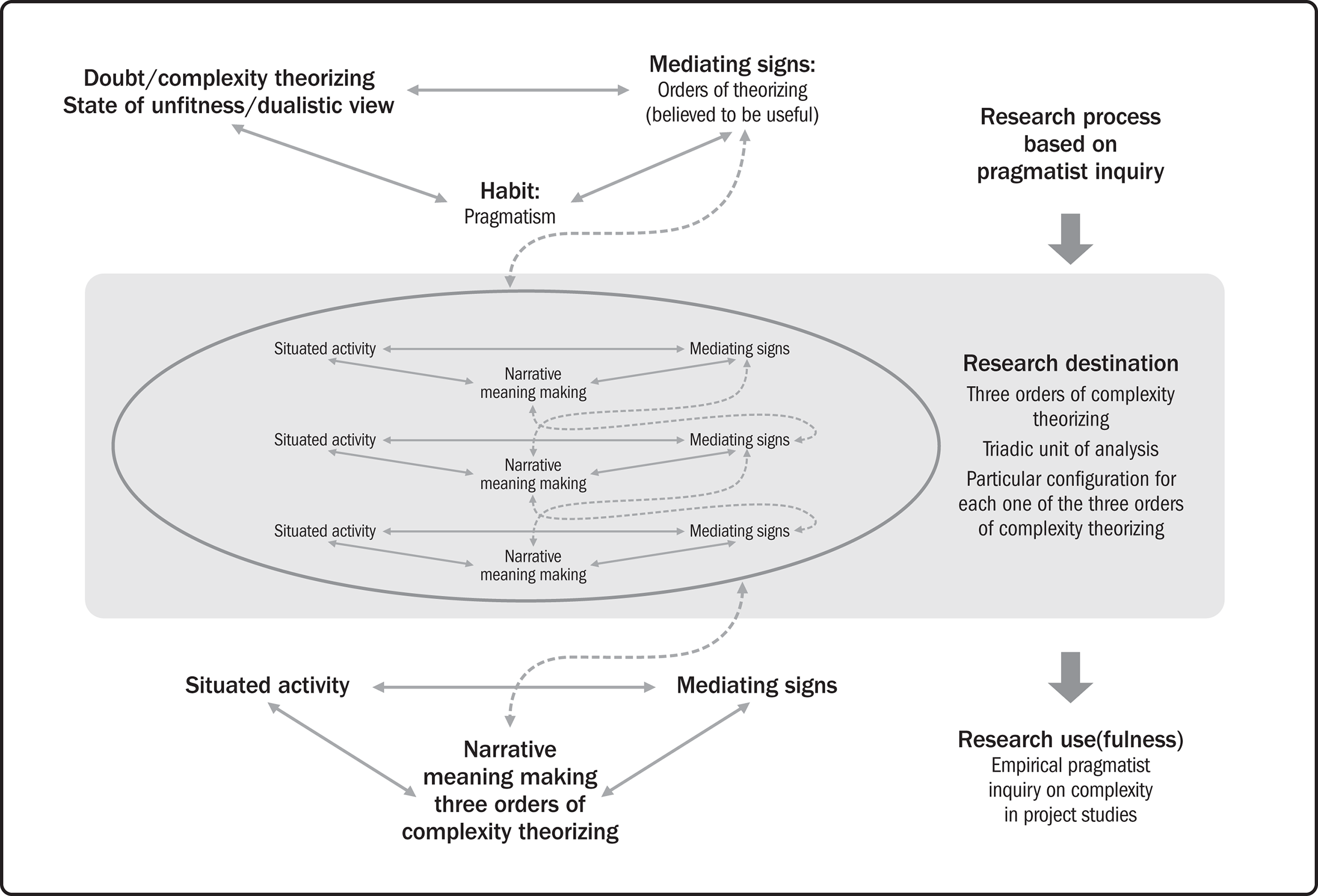
Thus, we view theorizing as an ongoing activity where action and meaning are interrelated (Dewey, 1986; Peirce, 1992) and a narrative process that “tries to fill the blanks and to organize acts and events into a meaning-making trajectory from situation A to situation B” (Lorino, 2018, p. 279). In order to model this process, we build on Lorino’s (2018) organizing processes triad of situated activity, narrative meaning-making, and mediating signs (pp. 281–282). Theorizing as a situated activity arises when emotions or tensions between existing habits arise, hence raising doubt (in this article: the unfitness of complexity theorizing in project studies).
This doubt triggers an inquiry aiming to make meaning of the observed dissonance through the generation of new modes of acting and narrative meaning-making, leading to paradigmatical shifts (here a new framework for complexity theorizing in project studies). This new meaning is instantiated in mediating signs. This process is iterative: the mediating signs are operative in a way that influences narrative meaning-making, leading to new doubts and a new inquiry, and resulting in new mediating signs.
Indeed, in a pragmatist inquiry, “Habits [in this triad, narrative meaning-making] are, simultaneously, for the inquiry: its object […], a resource […], its outcome […]” and “belief (not truth) is the destination of the inquiry, while doubt is the driving force” (Lorino, 2018, p. 102) [our addition]. Figure 1 summarizes our pragmatist inquiry process, its destination (i.e., the proposed configuration of a triadic unit of analysis for each one of the orders of theorizing), and its use.
Pragmatist inquiry process, destination, and use.
Furthermore, pragmatism invites scholars to theorize across multiple levels of analysis. Moving away from a sharp and dualistic distinction between micro-level and macro-level phenomena, the pragmatist perspective considers agency and structure as mutually constituent, interpenetrating, and coexisting at multiple levels (Lorino, 2018, pp. 124–125). Hence, it “offers much needed “microfoundations” for multilevel organizational theorizing” and “is highly suited to deal with change and complexity across levels” (Farjoun et al., 2015, p. 1796).
Therefore, in the remainder of the article, we develop our theorizing strategies for complexity theory in project studies along these last two pragmatist principles: categorizing as a process and multiple levels of analysis, which respectively lead to our conceptualizations of orders of theorizing (concerned with the degree of recursiveness of the theorizing process) and levels of theorizing (which deal with the micro, meso, and macro loci of analysis) as two useful, interrelated, and categorizing theory-building processes (Corley & Gioia, 2011).
We propose that orders and levels of theorizing, especially when they are brought together in a recursive relationship, can be a useful strategy for theorizing in project studies and, as such, they can help researchers make their theorizing explicit, trustworthy, antidualistic, and hopefully rigorous and relevant (Farjoun et al., 2015). Thus, following, we lay out three orders of theorizing, distinguish between three levels of theorizing, illustrate each with relevant examples from project research, and integrate them in order to explore their recursive relationships.
Orders of Theorizing
To construct our theorizing process for complexity in project studies, we build on Lorino’s (2018) triad of situated activity, narrative meaning-making, and mediating signs. In line with the spirit of an old interdisciplinary tradition of complexity studies epitomized by the Macy Conferences (Pias, 2003), we mobilize three interrelated lenses to populate each element of the triad. For situated activity, we rely on a social science and organization theory lens (Tsoukas, 2017), organizing aspects being the locus for investigating complexity theorizing in our perspective.
Considering narrative meaning-making, we retain a learning theory lens (Argyris, 2003, 2004; Bateson, 1973) as it captures well the deliberation process. Mediating signs, for their part, are viewed through a cybernetics or “the art and science of human understanding” 4 lens (Ackoff, 1974; Ashby, 1956; Von Foerster, 1984). Please note that, in a pragmatist perspective, there is no clear-cut distinction between these lenses: more often than not, deliberation leads to combining perspectives. We hasten to acknowledge that the three lenses selected reflect our own habits and beliefs as project scholars: other researchers coming from different backgrounds could mobilize a different set.
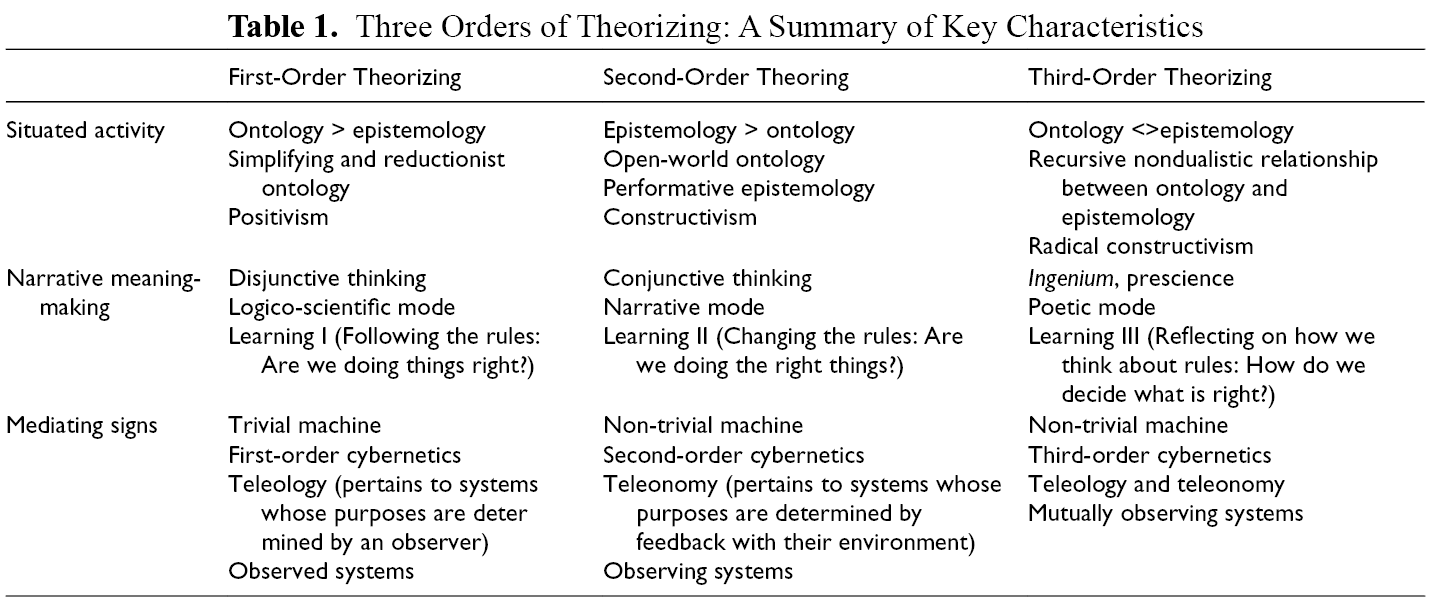
Our deliberations lead us to suggest three orders of theorizing. First-order theorizing is characterized by the primacy of ontology over epistemology, disjunctive thinking and single-loop learning, and first-order cybernetics (e.g., Shenhar & Dvir, 2007). Second-order theorizing is characterized by an open-world ontology and a performative epistemology, conjunctive thinking and double-loop learning, and second-order cybernetics (e.g., Geraldi, 2009). Finally, third-order theorizing is characterized by a recursive nondualistic relationship between ontology and epistemology, a poetic mode of thinking where ideas shape one another in complex ways, triple-loop learning, and third-order cybernetics (e.g., Graber & Giraudeau, 2018).
Thus, complexity theorizing in project studies is mediated by and mediating orders of theorizing (Lorino, 2018, pp. 281–282). Indeed, narrative meaning-making allows reflexivity about—and intelligence of—the empirical situation under inquiry (situated activity) and deliberation leading to inquiry outcomes (mediating signs; Figure 1). We now briefly discuss the three orders of theorizing for complexity in project studies, highlight some key characteristics of their triadic categories, and provide, whenever possible, some evidence of their existence in project studies.
First-Order Theorizing
Situated Activity
The situated activity is investigated using reductionist approaches and thereby assuming, for example, that there are cause-and-effect relationships between complexity, the independent variable, and project performance, the dependent variable (Tsoukas & Hatch, 2001, p. 983).
Narrative Meaning-Making
The meaning-making process is disjunctive: “It splits the world up, sets apart the knower from the phenomenon to be known, and separates facts from values” (Tsoukas, 2017, p. 137). It relies on Learning I, aka single-loop learning defined as “change in specificity of response by correction of errors of choice within a set of alternatives” (Bateson, 1973, pp. 263–264). The key question is: Are we doing things right? And this relates to following the rules.
Mediating Signs
In first-order theorizing, mediating signs fall mostly into representationalism. Organizations are modeled as trivial machines or “systems whose outputs and inputs are connected with a predetermined rule” (Tsoukas, 2017, p. 139). This modeling language from first-order cybernetics is associated with systems engineering (Umpleby, 2008).
First order machines are heteropoietic because they produce something different from themselves, by means of human design. This is a feature of inert systems, which are not able to build their own components, and which purposes are determined by an observer (teleology), therefore they are observed systems (Mancilla, 2011, p. 38)
First-Order Theorizing in Project Studies
Numerous project complexity papers display first-order theorizing strategies (e.g., Baccarini, 1996; Geraldi et al., 2011; Kiridena & Sense, 2016). For example, Shenhar and Dvir (2007) draw on the traditional innovation literature distinction of incremental versus radical innovation and the classic contingency theory to build their NTCP (Novelty, Technology, Complexity, and Pace) model that helps to distinguish among projects, classify them, and adapt the right management approach to the right project. However, while Shenhar and Dvir (2007) identify responses to complexity, what they call ”project management styles” (p. 13), they do not engage in second-order theorizing or consider how scholars qua practitioners make sense of complexity.
Second-Order Theorizing
Situated Activity
Tsoukas and Hatch (2001) argue that “one way of viewing organizations as complex systems is to explore complex ways of thinking about organizations as complex systems” (p. 980). In contrast to first-order complexity, this view, which they call second-order complexity, relies on a narrative, not a logico-scientific mode of thinking (p. 983). Indeed, “As Piaget so aptly remarked, ‘intelligence organizes the world by organizing itself’ (quoted in von Glaserfeld, 1984, p. 24).”
Narrative Meaning-Making
Following the same line of ideas, Tsoukas (2017) claims that theoretical complexification rather than simplification “is needed to account for organizational complexity” (p. 132). Further, based on cybernetics and in particular Von Foerster’s (1984) work, he suggests moving from a disjunctive and trivial machine view of organizations to a conjunctive and non-trivial machine view, where organizations “keep changing their rule of transformation” (p. 140). He thus adds that this conjunctive thinking relies on “an open-world ontology, [and] a performative epistemology […]” (p. 132).
Conjunctive thinking, we argue, is related to Learning II, also known as double-loop learning, defined as “change in the process of Learning I, e.g. a corrective change in the set of alternatives from which choice is made, or it is a change in how the sequence of experience is punctuated” (Bateson, 1973, pp. 263–264). The key question is: Are we doing the right things? And this conveys the idea of changing the rules.
Mediating Signs
A non-trivial machine view is related to what many authors name second-order cybernetics, where the need for a participant-observer is highlighted (Brand, 1976). The prevailing modeling language suggests reflexivity is at work but there is no specific mathematical approach (Umpleby, 2008). Besides the modeling dimension, Mancilla (2011), following Maturana and Varela (2012), summarizes the characteristics of second-order cybernetics:
Second order machines produce only themselves [autopoietic], therefore they are living systems and their purpose is determined by the feedback with their environment (teleonomy). Some of them can be cognizant and capable of self-description, which means that they observe [observing systems] and can use first order machines (Mancilla, 2011, p. 38, [added by the authors]).
Second-Order Theorizing in Project Studies
Some papers belong to the second-order category (e.g., Floricel et al., 2016; Sage et al., 2011). For instance, in her case study of complexity assessments in large engineering plants, Geraldi (2009, p. 665) finds that they are a matter of ”dialogue between conception and perception” whereby managers attempt to shape project complexity. However, like most complexity scholars in project studies who fall short of fully embracing complexity, this author does not engage in third-order theorizing.
Third-Order Theorizing
Situated Activity
In addition to Tsoukas’s (2017) first- and second-order considerations, we would welcome a third-order theorizing. This involves ”mutually observing systems” (Mancilla, 2011, p. 41), a poetic mode in which theorizing ideas shape one another in complex ways (Weick, 2004) and a recursive, nondualistic, relationship between ontology and epistemology. Indeed, “constructing” the “object” of inquiry (a complexity theory), involves an ontological creative action (poetic mode) from the observer as a non-trivial agent, while the observer is recursively shaped back epistemologically by the “object” they observe.
This circular relationship between ontology and epistemology mirrors the relationship between teleology and teleonomy: The purpose of the observer (making and giving sense to a complexity theory) influences the complexity theory and, in return, the complexity theory influences the observer by the sense they make and give. Weick (2004) acknowledges this poetic dimension and mutually observing dynamics: “The point is, ideas shape ideas, they lead on to other ideas, they enact their own contexts” (p. 657).
Such an antidualistic relationship between ontology and epistemology, typical of third-order theorizing, offers yet another contrast to first-order theorizing and its intrinsic disjunctive thinking process where ontology comes first (i.e., there exists an objective world) followed by epistemology (positivism), and second-order theorizing and its inherent conjunctive thinking process where epistemology comes first (constructivism; i.e., a complex thought process of sensemaking and giving prevails) followed by the construction of a reality—not THE reality (Chelli, 2018).
Thus, third-order theorizing is strongly associated with radical constructivism as developed based on Vico (1708). Illustrating the deep connections between Vico’s philosophy and pragmatism, this aspect of construction of a reality along with its relation to the issue of complexity in social sciences is underlined by the “natura-artificium question,” where the works of Vico (1744/1948) and Peirce (1998) lead Amadeu (2017) to contend that “things shape the mind and that we should thus be wary of their constitutive effects in the course of human history” (p. 1).
Narrative Meaning-Making
In our view, third-order theorizing—through the interplay between ontology, epistemology, and a poetic mode—aligns well with what Ganzin et al. (2020) and Corley and Gioia (2011) respectively name “magical thinking” with a focus on “future-oriented sensemaking” (Ganzin et al., 2020, p. 1) and “prescience” with its role in ”building theory about theory building” (Corley & Gioia, 2011, p. 12). A case in point, Corley and Gioia (2011) “define prescience as the process of discerning or anticipating what we need to know and, equally important, of influencing the intellectual framing and dialogue about what we need to know” (p. 13) through “giving meaning” (p. 24).
Thus, we submit that third-order theorizing is about modeling to understand (Le Moigne, 2003) or modeling as meaning-making rather than representing (Lorino, 2018), which calls for human action. As stated by Le Moigne (2007, p. 118), quoting Vico (1708), such a “poetic praxeology” (Tsoukas, 2017, p. 148) “is accomplished by the use of Verstehen ‘the intuitive quickness of enlightened understanding’ (Schütz, 1964, p. 4) […], or Ingenium, this mental faculty which makes possible to connect in a fast, suitable and happy way the separate things’” (Bredillet, 2013, p. 71).
Meaning-making related to Learning III 5 (Bateson, 1973) also known as triple-loop learning, “is change in the process of Learning II, e.g. a corrective change in the system of sets of alternatives from which choice is made.” Here, the key question is: How do we decide what is right? It is about learning about learning, and reflecting not merely on how we change rules but how we think about rules, and thus involving change in epistemology. Learning III challenges existing learning frameworks, models, and assumptions and hence goes beyond insights and patterns to include context.
Mediating Signs
The concept of autopoiesis may not apply to social systems. Therefore, in order to fully capture the complexity of social systems, there is a need for third-order cybernetics or “social autopoiesis,” which accounts for “mutually observing systems” (Mancilla, 2011, p. 41) or “relations between observers” (Johannssen & Hauan, 1994, p. 68). Third-order cybernetic systems/machines are practopoietic (Nikolić, 2015). They are adaptive or self-adjusting systems in which the autopoiesis of an organism occurs through allopoietic interactions among its components (these systems produce their structure but not their organizations). The components are organized into a poietic (creative or productive) hierarchy: one component creates the other. Each lower level contains knowledge that is more general than the higher level.
This hierarchy of knowledge enables the anapoietic (re-creating or reproducing itself again and again) level to directly store concepts, which are necessary for the emergence of mind. Third-order cybernetic systems are both teleological and teleonomical systems and the relation between teleology and teleonomy is circular: the purpose of an observing system (observer) can be influenced by the environment (teleonomy) and, in order to reach its purpose, the observing system can influence the environment (teleology). Finally, they are cognitive systems formed of interactions between observers and observing systems (Maturana & Varela, 2012).
Third-Order Theorizing in Project Studies
Rare are contributions that engage in third-order theorizing strategies in project studies. One notable exception is a political history of projects edited by a sociologist and an historian (Graber & Giraudeau, 2018). The book investigates the contemporary claims that we live in a world of projects characterized by radical innovation. Their analysis identifies a number of “project forms” 6 (Graber & Giraudeau, 2018, p. 21) each of which highlights—and also hides—critical aspects, leading to question the assumption that projects are homogeneous. Each of the forms is grounded in a specific habit that construes a project as a process of realization, a managerial practice, a network, or an innovation and characterizes projects as falling under modernity, contemporary, or even very contemporary times. Each of these forms speaks from a particular theoretical standpoint (habit—narrative meaning-making) and, thus, pays attention to particular project types, discarding others as not being projects or not worthy of consideration.
Graber and Giraudeau (2018) observe that each form on its own is too limiting (doubt), triggering a process of inquiry for a new definition rooted in a new narrative meaning-making (new habit) that can accommodate all forms: “A project is any action subject to prior examination by a validation or funding authority: it is this prior examination that defines the project” (Graber & Giraudeau, 2018, p. 20). This new definition (new narrative meaning-making – habit) initiates a change of perspective: The political history of projects becomes the political history of project forms.
Each project form can be identified relative to the others, in their differences and similarities, bringing to the fore their respective autonomy but also the existing links between them. This process of critical reflection on how project forms are contextualized raises doubts about their narratives and invites us to reflect on how projects (categories) are formed, resulting in the proposition of a new narrative meaning-making, and therefore illustrating third-order theorizing.
Table 1 summarizes the characteristics of the components of the triadic unit for each order of complexity theorizing.
Three Orders of Theorizing: A Summary of Key Characteristics
Having set out how pragmatism can lead to more sophisticated ways of theorizing complexity through the three orders, we turn our attention to multilevel theorizing in the next section.
Levels of Theorizing: The Need for Pragmatist and Multilevel Complexity Theorizing in Project Studies
The literature on complex systems has long drawn attention to their recursive nature (Beer, 1979). Complex systems are fractal (Mandelbrot, 1982): like Russian dolls, they exhibit the same shape at different levels of granularity and what happens at one level will influence the levels above and below through feedback loops (Ashby, 1956; Senge, 2006; Érdi, 2008).
Yet, it is not common to distinguish between levels of theorizing in complexity research in project settings. To date, many project scholars have focused on describing projects as complex adaptive systems, encouraging a departure from traditional and reductionist conceptions of projects and project management to address challenges arising from complexity (e.g., Cooke-Davies et al., 2007; Kiridena & Sense, 2016) or characterizing complexity and identifying its contributing factors (e.g., Bosch-Rekveldt et al., 2011; Geraldi et al., 2011). Unfortunately, few contributions attempt to theorize how the challenges associated with complex projects arise from the factors contributing to their emergence (e.g., Brady & Davies, 2014; Floricel et al., 2016; van Marrewijk et al., 2008). This state of the scholarly conversation reveals a blind spot: How are we to develop a comprehensive theory of complexity in project settings if we ignore the feedback loops between the factors contributing to complexity and the challenges and outcomes that arise from the interactions between factors (Boulton et al., 2015)?
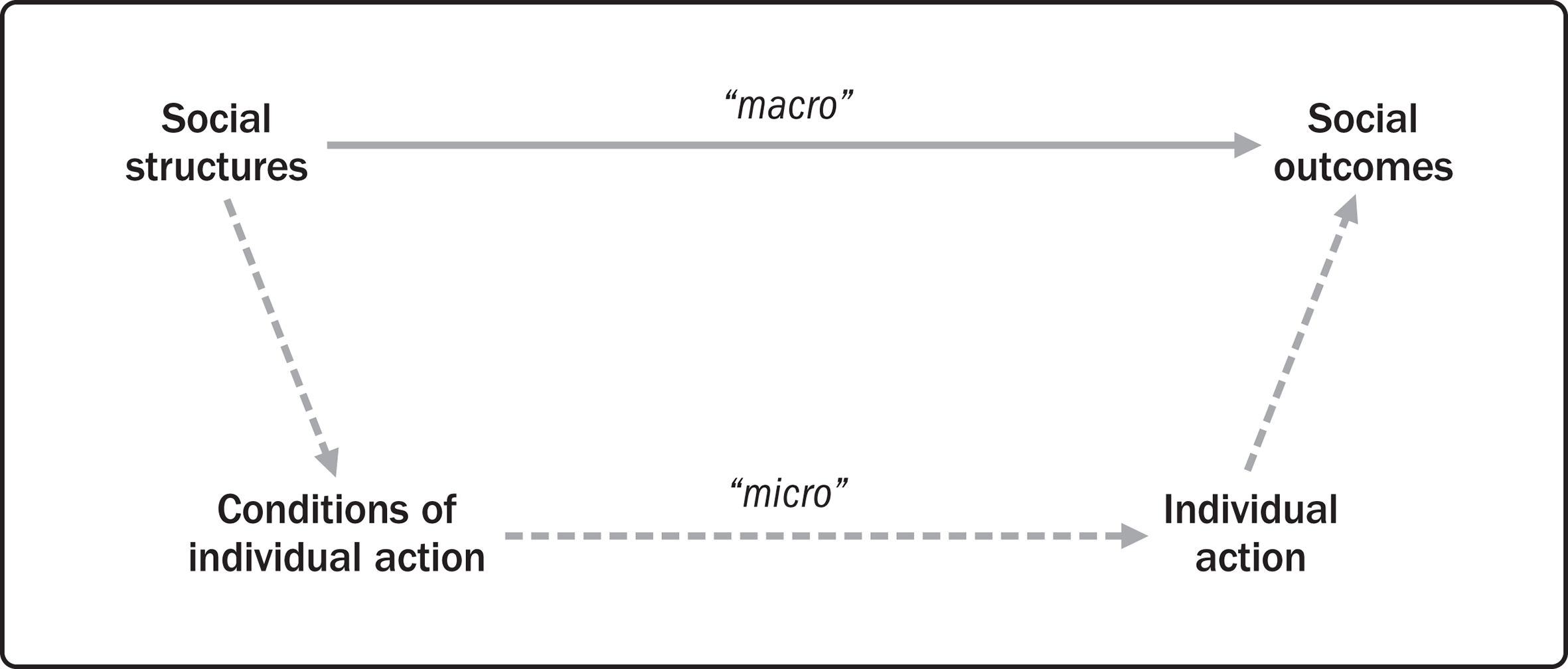
“Pragmatist principles are particularly relevant for dealing with the contemporary challenges of change and complexity across multiple levels of analysis” (Farjoun et al., 2015, pp. 1798–1799). This is because pragmatism straddles the micro–macro divide that separates theories emphasizing, for example, either the primacy of structure or that of rational agency (Farjoun et al., 2015; Lorino, 2018). This kind of dualism opposes theorizing that aggregates micro-level phenomena (individual actions) to produce macro-level outcomes (structures), and theorizing that pulls down macro-level events to the level of individuals (Felin et al., 2015; Powell & Colyvas, 2008). Scholars on both sides of the debate often refer to Coleman’s (1990) bathtub model in which macro-level structures condition individual actions, which in turn generate aggregated social outcomes (Figure 2). This is reflected in project studies where contributions that emphasize micro-level or macro-level theorizing can be found.
General model of social science explanation (adapted from Coleman, 1990; Felin et al., 2015; Hedström & Ylikoski, 2010).
Micro-Level Theorizing in Project Studies
Studies that focus on the micro level tend to look at how complexity manifests itself through themes, dimensions, or clusters of related factors (e.g., Bakhshi et al., 2016; Geraldi et al., 2011). Their aim is to unpack where the project complexities come from and classify factors of complexity along dimensions. The contribution by Bosch-Rekveldt et al. (2011) is representative of this approach; they identify 50 elements contributing to project complexity, which they group into three categories (technical, organizational, and environmental). The authors acknowledge that each category of elements is located at a different ”level of analysis” (p. 738) but the question of how these levels interact to generate outcomes is not identified in their paper as a concern. While micro-level theories are important to understand and describe project complexities, on their own they are insufficient to guide managerial action.
Macro-Level Theorizing in Project Studies
Conversely, contributions that focus on macro-level theorizing tend to emphasize how complexity contributes to generate a range of outcomes and advocate for adaptability and resilience to accommodate this diversity. In particular, early papers theorizing macro-level complexity were focused on conceptualizing projects as complex systems, and how this challenges the traditional and reductionist views, recommendations, and practices advocated by mainstream competency standards (e.g., Cooke-Davies et al., 2007). Saynisch (2010a, 2010b) is a representative example of the macro approach: The author provides a high-level reconceptualization of project management for complexity that identifies various ways in which complexity in projects need to be accommodated. However, the way the approach is framed does not clearly provide a pathway to identify how macro-level complexities lead to different ways to accommodate micro-level complexities.
Meso-Level Theorizing in Project Studies: Bridging the Micro-Macro Divide
Theorizing the linkages between micro and macro levels using a simple model, like Coleman’s bathtub (1990), only enables us to conceive of linear relationships between levels (Figure 2). Such a strategy has been widely used in social science models of multilevel theorizing (Felin et al., 2015; Hedström & Ylikoski, 2010).
Using this linear strategy, however, microfoundation theories do not deal well with one central aspect of complexity theory, emergence: “In all, the notion of ‘emergence’ remains vague and thus opportunities remain for both micro and macro disciplines to carefully specify the underlying actors, social mechanisms, forms of aggregation and interaction that lead to emergent outcomes” (Felin et al., 2015, p. 606). This observation suggests that something is missing from traditional approaches to theorizing complexity between the micro and macro levels: “This distinction (or implicit dualism) hinders multi-level theorizing and creates a barrier to understanding organizational change because it misses how phenomena co-constitute each other” (Farjoun et al., 2015, p. 1792).
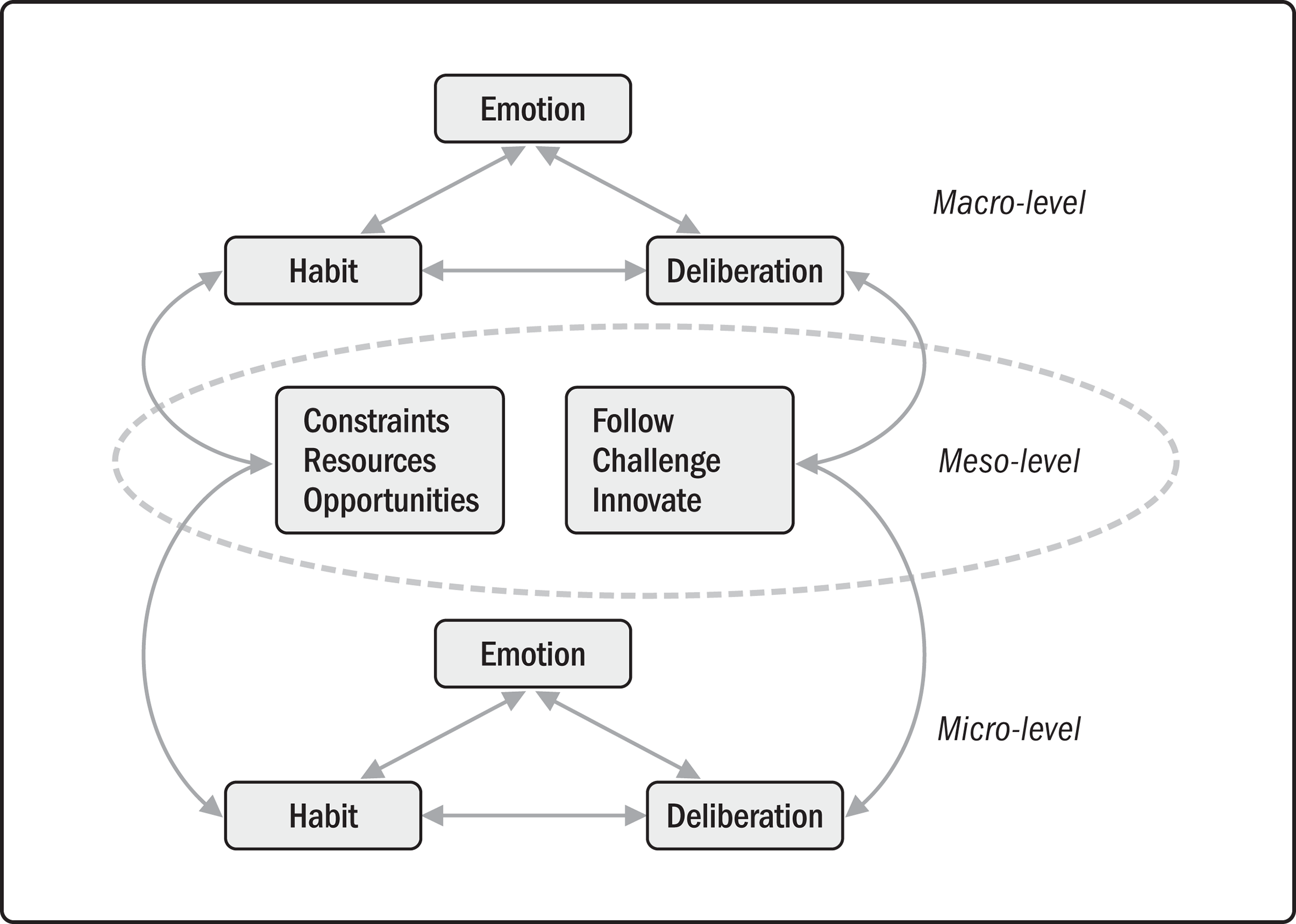
A pragmatist perspective focused on agency and structure and founded on the habit-emotion-deliberation triad, emphasizes the recursive relationships between agents and structures, rather than the constitutive essence of one or the other (Lorino, 2018). This conception allows for multiple modalities: Structures that simultaneously promote stability and innovation as social conventions are both incomplete and sometimes mutually in conflict, therefore providing opportunities that individuals can leverage.
Farjoun et al. (2015, pp. 1796–1797) suggest that strategic behavior generated by the habit-emotion-deliberation triad can be observed at multiple levels, and that processes of enactment are structurally similar at the individual and organizational levels. Their account indicates that macro-level structures provide constraints but also opportunities and resources, whereas individuals at the micro-level have the ability to follow, challenge, and innovate the macro-level social conventions. Together these provide a more nuanced account of the meso-level relationships between micro and macro levels as shown in Figure 3.
Relationships among micro, meso, and macro levels of theorizing.
There is a small but growing body of contributions theorizing project complexity from a meso-level perspective; these studies tend to highlight how interactions between factors or elements (micro-level) lead to outcomes at the macro-level and vice versa (e.g., Davies & Mackenzie, 2014; Sage et al., 2011; van Marrewijk et al., 2008). However, most of these studies tend to describe the interactions, rather than theorize them.
For example, the study by Brady and Davies (2014) is representative of this meso-level approach. Their work provides a comparison of two case studies (Heathrow T5 and London Olympics), each with a different complexity profile (structural versus dynamic complexity), where distinct (but somewhat overlapping) management strategies and governance structures were implemented to deliver successful outcomes. The contribution of the proposed multilevel pragmatist framework is to make explicit how the interactions among habit, emotion, and deliberation unfold at each level (micro and macro) and to draw attention to the factors (constraints, resources, opportunities) and mechanisms (follow, challenge, innovate) that project managers and team members as social actors can mobilize to enable action at the meso-level. In the next section, we discuss how orders and levels of theorizing interact with one another.
Integrating Theorizing Strategies for Complexity Theory: Orders and Levels
The theorizing process that defines our three orders is constructed through the pragmatist triad: situated activity, narrative meaning-making, and mediating signs. The aim of the theorizing process is to produce models (mediating signs) in a manner that action and thought are aligned. The three levels of theorizing are built on another pragmatist triad (habit, emotion, deliberation) at the micro and macro levels, linked by the factors (resources, constraints, opportunities) and mechanisms (follow, challenge, innovate) at the meso level, enabling to connect agency and structure. Thus, the two main theory-building categorizing processes are distinct from each other: orders are concerned with the degree of recursiveness of theorizing, whereas levels are concerned with the level of agregation of the theorizing objects (macro or micro) and how they are related (meso).
Orders and levels link up as follows: Mediating signs as theoretical models provide social actors with models of action (habits), which can then be mobilized across and/or between levels. This integration of orders and levels of theorizing is crucial to further complexify complexity theorizing. It is consistent with Ashby’s (1956, p. 207) law of requisite variety (“only variety can absorb variety”) and enables to transcend dualisms such as “complexity reduction” versus “complexity absorption” (Boisot & Child, 1999), “restricted complexity” versus “generalized complexity” (Morin, 2008) or “simplifying versus complexifying complexity” (Tsoukas, 2017). As with any recursive system model, there is no set sequence in which the steps can be activated (Ackoff, 1974; Checkland, 2000). However, we will follow a set sequence in our discussion to ease understanding.
In first-order theorizing, the articulation between orders and levels operates as a single loop: Does the mediating sign as a model provide a good template to capture the interactions between levels? For example, the Shenhar and Dvir (2007) NTCP model assumes that the strategic alignment between project strategy (micro) and organizational strategy (macro) can be achieved through one pass of analysis. The approach assumes a unitary context where stakeholders agree on what needs to be done (Jackson, 2019).
In second-order theorizing, the articulation between orders and levels operates as a double loop: Not only does one check that the model is appropriately capturing what is going on (are we doing things right?); one also enquires if the model is appropriately contructed (are we doing the right thing?). In other words, second-order theorizing invites a critical evaluation of the theory (mediating signs and habits) from within. For example, van Marrewijk et al. (2008), in their comparative study of two megaprojects, provide an alternative explanation to Flyvbjerg’s (2014) Iron Law or the idea that projects are over time, over budget, over and over, which relies on the detailed examinations of the relationships among project managers, context, and practices to assess project outcomes. In doing so, van Marrewijk et al. (2008) confront Flyvbjerg’s model with the empirical observations in their case studies and find that the outcomes they observe (macro level) do not match Flyvbjerg’s optimism bias and strategic misrepresentation (micro level), but rather that managers engage in a range of behaviors and mobilize resources and opportunities, therefore eliciting a different theory of the complexity of megaprojects.
In third-order theorizing, a third feedback loop is added, challenging the purposes that inform the inquiry (why are we doing this?). What Shenhar and Dvir (2007) and van Marrewijk et al. (2008) appear to have in common is that both take for granted what a project is. As noted earlier, this is one of the challenges embraced by Graber and Giraudeau (2018), who critically reflect on the conceptualizations of projects over time and challenge the underlying assumptions used to define projects, using five project forms. Here, the feedback loop is no longer between a theory and a contextualized object but between theories that contextualize objects in different ways (Graber & Giraudeau, 2018, p. 20). If a project is defined as “any action subject to prior examination by a validation or funding authority” (Graber & Giraudeau, 2018, p. 10), then the authority may be an individual, organization, or government, and the various chapters in the book explore these. For instance, understanding the dynamics and complexity of railway project forms in the United States in the 19th century requires examination of the relationships between politics and economics and between individuals (politicians, entrepreneurs, merchants, financiers, landowners, rail users, and investors) and their intertwined actions that co-constitute the sociohistorical context.
The critical theorizing of the project forms then emerges from a comprehensive examination of how social actors respond to contextual factors by mobilizing available resources. For example, how the creation of new religious orders in 16th-century Spain was facilitated by leveraging Teresa of Avila’s charisma, or how technological prototyping was used to promote innovation projects in the early 21st-century. This iterative process is illustrated in Figure 4. Theorizing project forms as new mediating signs leads Graber and Giraudeau (2018) to challenge widely accepted definitions of what is, or is not, a project, and one of the contributions of their book is to surface how the historical context shapes our understanding of projects, thus leading us to “engage in detailed work on the diversity of existing forms, as a better understanding enables (if necessary) their transformation” (p. 274).
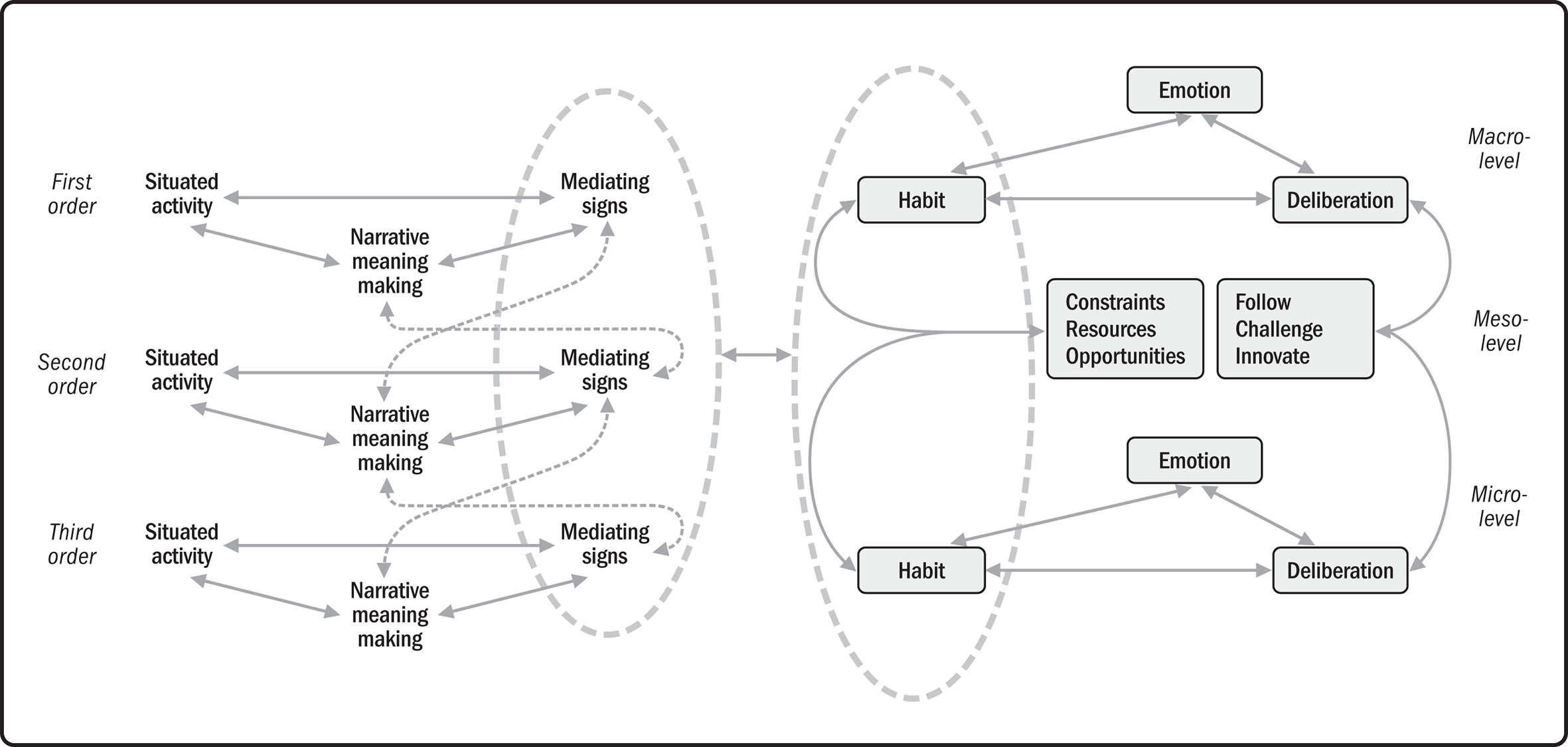
Linkages between orders and levels of theorizing.
Discussion and Conclusion
This article, whose purpose is to offer a pragmatist orders and levels approach to theorizing strategies for complexity theory, offers four major contributions. First, adopting a pragmatist stance (Farjoun et al., 2015; Lorino, 2018), this article takes issue with the prevailing dualistic deadlock in complexity theorizing, including the either-or categorization of existing complexity theories in project studies. Consequently, it offers a pragmatist approach to theorizing strategies for complexity theory along two interrelated categorizing processes: orders and levels brought together in a recursive relationship (Figure 4). This article thus shows how, in a quest for theoretical complexification, a research may display multiorder and multilevel theorizing. In doing so, the article contributes to project studies.
Second, beyond the established distinction between first-order theorizing characterized by a disjunctive thinking and second-order theorizing characterized by a conjunctive thinking (Tsoukas, 2017), we propose a novel third-order theorizing characterized by a more complex and poetic thinking that is akin to prescience (Corley & Gioia, 2011), which we contend, offers plentiful opportunities for enriching the variety of our understandings of complexity and complexity theorizing in project studies.
Third, through the three-level model of complexity theorizing, we contribute to literature by directing greater attention to the under-researched and under-theorized meso level, where the interactions and transformations between micro-level factors and elements and macro-level outcomes occur (Felin et al., 2015; Powell & Colyvas, 2008).
Fourth and last, our construction of orders and levels of theorizing strategies for complexity theory in project studies provides an illustration of how pragmatist principles can be operationalized to develop a useful theorizing process (narrative meaning-making) for a particular topic (situated activity) through the selection of appropriate lenses (orders and levels). This illustration can assist scholars interested in using pragmatist principles for theorizing in other thematic contexts. Taken together, these four contributions are full of implications for complexity theorizing in project studies.
Pragmatism Can Contribute a Good Deal to Complexity Theorizing in Project Studies
This article advances that there is a prevailing dualistic deadlock (Lorino, 2018) in complexity theorizing in project studies, which is noticeable in the either-or categorization of complexity theories and thus results in a lack of theoretical complexification (Tsoukas, 2017). As we have shown, the pragmatist stance—with its triadic thinking, quest for useful solutions, antidualistic ontology, unity of thought and action, and conceptualization of categorizing as a process—is particularly suitable for multiorder and multilevel complexity theorizing in project studies. In light of the unique view of theorizing as a social process through which theories are transformed, adapted, abandoned, or reinvented, the triadic unit of analysis of situated activity, narrative meaning-making, and mediating signs, and the orders and levels approach that we propose, pragmatism can help project scholars make headway in complexity theorizing in particular but it can foster theorizing in general.
Deeper Attention to the Meso Level May Enrich Complexity Theorizing in Project Studies
In project studies, much of the focus tends to be on the micro and macro levels and little on the meso. A case in point, both Geraldi et al.’s (2011) and Bosch-Rekveldt et al.’s (2011) contributions offer key insights into the elements of project complexity but do not shed light on the interactions between these elements and/or their effects. This prevailing focus on either the micro (e.g., Bosch-Rekveldt et al., 2011) or macro level (e.g., Saynisch, 2010a, 2010b) at the expense of the meso level (e.g., Brady & Davies, 2014), makes project scholars see the trees or the forest of complexity, without connecting one with the other, and too often overlooking how the interactions between the trees shape the forest, and vice versa.
In other words, complexity research in project settings does not fully explore what Geraldi and Adlbrecht (2007) call complexity of interaction. Thus, in theorizing strategies for complexity theory in project studies, we need to move beyond a micro-macro distinction and explore the interactions between elements and/or effects. As Weick (2004) argues, this micro-macro distinction “seems dispensable in the sense that there are ideas that finesse the distinction” (p. 665).
Indeed, the micro-macro distinction “impedes” project complexity, to borrow from Weick (2004, p. 664). Merely breaking project complexity research into micro and macro levels of theorizing is akin to some sort of (methodological) simplification of complexity or what Mintzberg (2009) would call ”the labyrinth of decomposition” (p. 164). In other words, as noted earlier, it exposes project complexity theorizing to dualism (Farjoun et al., 2015; Lorino, 2018). As shown in Figure 4, we argue that in order to bring back together the micro and macro levels of theorizing, which have been reduced to independent parts, we need to pay greater attention to the less researched connective parts of the meso level, where key interactions between the micro and the macro levels emerge, and in doing so we can complexify our complexity theories.
Second-Order Theorizing Helps Complexify Complexity Research in Project Studies but Third-Order Theorizing Is Needed for Building Theory About Complexity Theory Building
Complexity scholars seem to engage predominantly in first-order theorizing (e.g., Geraldi et al., 2011; Shenhar & Dvir, 2007) and less frequently in second-order theorizing (e.g., Floricel et al., 2016; Geraldi, 2009). This is detrimental to complexity research in project studies in that complexity scholars acknowledge the complexity of projects but often fail to theorize with requisite complexity (Tsoukas, 2017). We acknowledge the strong pull to “understand, reduce, respond” (Maylor & Turner, 2017, p. 1076) in project complexity research, but without second- and even third-order research (e.g., Graber & Giraudeau, 2018), theorizing risks remaining narrow and shallow.
While a theory of complexity might not help us predict the behavior of complex project systems (Cilliers, 1998), theorizing strategies relying on prescience would help build theory about complexity theory building, and thus identify and influence key conversations and as a result enrich debates about complexity research in project studies (Corley & Gioia, 2011). We then call on complexity scholars to take not only a first-order lens (the observed system of elements), but also second-order (the observer and the observed system) and third-order lenses (among observers and observed systems; Mancilla, 2011).
Complexifying Terminology Is Required for Complexity Research in Project Studies
As noted earlier, project complexity scholars acknowledge complexity but whether they consider it as complexity of faith, fact, interaction (Geraldi & Adlbrecht, 2007), complexity of or in, or even first- or second-order complexity (Cooke-Davies et al., 2007; Geraldi et al., 2011), or whether they take complexity and uncertainty to be distinct concepts or not (Padalkar & Gopinath, 2016), they tend to depict project complexity in relatively non-complex terms (Tourish, 2019) and therefore the theory fails to match the complexity studied. The following two examples may suffice to make this point.
First, the well-established Shenhar and Dvir’s NTCP (Novelty, Technology, Complexity, and Pace) model, despite all its interesting first-order interactions, is too static in that it overlooks the project life cycle. Thus, it does not take into account dynamic/emerging complexity (Bentahar & Ika, 2019), which is very important in complexity theorizing (Brady & Davies, 2014). Second and last, although Maylor and Turner (2017), in the true spirit of complexity theories, conceptualize complexity and response, not as dualism but duality as they are involved in a recursive relationship (Sonenshein, 2016), their responses to complexity appear depicted in non-complex terms. For example, these responses include a project management plan to confront structural complexity, a communications plan to deal with sociopolitical complexity, and a risk management plan to cope with emergent complexity. In so doing, are complexity scholars not still describing project complexity in the very reductionist project management best practices terms they lament?
Final Words
In this article, we have explored with a pragmatist stance theorizing strategies for complexity theory in project studies along two categorizing processes (orders and levels) brought together in a recursive relationship. Our exploration has revealed that, to date, project studies have privileged theorizing the micro and macro levels of complexity and first and second order. In turn, this research identifies opportunities for future contributions: investigations that breach the micro–macro divide to theorize further the meso level, where transformations and mechanisms enable to make and give sense to the co-evolution of complexity factors and outcomes; and theorizing that reaches up to the third order in order to escape reductionism and dualism and further complexify complexity theorizing using a pragmatist perspective.
Finally, only thirdness (i.e., third order/third level, Lorino, 2018, p. 43) allows “a mode of thinking that eludes both trivial and non-trivial thought processes – in the words of Gilles Deleuze and Félix Guattari a ‘non-thinking thinking’, as it were, a thinking beyond cognition and recognition” (Hörl, 2012, p. 116) . Being self-critical and hence embracing thirdness leads us to acknowledge that “it may be necessary to bracket (though not eliminate, avoid or delete), among others, terms like complexity, emergence, autopoiesis, coupling and recursions, all of which characterize the form of non-trivial rationality. Instead we need to find non-technological terms to describe our technological condition” (Hörl, 2012, p. 117). A fascinating avenue of research indeed!
Footnotes
Declaration of Conflicting Interests
The author(s) declared no potential conflicts of interest with respect to the research, authorship, and/or publication of this article.
Funding
The author(s) received no financial support for the research, authorship, and/or publication of this article.
Notes
Author Biographies