




Abstract
This article develops a framework for applying organizational narrative theory to understand project narratives that potentially perform and change the future. Project narratives are temporal but often get repeated throughout the project life cycle to stabilize meaning, and could be about project mission, vision, identity, value creation, and so forth. Project narratives have important implications for organizational identity and image crafting. This article differentiates among different types of project narratives in relation to a project life cycle, providing case studies of project narratives on three major UK rail projects. We then set out the future research agenda into project narrative work.
Introduction
The completed work, when constructed in accordance with my designs, will not only be the greatest bridge in existence, but will be the greatest engineering work of the continent, and of the age. Its most conspicuous features, the great towers, will serve as landmarks to the adjoining cities, and they will be ranked as national monuments. As a great work of art, and a successful specimen of advanced bridge engineering, this structure will forever testify to the energy and enterprise and wealth of the community which shall secure its erection (John Roebling in Shapira & Berndt, 1997, p. 339).
An important stream of theoretical development in organization and project management studies has been the increasing attention paid to narratives as the carriers of meaning in organizations. Narratives are defined as temporal discourses that provide “essential means for maintaining or reproducing stability and/or promoting or resisting change in and around organizations” (Vaara et al., 2016, p. 496). Narratives are widely accepted as a vital means of organizing (Currie & Brown, 2003; Rhodes & Brown, 2005). There has been relatively little deployment of this important theoretical development in project organizing research, yet as indicated by the epigraph from Roebling (in Shapira & Berndt, 1997), the promotor of the Brooklyn Bridge, narratives play an important role in project organizing by connecting practice in the present to projections of the future. We suggest that there is a real need for developing narrative theory in project organizing research, and our contributions will be in these three areas:
Projects are bespoke, one-off endeavors with a specific end date, but a usually long lifespan throughout which managers and teams keep changing. This creates a need for a creation of a project narrative about the mission, vision, and expected value before a project starts. Maintaining these project narratives throughout the project life cycle is often required to achieve shared understanding among the team members.
In projects, different organizational identities merge together (e.g., owners, suppliers, consultancies, and so forth), which creates a need for a project identity narrative or, in other words, a narrative about project DNA that is created and communicated to internal team members in order to align effort (Sergeeva & Roehrich, 2018).
Projects, especially megaprojects, attract attention from wide audiences (social media, external stakeholders, press), which generates a need for a coherent narrative about the project brand image that is created and consistently communicated to external stakeholders (Ninan et al., 2019).
In this article, we distinguish between narratives and stories: Narratives are characterized by coherence, performative intent, and repetition, whereas stories are more personalized, entertaining, and emotional in nature (Dailey & Browning, 2014; Green & Sergeeva, 2019, 2020; Sergeeva & Green, 2019). To date, we still lack an understanding of how narratives are (re)created over the project life cycle. Our aim in this article is to develop a framework for applying organizational narrative theory to project organizing and to better understand the concept of a project narrative, as something designed to potentially perform and change the future. Our particular contribution lies in distinguishing different types of project narratives such as the project narratives about mission and vision, identity, image, value creation in relation to the project life cycle. We focus on three major project phases: project shaping, project delivery, and post-project evaluation drawing on the work of Miller and Hobbs (2005), Miller and Lessard (2000), and Winch (2017).
Our contribution to theory and debates in project organizing takes the form of an essay (Gabriel, 2016; Suddaby, 2019), rather than a traditional research (empirical or theoretical) paper. This is in line with our understanding of the call for this Special Issue, which invited papers that provoke debate through bold theorizing. Suddaby (2019) argues that scientific essays can be used to introduce normatively new frontiers of knowledge where “facts and values interpenetrate and reinforce each other” (Suddaby, 2019, p. 443). Essays can also be “heretical” (Gabriel, 2016) and challenge accepted approaches within organization studies; for instance, narrative research is dominated by interpretive and post-structural approaches (Vaara et al., 2016); by contrast we introduce a realist view. “The realist approaches follow longitudinal representation of stability and change and examine the effects of narratives on other phenomena” (Vaara et al., 2016, p. 508); in our case, we show how project narratives potentially change and shape the future of economy and society.
The article is structured as follows. We will first review the research literature on organizational narratives, followed by identifying the recent developments of most relevance to project organizing. We will then explain why we have adopted a critical discourse analysis perspective underpinned by critical realism (Fairclough, 2005). On this theoretical basis, we provide case studies of project narratives on three major UK rail projects: one completed project (Channel Fixed Link) in which we observe different types of narratives throughout the whole project life cycle; one project in construction (Elizabeth Line) in which we explore different narratives in the shaping and delivery phases of a project life cycle; and one in the very early stages of development (Northern Powerhouse Rail), where we focus on shaping narratives and their importance. In our discussion, we will present the framework for better understanding the ways project narratives potentially shape and change the future. We finally suggest a research agenda into project narratives.
Organizational Narratives
Our argument builds upon the work of Vaara et al. (2016, p. 496) who define organizational narratives as “unique discursive constructions that provide essential means for maintaining or reproducing stability and/or promoting or resisting change in and around organizations,” which have “performative power.” Narratives are characterized by “persuasive power of narrative repetition” (Dailey & Browning, 2014, p. 27). Performative narratives are often repeated in organizations because repetition serves to stabilize particular meanings (Dailey & Browning, 2014). Performativity in organizational narratives entails change in organization by creating action and in turn new narratives (Frandsen et al., 2017). Organizational narratives are used for different purposes such as to persuade people, create and reinforce messages, achieve shared understanding, and the like. Abolafia (2010) demonstrates the ways elite policy makers use plotted, plausible, and repeated narratives to guide their actions. Such narratives are said to become formalized when they are reproduced in textual forms and/or published in corporate reports and websites; more minimally, they may be condensed messages on social media, such as Linkedin and Twitter (Ninan et al., 2019). Such performative narratives shape organizational actions, bringing into existence a social reality that did not previously exist (Brown, 2006). Narratives are temporal, meaning that while often repeated in organizations, they may also change and evolve over time, becoming new narratives (Cunliffe et al., 2004). Hence, performative narratives project particular futures.
The concept of performativity is rather a confused one in organization studies (Gond et al., 2016) but the key notion is that of words that do things (Austin, 1962). For Austin, words are either constitutive (i.e., they describe a situation that can be either true or false) or performative (i.e., they do something). One type of performative word is the “commissive,” which “commit the speaker to a certain course of action” (Austin, 1962, p. 156). In organization studies, words can be captured in formal texts, in particular, in strategy texts, so that “strategizing is an activity that does something” (Kornberger & Clegg, 2011, p. 138). However, mere expression of a strategy does not mean that it is realized (Mintzberg, 1994). We therefore need to add a temporal dimension to Austin’s (1962) concept of performativity, which is inherently synchronic, so we suggest that project narratives as strategy texts can have a performative intent. In other words, the author/s of the project narrative intend to do something but whether they actually do becomes an empirical question for later enquiry. Our unit of analysis, therefore, is the project narrative defined as a narrative with performative intent, which we will investigate in the three case study projects.
Narratives and the process of narrating have important implications for identity work. Brown (2006) argues that the identities of organizations are best regarded as produced by continuous processes of narration in which the narrator and the audience formulate, edit, applaud, and refute various elements of the narratives. Humphreys and Brown (2002) illustrate how an organization’s identity narrative evolves over time, as well as the variety of personal and shared narratives. They view efforts of senior managers to control processes of organizational identity formation as hegemonic acts required for legitimation purposes. Building upon the work by Gioia et al. (2000) and Gioia and Thomas (1996), we distinguish between project identity narratives and project image narratives. A project identity narrative is conveyed internally, whereas a project image narrative is projected to external stakeholders as project branding (e.g., for financiers, policy makers, potential objectors, environmentalists, etc.) (Ninan et al., 2019; Sergeeva & Winch, 2020). Narratives have important implications for shaping the internal identity and external image of projects. As stated by Brown (2006) and Brown et al. (2005), there is a need for research to explore how organizations’ identities, when conceived narratively, link conceptually and empirically to notions such as internal identity and external image. In this respect, there are limitations to the interpretivist and post-structuralist approaches (Vaara et al., 2016) on narratives. The emphasis of these accounts is on organizing over organization, focusing on process at the expense of structure and how the two interact (Fairclough, 2005). While generating many insights, these approaches tend to obscure the causal power of narratives and discourse more generally (Fairclough, 2005), and hence their performativity. We therefore adopt a critical discourse approach in order to better understand the ways project narratives potentially perform and change the future (Fairclough, 2013; Newman, 2020; Vaara et al., 2010).
In order to better understand organizational narratives, it is important to distinguish counternarratives as oppositional to dominant or master narratives. Andrews (2004, p. 1) defines counternarratives as “the stories which people tell and live which offer resistance to, either implicitly or explicitly, to dominant cultural narratives.” The counternarrative lens suggests the communicative processes and practices are seen as inherently influenced by power: The dominant performative narrative holds the power to shape individuals’ and organizations’ worldviews, yet this dominant narrative can also be challenged and negotiated. “I oppose” is just as performative as “I intend” (Austin, 1962). Furthermore, counternarratives challenge dominant narratives yet also can be challenged and changed by other counternarratives (Frandsen et al., 2017). There is hence an ongoing process of (re)negotiation and contestation of meanings, values, identities, and images through narratives in project organizing.
Narratives in Project Organizing
There has been relatively little deployment of narrative theory in project organizing research, and much of the work to date has involved empirical research with project participants during project delivery. Veenswijk and Berendse (2008) were among the first who distinguished between dominant, performative narratives and more personalized stories of everyday individual experiences in projects. They define narratives as vehicles through which meanings are negotiated, shared, and contested and that can be presented in oral, written, or filmed forms. However, they did not go further into exploring the ways diffferent project narratives are maintained, negotiated, and changed throughout the project life cycle. Similarly, Drevin and Dalcher (2011) explore the antenarratives of an information system project before the coherent post-project narrative of success or failure emerges. However, they did not explore how different project narratives potentially perform and change the future.
Havermans et al. (2015) draw upon narrative theory, arguing that language is constitutive of organizational reality rather than merely representative, and focusing on the individual stories mobilized by project leaders about their experiences and events. Enninga and van der Lugt (2016) further investigate the role narratives play in leading innovation projects and the ways innovation project leaders use stories in practice, referring to narratives and stories interchangeably. This body of work is valuable, but it mainly focuses on storytelling and the experience of project practitioners during execution, thus losing the performative and formal aspects of narrative theory derived from authors such as Dailey and Browning (2014) and Vaara et al. (2016). Boddy and Paton (2004) analyze accounts of three major projects and show how competing narratives are managed and reflect the diverse realities within which most projects take place. Manning and Bejarano (2017) examine how project histories and potential futures are framed and interlinked in narratives designed to appeal to project funders. They found that the imagined futures of a project were narrated in different styles: one style focuses on immediate future steps; the other places emphasis on the long-term vision but in doing so they refer to stories and narratives interchangeably without distinguishing among them.
Top managers sanction organizational values and identity through spoken and written narratives. Historical narratives are routinely mobilized for the purposes of creating a shared memory and collective brand image at the levels of the firm and sector as a whole (Duman et al., 2018). Carlsen and Pitsis (2020) introduce the concept of “narrative capital” as a mechanism by which people can engender meaning in and through projects in organizations; however, this focuses on the individual rather than the organizational level. Sergeeva and Winch (2020) show how project-based construction firms respond to government narratives about the need for innovation to improve performance and the implications of such interaction for meaning-making and crafting identity and images at different levels. Sergeeva and Green (2019) show the ways senior executives oscillate between performative narratives and anecdotal stories in crafting their informal roles and self-identities. Building upon this work, we argue that narratives tend to be deliberately used in project organizing for different purposes, including to create specific futures, persuade investors, legitimize actions, and promote projects, both internally and externally to the owner organization. We also distinguish between stories and narratives, arguing that the first are more personalized, entertaining, and emotional in nature, whereas the latter are more coherent and performative in their intent and repetition (Dailey & Browning, 2014; Sergeeva & Green, 2019; Vaara et al., 2016). Both stories and narratives are important parts of project organizing, but it is the latter on which we shall focus.
A basic concept in project organizing is the project life cycle (Lundin & Söderholm, 1995; Vaagaasar et al., 2020), so we need to align this temporality with the inherent temporality of narratives. There are many life cycle models in project organizing that typically have too much detail for our purposes here. We propose to split the project life cycle into shaping (Miller & Hobbs, 2005; Miller & Lessard, 2000) and delivery phases of the life cycle in a manner similar to a recent review of research on stakeholder management (Winch, 2017), with the point of inflection between them being the project peripety (Engwall & Westling, 2004). Project life cycle concepts typically terminate when the project organization terminates, yet the value generated by the project sustains for years later (Artto et al., 2016; Martinsuo et al., 2019), so we also need a post-project evaluation phase in our analysis.
From this review, we conclude that greater attention needs to be paid to formalized narratives with performative intent created for projects to link explicitly the present to the future in the manner articulated by Roebling in the epigraph. Much of the work to date has explored narratives as part of the lived experience of project delivery and is closer to organizational storytelling than narrating in the sense articulated by Ricoeur (1983). We agree with Boddy and Paton (2004) that there are competing project narratives throughout the life cycle of the project, while it is also expected that those managers in senior positions will create more coherent and consistent project narratives. In this article, we therefore aim to better understand the nature and role of different types of narratives in project organizing in relation to the phase in the project life cycle and the internal identity and external image of the project owner organization.
Research Method and Analysis
There are many different ways of researching narratives of stability and change from the positivist (Shiller, 2017) to the constructivist (Carlsen, 2006) perspectives. However, in line with critical discourse theory (Fairclough, 2013), we adopt a realist approach (Vaara et al., 2016) to narrative enquiry in which the researcher uses narrative representations to analyze the organizational dynamics within the case by abduction from the case data (Vincent & Wapshott, 2014). The predominant method of narrative enquiry among the papers reviewed earlier is the interview (e.g., Havermans et al., 2015; Manning & Bejarano, 2017; Veenswijk & Berendse, 2008). However, reliance on interview data sources can miss those high-level narratives that consciously perform and project the future, particularly during the early phases of project shaping. We therefore chose to mix sources of data drawing on archival research as well as interviews, in line with earlier research on organizational narratives (Dalpiaz & Di Stefano, 2018; Duman et al., 2018). We have therefore crafted the narratives from primary and secondary sources (such as reportage) in each case to identify coherent and competing narratives.
We build upon previous narrative studies and provide three case studies of project narratives on three major UK rail projects: one completed project (Channel Fixed Link), one project in construction (Elizabeth Line), and one in the very early stages of development (Northern Powerhouse Rail). Multiple case studies enhance the opportunity for the generation of more generalizable theoretical insights compared to single case studies (Kessler & Bach, 2014), while a focus on the railway system in one country provides context. The rationale for selecting these case studies is, first, to demonstrate our interpretation of the temporality of project narratives and their important implications for meaning making, identity, and image crafting. Second, it allows us to compare performative intent with actual performance in two of the cases. Third, we provide a relatively consistent context across the cases by choosing major rail projects in the United Kingdom. We acknowledge that there are other ways the data could be interpreted and we invite readers to access these sources to do so. The sources of the data include archival interviews with senior managers, official reports advocating the project, the outputs of embedded journalists, and other publicly available textual (e.g., newspapers) and video materials. For our purposes, major rail projects are a particularly rich source of data due to the public scrutiny they receive. It is important to note that in our analysis we rely on the narratives generated by project participants themselves, rather than post-hoc discourses revealed analytically in the manner of Marshall and Bresnen (2013), which serve other research purposes.
Narratives of European Integration: Channel Fixed Link
The Channel Fixed Link (CFL) opened to rail and road shuttle traffic in 1994. First mooted at the level of an artist’s impression in 1802 and physically commenced twice before, prior to cancelation, the CFL was an enormous achievement, both technically and politically. Faith in the narrative of an integrated Europe inspiring “hands beneath the sea” connecting the island of Great Britain to the European continent was central to this achievement. For over a century, the proximate narrative ranged from Queen Victoria’s seasickness when visiting her extended family to difficulties in mobilizing British troops to France during World Wars I and II. More recently, it has focused on economic development in the context of the UK’s membership of the European Economic Community and later the European Union. However, the narrative invariably referenced a shared European identity. The CFL, therefore, “has always been a mirror of European history, and particularly of the changing relations between France and Britain” (Hunt, 1994, p. 17).
The CFL has been promoted by successions of “apostles” meeting what Churchill called “a ponderous and overwhelming resistance [that] has always seemed a mystery” (cited: Hunt, 1994, p. 151). During the 1950s, the apostles were grouped into the Channel Tunnel Study Group, which developed the concept that was finally implemented after multiple setbacks. Their joint efforts finally yielded results with the authorization to go ahead with a second attempt. The United Kingdom joined the European Economic Community in January 1973, with the treaty between the United Kingdom and France being signed toward the end of that year. CFL received UK legislative approval at the end of that year; however, the project was not well-shaped (Morris & Hough, 1987) and was again canceled at the beginning of 1975 following a change of UK government.
The third attempt emerged in the early 1980s, with the deepening of the relationship between the French president and UK Prime Minister, meeting the former’s appetite for a “grand projet” and the latter’s appetite for showing what the private sector could do for infrastructure development. Their unlikely alliance finally ended the moated insularity of Great Britain in the context of the formation of the Single European Market in 1983. The UK Prime Minister welcomed the ratification of the Anglo-French treaty by hoping “that we can grasp the excitement of this project and the scale of the benefits which it could bring to both our countries and to Europe as a whole” (Hunt, 1994, p. 198). In complement, the French president argued “l’ouvrage permettra à nos deux pays de démontrer que notre vieille Europe est toujours capable d’inventer, de se surpasser, et d’étonner le monde” (cited Lemoine, 1994, p. 104) [“The works will allow our two countries to show that our old Europe is still capable of inventing, surpassing, and astonishing the world”]. Reflecting on how this had finally been achieved, the Chair of the UK promotors reflected that “If I was to sum up the overriding ethos which governed the directors ... it was the unarticulated faith, difficult to define or explain, but an abiding faith that we would get there in the end” (Henderson, 1987, p. 15). In sustaining this faith, scale models of the new facility played an important part in raising finance (Freud, 2006).
Throughout project shaping over a century, the project had always been described as the “Channel Tunnel”—sometimes contracted to “Chunnel.” This project shaping image narrative became increasingly unhelpful during project delivery. This is because digging the three tunnel bores—while an impressive civil engineering achievement—was of little use without fitting out the tunnel with track, electrical power, and signaling, and then ensuring that these interfaced with the trains. While the tunnel image narrative had been useful during project shaping in competition with advocates of bridge and bridge/tunnel (“brunnel”) solutions, as an identity narrative it hampered the full scoping of the project because it over-emphasized the civil engineering identity and under-emphasized systems engineering. Realization of this problem led to the development of the narrative of “channel fixed link,” emphasizing the project mission as an “integrated transport system” rather than its physical aspects as a tunnel (interview, Translink Director External Affairs, 2 December 1993). However, it was too late to avoid serious delays, and hence budget escalation.
Although the tunnels were completed on time, the installation of the fixed equipment and construction of the terminals suffered significant overruns, which led to expensive delays in offering a cross-channel service. Following the issuing of the Systems Acceptance Certificates for the fixed equipment and the rolling stock, commissioning could begin but was not fully completed by the issuing of Tests on Completion until January 1995. The original commissioning period planned was 6 months, from December 1993 to May 1994, which, effectively, doubled to 12 months (Winch, 1996). The co-chair of Eurotunnel admitted that “Nous avons peut-être sous-estimé le temps nécessaire pour que nos équipes se familiarisent avec le matériel qu’elles allaient utiliser et avec l’ensemble des procédures et fonctionnement du système” (La Tribune, 16 December 1994) [“Perhaps we have under-estimated that time required for our teams to become familiar with the equipment that they are going to use and with the procedures for the functioning of the system”]. The TML Director of Commissioning argued that this was because the civil engineering identity of the project prevented commissioning from being properly scheduled and resourced (interview, 12 March 1996), an analysis supported by a Director of Eurotunnel (interview, 5 September 1995). A major reorganization of TML was required at the end of 1989 to shift delivery identity from two national civil engineering organizations to a single transnational systems engineering organization.
CFL has now been operational for over 20 years, so we can evaluate the value generation of the project with an appropriate perspective. A retrospective cost-benefit analysis (Anguera, 2006) found that the net disbenefit to the UK economy was over £10 billion in 2004 prices, and there has been little economic stimulus to the Région Transmanche around the portals (Thomas & O’Donoghue, 2013). However, this calculation ignores the fact that little of the investment capital for the project came from the United Kingdom and only a little more from France. The Anguera’s (2006) calculation is only true at the level of the global economy as a whole, yet the benefits of the investment are essentially inter-regional (the London, Paris, Brussels triangle) rather than global. Following the opening in 1994, Eurotunnel struggled continually to achieve a stable financial basis due to its poor performance (Gourvish, 2006; Winch, 2013) and had to be completely recapitalized in 2007, accompanied by an extension of the concession period to 99 years.
That said, CFL is now an integral part of European transport infrastructure; it has captured most of the cross-Channel passenger market and much of the freight market. Performance of the facility improved with the full opening of the High Speed 1 in 2007 (linking the CFL to London directly), and Eurotunnel paid its first dividends in 2009. By 2016, Eurotunnel was reporting its best ever results (Financial Times, 1 March 2017). One banker summarized the project as “a wonderful thing from which we’ve all benefited, apart from the people who paid for it to be built who lost substantially all their money” (cited Financial Times, 5 May 2014).
In this case study, we can see how a long-standing project narrative about the utility of the project for transportation across the channel for leisure or military purposes failed for over a century to mobilize stakeholders in the Channel Fixed Link despite the advocacy of a number of influential people. It was only when that narrative was transformed into a narrative about a new and different kind of economic future within the European Union (EU), and hence a different kind of relationship between France and the United Kingdom, that resources were finally mobilized to launch the successful project. However, the process of shaping that narrative generated a delivery narrative, which focused on the tunnel as a project output rather than the fixed link system as a whole providing an outcome through enhanced transportation services, which impeded project delivery. The case also illustrates how the post-project evaluation narratives after completion remain unresolved. It will be interesting to see how those debates change due to the spectacular decline in international travel due to the COVID-19 pandemic and the exit of the United Kingdom from the EU at the end of 2020.
Narratives of Global Competition: Elizabeth Line
The Elizabeth Line (EL) running east/west under central London—long known as Crossrail—is expected to open fully in 2022. The need for such a line was first identified in the 1970s, but it was not until economic growth started to quicken in the 1980s that the proposal started to gain traction. The predominant image shaping narrative was one of congestion relief on existing rail services caused by the lack of any through rail (as opposed to tube) links across London, with the comparator being the new Réseau Express Régional (RER) network in Paris (Schabas, 2017). The focus on meeting the present needs of commuters left the narrative vulnerable to economic downturn, with development halted in 1994 when the United Kingdom was in recession. The setback was welcomed by many commentators who were otherwise well-disposed to rail investment because the focus on congestion relief alone was argued to be too limited and had a poor cost-benefit ratio (Wolmar, 2018).
As London boomed in the 2000s, the project was revived, with lively debates ensuing between those articulating a congestion narrative focused on present operational benefits and those articulating a more future-orientated development narrative, centered on London as a global city. While both narratives emphasized the importance of the central London tunnel, debate ensued around destinations at each end. The congestion narrative favored commuter destinations, whereas the global London narrative favored Heathrow Airport and Canary Wharf (the new global finance center). In the former camp was the Strategic Rail Authority, whose chair argued in 2001 that “with virtually all of London’s rail terminals now at full capacity in the peak, a more radical approach is required to meet the transport needs of the 21st century. Through-rail services across the capital address these pressures on capacity and provide a wide range of new direct journey opportunities” (Schabas, 2017, p. 217). The newly elected Mayor of London argued the global counternarrative, where Crossrail would serve London as “a single economic/business entity… linking Heathrow in the west to the City/Docklands in the east end…. [creating] a single integrated transport infrastructure … [with]the most adequate infrastructure base for maintaining London’s economic and business competitiveness in the early part of the 21st century” (Schabas, 2017, p. 217).
Slowly, the future-oriented global London competitiveness narrative started to dominate the present-oriented congestion relief narrative that had sustained the project over the previous 20 years. This narrative shift was supported by innovative technical work on the “wider economic benefits” of infrastructure investment. Its premise is that “London is a city on the global stage. Its cultural, political and economic influence extends worldwide…..While London is in a strong position to continue as a global leader, and to increase and secure employment, this should not be taken for granted. Other major cities are growing and investing in a bid to capture a slice of London’s markets” (Buchanan, 2007, p. 3). Taking a perspective on the economic development of London until 2076, the research argued that “the wider economic benefits are of critical importance in understanding the case for Crossrail. The increase in GDP that would be derived from the implementation of Crossrail suggests that such an investment could be financially viable, in terms of 60 year Present Values” (Buchanan, 2007, p. 26). Perhaps more importantly for clinching the business case, many of these effects would result in much enhanced revenues to the government from various kinds of taxes exceeding the capital cost of the Elizabeth Line, thereby underpinning the case for public sector investment.
The shift in image shaping narrative underpinned the decision for the EL to go ahead in 2008, with the delivery phase in 2011. A new identity narrative emerged that was to distort the delivery of the project. The EL consists of a completely new twin tunnel across London with connections on to existing but upgraded suburban lines to the east and west of London. The tunneling posed some enormous civil engineering challenges, which came to dominate the delivery identity narrative of the project at the cost of the systems integration narrative that was required to ensure that trains could run over the entire network. The focus on civil engineering identity led to a lack of attention to systems integration identity with serious consequences for the schedule and budget of the project.
The dominant delivery narrative can be summarized in the trope of “urban heart surgery,” which captured the enormous difficulties of tunneling underneath London:
as they burrow the forty-two kilometers of tunnels, engineers must battle to make sure that listed buildings don’t crack, London Underground trains keep running, roads don’t shut and the City stays in business. Crucially, they must drive one of their gigantic 1,000-tonne tunnel boring machines through a tiny gap in the congested underbelly of Tottenham Court Road station without the passengers on the Tube platforms below knowing they are there (Lubman, 2014c).
This emphasis on the delivery identity narrative of tunneling is found in both the BBC reportage on the project discussed earlier and on the Crossrail YouTube channel (www.youtube.com/user/CrossrailLtd/, accessed 18 May 2019). An analysis of the playlists in the channel shows that of 345 videos, 23% are directly on tunnels, and a further 8.1% on related topics such as archeology. In addition, only 2 of the 23 (6.7%) videos devoted to the three quarters of the EL that runs above ground are devoted to electrical engineering (e.g., overhead catenary) compared to civil engineering (e.g., new bridges) upgrades. There are 28 (8.1%) videos on rail systems, but many of these are on track installation and there are only three videos on the integrated dynamic testing systems that involved running trains. The seven films in the Fifteen Billion Pound Railway Series for the BBC (Lubman, 2014a, 2014b, 2014c; Reading, 2017a, 2017b, 2019a, 2019b) are almost entirely focused on tunneling and station construction, with some attention to the manufacture of the trains, dynamic testing, and the training of the drivers. The vision for crafting the EL is only mentioned in passing, with no attention paid to signaling or other operational electronic systems.
Our interpretation is not intended to diminish the civil engineering achievements in crafting the EL, as clearly there is much to inspire future generations of civil engineers; however, civil engineering was not where the project faced its greatest challenges. These lay in systems engineering around the integration of the new signaling systems in the central sections of the EL, with the two different systems already in place on the existing three quarters of the line and also control systems for the stations. We have found no video—or indeed any other similar publication—on signaling. Despite being commended for its progress on schedule and budget when tunneling dominated, approximately halfway through delivery (National Audit Office, 2014) for planned opening at the end of 2018, things began to unravel publicly in mid-2018 and, at the time of writing in 2021, was expected to open in mid-2022 £4 billion over budget (Financial Times, 21 August 2020). The problem is fundamentally one of integrating the three signaling systems (National Audit Office, 2019) and the inability to announce a delayed opening date, which suggests that this challenge is still not under control. We suggest that the “urban heart surgery” trope reflected a delivery identity narrative, which was a seductive but misleading narrative that shifted attention to the heroic civil engineering aspects of the project and away from the mission of the project, which is to run trains.
In this case, we can see how a project shaping narrative based around the contemporary needs of London commuters underpinned by conventional cost-benefit analysis failed to persuade stakeholders to mobilize the necessary resources. It was only when a political change in the governance of London occurred due to the election of a mayor who advocated a shift in the narrative toward a future-oriented London as a global city, that resources began to be mobilized. This new project narrative resulted in a real change in the project mission to include a spur to London’s principal airport. However, the legacy of the original image shaping narrative generated a delivery identity narrative, which emphasized tunneling over the integration of those tunnels into the overall rail system as the overall project narrative evolved through the life cycle. It is too soon to tell whether the post-project value narrative will be positive or negative—the present tenor of the debate is overwhelmingly negative but this may well change once the Elizabeth Line becomes a familiar part of London’s transportation system.
Narratives of Rebalancing: Northern Powerhouse Rail
The United Kingdom has traditionally been a highly centralized country from an administrative perspective; in reaction to this, there has been considerable debate about devolution of powers from central government. A round of initiatives gave much greater autonomy to the constituent nations of the Union (Scotland, Wales, and Northern Ireland), which then led to calls for greater devolution within England. In particular, the North of England has grasped this opportunity through a number of devolution deals for city regions in the North, and, most relevantly for this case study, through the establishment of Transport for the North (Transport for the North, 2019) as a devolved entity from the UK Department for Transport.
These changes in UK governance arrangements provide the institutional context for the development of the complex project image narrative for Northern Powerhouse Rail. There are three principal interwoven elements to this narrative: (1) conventional benefits in the cost-benefit calculus, (2) wider economic benefits, and (3) a “fairness” rhetoric around the bias of government capital spending on transport toward the southeastern part of the country. What twines these three narrative elements together is a vision of transforming the relative rate of economic growth of the North compared to the southeast in an economic “rebalancing.” As the (then) Chancellor of the Exchequer put it: “…The cities of the north are individually strong, but collectively not strong enough. The whole is less than the sum of its parts….We need a Northern Powerhouse ….Not one city, but a collection of northern cities – sufficiently close to each other that combined they can take on the world” (Speech by George Osborne, Manchester, 23 June 2014).
The commitment to construct High Speed Two (the new north/south high-speed railway) prompted reflection among leading northern politicians on realizing the maximum benefits for the region from that investment. It was quickly realized that High Speed Two (HS2) did not address the issue of east-west connectivity in the north of England, which has long been poor due to a range of hills (the Pennines) running north-south. These hills were once highly valuable economically because their rivers provided the energy that powered the early stages of the industrial revolution (cotton in the west; wool in the east) but now had become a barrier to economic growth, which lagged behind the rest of the country. These politicians articulated their shaping narrative as: “Our aim is to grow the national economy by invigorating the North’s economy as a whole, delivering higher levels of productivity and greater competitiveness through designing a program of transformed connectivity for the North” (One North, 2014, p. 6). They called for a substantially new 200 km/hour trans-Pennine route, with a delivery date of 2030, in addition to the upgrade of the existing line then under way.
Momentum was maintained by the publication of a joint report by central and local government in the region with a recommendation for feasibility studies for the trans-Pennine link, which became known as HS3. The image shaping narrative became clearer as well: “Our strategy is about using transport to aid change in future patterns of land use and economic growth, with the goal of creating a single economy in the North. Rather than forecasting the future from current trends we aim to change that future” (Department for Transport, 2015, p. 4). Both of these reports referred to other European regions consisting of a large number of geographically close medium-sized cities and made unfavorable comparisons with their journey times and train frequency, thereby introducing two key elements of the image shaping narrative—time saved and capacity—to underpin the narrative around wider economic benefits.
Transport will underpin this vision – a fast, efficient and effective transport system will operate across the North providing a catalyst for growth and supporting people and businesses to fulfil their potential…… We can see how an efficient and effective transport system in the Northern European urban areas of the Randstad and the Rhine-Ruhr unite smaller cities into one economic area and increase overall performance (Department for Transport, 2015, p. 8).
These were official reports and so did not articulate the third narrative, which was more challenging for central government and left to a think tank—IPPR North. This narrative argued that capital allocations for transportation investment were heavily biased against the northern region compared to the south-east: “Despite a series of high-profile ministerial announcements about transport spending in the north of England, the overall pattern of planned capital investment in transport infrastructure is largely unchanged, with more than 89 per cent allocated to projects in London and the South East” (IPPR North, 2013, p. 4). A narrative of “fairness” was then taken up by many of the newly appointed mayors of the northern city regions, particularly as they were typically from the opposition party to the government at the time.
In order to develop the narrative around wider economic benefits, Transport for the North commissioned a major report into development prospects (SQW, 2016). This identified the strengths and weaknesses of the northern English economy. In addition to skill development, “lack of agglomeration and poor connectivity, relative to benchmarks” (SQW, 2016, p. 9) emerged as a crucial barrier to more rapid economic development. The theoretical concept of agglomeration (Glaeser, 2010) thereby became a key element of the narrative reinforced through reports by specialist think tanks such as the Centre for Cities (2016) and lobbying groups such as the Northern Powerhouse Partnership (2017).
The cumulative effect of these reports and the lobbying activity, which drew upon, them created a momentum behind HS3—redubbed Northern Powerhouse Rail (NPR)—culminating in the launch of the Transport for the North Strategic Transport Plan in early 2019:
Northern Powerhouse Rail is the only solution that can deliver the step-change in access to jobs, businesses, key international gateways, freight distribution centres and leisure destinations. That change in accessibility will drive increased employment, improved productivity and increased business investment through the expansion of markets, allowing businesses to access a larger labour force, more customers and other businesses. It unlocks opportunity and shared prosperity for people and places across the North (Transport for the North, 2019, p. 57).
This report thereby reiterated the speed and capacity argument and the argument around the wider economic benefits derived from agglomeration, while the political commentary associated with its launch reiterated the fairness argument: “If there is only one cheque, it has to be NPR before Crossrail 2 [in London]. It is about rebalancing the economy” (Steve Rotherham, Mayor of Liverpool City Region, cited: Financial Times, 2 November 2019).
In this case we can only study the shaping narrative, revealing insights into some of the principal arguments. The promotors of the project are presently working hard to articulate a future-oriented narrative around regional rebalancing rather than a present-oriented narrative around regional commuter needs to the principal stakeholders. The narrative is oriented toward UK central government, which is being asked to finance the project. Momentum is presently accelerating on project shaping, although it will be two years or more before final approvals are given and the project can move into the delivery phase. Alternatively, the project may stall as the Elizabeth Line did for decades and the Channel Fixed Link did for centuries.
Discussion: Performative Narratives of Projects and a Framework
We can see from the cases how important finding the appropriate narrative during project shaping to engage with the sociopolitical context is, and how shaping narratives that do not connect with the future are less compelling for stakeholders than those that do. Project shaping narratives focused on current issues, such as congestion on London Transport or the discomfort of crossing the Channel by sea, can be seen to be less powerful and to fail to mobilize the resources required for the project than those that articulate the future, such as European unity in the year the United Kingdom joined the Single European Market or that positioned London as a global economic powerhouse. The promotors of NPR have, therefore, wisely focused on a shaping narrative that connects to future economic growth.
There is no implication in this analysis that project narratives are in some sense inherently correct. Project image narratives during shaping can fail to perform the future, as was seen in the CFL and EL cases over many years. It remains to be seen how well NPR will fare, although it has confidently articulated a future connection in its project image narrative. Project narratives during the delivery phase can perform a misallocation of resources. Both CFL and EL crafted a delivery identity narrative of heroic civil engineering challenge and therefore under-allocated resources to less visible systems engineering challenges, with resultant project escalation (Winch, 2013) when those challenges manifested themselves in systems failures. Identity narratives that do not fully encompass the project mission can result in the mis-allocation of resources. It is remarkable that both CFL and EL appear to have made the same error, leading both to significant project escalation.
In this article we have demonstrated the temporal, performative, and consistent nature of project narratives (Cunliffe et al., 2004; Dailey & Browning, 2014; Humphreys & Brown, 2002; Vaara et al., 2016). Project narratives are represented in spoken (e.g., talk, dialogues, speeches), written (e.g., reports, documents), and visual (e.g., pictures, videos) forms and need to be crafted for defining the project mission and vision, getting approvals from investors and convincing internal and external stakeholders. Inevitably, project narratives have important implications for achieving project outputs (e.g., deliver on time and on budget) and outcomes (e.g., create value for customers; Green & Sergeeva, 2019; Martinsuo et al., 2019). Project narratives are also used for crafting project identity for the project delivery team and the suppliers and project image for external stakeholders.
To further our understanding of the nature, roles, and types of narratives in project context, we need to pay closer attention to the life cycle of a project itself. We argue that during the shaping of the project at the front end of a project life cycle, image narratives are crafted about the desired mission and vision and expected value of the project to get approval and support from stakeholders about intended project outputs and outcomes. Fundamentally, project image narratives concern connecting the project to desired future states of economy and society. These narratives may also—indeed often do—stimulate the development of counternarratives. Refer to, for example, the Stop HS2 campaign at http://stophs2.org/ (accessed 5 April 2019). During the delivery phase, project identity narratives are important internally for project team members, and project leaders are expected to sustain the project identity narrative throughout a project life cycle. An important contrast between reportage for the BBC on EL by Windfall films (2015–2019) and the Thames Tideway by Raw TV (2018) is that the latter continually emphasize the project mission of cleaning up the River Thames. That emphasis was echoed in the first book to be published on that project (Stride, 2019). Thus, identity narratives of projects are developed, and project leaders aim to construct a more coherent and consistent narrative to maintain stability in the context of the ever-dynamic project environment. However, as cases show, these identity narratives need to be carefully crafted and articulated; particular attention has been paid to this on the Thames Tideway megaproject.
Another issue, which only the CFL case is able to address, is the narrative about value created once the project is completed, addressing the question: “Was it worth it?” These are often cast as a “policy failure” narrative such as the recent work on megadams (Scudder, 2017) or a “white elephant” narrative (Winch, 2010). However, such post-project value narratives are not necessarily stable through time. For instance, the Sydney Opera House post-project evaluation value narrative has changed from “great planning disaster” (Hall, 1982) to icon of Australian modernity (Murray, 2004; Watson, 2006) since it was opened in 1973. Figure 1 presents project narratives in relation to the life cycle of a project. Two different types of narratives—project identity narratives and project image narratives—can be identified. The relative importance of these for the project leadership team varies over the life cycle, with project image narratives being relatively important for branding during shaping, and post-project evaluation of value and project identity organizational narratives being more important during project delivery. We suggest that in order to understand narratives in project organizing we need to pay more attention to the temporality and associated life cycle of a project.
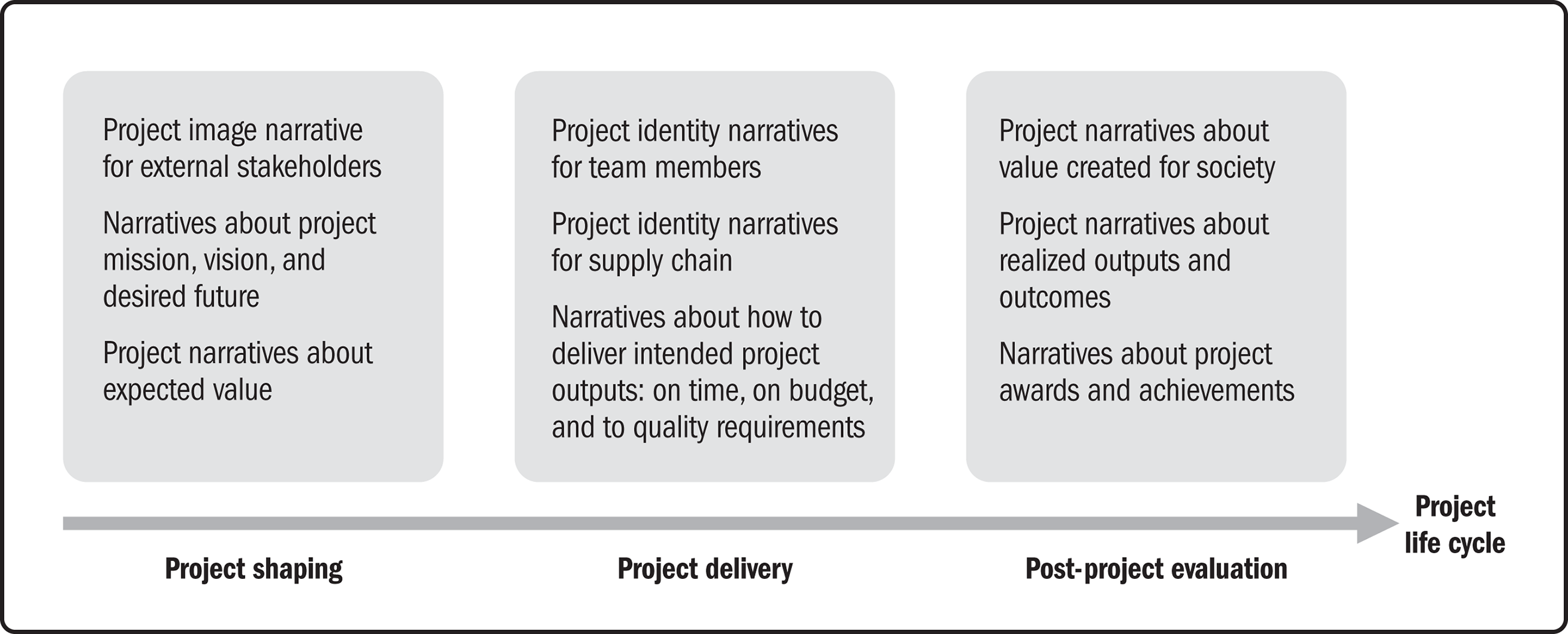
Project narratives throughout the life cycle of a project.
In Figure 1, we show the temporal dimension of project narratives and distinguish between different project narratives through the project life cycle. During project shaping narratives about future mission, vision, desired future, and expected value (Liu et al., 2019; Martinsuo et al., 2019) are crafted, often become formalized, and then communicated to different stakeholders. During the project shaping phase, an image project narrative is articulated with the purpose of projecting the desired future to external stakeholders as branding. There may also be different competing antenarratives observed during project shaping and counternarratives may form. During the project delivery phase, the identity narrative becomes more important and is articulated by the owner project team and shared with the supply side in order to align effort. In project delivery, different organizational identities from different supplier firms merge together in the temporary delivery organization, and so forming a narrative about project identity becomes important. Following project completion, evaluation of the socioeconomic value generates project narratives about value created for stakeholders, and industry awards to the project delivery team enable achievements to be communicated more widely, thereby enhancing careers. Narratives about project value for economy and society are shared more widely in textual, audio, and video forms as well as through social media. Again, there may be competing narratives answering the question: “Was it worth it?” Project leaders may strive for consistency in crafting narratives that are repeated throughout the life cycle of a project and, as such, they aim to align the shaping narrative of the intended future with the post-project evaluation image narrative of actual achievements. It is important to recognize that narratives are temporal and we live in a dynamic world of an ongoing flux of activities on projects.
Conclusions
In this article, we have focused on project narratives, defined as temporal but often repetitive narratives, which have the potential to perform and shape the future. Taking a critical discourse analysis approach, which is inherently normative and relational (Fairclough, 2013), we crafted the project narratives in the cases from archival and publicly available materials and showed how a realist critical discourse approach allows us to move on theoretically from existing deployments of narrative research in project organizing. We found that strong project narratives need to be clearly stated, convincing, and appealing to the project delivery organization and to stakeholders, as well as aspiring to demonstrate long-term value achieved through project outputs and outcomes. Project narratives tend to be repeated throughout the project life cycle and beyond by project leaders who strive for consistency in their approaches. Yet project narratives are temporal in nature and they change over time and become new narratives through the phases we have identified in Figure 1. In this sense, they are performative in the way project organizing changes the future. We conclude that the development and articulation of a convincing project narrative during both the shaping and delivery stages of the project life cycle into the post-project evaluation narrative have important implications for project identity and image crafting. As projects are very complex and uncertain temporal endeavors, there cannot be a linear relationship between narrative articulation and the real effects those narratives have on the project organization. Narrative construction and repetition is a continuous process of negotiation between different narratives. Image shaping narratives, which articulate a desirable future state, appear to be stronger than those that focus on current benefits, while project identity narratives that articulate only one professional identity within the project team can be seen to hamper the overall delivery effort. These different project narratives (e.g., project narrative about mission and vision, project image narrative, project identity narrative, project narrative about value) all play their roles throughout a project life cycle.
We suggest a research agenda for further work on project narratives:
The future-oriented nature of project narratives means that they potentially perform and change the future. The future is uncertain, yet our faith and commitments turn narratives into actions and actions into realized outputs and outcomes (Kay & King, 2020) The personal intuition, faith, and commitment of project leaders and how these impact the narratives they construct, communicate, and turn into actions merit further exploration. Psychological behavioral studies are favored for this research direction.
The temporal nature of narratives means that they tend to change throughout the project life cycle, as we have seen in the differences between shaping and delivery narratives. Yet, those in leadership positions tend to strive for consistency in communicating project narratives. The ongoing process of sustaining and repeating the appropriate narratives (e.g., narrative about the intended outputs and outcomes) in the dynamic flux of project activities and changes in personnel is an important agenda for future narrative work. To better understand the process of narrating in project organizing further, more longitudinal, multimethods research is recommended, with a particular focus on how the future is created and changed.
Critical discourse analysis favors investigation of the power relationships behind the narratives. There are clearly important power relationships at play in all three cases, which would warrant detailed further investigation where narrative analysis can be used in a true critical realist methodology to reveal those power relationships (Fairclough, 2013). Such research would reveal many insights into narrative causality and the extent to which project narratives complement other forces to get projects done.
We have shown and highlighted that there are always counternarratives to the dominant narratives of projects crafted and articulated by opponents of a project. The interactions between dominant and counternarratives merit further empirical research using other project case studies, archival data, and ethnographic approaches. Archival data (e.g., newspapers, Twitter messages) would allow us to explore counternarratives crafted by external stakeholders and how project teams deal with these narratives and construct narratives in response. Ethnographic research would allow us to explore the lived experiences of project leaders and how they construct narratives to overcome resistance to change.
We have argued that narratives have important implications for shaping the internal identity and external image of projects. This is an important contribution to project organizing research, which often omits the nature and role of narratives in forming and (re)crafting identities and images at the levels of the network, firm, project, and individuals. Further research is required to combine research into narrative and identity work to better understand their connections.
Further narrative research is recommended to explore the symbolic nature of materiality and the (re)creation of narratives over time. For example, there is emergent work on the symbolic nature of megaprojects developing over time (Van Marrewijk, 2017). The materiality (e.g., buildings) itself creates narratives and it is people and their lived experiences that interpret narratives all the time. This would enable us to explore how value narratives are (re)crafted over time.
Finally, we need more longitudinal research—possibly historical but preferably in real time—to understand how project narratives become performative and how other competing project antenarratives (Vaara et al., 2016) are nonperformative and eventually forgotten. Here, attention to framing contests (Kaplan, 2008) and narrative interactions (Sergeeva & Winch, 2020) would be warranted.
Footnotes
Acknowledgment
We are very grateful to Professor Stewart Clegg for his help in developing the final version of this article.
Declaration of Conflicting Interests
The author(s) declared no potential conflicts of interest with respect to the research, authorship, and/or publication of this article.
Funding
The author(s) disclosed receipt of the following financial support for the research, authorship, and/or publication of this article: Economic and Social Research Council (ESRC) “Narratives of Innovation: The case of UK infrastructure” (ES/R011567/1) and Project Management Institute Inc. “Innovation champions in UK infrastructure megaprojects.”
Author Biographies