




Abstract
Project scholarship suggests that an increasing volume of activities in organizations, economies, and societies occurs in the form of temporary projects. Drawing on research on project value, we aim to build a contextual understanding of why business organizations choose to participate in projects. Discussing value creation, capture, and destruction patterns for the owner, project-based firm, and the temporary project domains of project organizing, we develop a typology of project value domains for business organizations. We contribute to the theory and debate in project studies, integrating the conversations on the projectification of economies and societies with the stream of work on project value.
Introduction
Motivated by the challenge to extend theory and debate in project studies, the aim of this article is to re-engage with one of the foundational questions of the field: Why do business organizations choose to participate in projects? The broad motivation for this question stems from research that focuses on the proliferation of projects in organizations (Fred, 2015; Godenhjelm et al., 2015; Maylor et al., 2006; Midler, 1995; Müller et al., 2016; Söderlund & Tell, 2011). This proliferation has led to the emergence of complex project business entities (Artto & Kujala, 2008; Artto & Wikström, 2005; Wikström et al., 2010), which, through repeated interactions with individuals, other public organizations, and private firms, are becoming institutionalized as the project society (Jensen et al., 2016; Lundin et al., 2015; Lundin, 2016). Along the same lines, recent research indicates that projects contribute to approximately one-third of the gross domestic product (GDP) in a typical Western economy transitioning from an industrial to a post-industrial setting (Schoper et al., 2018).
While the stream of work describing and theorizing trends of projectification provides invaluable insights into how organizations, businesses, and societies engage in projects, extant research underplays the importance of the why question in their phenomenon of interest. The assumption of a steady progression of industries, economies, and societies toward temporary organizational forms and practices based on projects is problematic because it falls short of adequately explaining why organizations choose to undertake projects in the first place. It is also problematic when projects, as a category of organizing economic production, have been repeatedly criticized for their poor track record in performance compared with other organizational forms (Flyvbjerg, 2006), and when project scholarship has found it difficult to gain traction among the ranks of general organization and management research (Jacobsson & Söderholm, 2020). The aim of this article is therefore to revisit the foundational question around organizational participation in projects to reinvigorate the debate and theoretical discussions in project studies (Geraldi & Söderlund, 2018; Geraldi et al., 2020) and help maintain the relevance and meaningfulness of project studies as a maturing scholarly field in line with Alvesson and Sandberg (2011).
Before continuing with the development of the argument, it is important to clarify the scope and theoretical focus of our discussion in this article. First, we delimit the scope of the argument to participation of business organizations in projects. We understand such business organizations as actors operating in a market economy where commercial interests are an important driver for the project activity. Second, we operationalize our interest in the organizational participation in projects as fundamentally a value question in the form of a rationale that project actors adopt to justify their participation in projects as a key organizational outcome of interest (Svejvig & Andersen, 2015; Winter & Szczepanek, 2008). We continue by developing our argument grounded in these two conceptual points of departure.
The extensive research stream on project value has gained in both prominence and volume in the past decade, encompassing aspects of context, creation, co-creation, delivery, and capture of value (Martinsuo et al., 2019). Along these lines, research explored how value creation occurs through a variety of interactions among the core project actors (delivery coalition) and other stakeholders during the project front end (Edkins et al., 2013; Matinheikki et al., 2016; Morris, 2013) or execution (Artto et al., 2016). Similarly, projects have been explored as constellations where value is created by the different actors collaborating and interacting supported by the mutual alignment of goals (Artto et al., 2016; Laursen & Svejvig, 2016). Recently, in project studies, there has been an emphasis on project value creation phenomena, acknowledging the sophistication in which project organizations generate value through interactions with their contexts and other actors (e.g., Kujala et al., 2010; Laursen & Svejvig, 2016; Martinsuo & Killen, 2014). Research on value in organizational and strategic management literature emphasizes the interactions among different actors (such as firms, supply chain, end users, and customers) and the multiplicity of levels (individuals, teams, organizations, societies; Bowman & Ambrosini, 2010 ). Similarly, research has focused on the co-evolution of different aspects of value (value creation and capture; Pitelis, 2009) to understand the form and structure of the value phenomena (e.g., Lepak et al., 2007).
While the extant work on project value (Artto et al., 2016; Fuentes et al., 2019; Green & Sergeeva, 2018; Invernizzi et al., 2019; Pargar et al., 2019; Svejvig et al., 2019; Willumsen et al., 2019) covers a variety of empirical settings—with implications for project value in the broad sense of the term—we could not identify research expanding on project value as a rationale that informs the decision on whether or not the organization should take part in the project. Such additional nuance to the understanding of project value would not only inform the argument on organizational participation in projects but would also contribute to the long-standing conversation in project scholarship on why projects exist (Söderlund, 2004). It would also recognize that value ultimately materializes for permanent organizations that continue to exist beyond the project life cycle of temporary organizing (Bos-de Vos et al., 2019).
In line with Martinsuo (2020), we seek to develop an argument on project value in its organizational context, recognizing that different types of organizations participating in projects are likely to have different value rationales. To this end, we build on Winch (2014) and the three-domain framework as a useful representation of the most common business organizations that take part in project organizing: owners, project-based firms, and temporary project organizations. Focusing on project value from the perspective of the typical organizational actors, we further develop project value domains to differentiate between value created by permanent organizations in the project setting and value created by the project organization, combining the value contributions of various participating actors. We discuss the genesis, dilemmas, and ambiguities across the different domains to understand value destruction as the downside of project value. Expanding on the value creation, capture, and destruction in different organizational contexts begins to unveil the business rationale for organizational participation in projects, thereby informing our research question. We consolidate the argument by proposing a typology of project value domains, concluding with its implications for advancing theory and debate in project studies and suggesting several avenues for potential future research in this area.
Project Value in Business Organizations
Projects are widely understood to be significant, nonroutine efforts deploying substantial resources in an aspiration to reach a future state by achieving tangible goals (e.g., Winch, 2015). It is the notion of value based on future benefits realization (for example, growth, competitive advantage, or sustained quality of service provision for the organization in question) that motivates a project client to undertake a project (Morris, 2013). Along similar lines, the project valuation practice is understood as being an economic argument based on the calculation of the ratio between the anticipated future benefits of the project weighted against the present costs needed to achieve those benefits (Laursen & Svejvig, 2016).
Recent research broadly describes project value as a process occurring among multiple organizations aligned in their interests and working (Artto et al., 2016) on common project outputs (Svejvig & Andersen, 2015). Similarly, there is increasing coverage of the diverse aspects and facets of project value. A recent collection of contributions differentiates between concepts of value as worth (underpinned by engineering and economics) and value as ideals (underpinned by the social sciences) (Martinsuo et al., 2019) to address a variety of value considerations in projects. Examples include value in context (Green & Sergeeva, 2018; Invernizzi et al., 2019; Riis et al., 2019), value creation (Pargar et al., 2019; Willumsen et al., 2019), value co-creation (Fuentes et al., 2019; Liu et al., 2019), value delivery (Svejvig et al., 2019; Vuorinen & Martinsuo, 2019), and value capture (Bos-de Vos et al., 2019). In this way, the extant studies explore a myriad of specific theoretical and empirical phenomena, which have implications on project value in a broad sense (Laursen & Svejvig, 2016; Martinsuo et al., 2019). As the most recent contribution to this debate, Martinsuo (2020) suggests that understanding value as a set of beliefs held by multiple stakeholders has the potential to alleviate the multiplicity, dynamics, different priorities, and tensions as the main challenges associated with the concept of project value.
While current studies acknowledge the complexity of project value phenomena, the use of the term project value itself can be problematic as it can acquire a number of different meanings, depending on the phenomenon this term is used to describe and the analytical level it assumes. This situation creates several conceptual problems, including the inability to address the temporal and relational disconnect in the project value needed for the development of a more nuanced understanding of this phenomenon. More specifically, project value occurs across different time frames (project life cycle versus operations and use), whereby a project client or owner can only realize the value of the project in the operations and use phase of the asset, which is beyond the remit of the temporary organization often used as the empirical setting for project value studies. This generates a discontinuity in project value flows and calls for an alignment of incentives and agency between the project organization and permanent organizations that undertake it (Zerjav, Edkins, et al., 2018). A similar issue pertains to the multiorganizational settings, which represent a large and important segment of project organizing (Ahola, 2018; Sydow & Braun, 2018); there is a diversity of actors involved in project organizing, including the client, project-based firms, supply chain, and a variety of stakeholders and users. This diversity of actors makes the distribution of value creation and capture asymmetrical in that the set of actors who create value (delivery organization) often do not coincide with actors who capture value (users and stakeholders), creating tensions as value creators will also want to capture their share of the value. Moreover, the involvement of a variety of actors with competing and conflicting interests in project organizations, and a temporal disconnect between project and business as usual, suggest that value translation mechanisms are needed to establish the rationale for participating in a project based on the projected future value.
This problematization calls for the development of a more nuanced understanding of project value, including an organizational contextualization of where and how project value is generated and captured. Delimiting our focus on projects in a market setting, we draw on the conceptual framework proposed by (Winch, 2014), suggesting that (1) owners and operators, (2) projects and programs, and (3) project-based firms form distinct organizational domains of project organizing. The conceptual framework is useful for our organizational contextualization of project value in business settings because it integrates the role of permanent organizational entities (owners and suppliers) within the temporary organizational context (projects and programs). This framework helps address the problem of the temporal and relational disconnect in extant conceptualizations of project value, informing the decision on whether an organization should participate in a project or not.
Toward a Typology of Project Value for Business Organizations
To establish our conceptual model, we adopt the contextual position of projects as temporary configurations where permanent organizations are assembled to deliver specific outputs. We establish the three-domain model as a typology (Baden-Fuller & Morgan, 2010) based on the notion of the Weberian ideal type as a scientifically formulated generalization of empirical observations that extracts the basic idea of a complex empirical category. Our approach thus takes the perspective of typical business organizations that participate in projects and it adopts the assumption that they comprise actors who are self-interested in that they will only participate in a project based on a favorable assessment of the value that this participation will bring to them. Moreover, we assume that actors will continue to stay involved with the project for as long as they are able to appropriate a proportion of value created. In this way, we derive and elaborate the different organizational domains of project value, addressing the business rationale that justifies actors’ participation in projects. To better understand the roles and relationships among the types of project value in different organizations, we explore the mechanisms of value destruction for the types identified. In this way, we structure this section contrasting the business rationale of value creation and capture with the value destruction within the given rationale. Thus, we focus on the good and the bad of project value, to explore the extremes of the value phenomenon, while at the same time acknowledging that value creation, capture, and destruction are entangled and form part of the larger phenomenon of project value that is experienced and acted upon differently by project actors.
Project Owner
The first organizational type of project value pertains to the owners as permanent organizations that operate through the continuous provision of services but undertake projects to upgrade or expand their business infrastructure. While the role of the project owner in some respects overlaps with that of a project client, it is important to make a conceptual distinction between the two. A project client is a tactical role focused mainly on the purchasing of services leading up to the project delivery, whereas a project owner is a strategic role often with long-term involvement with the business to which the project is contributing. As a result, a project owner typically owns the asset after the project has been completed, whereas there is no such expectation for project clients. Moreover, as projects are typically not the core business and operational model for owner organizations, organizational designs are based on an owner committing resources and selecting a core team and dealing with stakeholders and the market to deliver on the demand requirements. As a result, the context of project owners represents the business organizational domain where projects are negotiated, defined, and finally sanctioned (Winch, 2014)
Project-Based Firm
The second organizational type of project value pertains to the project-based firm that engages in projects as their main operational and business model (Davies, 2004; Gann & Salter, 2000; Whitley, 2006). The project-based firm is a permanent type of organization hired by the owner to supply services for their commissioned projects. As a result, project-based firms tend to be suppliers of specialist services for external clients on a project-by-project basis.
The ultimate outcome of the scenario is the inability of all, but the actors with the most market power in the supply chain, to capture value through participating in the projects. Actors with positional power can therefore capture value regardless of whether the project has achieved its asset value or not. Project literature abounds with empirical examples of structural challenges and issues pertaining to the hold-up problem, where parties fail to cooperate due to the perceived risk of opportunistic behaviors by their business counterparts (e.g., Chang & Ive, 2007)—a phenomenon also linked to poor performance of industries such as, for example, construction (Green, 2011).
In the past several years, industries with business models based on outsourcing have shown to be examples of value extraction practices. In particular, the construction contracting industry in the United Kingdom has been prone to failures due to systemic problems with fragmentation and poor cooperation leading to poor financial and innovation performance (Smyth, 2018). A notable example of this is Carillion, the second largest UK-based construction company that collapsed in 2018, which led to large-scale repercussions across its supply chain and client base. This ultimately called for government intervention in the form of a change of attitudes toward the Private Finance Initiative (PFI), a procurement model used for contracting projects in social infrastructure (Zerjav & Vine, 2018). The value extraction process took the form of the company taking on more and more new project contracts, which they could not deliver on, resulting in major losses for the organization. This situation was exacerbated by late payments to the supply chain, aggressive accounting practices, and payments of high dividends to shareholders, despite poor performance of these projects (Hajikazemi et al., 2020). Consequently, the illusion of the business success of the company was fabricated as a result of value extraction practices in relation to both the project owners and the supply chain.
Temporary Project Organization
The final organizational type of project value pertains to the temporary project and program organizations (Lundin & Söderholm, 1995), which are key for the creation of value for project owners, suppliers, and other stakeholders. We specifically define projects and program organizations as configurational (Winch, 2014) and contextual settings (Grabher & Ibert, 2011) for the value creation by owners, project-based firms, and other stakeholders. Projects and programs provide a temporary organizational context where project actors and stakeholders work on joint outputs (Manning, 2017; Ahola, 2018), assembled around a network governance model (Jones et al., 1997), polycentric governance (Gil & Pinto, 2018), or even a common goal without traditional economic contracts (Gulati et al., 2012; Spillman, 2018). Collaboration-based organizational designs emphasize contractor, supplier, and stakeholder engagement by focusing on multiparty and interorganizational interactions, which necessitates considerations of stakeholder management, trust, team integration, and other relational mechanisms (Carson et al., 2006; Henisz et al., 2012; Jeffries & Reed, 2000).
There are numerous examples of the broken agency scenario in projects. Perhaps the most notable example is the Berlin Brandenburg Airport, where planning issues, technical difficulties, and management changes contributed to a nine-year long delay in the opening of the airport (Fiedler & Wendler, 2016; Financial Times, 2020a). Another example is Crossrail—the East-West London high speed underground line that suffered systems integration problems between signaling systems and tracks, adding just under £4 (US$5.5) billion to the original £14.8 (US$20.5) billion budget (Financial Times, 2020b).
This section derived theoretical types for project value that affect permanent and temporary business organizational entities and thus inform their decisions to participate in projects. Permanent organizations expect returns based on the capture of their investment value or transaction value in the principal-agent relationship. The temporary organization, on the other hand, realizes project value through collaborative production of joint outputs in the project setting. The value types come with their common problems and issues, as we illustrated through the white elephant and value extraction syndromes in the permanent organizational settings and the broken agency in the temporary organizational setting.
A Typology of Project Value Domains
Next we propose a conceptual model that summarizes our argument on the domains of project value for business organizations. To this end, Table 1 presents a typology (Baden-Fuller & Morgan, 2010) as a collection of ideal types foregrounding some organizational features of project value while backgrounding others. Our typology of project value domains integrates the previous argument as a conceptual framework in line with that of Shapira (2011), which helps us understand the phenomenon of project value contextualized in the domains of business organizations.
Typology of Project Value Domains
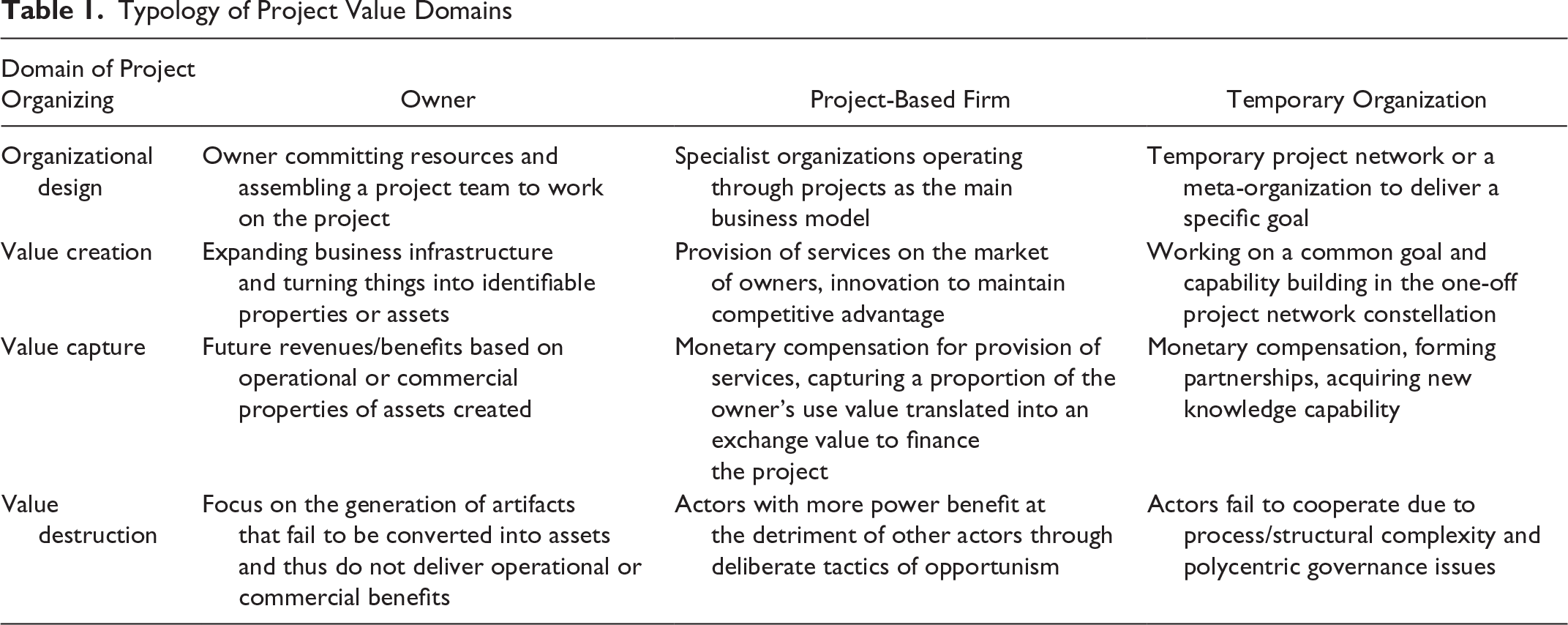
The typology of project value domains helps in the development of a more nuanced and comprehensive understanding of project value that explicitly acknowledges the organizational context in the creation, capture, and destruction of project value, following the recommendation by Winch (2014) to consider projects as temporary configurations of permanent organizational entities. Moreover, the typology associates the project value type in each organizational domain with its upside and downside to allow a more comprehensive understanding of the strategic choices for organizational participation in projects. Such an understanding can inform qualitative project valuations that can be used by project actors in different stages of the project life cycle to revisit the participation rationale based on the project value perspective. Similarly, it can be used to interpret the tensions and trade-offs among the different project actors as conflicts between the dominant business rationales they represent in the given project context and point in time, thereby helping to resolve the temporal and relational disconnect in the project value flows.
Contributions to Advancing Theory and Debate in Project Studies
Motivated by debates about the increasing proliferation of projects in organizational, economic, and societal activities, this article focused on the long-standing question of why business organizations participate in projects. We develop an argument that distinguishes among the project value created, captured, and destroyed by project owners, project-based firms, and temporary project organizations. Perhaps, unsurprisingly, our argument elaborates on why participating in projects can make sense for business organizations: to invest in assets to support their business infrastructure, to offer services in the market of projects, and to collaborate with others on joint outputs. More interestingly, however, our focus on the why rather than the how of organizational participation in projects helps begin to understand some of the drivers behind large-scale processes of the projectification of organizations (Fred, 2015; Godenhjelm et al., 2015; Maylor et al., 2006; Midler, 1995; Müller et al., 2016; Söderlund & Tell, 2011) and societies (Lundin et al., 2015). Moreover, focusing on value patterns for the most common constellation of business organizations in project organizing provides a useful starting point for theorizing what can be seen as a core element for the project economy (Schoper et al., 2018). This point begins to uncover a much wider research agenda about the inner workings of such a project economy, focusing on the project organizations that create it.
To provide counterbalance for the rather enthusiastic outlook on project organizing espoused through the value creation and capture, our discussion of value destruction equally identifies pitfalls and deterioration patterns in the value rationale as reasons for why business organizations should not participate in projects. In such a way, we hope to have derived an argument that provides a summary of the good and the bad of organizational participation in projects, thereby enriching our understanding that projects are omnipresent in our economy, society, and lives (Jensen et al., 2016). Specifically, our analysis on value creation, capture, and destruction broadly implies that, at the aggregate level of economic sectors and markets, investment into assets relates to economic growth; service provision relates to increases in productivity; and collaboration value leads to the development, transfer, and recombination of knowledge and services leading to innovation of products and service bases. Conversely, the white elephant, value extraction, and broken agency scenarios lead to market bubbles (in which a large number of projects are initiated without an asset value justification), and low-productivity industries that will detract the best players from participating in them. Although it was beyond the scope of this article to engage extensively in the development of this argument, future research should engage with the macro-level argument on project fields, industries, and economies alongside their functional mechanisms and pathologies.
We suggest that the primary contribution of this article is to motivate future debate and theorizing of drivers and mechanisms behind the projectification of organizations, the project society, and projects as a human condition to elaborate not only how but why these phenomena occur. We hope this will initiate a debate questioning the extent to which projects should be everywhere, based on a reflection and balanced understanding of not only what projects are and what they can become but, equally, what they are not and what they cannot become.
Additionally, informing our study with the research on project value and using the domains of project organizing framework to contextualize the concepts in their respective organizational settings, this article also contributes to two other streams of conversation in project studies: project value and domains of project organizing. In line with the recognition of the need for more studies on project value in context (Martinsuo et al., 2019), we provide a macro-level contextualization of project value, focusing on organizational contexts within which project value occurs. By distinguishing among the different types of project value in the different domains of project organizing, we speak to the recent discussions about the need to acknowledge the multiplicity of project value espousing challenges with different priorities, tensions, and dynamics (Martinsuo, 2020). This extends the current studies on project value by offering a framework to integrate thus far disparate theoretical concepts, such as value creation, capture, and destruction, thereby addressing the identified need for expanding the theoretical understanding of value in projects (Laursen & Svejvig, 2016; Martinsuo et al., 2019). We also contribute to the discussion on domains of project organizing by extending this useful conceptual framework beyond the setting of economic infrastructure projects where it was originally developed. Moreover, by introducing the discussion on project value that materializes through interactions among actors, we contribute to the debate on the governance, commercial, and resource interfaces among the domains, identified as an important area of research (Winch, 2014). While our choice of the three-domain framework was informed by its simplicity and representativeness of key business organizations in a project setting, future research can use other frameworks of project-based organizing to expand on other contextual dimensions of project value. In particular, we see a number of opportunities for conceptual development building on the project business (Artto & Kujala, 2008; Artto & Wikström, 2005; Wikström et al., 2010) and project society (Lundin, 2016) frameworks. Whereas in this article we focused on value creation, capture, and destruction within each organizational domain, future research should provide an in-depth exploration of the trade-offs, interfaces, and overlaps among the different project value types and associated interactions among actors that typically co-occur in project settings. Similarly, we suggest there is a considerable opportunity in continuing to explore the good and the bad of organizational participation in projects, focusing on value destruction patterns that can materialize from the tensions and ambiguities inherent in different value types.
As the aim of the article was to provoke interesting future debate rather than to provide a definitive elaboration of organizational participation in projects, we expect that future work will challenge some of the ideas presented in this article. We contend for example that our typology may be viewed as providing a rather simplistic and, in some ways, limited view of project value, which has been repeatedly acknowledged as a multifaceted, context-dependent, and subjective phenomenon (Martinsuo, 2020). While we wanted to provide a parsimonious and theory-informed conceptual framework in this work, future work should revisit the multiple levels and perspectives of organizational participation in projects. Future work should include organizations beyond the conventional business setting taken as the scope of the argument covered in this article. Examples of these include public, non-governmental, and other kinds of organizations, which should be included in the analysis to take into account the various types of value that motivate a variety of actors to participate in projects. We also acknowledge the importance of the diverse range of stakeholders in the definition of project value. For this reason, future work should also address the stakeholder aspects of project value, following the important stream of work on stakeholder values in projects (e.g., Vuorinen & Martinsuo, 2019). Although we chose project value as the best-suited theoretical framework to approach the research question, we do not preclude the suitability of other angles that might illuminate the phenomenon of organizational participation in projects. Finally, empirical studies should complement the conceptual work in this article to generate a comprehensive debate on organizational participation in projects and project value in context.
In conclusion, we argue that this article raises a number of interesting questions that the project scholarship community should address to continue to advance the theory and debate in project studies (Geraldi et al., 2020). This research should revisit long-standing questions and controversies (Kreiner, 2020), thus helping our scholarly community to solidify its traction in the mainstream scholarship on management and organizations (Jacobsson & Söderholm, 2020) as well as in the community of practitioners and policy makers.
Footnotes
Acknowledgments
I would like to thank the Special Issue Editors and the four anonymous PMJ reviewers for the comprehensive and constructive suggestions that helped develop the argument in the article through no less than five iterations of comprehensive revisions. Moreover, I gratefully acknowledge Professor Andrew Davies and Dr. Maria Gradillas-Garcia for valuable discussions that contributed to the development of the argument presented in this article. In addition, I would like to thank my colleagues in the UCL Bartlett School of Construction and Project Management and Science Policy Research Unit (SPRU) at the University of Sussex, where I presented early ideas leading to this article. I would like to acknowledge members of the Stanford Global Projects Center for the inspiring conversations during my research stay in 2017, which also contributed to the ideas presented in this article. All these contributors are the reason for the use of the plural personal pronoun “we” throughout the article. Any errors and omissions, however, remain my own.
Declaration of Conflicting Interests
The author(s) declared no potential conflicts of interest with respect to the research, authorship, and/or publication of this article.
Funding
The author(s) disclosed receipt of the following financial support for the research, authorship, and/or publication of this article: I gratefully acknowledge the UK Economic and Social Research Council (ESRC) for funding this research through the Future Leaders grant [Ref: ES/N016815/1].
Author Biography