




Abstract
This article provides insights into ways in which project studies can be extended to make further impact on and contributions to other research domains, including more general management and organization studies. Inspired by literature on the phenomenology of science, publication practices, logics of research communities, and theory building, we analyze some examples of project studies that reach beyond the project domain. Based on this analysis, we present an “escape artist’s manual” consisting of strategies and practices for how researchers could think about and design project studies to enable contributions beyond the home domain.
Keywords
Introduction
Projects abound in society, and the scholarly interest in projects is ever increasing. Project studies today are also attempting to provide contributions to other domains, including more general management and organization studies (Söderlund, 2011), although the impact could be more profound. Searches for projects in management journals outside the project domain provide limited hits, and projects are covered only occasionally in standard management textbooks. Therefore, it makes sense to ask how contributions from project studies can be developed to further increase the impact on other research domains. In this article, we argue that project studies have a lot more to offer other research domains, but that project researchers can be more skillful in generating new contributions and conveying their results to audiences outside the home domain.
However, providing a complete roadmap for how to reach beyond the project domain is far from a straightforward endeavor. To further claim that the authors of this article would have all the answers to this would be presumptuous. Still, in answering the call of this special issue, we aim to demonstrate and outline one way that studies of projects could enrich other research domains and thus develop project studies at large. We call this approach “an escape artist’s manual.”
The starting point is an article by Jacobsson and Söderholm (2011), who argued for the need for project studies (and project researchers) to reach beyond the project domain or, as the title of their article indicates, “to break out of the straitjacket” of traditional project research. In their concluding paragraph, Jacobsson and Söderholm (2011, p. 386) claimed that, for project studies to be truly relevant, projects as an empirical phenomenon “must be relegated from being the centre of research to one case among others.” The authors were implying that the relevance of projects cannot be taken for granted by project researchers; instead, the relevance needs to be illustrated in relation to other organizational forms and phenomena if projects are to have a larger impact on other domains, including general management and organization studies.
In this article, we take these claims further by elaborating on how researchers can think about and design project studies to increase the potential contribution beyond the project domain. We argue that one way to achieve this is based on exploring the interconnectedness between the salient characteristics of projects and the domain to which a particular research effort aims to contribute. Researchers whose aspirations are to reach beyond the project domain with their contributions must also act like an “escape artist” in that they need to develop a “discursive competence” and understand the phenomenology of the domain to which they aim to contribute. We use the term “escape artist” in order to further develop the straitjacket idea presented by Jacobsson and Söderholm (2011) and also to indicate that this is not only a scholarly approach. It is also an art form where the scholarly equivalent to an escape artist would need to develop and use a combination of skills and strategies to break out of one domain and enter into another one.
Breaking Out Again
Despite the forward-looking focus of this article, history should not be disregarded when explaining why contributions from project studies have had limited reach beyond the project domain. Part of the explanation comes from the heritage in the military–industrial complex (Scranton, 2014), the basis in operations research (Packendorff, 1995), and the strong anchoring in operational practice and problem solving (Blomquist et al., 2010). Another part of the explanation comes from influential professional organizations (such as the Project Management Institute [PMI] and International Project Management Association [IPMA]), which have long upheld a discourse of projects as a tool or method rather than a form of organizing (Jacobsson et al., 2016; Söderlund, 2004a). Other parts of the explanation can be found in the ways in which the academic domain of project studies is organized and how research and academic publishing have developed at large.
In their 2011 article, Jacobsson and Söderholm analyzed the contemporary state of project studies and outlined how different ways of doing research, as well as different audiences within the project domain, had emerged (Jacobsson & Söderholm, 2011). They outlined four streams of project research: three within what is commonly considered the project domain (Söderlund, 2004b) and one reaching beyond the existing domain. In their analysis, they built on Davis’s (1971) seminal work of what makes theories interesting. Davis’s (1971) phenomenologically inspired assertion is that interesting theories are not interesting merely because they are true, but because they deny certain taken-for-granted assumptions of the audience. Non-interesting theories, on the other hand, affirm such assumptions (Davis, 1971). The logic is as simple as it is applicable. If presented with a statement or theory that is already part of our mental schema of what we perceive as plausible (that is, our taken-for-granted assumptions), we tend to respond, ‘that’s obvious’ or ‘everybody knows that’ (Davis, 1971, p. 311). If we are presented with a proposition that is totally outside our mental schema, we respond, ‘that’s crazy,’ but if presented with new information that challenges our assumptions to the right extent, we react with, ‘that’s interesting!’ One could thus argue that interest, like beauty, is in the eye of the beholder, and in order to be (perceived as) interesting, one needs to be able to understand and challenge the taken-for-granted assumptions of the prospective audience (see, e.g., Zahra & Newey, 2009).
Jacobsson and Söderholm (2011) are not unique in discussing different streams of research and/or the phenomenology of science. For example, Corley and Gioia (2011) used Davis’s ideas in discussing theory building in management sciences in relation to originality and utility. Alvesson and Sandberg (2014) claimed that research is increasingly targeted at satisfying, or contributing to researchers of the same domain, or box, with the same taken-for-granted assumptions and argued for the need to produce box-breaking, rather than boxed-in research. They also claimed that prospering academic practice generates a shortage of novel and influential ideas due to increased specialization and boxed-in research. In the project domain, based on Habermas’s knowledge constitutive theory, Geraldi and Söderlund (2018) outlined and discussed three types of project research: Type 1 is a technical interest that mainly focuses on prediction and control; Type 2 is an interest in the nature and dynamics of a project as a social system; and Type 3 is “based on the human interest of emancipation, where critical reflection culminates in deliberate changes in the status quo” (Geraldi & Söderlund, 2018, p. 60).
If Davis’s (1971) logic of what makes theories interesting is applied on the possibility for project researchers to make an impact beyond the project domain, the argument is as follows. Challenges made by project researchers cannot be too bold (or unrelated) or they will be perceived as unlikely or irrelevant by recipient domain proponents. On the other hand, if existing domain assumptions are merely confirmed, vaguely re-interpreted, and not challenged based on findings from project studies, they will be considered boring and as providing no or marginal impact. Consequently, researchers interested in project phenomena and who aspire to reach beyond the project domain need to find a balance between being bold and boring in the eyes of the audience. To this end, project researchers need first to develop discursive competence where the core question would not only be what project studies can offer, but also what other research domains need.
Discursive Competence and Microtribes
The protectionist mind probably reacts to the proposal of asking: what other research domains need as a way of dismantling project studies, ultimately leading to the death of project studies as we know it. However, we would argue for the opposite—that protectionism ultimately leads to lack of relevance and potential death in a metaphorical sense. It should, of course, be acknowledged that the institutional pressure—in the way in which research is organized, communities are developed, publications are assessed, and individuals are promoted—often pushes individual researchers to act in a protectionist or boxed-in way. In simple terms, boxed-in specialization and exploitation of domain knowledge is often the fastest and easiest road to success and an academic career. Exploration is however harder to achieve. The authors of this article are not exempt from this exploitation pressure and over the years have produced plenty of boxed-in contributions; they have also made more or less successful attempts to break out of the project box (or domain). Still, in discussing this potentially vicious circle of academic protectionism, Alvesson, Gabriel et al. (2017) argued that researchers have developed (or run the risk of developing) into microtribes among other microtribes, each subject to an internal logic of safeguarding interests and often ignoring the development and history in other domains. The same authors argued that acting in a way that only strengthens the microtribe(s) in its current form (that is, mere exploitation of domain knowledge and communication within the home domain) limits the opportunities to take on some of the grand challenges of society.
Therefore, as stated at the outset of this article, it is of interest to break out of such protectionism and achieve exploration, rather than mere exploitation of domain knowledge. In other words, it is of interest to further develop processes for contributions across different domains, by engaging with other microtribes and, more specifically, creating contributions based on project studies that are found interesting by other management areas. In order to do this, however, we propose that researchers need to develop a discursive competence.
Starting with the notion of discourse, a Foucauldian interpretation of the concept implies that it is a matter of ever-changing power relationships expressed through language and practices (McHoul et al., 2015). In the realms of academia and research, such discourse is established through processes of collective learning in a shared domain (Wenger, 2011), theory, or practice, manifested in such forms as conferences, interest groups, and joint publication outlets. Using the ideas of Wenger et al. (2002), the language and practice in these domains mirror the institutionalized understanding of how things are done, which is negotiated and aligned within a community and manifested in a collective set of taken-for-granted assumptions.
Combining the idea of discourse with the logic of Davis (1971), the recipient domain—or, in the terminology of Alvesson et al. (2017), the safeguarding microtribe—must therefore be thoroughly understood and challenged if an interesting and relevant contribution is to be made. To be really successful, project researchers might even need to master the conventions, rituals, and jargon of other microtribes, as these are likely to change, depending on both the social milieu (Morgan, 1980) and the theoretical focus (Jacobsson & Söderholm, 2011). Thus, a discursive competence could be defined as the ability to decode and tap into the mindset and manners of the recipient microtribe in order to operate in an acceptable manner in the recipient domain. A discursive competence, we argue, is essential in order to develop interesting project research that transcends the boundaries of more traditional project studies.
Strategies and Practices to Create Contributions Across Domains
Locke and Golden-Biddle (1997) provided an interesting discussion that outlines a way to use the notions of discursive competence to develop and communicate contributions across domains (even if the authors did not directly refer to it as discursive competence). In their article, they investigated how contributions are made to organizational studies in terms of textual constructs and highlighted two processes: (1) structuring intertextual coherence and (2) problematizing. While the former deals with the creation of coherence (either synthesized, progressive, or non-coherence), the latter is concerned with the situation to which the contribution is made (either as incomplete, inadequate, or incommensurable). Their conclusions are based on an empirically grounded study, but it is possible to discuss their findings as potential strategies to use to facilitate contributions. Locke and Golden-Biddle (1997) did not particularly discuss contributions across domains or microtribes, even if the processes described in their article could be considered strategies to achieve what Davis (1971) would have labeled interesting for a particular audience.
Davies et al. (2018) proposed another strategy by looking into cross-fertilization between the neighboring research domains of innovation management and project management. They noted that relations between research domains can be quite superficial if concepts and ideas from one domain are encapsulated in the other domain, thus contributing to domain exploration and research specialization rather than cross-fertilization. However, if meta-theories and community-building initiatives are added, a more comprehensive cross-fertilization may be achieved. In that way, meta-theories could provide a basis for the joint understanding and development of two neighboring domains. Meta-theories could, in terms used by Alvesson et al. (2017), be understood as the research area of a meta-tribe in which several microtribes reside. Zahra and Newey (2009) discuss the hierarchy of scientific knowledge in a similar way using more traditional language. They differentiate between theories (e.g., change theory), which aggregate to fields (e.g., organizational behavior), which aggregate to disciplines (e.g., organization studies). Consequently, different theories within the same field can use the field as a joint meta-theory platform, and different fields can relate to each other within the platform represented by the discipline. Even though research specialization over the years may have separated the tribes, there are some roots or common meta-theoretical standpoints on which they rely. This common ground can be used for communication and cross-fertilization between domains and microtribes.
Along similar lines, Kuura et al. (2014) pointed out that there is also a cross-fertilization possibility to explore by linking different research practices and empirical practices to each other. For example, research in one domain may seek inspiration from another domain of practice or theory (what Jacobsson and Söderholm [2011] labeled as “in search for inspiration”) or research practices in different areas finding synergies based on interaction. Kwak and Anbari (2009) provided an overview and discussion of which domains could be considered neighboring project studies. They discussed eight allied domains to project studies (such as operations research, organizational behavior, and human resource management) and showed that publications on integrated subjects covering projects and at least one of the allied domains are becoming more frequent. Allied domains, or overarching meta-theories, are both approaches used to define areas where there is a conceptual resemblance on which cross-fertilization can be built.
The intersection, or cross-sectional, connections among different research areas, can prove to be useful for theory building in different ways. A neighboring field could, as mentioned, be an inspiration for theory building or it could have a major impact on the core of the theory. Zahra and Newey (2009) discuss this in terms of mode 1 (borrowing and replicating), mode 2 (borrowing and extending), and mode 3 (transforming the core). They also discuss levels of knowledge areas where different theories build a field, and different fields build a discipline; intersections can be defined on all these levels and most definitely, among levels.
In summary, the literature has described that contributions can be made in at least three directions. First, between neighboring domains (such as project studies’ contributions to new product development research). Second, between practice in one domain and theory in another domain (for example, studies of entrepreneurial behavior in projects to enrich entrepreneurship theory). Third, more generally, between a specific domain (such as project management) to meta-theory within social science or broader theoretical areas such as general management theory or organization theory. Thus far, domains have primarily been defined as parallel or neighboring research areas; however, when we refer to the recipient domain in the following text, it could be either a neighboring research area or a meta-theory in terms of a broader theoretical area.
Community building—another useful process identified by Davies et al. (2018)—is joint research-related practices among scholars from different, but neighboring, domains. The practices could be anything from conferences to workshops, special issues, and PhD training events that increase interaction and collaboration among scholars and promote a deep and insightful discussion on common subjects. By creating joint communities through interaction among scholars, the mutual understanding increases as does the willingness to contribute to each other or to formulate new, cross-fertilized, research agendas, studies, and publications.
Davies et al.’s (2018) identification of the social aspects of research represents an important observation. In addition to facts and theories, there is also a need for social interaction involving individual scholars that jointly agree to contribute to a common good or engage in cross-fertilization activities for a deeper and more profound contribution across tribal borders. Tribes, as such, are obviously made up of the tribal members that constitute the tribe. Alvesson and Sandberg (2014) also highlighted social dimensions as important when making so-called box-breaking research efforts, such as conferences, seminars, and developing relationships with colleagues.
Another important contribution emphasizing the importance of social skills and social dimensions of scholarly work is that of Huff (1999), who discussed how to choose conversants and how to make good conversation by being polite, connect with what is already said, and consider what would interest the conversant. As Huff (1999) points out, this conversation advice is taken from social life but must be implemented not only in social interaction but also in text. If you want to break through a barrier—or break out of the straitjacket—you must demonstrate your ability to communicate in a way appreciated by those on the other side of the barrier (other microtribes in other domains). Consequently, social rules could also be applied to academic communication if the text itself is part of a strategy to create a contribution to other domains.
Beyond the Straitjacket
Following the various strategies and practices reviewed in the previous section, it is necessary to explore the salient project characteristics or concepts that can be used to successfully create contributions beyond the project domain. To explore such characteristics, but also start to outline a way for how research on projects could enrich other domains (including more general management and organization studies), we have analyzed a few examples of box-breaking research; that is, research on projects that contribute beyond the project domain. More specifically, we used Gersick’s (1989) study of project groups, Bechky’s (2006) study of role-based coordination in film projects, Lindgren and Packendorff’s (2006) study of how gender is reproduced in project-based firms, and Jacobsson and Hällgren’s (2016) study on the nature and role of impromptu teams. These four examples are analyzed and juxtaposed in Table 1.
Examples of Contributions Beyond the Straitjacket
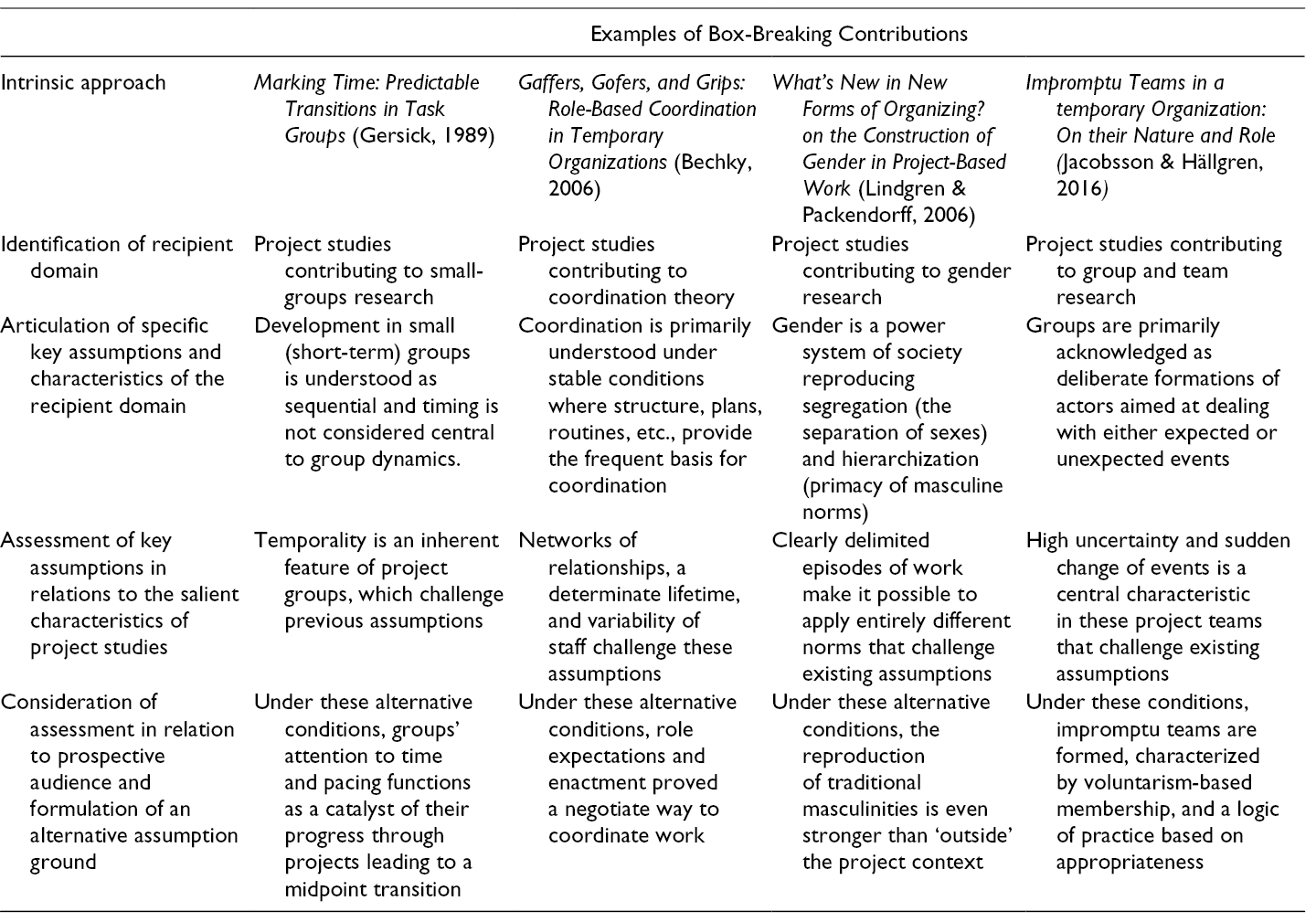
Gersick’s (1989) classical study investigates the role of time in project groups. She introduced, among other things, “midpoint transition” as a concept for understanding how time perception changed as time in projects became scarce. Contributions are mainly to research on small groups, social interaction, and group development. The salient characteristic that enables this contribution to be made is the challenged notion of temporality and time perception, which is shown to be unique to these project groups compared with previous studies on timing and group dynamics. The second example is Bechky (2006), who studied how coordination can be based on enacted roles instead of positions in situations lacking a formal structure. Film projects are used as the empirical setting for the study. Role expectations, enactments, and continuity across organizational settings provide a continuous yet negotiated way to coordinate work. The contributions to be made are to the field of coordination research, where taken-for-granted assumptions are challenged on the basis of salient characteristics of less formal structures in projects and the institutionalized role expectations in this specific setting.
A third example can be found in the work of Lindgren and Packendorff (2006), who studied the reconstruction of gender in project-based organizing. The empirical setting is project teams in an IT consultancy company. The salient characteristic used to challenge existing assumptions is the clearly delimited episodes of work, which acted as a pressure cooker in terms of how traditional masculinities were reproduced, thus contributing to gender research. The final example is the study on impromptu teams in temporary organizations by Jacobsson and Hällgren (2016). Their study challenges commonly held assumptions that groups are purposely formed to deal either with expected or unexpected events. Climbing projects are used as the empirical setting where a high level of uncertainty and sudden change of events constitute salient characteristics. Under these conditions, a rare team type—impromptu teams—is formed through a voluntarism-based membership and a logic of practice based on appropriateness; thus, contributions are made to groups and team research (Hällgren & Jacobsson, 2019).
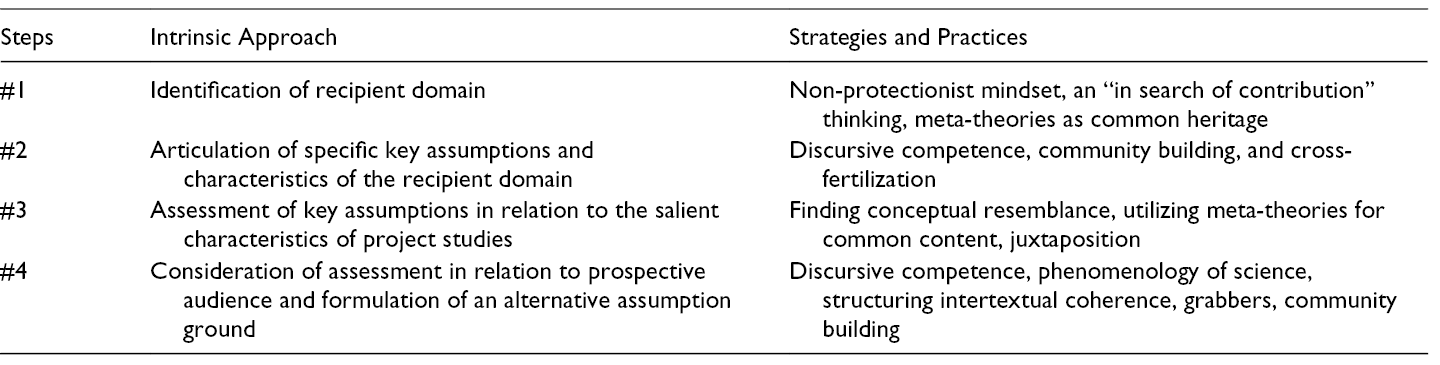
In addition to using salient characteristics of respective project setting to challenge specific key assumptions of the recipient domain, a common feature of all the above-described examples is an intrinsic approach that enables the contributions to move beyond the project domain. As summarized in Table 1, the approach identified consists of four steps: (1) identification of the recipient domain, (2) articulation of the key assumptions and characteristics of the field, (3) assessment of these in relation to the salient characteristics of project studies, and (4) the assessment of the audience and formulation of an alternative assumption ground.
In the next section, this approach will be further discussed in relation to the previously outlined strategies and practice to create contributions beyond the project domain. The descriptions of the four steps are related to the discussions by both Davies et al. (2018) and Alvesson and Sandberg (2014), in addition to the conversational advice pointed out by Huff (1999). In the terms used by Zahra and Newey (2009), our approach is close to a mode 3 (transforming the core). Thus, the approach has a combined social and academic component; for example, each step requires both academic and social skills to be well performed, and the steps are therefore part of a process that can be part of academic training and done systematically. In outlining this, we will use the article by Bechky (2006) as an illustrative example.
An Escape Artist’s Manual
As outlined in Table 1, the approach by which the four examples move beyond the project domain is built on the interconnectedness between the salient characteristics of projects and the theoretical domain to which a particular research effort aims. As a result, the contributions have been acknowledged outside the project domain and they are simultaneously rooted in research or empirical practices from the world of projects. Therefore, it is not primarily a matter of where articles are published but how the contributions are constructed and to which audience they are targeted. Publications can appear in journals outside the traditional project research area and still be targeted at the project audience and vice versa. For example, refer to Söderlund’s (2011) overview of publications in respected management journals contributing to the seven schools of thought of project studies.
When further discussing how the process of achieving the box-breaking contributions has been designed, it should be noted that the outlined approach may not have been a deliberate tactic that the authors used to create their contributions. This is something we don’t know. Nevertheless, it would still be possible to assign specific strategies and practices to each component in the approach based on the literature review discussed earlier in this article. In so doing, the outline of an escape artist’s manual for box-breaking research is emerging; a way to “break out of the straitjacket” of traditional project studies. In addition to being a play on words, this phrase also highlights that, to break out of one domain and enter into another one, scholars need to develop and use a combination of social skills and theoretical knowledge.
Identification of the Recipient Domain
The first step of our proposed escape manual is to identify the recipient domain, which requires a non-protectionist mindset with an open attitude toward, and genuine interest in, other domains. The domain also needs to be outlined in terms of common research outlets, classic or seminal contributions, literature reviews, and research contributors. Bechky (2006) observed the potential of temporary organizations (i.e., project studies) to contribute to traditional coordination theory based on their temporality and the way they are governed. When framing this in the article, she wrote, “Temporary organizations contrast with traditional hierarchical organizations as they are governed through networks of relationships rather than by lines of authority (Jones et al., 1997; Powell, 1990). Thus, coordination across firms in these networks relies more heavily on social mechanisms such as reciprocity, socialization, and reputation (Jones et al., 1997)” (Bechky, 2006, p. 3).
Similar to the above example, the recipient domain (here, coordination studies) needs to share some common ground with project studies, so meta-theoretical understanding and discursive competence are essential. Consequently, researchers and research teams should not only develop skills in a narrow project domain; they should also develop a broader understanding, and a wider portfolio of reading is thus required and should be promoted by senior researchers. As Kuura et al. (2014) noted, such broader understanding and cross-fertilization can be done in various ways, such as exporting, importing, and integrating theory and practice. Thus, included strategies are a non-protectionist mindset, cross-fertilization practices, and meta-theoretical discourse understanding.
Articulation of Specific Key Assumptions and Characteristics of the Recipient Domain
Once the domain has been identified, the current debate—or, perhaps, never-ending debates—in the domain should be understood and articulated. To start this process, it is necessary to know the characteristics of the recipient domain (or microtribe or box; see Alvesson & Sandberg, 2014; Alvesson et al., 2017). This necessitates a discursive competence, defined as the ability to decode and tap into the mindset and manners of the recipient domain in order to operate in a way that is acceptable. This also includes an understanding of the need of the recipient domain. What are the unresolved issues or the conflicting areas to which contributions could be made? What are the conceptual areas where there is a need for more profound analytical approaches? In other words, try to connect with points already made, as Huff (1999) suggested.
Regarding the needs, differences, and potential for contribution, Bechky (2006) argued that coordination is commonly understood under stable conditions where structure, plans, routines, and so forth provide the frequent basis for coordination. Bechky wrote, “... an investigation of the actual practices of coordination in temporary organizations would not only help us understand the implications of this form for the work of its members, but also provide insight into how coordination is achieved more generally in settings with few formal organizational structures” (Bechky, 2006, p. 4).
A thorough understanding can be created by engaging in research discussions in seminars, conferences, or workshops, expanding reading assignments, and digging into the core concepts of the recipient domain. It is always good to be part of a team and share both the workload and experiences; strategies to facilitate this include discursive competence, community building, and research training.
Assessment of Key Assumptions in Relation to the Salient Characteristics of Project Studies
Project studies have their own core concepts and salient characteristics. One generic example of a set of concepts are time, task, team, and transition (Lundin & Söderholm, 1995), which are built on project definitions in practice and later turned into theoretical concepts. Jacobsson et al. (2015, 2013) discussed both an internal and an external focus on projects and placed the above-mentioned concepts as the internal focus. An external project focus, by contrast, is built on concepts such as goals, expectations, and control.
Assessing such characteristics could be a matter of finding conceptual resemblance with other domains. The points to be made here are (1) that in order to assess possible cross-fertilization possibilities, the juxtaposing of salient characteristics of project studies with those of the recipient domain requires a thorough and open-minded approach; and (2) the starting point needs to be taken in the recipient domain and based on the key assumptions of that domain. Ask not what project studies can offer, but what the recipient domain needs.
Bechky (2006) took the starting point in previous conceptualizations of coordination and the conditions under which these conceptualizations have been made. She then contrasted that with the determinate lifetime and networks of relationships in temporary organizations; that is, using the salient characteristics, (limited) time and team (networks; Lundin & Söderholm, 1995). Similarly, the salient characteristics used in the other analyzed examples of box-breaking contributions are: temporality and perception of time in Gersick’s (1989) study, bounded episodes of work in the article by Lindgren and Packendorff (2006), and high uncertainty and sudden change of events in the study by Jacobsson and Hällgren (2016). As previously stressed, these are just examples of characteristics, not an exhaustive list. The limitation in trying to outline a more complete list is that uniqueness is relational rather than absolute in that it is a matter of interconnectedness with other domains. What is unique in one situation (with one domain) might not be unique in another situation. Therefore, uniqueness related to salient characteristics needs to be outlined in each case. Strategies used to achieve the assessment of key assumptions are summarizing, use of cross-fertilization skills, the deliberate use of meta-theories, and scientific juxtaposition.
Consideration of Assessment in Relation to Prospective Audience and Formulation of an Alternative Assumption Ground
Once such uniqueness has been identified it should be confronted with interpretations, current debate, and research frontiers in the recipient domain. According to Locke and Golden-Biddle (1997), such a communication strategy could be to create coherence (or lack of coherence) by placing topics in a problematized situation that is understandable in the other domain. In this process, a discursive competence, combined with a phenomenological understanding of the recipient domain, is crucial to be able to construct contributions viewed as interesting by the audience of the recipient domain (Davis, 1971). One useful rhetorical device could be the use of a grabber or hook to capture the reader’s attention and indicate why a contribution is interesting, relevant, and important (Jacobsson & Hällgren, 2014). Central to such attempts is the ability to formulate an alternative (and interesting) assumption ground.
Bechky (2006, p. 4) explicitly formulated this alternative assumption ground in the introduction, writing, “... I propose that the portrayal of temporary organizations as ephemeral, unstable systems that require swift trust is inaccurate: In fact, these organizations are organized around enduring, structured role systems whose nuances are negotiated in situ. I find that what drives coordination in these temporary organizations and maintains continuity across projects is the negotiated reproduction of role structures—the mutual reinforcement of the generalized role structure and repeated enactments of these roles on specific sets.” In this statement Bechky not only points to the importance of understanding structured role systems for coordination theory, but also the contribution she makes to project studies by arguing for the excessive belief in the need for swift trust.
Strategies that can be used for assessing the relation to a prospective audience and formulation of an alternative assumption grounds are discursive competence; intertextual coherence (or incoherence); the use of grabbers; and various community-building efforts, such as conferences, joint research funding with research teams in different tribes or domains, and joint PhD courses, which create kinship and social connections among researchers (and reviewers).
Table 2 summarizes the suggested strategies and practices to use for each step. While the approach is applicable to a specific scientific contribution, the strategies and practices are developed, shaped, and reshaped over time. These strategies and practices are not only important for the individual researcher to outline contributions across different theoretical domains in a particular article, but they also have profound implications for how to design and manage a research environment, including research education.
An Escape Artist’s Manual
Conclusions: Toward a Theory of Academic Escapology
Escapology—the art of escaping from constraints or other traps—involves illusion as well as actual skills. Like escapologists (or escape artists), researchers face a great variety of constraints and challenges, which necessitate different strategies and practices to enable researchers to break free. The historical trajectory, publication practices, quality assessment measures, and career paths are just a few examples of what today puts constraints on researchers and creates institutional pressure to produce boxed-in research (Alvesson & Sandberg, 2014). This pressure and these constraints promote exploitation of domain knowledge rather than exploration. Without entering the debate on all the long-term consequences of such practices, it is clear that this situation creates fragmentation and is neither good for science at large, nor does it encourage researchers to engage with other microtribes or domains. This is where this article contributes through its proposal of an escape artist’s manual.
The outlined escape manual provides a path for project researchers to engage in exploration, rather than exploitation, and move beyond the home domain and contribute to other domains including more general management and organization studies. The approach builds on a combination of empirical observations (Bechky, 2006; Gersick, 1989; Jacobsson & Hällgren, 2016; Lindgren & Packendorff, 2006) and previously outlined strategies and practices (see, e.g., Alvesson et al., 2017; Davies et al., 2018; Davis, 1971; Kuura et al., 2014; Locke & Golden-Biddle, 1997), each serving its own purpose and providing support to break out of the existing project box. In doing this, we have illustrated how to develop project studies in order to be interesting beyond the microtribe of the project domain. By interesting we adhere to the conceptualization of Davis (1971, p. 342), who, at the end of his article, stated: “… I have asserted that all social theories which are found interesting involve a certain movement of the mind of the audience who finds them so.” Of course, research contributions can be interesting for many different reasons, even though we have focused on box-breaking and movement of the mind connected to that kind of approach.
It should thus be noted that we do not claim that this is the way, but one way of breaking the boundaries of the existing domain to promote exploration. An alternative path forward is to inductively theorize some of the unique characteristics of projects and build a more general theory of project or temporary organizing from the inside out. As part of the contemporary knowledge base of project studies, there are several older (e.g., Engwall, 2003; Kreiner, 1995; Lundin & Söderholm, 1995) and more recent examples of this strategy (e.g., Jacobsson et al., 2016; Kenis et al., 2009; Söderlund & Sydow, 2019; Tukiainen & Granqvist, 2016), all of which expand the notion of projects in different ways. Increased theorizing based on the uniqueness of projects is clearly another way forward, even if such a path is not problem-free either. The future may lie in multiple approaches of how to move beyond the domain combined into a theory of academic escapology.
Finally, it is worth repeating that this approach is not only dependent on pure academic or scientific skills. There is also a more general community-building side of the coin, which we highlight in this article. The message we wish to convey is that social practices are a vital and important part of research contributions across (as well as within) different domains. In a wider perspective, this article carries important notions on how to organize and manage research organizations.
Footnotes
Declaration of Conflicting Interests
The author(s) declared no potential conflicts of interest with respect to the research, authorship, and/or publication of this article.
Funding
The author(s) received no financial support for the research, authorship, and/or publication of this article.
Author Biographies
