




Abstract
In concurrent engineering projects driven by short delivery times, team performance rests on the team’s capability to quickly and effectively handle different, emergent issues. We conducted an exploratory study of a large, dynamically complex project in which team members had a record of “good problem-solving abilities.” The study revealed how the team members demonstrated a collective ability to swiftly handle emergent issues, which again decreased the intensity of time and performance pressure. Beyond formal processes combined with lean practices, supporting this ability were situation awareness, task-based subgroups, direct lines of communication, and trust.
Introduction
As projects are getting bigger and more complex, project teams need to deal more with emergent issues (Bosch-Rekveldt et al., 2011; Geraldi et al., 2011; Kiridena & Sense, 2016; Maylor et al., 2008; Morris & Hough, 1987). The performance of many projects suffers because of these unknowns (Floricel et al., 2016; van Oorschot, Eling et al., 2018a). Numerous dynamically interacting entities and frequent changes related to development, production, and planning make it harder for project teams to respond effectively to issues. We know examples of projects that are delayed, over budget, or poor quality, all too well. Although they are few, there are also projects that are successful in spite of being dynamically complex (Brady & Davies, 2014). Some findings indicate that higher degrees of complexity require more routines, procedures, and standards (Austin et al., 2002; Marzagão & Carvalho, 2016). Other findings suggest that dealing with complexity requires a great degree of freedom and flexibility, and, as such, a removal of routines, procedures, and standards (Daniel & Daniel, 2018; Davis et al., 2009; Endsley, 1995; Galbraith & Nathanson, 1978; Petit & Hobbs, 2010; Pinto et al., 1993; Weick, Sutcliffe, Obstfeld et al., 1999), leaving formal planning and controlling mechanisms with shortcomings for successful management of projects (Collyer, 2016; Hazir, 2015; Hällgren & Maaninen‐Olsson, 2009; Kapsali, 2013; Saynisch, 2010; Vaagen, Kaut et al., 2017).
These inconclusive findings give rise to our overall research question: While facing time and performance pressure in a dynamically complex project, how do teams effectively maintain project progress while handling a large variety of emergent issues?
The construct of “emergent” issue is intended to capture the effect of a dynamic process (Kozlowski & Klein, 2000). By “dynamically” complex projects, we refer to project environments with difficult-to-estimate changes throughout the project delivery, after the design phase has started, and often far into the engineering and execution phases. Such changes lead to continuous adjustments and iteration loops in design, engineering, procurement, and production activities (Emblemsvåg, 2014), making the planning problem very difficult (Vaagen, Kaut et al., 2017). Hence, we focus on events that are difficult to predict, and therefore difficult to handle by traditional project risk management approaches (Daniel & Daniel, 2018; Hoskisson et al., 2017; Kahneman & Tversky, 1979). We do, however, explicitly distinguish between high- and low-impact effects for events to better understand where to direct limited risk management resources and where there is a need for proactive efforts to better handle high impact changes (Hällgren & Maaninen-Olsson, 2005). Currently, changes with limited predictability are most commonly handled reactively, after a disturbance has materialized. To enable the distinction between the high and low impact of limited predictability events, we would need to develop understanding of the impact of a potential future change disregarding the probability of occurrence. This discussion, while important, is outside of our scope. The question we attempt to answer is why and how some teams in dynamic environments are better at handling emergent issues, and this remains a central question in research into teams (Bates & Gupta, 2017; De Rezende et al., 2018; Gardner, 2012; Uitdewilligen et al., 2018; Woolley et al., 2015) and projects (De Rezende et al., 2018; Padalkar & Gopinath, 2016b; Petit, 2012; Zhu & Mostafavi, 2017). In research into projects, scholars have theorized about decisions being made in dynamic environments (Love et al., 2002; Lyneis & Ford, 2007; van Oorschot et al., 2013; Wang et al., 2017; Wen et al., 2018), but more research is needed regarding how project teams plan, act, and react in order to maintain the stable progression of highly dynamic projects, and how these actions themselves have consequences for the project (Burke & Morley, 2016; Daniel & Daniel, 2018; Pinto & Winch, 2016). To answer the research question, we conducted a longitudinal, in-depth qualitative process study of a shipbuilding project that makes use of concurrent engineering. Concurrent engineering describes the process of having upstream and downstream tasks overlapped in order to minimize time to market (Ford & Sterman, 2003; Loch & Terwiesch, 1998; Mitchell & Nault, 2007). Plenty of research states that concurrent engineering by definition leads to additional mistakes (and thus unexpected work) because the downstream phase starts to work with preliminary information from the upstream phase (Mihm et al., 2003; Mitchell & Nault, 2007; Savci & Kayis, 2006).
The case setting was useful for a number of reasons. First, the project had unique challenges in the sense that the vessel was “one of a kind,” implying specification changes throughout the project delivery. Second, the vessel was the largest and most technologically advanced ever built in its class. Third, the project organization had all the required “baseline” project management tools and techniques in place. Fourth, the project was task- and goal-directed with an ambitious deadline, signifying that time was of the utmost importance and therefore increasing the need to handle issues swiftly. Fifth, team members were highly experienced, with a proven record of successful delivery of complex projects. Sixth, because the team used concurrent engineering, many issues could be expected due to the overlapping of phases. By identifying relations and interactions among key entities of the project, we add to the understanding of how project teams in dynamic environments are able to effectively handle a range of emergent issues (Maloney et al., 2016; Waller et al., 2016; Weick, 2017). We show how collective intelligence (Weick & Roberts, 1993; Woolley et al., 2010) organized with trust, situation awareness, creation of task-relevant subteams, and direct communication counteract the negative effects of time and performance pressure. On a fundamental level, our results show that in the course of a large and dynamic project, the team increasingly relies on flexibility as a mechanism (i.e., loose coupling and room for error; Farjoun, 2010). This flexibility is reflected in a global pattern of a limited number of interacting processes.
The article is organized as follows. First, we present the main research streams and relevant literature on how dynamic relations and uncertainty in projects are handled in the established literature. Extended focus is given to the literature related to dynamic complexity and team agency as an embedded process. Second, we provide our methodological approach. Third, we present the case narrative and our findings. In the end, we discuss the significance and implications of our research, its limitations, and potential for future research.
Dealing with Emergent Issues in Dynamically Complex Projects
Dealing with new issues is an integral part of project management (Hazir, 2015; Stingl & Geraldi, 2017). Issues emerge when unplanned changes interfere with the intended progression of work (Weick & Sutcliffe, 2001). The new “realized” situation, having been unpredictable at the front end, may have a large or small, positive or negative effect on the project plan (Hällgren & Maaninen-Olsson, 2005). Issues may originate internally or externally to the project and may be attended or unattended to by the project team (Love et al., 2002). External issues emerge because of changes in, for example, customer requirements, markets, and technologies. Internal issues arise from within the project, primarily caused by the organization of the project itself, and by the way in which the project team tries to deal with emergent issues. Concurrent engineering is often chosen as an organizational process to speed up the project (Akkermans & van Oorschot, 2016) through the overlapping of different project phases. Here, a project phase starts before the previous phase is finished, thereby potentially saving time (Terwiesch et al., 2002). This way of working also requires much more interaction and communication between project team members working in different project phases, which enables learning and productivity (Akkermans & van Oorschot, 2016). However, working in parallel with incomplete information or designs from the previous phase also leads to mistakes and rework (emergent issues; Mihm et al., 2003). As such, concurrent engineering is meant to save time, but its consequences (more mistakes, more rework) cost time and resources. Concurrent engineering approaches are likely to put teams under pressure because of these emergent issues. Dealing with the issues entails more intense coordination among team members, as each individual needs to deal with more information and dependency issues (Espinosa et al., 2007). Performance feedback and reflection are therefore crucial in improving flexible team cognition (Rico et al., 2008), and collective reflection has been shown to set apart higher performing groups from lower performing ones (Schippers, Den Hartog, Koopman et al., 2003, Schippers et al., 2007).
The dynamic relationship between emergent issues and a team’s ability to handle these issues includes considering how team responses impact other emergent states, and the influence of these emergent states on the outcome of interest (Kozlowski et al., 2013; Marks et al., 2001; Weick, 1988). For instance, by tackling issues collectively, teams bring more potential information to the table, but may also cause misunderstandings that would reduce both speed and timeliness of resolutions—a key aspect of handling deviations (Eweje et al., 2012; Hällgren & Maaninen‐Olsson, 2009). As a project becomes more complex, the project team increasingly depends on feedback, adaptation, and learning (Noriega-Campero et al., 2018), as ongoing action happens simultaneously with attention (Weick & Roberts, 1993). The pacing and dynamic complexity of the project itself—coupled to the high reciprocal interdependence and mutual adjustment among stakeholders (Thompson, 1967)—means that the full effects of satisficed solutions (Simon, 1957) are not always known until further down the road. Actions and events influence each other, and produce causality relations that are difficult to identify by decision makers (Daniel & Daniel, 2018; Sterman, 1994; Van de Ven, 1986). Viewed as a system, changes in one part of a project potentially cause surprising change, or issues, in other parts. It is only natural to assume that pressure on performance and time will increase when a complex project is performed in a concurrent way. Complex tasks necessitating the integration of various input sources seem to be particularly sensitive to the effects of stressors (Broadbent, 1954; Jerison, 1959), such as there being a lot at stake (Ariely et al., 2009). One key danger to the maintenance of general operational awareness is the effects of production pressure and overload (Weick et al., 1999). Similarly, time pressure seems to decrease creativity (Amabile et al., 2002), limit long-term thinking (van Oorschot et al., 2018b), and increase the use of generic expertise not (necessarily) adapted to the situation (Gardner, 2012). As a result, there may be a tipping point where emergent issues start to exceed the ability of the team and simply push it over the edge (Rudolph & Repenning, 2002).
Projects also rely on linear logic planning and implementation methodologies in order to be performed efficiently (Ashby, 1956; Pinto & Winch, 2016). Holahan et al. (2014) found that when the level of innovativeness increases, flexibility decreases in parallel with an increase in formal controls that are imposed on the development team. When facing uncertainties, project managers often prefer more structure instead of less (Akkermans & van Oorschot, 2016). Jørgensen and Messner (2009) state that formal management control procedures that enable employees to deal more effectively with the work process and inevitable changes are beneficial to overcome the challenges and risks of uncertainties. Still, to the experienced project team, dynamic environments are often perceived as expected uncertainties (Shenhar, 2001; Wang et al., 2017); and judgmental decision processes and informal coordination are brought to the forefront as model-based decision aids become insufficient to deal with the many emergent issues (Ben-Menahem et al., 2016; Böhle et al., 2016; Davies et al., 2016; Lee et al., 2006; Vaagen, Kaut et al., 2017; Wang et al., 2017). The arrival of information and future decisions are handled simultaneously, which is a complex stochastic dynamic problem (Vaagen, Kaut et al., 2017). The difficulties in modeling and solving such problems has led to simplifying assumptions on the central terms of information arrival and future decisions and subsequently, to models that are not well suited to handling emergent issues flexibly. While simplification and abstraction are needed, we may omit crucial information and end up solving a problem different from the actual one (Weick & Sutcliffe, 2001). Planning flexibility requires a proactive approach to future changes, which is inherently different from the common approaches where changes are most often not addressed in advance, but managed reactively after a situation has materialized (Hällgren & Maaninen-Olsson, 2005; Weick, 1988). This often leads to unreasonably large adaptation costs (Vaagen, Kaut et al., 2017).
With increasing recognition that many projects are characterized by very high levels of uncertainty that are difficult to anticipate and quantify, and where model-based approaches are only practicable and successful to some degree (Böhle et al., 2016), the focus has been increasingly directed toward less tangible but more generic management processes associated with building trust, sensemaking, organization learning, and building an appropriate organizational culture (Atkinson et al., 2006; Maitlis & Sonenshein, 2010). Cook (2001) argues for trust being increased and uncertainty reduced by knowing the competence of other staff. Atkinson et al. (2006) point to trust as the most economic method of compensating for gaps in information certainty in model-based planning, and emphasize that the relations between uncertainty, control, and trust could be improved if the factor of “trust” was included in uncertainty management processes. The same can be argued in the case of sensemaking, the broad collective effort made by teams to extract shared patterns of meaning from ambiguous environmental cues (Maitlis & Sonenshein, 2010; Maitlis, 2005; Weick et al., 2005; Weick, 1988) as efficient sensemaking strengthens the collective enactment of preferred organizational realities (Weick, 1979, 1988). Questioning the status quo is essential to enable adaptive rather than destructive behavior during change (Farjoun, 2010; Weick et al., 1999). Similar to the role of trust, commitment, identity, and performance expectations can likewise enable or constrain productive sensemaking through the creation of positive or negative emotions (Maitlis & Sonenshein, 2010; Mitchell, Greenbaum et al., 2019). The fact that team members can attain, or be “given” the sense of the positive value of a change may potentially start a contagion of positive emotion through the team and beyond (Weick et al., 2005). The ability of a team to consistently perform well across different issues and contexts also suggests an underlying team ability to reinforce successful behavior (Sterman, 1994).
Constant change is a basic premise of the organizing of projects (Van de Ven & Poole, 2005); and team problem solving takes place through dynamic interactions as team members share information (Kozlowski & Klein, 2000; Uitdewilligen et al., 2013) and try to enact the near future (Endsley, 1995). Formal project structures and approaches appear to be supplemented, in extreme situations even supplanted, by flexible and informal human interactions. Earlier research has demonstrated that interaction is crucial for team performance, since it is the means by which relevant knowledge is shared within the team (Mesmer-Magnus & Dechurch, 2009). A closer assessment of how project teams make sense of emergent issues through structure and/or flexibility, and of how the simultaneous processes of enactment ultimately affect project success, requires an in-depth study of the unfolding of events during the project.
Method
We carried out a process study using grounded theory methodology with use of theoretical sampling (Glaser & Strauss, 1967), process tracing (Czarniawska, 2002), and narrative (Pentland, 1999). Process theory conceptualizes decision-making processes as a series of unique and interrelated events that result in an outcome (Poole & Van De Ven, 2010; Sminia, 2009). We based our search for an appropriate case on the four guiding principles suggested by Pettigrew (1990): to look for a case comprising extreme situations, polar types, high experience, and informed choice. We expected both the beneficial and detrimental effects to manifest more clearly in a project characterized by performance expectations, an ambitious deadline, and a multitude of complex and interconnected events, tasks, people, and decisions. When teams are faced with unexpected issues, differences in effectiveness between teams often become evident (LePine, 2005; LePine, 2003). The first author observed the team while it was working on the project and handling issues as they emerged, interviewed team members, and collected documents and second-hand data. Notes were made and interview transcripts were written upon each company visit. The first author analyzed notes and transcripts, classifying the data using open coding. On several occasions during the process of the study, the three authors met to review codes and meaning of the data.
Setting
We followed a project at “XCo,” a business unit of a multinational shipbuilding company named “XGroup,” which had successfully carried out large, complex, and unique projects before. The project teams at XCo were known to have a high performance rate (DeChurch & Mesmer-Magnus, 2010), and the organization as a whole was known as a market leader, consistently producing advanced vessels in a compressed period of time. Being embedded in an area with a long history of shipbuilding, XCo had gone from local to global since their beginning a hundred years earlier.
As short delivery times were critical, most vessels were put into engineering and production when technical uncertainty was still unresolved. For instance, it was normal that the engineering of the vessels began while only the outline of a strategic component was known. At the same time, engineering continued parallel with production, as frequent changes and further details needed to be approved and updated in the drawings. Together with the use of industrial state-of-practice planning and decision-making tools, the changes were underpinned by ongoing judgment, planning, and decision making (Vaagen, Borgen et al., 2016). As an overall result, time was saved in comparison with more linearly executed projects (for more details on this, see Vaagen et al., 2017).
Collection of Data
From late summer of 2015 until the end of the project in the early fall of 2016, the first author attended numerous meetings in the company’s production department, the adjacent technical department, the management and administration department, and in the actual production areas on and around the vessel. Meetings included frequent planning, action, production, and start-up meetings as well as a multitude of ad hoc meetings varying in participants, location, and duration. Hence, observations were made during all phases of the project, except for the initial design phase (in which concurrent engineering was not yet taking place). The individuals taking part in this “process of meetings” were planners and coordinators from the production and technical departments; supervisors and department managers from production; the project manager; employees from support functions such as health and safety and purchasing; and representatives from suppliers, subcontractors, clients, and public entities. Having free access to observe meetings in all shapes and forms greatly helped us to study the issues as they unfolded, how they were perceived, how they were resolved, and how this in the end affected the overall success of the project.
Observations were carried out through about 200 hours of observations, conversations, and interviews over a period of 40 days, spread over 13 visits, with each visit typically having a duration of three working days. We carried out three visits during the latter part of the “hull phase,” that is, during the early outfitting phase, until the hull arrived at XCo 40 weeks into the project. During the ensuing production at XCo, we made eight visits to the yard. One month after delivery of the vessel, we made a follow-up visit; half a year later, we had a retrospective workshop with the then dismantled project team. Briefings took place between visits by telephone or email, and on the first day of all visits. Conversations were primarily about work at XCo as such, the ongoing project in general, and concrete real-time events and changes. A total of 24 semistructured interviews with key decision makers were carried out during the second half of the visits, and one workshop was carried out after the project. The interviewees were the client, the project manager, four production coordinators, the technical coordinator, the project planner, the procurement coordinator, and three supervisors with responsibility for individual activities and work packages. Albeit presenting a partial view, observing meetings of central decision makers was fundamental to assessing the collective decision processes. XCo also provided us with different project documentation, such as (often changed) project plans containing activities, milestones, staffing, as well as drawings, punch lists, and correspondence.
Data Analysis
While primarily being inductive, tracing the emergence and handling of an issue in its setting necessitated attention to how the solutions became enacted during the process. Hence, this study began with ex-ante focal and arranging concepts as a selective focus for observing the change processes (Van de Ven, 2007). Since we were interested in the processes of how issues were confronted, we used the concepts events, setting, issues, interaction, complexity, solutions, outcomes, and learning points. In order to distinguish between different kinds of complexity, we included the concepts of: managerial complexity (Maylor et al., 2008); the basic natures of structural and dynamic complexity; human complexity (Snowden & Boone, 2007), since social interaction played a particular role; and pace, since the speed with which problems needed to be solved amplified the intensity of the other three. In order to distinguish between different kinds of collective problem-solving strategies, we included the basic natures of generating, deciding, negotiating, and executing solutions in teams (McGrath, 1984). The subsequent research process involved recognizing the central types of actions and events in the collected data, as well as their temporal relationships. As the study—and hence also the codes—evolved, we added, removed, or refined concepts and relations into patterns that best described the manner in which the project team handled emergent issues.
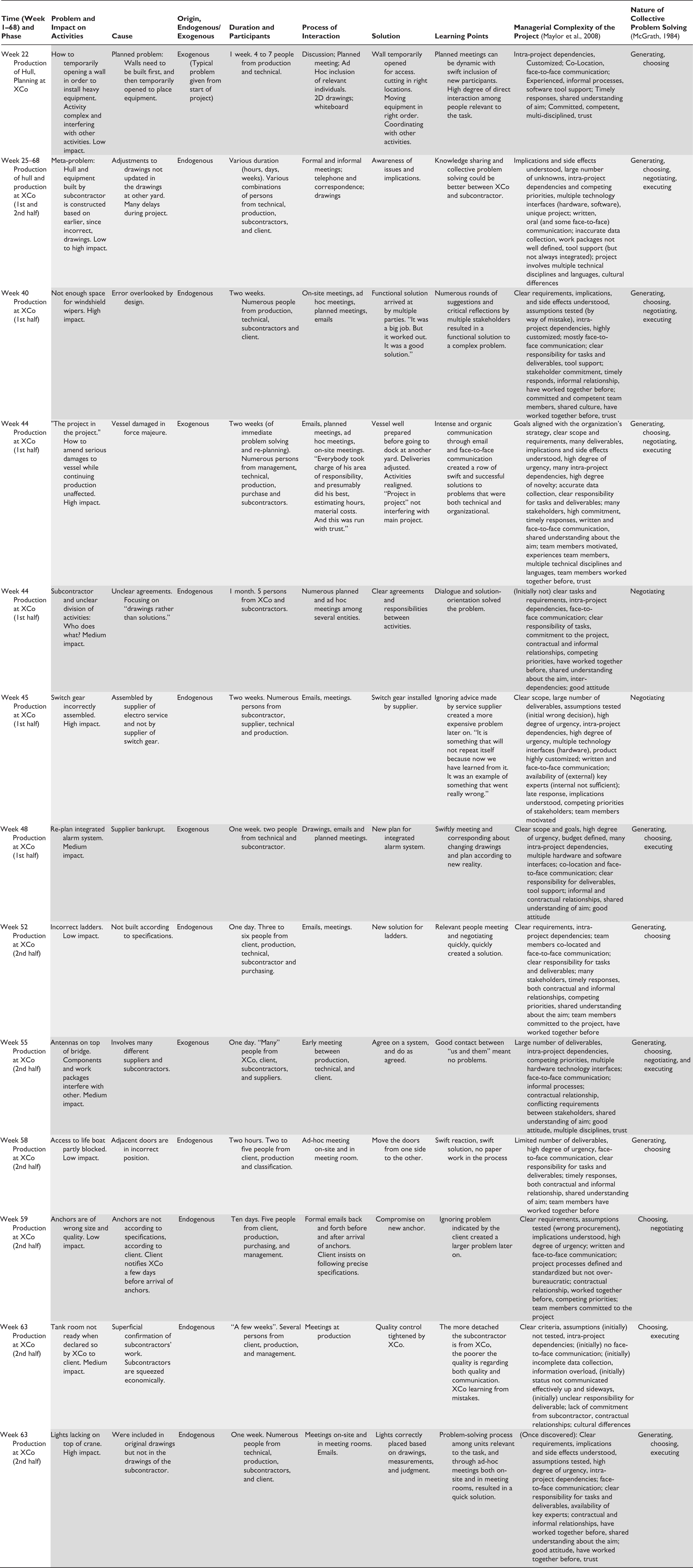
Searching for the problem-solving processes where we could account for field data from start to end, we ended up with a collection of different issues illustrating the what, why, who, how, and how long (see Appendix, Table 1, left side). We then reflected conceptually upon the issues by looking at their learning points, types of complexity, and nature of collective performance (right side). Finally, we determined the events, actions, and outcomes, as well as their interrelations as a dynamic system, that most adequately and sufficiently illustrated the observed patterns of problem solving (Poole & Van De Ven, 2010), with the specific aim of assessing how the project team during the project was able to cope with the properties emerging from systemic interactions and interdependencies among states, events, and actions (Zhu & Mostafavi, 2017). A dynamic model can illustrate exogenous events, team actions taken to correct the impact of the events, and the consequences of these actions as the project progresses (Howick & Eden, 2004). We categorized all data using NVivo (QSR International, Melbourne, Australia), a qualitative data management software. We wrote the following narrative (Langley, 1999) as a detailed story assembled from raw data, which yielded information about what happened and who did what when. For this reason, we have not aimed at testing a deductive set of hypotheses, but rather at discovering relations and patterns for further examination.
The Narrative
What Happened Overall?
The vessel was the largest of its kind ever built for complex marine operations. Although the fixed workforce at XCo consisted of about 100 blue-collar and 70 white-collar workers, at peak production, approximately 800 people were working on and around the vessel, with a few hundred from the group (Headquarters, design, and other XGroup yards in the area), a few hundred from subcontractors and their subcontractors from external services, inspection, client organizations, and so on. What made this project special was not only the complexity, but also the short delivery time of seven months. During the project, overtime went from being periodical to perpetual. The challenges confronting the project team were both planned tasks and emergent issues that demanded a speedy solution; the overall question was, how to conduct multiple and changing activities in a short time span with little buffer?
You have to be creative. Come up with simple solutions so that everybody is satisfied. But it takes human resources. And … you never manage to take into consideration everything that happens around it. Unanticipated events, events that nobody thought of. To build such a boat is a lot of small bumps up and down. (Reflection from a production coordinator in week 50)
The project delivery was divided into two major periods: (1) the pre-outfitting phase with design, engineering, and hull production activities during weeks one through 39; and (2) the final outfitting phase during weeks 40 through 68.
Week One Through 39: Design, Engineering, and Production of the Hull
From the start, the project plan was tight, uncertain, and had very little buffer, and the client expected a state-of-the-art product to be delivered in a short time. Project team members were selected based on their required technical know-how, experience, and availability. Of equal importance was the fact that team members had shared a work culture in previous projects. The core team consisted of the project manager, three production coordinators, the project planner, two department managers, the technical coordinator, and a few central engineers. Other key team members, such as production supervisors, were finishing ongoing projects at XCo, and therefore were not involved in the planning until the end of this phase. The core team planned the activities, assessed their interrelations, discussed problems and solutions, and arrived at agreements internally and with external stakeholders. While there was pressure from the start to plan, coordinate, deliberate, and negotiate a high variety of details, team members spent most of their time on business-as-usual project planning. Unplanned issues emerged to a lesser extent.
In the spirit of the Last Planner® of planning and control in lean construction (Ballard & Tommelein, 2016), detailing activities were postponed until five to eight weeks before their execution, or until the last feasible moment. A similar, but slightly smaller vessel, had recently been finished by another XGroup yard in cooperation with another yard in Europe. The post-hull production lasted 12 months. Thus, doing a similar amount of work at XCo in seven months was challenging.
I wonder how we are going to do the same amount of work in half the time. (Reflection from a production coordinator in week 22)
Late in this phase, scheduled weekly and daily meetings were increasingly intertwined with ad hoc meetings as issues started to materialize. For instance, work done on the hull according to obsolete drawings would turn out to be a recurring problem. Hence, apart from the planned briefings and coordination, scheduled and ad hoc meetings slowly started to deal more with immediate issues and cycles of replanning. While handling issues face to face in the offices and corridors, the conversation was going back and forth between people relevant to the task, often including people whose profession or area of responsibility was not directly relevant to the task.
Week 40 Through 68: Outfitting and Concurrent Engineering
The hull arrived for outfitting at XCo 40 weeks after the contract had been awarded. The outfitting phase was the most value adding in the project, including a complex “Tetris” of engines, heavy equipment, outfitting, and other complex or high-tech systems, while it was also the phase most prone to disturbance. Many important technical details, activities, and dates were still uncertain, and the project team was now handling production and planning concurrently while increasingly dealing with emergent issues.
Errors and disturbances were expected, however, since a vessel of such a structural complexity always involved a great deal of subdesigns and uncertainties. Although sometimes costly, arriving at speedy solutions to new problems was part of the “business.” Design errors were usually detected by the client, by detail engineers, or by personnel on board the vessel during inspection, the two “daily rounds,” or production. The problems were either dealt with on the spot or taken up at subsequent meetings. Most problems were solved informally in minutes or hours, or days at the most. More complicated problems, however, could trigger a formal process lasting weeks, involving an appropriate team to work and report on the progress. The planned meetings were structured with both announcements and interactions among the participants; for instance, at the end of all meetings, participants declared in turn whether they had “any other business” to add. All ad hoc meetings, as well as a large part of the planned meetings, dealt with emergent issues. The problems varied in both complexity, consequences, and need for team-member interaction.
It needs to be sanctioned; it needs to be drawn; it needs to be discussed with the ship owner; it needs to be classified and approved, ex. fire approved and fire plan. All these things have an effect. Maybe Design needs to be involved. The whole gang, so it moves fast—what affects what. It’s very important to have a dialogue with the ship owner, so he is informed about what is happening. In some cases, it is the client who brings the change to the table. It is close cooperation to get things done. (Reflection from the project planner in week 47)
As such, meetings in the widest sense were taking place during the entire production team at XCo, involving small problems being dealt with informally by two people in a few minutes, to large problems involving up to 10 people having meetings over several weeks.
Some issues we tackle on board—sometimes with the ship owner—on the spot: “This is the way we agree to do it.” I like to involve the ones in production who are going to do the job—and then we agree—because they might have a simpler view of things than I do. In that sense, there are many skilled [people] out there in the production. If it is an issue that has to do with classification, it needs to be handled with the Technical Department. All this is done straight away. (Reflection from a production coordinator in week 50)
Face-to-face communication was preferred when possible, followed by emails for the record.
When working with organizations external to XGroup, a swift understanding of the project team was sometimes lower, especially when subcontractors had their own subcontractors. This was both due to a higher level of formality and a lower degree of interaction, and due to the fact that the external workforce was not always sharing the same problem-solving practices.
By week 57, the project buffer had all but disappeared, and a further increase in unpredictable events meant that the perceived lack of room for reorganization between activities was coming to a peak, and errors were only discovered upon manifestation (Endsley, 1995). By now, overtime was a daily routine.
It’s the most extreme I have been involved in so far in relation to what you are capable of planning, because it is very limited what you can manage to plan to begin with as there is so much that is going to take place—and there is a lot that changes from day to day. (Reflection from a supervisor in week 60)
We don’t have time to wait. In some cases, when we are going to get the final answer the following day, we just have to say, “Ok, just begin to make it like this. We are quite sure that it is the way it is going to be.” And then we have to go and check it again whether we made the right decision or not. We do it like that rather often, actually … From [when] the boat arrives until we deliver it, it might be 80% unforeseen events and 20% updating and following plans. Most of our time is “change of plans.” (Reflection from a production coordinator in week 60)
Although the atmosphere at planned meetings toward the end of the project became more intense as new issues emerged, work motivation remained high.
But this is a new boat, and that is often where the problems are. Toward the end, details begin to accumulate with things and are then thrown at us without us having planned anything in that regard. And maybe then, we have too few people to handle what may appear, which might cause some sparks, but then again, most things move forward as intended. (Reflection from a production coordinator in week 60)
Despite a further increase in problem-solving intensity during this phase, the project team in general carried on identifying and solving the many issues as they emerged.
In a project like this one—with a very limited time for equipping the vessel, and so many activities to finish in such a short time—we don’t have the privilege to stop and reflect. We have to move on. The core—and the positive aspect of being such a small, flexible, and open, project organization—is our ability to assemble, discuss, and make a decision, etc. (Reflection from the project purchaser in week 60)
At meetings, the chair habitually stressed that everybody continued to collaborate effectively and to keep the higher level goal at sight.
When people are under pressure, it may be a challenge, and collaboration becomes more difficult as people become focused on their own immediate tasks. In those situations, you have to pull them up a bit in order to regain the overview. (Reflection from the project manager in week 60)
While the overall problem-solving ability remained high as the project team faced increasing intensity, mistakes did happen.
Leaving us out of the loop happens from time to time. It is not a conscious act. Sometimes you just don’t see the consequences of it. The less time you have, the more often it happens. (Reflection from a supervisor in week 66)
It is a challenge for the yard, to have things happen in the right order. Maybe they place an activity a bit late. This affects paint, or the foundation or equipment, and so on. We may often raise concerns in connection with inspection, such as with paint, but we understand that it’s not easy … Coordinate, have the right people, all those things … Maybe they have been annoyed by us from time to time. But they take it in a good spirit. (Reflection from client captain in week 66)
In week 66, the sea trial took place; and in week 68, the vessel was handed over to the client, two weeks after the original delivery date. Figure 1 illustrates observed problems during the project, and their impact in terms of the extent of rework and replanning needed. The figure shows how issues had varying levels of impact (low, medium, or high); all the while, overall pressure on time and performance was gradually increasing from medium to maximum. (The figure is based on the table in the Appendix, which provides a fuller description of the individual issues.)
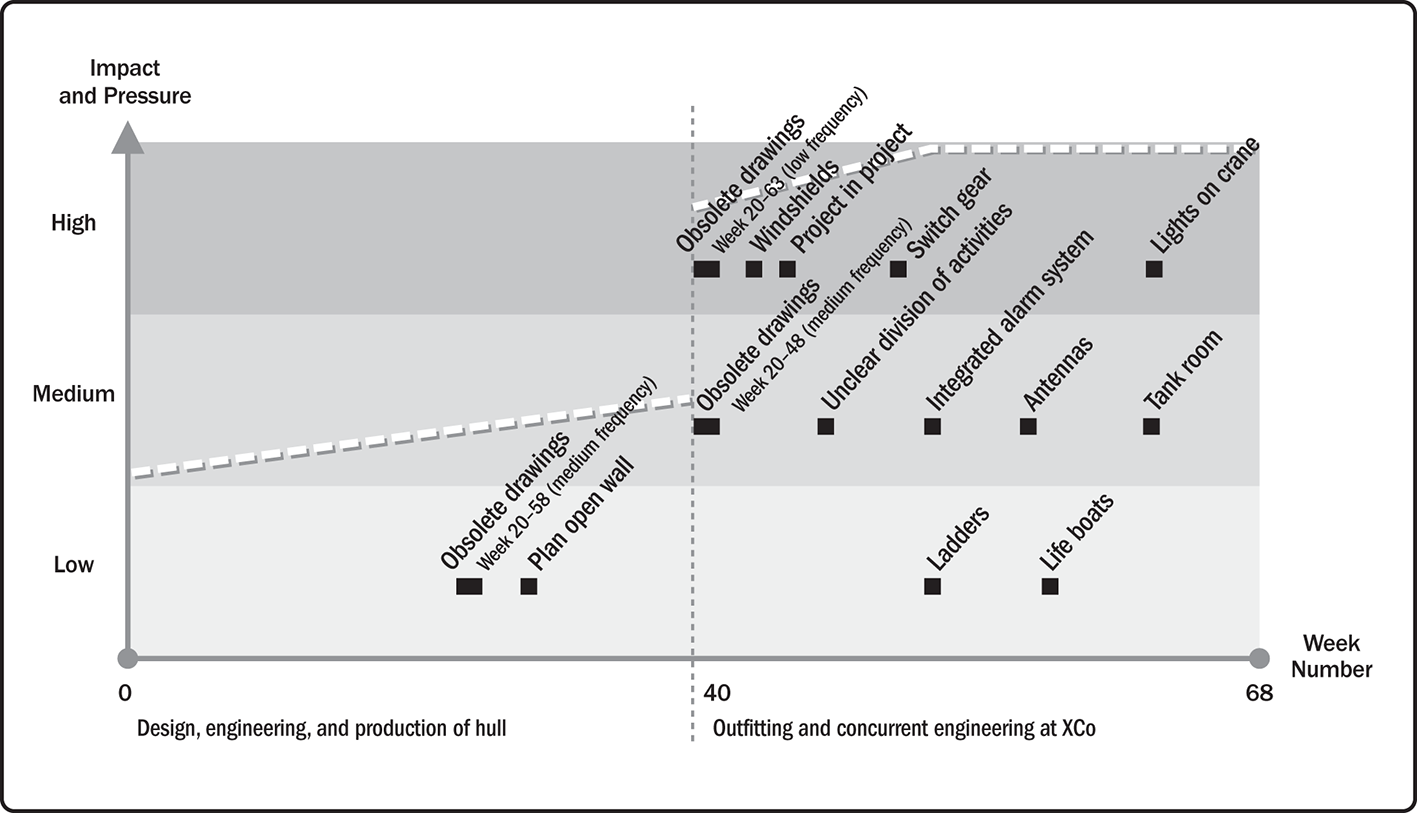
Timing and impact of observed issues. Examples are indicated categorically with ■. Pressure is indicated gradually with
Findings
Reflected in a dynamic pattern of processes, the results of this study reveal how the project team was able to handle a great variety of emergent issues. A large number of incompletely specified and interdependent issues and deliverables created new issues, and as a result, a high degree of managerial complexity (Maylor et al., 2008). The numerous emergent issues, varying in nature and size, originated both inside and outside the influence of the project team; they were diverse in complexity and pace; they put pressure on time and performance; and they demanded flexible performance by the team, in parallel with the handling of different issues. Yet, in the end, the project team was able to deliver as guaranteed. The team members were well aware that of the many swift solutions, some would turn out as errors, and some would cause new issues later on. By definition, and in accordance with our observations, this also meant that endogenously caused changes emerged more commonly in the later phases of the project than in the earlier phases, contributing to the increase in overall workload and pressure as the project progressed. In parallel with pressure, the need for flexibility increased throughout the project.
As a proxy for cognitive ability (Guion, 1998), professional know-how and experience were a given antecedent of the project team’s ability to handle the emergent issues; and the high-profile project had the appropriate state-of-practice project management systems in place. In addition, structures like objectives, routines, and approaches to interaction helped the project team sustain commitment and be prepared for emergent issues. By having sufficient flexibility and available workforce, the project team was able to improvise swiftly (Miner et al., 2001) when emergent issues surfaced, which they increasingly did during the project. When needed, subteams were formed fluidly as problems were handled by the relevant parties on the spot, or, at the latest, during the same or following days. This ability to handle issues “live” fostered security and continuity in the project. When handling the issues, the project team made use of moderate room for error (distributed risk sharing). On aggregate, this in turn decreased the number of new (hidden) issues.
As such, the project team resembled a cheetah team (Engwall & Svensson, 2001) or an action team (Mohammed et al., 2010); that is, a team performing goal-directed, time-sensitive tasks necessitating members to coordinate actions in real time and under pressure. These teams occur particularly in complex settings (Salas et al., 2008), where swift responses depend on team members’ ability to effectively incorporate their cognitive abilities. In doing so, the project team relied on tacit knowledge (Nonaka, 1991), and the ability of its members—mostly in concert—to effectively monitor and deal with uncertain and continuously changing circumstances (Killen et al., 2012).
Keeping the Forces of Pressure at Bay
The project was the largest and most compressed project any of the team members had previously been involved in. As such, the performance pressure, time pressure, and dynamically changing conditions would be expected to cause a decrease in the ability of the project team to handle the issues during peak situations, leading to more errors as a consequence (Rudolph & Repenning, 2002). Nonetheless, our data suggest that the project team, by and large, was able to handle most issues, almost regardless of the level of expectations and compressed workload. It may be that even higher time pressure would have resulted in a significant decrease in team performance—for example, with the team members consistently seeking to meet explicit and narrowly defined performance goals instead of generating more detailed information or considering other options (Amabile et al., 1976; Siegel-Jacobs & Yates, 1996), but we did not find significant indications of this. It seems that certain processes of collective problem solving “shifted” the tipping point considerably by enabling the project team to better absorb higher levels of emergent pressure on time and performance. The findings are in line with earlier findings pointing to ways of retaining the positive motivational effects of performance pressure while limiting the cognitive constraints that lead to ignoring crucial team knowledge (Gardner, 2012; Mitchell et al., 2019). What were the basic processes by which the team performed so well in such a dynamic environment, and how did the project team keep the pressure at bay? To answer this question, we looked closer at specific patterns of relationships among constructs and their logical arguments (Eisenhardt & Graebner, 2007; Eisenhardt, 1989a; Pettigrew, 1990; Sterman, 1994).
Handling the Emergent Issues
Akin to Davis et al. (2009), we find that the project team made use of a few simple “rules” that proved especially effective for consistent improvisation in a highly unpredictable environment.
Situation Awareness and Goal-Directed Improvisation
As emergent issues with an impact on the project were perceived by individuals, they were quickly shared and discussed with others. Across observations and interviews, team members stressed the importance of continuously communicating and making consultations as to what should be done, who was going to do it when, and for how long. This kind of ongoing “situation awareness” (Endsley, 1988) provides the most relevant basis for subsequent problem solving in dynamically complex systems (Sterman, 1994). Our observation mirrors this, as does its research, stressing the importance of situation awareness in adaptive team performance (Burke et al., 2006; Orasanu, 1990; Seppänen et al., 2013).
Being aware of the situation at hand is also a goal-directed process (Endsley, 1995), and the omnipresent goal of meeting the ambitious, overall project deadline strongly influenced the way the project team committed and performed throughout the project. Similar to findings by Williams et al. (2000), we found that collective attention to goals enabled goal achievement. Goal commitment and importance have previously been shown to enhance performance through increasing motivation, and to guide attention and effort toward goal-relevant activities (Locke & Latham, 2002). Similar to Gardner (2012), we found the effect of performance pressure on performance to be lessened by effort-directing actions. When teams are motivated to perform well, they engage in activities that help them toward that goal (McGrath, 1984). In that sense, this study delivers further empirical evidence that project teams that organize themselves according to outcomes, and have a well-developed awareness of situations, are likely to have high problem-solving ability (Rico et al., 2019).
Situation Awareness and Ad Hoc Subteams
The project team quickly formed into “subteams” that were dissolved once they had solved the problem. Supporting the timeliness of the cooperation was the explicit attentiveness by team members to knowing what information to share with whom, and conversely, whence relevant information was obtainable (Endsley, 1988; Wegner, 1986). Ren et al. (2006) found that knowing who has the needed information is particularly beneficial to small groups doing qualitative work, large groups operating in a dynamic task environment, and groups working in a volatile knowledge environment under time pressure. Similar to search-and-rescue operations (Seppänen et al., 2013), in the case we studied, it was vital both to recognize the information that needed to be shared, and to know its source. The process of handling the emergent issues echoed that of ‘teaming’—gathering relevant specialists in temporary teams to solve problems they may be facing for the first and only time (Edmondson, 2012). Eisenhardt (1989b, p. 544) found that such a “layered advice process” of dynamic innovation characterized strategic decision makers when making decisions in high-velocity environments. Hence, heedful formation of temporary subteams boosted the ability of the project team to handle a wide array of issues.
Trust and Face-to-Face Communication
Through trust-based direct communication, the team members were able to combine divergent and convergent modes of thought (Uitdewilligen et al., 2010). The team members had worked together previously, resulting in a higher degree of trust (Rico et al., 2008) and detailed, mutual understanding (Lewis, 2004). In addition, explicit communication meant that the team was better at adjusting their work structure when issues emerged (Faraj & Xiao, 2006). Trust played an important role in team adjustment behaviors that facilitated the sharing of relevant, high-quality knowledge across the project team, for example, through active participation (Edmondson, 2003). In addition, most interaction in the team was face to face, and it generally didn’t take long for the team members in the project to develop shared strategies for solving the tasks (Orasanu, 1990). However, the ability of the project team to handle problems was limited by the fact that the greater the organizational distance from members of the core project team to other members of its subteams, the more frequent the obstacles in arriving at solutions quickly. Similarly, studies have shown that a high level of virtuality and a lack of shared physical space reduce shared cognition (Clark et al., 1991; Kirkman et al., 2004). Other problems in the project typically happened because something or someone was left out in the heat of action. Our findings mirror earlier research into team cognition, where implicit coordination substitutes for or supports explicit communicative processes (Huber & Lewis, 2010; Rico et al., 2019).
Intelligent Team Behavior: Collectively Solving a Wide Array of Problems
In the project, team members could not expect a given state of affairs to be stable over time, but they could expect an array of different “unknown unknowns” (Loch et al., 2006) to emerge and warrant an immediate and effective resolution. The direct and task-relevant communication during the collective problem-solving processes was a key element of a broader capability of intelligent processing (Weick & Roberts, 1993). Akin to general intelligence (Spearman, 1904), experimental studies have introduced a team-level notion of collective intelligence (i.e., the ability of teams to consistently perform well across a variety of tasks; Woolley et al., 2010). By enriching the communication in face-to-face settings, team members’ chances to read each other better and quicker were improved, in the end enhancing the collective problem-solving ability of the team. Depending on the issue, the project team made use of different types of collective problem-solving processes, ranging from brainstorming (with low need of team member integration) to more complex social cognition (with high need of team member integration). For instance, handling more complex issues with dynamic effects called for more coordination among team members by means of more informational cues (Espinosa et al., 2007). In being able to deal with a large number of emergent issues, the project team maintained the project as a stable yet flexible system.
Discussion
Modeling a Pattern of Intelligent Processes
This research started with our research interest in increasing understanding on how some project teams are better able to handle emergent issues in dynamic environments, often characterized by high task variability in which the teams must adapt to different tasks and requirements (Driskell et al., 2018). Mirroring findings in similar case settings by Emblemsvåg (2014) and Vaagen et al. (2016), we found that frequent client input, regulatory interventions on the edge of known technology, and incidents related to logistics and production, brought about a multitude of different issues throughout the project. Above all, the study suggests that dynamically complex projects are sustained through a “functional freedom” to improvise on emergent issues. We identified a pattern of five “structured” processes by which the project team handled emergent issues. The higher the level of concurrency, the higher the interaction among the five processes. As concurrency caused more issues to emerge, the importance of having a team that was able to efficiently deal with different issues increased. The team’s flexibility in handling the emergent issues again reinforced the stability of the structures (Farjoun, 2010). Contrary to the linear-probabilistic understanding of projects, flexibility was not “narrowed down” in the course of the project, but remained a basic driver of the overall performance. Looking more closely at the pattern, we were interested in learning how the project team was able to reliably handle different, emergent issues. Bendoly (2006) points to the fact that team processes often reflect unique solutions not visible within traditional project management approaches. Studying the synergy emerging from cooperation, Driskell and Salas (1992) link team performance to the rate with which individuals participate in collective, cooperative behaviors, such as accepting and receiving input and suggestions from other team members. Project teams typically perform the tasks under performance and time pressure, however, at times straining the ability of the team to solve urgent issues effectively (Gardner, 2012). Lack of cooperative planning may, for instance, result in more rework (Mitchell & Nault, 2007). Previous studies have shown that if a project is highly dynamically complex, it is more difficult for team members to make sense of information, in some cases “trapping” the team in vicious circles of suboptimal planning (van Oorschot et al., 2013) or ongoing problem “firefighting” (Bohn, 2000). Ligthart et al. (2016) found that time pressure disabled flexibility. Agency plays a crucial role in the complexity (Poulis & Poulis, 2016) of dynamic projects—that is, project teams play a role in staging their own issues.
Figure 2 depicts how the project team was able to solve a wide range of issues in a dynamically complex project by the use of five processes. Identifying the relations between features, events, and actions as a dynamic pattern helps us understand how performance was achieved in the project.
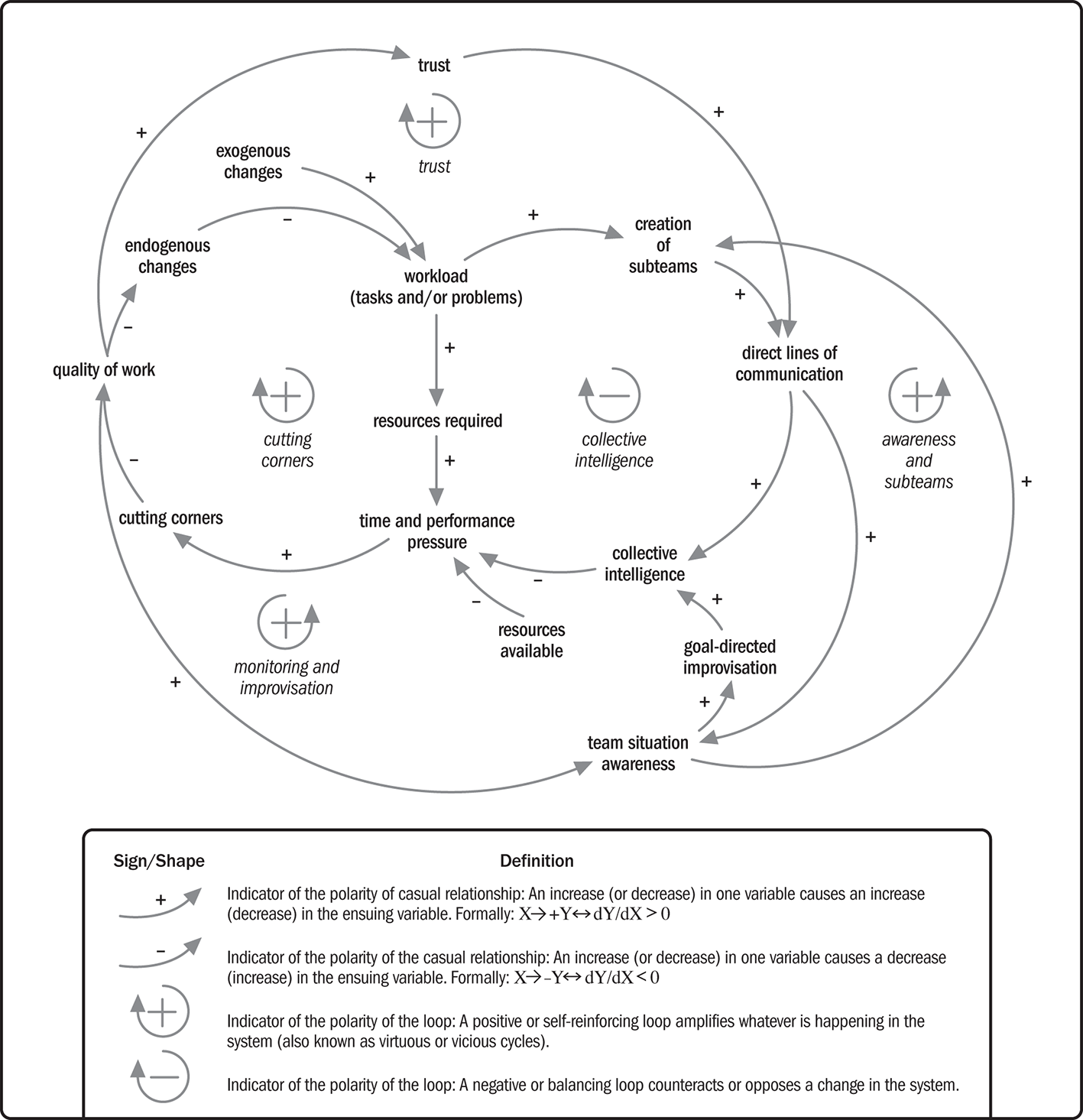
Causal loop diagram of collective intelligence in a dynamic project.
Description of the Reinforcing Cutting Corners Loop
The arrival or discovery of changes leads to an increased workload for the team. As a result, the team needs more resources (time, budget, and people). When the available resources remain unchanged, this leads to an increased pressure on time and performance. This may again increase the level of pressure on the team to the point where the pressure begins to have a negative effect on performance (Yerkes & Dodson, 1908). To deal with this increased pressure, the team may be inclined to cut corners, trying to find a quick fix for a problem (Oliva & Sterman, 2001; van Oorschot et al., 2018b). In a tightly coupled setting such as this, superficial problem solving may reduce the quality of work, which can lead to more endogenous changes (caused by the team decisions made earlier) and more workload in the future.
Description of the Balancing Collective Intelligence Loop
The discovery of problems leads to the creation of spontaneous, small subteams that have short lines of communication (face to face) in order to deal with the problem as fast as possible. These short lines of communication have a positive impact on the mutual understanding and problem-solving ability of the team. This makes the team more resilient in dealing with high pressure, or even reduces the pressure. As a result, cutting corners to save time is no longer necessary and the quality of work is increased, which prevents further changes or issues in the future. If necessary, resources can be added.
Description of the Reinforcing Attention and Improvisation Loop
High quality of work (good performance) has a positive impact on the team’s situation awareness, which again improves the team’s ability to improvise according to prevailing goals. The improved goal-directed improvisation leaves the team better able to solve emergent issues, ultimately decreasing the amount of low-quality work. This reinforces team situation awareness even further. These findings are in line with earlier research indicating that performance-driven teams are more susceptible to engage in extensive knowledge interaction processes, as complex problem-solving tasks call for team members to proactively integrate their knowledge (Gupta & Hollingshead, 2010; Littlepage et al., 1995).
Description of the Reinforcing Awareness and Subteams Loop
When team situation awareness is high, it is easier for the team to quickly create small subteams that are capable of handling the issues (team members know who to ask for help and when). This in turn helps to form direct lines of communication, which again helps to improve sensemaking and increase team situation awareness.
Description of the Reinforcing Trust Loop
High quality of work (good performance) has a positive impact on the commitment and trust between team members, which has a positive effect on the direct lines of communication. Communication processes tend to be better when trust is high (Levin & Cross, 2004). This enhances the problem-solving ability of the team, increases the quality of work, and in turn positively influences trust.
Depending on the type and size of change and the level of pressure on the one side, and the combined collective intelligence, awareness and trust on the other, the project team, may or may not be able to keep up with issues as they emerge. By increasing its tendency to cut corners, for instance, the team may trigger a vicious circle, creating more issues than the team in the end is able to handle. At the same time, although individuals struggle to understand dynamic relationships (Sterman, 1994), a team having a well-developed, cognitively interdependent system for encoding, storing, and retrieving detailed information (Wegner, 1986), and performing direct and heedful interaction, is better positioned to develop a general ability for real-time enactment (Weick & Putnam, 2006). Becoming better at collectively handling issues frees resources for the team to handle changes and maintain overall stability, resulting in less pressure on time and performance. The tipping point between optimal and too much workload in a project is dynamically related to the ability of the project team to handle the issues emerging from events, variations, and actions. Moreover, as the team develops a collective ability over time to handle a wide range of emergent issues, it also shifts the tipping point toward higher levels of workload tolerance.
Limitations and Theoretical Implications of the Research
We treated collective intelligence as the general ability of teams to perform a wide variety of tasks. Apart from the prerequisite professional skills, it might be that collective intelligence is more developed in real-life settings where team members often know and trust each other from previous experiences, and therefore are better able to reason with and about each other. By undertaking a longitudinal study in a single organization, we also excluded ourselves from validating our findings with a case from a different organization. Findings of similar behavioral patterns were, however, reported by Vaagen, Borgen et al. (2016) in their social network approach to project work at a shipyard with comparable complexities. Moreover, we did identify repetitive patterns of events in the same organization, which allowed the validation of the findings in the same sample but at a different time (Van de Ven, 2007). In this manner, we provided further empirical input on how sensemaking and enactment processes in project teams unfold over time.
We notice the paradox that project teams in dynamic settings handle emergent issues better when they follow a few and stable processes (Farjoun, 2010). Our data suggest that a limited number of recurrently interacting processes appear to be central to handling emergent issues in a dynamic setting (Amabile, 1988; Brown & Eisenhardt, 1997; Kiridena & Sense, 2016). The processes reflect the different, interlinked nature of structure and action (Poole & Van de Ven, 1989). In following Farjoun (2010, p. 220) in combining the two sets of literature, “that concerned with risk taking, innovation, and entrepreneurship and that concerned with reliability, risk reduction, institutions, and stability,” our study helps us better understand the particular duality between stability and change that characterizes large, dynamic projects. Similar to research by Padalkar and Gopinath (2016a), Biazzo (2009), and Van Oorschot et al. (2018a), our study finds that an overly inflexible project execution has shortcomings in handling emergent issues, and that flexible execution based on a few processes instead leads to better performance. Indeed, it seems that the need for change as a mechanism increases during dynamic projects as phases become concurrent. Our study hence further qualifies the boundaries of linear planning in large and dynamically complex projects by pointing to shortcomings when changes in upstream phases cause issues downstream, and vice versa. It also shows that underneath the apparent stability of a project, there may be a limited number of heedful processes of cognition and cooperation actively at work.
Nevertheless, although the team succeeded in quickly handling a great variety of difficult situations, it did so at a considerable (potential) cost. We know from quantitative research that reactive approaches without any definition and preparation (e.g., to enable the late selection of outfitting equipment alternatives) may have unreasonably high consequences on the cost element of the iron triangle of project cost, time, and scope, despite team abilities to quickly handle emerging changes. For small problem instances of the true complexity with uncertainty and dynamics, Vaagen et al. (2017) report over 20% increase in cost for a 20% decrease in project completion time, suggesting a potentially much larger deviation for large-scale real projects. In the case at hand, team abilities are discussed in relation to time and scope/quality (as the primary value drivers from a client perspective), while the cost element in relation to time and quality is omitted from the discussion. In fact, resources were treated as (nearly) unlimited (i.e., high degree of overtime, variable workforce, and outsourcing), and consequently only restrained the potential room of maneuver in a limited manner. In the case, the high-impact “project in the project” (Figure 1) was one such event the team handled well—but with the needed resources coming from the insurance as the event was a force majeure. Having the advantage of many resources is typically the exception in project management, and future research should address how more limited resources interact with mechanisms of pressure and efficient team enactment in adapting to changes. Despite a high ability of the team to handle numerous issues, some are simply too difficult to handle effectively in a reactive manner, and they need definition before they can be handled swiftly and cost effectively. This is particularly true in technologically advanced projects on the edge of known technology, such as the one at hand, where frequent changes in design and technical specifications throughout the project delivery are common. Most of these are perceived as high impact changes with limited predictability, and with increasing impact as the project progresses toward execution. Often little information is available early to ascertain the best alternative, instead leaving sensitivity to operations as crucial to resilient performance (Weick & Sutcliffe, 2001). In the end, our research is therefore complementary to, and increases the value of, research into more formal proactive approaches to managing the unpredictable.
Practical Implications
Projects can be volatile and unpredictable, and project teams often need to handle situations as they evolve. By relying too much on formal planning, project managers and their teams risk overlooking emergent issues until it is too late. Our findings suggest that in a project expected to involve a great deal of changes, project managers and project teams should make use of five processes that are related to the general ability of the team to quickly handle disturbances by the means at hand:
A project team is better able to deal with frequent changes by relying on a limited number of routines supported by a culture of less control and more trust (Atkinson et al., 2006). A lack of trust can cause a dynamic that decreases timely and direct communication between team members, thus also decreasing the ability of the team as a whole to deal with problems. Emergent issues involve uncertainty, and are necessarily linked to a certain risk-taking attitude involving trust and innovation (Adler et al., 2016). Establishing trust normally takes time, but projects are time limited, which adds to the challenges facing a project manager in organizations where project teams are dispersed upon completion (Anantatmula, 2010). To counteract the emergence of mistrust, project managers should seek to enact “swift trust” (Meyerson et al., 1996)—that is, team members assume trust from the beginning, and later verify and adjust trust beliefs accordingly. In the same study, Meyerson et al. (1996) found that swift trust is found in high-risk, high-stake projects with limited normative structures and institutional safeguards to minimize errors.
Monitor and Improvise
In dynamic projects, timely feedback and reaction are crucial. Detailed information and rich accounts need to be fluidly shared among the team members through structured encounters, but, equally as important, via informal meetings in the moment. Since many issues are unique, sensing operations with current updates or changes—and what they mean to what and whom—is important. As there typically is no manual on how to handle a particular issue, project teams can only improvise on the best information they have.
Create Awareness and Divide Into Subteams
Project teams coordinate and handle issues better if team members share knowledge about the setting and objectives, and are aware of each other’s particular responsibilities and areas of expertise. Teams in dynamic environments depend upon the quick understanding of unforeseen issues, and relevant information should be passed on to the relevant team members at the first given opportunity. As new issues emerge, teams should be coordinated into teams reflecting the particular task and time. Trust is increased and uncertainty reduced by knowing whom to involve when a given issue emerges (Atkinson et al., 2006).
Don’t Cut Corners
Cutting corners may lead to even bigger issues later on, and in the end, negatively affect the intended product or end result. Project managers and team members in hectic and uncertain settings should monitor whether pressure starts to provoke errors, such as teams taking unnecessary risks or having unduly optimistic outlooks on uncertain outcomes. One independent performance goal is to ensure that perceived pressure on time and performance does not increase excessively. An increase in workload may be more than the project team is equal to at a critical moment.
Get Together
In order to increase effective handling of immediate issues, a project manager should seek to maintain goal awareness and high levels of direct communication among members of the project team, such as by motivating team members to meet face-to-face, and keeping minimum barriers, for instance, by adopting an “open-door” policy. Teams that actually increase levels of communication when problems emerge are better at changing their work structures than those teams that carry on integrating work by formal operation procedures and communication. Mapping causal relationships (as in Figure 2), for instance, would help team members, because it would make them uncover, not only causes and effects in the project, but also their dynamic properties (Ramanujam & Goodman, 2003). In a real setting, collective intelligence does not appear out of thin air, but rather, it emerges in concert with a simple pattern of interconnected processes by which the project team is able to handle issues in real time.
Footnotes
Appendix
Problems and Solutions—Complexity and Process
| Time (Week 1–68) and Phase | Problem and Impact on Activities | Cause | Origin, Endogenous/Exogenous | Duration and Participants | Process of Interaction | Solution | Learning Points | Managerial Complexity of the Project (Maylor et al., 2008) | Nature of Collective Problem Solving (McGrath, 1984) |
|---|---|---|---|---|---|---|---|---|---|
| Week 22 Production of Hull, Planning at XCo | How to temporarily opening a wall in order to install heavy equipment. Activity complex and interfering with other activities. Low impact. | Planned problem: Walls need to be built first, and then temporarily opened to place equipment. | Exogenous (Typical problem given from start of project) | 1 week. 4 to 7 people from production and technical. | Discussion; Planned meeting; Ad Hoc inclusion of relevant individuals. 2D drawings; whiteboard | Wall temporarily opened for access. cutting in right locations. Moving equipment in right order. Coordinating with other activities. | Planned meetings can be dynamic with swift inclusion of new participants. High degree of direct interaction among people relevant to the task. | Intra-project dependencies, Customized; Co-Location, face-to-face communication; Experienced, informal processes, software tool support; Timely responses, shared understanding of aim; Committed, competent, multi-disciplined, trust | Generating, choosing |
| Week 25–68 Production of hull and production at XCo (1st and 2nd half) | Meta-problem: Hull and equipment built by subcontractor is constructed based on earlier, since incorrect, drawings. Low to high impact. | Adjustments to drawings not updated in the drawings at other yard. Many delays during project. | Endogenous | Various duration (hours, days, weeks). Various combinations of persons from technical, production, subcontractors, and client. | Formal and informal meetings; telephone and correspondence; drawings | Awareness of issues and implications. | Knowledge sharing and collective problem solving could be better between XCo and subcontractor. | Implications and side effects understood, large number of unknowns, intra-project dependencies and competing priorities, multiple technology interfaces (hardware, software), unique project; written, oral (and some face-to-face) communication; inaccurate data collection, work packages not well defined, tool support (but not always integrated); project involves multiple technical disciplines and languages, cultural differences | Generating, choosing, negotiating, executing |
| Week 40 Production at XCo (1st half) | Not enough space for windshield wipers. High impact. | Error overlooked by design. | Endogenous | Two weeks. Numerous people from production, technical, subcontractors and client. | On-site meetings, ad hoc meetings, planned meetings, emails | Functional solution arrived at by multiple parties. “It was a big job. But it worked out. It was a good solution.” | Numerous rounds of suggestions and critical reflections by multiple stakeholders resulted in a functional solution to a complex problem. | Clear requirements, implications, and side effects understood, assumptions tested (by way of mistake), intra-project dependencies, highly customized; mostly face-to-face communication; clear responsibility for tasks and deliverables, tool support; stakeholder commitment, timely responds, informal relationship, have worked together before; committed and competent team members, shared culture, have worked together before, trust | Generating, choosing, negotiating, executing |
| Week 44 Production at XCo (1st half) | “The project in the project.” How to amend serious damages to vessel while continuing production unaffected. High impact. | Vessel damaged in force majeure. | Exogenous | Two weeks (of immediate problem solving and re-planning). Numerous persons from management, technical, production, purchase and subcontractors. | Emails, planned meetings, ad hoc meetings, on-site meetings. “Everybody took charge of his area of responsibility, and presumably did his best, estimating hours, material costs. And this was run with trust.” | Vessel well prepared before going to dock at another yard. Deliveries adjusted. Activities realigned. “Project in project” not interfering with main project. | Intense and organic communication through email and face-to-face communication created a row of swift and successful solutions to problems that were both technical and organizational. | Goals aligned with the organization’s strategy, clear scope and requirements, many deliverables, implications and side effects understood, high degree of urgency, many intra-project dependencies, high degree of novelty; accurate data collection, clear responsibility for tasks and deliverables; many stakeholders, high commitment, timely responses, written and face-to-face communication, shared understanding about the aim; team members motivated, experiences team members, multiple technical disciplines and languages, team members worked together before, trust | Generating, choosing, negotiating, executing |
| Week 44 Production at XCo (1st half) | Subcontractor and unclear division of activities: Who does what? Medium impact. | Unclear agreements. Focusing on “drawings rather than solutions.” | Endogenous | 1 month. 5 persons from XCo and subcontractors. | Numerous planned and ad hoc meetings among several entities. | Clear agreements and responsibilities between activities. | Dialogue and solution-orientation solved the problem. | (Initially not) clear tasks and requirements, intra-project dependencies, face-to-face communication; clear responsibility of tasks, commitment to the project, contractual and informal relationships, competing priorities, have worked together before, shared understanding about the aim, inter-dependencies; good attitude | Negotiating |
| Week 45 Production at XCo (1st half) | Switch gear incorrectly assembled. High impact. | Assembled by supplier of electro service and not by supplier of switch gear. | Endogenous | Two weeks. Numerous persons from subcontractor, supplier, technical and production. | Emails, meetings. | Switch gear installed by supplier. | Ignoring advice made by service supplier created a more expensive problem later on. “It is something that will not repeat itself because now we have learned from it. It was an example of something that went really wrong.” | Clear scope, large number of deliverables, assumptions tested (initial wrong decision), high degree of urgency, intra-project dependencies, high degree of urgency, multiple technology interfaces (hardware), product highly customized; written and face-to-face communication; availability of (external) key experts (internal not sufficient); late response, implications understood, competing priorities of stakeholders; team members motivated | Negotiating |
| Week 48 Production at XCo (1st half) | Re-plan integrated alarm system. Medium impact. | Supplier bankrupt. | Exogenous | One week. two people from technical and subcontractor. | Drawings, emails and planned meetings. | New plan for integrated alarm system. | Swiftly meeting and corresponding about changing drawings and plan according to new reality. | Clear scope and goals, high degree of urgency, budget defined, many intra-project dependencies, multiple hardware and software interfaces; co-location and face-to-face communication; clear responsibility for deliverables, tool support; informal and contractual relationships, shared understanding of aim; good attitude | Generating, choosing, executing |
| Week 52 Production at XCo (2nd half) | Incorrect ladders. Low impact. | Not built according to specifications. | Endogenous | One day. Three to six people from client, production, technical, subcontractor and purchasing. | Emails, meetings. | New solution for ladders. | Relevant people meeting and negotiating quickly, quickly created a solution. | Clear requirements, intra-project dependencies; team members co-located and face-to-face communication; clear responsibility for tasks and deliverables; many stakeholders, timely responses, both contractual and informal relationships, competing priorities, shared understanding about the aim; team members committed to the project, have worked together before | Generating, choosing |
| Week 55 Production at XCo (2nd half) | Antennas on top of bridge. Components and work packages interfere with other. Medium impact. | Involves many different suppliers and subcontractors. | Exogenous | One day. “Many” people from XCo, client, subcontractors, and suppliers. | Early meeting between production, technical, and client. | Agree on a system, and do as agreed. | Good contact between “us and them” meant no problems. | Large number of deliverables, intra-project dependencies, competing priorities, multiple hardware technology interfaces; face-to-face communication; informal processes; contractual relationship, conflicting requirements between stakeholders, shared understanding of aim; good attitude, multiple disciplines, trust | Generating, choosing, negotiating, and executing |
| Week 58 Production at XCo (2nd half) | Access to life boat partly blocked. Low impact. | Adjacent doors are in incorrect position. | Endogenous | Two hours. Two to five people from client, production and classification. | Ad-hoc meeting on-site and in meeting room. | Move the doors from one side to the other. | Swift reaction, swift solution, no paper work in the process | Limited number of deliverables, high degree of urgency, face-to-face communication, clear responsibility for tasks and deliverables; timely responses, both contractual and informal relationship, shared understanding of aim; team members have worked together before | Generating, choosing |
| Week 59 Production at XCo (2nd half) | Anchors are of wrong size and quality. Low impact. | Anchors are not according to specifications, according to client. Client notifies XCo a few days before arrival of anchors. | Endogenous | Ten days. Five people from client, production, purchasing, and management. | Formal emails back and forth before and after arrival of anchors. Client insists on following precise specifications. | Compromise on new anchor. | Ignoring problem indicated by the client created a larger problem later on. | Clear requirements, assumptions tested (wrong procurement), implications understood, high degree of urgency; written and face-to-face communication; project processes defined and standardized but not over-bureaucratic; contractual relationship, worked together before, competing priorities; team members committed to the project | Choosing, negotiating |
| Week 63 Production at XCo (2nd half) | Tank room not ready when declared so by XCo to client. Medium impact. | Superficial confirmation of subcontractors’ work. Subcontractors are squeezed economically. | Endogenous | “A few weeks”. Several persons from client, production, and management. | Meetings at production | Quality control tightened by XCo. | The more detached the subcontractor is from XCo, the poorer the quality is regarding both quality and communication. XCo learning from mistakes. | Clear criteria, assumptions (initially) not tested, intra-project dependencies; (initially) no face-to-face communication; (initially) incomplete data collection, information overload, (initially) status not communicated effectively up and sideways, (initially) unclear responsibility for deliverable; lack of commitment from subcontractor, contractual relationships; cultural differences | Choosing, executing |
| Week 63 Production at XCo (2nd half) | Lights lacking on top of crane. High impact. | Were included in original drawings but not in the drawings of the subcontractor. | Endogenous | One week. Numerous people from technical, production, subcontractors, and client. | Meetings on-site and in meeting rooms. Emails. | Lights correctly placed based on drawings, measurements, and judgment. | Problem-solving process among units relevant to the task, and through ad-hoc meetings both on-site and in meeting rooms, resulted in a quick solution. | (Once discovered): Clear requirements, implications and side effects understood, assumptions tested, high degree of urgency, intra-project dependencies; face-to-face communication; clear responsibility for tasks and deliverables, availability of key experts; contractual and informal relationships, have worked together before, shared understanding about the aim; good attitude, have worked together before, trust | Generating, choosing, executing |
Author’s Note
Kim van Oorschot is also affiliated with NTNU Norwegian University of Science and Technology, Norway.
Declaration of Conflicting Interests
The author(s) declared no potential conflicts of interest with respect to the research, authorship, and/or publication of this article.
Funding
The author(s) disclosed receipt of the following financial support for the research, authorship, and/or publication of this article: Hansen and Vaagen are partly supported by the Research Council of Norway.
Author Biographies