




Abstract
Project value is an important topic of debate in project studies, and previous research has identified challenges in value management. This article reveals the challenges of subjectivity, dynamics, and tensions stemming from multistakeholder involvement and competing values over the project life cycle. This research seeks solutions to the management of values by exploring values as beliefs to supplement their treatment as worth. Management of values is portrayed as an exercise in sensemaking, negotiation, and co-creation when adjusting beliefs to transform project practices and outcomes. A research agenda is proposed to cover the social and behavioral aspects of values in project studies.
Introduction
Interest is growing in projects as mechanisms of value creation for organizations and project networks (Artto et al., 2016; Winter & Szczepanek, 2008), which is also reflected in a topical special issue in the International Journal of Project Management on delivering value in projects and project business (Martinsuo et al., 2017; Martinsuo, Klakegg, van Marrewijk et al., 2019). Projects are relevant not only because of their temporary problem-solving nature, but also because of their potential for delivering strategic life cycle value (Martinsuo et al., 2012) and creating the necessary preconditions for continuous operations in organizations (Smyth, 2018). The dominant perspective regards value as the worth of the project or its outputs and outcomes, including the benefits and sacrifices from the project to relevant stakeholders over the project life cycle (Ahola et al., 2008; Zwikael & Smyrk, 2012). From this viewpoint, value is considered from multiple dimensions (Ahola et al., 2008; Eskerod & Ang, 2017; Kivilä et al., 2017) and as something that can be planned, assessed, and managed. However, the management of values has been perceived as challenging, for example, due to the multiple stakeholders’ different perceptions of what is of value to them in specific circumstances (Laursen & Svejvig, 2016).
Projects involve multiple different stakeholders (where a stakeholder is “an individual, group, or organization who may affect, be affected by, or perceive itself to be affected by a decision, activity, or outcome of a project”) (Project Management Institute (PMI), 2013), internal and external, each of whom may have specific ideas of what constitutes value (Eskerod & Ang, 2017). Value management in project business deals with the means to identify stakeholders’ explicit expectations about what is of worth/worthy and convert these expectations into plans and measurable benefits (through project activities). In contrast to the traditional product- and output-centric idea of project success, adopting the value creation perspective draws attention to the broader project life cycle, including the customers’ customers and their anticipation of implemented outcomes (Winter & Szczepanek, 2008). Value management, in this vein, implies not only planning and creating value throughout the project, but also delivering and capturing it long after the project is complete.
In reality, however, it is very difficult or even impossible to estimate and quantify project value in absolute terms and thereby control or capture it. In fact, there is ample criticism of the hard approach to value management when it is essential to discover a shared understanding among individuals about what value is and how values are prioritized (Green & Sergeeva, 2019). How can you manage value if its nature is not fully known or shared by stakeholders? Which dimensions of value are relevant to a specific project? Which stakeholder’s perception of value is the right one, and how are multiple stakeholders’ viewpoints on value aggregated? How can management really promote value (instead of destroying it) if they do not know exactly which value they are managing? Despite a variety of available techniques and methods for managing value and benefits, previous studies indicate that the character of value is situation specific, subjective, and even negotiated (Eskerod & Ang, 2017; Laursen & Svejvig, 2016), thereby challenging idealistic assumptions about its manageability.
The rationale for this article deals with the fluidity and ambiguity of the concept of project value and, at the same time, its tempting character that attracts the attention of both practitioners and researchers, linking the temporary project with the owner’s continuous operations, and potentially enabling versatile approaches to assessing project success. The article will challenge the current fixation on value as worth that can be measured and managed. It brings in the social and behavioral views on values as an individual’s abstract beliefs about ideal modes of conduct and ideal terminal goals —in other words, as end-states that are or are not worth attaining (Rokeach, 1973). From this perspective, values-in-use influence the selection of alternative means, ends, and actions (Hofstede, 1980).
When viewing values as beliefs, there is a need to distinguish among espoused values (those that are defined and communicated explicitly), values-in-use (those that are really adopted and reflected in behaviors and artifacts), and enacted values (espoused values that are implemented in practice; Schein & Schein, 2017). The management of values implies an attempt to change the values-in-use. People adopt values through socialization (van Maanen, 1976), and changes of values at the organizational level may be extremely challenging transformations calling for strong leadership (Schein, 1985). Therefore, the management of values occurs in and through the minds of people, which offers a novel perspective on value management in projects and questions the current paradigm of value management as organization-level processes of creation, delivery, and capture. Such a moral and social perspective on values has been acknowledged in the context of projects (Aliakbarlou et al., 2016), and also as a means to frame or justify stakeholders’ priorities during project preparation (Martinsuo, Vuorinen et al., 2019), but it has not been analyzed thoroughly.
This article theorizes the management of values in project business in terms of adjusting beliefs to transform project practices and outcomes. The goal is to propose a novel research agenda for the study of project value from the perspectives of stakeholders’ beliefs and to complement the dominant view of value as worth. The focus is on two questions: (1) What are the main challenges caused by viewing value as worth? And (2) How can project management research benefit from viewing values as beliefs? Since the article is conceptual, no new empirical data are reported, and projects are treated generally, with no particular attention being paid to specific project types. However, for the sake of simplicity, both the perspectives of investment and delivery are included, and projects of varying sizes are acknowledged where needed.
With this focus, the article deviates from the positivistic research philosophy wherein the nature of reality is considered objective; knowledge is measurable and follows natural laws; and knowledge about truth is available through sensory experiences, reason, and logic. Rather than move completely to the interpretivism end of the research philosophy spectrum, which would build strongly on individuals’ subjectivity, the orientation of this article is realism instead (Saunders et al., 2009). In this article, reality exists independently of our thoughts and can be observed in the behaviors, artifacts, and outcomes that organizations exhibit and produce. These observations may include inaccuracies due to a lack of data and possibly also due to researchers’ worldviews. In realism, researchers can build knowledge about values as beliefs by both asking individuals and observing the manifestation of the values in practice, while acknowledging the inaccuracies of human perception (Saunders et al., 2009).
The article will next introduce the current understanding of value as worth, characterize its current understanding over the project life cycle, and identify three dominant challenges. Then, the alternative perspective of values as beliefs is introduced and used as a way to explain the identified challenges. Finally, an agenda for future research is suggested to enable further inquiry into the management of values in project business. Since values are relevant not only in single projects, but also on multiple organizational levels including portfolios and programs (Martinsuo, 2019; Martinsuo & Killen, 2014; Thiry, 2002), the article will take these multiple levels of analysis into account.
Value as Worth in Project Business
Often, when researchers characterize the projects included in their studies they explicate the budget, duration, possibly also the partners involved, and/or the resource requirements for the project. Similarly, when the media communicates about forthcoming, ongoing, or completed projects, they may easily express the worth of the project in terms of the financial investment required for planning and implementing the project. Such numbers may differentiate among ordinary, small, large, major, and megaprojects and delimit attention to the project implementation phase.
This idea of financial investment, however, is a poor way of characterizing the true value of the project because it does not include any indication of future income that will be achieved through the use of the project outcome or the other benefits and costs related to it. Therefore, the current understanding about project value considers value in relative terms, as the quotient of benefits and costs (Laursen & Svejvig, 2016), and often also acknowledges the accrual of those benefits and costs over the life cycle of the project (Ahola et al., 2008; Laursen & Svejvig, 2016), not just during project implementation. Also, current understanding is that value needs to be considered both in the short and long term (Ahola et al., 2008) and extends beyond simply financial value. Value covers various dimensions or components, such as economic, environmental, social, technological, political, symbolic, or aesthetic (Eskerod & Ang, 2017; Flyvbjerg, 2017; Kivilä et al., 2017; Martinsuo & Killen, 2014), and commercial, intellectual, and collaborative (Liu et al., 2019). Flyvbjerg (2017) refers to some of these as the “sublimes” that drive megaproject development.
The dimensionality concerning project value is already apparent in taking novel approaches to defining and assessing project success. It is not sufficient to assess a project’s success merely in terms of reaching the project’s goals of scope, budget, and schedule (Atkinson, 1999); instead, the life cycle–oriented benefits of impacts on customers, impacts on business, and preparing for the future need to be covered as well (Shenhar, Dvir, Levy et al., 2001). Any of the value dimensions could be considered in assessing project success, depending on the project’s expected value. For example, the aesthetic or symbolic values may be particularly relevant to large, enduring infrastructures with societal significance (e.g., Eskerod & Ang, 2017; Flyvbjerg, 2017), whereas knowledge development and learning might be more central to technology development projects (Martinsuo & Killen, 2014). Measures of project value cannot necessarily be considered at the time of project completion, but their achievement may imply months, years, or even decades of follow-up (Artto et al., 2016; Eskerod & Ang, 2017).
The management of values as worth deals with the question of how managers, project personnel, and other stakeholders can guarantee that the expected values will be achieved. As such, it is closely linked with project control (Kivilä et al., 2017), risk and uncertainty management (Laine et al., 2016; Olsson, 2007; Willumsen et al., 2019), and stakeholder influence (Vuorinen & Martinsuo, 2019), and it requires anticipation of the operations phase already during project implementation (Artto et al., 2016; Laursen, 2018; Smyth, 2018). One stream of research has explored value engineering and value management over the project life cycle, in and across its different phases (e.g., Artto et al., 2016). Figure 1 illustrates key activities and decisions (or achievements) across the project life cycle, as discussed in previous research. Typically, a distinction is made between pre-project phases (ideation and planning, i.e., the front end), project implementation (and closure), and post-project phases (operations, i.e., the back end), but the research only focuses on a specific phase. The life cycle view assumes that expectations of project value are converted into plans that are used as guidelines for implementation and delivery and eventually transformed into value that is captured for the owner of the project outcome. Figure 1 highlights that in the pre-project phases, the stakeholders’ ideas and expectations of life cycle value guide the project work (arrows toward the life cycle), whereas in later phases, the achieved value accumulates to the life cycle value (arrows starting from the life cycle).
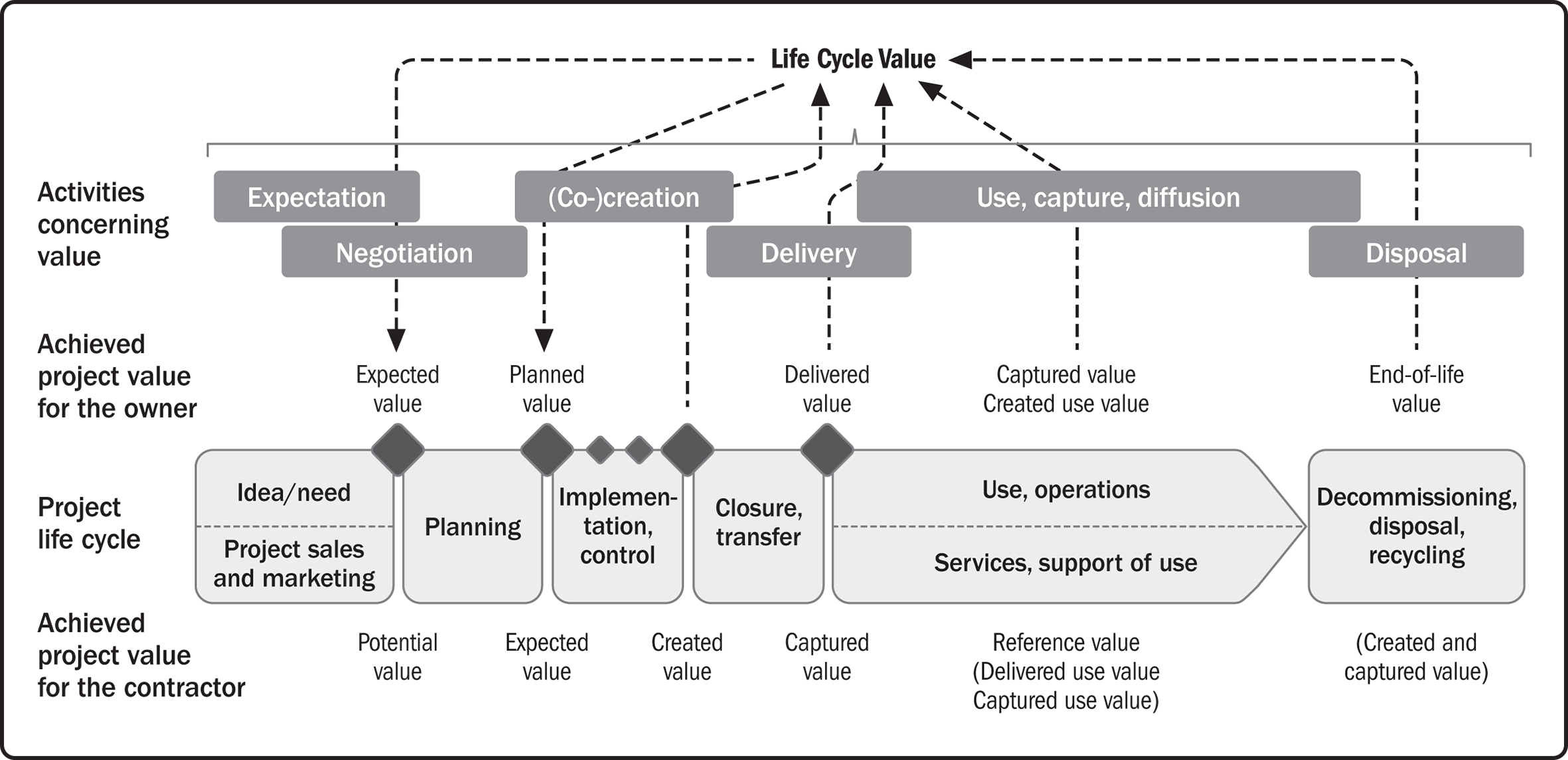
Overview of the current understanding of how project value (as worth) emerges as part of the project life cycle (author’s interpretations, building on the project life cycle phases as covered in Artto et al., 2011).
During the pre-project phases of idea generation, sales, and planning, the task is to identify what kind of value is expected from the project and negotiate among the stakeholders involved how this value will be created and delivered (e.g., Edkins et al., 2013; Martinsuo, 2019; Matinheikki et al., 2016; Williams & Samset, 2010). Research has identified the diverse expectations of stakeholders (Matinheikki et al., 2016) as well as the co-creation and negotiation required (Liu et al., 2019) to achieve a common understanding about the project goals and value to be delivered through the project. This common understanding appears to be quite important to the success of the project.
In the implementation and possible commissioning of projects, the aim is to optimize and maximize the value created and delivered in the project. Stakeholders influence the delivery of value through their own priorities and involvement (Vuorinen & Martinsuo, 2019). Project implementation is often seen as a phase where value is jointly co-created by the partners involved in the project delivery (Fuentes et al., 2019; Laursen, 2018; Lehtinen et al., 2019), the project is linked through appropriate mechanisms to the parent organization (Riis et al., 2019), and the responsibility for the project outcome is transferred to the customer. During project implementation, however, the created value is primarily visible to the contractor because the deliverable has not yet been transferred to the owner.
Recent research has been increasingly active regarding post-project phases, where the owner of the project deliverable and possible stakeholders expect to create use value and capture the value promoted by the project in the post-project operations (Artto et al., 2016; Laursen, 2018; Smyth, 2018). Typically, stakeholders do not see the full value of the project until long after its completion (Eskerod & Ang, 2017). Particularly in connection with delivery projects, the project contractor may need to involve the users during the project’s implementation and offer post-project services in order for the owner to realize the project’s full value (Artto et al., 2016; Kujala et al., 2013). Furthermore, some studies question whether or not there is value in the end-of-life of infrastructures, drawing attention to how large infrastructures are withdrawn from use and dismantled safely (Invernizzi et al., 2019).
Figure 1 illustrates that value appears in different forms for the owner and the contractor over the project life cycle. The owner experiences the full life cycle of the project and the delivered solution, and the owner’s dominant interest is in the captured value and created use value after the project. The contractor, in turn, requires value creation and capture already during and at the end of the project, and the contractor may experience only a part of the project’s life cycle, if it is not involved in planning and delivering the post-project services to maintain, upgrade, or dispose of the solution delivered in the project. The owner’s and contractor’s different perceptions and specific timing in the expected, created, and captured value lead to some challenges in the overall idea of project value, which will be discussed next.
Challenges in Relation to Value as Worth
There are three issues in the project life cycle setting that challenge the theoretical considerations concerning viewing value merely as worth, and these are summarized in Figure 2.
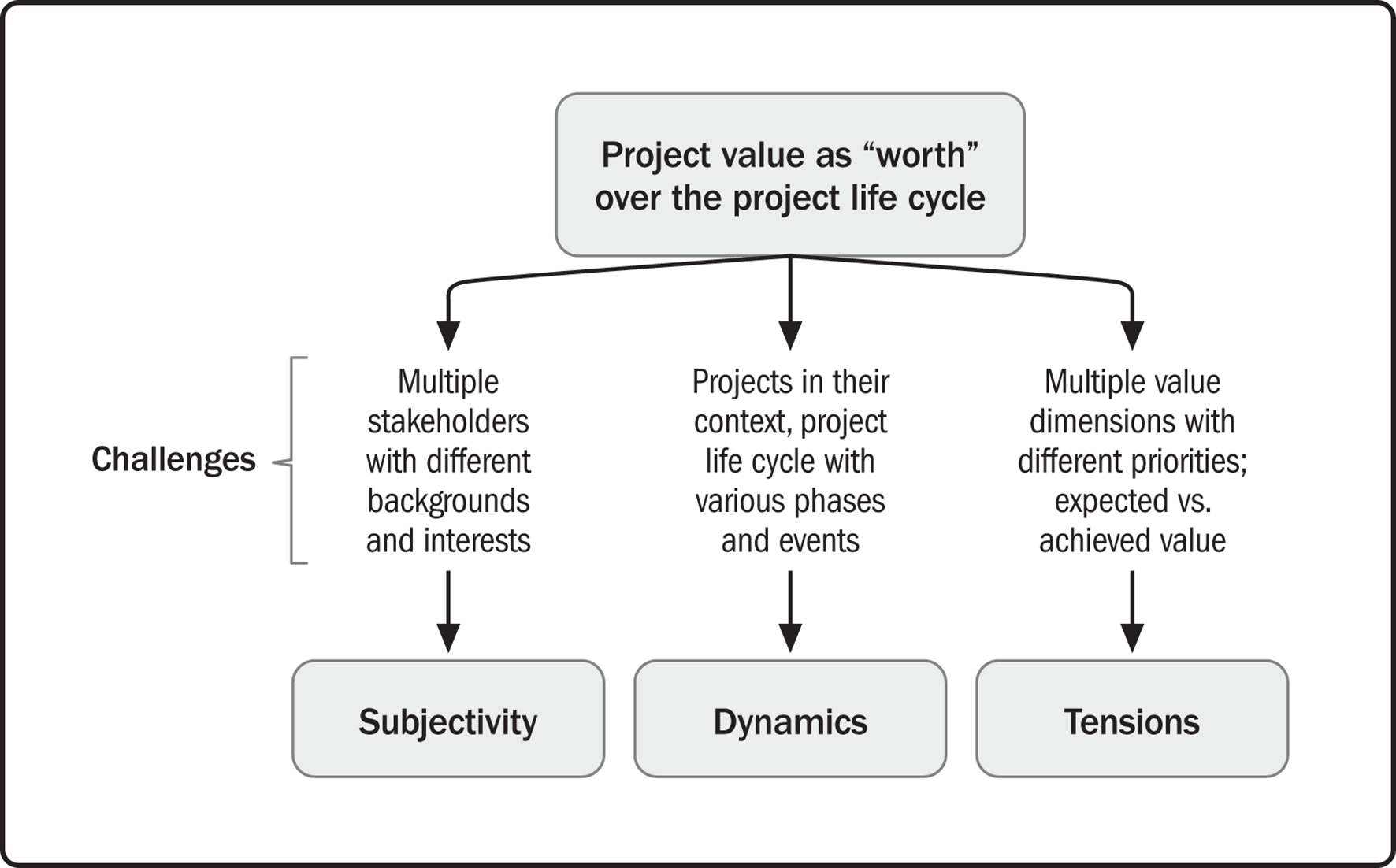
Overview of challenges in relation to viewing value as worth over the project life cycle.
Firstly, the existing literature repeatedly expresses that multiple stakeholders each have their own perceptions of value and that this subjectivity is reflected in stakeholders’ attitudes, decisions, and behaviors (Ahola et al., 2008; Eskerod & Ang, 2017; Martinsuo & Killen, 2014, Martinsuo & Killen, 2014; Vuorinen & Martinsuo, 2019). When value is understood as subjective (instead of objective and measurable), needs emerge for negotiation, cooperation, co-creation, and problem solving over the project life cycle to resolve issues caused by the stakeholders’ different needs (Lehtinen et al., 2019; Matinheikki et al., 2016). What guides an individual’s expectations and assessments of value? Is the project’s original concept of planned value coherent or unanimous across individuals (when eventually explicated)? How will the individuals’ expectations and assessments be aggregated and/or prioritized? What happens to the expected value if it is not covered in the project? Current research does not consider what guides individuals’ value assessments, how they are aggregated to formulate expected project value, and what happens to such expectations when they are not fulfilled in the given project.
Secondly, previous research typically settles on cross-sectional assessments of value, either at a given moment during project delivery, generally concerning the project as a whole (Kivilä et al., 2017; Vuorinen & Martinsuo, 2019), or after the project is completed (Eskerod & Ang, 2017). However, the project and its context evolve all the time through the events that take place in the environment, the actions of the stakeholders, and the actions taken within the project by the project personnel (Martinsuo, 2013, Veeneman, Dicke et al., 2009). Therefore, we should acknowledge that project value is dynamic and evolves over time. It is likely that the perceptions of value may vary over time as well, because changes take place in the project and its environment, the project stakeholder composition may vary over time, and individuals’ value priorities may change because of life circumstances and experiences both within and outside the specific project. Indeed, how does value evolve over time, and how are changes in value perception reflected in behavior?
Thirdly, achieving the value anticipated in the expected value is neither easy nor straightforward—in fact, it can be demanding and problematic. We argue that the idea of project value remains incomplete and under tension throughout the life cycle of the project, and this tension requires constant adjustments from the people involved in the project. Tensions deal with the interplay among different value dimensions (economic, social, ecological, technical, symbolic, and so forth) and the necessary compromises or prioritization that take place among them, as well as the gap between expected and achieved value. Research that draws attention to value slippage (Bos-de Vos et al., 2019), conflicts (Lehtinen et al., 2019), and project failures show tensions in project teams’ and leaders’ considerations that create a need for compromises and decisions. These tensions carry the possibility of both enabling and jeopardizing value creation and capture. Furthermore, a source of tension may relate to the difficulty of assessing project success in projects where the project need is not agreed upon or where the goals are not met, but benefits are accumulating over time in a positive manner. For example, the frequently used example of the Sydney Opera House (Shenhar & Dvir, 2007) and the recent study on the Astoria Bridge (Eskerod & Ang, 2017) suggest that the idea of value is incomplete at the time of project completion and that full project value is less than perfectly understood during the project. What is project value, then, if the value dimensions conflict with each other and the idea of worth remains incomplete?
There is a need to understand more deeply the subjectivity, dynamics, and tensions concerning project value. Therefore, explanation is sought from a supplementary perspective on what value is.
Values as Beliefs in Project Business
In social and behavioral research, value is considered in plural: values are individuals’ abstract, deeply held beliefs about ideal modes of conduct and ideal terminal goals—in other words, end-states that either are or are not worth attaining (Rokeach, 1973). Individuals learn their values during childhood through their upbringing and schooling and may continue to learn and adopt new values later in life as well. However, values are often considered highly stable—it is difficult to unlearn the values adopted in childhood. Research on organizations—organizational culture in particular—claims that organizations have values, adopted as a means to survive in their business environments, and these values are reflected in the behaviors and artifacts in the organization (Schein, 1985). However, organizations do not necessarily represent an integrated, homogenous entity in their values and culture, and they may have intraorganizational differentiation and even fragmentation that is reflected in multiple different subcultures (Martin, 1992).
Schein and Schein (2017, p. 4) emphasize that espoused values are “articulated and publicly announced principles and values that the group claims to be trying to achieve,” and they distinguish the promotion of certain espoused values in an organization from the individual values-in-use (that are reflected directly in behaviors). While organizational values may be difficult to change, they do evolve over time as the organization resolves issues pertaining to its survival and success in the environment (Hatch, 1993). The dynamics dealing with the interplay of values, artifacts, assumptions, and symbols in Hatch’s (1993) cultural dynamics model actually convey the idea of cultures as dynamic entities.
This viewpoint on values offers a novel angle from which to consider project value and, potentially, to theorize and explain some of the abovementioned issues dealing with its subjectivity, dynamics, and tensions. During the project front end, individuals may (or may not) espouse their values as their expectations of project value (Martinsuo, 2019; Martinsuo, Vuorinen et al., 2019). Values-in-use emerge from the deeply held beliefs and assumptions of individuals, and they guide individuals’ behavior during the project. In a social context, neither the espoused values nor the values-in-use operate in isolation but within the context of other individuals’ values. The enactment of values means that although an organization or individual espouses certain values, the enacted values are socially constructed through the processes of sensemaking, negotiation, and co-creation, and each dimension of value may evolve differently in these processes of sensemaking (Veeneman, Dicke et al., 2009). These processes take place at any level—within a group, in an organization, and in an inter-organizational network—among stakeholders (Martinsuo, 2019). Figure 3 illustrates the differences between value as worth and values as beliefs in project business.
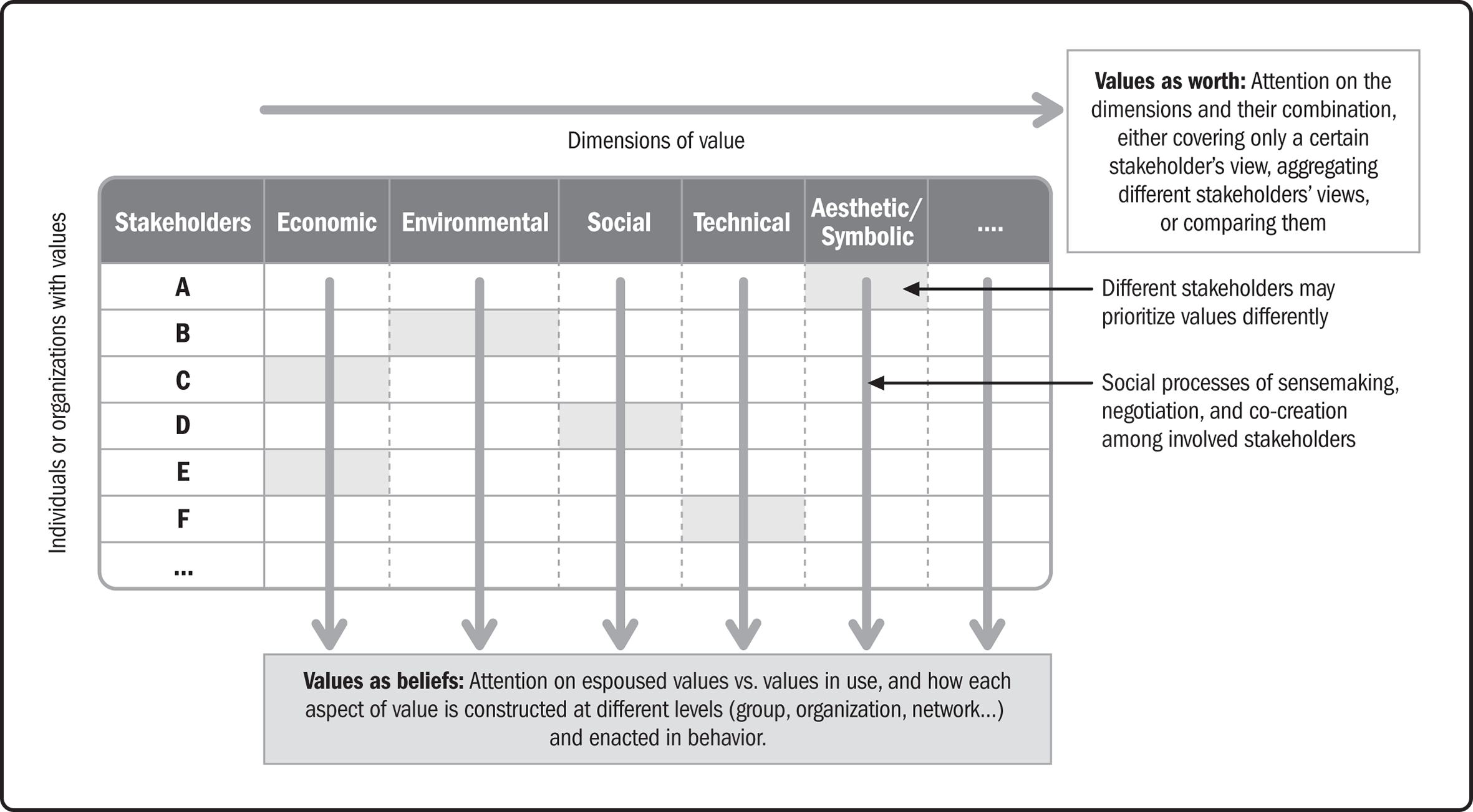
Differences between value as worth and values as beliefs (author’s illustration, including value dimensions from Eskerod & Ang, 2017; Flyvbjerg, 2017; Kivilä et al., 2017).
The social and behavioral aspects of value explain why value cannot be considered in a merely additive sense, meaning that the total project worth is not simply the sum of all value components. The main question is: How do the multiple stakeholders in a project construct and continuously re-construct their joint idea of value over the life cycle of a project? A project’s expected and planned value could well be considered as aggregated espoused values that may (or may not) guide the involved stakeholders’ values-in-use. Yet, the delivered and captured value of the project may be a result of some other stakeholders’ values-in-use, depending on their position and tasks in the project. Each of the stakeholders contributes a specific cultural context and values—not just of the organization, but also of the industry and society—because of the deeply rooted character of human values. Furthermore, this deeply rooted, contextual character of human values can explain the conflicts and problems experienced throughout the project life cycle. Following, each of the abovementioned challenges from this perspective of values is considered.
Viewing cultural values as beliefs offers a foundation for why and how the subjectivity in value judgments plays out between the stakeholders. Project stakeholders bring their particular values with them to all the possible sensemaking and negotiation events taking place in the project. Therefore, the idea of project value is not just one among several identifiable and constant values, but it is an assemblage of the values of all the stakeholders involved at any given moment. Subjective biases and non-rational decision making are understood particularly at the front end of projects (Williams & Samset, 2010) and in the multistakeholder tradeoffs concerning value (Bos-de Vos et al., 2016); they also need to be understood even more broadly throughout the project life cycle, as some stakeholders may only become active in the later stages. Each stakeholder might purposely engage in value-oriented influence in any phase of the project (Vuorinen & Martinsuo, 2019), and the specific types of value may differ at the different levels of the organization or administrative system (van Gestel et al., 2008; Veeneman, van de Velde et al., 2006). Additionally, stakeholders may use specific framing tactics to promote specific values and thereby drive their own interests in the project (Martinsuo, Vuorinen et al., 2019). Subjectivity, as a whole, implies a diversity of values across stakeholders and the requirements for sensemaking, sharing, negotiation, and co-creation based on the stakeholders’ unique values. This subjectivity is currently covered in a very static sense in the existing research.
Through subjectivity, the dynamic and evolving nature of values also becomes very understandable over the life cycle of the project, as the involved stakeholders face different events that may test and either endanger or enable the project’s survival and success. When the stakeholders interact during the project, their values become objects of negotiation in different events. The decisions made concerning value range from the critical issues of project selection and resource allocation to the very small, day-to-day issues regarding problem solving and managing any of the project’s details. All these decision-making events are points of influence for the stakeholders, and the priorities and consequent stakeholder influence may vary from one project phase to another (e.g., Laursen, 2018; van Gestel et al., 2008; Veeneman, van de Velde et al., 2006). Eskerod and Larsen (2018) propose the shadow of the context concept, in other words, the need to acknowledge stakeholders’ perceptions of the relevant past, present, and future in project decision making in order to develop a richer and more holistic picture of the stakeholders’ needs. Events in the surrounding environment may also activate sensemaking in various ways. While some studies already take event-based or process-based approaches to exploring project value (Fuentes et al., 2019; Matinheikki et al., 2016; Vuorinen & Martinsuo, 2019), they do not fully exploit the possibilities of changes in values over time and the drivers of these changes.
The beliefs perspective enables viewing the tensions and incompleteness of values in two ways. Firstly, when values are understood as beliefs, it allows us to accept that values are competing with each other—they are not equally strong or desirable, but they are prioritized differently by different stakeholders for project decision making in all decisions, and these priorities may change over time as new stakeholders become involved in the project. While research on organizational culture acknowledges competing values (Cameron & Quinn, 2011), for project business this aspect is covered only marginally (Hannevik et al., 2014; van Gestel et al., 2008; Veeneman et al., 2006, 2009; Wiewiora et al., 2013) and with an emphasis on ways of working instead of desired end-states, opening up further possibilities for research.
Secondly, this perspective also accepts the imperfections of values at a given moment and encourages moving toward a constant comparison between espoused and enacted values to guide further behaviors. What is desired is that the enacted values increasingly match with the espoused values as the project progresses, and if slippages, conflicts, and problems occur, they are resolved to ensure better value alignment. As the study of Bos-de Vos et al. (2019) shows, stakeholders can mitigate the value slippages through different strategies.
Figure 4 illustrates in a simplified manner how project stakeholders’ different values appear, meet, and are shared, negotiated, and co-created over the life cycle of the project. The figure shows the evolving involvement of stakeholders in sensemaking, sharing, negotiation, and co-creation processes and thereby their dynamic contributions to how expected value transforms into planned, created, delivered, and captured value. Figure 4 also shows that industry values and norms (and, more broadly, those of society) may influence the value-related processes within projects.
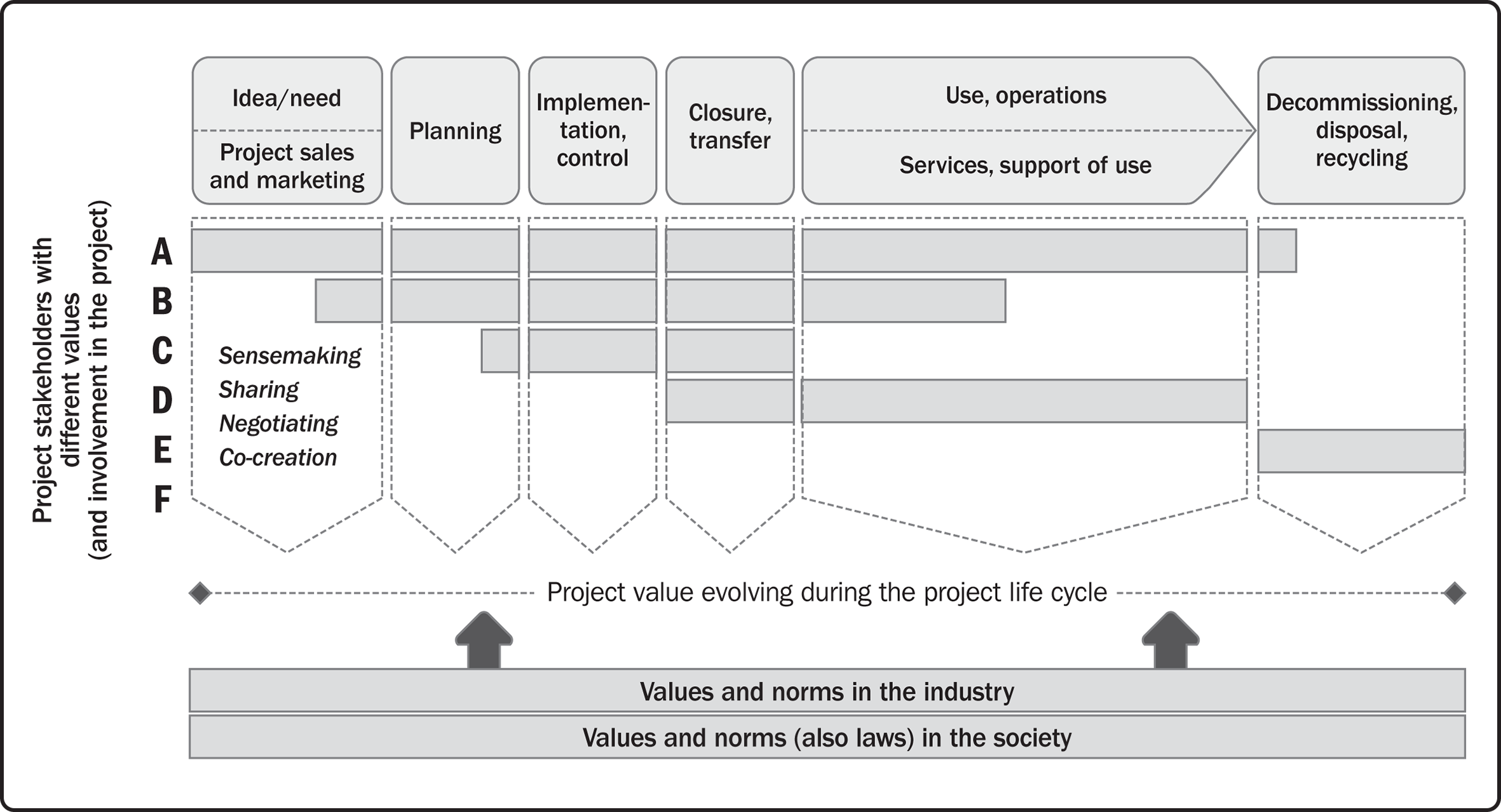
Joining and aggregation of stakeholders’ values as beliefs over the project life cycle (author’s illustration building on the project life cycle phases as covered in Artto, Martinsuo et al., 2011).
Discussion and Research Agenda
When value is perceived as worth—an objective and measurable issue external to individuals—it is assumed to be manageable and even engineered (i.e., planned, designed, implemented, and controlled) as a part of project management. Thus far, however, project management frameworks have maintained their efforts to manage costs and benefits separately (e.g., APM, 2012; Project Management Institute (PMI), 2013) instead of value as a whole. This article has pointed out three major challenges—subjectivity, dynamics, and tensions—as issues emerging from the externalized treatment of value. Therefore, additional attention should be paid to values as beliefs that guide the behaviors of individuals and groups (acknowledged partly in the International Project Management Association [IPMA], 2006, p. 120). Previous research has already indicated that values are beliefs that require and result in sensemaking and negotiation in the social context (e.g., Thiry, 2002), framing issues in light of stakeholders’ subjective interests (Martinsuo, Vuorinen et al., 2019) and social construction and sharing through the communication of individuals (Green & Sergeeva, 2019). When focusing on beliefs about ideal modes of conduct and end-states worth attaining, we can potentially discover ways to lead through values (espoused) and manage values (enacted) and thereby adjust individuals’ beliefs to make changes in project practices and outcomes (values-in-use). At least five possible research avenues emerge through this alternative perspective and are discussed as follows.
Multiple Levels of Analysis in the Study of Values
Where previous studies of project value primarily discuss value in a single project or program, viewing values as beliefs invites further research on the individual, organizational, and network levels. While certain project-level (expected or planned, and thereby espoused) values may become selection and prioritization criteria at the portfolio level (Martinsuo & Killen, 2014), they are linked with the parent organization in even more versatile ways (Riis et al., 2019; van Gestel et al., 2008). The interplay of values across the levels of analysis should also be explored further. As the industry and societal values and norms shape projects’ espoused and enacted values, this value-laden influence by and through the environment also requires further attention as potential sources of conflict and debate. Similarly, projects’ possibilities to renew the norms and values in their societal context is worth studying, as some projects are purposefully designed to renew industries and social conditions. Understanding the different levels of analysis could help in developing an in-depth understanding of project cultures in their context.
Change of Values Over Time
As cross-sectional studies cannot cover the evolving and dynamic nature of values, longitudinal studies could offer new information for understanding the management of values. Such studies take the form of event or process studies, and they could follow decision making and actions and how they develop as the projects proceed. Some studies already reflect this life cycle orientation (Artto et al., 2016; Fuentes et al., 2019; Matinheikki et al., 2016) and seek ways to accelerate projects’ possibilities to deliver value (Svejvig et al., 2019), but they do not necessarily reveal the evolving nature of values over time. For example, more attention could be directed at the tensions among the values and how these tensions evolve and are resolved or convert to risks over time. Exploring the evolution and tensions concerning values over time could offer novel possibilities for the temporal studies of interinstitutional projects (Dille & Söderlund, 2011; Dille et al., 2018).
Success as a Comparison of Expected (Or Espoused) and Achieved (Or in-Use) Values
Studies of project success have already pointed out the need to assess project success and performance using more versatile dimensions of value than merely reaching goals or efficiency (Atkinson, 1999; Shenhar et al., 2001). If the expected value is explicated properly at the front end of projects—and if stakeholders’ specific espoused values are communicated—then comparing the achieved value with the expectations will become of interest in terms of each stakeholder’s values-in-use (how the values have been transformed into practices and outcomes). A more nuanced multistakeholder view on the comparison of expected and achieved values could contribute to studies of project success. Thus, success is not just a singular objective measure, rather it needs to be compiled from multiple stakeholder-specific comparisons between achieved and expected values. The identification of gaps between the espoused and enacted values would also be helpful in activating learning toward the subsequent projects, when assessing success at project completion, and in certain follow-up episodes.
Managing Competing Values and Stakeholders’ Different Priorities
Previous research approaches value dimensions as a list, as if all values are prioritized the same or hold the same position in the project. When viewing values as beliefs, the values necessarily compete and are prioritized differently by the stakeholders. There is a need to understand this value-related competition and the stakeholders’ different priorities better. How are the competing values handled in different decision-making situations? How can they be prioritized during negotiation? What kinds of management mechanisms are needed to convert competing values into shared values? Since this value competition also spans across projects to multiproject programs and portfolios, there is a need to explore this competition on multiple levels of analysis (Martinsuo, 2019). Recent studies suggest that values in public-sector projects are prioritized across alternative simultaneous investment proposals due to political processes and limited funds (Martinsuo, Vuorinen et al., 2019; Vuorinen & Martinsuo, 2019). The comparative approach could offer novel perspectives on project decision making under uncertainty and the project’s position in the parent organization’s operations more generally.
Practice of Leading by Values
Finally, this article draws attention to the practice of managing values and leading by values. Thus far, the use of language, sensemaking, negotiation, and co-creation among project stakeholders has already been identified, but often from the perspective of effort, tasks, or something other than values specifically. This article calls attention to values as a means of leadership in projects and project business. What do people actually do when they espouse and enact their values? Why do the values emerge and where (for example, which linguistic expressions and which behaviors)? Why and where are values absent or tacit? What mechanisms in the project and organizations enable the expression of leadership through values? What do managers do to lead by their values? The micro-level treatment of values, and even the observation of value-related discourse in detail, could be a novel avenue to contribute to research on projects as practice.
Conclusion
This article builds on the ongoing current debate and discussion regarding project value, offering further insight into worth-centric studies of project value by bringing in the social and behavioral viewpoints of values as beliefs. The article shows that the achievement and capturing of project value have been challenged by the subjectivity and plurality of stakeholders’ values, the constant evolution of those values over the project life cycle, and the tensions between the different value dimensions and the espoused and enacted values. However, accepting these issues and acknowledging the diversity of human value-related beliefs will also enable the development of new means of managing values and leading by values in projects. While this article deviates from the idea that value could be engineered and controlled by project managers, owners, and other stakeholders; at the same time, it empowers the project stakeholders by giving them agency through the possibility of using their judgment and negotiation skills to thereby socially construct project value.
This article has suggested linking value-related research avenues to project studies concerning cultures and context, time, success, decision making, and practice, and it has thereby invited researchers to link project values with the values prevalent in the project’s external context. After all, values affect projects not just from within but on multiple levels, from both society and industry. As projects take place in all domains of society, and the field is evolving fast, this article is limited by its primary focus on the previous research in industrial project business and the currently available research. This article’s very general orientation serves as another limitation, since choices were not made regarding a particular project type, the level of analysis, or a specific group of stakeholders. It is clear that different project types, levels of analysis, and stakeholder groups deserve further (and individual) attention concerning their values and leading by values.
While the suggested research agenda guides project business research primarily, the specific nature of projects and programs as temporary organizations could also be informative for organization studies more generally. Studying values in the context of temporary organizations could enlighten studies of organizational culture and routines, particularly in terms of the dynamics with which cultures change, starting from their micro-level routines and practices. Temporary organizations can also be informative for studies regarding decision making, since the parent organization’s values and patterns of decision making are repeated across projects, offering fruitful contexts for studying the deployment of values in decision making. Studies of strategizing and organizing could benefit from learning from temporary organizations, particularly in terms of their interorganizational multistakeholder strategizing and organizing. Furthermore, the value-centric perspective in temporary organizations could offer new insights into studies of leadership by explaining why and how successful leadership can be developed over time.
Footnotes
Declaration of Conflicting Interests
The author(s) declared no potential conflicts of interest with respect to the research, authorship, and/or publication of this article.
Funding
The author(s) received no financial support for the research, authorship, and/or publication of this article.
Author Biography