




Abstract
As projects end and operations begin, we argue that transition involves boundary-spanning work to ensure continuity across changing forms of organizing. A study of transition in the London megaproject ecology (Heathrow Terminal 5, London 2012 Olympics, and Crossrail) is used to build new theoretical insight into how transition is accomplished. We find that multiple temporalities meet and disjunctures emerge, with stability to close projects sought as interorganizational futures shift. Our work extends the research on temporal boundary spanning, to articulate how disjunctures and shifts are managed, and continuity is enhanced, through the use of artifacts, procedures, soft landings, and tests.
Introduction
Projects and operations involve forms of organizing with different temporalities (Bakker et al., 2016; Brookes et al., 2017). When projects end and operations begin, there is a transition from more temporary, goal-oriented, evolving forms of organizing to more permanent, ongoing, routine forms of organizing. The term transition denotes this change from one state to another 1 ; it is used by Gersick (1988) to denote a “concentrated burst of changes” (p. 16).
Within temporary organizing, transition has been associated with a progression, achievement, or accomplishment (Lundin & Söderholm, 1995). Project execution can be framed as a sequence of stages, from the project front-end (Edkins et al., 2013; Matinheikki et al., 2016) to its back-end (Artto et al., 2016; Zerjav et al., 2018). The project evolves and can be seen as a process of change (Maaninen-Olsson & Müllern, 2009). Yet Bakker (2010) finds relatively little research on transition, noting only some work on punctuated equilibrium and midpoint transition. In the transition at project close, there is an end to the process of change that characterizes a project. Lundin and Söderholm (2013) highlight the particular need for “theory building on the notion of end state” (p. 587). The transition at the end of project delivery, from project to operations, has distinctive characteristics. Multiple temporalities with different orientations to past, present, and future (Schultz & Hernes, 2013) come into contact: At the same time projects are ending, there is a refocusing of attention toward the beginning of operations.
The practical challenges of this transition from project delivery into operations are particularly significant in megaprojects. Such projects are inherently risky because of their “long planning horizons and complex interfaces” (Flyvbjerg, 2014, p. 9) and often fail to deliver expected benefits on time and on budget. They have a large economic impact (defined as a budget greater than US$1 billion) and are future oriented. It is toward the end of these projects, in preparation for operations, that project deliverables are put to the test. Brandenburg Airport, which planned to open in 2011 (Fiedler & Wendler, 2015) and at the time of writing in 2020 is still not open, is one of many examples of megaprojects failing at this stage, costing the German taxpayer €1 million a day (Euronews, 2017). Transition at the end of a megaproject reveals the quality of previous planning and provides a window of opportunity, within which delivery professionals can work alongside operations teams (Whyte et al., 2016). This transition has received relatively little research attention despite the practical challenges that arise and its importance in realizing project value.
A major challenge is that the transition from the project into operations requires collaboration across forms of organizing with different temporalities. In this article, we develop a new understanding of this transition by addressing the question: “How is the transition from more temporary, goal-oriented, evolving forms of organizing to more permanent, ongoing, routine forms of organizing achieved?” Because this transition is embedded within the multicontextuality of more or less temporary forms of organizing (Bakker, 2010; Brookes et al., 2017; Lampel, 2011; Stjerne & Svejenova, 2016), we explore it through an interpretive study of transition in the London megaproject ecology. The knowledge and practices associated with transition are shaped, transferred, and maintained across this ecology. We have purposely interviewed managers who worked on the transition into operations of one or more associated megaprojects: Heathrow Terminal 5, the London 2012 Olympics, and Crossrail. Such megaprojects are both interorganizational (Sydow & Braun, 2018) and long-term (Brookes et al., 2017) in nature. To theorize our findings, we draw on the concepts of temporal work (Kaplan & Orlikowski, 2013) and temporal boundary spanning (Stjerne & Svejenova, 2016), which we see as being involved in a change of organizational form and orientation.
The contribution of this article is to show how transition is accomplished by ensuring continuity across changing forms of organizing, and to extend recent research on temporal boundary spanning to articulate the role of artifacts, procedures, soft landings, and tests. The next section describes the research relevant to theorizing the transition from projects to operations. This includes work on temporality in megaprojects as interorganizational and long-term projects, and on temporal boundary objects and boundary spanning. Following a section outlining the research strategy, context, and methods, we then describe our findings. First, we articulate the disjunctures between, and transition across, linear and cyclic temporalities, examining how project managers feel time is compressing up to project closure. Second, we outline the shifts in interorganizational futures. New futures become imagined as organizations join during transition. Project completion is thus concerned with creating stability in shifting contexts. Third, we discuss how transition is accomplished using artifacts, procedures, soft landings, and tests to manage disjunctures and shifts in transition. We conclude by discussing the importance of further theorizing this transition from projects to operations and the implications of the new understanding of temporalities and transition for research on project organizing and organization studies.
From Ending to Beginning
The transition from projects to operations involves a change from projects ending to operations beginning. While there is relatively little research on this, related topics such as the preparation for operations (Davies et al., 2019; Zerjav et al., 2018) and the role of digital information in handing over knowledge (Whyte et al., 2016) have begun to be explored theoretically. Through a study on Heathrow Terminal 2, Zerjav et al. (2018) articulate how organizations carry out testing on systems and ensure operational readiness to create a smooth transition to the owners and operators. Using work on Heathrow Terminal 5, Davies et al. (2009) highlight the importance of tests and trials that indicate how people, processes, and systems will interact when the project becomes operational. Drawing from their case of the London 2012 Olympics Whyte et al. (2016) explain the handover/takeover process with the analogy of passing a baton. Similar to the series of handoffs in a relay race, handing over a major infrastructure project into operations is described as a series of processes through which knowledge, in the form of digital asset information, is passed from the delivery client to the long-term owners and operators (Whyte et al., 2016). These passes or handovers occur within a limited time period, at the end of the very long chain of activities involved in project delivery.
Also relevant to theorizing on transition is the existing literature that examines how practitioners negotiate the understanding of time in order to plan future outcomes in their current practice. Like the Roman god of doors, Janus, transition faces both ways: activities in transition require attention to probing future operations and to evolution from the past into that future (Brown & Eisenhardt, 1997; Whyte et al., 2016). The past, present, and future may be viewed as both distinct and as part of an ongoing flow (Reinecke & Ansari, 2017). Temporal work is described as work that resolves differences, linking “interpretations of the past, present, and future” (Kaplan & Orlikowski, 2013, p. 965), with organizations accommodating seemingly contradictory temporalities (Reinecke & Ansari, 2015). Transition is thus a threshold between pasts and futures. Project managers may envision the future (e.g., through future perfect strategies (Pitsis et al., 2003)) and be actively engaged in future making (Comi & Whyte, 2018).
In relentlessly shifting organizations Brown and Eisenhardt (1997) argue that change is endemic and it is stability that needs explained. Continuous change is managed through links across time, sequenced steps, and forms of organizing (semistructures) that are between order and chaos (Brown & Eisenhardt, 1997). But what of the bursts of change involved in the transition from more temporary, goal-oriented, evolving forms of organizing to more permanent, ongoing, routine forms? In the following section, we consider how, in megaprojects, transition involves multiple organizations and temporalities, before turning to the roles of temporal boundary objects and boundary spanning in this transition.
Multiple Organizations and Temporalities
Recent literatures call into question simple dichotomies between projects as temporary organizations and firms as permanent organizations (e.g., Brookes et al., 2017) drawing on wider debates on temporality in organizing (e.g., Dawson, 2014; Langley et al., 2013). Temporal boundaries and temporality are beginning to be explored in emerging literatures that frame megaprojects as interorganizational projects and as long-term projects. Such framings draw attention to temporal boundaries within projects as complex organizational settings and the durability of more or less temporary forms of organizing.
Interorganizational Projects and Temporal Boundaries
A growing literature on interorganizational projects (Sydow & Braun, 2018) has begun to interrogate the temporal boundaries that arise across organizations. Megaprojects are delivered through the work of multiple organizations (Artto et al., 2016). Participants from diverse firms work together on projects, engaging in both relatively permanent and temporary forms of organizing at the same time (Stjerne et al., 2019). Across projects, associated firms, and other stakeholders, institutionalized approaches to time may come into conflict (Dille et al., 2018).
This work considers temporality in relation to the tensions that arise between permanent and temporary organizing (Stjerne et al., 2019), the temporal institutional complexity of the setting (Dille et al., 2018), and the flexibility to change in delivery (Ligthart et al., 2016). Tensions relate to differences in projections of the future and in understandings of pace, and to the competition for attention between past and future tasks (Stjerne et al., 2019). As temporal understandings change, to progress their work, project managers develop strategies to marginalize other understandings of time, divide or sequentially attend to them, or play them off each other (Dille et al., 2018). Ligthart et al. (2016) describe the ability to change in interorganizational projects as enabled by shadows of the past, such as prior experience working together, and by shadows of the future, such as expectations of future work together.
Long-Term Projects as Enduring
The notion of long-term projects highlights the durability of project organizing, and that it may outlast other types of organizing. Across the life cycle, from initiation to decommissioning, many of the firms involved may exist for a shorter duration than the project. A megaproject can be viewed as a long-term project, with “different temporalities associated with the delivery project, lifecycle, stakeholders that set-up the project, and special purpose vehicles through which it is delivered” (Brookes et al., 2017, p. 1213 ). Here the notion of the end state is problematized in the context of multiple temporalities, as is the dichotomy between projects as temporary and firms as permanent.
Among the multiple project delivery models available for delivering megaprojects, one such model involves a Special Purpose Vehicle (SPV), a legal entity set up to achieve temporary objectives that may be set up as a delivery client (Sainati et al., 2017). In the case of the wind farm discussed by Brookes et al. (2017), the SPV has sustained its existence for over a decade, lasting longer than associated firms and persisting into operations. The full life cycle of the project through to the decommissioning phase was planned in advance (although the end date continues to be negotiated within a shifting political environment).
Rather than distinguishing and contrasting the delivery of projects and operations, the literature on long-term projects (Brookes et al., 2017) and the work it draws on includes operations in the project life cycle (Alderman et al., 2014; Brady et al., 2005; Brookes et al., 2017). It also reflects changes in procurement that have led to the longer term engagement of firms through delivery and operations, moving away from what a government minister calls the “BAD old days – Build and Disappear” (quoted in Winch, 2000, p. 149), to new forms of partnering and public–private partnerships. It extends discussion of systems life cycle (e.g., Zerjav et al., 2018) to indicate the continuity of organizational forms as well as deliverables. While drawing on this literature to treat the durability of different organizational forms as an empirical question, here the delivery project and operations are treated as distinct in order to theorize the significant transition across forms of organizing with different temporalities as the project ends and operations begin.
Temporal Boundary Objects and Boundary-Spanning
Temporal Boundary Objects
The existing literature on temporal boundary objects discusses how, within interorganizational and long-term projects such as megaprojects, timelines provide a locus for coordination and planning. Such representations of time enable the discussion and negotiation of temporalities across temporal and organizational boundaries (Chang et al., 2013; Yakura, 2002). These may focus understanding on the nature of the past, present, and future or on the temporal flow and unfolding of time.
More broadly, however, the traces left behind through work enable indirect forms of coordination (Christensen, 2012) across temporal boundaries. These traces may include timelines, but may also include representations of project deliverables. Their use represents ideas that come from the past, and their persistence makes these ideas available in the present. Such traces also become mobilized in future making, as artifacts, such as visual representations, become involved in turning abstract imaginings into realizable courses of action (Comi & Whyte, 2018).
The use of representations of project deliverables, as well as timelines, suggests a broader understanding of the objects involved in temporal boundary spanning as such representations persist and are both traces from the past and imaginings of the future. Latour (1986) emphasizes the role of representations in persuading others. Knorr Cetina (1999) describes how such traces may be used to frame knowledge work (technical objects) or they may be productively engaged with and changed in the knowledge work (epistemic objects). Ewenstein and Whyte (2009) describe how in organizations representations become used in trans-epistemic work, both spanning boundaries and forming a locus for knowledge work. Thus, across organizational and temporal boundaries, knowledge becomes mediated through a range of material artifacts.
Within projects digital systems, in particular, become a key medium for organizing documents and representations. As digital systems become involved: “material features of these systems, when combined with new knowledge creation and sharing practices, within and between the local and the remote sites generate richer, multi-faceted inter-organizational knowledge flows” (Jonsson et al., 2009, pp. 233–234). These enhanced flows brings projects, owners, operators, and end users into closer dialogue. They change expectations, both of project deliverables and of relationships between projects and operations (Whyte, 2019).
Temporal Boundary Spanning
Interdependence (the reliance of one on the other) is important to understanding projects as temporal endeavors (Lundin & Söderholm, 1995; Morris et al., 2012). The notion of sequential task interdependence managed through planning has been used to describe how work is coordinated over time (Thompson, 1967). Yet, megaprojects are a context in which planning becomes insufficient to managing temporal boundaries and there becomes the need to negotiate across different temporalities and cultures (Whyte, 2015; van den Ende & van Marrewijk, 2014). As discussed above, objects become used in such negotiation.
Mutual adjustment is thus needed to manage the reciprocal interdependencies emerging between organizations (Thompson, 1967). Artto et al. (2016) draws on the work of Morris, (1983, 2013) and Sayles and Chandler (1971) to argue that it becomes necessary in interorganizational projects because they are complex and dynamic. Reciprocal interdependencies can be compatible where “interdependent parties exchange information frequently during task execution and update each other immediately of changes” (Levitt, 2015, Table 1, p. 9). Negotiation is needed where they are more contentious. High-level goals and tradeoffs are clarified and shared by managers and then “interdependent parties negotiate solutions; parties escalate in the case of impasse; managers clarify tradeoffs in case of impasse and let parties renegotiate” (Levitt, 2015, Table 1, p. 9).
Interviews Conducted in 2017 with Specific Focus on Transition
Boundary work may be configurational, where the focus is “to ensure that certain activities are brought together while others are kept apart, orienting the domains of competition and collaboration” (Langley et al., 2019, p. 704). In and around projects, temporal boundaries are created and spanned to address the complexity that arises as a result of the associated complex sequences, long-duration, high tempo, and need for synchronization (Maaninen-Olsson & Müllern, 2009). Tensions arising across the temporal boundaries of permanent and temporary organizing (Stjerne & Svejenova, 2016) may be addressed through boundary spanning work to extend or shrink the collaboration time horizon, to establish a common pace, and to refer to past practices to celebrate a need for change (Stjerne et al., 2019).
While such research significantly extends our understanding of the interactions between temporary and permanent forms, the existing work on temporal boundary spanning considers the boundaries between temporalities that coexist, rather than how things join and separate over time. A question remains about how the transition (from goal-oriented, evolving forms of organizing to ongoing, routine forms) can be achieved as projects end and operations begin.
Setting and Methods
The research strategy is interpretative, drawing on contextualist modes of analysis (Pettigrew, 1990), particularly as exemplified by studies of project organizing (e.g., Ahern et al., 2014; Newell et al., 2008; Whyte, 2019). To theorize from the empirical data on transition in a grounded way, we have iteratively collected and coded data (Glaser & Strauss, 2017; Silverman, 2015), comparing and contrasting emergent findings and extant literature. We progressively sought to discuss, test, and relate our emergent categories and understandings to the project management literature, as we moved from descriptive analyses to a more theoretical conceptualization of transition.
Research Setting
Building on Bakker’s (2010) recommendation to extend the scope of project studies, we studied the London megaprojects ecology (Davies, 2017) as a setting in which knowledge and practices are shaped, transferred, and maintained. From 2006 onward, the first author conducted a series of empirical studies of three megaprojects within this ecology: Heathrow Terminal 5, the London 2012 Olympics, and Crossrail (e.g., Whyte, 2019), and identified the transition from project to operation as an important topic for research (Whyte et al., 2016). We returned to the field in 2017 with a specific focus on the transition from project to operation. As discussed in the following, project closure, the point at which projects end and operations begin, was challenging on these three projects within the London megaproject:
Heathrow Terminal 5
Operations began on 27 March 2008. Press was invited to the opening of Heathrow Terminal 5 and this opening received negative press (Brady & Davies, 2010). The BBC (2008) reported how the baggage system failed, with an accumulation of failures, resulting in 34 flights being cancelled and a backlog of 15,000 bags. This was despite the success and influence of the construction project, which delivered, within a major international airport operating near capacity, two terminal buildings, an air traffic control tower, roads and railway transportation, tunnels, an airfield, a car park, and a hotel (Davies et al., 2009) at a cost of £4.3 billion (Heathrow, 2013; Transport Committee, 2008). There was training for staff to receive, run, and maintain the infrastructure, with both BAA (British Airport Authority) and BA (British Airways) having parallel FIT (familiarization, induction, and training) programs, which they had managed separately (Transport Committee, 2008). The first day of operation at Heathrow Terminal 5 had 380 flights scheduled, which was 70% of BA’s daily capacity (Webster, 2008).
The London 2012 Olympics
Opening in a hugely popular ceremony on 27 July 2012 and watched by a global television audience, the Olympic Park and its major venues were perceived as performing well in the Olympic Games. The legacy of the Olympic Park was central to the project that delivered the Park and venues, in contrast with cities that previously hosted the Olympic Games (e.g., Sydney in 2000, Athens in 2004, and Beijing in 2008). The regeneration of East London had been a key part of London’s successful bid in 2005. Hence, despite operations beginning in the opening ceremony for the Olympic Games, the transition from project to operations involved multiple organizations and temporalities, with ongoing uncertainty about the boundaries of the infrastructure megaproject and its timescales. In 2011 the plan was that the delivery client—the Olympic Delivery Authority (ODA)—would be dissolved before the Olympic Games started, but the timescales were extended and were kept active until after the Olympic Games ended. This was done to take back the facilities and venues and then hand them over to the London Legacy Development Corporation (LLDC) for transformation to legacy operations (itself a £300 million project), eventually dissolving in late 2014. For the Olympic Stadium, the long-term plan for operations continued to evolve well after the Olympic Games, with a football club—West Ham United—securing a lease as primary tenants in 2013 after various rounds of bids, appeals, and reviews.
Crossrail
Originally scheduled to open in December 2018, the Crossrail megaproject has experienced delays in opening to allow more time for testing. In January 2019, the incoming CEO of Crossrail said: “I can’t see how this job can be delivered in calendar year 2019. […] I don’t actually know when it will be delivered after that” (Lydall, 2019, p. 3). To be known as the Elizabeth Line in operations, the project is intended to increase the rail capacity in Central London by 10% (Barrow, 2016) with trains holding up to 1,500 passengers in 200-meter long trains (Davies et al., 2014). Crossrail (CRL) is the delivery client, with responsibility for delivering this new East–West underground railway line across London. The Crossrail Act in 2008 envisioned the railway running from Shenfield in the east to Maidenhead in the west, and later extended through to Reading in the west. The delivery project involved updating the existing overground railworks, building new stations and new tunnels to extend existing underground systems (Whyte et al., 2016). Preparations for operations are challenging as the new line intersects with existing tracks owned and operated by Transport for London and Network Rail, with three different signaling systems. Systems integration is thus more challenging than in most civil engineering projects, as integration across diverse control systems is needed to run train services.
Data Collection
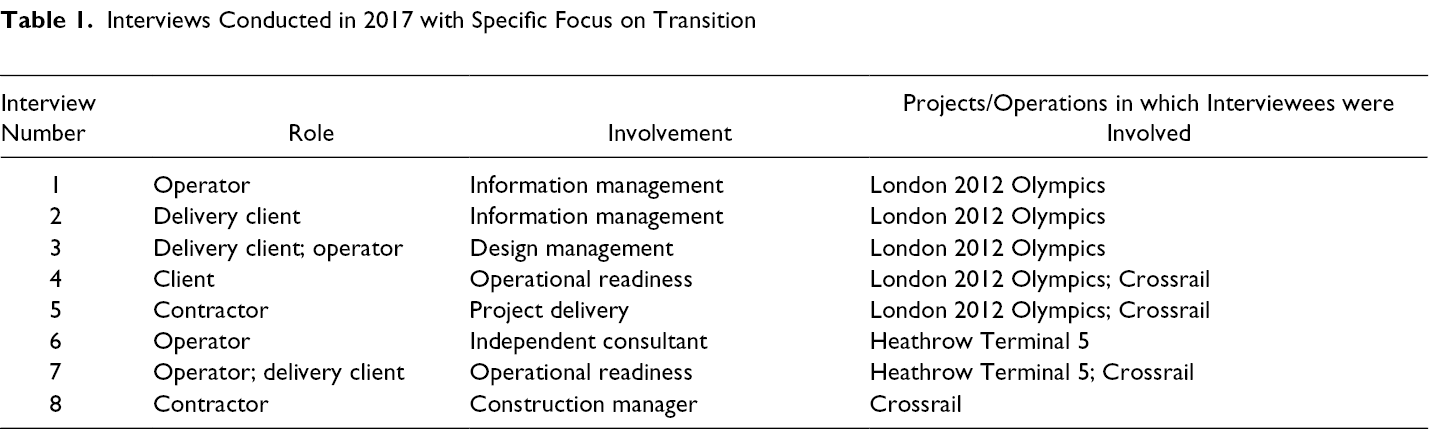
In collecting new data on the transition from projects to operations in 2017, the second author conducted eight semi-structured interviews on megaproject transition, with professionals operating in the London megaproject ecology who had worked on one or more project transitions into operations. Table 1 provides an overview of the interviews. Each interview was taped, transcribed, and lasted about 1 hour. The research protocols were developed to ask about methods used in handover/takeover, the main successes and challenges in transition, what data were important, how preparations were made for operation, and how knowledge was handed over. We identified interviewees from our previous research and through a snowball strategy from the initial interviews, seeking perspectives from both the delivery client and the owners and operators.
Table 1 indicates the main projects/operations in which interviewees were involved. Interviewees were selected because of their experience in transition and they brought a range of experience across the London megaproject ecology, including work on Heathrow Terminal 5, London 2012 Olympics, and Crossrail megaprojects (as shown in Table 1). They also discussed their experience on other Heathrow Terminals, Jubilee Line Extension, Channel Tunnel Rail Link (High Speed 1), East London Line, Thameslink, Millennium Dome, Tideway, and High Speed 2.
A data set of related secondary data on this transition from project to operations was also collected from both publicly available and internally published sources, where this data set included documents, articles, and web pages. These sources included work focused on general lessons learned on transition in the London megaproject ecology (including a report on “Project closure and operational readiness” by the Major Projects Association). They also include work on the lessons learned in specific projects (Parliamentary publications, reports from the National Audit office) and their experience of transition (press articles through a search of the database Factiva, and reports in the projects’ learning legacy websites). These secondary data were used to contextualize and interpret the interview data.
Data Analysis
In the analysis of the data set, the second author first conducted open coding to identify the most prominent themes arising from informant accounts (Glaser & Strauss, 2017). We identified the activities undertaken to accomplish transition. These are associated with operational readiness and handing on asset information (e.g., establishing the information required by the operators and appropriate data transfer methods, understanding the challenges of using different document control systems, preparing staff for operations, and testing the systems in real-life scenarios). To realize the theoretical potential of the data, we related the themes emerging from informant accounts to the literature on project management, returning to and recoding our data as we compared and contrasted our emergent findings with existing insights. We also discussed the linkages (with each other and peers in the research community) in order to use the analysis to extend the understanding of transition. We first drew on the notion of interdependency (from Thompson onward); then on ideas of reciprocal coordination across more or less temporary forms of organizing, before framing our analyses in relation to recent work and debates on temporality and boundary spanning.
Findings
Our data suggest that as projects end and operations begin, transition involves boundary-spanning work to ensure continuity across changing forms of organizing. The extent of change is significant. Transition is a process that unfolds over time and involves organizations, people, knowledge, and artifacts joining and leaving. It involves both project closure and the opening day. The project team shrinks in size as the operations team grows, with new organizations joining and old organizations leaving, and as responsibilities are handed over. Across this transition, understandings of past, present, and future are contested. New narratives are developed and negotiated. Ensuring continuity thus becomes a focus of work across the changing organizational forms and temporalities. Table 2 provides a high-level overview of the data set.
Structure of the Data Set
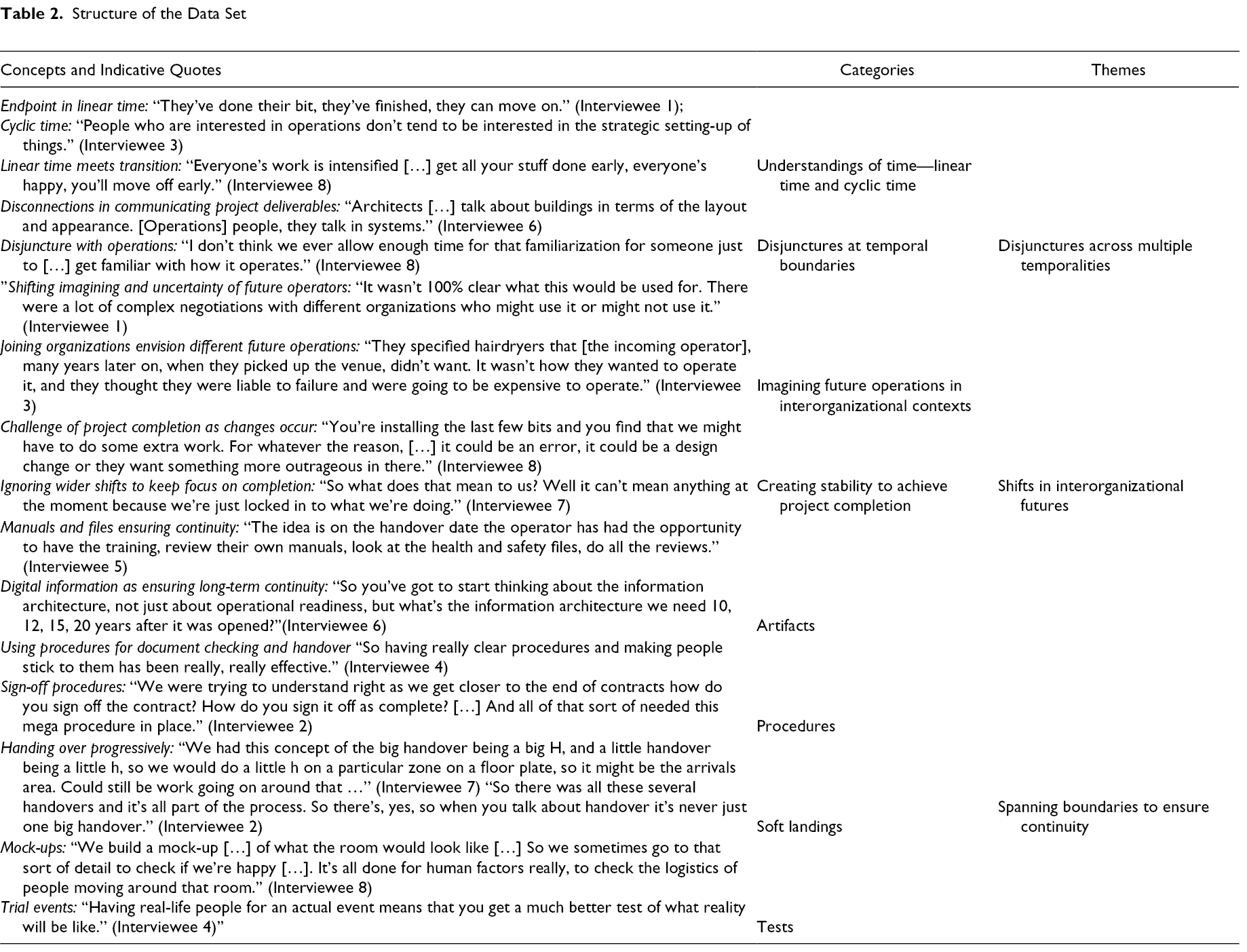
The interviewees discussed their learning on transition and temporalities across projects in the London megaproject ecology. Also, in some cases, the interviewees described how they had moved back and forth between megaprojects before a transition, for example, “I wasn’t planning to come back to Crossrail, I was on [a different project…] but I’ve been asked to come back to this job to help out because I’ve got experience at Crossrail before” (Interviewee 8). Drawing on our analyses, we first examine how multiple temporalities meet and temporal disjunctures emerge in transition. We then discuss the shifting interorganizational futures around and within the project involved in transition. Finally, we articulate how practitioners work to ensure continuity through spanning boundaries using artifacts, procedures, soft landings, and tests.
Multiple Temporalities
We find that transition brings into contact organizations and professional groups with different temporal orientations, and that dominant perceptions of time change during the transition. There is a shift from linear to cyclic time. Disjunctures emerge at temporal boundaries.
From Linear to Cyclic Time
Project managers describe the end of megaproject delivery in terms of closure and completion, emphasizing the increased intensity of work they experience as they approach deadlines associated with the end of a project:
“The program is getting compressed all the time and you find you’re doing a lot of extra work at the end of any of these big projects. You’re working day and night to install and test and commission all of these. So that’s the big challenge I find. We tend to not take cognizance enough of what I call the “tail-end Charlies,” the people that come at the end. All the flow is gone. […] We never leave enough time for testing and commissioning” (Interviewee 8).
Project practitioners refer to temporal boundaries associated with transition as phases or activities in project plans or schedules, with testing, commissioning, handover (of physical assets and digital information), operational readiness, takeover, and so forth. These people that come “at the end” include professionals who join the project as specialists in testing and commissioning large projects, as well as the operators that begin to join the process to prepare for operations. As Interviewee 8 describes above, the experience is of a compression of time as the deadlines loom. Project practitioners who are already working on other projects may be asked by their companies to return to support the completion of work.
Thus, project delivery team members are concerned with the end state, and with the idea that when they get there, “they can move on.” Contracts and financial incentives for the multiple organizations involved in delivery are set up to ensure training of operators:
“The contractors are very much focused on their contractual end date and meeting the terms of their works information. So they have a very clear requirement in their contract to do “Train the Trainer,” and it’s very specific about how many people they shall train. So they all have to produce information, a training plan, and then deliver their training to either the maintainers or the operators. So from that point of view they’re very interested because it’s a term of their contract. They don’t get paid unless they do it or have to do it. Beyond that, they’re probably not that concerned. […] But into the operational trials period, in theory they’re out of here, they’re just gone” (Interviewee 7).
Hence, contractors may be gone by the operational trials period. The contractual obligations are used to ensure the delivery of information and a training plan. While project team members are focused on finishing work, they are nonetheless required to train the maintainers or operators.
While operators join the team in the run-up to opening day, those involved in operations may show interest in a known steady state (business as usual) rather than the set-up work at the beginning:
“They like operations and they like the business as usual. This is what happens, this is how we operate, and this is how we run things. And they tend not to be interested in set-up and start-up” (Interviewee 3).
Thus in this transition, understandings of time as linear—with a flow, beginning, middle, and end—meet and increasingly shift toward more cyclic understandings of time as routine and ongoing. For the project manager, at the project end “all the flow is gone.” The sense of forward progress associated with a linear understand of time is no longer there. Yet, for operations managers, there is not an interest in the beginning and strategic set-up. Issues can arise as such linear and cyclic temporalities meet in transition.
Disjunctures at Temporal Boundaries
These temporalities involve different understandings of time and its consequences, with differing orientations to and focus on past, present, and future. Disjunctures are separations of disconnections. They are intrinsic to transition: organizations separate, the facilities are handed over, and project teams leave. However, these disjunctures can become problematic where organizations are separated before issues are resolved or things don’t join up in the right way, for example, as Interviewee 7 notes, that there can be a reluctance to take on the new accountabilities associated with the physical occupation of the site:
“The accountabilities that go with that, because as soon as you do hand something over, the party you’ve handed it to becomes accountable for it, and that’s where the difficulties lie” (Interviewee 7).
Afterward operators may find they don’t have what they expected. Interviewee 1 draws attention to the role of contracts and sanctions in ensuring work has been done by contractors and their supply chains as project staff members leave:
“What do the contracts say exactly? What are your sanctions if somebody doesn’t do something that they have said they’re going to do, and then you discover they haven’t done it? If we go out, for example, and look at some part of the park, and somebody’s supposed to have done something, and we discover, two years later, they haven’t done it, we haven’t really got any power over them. But neither can we constantly go round and double-double check” (Interviewee 1).
As organizations separate, where such issues are not caught within the timescales where they coexist within the transition, it becomes hard to address them afterward. Managing these disjunctures, and creating continuity across them, becomes particularly important in transition.
Shifting Interorganizational Futures
We find that in the transition to operations, the megaproject delivery team feels the need to create stability, closure, and completion against a sea of change—delivering within a set of multiple, relentlessly shifting, futures. These futures are imagined, across the complex institutional landscape of different organizations within and around the project involved in transition. We describe such futures as shifting as we find great uncertainty and fluidity, with new narratives and strategies coming into view and changing conceptualizations of the past, present, and future. In the following section, we discuss changes and uncertainties in how future operations are imagined as boundaries change around the project, new organizations join, and understandings of futures shift across the wider interorganizational context of the project ecology. Then we discuss how within the project, project managers seek to create stability and ordered transition within these shifting futures, while operators invoke understandings of future operations.
Changes in the Imagining of Future Operations
The broader set of contexts around the megaproject becomes salient in transition. We find that there are often significant changes in the purposes of the megaproject before and during transition, and in the organizations involved. Interviewee 1 describes how:
“You get an idea of different boundaries. And so this is interesting, because this is actually outside all of what we do. But we can’t just build a bubble here. We’ve got to connect up” (Interviewee 1).
In connecting with these other organizations across the project ecology, new futures become imagined. We use the idea of imagining the future, rather than projecting or shadowing the future, to imply the uncertain and changing nature of futures, and the role of imagining in future making (Comi & Whyte, 2018). Projecting backward to describe how such imaginings of the future change, Interviewee 6 told us the following story from a previous project:
“[The project manager] said, will you please just tell me what you want? Just write down the brief, produce a concept design, and then I’ll go and build it. And there was a silence. And then, again, the same very experienced ops [operations] guy said […] let me just tell you a story, he said, about when Terminal 4 was built. There was only one thing everybody agreed on, until 12 months before it opened, and that was that British Airways was never going in Terminal 4. And 12 months before it opened, there was a big change of mind, and they redesigned the whole thing. And the point he was making was that you cannot even forecast what the operational requirement will be at the end of the design and construct period, for many buildings” (Interviewee 6).
This point, made here by the experienced operations professional in this story, was well represented in our data set. In megaprojects the operational requirements continue to change and evolve up to and beyond the end of design and construction as a broader set of stakeholders come into view with changing understandings of project scope and purpose, and the configuration of organizations involved in the project also evolves.
Another example of this is the London 2012 Olympic Games, where the idea was to use the games as an opportunity to regenerate the area and create jobs, but there was no exact blueprint after the games as to what that would involve. This was beneficial as it generated competitive bids for the structures, which resulted in a greater profit. However, often the designs needed changing in the transition from the Olympic Games to legacy use in order to fit the working practices of the operator. For example, although the potential legacy use of the Olympic Stadium as a home for the West Ham United football club had been discussed in the bidding stage, there was a decision to make an athletics-only stadium for the 2012 Olympic Games. A final decision on legacy was only taken in 2013. The organizations involved in legacy operations continued to discuss and negotiate:
“If you went way back to very early on, in 2006–2007, they were looking for a future operator of the stadium, for instance. They did try to get West Ham or Tottenham Hotspur to take an interest in it. And, at that time, neither of those football clubs did. […] So I think the intention was always there, to bring people in early if you could. But it’s a risk-averse world, and obviously the bigger the venue, the more risk averse and the more risk you would take on to get involved in it, and particular given that each of the venues, […] was going through such an extraordinary transition on its journey to get to you” (Interviewee 3).
Delays in making decisions and taking accountability led to significant uncertainty in design and construction. In project delivery, the future of the stadium after the Olympic Games was unknown. This required a major refit to the stadium after the Olympic Games, reducing the seating, and covering the entire seating area. Rather than working with a known future that the project implements, futures continued to be imagining beyond the end of the delivery project, requiring a further transformation project.
As project teams shrink and operation teams grow, there may be no simple answer to a question such as when a project ends. There may be uncertainty about timescales for completion and also potentially unknown future transformations and knowledge transfer, beyond a formal project close. Uncertainty about timescales for completion is exemplified by the incoming CEO of Crossrail’s uncertainty about when the project will be open beyond 2019: “I don’t actually know when it will be delivered after that” (Lydall, 2019). The potentially unknown future transformations is exemplified by the London 2012 Olympics, where the delivery client, the ODA was due to cease existing in 2012 after transition to the Olympic Games but was extended to 2015 to manage knowledge transfer and transition to legacy use. Thus projects are temporal, but not of a known duration.
Such shifting interorganizational futures around the project are particularly difficult to manage where future operators are unknown. Interviewee 6 compares the understanding of future operations in Crossrail, the London 2012 Olympics, and Heathrow, and comments on the different statuses of delivery teams and operators:
“Crossrail and the Olympics have [been] designed without an operator. But that’s the difference, I suppose. With Heathrow, it was designed with an operator. So, ultimately, they knew exactly how it was going to run, because they were the ones who designed it. […] the government announced Crossrail and spent 10, 15 years working on Crossrail, without anybody knowing who the operator would be. […] The cultural issue is, for a variety of reasons, the creation of infrastructure has been dominated by project people, and by professional engineers, and contractors, and suppliers, and people like that. And culturally, within infrastructure companies, the operations and maintenance have been, kind of, second-class citizens” (Interviewee 6).
Without a known operator at the outset, or with uncertainty or changing understandings of future operations, in the process of transition, new organizations come into view, with different imaginings of future operations. One of the challenges of transition is the temporal institutional complexity (Dille et al., 2018) around projects with organizations across the project ecology imagining the future differently.
Creating Stability to Complete the Project
Within the project, when discussing transition, project managers describe how they become locked into a set of tasks. Project setup provides the framework and directions that created stability and the potential for closure, against a wider landscape of relentlessly shifting understandings of the megaproject, who will operate it, and how it will be operated:
“That original setup, about what governance are you following, what are the rules, who are you handing over to, it’s really, really important because if you get it wrong or if you change it halfway through, you do find yourself in these sub-optimal positions where, had we known that we would have done it differently. […]But sometimes you just shrug your shoulders and go, well, okay, we couldn’t have known that 10 years ago. So we could have either waited for the perfect answer and not done anything or just cracked on [proceeded]” (Interviewee 7).
The future is not controlled or known by project managers, but is imagined, based on the information available at the time. At the point of the transition from the project to operations project team members are committed to deliver based on decisions made earlier. These decisions were based on how they envisioned the future. In order to complete, they treat as out of scope the new futures that come into view as operators join.
For the operators directly involved in the project, shifting interorganizational futures can lead to fluidity of decision making continued through transformation, as there is new scope for ongoing change:
“There was a plan, moving forward, but it wasn’t set in stone. So if you think of this as being September 2012, it wasn’t 100% clear what it would look like by April 2014. So there were various things discussed” (Interviewee 1).
Decision making takes place over time, so the differing temporalities across the interorganizational setting can easily lead to previously complete designs and decisions to become reconsidered and reopened in preparation for transition, as issues of operation as “business as usual” become invoked. It is this opening up of new futures that project managers seek to close down or treat as outside of their scope.
A hairdryer in the Aquatics Centre at the London 2012 Olympics provides an example of this invoking of operations to imagine new futures. The hairdryer was specified to be part of the detailed design, but an operator who later became involved did not want to maintain and operate this type of hairdryer. As Interviewee 3 stated:
“They specified hairdryers that [the incoming operator], many years later on, when they picked up the venue, didn’t want. It wasn’t how they wanted to operate it, and they thought they were liable to failure and were going to be expensive to operate” (Interviewee 3).
Such considerations can lead to substantial rework in transition, and a number of interviewees point to concerns about the right time to involve operators, in this case making the argument that “operators were just not on board early enough to influence things” (Interviewee 3).
However, there were other perspectives articulated by our informants. For example, Interviewee 4 argues that the temporal focus on business as usual rather than the future limits the understanding of operators about what they might achieve through a project. Here, operational readiness issues are seen in part as created through multiple temporalities coming into contact earlier in the project, where the orientation of owner operators can lead to a briefing process at the outset that: “is driven more by the failings of your current arrangements rather than what is it that you’re trying to achieve” (Interviewee 4). The argument here is that the futures that operators imagine are routed in their past, whereas the project should imagine different futures. These arguments reveal different understandings of relevant pasts and how to imagine the future.
In transition, credibility is given to the future operations that are imagined by the actual operators. There were a variety of ownership models for venues in the Olympic Park, where the eventual owners of venues, such as the Stadium and Aquatics Centre, were not known at project closure (and after project closure); however, others had long-term owners from the outset and had a different relationship with the project team in transition:
“If the actual operator is saying to you, no, that really isn’t going to work, and we really will not sign the handover documents if you do it that way, that’s quite forceful, as opposed to someone simply representing an idea of an operator, saying, well, that’s not going to work, is it? You shrug your shoulders. Well, how do you know?” (Interviewee 3).
The credibility of future imagining is greater, where the long-term operator is involved in project delivery and transition. The transition to operations is easier because long-term objectives have been detailed in the brief. Yet such early involvement may require operators to take on unusual risks and responsibilities, and to engage with different temporalities and forms of organizing. It requires a negotiation of imagined futures, and unless all organizations are there at the outset it is to be expected that organizations that join will bring new imagining of the future that could potentially change understandings of project scope and purpose.
Ensuring Continuity by Spanning Temporal Boundaries
As the forms of organizing change, participants focus on ensuring continuity in the things organized during the transition. Our data suggest that transition is achieved, and disjunctures and shifts are managed, through indirect, as well as direct, forms of boundary spanning. These are used to address the challenges that arise because of the disjunctures that arise at the meeting of linear and cyclic temporalities, and the shifts in interorganizational futures. Artifacts and procedures transfer knowledge of the physical deliverables from the project and codify processes for transition and operation. They include information architectures, workflows, and methods. Soft landings and tests are used in mutual adjustment and also bring understanding of operator working practices, motivations, and interactions. Artifacts, procedures, soft landings, and tests are discussed in the following subsections.
Artifacts
Artifacts—digital information systems, data, and the physical site—span temporal boundaries and provide indirect forms of coordination (or stigmergy) over time, playing a significant role in ensuring continuity throughout the transition. Digital information systems and data are handed over with the physical site. Through persistence, these systems and data span temporal boundaries, and are used not only in the project but also in operations. As an operator explains:
“And what we want is a correlation between the actual physical works and what’s been updated in the document register. That’s what we want, so that we can actually see that the work has been done. It’s no use them saying to us: we’ve done it. We want to see the documentation to show that they’ve done it. And eventually, at the end, after a great deal of blood, sweat, and tears, you get to the point where the building is now open … fit to be open to the public, and we’ve got all the documents we want.” (Interviewee 1)
Thus, digital information is used to document both the work involved in the transition itself and the physical artifacts that are transferred across organizations. In addition to the schedules and deadlines (previously discussed in the literature as temporal boundary objects), we see a wide range of artifacts—particularly digital systems and data, and the physical assets themselves—being mobilized to share knowledge over time.
These artifacts transfer knowledge and understanding over time, into distant futures, as this interviewee continued in discussing the quality of the data:
“Whoever’s managed this has done it really, really well. And it’s interesting, because the implications of that go a long way into the future. And the implications of the bad management data can go a long way into the future, as well. […] The quality of this is actually increasing with time. It’s not decreasing” (Interviewee 1).
Thus the implications of good, well-organized data persist into the future. The data remained as organizations left and new organizations joined during transition and can continue to be used in operations. The quality of this data set, which means it can be shared and relied on “a long way into the future”, was delivered, in a distant past, through the delivery project.
Obtaining information that is relevant in operations is a negotiated process in transition. As professionals from the project and operations teams come into contact in transition they bring different views as to what information is relevant in operations. From an operator perspective, this process involves:
“Consultants and contractors who don’t really know anything about operating facilities … consequently you end up with loads of unnecessary information being pushed through and often the information you do need isn’t pushed there” (Interviewee 6).
Operators are interested in documents such as final as-built drawings, models and information sets, operations and maintenance manuals, acceptance certificates, and work instructions. Obtaining these requires a significant filtering, re-ordering, and re-prioritizing of information. For example, this interviewee argued:
“So, over here, we’ve got the ODA. It’s got 7.5 million files, and we’ve got to go into transformation phase. We don’t want 7.5 million files. We don’t care about their Christmas party. We don’t care about their holidays. We don’t care about any of that stuff. All we want is the final as-builts for the buildings that they built” (Interviewee 1).
The final as-builts are records of the completed state of the buildings delivered and the starting point for the operator. In this case, they transferred about 130,000 files of the 7.5 million files used in the delivery megaproject into everyday operations. Extracting the information needed in operations involved translations across multiple systems.
While some of that data from delivery will be highly relevant to operations and accessed daily, other data will not be needed or may only become relevant over longer time frames. Talking about such a set of data (in this case of drawings, rather than documents), this interviewee went on to argue that it was important to have the data, not the systems, in operations:
“In four years, no one has ever asked to see any of that data. Whereas we could have spent half a million pounds on that in the last four years, just running a system which nobody ever uses” (Interviewee 1).
Although no one has used this information, the operator was happy to have it as it may become useful over the operational life of the asset—it can be problematic if the organization no longer has access to information that becomes needed later on. As the interviewee stated, it was the right decision to store the data in case needed in the future.
Locating, interpreting, and using the data from the delivery project are the focus in operations. Hence, during transition, there is a focus on mapping data that will be accessed and used on a daily basis into the systems of the receiving organization, where “Utopia is that everybody works off the same system” (Interviewee 5) as it is rare that data can be completely system independent. It is this translation across digital systems, and transfer of digital data, that becomes important in ensuring continuity through the process of transition.
Procedures
Across the multiple temporalities and organizations involved in transition, getting updated documents and drawings is a major issue. In order to achieve this and manage disjunctures, there is a need for agreed-on and managed processes and procedures in transition, as Interviewee 1 explains:
“We don’t always get the updated drawings. And that will mean that, over time, the information will degrade. […]. So that’s an issue. But that’s a process issue. That’s an issue about managing the process, and about having clear procedures and having a way of managing your procedures” (Interviewee 1).
These procedures mediate across multiple organizations and temporalities, iterating to ensuring the information is in place by spanning the temporal boundary between a linear temporality, with a task and finish focus; and cyclic temporality, with a focus on ongoing operations.
However, spanning temporal boundaries is not easy, and there are challenges arising in the interaction between the operations document controllers, focused on the long-term future; and the contractors involved in delivery, who have more immediate concerns with project closure:
“But it’s that sort of rigor with the document control. That’s made our document controllers very unpopular, sometimes, with the contractors, but they’re paid a lot of money to do this stuff. And we’re not here to be popular with them. We’re here so that, in ten years’ time, somebody’s looking for this stuff, and they can find it, and we know we’ve got it. […] And, yes, so it’s having that, sort of, rigour, of actually doing that, which has been really important. So having really clear procedures and making people stick to them has been really, really effective” (Interviewee 1).
The infrastructure that these megaprojects deliver has a long operational life, and such direct coordination through processes and procedures, enacted in the present time of transition, enables artifacts to persist into the future when people may need the information.
Soft Landings
Rather than an abrupt transition across temporalities, soft landings are used to iteratively and progressively transition from one organizational form to another. On a large program of work, transition may be staged so that operators take responsibility for some physical assets, and their associated asset information, while others are still being delivered:
“And that way you got the operator progressively occupying bits […] rather than leaving it right to the end where it’s one big bang. So because we did it in that way you ironed out the wrinkles of all the usual stuff about asset information, and documentation, and proving that it’s safe, and all the other stuff you have to do in order to handover, because we started doing it bit by bit over a period of about a year, I think as I recall. So when bits were ready we handed them over” (Interviewee 7).
Within the London megaproject ecology, this was felt to be a learning that came out of the opening of Heathrow Terminal 5, which was initially adapted to projects to upgrade other Heathrow terminals, and then onto other megaprojects, as this interviewee continued to explain:
“The biggest learning coming out of T5, which is why T2 started the way it did, it started very quietly, there was no press announcements, there was no big opening ceremony, we only did that once we knew it was working” (Interviewee 7).
While the first day of operation at Heathrow Terminal 5 ran at 70% capacity, in comparison and learning from this, the next megaproject in Heathrow’s program of work, Terminal 2, scheduled around 10% capacity of flights for the opening day in 2014, gradually increasing capacity over a six-month period.
This lesson is codified into a UK government soft landings policy for major projects, with the Cabinet Office and the Building Services Research and Information Association (BISRIA) taking a lead. This was also embedded in the national policies on Building Information Modelling (BIM) through the work of the BIM Task Group from 2011 through 2016. We suggest that the iteration and progressive handover, articulated in our interviews and codified in the policy, are useful, not only in ensuring artifacts are joined and separated in the right way, but also in mediating between linear and circular temporalities, and enabling mutual adjustment where disjunctures emerge.
As part of a soft landings approach, the same organizations, that are part of the interorganizational delivery project, may also become involved in delivery to enhance continuity. Training is part of this, with the training plan seen as part of the project closure documentation and obligations on project delivery teams, so that: “Our supply chain would train the operator” (Interviewee 3). The need for longer engagement, and forms of contracting that might enable it, are also discussed by our interviewees, as: “The construction industry somehow needs to become much more tuned in with operations” (Interviewee 3). In a number of interviews, the idea of continuity is raised, for example: “We could run the maintenance for the first year and it could be a phased transition” (Interviewee 5) with some contracts running through the transition, for example, “Contract with [company x], which runs beyond just delivering [asset y], they are then an integral part of the maintenance and operations team” (Interviewee 7). Here the transition across temporalities may not also involve a transition across firms, with the same organizations becoming engaged in both project delivery and operations.
Beyond project closure, even when contracts do not extend into operations, the project team views multiple futures, including their own future work. As Interviewee 8 explains, the consultants retain a few people involved in the project through the transition:
“So we have to have people there. We wouldn’t just disappear off. That’s no good for your future work. You stay with that client, check if they’re happy, and once they’re happy then you can just disappear. But very rarely do you just close and disappear. You might keep a few people back as someone the client can talk to …” (Interviewee 8).
Thus a culture of soft landing instead of build and disappear is growing, with continuity developed through people, for example, “very rarely do you just close and disappear” (Interviewee 8).
Tests
Tests are used to manage disjunctures in transition through probing future operations. As Interviewee 8 notes, this is important because:
“Assumptions made about operations during construction don’t necessarily hold true when you then move into operations” (Interviewee 3).
Systems integration, the commissioning of the physical systems and operational readiness are important steps at project closure and the transition to operations in infrastructure megaprojects. As part of ensuring operational readiness, testing is most effective when it simulates real operating conditions, thus another interviewee notes:
“When you get real people in here who’ve got a packed lunch in there and a child’s pushchair [stroller] or whatever, it’s completely different” (Interviewee 4).
This interviewee contrasts this with the less successful opening at Heathrow Terminal 5, where:
“All of their staff familiarization was done in hard hats walking round the building site” (Interviewee 4).
Thus, tests provide an opportunity to check assumptions and to probe the realism of future imaginings, before opening day. They bring future imaginings into the present as a step in the process of future making (Comi & Whyte, 2018).
Discussion and Conclusions
We theorize the transition from more temporary, goal-oriented, evolving forms of organizing to more permanent, ongoing, routine forms of organizing. Our main contributions are, first, to show how transition from project to operations is accomplished by ensuring continuity across changing forms of organizing; and, second, to extend the recent research on temporal boundary spanning (Maaninen-Olsson & Müllern, 2009; Stjerne & Svejenova, 2016; Stjerne et al., 2019) to articulate the roles of artifacts, procedures, soft landings, and tests in addressing disjunctures and shifts in transition to ensure continuity. By clarifying the notion of transition conceptually we make contributions both to project studies as a field (e.g., Artto et al., 2016; Lundin & Söderholm, 1995) and to the study of temporary organizations as a subset of organization studies (e.g., Bakker et al., 2016; Lundin & Söderholm, 2013).
We extend the work on temporal boundary spanning in projects (Maaninen-Olsson & Müllern, 2009; Stjerne & Svejenova, 2016; Stjerne et al., 2019) by theorizing how temporal boundaries are spanned. We describe the issues arising at temporal boundaries in transition as caused by disjunctures and shifts, emerging over time, rather than tensions across contemporaneous forms of organizing that coexist. We argue that transition from projects to operations is accomplished by ensuring continuity across changing forms of organizing. In this transition different temporalities come into contact. As these temporalities orient differently to the past, present, and future, temporal work is done to stretch across disjunctures and to create stability to close the project amid shifting interorganizational futures. Continuity across projects and operations has previously been emphasized in research that treats operations as part of the project life cycle on megaprojects as long-term projects (Alderman et al., 2014; Brady et al., 2005; Brookes et al., 2017). We recognize the multicontextuality of more or less temporary forms of organizing involved in transition. However, our work instead treats as distinct the delivery project and operations in order to theorize the temporal work that is done in transition to span temporal boundaries and ensure continuity across forms of organizing as projects end and operations begin.
A contribution of this work to organization studies is to suggest an extension beyond the idea of temporal boundary objects as referring only to those objects that specifically represent and reference time (Chang et al., 2013; Yakura, 2002). Across transition, we find that many artifacts become important in spanning across temporal boundaries, providing persistence across the changing forms of organizing. These artifacts represent project deliverables as well as time and span temporal boundaries by enabling traces of the past and future imaginings to be represented in the present. Along with prior experience or expectations of future working together (Ligthart et al., 2016), they enable collaboration in the process of transition. As such artifacts become digital, structured digital information becomes used alongside procedures that codify and transfer common processes for transition and operation.
While artifacts and procedures are used to transfer knowledge into operation, we also find that soft landings and tests are used to provide an iterative approach to understanding operations. They enable practitioners to project future operations and to align their understandings of past, present, and future across the interorganizational setting through mutual adjustment. Because mutual adjustment is often difficult and takes time, Thompson did not see it playing a large role in organization, arguing that organizations would instead seek to reframe activities to reduce reciprocal interdependence (Gittell, 2006). We do see some evidence of this, where project managers disconnect from the wider shifting interorganizational futures to create the stability to complete the project according to its initial brief. However, we also find that transition is a time limited window of opportunity for contestation, mutual adjustment and negotiation, as organizations leave and others join. Soft landings and tests provide mechanisms for this.
Such explanations build on and extend the prior work on transition, including Brown and Eisenhardt’s (1997) early observations that transition involves links across time, sequenced steps, and intermediate forms of organizing (which they term semistructures). Our work responds to the call to theorize the project end state (Lundin & Söderholm, 2013) drawing on the significant learning on transition institutionalized in the London megaproject ecology, where transition from project to operation involves ends, middles, and starts—from project closure to opening day. It extends understandings of transition beyond punctuated equilibrium and midpoint transition (Bakker et al., 2016). In describing soft landings, our work uses language developed by practitioners in the London megaproject ecology and concurs with Whyte et al.’s (2016) finding that practitioners seek to extend the window of opportunity in which practitioners from the project and from operations can work together to prepare for operations.
Our analyses suggest that project closure is accomplished within shifting futures, with project delivery managers experiencing a compressing of time. Around interorganizational projects, there are relentlessly shifting understandings of future operations. Transition involves a broader set of organizations coming into view, contesting scope and purpose. Our findings here concur with Dille et al.’s (2018) work as there is institutional temporal complexity around projects. In transition, these shifting futures add to the challenge creating the stability required to complete the project. We show how project managers perceive it as useful to see themselves as locked in to a trajectory of delivery in order to accomplish project closure. We go beyond prior explanations to theorize how in this transition from projects to operations, practitioners orient to the future of the project. Instead of employing a future perfect strategy (Pitsis et al., 2003), we find project practitioners working to sustain the plan, while cognizant of its imperfections in relentlessly shifting interorganizational contexts. At the same time, new imaginings of the future (Comi & Whyte, 2018) are brought into view as operators join. Prior research has drawn attention to the rituals of transition (van den Ende & van Marrewijk, 2014)—such as the opening day. Our work suggests that such rites of passage must also be timed right with, for example, the celebration of opening day happening after transition has been achieved, when the work of testing, commissioning, and operational readiness has been completed, and the facility is, at least at a limited capacity, already experienced in being open and running.
Practical Implications
Transition is practically challenging, often takes longer, and involves more work than anticipated. Examples such as Brandenburg Airport show how megaprojects often fail to realize value as they complete. Thus, new insight on transition is not only of theoretical interest, but may also have practical implications for improving the transition process from ending the project to beginning operations. Our work suggests that transition involves ensuring continuity across changing forms of organizing (which have different understandings of time), and that artifacts, procedures, soft landings, and tests can play important roles in the temporal boundary spanning that accomplishes this continuity and enables project closure, as new organizations join and understandings of the future shift. A practitioner overview is shown in Figure 1.
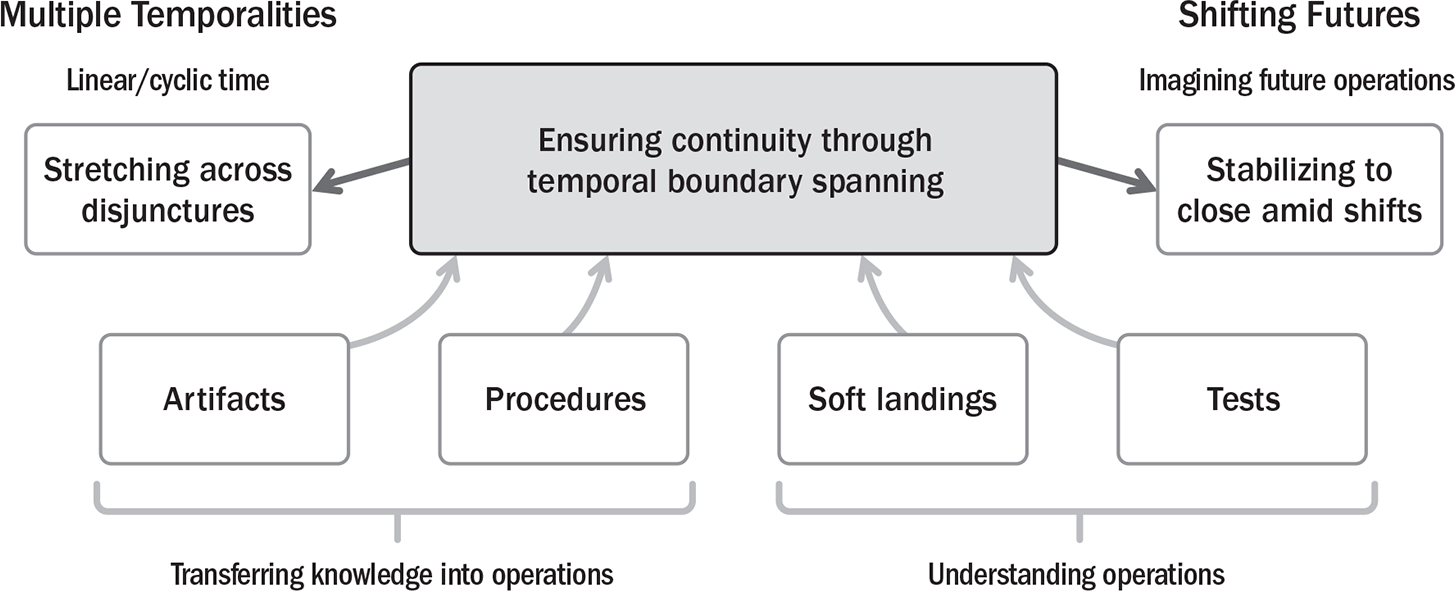
Practitioner overview—Temporal boundary-spanning work and the roles of artifacts, procedures, soft landings, and tests in ensuring continuity between project ending and operation beginning.
Practitioners should be aware of the potential for disjunctures and shifts to emerge and should plan strategies for mobilizing artifacts, procedures, soft landings, and tests effectively to address these. Where strategies to span temporal boundaries to accomplish an end state fail or where work is still incomplete, the project can become significantly delayed at the transition phase. Artifacts and procedures are useful for transferring knowledge of the physical deliverables and processes for transition and operation. Soft landings and tests are critical to understanding operator working practices, motivations, and interactions. Our research provides the basis to further detail practical guidance for practitioners. It suggests that there is a benefit in practitioners giving greater attention to the organizational and temporal aspects of boundary spanning work between project ending and the beginning of operation.
New Directions for Research
This work suggests significant new directions for research. For project scholars, there are new opportunities to build on this work to extend the understanding of how, in the transition from projects to operations, forms of organizing with different temporalities meet. It would be useful to question empirically how project managers and operators differ in their approaches. What are the implications of setting out to accomplish goals, using forms of organizing that are more temporary and ends oriented, with focus on task completion? How does this contrast with concerns that are about sustaining activities, such as service provision and maintenance over the lifetime, using forms of organizing that are conceived of as more permanent, ongoing and routine forms? A limitation of our data is that they focus on the transition from project managers to operations managers, and do not include the earlier practices involved in integration across the supply chain that support transition. Future work could carefully articulate and examine the systems integration, testing and commissioning activities as well as the handover and operational readiness activities focused on here. For organization scholars, there are opportunities to build on this work to understand transition and temporalities in contexts where temporal boundaries do not coexist in a stable ongoing way. This has implications for organizational scholars working on temporality and boundary-spanning and in related fields of work such as interorganizational routines and sociomaterial practices. There has been relatively little work on coordination in evolving contexts, where organizations leave and join, and bring with them different temporalities. There is more work to be done to consider and unpack the organizational strategies for managing the disjunctures and shifts that occur, and an opportunity to elaborate our understanding to develop process models of transition. This work provides a starting point for such theorizing of both the change across organizational forms and the work to ensure continuity where there is a transition.
Footnotes
Declaration of Conflicting Interests
The author(s) declared no potential conflicts of interest with respect to the research, authorship, and/or publication of this article.
Funding
The author(s) disclosed receipt of the following financial support for the research, authorship, and/or publication of this article: The first author would like to thank the Royal Academy of Engineering and Laing O’Rourke for funding her position.
Note
Author Biographies