




Abstract
Introduction
Projects have become one of the most common ways of organizing work in organizations (Bakker, 2010; Bakker et al., 2016). They are the major means by which organizations structure and deliver both operational and strategic objectives (Chipulu et al., 2019; Ojiako et al., 2015), and projects also represent the means by which visions are operationalized (Maylor et al., 2018). Hence, projects are of insurmountable value to any organization (Parvan et al., 2015). In fact, scholars highlight that projects have evolved from being an organizational concern to playing a much more important role within society. As Jensen et al. (2016) observed, “Projects have become omnipresent not only in the economy but also in our society and our lives” (p. 21). In parallel, considering the scholarly development of research and teaching in project management, project management has clearly developed into a rich and multidisciplinary field of scientific research.
The Project Manager Role and Career: What We Know
Central to the project management discipline is the position of the project manager (Meng & Boyd, 2017; Sommerville et al., 2010), generally construed as the individual with assigned responsibility and accountability to successfully deliver the project within performance standards as articulated by the client. The project manager has also been the focus of much research on project management over the years, including studies on the roles and competence of the project manager. Furthermore, obviously, the project manager is essential for the many professional organizations around the world, including the Project Management Institute with over 500,000 members. One reason for this growing popularity is that project managers need training and support.
As pointed out by scholars, the project manager career path is one of peculiarities (El-Sabaa, 2001). For example, we know that project managers experience substantial lateral changes when compared to managers in other fields (El-Sabaa, 2001). We also know that the role is eclectic (McKevitt et al., 2017), not constrained by traditional organizational boundaries (Bredin & Söderlund, 2013), and often involves cross-occupational moves (El-Sabaa, 2001). McKevitt et al. concluded that a project manager is a “…jack-of-all-trades” (p. 1674). Thus far, the route into the project management profession has often been, and still is, considered ‘accidental’ in nature (Havermans et al., 2019; Richardson et al., 2015). Indeed, rarely does a career as a project manager begin within the profession. The role of a project manager typically appears ‘pushed’ or ‘thrust’ onto individuals (Pinto & Kharbanda, 1995), and the typical career as a project manager seems to be a consequence of prior practical experience within the industry (Marion et al., 2014). This makes it difficult to predict who will grow into this role and what qualifications are critical to a successful career as a project manager. In fact, despite the existence of a relatively rich literature on project manager competencies (e.g., Alvarenga et al., 2019; Chipulu et al., 2013; Skulmoski & Hartman, 2010), any understanding of the project manager career is particularly challenging, as most available research has considered such competencies to be relatively static. The result of this is that the dynamic nature of the project manager career has rarely been incorporated into assessments of project manager and project success competencies (Chen et al., 2019). Taken together, we can conclude that both scholars and practitioners have highlighted the importance of enhancing our understanding of the preconditions and challenges of project managers’ career paths, but also that we still have a long way to go before we arrive at such an understanding. Indeed, as several scholars have emphasized, we still know little about the career paths of project managers.
The Project Manager Role and Career: Why We Need to Know More
Research in project management has consistently pointed toward the critical role of the project manager in achieving project success (Malach‐Pines et al., 2009; Müller & Turner, 2007), and the relationship between project team management and leadership and the performance of projects (Geoghegan & Dulewicz, 2008; Müller & Turner, 2010; Yang et al., 2011). However, despite the important and central role of the project manager to the successful delivery of projects, there is very limited understanding of the routes into the profession and, subsequently, progression in the profession. There have been recent attempts to contribute to this lack of knowledge, but most studies have been anecdotal (e.g., Marion et al., 2014), only indirectly focused on project manager career paths (Cheng et al., 2005; Chipulu et al., 2013; Ekrot et al., 2018), and primarily focused on project management as an accidental profession (Havermans et al., 2019). Yet, despite these contributions, there is still a dearth of studies addressing in a more structured manner what the key building blocks are of project managers’ career paths and how their careers evolve over time.
The lack of understanding of project managers’ careers is problematic from the perspectives of both the project manager and the employing organization. First, as Bredin and Söderlund (2013) have argued, project management is not only one of the most common management assignments among professionals; it is also often the first one in people’s careers. Moreover, it is a highly complex role. Often, it involves a temporary assignment with limited authority and highly stressful working conditions. This makes it all the more important that the dynamics of project managers’ career paths are better understood. Second, the literature suggests that career paths are, in part, a function of organizational structures, which may comprise training, clear-cut career pathways, appraisal and feedback mechanisms, and other factors (e.g., Delery & Doty, 1996). Thus, a lack of understanding of project managers’ career paths is also problematic from the organizational perspective. Projects are of high strategic importance, which makes it crucial to effectively support project careers (Huemann et al., 2019; McKevitt et al., 2017) and foster the management of project management talent within the firm as a critical part of strategy development (Söderlund & Tell, 2009). This could be undertaken, for example, by designing incentive systems and career systems (Ekrot et al., 2018). Taken together, both from individual and organizational perspectives, it is crucial to gain a better understanding of project managers’ career paths and systems.
The Project Manager Role and Career: Integration With the Field of Career Studies
In trying to better understand project managers’ careers, it makes sense to be informed by the field of career studies, which can be characterized as research on “people's lifelong succession of work experiences, the structure of opportunity to work, and the relationship between careers and other aspects of life”. 1 In this field, a career has typically been defined as “…the evolving sequence of a person’s work experiences over time” (Arthur et al., 1989, p. 8). Several recent review studies have been published (Akkermans & Kubasch, 2017; Baruch et al., 2015; Byington et al., 2019; Lee et al., 2014; Wang & Wanberg, 2017), which all reflect on the key topics that have been studied in the field. These topics include, but are not limited to, career choice, career success, career transitions, and employability. In all, the field of career studies has flourished in recent years, and offers many relevant insights that can help us better understand the careers of project managers.
The need to gain a better understanding of the career development processes of project managers is what led us to call for new research in the area of career paths of project managers and to organize that research in this special issue. In doing so, we adopted both an
In terms of ‘outside-in,’ we hope to start answering questions such as: “What factors contribute to the career success of project managers?” “What is the role of career competencies in the career paths of project managers?” and “What are the antecedents and outcomes of project managers’ employability?” In terms of ‘inside-out,’ key questions that we departed from were: “How can project management competencies contribute to career success and employability?” “What is the role of experience in the careers of project managers?” and “Is entry into the project management profession still ‘accidental’?” Addressing these questions will advance both research and practice in the fields of project management and careers.
Overview of Studies in the Special Issue
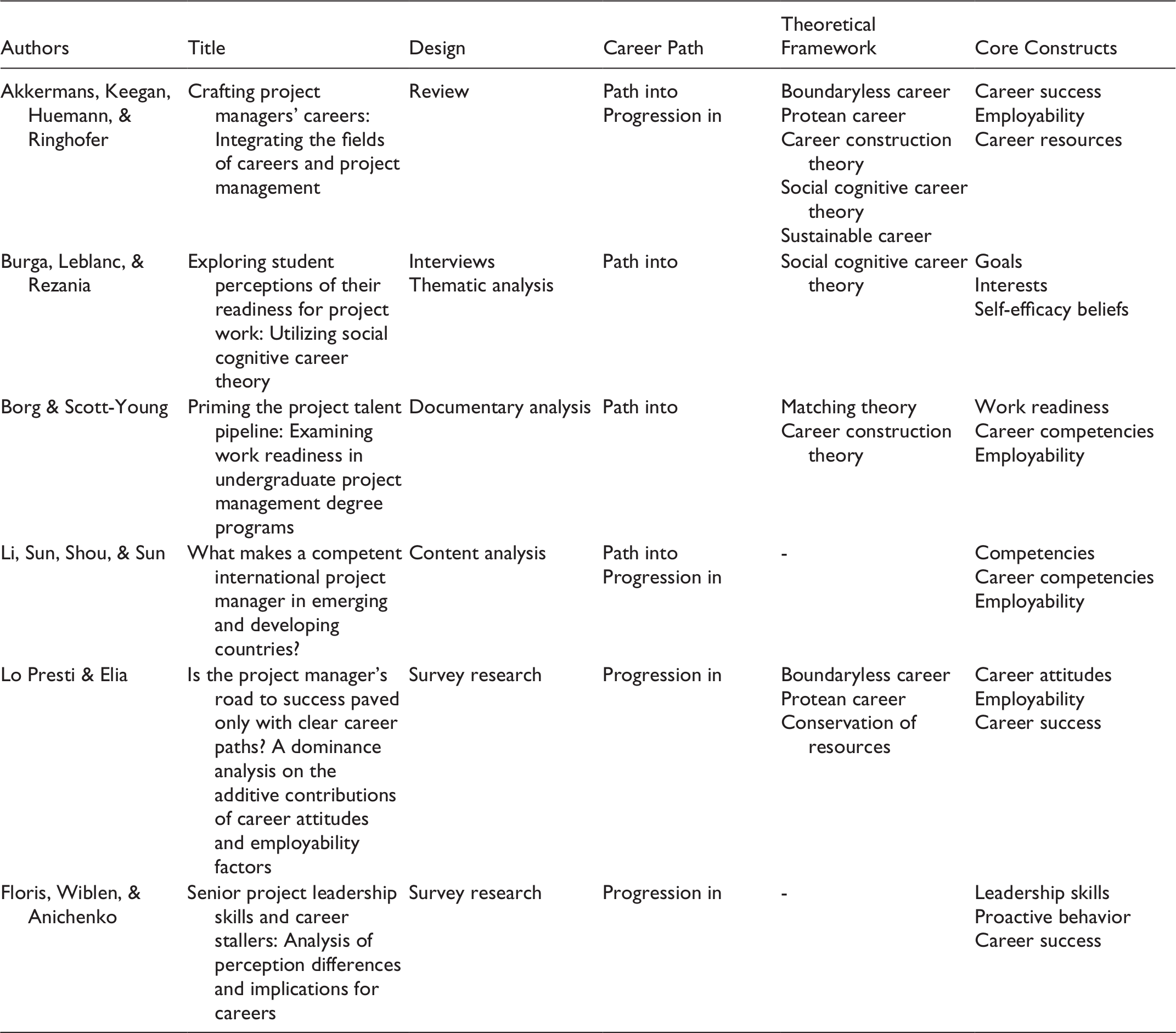
Table 1 provides an overview of the studies in this special issue. Here, we will reflect on their core contributions to the literature on career paths and systems of project managers.
Overview of the Special Issue Articles
Akkermans, Keegan, Huemann, and Ringhofer
In the first contribution of this special issue, Akkermans et al. offer an integrative review of the careers and project management literature. They discuss some of the most influential theories in the field of career studies: boundaryless careers (Arthur et al., 2005; Defillippi & Arthur, 1994); protean careers (Briscoe & Hall, 2006; Mirvis & Hall, 1994); social cognitive career theory (Lent et al., 1994, 2002); career construction theory (Savickas, 2002, 2005); and sustainable careers (De Vos et al., 2020; Van der Heijden & De Vos, 2015). In searching for connections with the existing project management literature, their conclusion is that only the boundaryless career perspective has received quite some traction in project management studies, whereas the other theories are mostly only implicitly mentioned, and only in a handful of studies. The authors also examine whether or not some of the core career constructs have been used in the study of project managers’ careers. Their conclusion is that career success, employability, and career resources have all been used implicitly quite a bit, yet those studies have rarely capitalized on the existing research from the field of career studies. Akkermans et al. conclude that there is a lot of untapped potential with regard to integrating the two fields, and they formulate a research agenda for future studies in this area. The authors’ main recommendations are that project management scholars can use existing career theories and constructs to better understand the careers of project managers. The rich literature from the field of career studies forms an excellent basis to do so. At the same time, they also urge career scholars to test their knowledge among project managers, as this target group is a perfect representation of the dynamic and flexible career that many people face today.
The article by Akkermans et al. offers several important contributions to our goals for this special issue, both in terms of paths into and progression in the profession. (1) From a theoretical and conceptual perspective, they provide a clear summary of some of the key ideas in the field of career studies. They also offer suggestions for how career theories and constructs may help us to better understand project managers’ career paths and systems (outside-in) and for how project managers might offer a unique insight into contemporary careers that other target groups cannot offer (inside-out). (2) From an empirical perspective, they provide concrete suggestions for how the two fields may be integrated in future research. In sum, their article offers a very hopeful starting point for integration between the fields of project management and career studies. Only a small amount of research in this area has been done and there is huge potential for future research. In light of this, their article can also act as a starting point and a guide for future studies.
Burga, Leblanc, and Rezania
The second article in this special issue focuses on students’ readiness for project work. Burga et al. examine students’ ideas about the profession of project manager and the role of their educational project work in preparing them for this career path. They note that the path into project management may not be as accidental as it once was, and that proper preparation is key. Departing from social cognitive career theory, the authors argue that career self-efficacy, outcome expectations, and personal goals (Lent et al., 1994) are key mechanisms that may explain students’ preparedness for a career as a project manager. Based on the existing project management literature, Burga et al. performed a qualitative study among 30 students in two phases: first a content analysis and then, based on that, in-depth interviews. Their findings mostly supported existing research by showing that students had rather accurate expectations of the project management profession in terms of self-efficacy beliefs (e.g., what would be effective skills), outcome expectations (e.g., what would make a project manager successful), and personal goals (e.g., does the role of project manager fulfill the goals of graduates). The main conclusion that Burga et al. draw from their study is that project management may still be an accidental profession to many graduates, yet good preparation is still necessary regardless of that.
The study by Burga et al. mainly contributes to better understanding the path into the project management profession. Their findings seem to support the notion of project management as an unplanned, even accidental profession, which is in line with the dominant assumption thus far (e.g., Havermans et al., 2019; Richardson et al., 2015). However, their findings do come with ‘a twist’ on that perspective. The authors argue that even though project management may not be a deliberate career plan for students, this type of unplanned career move actually fits with contemporary career paths because young adults tend to be more flexible and less focused on one specific occupation. This is in line with recent research on school-to-work transitions that depicts this transition as a dynamic process that often includes multiple steps, and is characterized more by ongoing career crafting than by one single occupational choice (De Vos et al., 2019). Furthermore, Burga et al. also emphasize that regardless of whether project management is a deliberate career choice for young adults, good preparation for such a role is still crucial, as it has become a likely career step for many people at some point during their careers. Indeed, their findings showed that project management was considered an appropriate role for members of their age cohort, which makes the preparation for such a role all the more relevant.
Borg and Scott-Young
In the third contribution to this special issue, Borg and Scott-Young focus on graduate work readiness. They explore whether undergraduate project management degrees are preparing students effectively for a career in project management, using a documentary analysis of 12 Australian bachelor’s degree programs. Specifically, based on matching theory, they examine the work-ready attributes that these programs are teaching to their students, and compare these with attributes required by employers. Borg and Scott-Young make several explicit connections to the careers literature in doing so. For example, they use the graduate employability literature (e.g., Tomlinson & Holmes, 2017) to theorize about graduate work readiness. Furthermore, they connect their study with several career theories, arguing, for example, that the ideas from career construction theory (Savickas, 2002, 2005) can help to understand undergraduates’ adaptability, and that the boundaryless career framework (Arthur et al., 2005) helps to grasp the flexibility required in today’s career landscape. Another link they make is with the career competencies literature (e.g., Akkermans, Brenninkmeijer, et al., 2013), comparing these with project management competencies (e.g., Chipulu et al., 2013; Nijhuis et al., 2018). Borg and Scott-Young analyze which values, behaviors, and skills are most often mentioned in the learning outcomes of the bachelor programs, showing that knowledge acquisition, respect, and work ethic (values); being globally aware, collaborative, and self-aware (behaviors); and being critical, literate, and good at problem solving (skills) are the most frequent learning outcomes. Furthermore, their findings show that although many employer-desired outcomes were represented in the programs, others were not. Interestingly, those attributes that link closely to contemporary careers research—such as being adaptable and resilient—were not featured in any of the programs.
The study by Borg and Scott-Young primarily contributes to knowledge on the path into the role of a project manager. Similar to the study by Burga et al., they focus on the readiness of graduates to move into a role as a project manager. One particular contribution they make to this end is a careful analysis of the learning outcomes of dedicated project management bachelor’s degree programs, thereby showing that these learning outcomes match up with desired attributes in the field relatively well. Thus, in line with Burga et al., they argue that good preparation is key for a future career path toward project management. However, the authors go one step further by arguing that considering a career as a project manager as being ‘accidental’ does not offer the best possible career path into project management. Rather, dedicated preparation in terms of work readiness and career competencies may help young adults make a deliberate and successful step toward project management. Finally, despite the often heard discussion about gaps between educational institutions and professional organizations (e.g., Andrews & Higson, 2008), the study by Borg and Scott-Young offers a promising perspective in which that gap seems relatively small. However, in line with recent graduate employability research (Jackson, 2010, 2013), it seems that, especially, soft skills preparation may be a challenge for educational institutions, given that attributes such as adaptability and resilience were not featured in any of the programs. Additionally, this research further points toward the integration of careers literature in the field of project management education, as these attributes have been at the core of that literature in recent years (cf. Akkermans & Kubasch, 2017).
Li, Sun, Shou, and Sun
The fourth study in this special issue connects with the existing literature on project manager competencies and focuses specifically on those competencies that would be key for project managers in international projects. Li et al. build on the literatures on project manager competencies (e.g., Cheng et al., 2005; Crawford, 2005), career competencies (e.g., Akkermans, Brenninkmeijer, et al., 2013; Akkermans, Schaufeli, et al., 2013), and employability competencies (e.g., Van der Heijde & Van Der Heijden, 2006) to examine the competencies that project managers in international engineering projects require to be successful. The authors use qualitative content analysis and, subsequently, multidimensional scaling among 26 project managers in a Chinese context to answer their research question. In the first step of their analyses, Li et al. present a list of 26 competencies that are important for project managers in international projects. These competencies range from rather specific ‘hard’ competencies (e.g., technical skills, risk management, and procurement), to more generic ‘soft’ competencies (e.g., cultural awareness, proactive planning, and adaptability). In the next step, they find two dimensions of competencies: effectiveness versus efficiency and input versus output oriented. All 26 competencies are subsequently mapped onto these dimensions, resulting in four sets of competencies: (1) fundamental knowledge and skills (e.g., expert knowledge and technical skills); (2) project management goals-oriented competences (e.g., quality and resource management); (3) uncertainty and change management competencies (e.g., design optimization and proactive planning); and, (4) internal and external stakeholder management competencies (e.g., team building and third-party management).
The study by Li et al. contributes both to paths into and progression in the project management profession. Specifically, their study connects with the literatures on project manager competencies and career competencies, and builds on those literatures by focusing on international projects in an emerging economy. The findings indeed reflect that the critical competencies are a combination of those specifically related to the profession of project managers (e.g., having technical skills, having knowledge of international standards) and more generic career-oriented competencies (e.g., adaptability, being proactive). Thus, this study also contributes to knowledge on career competencies and employability competencies by showing which kinds of competencies are key for project managers who operate in international contexts. Moreover, in line with recent graduate employability literature (cf. Jackson, 2013; Tomlinson & Holmes, 2017), the findings of Li et al. emphasize that the combination of ‘hard’ and ‘soft’ skills in project management education would be key in preparing people for a career in international project management. In all, this study contributes to research and theory in the sense of elucidating competencies that are crucial to achieve career success as a project manager in (large) international projects. Furthermore, it provides practical implications both to educational institutions (preparation) and human resource management (progression) in terms of what kinds of competencies they could stimulate among (future) project managers.
Lo Presti and Elia
Lo Presti and Elia, in the fifth article in this special issue, study the factors that can predict objective and subjective career success among project managers. They extend prior literature that has studied the importance of offering clear career paths to project managers (e.g., Hölzle, 2010; McKevitt et al., 2017) by studying additional antecedents of project managers’ career success. Specifically, they look at the roles of career attitudes and employability culture as key predictors of career success. In doing so, they explicitly bridge the fields of project management and career studies by bringing in existing knowledge in the area of career success (see Spurk et al., 2019 for a recent review), career orientations (see Wiernik & Kostal, 2019 for a recent review), and employability (see Forrier et al., 2018 and Vanhercke et al., 2014 for recent reviews). Using a sample of 552 Italian project managers, Lo Presti and Elia mostly found support for the predictive roles of clear career paths, career attitudes, employability culture, and objective boundarylessness on career success. Interestingly, and contrary to expectations, they found that a boundaryless career attitude—characterized by a need to pursue work across organizational boundaries—negatively related to subjective career success and was unrelated to objective career success. Contrarily, a protean career attitude—characterized by being values-driven and self-directed—related positively to both subjective and objective career success. Employability culture also positively related to both types of career success, whereas objective boundarylessness only related significantly to subjective career success. Of note, being offered clear paths was also a key antecedent of both types of career success, thereby supporting prior research. In a final step, the authors performed a dominance analysis to see which factors most strongly related to both types of career success. Their findings show that a protean career attitude and an employability culture were the most dominant factors for career success, followed by being offered clear career paths.
Lo Presti and Elia’s study offers a number of important contributions, most notably to progression in the profession of project manager. A first conclusion based on their study is that project managers’ career success is clearly a combination of individual agency (here: a protean career attitude) and the organizational context (here: employability culture). This finding heeds recent calls in the careers literature that the context needs to be incorporated into studies on careers more deliberately (e.g., Akkermans & Kubasch, 2017; Rodrigues & Guest, 2010). As a second contribution, the study of Lo Presti and Elia shows that offering clear career paths is indeed important for project managers’ career success, corroborating prior research in this area (Hölzle, 2010; McKevitt et al., 2017). Yet, protean career attitudes and employability culture were more dominant as antecedents of career success, showing that there is much more that can be done to foster project managers’ career success, such as encouraging a values-driven and self-directed approach to career management, and offering an organizational culture that is supportive of individual development. A third contribution relates closely to the conclusions of the review by Akkermans et al. in this special issue: they found that the boundaryless career, in particular, has been an influential theoretical perspective in project management literature thus far. Lo Presti and Elia, though, argue that in the field of career studies, the protean career has been more dominant than the boundaryless career. Their results show that a protean career attitude was more influential in project managers’ career success, further showing that the protean career perspective should receive more attention in the scholarly studies on project managers’ careers.
Floris, Wiblen, and Anichenko
In the sixth and final contribution to this special issue, Floris et al. examine the key skills and potential career stallers (i.e., factors that could hinder career progress) of senior project managers. As such, they zoom in on leadership skills in project management (Müller & Turner, 2010; Müller et al., 2018) and connect these to the literatures on active career crafting (Akkermans & Tims, 2017; Tims & Akkermans, 2020) and career success (Kaše et al., 2018; Spurk et al., 2019). The authors focused on 21 senior project managers and rated their skills and career stallers via a multi-rater instrument. Specifically, they asked the project managers themselves, as well as (former) managers, peers, and direct reports to rate the skills and career stallers for that particular senior project manager. In doing so, Floris et al. sought to explore whether rater groups differed in their assessments, and whether assigned skill importance related to actual skill performance, as well as possible correlations between career staller harmfulness and presence. Overall, the findings show that across rater groups (i.e., managers, peers, direct reports, self), drive for results was rated the most important skill. Other important skills were building effective teams, integrity and trust, decision quality, and political shrewdness. On the other end of the spectrum, self-knowledge, self-development, compassion, and creativity were among the skills rated the least important across rater groups. Interestingly, although the authors found some differences between rater groups, these were minor, indicating that the four different rater groups had highly similar opinions on skill importance. For the perceived harmfulness of career stallers, there were more differences between rater groups. For example, the authors found that managers and direct reports rated a betrayal of trust as the most important career staller, whereas peers and the senior project managers themselves rated the failure to build a team as the primary career staller. Similar results were found for skill performance and the presence of career stallers. In terms of the former, perseverance, a drive for results, and integrity and trust were the highest rated skills. Regarding the latter, over-managing, being arrogant, and being insensitive were the most prominently present career stallers. Finally, Floris et al. find that there are moderate positive correlations between skill importance and performance, and moderate negative correlations between career staller hindrance and presence.
The study by Floris et al. primarily contributes to knowledge on progress in the profession of a project manager, as it specifically targets skills and potential career stallers for senior project managers. Growth into such a senior project management role can be considered a promotion and an indicator of objective career success (cf. Spurk et al., 2019). As such, their study contributes to our knowledge on project manager objective career success by shedding light on the skills that are deemed most crucial to achieving this career success and the career stallers that might hinder it. A related implication for project management research is that the differences across rater groups were, overall, quite modest. This indicates that the perceptions of skills and career stallers are similar across hierarchical levels, ranging from direct reports to peers to managers. Hence, this study not only sheds light on factors that can enhance (skills) or undermine (stallers) senior project managers’ career success, it also shows that these factors are shared across groups, indicating that the path to a senior project manager position seems to be quite clear. Herein lies an important practical contribution of the study by Floris et al.: People who aspire to move into a senior project manager role apparently already have an accurate idea of which skills and stallers are influential. If they can either craft such skills and prevent such stallers in a self-managing, proactive sense (cf. career crafting; Akkermans & Tims, 2017), or receive the proper support by their organization, this could contribute to clear career paths for project managers.
Project Management and Careers: Core Contributions
The point of departure for this special issue on career paths and career systems for project managers was to enrich our understanding of the paths into and, subsequently, progression in the project management profession by integrating the fields of project management and career studies. We adopted outside-in and inside-out perspectives to emphasize the potential for cross-fertilization between these fields. On the one hand, the field of project management can learn from the vast knowledge on careers, generated from decades of dedicated careers research. On the other hand, project management is a unique profession that represents many of the changes in contemporary careers that career scholars advocate. As such, this special issue aimed to bring together these fields and generate more structured and detailed knowledge on project managers’ career paths.
Outside-In
The studies in this special issue have clearly contributed to the knowledge gained from the field of career studies and added to the domain of project management. As an example, the article by Akkermans et al. offers a comprehensive overview of some of the most prominent theories and constructs from the field of career studies, along with examples of studies in the field of project management that have—explicitly or implicitly—mobilized these theories and constructs. Their review offers a concrete starting point for incorporating the knowledge from the field of career studies into the project management literature. The empirical studies in the special issue further contribute to the outside-in enrichment of the project management literature. In terms of theoretical frameworks, the studies use several prominent career theories in their work on project managers’ career development, such as social cognitive career theory (Burga et al.), career construction theory (Borg & Scott-Young), and the protean and boundaryless career perspectives (Lo Presti & Elia). In terms of incorporating career constructs, the studies most prominently link existing literature on career competencies with project manager competencies (Borg & Scott-Young; Li et al.) and also zoom in on project managers’ employability and career success (Floris et al.; Lo Presti & Elia). In all, the empirical studies have offered a starting point for using the theories and constructs discussed in the review article by Akkermans et al. and thereby offer new insights into the paths into and progression in the project manager occupation.
Inside-Out
The studies in the special issue also offer important contributions to the field of career studies. There has been a rich literature on school-to-work transitions and early career preparation in this field, to which especially the studies of Burga et al. and Borg and Scott-Young make important contributions. Their studies specifically zoom in on preparing students for a career in project management, thereby providing insights into preparatory mechanisms and tools to help young adults have a successful start to their professional careers. Another contribution relates to employability as a core careers concept in recent years. The study by Li et al. offers important findings on the importance of both soft skills and hard skills in building project managers’ employability. Their findings further emphasize how crucial it is to combine agency and structure in studies on career development. Finally, overall, the studies in the special issue cover multiple career stages (e.g., early stage and senior stage) and career contexts (e.g., international assignments). The findings show that, for example, the specific types of competencies and success predictors are different across the studies, thereby implying that contextual and temporal factors are crucial and should be taken into account when studying careers.
Project Management and Careers: A Research Agenda
In this section, we discuss how future research might help to further integrate the fields of project management and career studies. In doing so, we adhere to two of the key overall themes that came out of the special issue articles. First, the theme of project management as an accidental profession or a deliberate career path. To a certain degree, and together, the special issue studies connected to this theme to offer important insights into how people move into the project management profession. Second, the career paths of project managers as an interplay between the individual, their context, and developments over time. All studies connected with this theme either explicitly or implicitly. Overall, they show that project managers’ careers can be crafted to a considerable extent, yet are also closely related to the particular context they evolve in, and the temporal issues that play a role in different career stages and among different individuals. Finally, though it was not a prominent theme in the special issue, we also offer some thoughts on future research in the area of project work and careers, given the rising momentum of project work research and its close connection to project management.
Project Management: Accidental Profession Versus Deliberate Career Choice
As we stated earlier, becoming a project manager is still often considered to be an ‘accidental’ career step that follows from extensive experience and expertise in one’s industry (e.g., Havermans et al., 2019; Richardson et al., 2015). Indeed, the findings by Burga et al. and Borg and Scott-Young indicate that this idea may not have changed among the current cohorts of students who will start their professional careers in the near future. However, Borg and Scott-Young do emphasize the importance of deliberate preparation for making a career step to becoming a project manager. Their study shows that, at least in Australia, there are already a large number of dedicated academic programs that prepare students for a future role in project management. Moreover, the competencies and values that those programs are teaching their students mostly overlap with employer-desired competencies and values. Connecting this to the existing careers literature on the importance of deliberate preparation and individual action for achieving a successful transition into one’s professional career (e.g., De Vos et al., 2019), it is clear that a strong preparation for a future role as a project manager can help strengthen the start in the career paths of project managers.
The studies in this special issue raise some thought-provoking questions for future research in this area. One of those questions points toward a potential paradox in the preparation of graduates for the role of project manager. Typically, experienced people within a certain industry are likely to be chosen for the role of project manager, which means that a fundamental aspect of moving into the project management profession is that someone needs to have built a solid base of experience, expertise and, most likely, also a reputation in the field. These requirements are, by definition, impossible to attain before graduation, because students will first need to gain experience before they can build expertise and reputation. Hence, the question becomes: If we can prepare students with important competencies for becoming a project manager, can they do so directly after graduation? If not, and if extensive experience will remain a critical requirement, this might demotivate students from choosing a career in project management, as it might simply take too long to get there. On the other hand, perhaps if more well-prepared graduates enter the labor market, the project management profession itself will be changing and allow for other, quicker, and more deliberate paths into this profession. Given the increasing emphasis on project management in academic programs, this tension of preparing young people for project manager roles versus the requirement for extensive experience might cause major shifts in the project management profession. Future research could shed more light on this trend.
This discussion also connects with the special issue studies that examined project manager competencies, as well as with the existing literature on career competencies (e.g., Akkermans, Brenninkmeijer, et al., 2013; Akkermans, Schaufeli, et al., 2013). Moreover, it fits with the call from Chen et al. (2019) to adopt a more dynamic perspective on project manager competencies. Indeed, we argue that it is highly likely that different competencies are required at different career stages. The studies in this special issue already offer a preliminary indication about this, as the competencies distinguished across the studies differ and the studies used samples of people in different career stages. For example, some of the competencies that Floris et al. highlight—such as integrity and compassion—might become especially important once a project manager enters a senior career stage, because they need to manage projects of greater magnitude and with higher numbers of project workers. If we would speculate, it could be that the project-related competencies change over time, whereas the career-related competencies might remain relatively stable. For example, young professionals who first move into a project manager role might predominantly need competencies to ensure project success and focus on technical skills, whereas senior project managers might require more complex skills that are a combination of technical skills and leadership skills. At the same time, career competencies such as being aware of your talents and passions, being able to network and demonstrate your skills, and being able to explore opportunities and set goals (Akkermans, Brenninkmeijer, et al., 2013; Akkermans, Schaufeli, et al., 2013) are likely important throughout the project manager’s career path. This dynamic interplay between project competencies and career competencies throughout the project manager’s career would be a fascinating avenue for future research.
Project Managers’ Careers: The Interplay Among Person, Context, and Time
Considering the combined contributions of all six articles in this special issue, it is clear that project managers’ career paths are formed by an interplay among individual agency, contextual elements, and developments over time. For example, Lo Presti and Elia show that project manager career success can be enhanced by having a values-driven and self-directed (i.e., protean) career orientation, as well as experiencing organizational support for employability development and receiving clear career paths. Similarly, Li et al. show that project managers in international projects require competencies that may be less critical in domestic contexts, for example, being globally aware. The studies also show that project managers’ career paths may depend on different competencies at different times. This interplay among person, context, and time closely aligns with the sustainable career perspective that Akkermans et al. discuss in their review article in this special issue (see also: De Vos et al., 2020; Van der Heijden et al., 2020). According to the emerging research on sustainable careers, it is this interplay that determines whether individuals can achieve high levels of person–career fit, thereby enabling them to be happy, healthy, and productive (i.e., sustainable; De Vos et al., 2020) throughout their career. At the same time, this perspective emphasizes that career sustainability is not a normative end state of someone’s career, but rather a dynamic process and something to strive for because it enables individuals to continue working throughout their lifespan in a manner that best suits them. We believe this perspective fits especially well with project managers’ career paths, as they make relatively many career steps in often dynamic and challenging circumstances. As such, they might need even higher levels of individual agency to actively craft their career. They also typically have multiple stakeholders to deal with, meaning their context is highly complex. Interestingly, of the career theories mentioned in the review article by Akkermans et al. in this special issue, the sustainable career perspective was the only one not mobilized in any of the empirical studies. This opens up an important opportunity for future research. We therefore invite scholars to more closely examine the paths to career sustainability among project managers.
Although the sustainable career perspective offers much promise, we do echo the conclusions from Akkermans et al. that there is much more potential to further integrate theories from the field of career studies in studies on project managers’ career paths. In the vocational psychology literature, social cognitive career theory (SCCT; Lent et al., 1994, 2002) and career construction theory (CCT; Savickas, 2002, 2005) have been highly influential in understanding early career decisions. These two theories offer a theoretical understanding of how early careers can develop and also provide concrete practical implications. For example, CCT has been used as the foundation for many career-counseling interventions in recent years. Both theories also consider early career development as an interplay between individual and context and can help to study how and why students and young professionals might (not) choose a career in project management. Similarly, and in line with Lo Presti and Elia’s article in this special issue, the protean career perspective (Briscoe & Hall, 2006; Mirvis & Hall, 1994) might enrich our knowledge on project managers’ career development in different career stages. Being values-driven and self-directed—the two hallmarks of a protean career orientation—would seem to be especially important for project managers as they face complex and challenging circumstances that they need to successfully navigate. In all, we would encourage researchers studying project managers’ career paths to incorporate existing career theories in their work, as this would enrich the understanding of project managers’ career processes and contribute to those theories by applying them in this unique group of individuals.
Careers in Project Work
The articles in this special issue have focused primarily on the careers of project managers. Closely related to this are the careers of project workers: people who do not necessarily manage a project and have the primary responsibility of achieving project success, yet share many of the characteristics of work that project managers also face. As such, the studies in our special issue may also inspire future research on the career paths of project workers.
One potentially interesting avenue for future research is the tension between specialization and generalization that confront project workers. Project workers are typically socialized into rather specific roles within projects, often even being hired for a specific expertise and expected to fulfill a specific and stable role in a project (Bechky, 2006). This offers benefits in terms of building strong expertise in that particular area, thereby contributing to their human capital and internal employability (Van der Heijde & Van Der Heijden, 2006). At the same time, this specialization may also cause a situation of being ‘locked in’ a specific niche role (cf. Stengård et al., 2016), which could impair their external marketability and employability (Forrier et al., 2015). From a careers perspective, this is especially complex, as project roles are not always clearly tied to organizational units or departments, and project workers’ careers may move between projects rather than within or between organizations. Hence, future research could focus on reconciling the need for specialization versus generalization among project workers and its role in achieving career success. Furthermore, a stronger understanding of the role of different types of contexts in project workers’ careers, taking into account both the organizational and project contexts, is needed. In this light, future studies can focus on organizational approaches to managing project work: Which approach would be best for the individual project worker? Which would be best for project success? And which would be best for the organization? Can these three be reconciled in effective ways?
Building on these ideas, we would also encourage future research to further investigate the interplay among all the different stakeholders involved in the careers of project workers. In particular, the crucial role of human resource management (HRM) in project work could be more strongly and explicitly tied to the field of career studies. Several researchers have recently reflected on HRM in project work. For example, Bredin and Söderlund (2011) discussed how effective HRM depends on the interplay among HR professionals, line managers, project managers, and project workers. Furthermore, Keegan et al. (2018) introduced the project as a separate level of analysis, arguing that HRM policies and practices need to be specifically tailored to this. Future research could further elaborate on how such practices—as the product of the interplay between the different stakeholders—may enhance or impair project workers’ careers. In doing so, it would also be necessary to take into account the important role of career support from HR, line managers, and project managers as this is not a given for many project workers (Huemann et al., 2019).
Conclusion
This special issue aims to contribute to further integration between the fields of project management and career studies. With this special issue introduction article, a review article, and five empirical articles, the issue contributes both to outside-in and inside-out advancement of the literature on project managers’ career paths. We sincerely hope that this special issue will be a starting point for scholars and practitioners to come together and learn from each other to advance our understanding of the careers of project managers and project workers. This is not easy. As Davies et al. (2018) already showed, ‘simply’ sharing insight among disciplines is likely not enough to create a common and interdisciplinary understanding of this phenomenon; rather, it will require community building and shared theorizing. Similarly, Gunz and Mayrhofer (2018) argue that three activities can help in this regard: (1) equivalizing by looking for similar discussions outside of one’s direct field of expertise; (2) understanding those discussions; and (3) importing those insights to truly enhance the understanding of one’s discipline using outside knowledge (i.e., the outside-in perspective used in this special issue). We believe such cross-fertilization is possible and desirable when discussing project managers’ careers. We invite scholars from both disciplines to use each other’s knowledge and actively seek each other out to create a common, interdisciplinary lens for the study of project managers’ and project workers’ careers. If our special issue can serve as a springboard for this, then our mission will have been accomplished!
Footnotes
Declaration of Conflicting Interests
The author(s) declared no potential conflicts of interest with respect to the research, authorship, and/or publication of this article.
Funding
The author(s) received no financial support for the research, authorship, and/or publication of this article.