




Abstract
A current challenge for project network scholars is to explain “how history matters”; in other words, how past experiences of collaboration between actors in a project network are transformed into an (informal) organizational format that is replicable in future collaborations. How are project networks formed in the first place? By examining a collaboration under formation between two organizations, this article proposes that project networks can be conceptualized as psychological contracts. In this formation process, critical incidents play a key role as they define “items” in the psychological contract; in project network terms, these items define routines for collaboration.
Project network research is an area of project management that investigates a new unit of analysis, the (informal) organizational format that organizes different actors in repetitive value-creating networks. As a phenomenon, project networks have been investigated from different perspectives, with different labels, including project networks (DeFillippi & Sydow, 2016; Gemünden, 2016; Manning, 2010, 2017; Sydow & Staber, 2002; Windeler & Sydow, 2001); interorganizational projects (Sydow & Braun, 2018); and temporary organizations (Bakker, DeFillippi, Schwab, & Sydow, 2016; Bechky, 2006; Hellgren & Stjernberg, 1995).
On an overall level, project network research can be split into two major streams: the governance of project networks seen as a single interorganizational project and the governance of project networks seen as a series of projects interconnected by interorganizational relationships (DeFillippi & Sydow, 2016). The former stream takes a project management view on related types of interorganizational arrangements, in innovation research, for example, R&D consortia (Doz, Paul, Olk, & Smith Ring, 2000); in open innovation (Chesbrough, 2003); and in strategic alliances (Culpan, 2009; Kaulio & Uppvall, 2009). The latter stream, where project networks are seen as a series of projects interconnected by interorganizational relationships, is more interested in the structural aspects of multi-actor projects in which a number of different actors with defined roles and developed routines assemble and execute a project that replicates a previous production (Sydow & Staber, 2002). Typically, this latter stream of research has approached the formation of project networks using Gidden’s (1984) structuration theory (see Manning, 2010; Sydow & Staber, 2002; Windeler & Sydow, 2001). These studies have provided important insights into both how project networks function as organizational archetypes and how they should be governed. In addition, a central issue, referred to as the “temporal paradox” (DeFillippi & Sydow, 2016) has emerged as a core characteristic of a project network. In short, the temporal paradox refers to tensions between past, present, and future project work when project networks are replicated. The unanswered question remaining, however, is this: How are project networks formed in the first place? In other words, how are relational structures formed in a project network?
To address this question, this article presents a perspective where informal and tacit agreements between actors in a project network are conceptualized as a psychological contract (Conway & Briner, 2005; George, 2009; Rousseau, 1995, 1998). More specifically, two research questions are addressed: (1) Could the (informal) organizational format of a project network be conceptualized as a psychological contract? (2) Could a psychological contract perspective shed light on how project networks are created in the first place?
As an empirical illustration, a case study of the collaboration between two parties is used. The outcome of this collaboration was a product (i.e., the specific outcome of the project networks achievement in the specific case).
However, another outcome was that one of the participating companies fine-tuned its model of engagement with clients and, based on the experiences gained from this collaboration, they developed their own format of engagement with subsequent clients. In other words, they created what sometimes is referred to as a “shadow of the future.”
The article develops as follows: First, in the theoretical background, a psychological contract perspective on project networks is presented. Thereafter, following the logic of Åhlström and Karlsson (2009), the methodology is presented. Finally, the discussion, conclusions, areas for future research, and managerial implications for project network governance are presented.
A Psychological Contract Perspective on Project Networks
The theoretical starting point for this article is to conceptualize project networks as psychological contracts (Conway & Briner, 2005; George, 2009; Rousseau, 1995, 1998). First, psychological contract theory is presented, followed by a discussion about project networks as psychological contracts.
Originally, psychological contracts were used to investigate employee–employer relationships (i.e., individual–organizational relationships); however, the concept has since been applied to team dynamics (Lacoursiere, 1980), team charters (Svendrup & Schei, 2015), as well as to interorganizational settings (i.e., organization–organization relationships), and then specifically to client–supplier relationships (Herriot, Manning, & Kidd, 1997; Koh, Ang, & Straub, 2004). The classical concept of psychological contract, originally developed by human resource management scholars (e.g., Argyris, 1960; Conway & Briner, 2005; George, 2009; Rousseau, 1989, 1995; Schein, 1965), describes mutual obligations between employers and employees in organizations. In its original context, it was mainly related to social exchange theory. When the concept was later further operationalized, it mainly became a concept used to describe employment relationships (Cullinane & Dundon, 2006). Rousseau (1989, 1995) provides a common definition of psychological contracts as the employee’s beliefs regarding the promises of the reciprocal exchange agreement between the employee and the organization.
In psychological contract theory, critical incidents play a central role. Critical incidents may manifest in violations and/or breaches of the contract. Herriot et al.’s (1997) seminal investigation is an example of a study that aims to define the content of a psychological contract by focusing on critical incidents. Using data collected from critical incidents, and assuming the hypothesis that there exists a general agreement between employees and the organization concerning their obligations, they investigated both employees’ and managers’ perceptions of these obligations within the organization. Findings showed that there was a considerable level of agreement between employees and the organization and ideas of what exists in the contract, which seemed to indicate there is indeed a psychological contract.
In a later study, Koh et al. (2004) examined client–supplier relationships in IT outsourcing processes using the same approach. In their study, through a multi-method approach, they have identified (psychological) mutual obligations between the client and the suppliers in a business relationship, not in an employer–employee relationship, something that indicates that the concept of psychological contract is transferable also to inquiries of business relationships. Consequently, given Koh et al.’s (2004) study of business relationships, it seems possible to likewise apply the concept of the psychological contract to network relations such as project networks.
Moreover, past research has suggested that psychological contracts can take a variety of forms; the most commonly used distinction is that between transactional and relational contracts (George, 2009; Majchrzak, Jarvanpaa, & Bagherzahdeh, 2015; Rousseau, 1989). Within interorganizational relationship literature, transactional contracts are typically defined as the formal agreement and the relational as the informal agreement (Majchrzak et al., 2015). In psychological contract theory, however, both types refer to psychological contracts (i.e., informal contracts in interorganizational relationship literature). In psychological contract literature, transactional psychological contracts typically refer to limited involvement, short-term obligations, monetary compensations, and a relationship in which the identities of the parties are irrelevant. Conversely, relational psychological contracts emphasize deeper long-term involvement: loyalty as well as an interest in the other party. Accordingly, by utilizing the same approaches used in psychological contract research, it is likewise considered logical to examine the latent informal and tacit expectations between actors in a project network as well as characterize a project network as being either transactional or relational to its nature.
Methodology
To address the questions posed, a retrospective longitudinal case study was used. Case studies are typically used for answering how and why questions (Yin, 2009), for investigating contemporary difficulties in demarcating phenomena (Yin, 2009), for conducting process studies (Åhlström & Karlsson, 2009), as well as for inductive theory building (Eisenhardt, 1989) and theory elaboration (Ketokivi & Choi, 2014). The present study is theory elaborative (Ketokivi & Choi, 2014), examining the evolution (i.e., the process) of a partnership between two companies during the initiation and execution of a project to codevelop a new product. This relationship can be viewed as a focused analysis of a strong tie in a project network. Such a relationship (i.e., a tie) is embedded both in terms of formal and informal organizational arrangements, and the evolution of a relationship is determined by the respective actors’ business goals, practices, and cultures.
The Setting
Two companies participated in the partnership: The Lead Company. This is a business unit of a large global U.S.-based industrial firm that develops, produces, and markets complex electronics and systems. The conglomerate focuses on high-growth sectors, mainly through a process of acquisition and development. A set of tools and processes that are referred to as being inspired by the Toyota Production Systems are central to their operating strategy and these are continuously used to improve business performance in critical areas such as quality, delivery, cost, and innovation. The system is based on five cornerstones: teamwork, customer focus, Kaizen, innovation, and shareholder focus. The Research Company. This is a medium-sized R&D company in the field of optics and electronics. The company, with a history dating back to 1974, offers technology scanning and consulting, product development, and production. The competitive advantage of this company is its core competency in physical and geometrical optics. A project model has been developed around these core competencies, which cover the product life cycle.
Data Collection and Analysis
Data for the case description include secondary data, interview data, and data from critical incidents. The starting point for the analysis was a report from an organizational consultant, who was engaged in the project and tasked with finding a solution to the toxic relations between the partners. This secondary material was complemented with project plans and company presentations. Using this secondary material as a foundation, interviews with representatives from both sides of the collaboration were conducted. These interviews included respondents representing both engineering and management. In total, nine interviews were conducted with six respondents, three from each organization. Feedback was provided to the managers on both sides in order to ensure that their descriptions were correct. A key goal of the interviews was to elicit and identify critical incidents. As mentioned in the theoretical section described earlier, the reason for this focus on critical incidents was that they could reveal insights into violations of the psychological contract and, by investigating these critical incidents, the psychological contract could be made explicit. This approach is in line with Eskerod, Huemann, and Ringhofer (2015) whose research design included the collection of critical incidents.
The interviews followed the following structure. First, the respondents were asked to describe the alliance in general terms. Then followed questions about the respondent’s role and engagement in the partnership. Respondents were also asked to identify specific events (i.e., critical incidents) during the process that had had significant influence on the relationship with the partner or on the outcome of the alliance. Each identified critical incident was then further discussed with the intention of outlining the situation, the actions taken, the impact on the relationship, the progress of the partnership, and the resolution of the event. Only incidents identified by both partners were included in the case description, which led to a consensus about the main critical incidents that had had a major influence on the development process. These incidents then functioned as focal points in the case description and the theoretical interpretation.
Findings: Evolution and Outcome of the Collaboration
Following is a description of the evolution of the collaboration between the lead company and the research company. The presentation is divided into two sections: the process and the outcome.
Process
The two companies had been aware of each other years before the partnership started. The research company had been especially interested in getting the lead company as a client for a long time. One manager at the research company put it this way: “We have been interested in collaborating with the lead company for a long time as they are a leader in their industry and everyone looks at what they do.” In a similar vein, although not with the same intensity, the lead company was very aware of the competence that existed in the research company and that there was a large potential for collaborating with the research company. Discussions took place between the companies over several months and, in the final stage of the negotiation (immediately before a contract was signed), the actual decision to start a joint project was made in an atmosphere of “close the deal and fix the details later.” (In later interviews, the respondents highlighted this fact as an explanatory factor for why things fell apart later in the process.) From the lead company’s perspective, the motivation for engaging in the alliance was to be able to outsource hardware development and production while the company focused its resources on software. From the research company’s perspective, the project fit very well with its business strategy of offering complete solutions within optics and mechatronics. These areas included development, production, and product management.
A contract containing the following main issues was created: (1) Both the pre-study and the development phases should be delivered at fixed prices, and (2) the cost of development should be divided in accordance with the unit price set on each product by the research company. This was a solution that suited both the research company’s business concept and the lead company’s R&D strategy, where the latter partner saw it as a risk reduction strategy.
A pre-study aimed at refining the initial cost estimates and planning a full project was initiated. The focus of this phase was to establish a specification for the product to be developed: the fifth generation of the system. The first critical incident, observed by both partners, occurred during the later stages of this pre-study.
Critical Incident 1: Once the pre-study had been completed, a conclusion was that the initial estimations of the cost of the development project should be revisited. The cost of development would be higher than earlier estimations.
As time-to-market was crucial for the lead company, the development phase of the project was initiated and work proceeded as planned during the succeeding development period. During this period, the research company worked primarily on its own, largely guided by a specification developed during the pre-study (as earlier decided).
Interactions between the research company and the lead company were limited to progress meetings with little knowledge transfer, apart from what was included in the specification. The relationship between the two partners’ engineers was good; however, the following critical incidents radically changed the relationship between the two companies:
Critical Incident 2: After 3 months, a hardware prototype entered a test phase to test the functionality of the hardware and software integration, and the lead company had developed specific software for this test procedure. During the testing, the research company discovered that it could not guarantee full hardware functionality since the software only tested parts of this functionality. The lead company, in turn, argued that the research company was responsible for the hardware regardless of the software, which was meant to be used as a tool for testing the hardware, and not to be used as a contract disclaimer for the research company.
As a consequence, the relationship between the partners became toxic. An extra steering committee meeting was held, and strategies for continuing the work were discussed. No immediate decision was made and this discussion lagged on for another 6 months without any definitive solution. The result was that the project was delayed by 8 weeks, which led to increased project costs. Still, the formal contract was not renegotiated.
Critical Incident 3: A technical problem was found at prototype delivery: the sound level of the hardware was too high. The lead company was of the opinion that the research company had missed a requirement or hidden the obvious difference in the sound level from the previous version. In contrast, the research company argued there was no specification of sound levels in the formal specification.
Step by step, the engagement of the engineering work reached a very low level.
At this point, an organizational consultant was engaged to shed some new light on the collaboration. The consultant’s task was to provide a “second opinion” on the alliance and how it developed. He reported that “from a strategic point of view the alliance seemed to be an optimal fit between the two partners’ competencies in order to create the product.” However, the consultant suggested several improvements related to how the project was run: to increase the cooperation between the parties (i.e., make explicit all dependencies between each party in the project); to change the compensation model to include major change requests; and to form a stronger steering committee. None of these recommendations was implemented. The project continued to slide.
Critical Incident 4: The project was put on hold and all engineering work stopped. The CEOs of the respective companies now joined the discussion and a process of renegotiation started; this concerned scope, business terms, and engineering tasks.
The Character of the Psychological Contract Before and After Critical Incident 4.
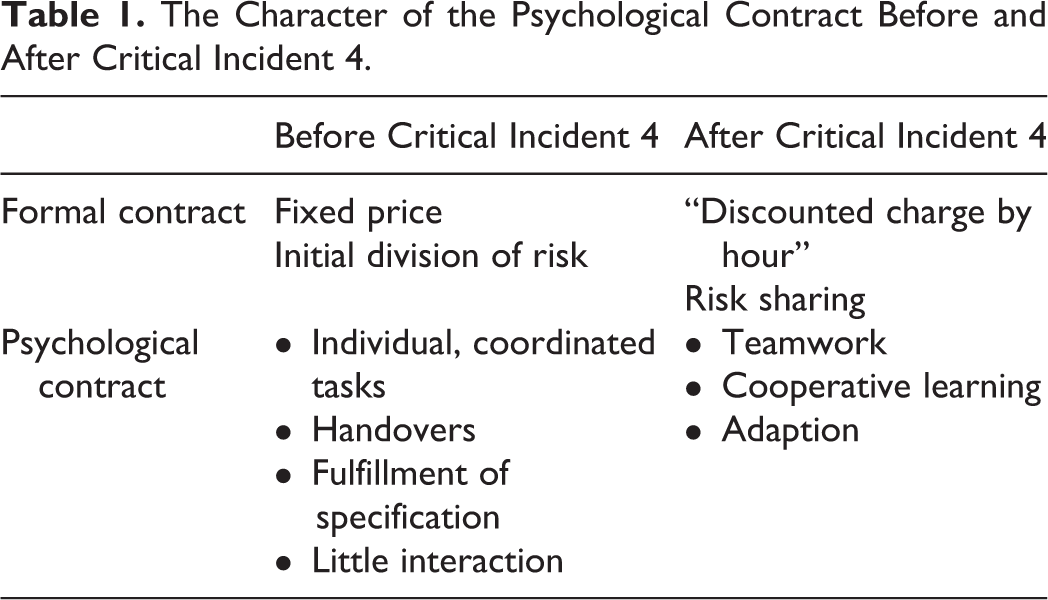
This was a critical incident, which followed other incidents, thereby fostering escalating distrust. The renegotiation (Critical Incident #4) described here is just the consequence of the previous critical incidents. The renegotiation, therefore, became a natural step for the lead company to restructure the project. In a similar vein, the renegotiation incident also became an opportunity for the research company to renegotiate the contract, something they had wanted to do for a long time. Previous reasons for rescheduling the time plan of the project had existed (e.g., when the test software was not ready); however, nothing had been formally done until this halt.
Outcome
Even though from a technical perspective the project had delivered an innovative leap relative to the previous generation of technology, immediately following the project both partners felt that the project had been a failure because time and cost frames had been overrun. The project had also generated much frustration within both organizations, with each side blaming the other, which also contributed to the project being labeled a failure. The product was delivered a year later than initially planned. From a technical point of view, the new solution seemed to be a success: an innovative design had been developed. From a managerial point of view, and in terms of scheduling and cost, the collaboration appeared to be a failure. However, later follow-up interviews with participants in the project revealed that from a business perspective the project had been successful. The lead company had launched a very successful product, which represented a new generation of their product. From the research company’s perspective, the project network, which in the short term seemed to be a failure, later developed into a project engagement template, which the research company later replicated in new partnerships. Based on the learnings gained, they developed a model for engagement, which could be applied to subsequent project networks. In its essence, this model included a consulting part (an overall responsibility for product development and subsequent updates) and an outsourcing part (the responsibility for production), combined with financing and insurance. The financing solution provided was an installment model. Part of the consulting work was paid by an increased price for each produced item; in addition, the client owns all intellectual property rights (IPR) and thereby had the ability to change subcontractors.
Discussion and Conclusion
In contrast to classical project management research, which aims to understand the solitary organizational unit of a project, new units of analysis such as program, portfolio, project-based organizations, and project networks have emerged in the project management research (Gemünden, 2016). This interest in other units of analysis manifests in an ambition to capture the inherent complexity faced by today’s project leaders. Managing a single well-demarcated project is simply not enough. Although not a new concept, but currently driven by globalization and new means for virtual communication, scholars have recently shown a renewed interest in project networks (Bakker et al., 2016; DeFillippi & Sydow, 2016; Manning, 2010; Oliveira & Lumineau, 2017; Ruuska, Ahola, Karlos, Locatelli, & Mancini, 2011). Accordingly, a current challenge for project network scholars is to explain “how history matters”; in other words, how past experiences of collaboration between actors in a project network is transformed into an informal organizational format that is replicable in future collaboration—something referred to as the “temporal paradox” (DeFillippi & Sydow, 2016). However, a question that has yet to be addressed in project network research is as follows: How are project networks formed in the first place?
Based on an investigation of the formation of a collaboration between two parties, which later was developed into a project engagement template, this article has investigated two questions: (1) Could the (informal) organizational format of a project network be conceptualized as a psychological contract? (2) Given question 1, could a psychological contract perspective shed light on how project networks are created in the first place?
The first contribution from this study, which addresses this question, is that a psychological contract perspective could be used to describe project networks. In parallel to the formal organization (i.e., the contract), the psychological contract theory highlights the informal structure in terms of expectations. In this current case, the focus rested on mismatches in expectations shown in a series of critical incidents. These critical incidents could be interpreted as repeated violations of the psychological contract between the parties, something that was needed in order to trigger a situation in which the formal contract was changed. Expectation related to different aspects of the other partner’s competence dominated the incidents. Accordingly, a preliminary finding is that the psychological contract in a project network is, to a large extent, formed by expectations related to an understanding of the other party’s competence. A process of mutual adjustment of expectations could be interpreted as a process where relationships are formed; therefore, by introducing psychological contracts as a new unit of analysis, future studies could examine in more detail how critical incidents shape the (reshaped) project network.
Findings from the study also suggest that project networks are formed both by the formation of a formal agreement (i.e., a contract) that specifies roles and responsibilities and by the formation of a psychological contract that specifies expectations. In the present case study, a major breach of the psychological contract was made. It could be argued that this breach manifested in a transition from a transactional-based to a relational-based psychological contract. This indicates that the character of the interaction process (characterized as a transactional or relational psychological contract) between the partners is related to the successful outcome of the cooperation. The hypothesis from this study is that a relational character of the process is linked to success.
A number of managerial implications could be drawn from this study. One managerial implication is that an articulate psychological contract, in parallel to the legal contract, could be a useful management tool for governing the alliance. By defining the content of such a contract early on, a new mediating object can be introduced to support team discussion within, as well as between, the parties. Accordingly, the crafting, as well as the maintenance, of this psychological contract will be a key issue for managers in a project network. A second managerial implication is linked to the governance structure of project network nodes. Since the contractual issue is often the responsibility of upper management, there is a need for an articulated shared leadership model where the division of responsibilities between the managerial and the engineering levels (i.e., the business and the technical level) is clear. Business issues (related to cost, priorities, and initial conditions) need to be managed on a (top) managerial level, whereas issues related to engineering and technical development could be the responsibilities of the technical project leaders.
This study does, however, have several limitations. First, it is a single case study, from which it is difficult to generalize. However, as the goal has been to illustrate the application of a theoretical approach, it can be argued that the findings are valid to knowledge-intensive, contractually based project networks, such as R&D project networks. Second, another weakness is that the case presented does not include repetitive replications of the project network. However, it shed light upon the transformation of one strong tie in a project network; accordingly, further research is needed. One potentially fruitful approach for future research would be additional case studies, including the analysis of critical incidents as indicators of project deviations/psychological contract breaches This should be done in the whole project network, not only on a dyadic relationship. Another fruitful approach would be to describe the perception of psychological contracts as those done by Herriot et al. (1997) and Koh et al. (2004), where the interesting topic would be to map on the one hand the formal contracts, including the division of work (i.e., roles and responsibilities), and on the other hand the content (or perception of) the psychological contract between the actors (i.e., the routines and relationships).
A further interesting question for future research is if project networks can be formed on formal contracts only (i.e., transactional contracts only) or if a relational component is needed. The content of the psychological contract has not specifically been the focus of this study; however, future studies should also employ the same methodology as Koh et al. (2004) and investigate the content of the psychological contract as applied in different types of project networks. Yet another interesting topic with both theoretical and practical implications is to investigate how critical incidents are managed and the pace at which they are resolved; how this “coping process” influences the character of the relationship between the parties would be another area. This last topic could be framed as a leadership challenge, an issue touched upon by past research (Sydow, Lerch, Huxham, & Hibbert, 2011; Thorkildsson, Kaulio, & Ekman, 2015). Increased knowledge on these crucial issues would be beneficial for both streams of project network governance research as well as practicing managers.
Footnotes
Acknowledgments
The author would like to thank John Steen, two anonymous reviewers, and Dr. Maxim Miterev at KTH for their helpful comments on different versions of this article. The research was partly funded by the Swedish Agency for Innovation Systems (VINNOVA).
Declaration of Conflicting Interests
The author(s) declared no potential conflicts of interest with respect to the research, authorship, and/or publication of this article.
Funding
The author(s) received no financial support for the research, authorship, and/or publication of this article.