




Abstract
The vast amount of previous research on project management competence does not provide a basis for educational needs. Analyzing previous research poses two challenges: the lack of a uniform list of competences, necessitating a taxonomy, and the use of importance as a criterion, favoring general important competences. Criticality is introduced as the competence a project manager adds to the team. Validation research using criticality and the taxonomy among experienced Dutch project managers is more comprehensive and provides a lesser focus on general important competences than previous research. Criticality focuses more on the essence of the profession.
Keywords
The field of higher education is feeling the widespread need to prepare students for project management (Crawford, Morris, Thomas, & Winter, 2006; Ojiako, Ashleigh, Chipulu, & Maguire, 2011; World Health Organization, 2009); however, there is no easy solution to satisfying this need because project management education is not without its critics—in the ways it is being taught and the choices being made in what should be taught (Berggren & Söderlund, 2008; Córdoba & Piki, 2012; Durrani & Baroudi, 2015; El-Sabaa, 2001; Wearne, 2008). From several directions, including education (Kessels, 1993) and project management (Thiry, 2004), it has been stressed that the identification of educational needs is crucial for developing professional education. A method to finding these educational needs is through identifying the relevant and critical competences to be addressed in education. Some academics undertake research in order to find the competences needed (Bentley et al., 2013; Ortiz-Marcos, Cobo Benita, Mataix Aldeanueva, & Uruburu Colsa, 2013). This route ignores the vast amount of data on competences already present in the literature. Can previous research be used to provide higher education with a basis for educational needs?
Higher education offers varying levels of project management education, ranging from bachelor’s degree curricula, which merely mention the profession, to doctoral studies aimed solely at project management. This article targets basic project management education: the student getting acquainted with project management. Here, there is no distinction between bachelor’s and master’s degrees, since research into the offerings of project management courses have revealed no real differences between intended learning levels, on average spending less than 10% of their curricula on project management education (Nijhuis, 2017a). The underlying assumption of this article, therefore, is that a uniform set of competences for higher education exists as project management certification systems seem to suggest, with uniform criteria for industries and countries. This assumption is reviewed in the Discussion section.
Analyzing previous research poses several challenges. The first challenge is the diversity of the previous studies, most of which are restricted to a country, region, or specific industry. Can these be aligned to form a uniform competence set? The project management certification systems seem to suggest the existence of such a globally uniform set. The Discussion section reflects on the alignment of diverse studies.
Second, previous research is not built around a uniform list of competences to research, which necessitates a taxonomy to compare or align them (Nijhuis, 2015). This necessity is illustrated in the incorporated overview of competence research. This article presents such a taxonomy.
Third, importance is used as a criterion to classify and sort competences in previous research, which favors general important competences such as information technology and communication skills. Criticality is defined in this article as the competences needed by a project manager compared with those of the team. For example, “knowledge and expertise in specific project area” (Krahn, 2005). A project manager who has more knowledge and expertise in the specific project area than expert team members is usually considered to be unproductive, as commented on in several focus groups in the validation research reported further on in this article. Another example is “basic computer skills” (McHenry, 2008), a clear example of a general important competence for almost all professions requiring a degree in higher education. This does not define the essence of the profession of project management. The essence of the profession is what a person needs to be appointed the job of project manager and which competences this person needs to add on top of existing competences in a project team.
The fourth and last challenge is the definition of competence. Crawford states that competence is made up of several components, such as knowledge, skills, personality, and performance, and builds a framework to incorporate all (Crawford, 2005). This framework allows the incorporation of input, personal, and output competences. As explained by Medina and Medina (2015), input competences refer to a person’s knowledge and skills, whereas personal competencies are core personality characteristics a person needs to perform a job. Output competencies are related to performance and the individual’s ability to perform activities in relation to expected performance. They go on to conclude that “competence is based on knowledge, skills and personal characteristics but are also related to a person’s demonstrable performance” (p. 285). An integral view on competence is promoted in education, giving attention to both the (demonstrable) tasks and the various underlying attributes (knowledge, skills, and personal characteristics; Hager, 2017). This article practices this integral view on competence, incorporating all factors and addressing all as competences.
Demonstrable competences can take on various forms, varying from process competences such as managing the planning stage of a project to a more confined ability to prepare and chair meetings. Process competences imply knowledge and skills in several areas and therefore exhibit large overlaps. The ability to manage projects, the ability to perform risk management, and the ability to manage the planning stage of a project are all examples of process competences. The integral view on these process competences implies several common skills, including writing, oral communication, and negotiating; several common knowledge areas, including planning software, the industry, and the technical aspects of the project; and common personal attributes, such as openness, conscientiousness, and decisiveness.
This article describes the steps taken to address whether previous research can serve as a basis for educational needs. First, the search for publications on project management competences is described, resulting in the identification of 30 publications. The need for a classification tool (a taxonomy) is identified by describing several competences used in previous research. After defining criteria for such a classification tool, a useful taxonomy from management research is identified. The ordering of competences, using the found taxonomy, leads to the addition of several competences, which are defined and argued. The result of a validation study using criticality among experienced project managers is used to compare with the findings of the 30 studies. The confrontation is discussed, leading to conclusions and recommendations.
Project Management Competence Research
Several academics have recognized the need to do research on project management competence; this has been addressed at conferences, in journals, and in dissertations. The lens of this article is that of higher education, identifying competences that need to be addressed in preparing young professionals for a career in project management. Project management is a complex subject to teach (Ellis, Thorpe, & Wood, 2003), especially since the space for incorporating project management competences in higher education is limited (Ellis et al., 2003; Project Management Institute, 2015b, pp. 1–20). The search is therefore limited to studies that reveal an order in importance of project management competences, enabling the creation of a prioritized list of competences.
Project management changes over time. Whereas the iron triangle (time, budget, and quality) used to be the single guideline for project success, the views of project success are changing (Jugdev & Müller, 2005) and now include less tangible items such as stakeholder appreciation, fit for use, and contributing to the higher (program) goals. New methods for projects, including Scrum, have emerged. The search is therefore limited to relatively new studies, those published after 2000.
The studies included should have a complete or integral view on project management, not limited to a subset of competences such as communication, the use of planning software, or the ability to work in a virtual team.
The search is limited to studies built on experience with project management: The respondents, interviewees, and/or participants have experience either in the practice of project management or in recruiting, hiring, promoting, or managing project managers.
To summarize, the criteria for including these studies are Qualitative or quantitative studies Providing an order in importance of competences Building on experience in project management (or in recruiting project managers) Integral or complete view of project management Published in 2000 or later
A total of nine different searches were performed using EBSCO-host in July 2016 (see Table 1) where publications without an abstract were disqualified.
Search Characteristics and Results in EBSCO-Host.
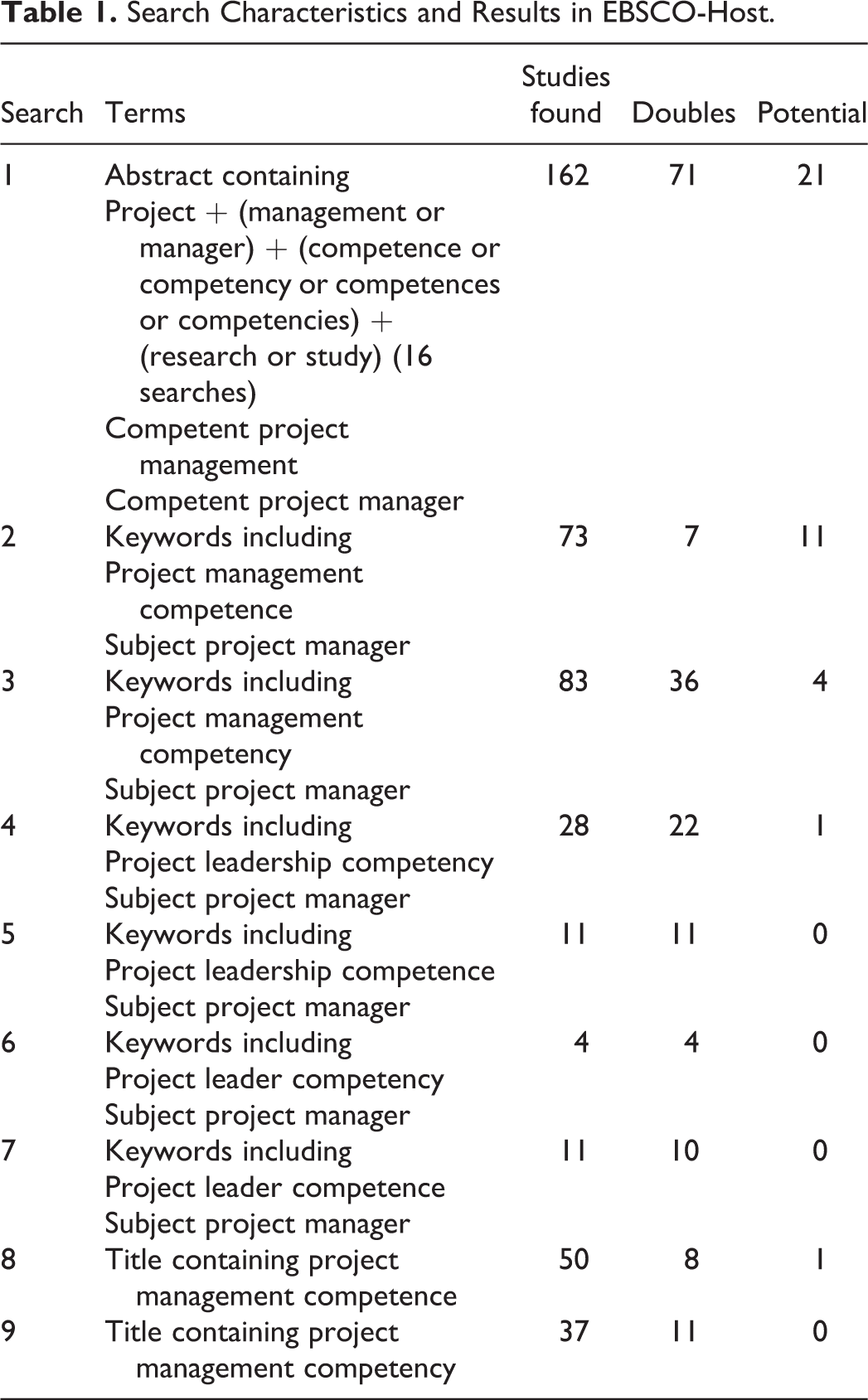
The abstracts of 38 publications (of 459) show potential. The vast majority are studies that do not meet the criteria (concluded on the abstract; 215) or doubles (180). A small number do not supply an abstract (25). The first four searches yielded 37 potential publications; the last five searches yielded only 1.
The 38 publications that show potential are examined, revealing only 22 that fully satisfy the criteria. The list of references of these studies is examined as are the studies that referred to these studies; this revealed that of those 22 studies, 16 can be used directly. Three are discounted because they are based on the same study as 1 of these 16. Three others are replaced by a publication based on the same study that provides a better fit for incorporation.
Further examination of the references reveals an extra nine publications, mainly PhD and master studies, which meet the criteria. Two additional studies were found through a LinkedIn discussion on important competences, for a total of 30 publications.
The full list of included studies and some of their characteristics are provided in Appendix A. Please note that an important publication on project management curricula has not been incorporated: the Project Management Curriculum and Resources, published by the Project Management Institute (Task Force on PM Curricula, 2015). A vast number of academics put together an elaborate framework for designing curricula with an overview of a large number of competences: 72 (pp. 16–17). Although an impressive work on project management curricula, this publication does not order these competences in importance and therefore does not meet the criteria for inclusion.
Four of the incorporated studies analyze their inputs afterward—gathering results in open style interviews and most provide a framework for their respondents, typically a survey. A small minority uses a previously published list; the others build their own lists using the existing literature, experts, interviews, and/or focus groups.
Of the incorporated studies, only three list the important competences, some supply their own cutoff criteria for importance, and some supply several ordered lists without cutoff criteria. In those cases the most discriminating ordered list is used and a criterion for distinction between important and “nice to have” competences is set. For example, when a 5-point Likert scale was deployed, the criterion was set at 4.00. Appendix A supplies the criteria used to mark a competence as important. A total of 289 out of 721 competences are classified as important. Only one study actually produces competences to avoid: traits that inhibit successful project management (Giammalvo, 2012). Several studies produce results that are hardly discriminating, since almost all researched competences score 3.5 or higher on a 5-point Likert scale.
The number of competences researched and important per study varies greatly, as illustrated in Figure 1. Five of the 30 studies incorporate more than 40 competences, together accounting for 317, or 44%, of the total number of competences. The 105 important competences in these “big five” account for 36% of the total number of important competences. In this article, both the combined results and the results of the subset of 25 smaller studies are analyzed.
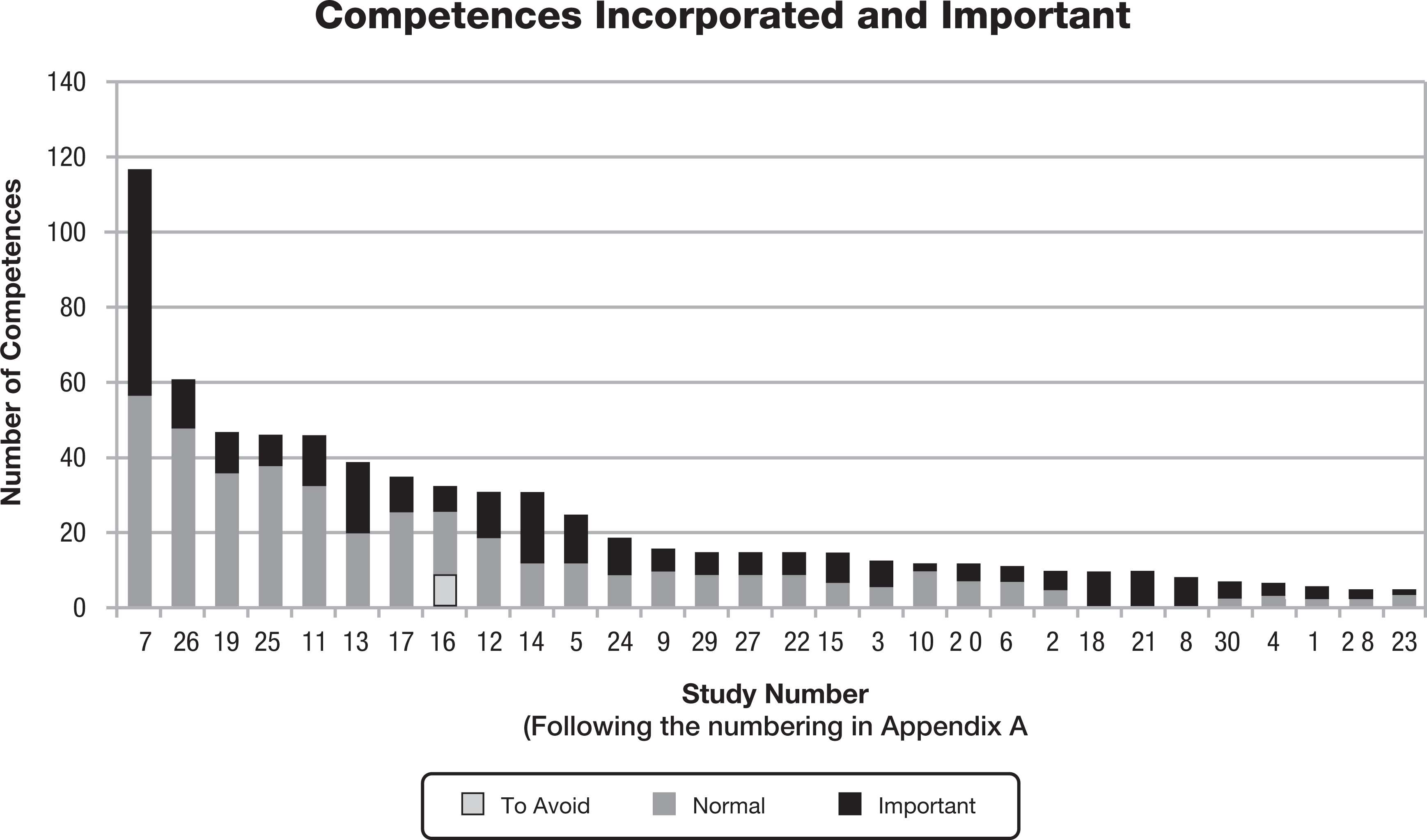
Sorted studies on number of competences and their share of important competences.
Interpretation of the results can be problematic. The publications that supplied (parts) of the used survey showed that no descriptions were given to respondents, leaving ample room for interpretation of terms by respondents. This is addressed by one of the studies that coded results afterward: “Our idea was to avoid learning that they need leadership without being able to classify what leadership specifically means in their situation and so on for general competences” (Brière, Proulx, Flores, & Laporte, 2014).
Leadership is a term that is mentioned often: Eleven incorporate the term “leadership” with several others using terms such as “project leadership,” “leader,” or “leadership skills” in their survey, which tends to be found important. The interpretation of the term varies. Turner and Müller (2006) split leadership into 15 different competences, including critical thinking, communication, and emotional resilience, terms used in other studies alongside leadership. Based on their research, Brière et al. (2014) construct leadership as a combination of “engage, strategic vision, and understanding one’s environment,” also found in several combinations with leadership in other studies.
A multitude of terms related to communication are used, including communication, communication skill, communication style, open communication, ability to communicate, engaging communication, and “deliver good and bad news effectively”; written communication, oral communication, report, writing reports, presentations skills, and so forth, are also included. These terms are on different levels of specification and are spread over the three categories of competences: input (knowledge and skills), personal characteristics, and output (demonstrable performance). It can be observed that most studies mix various types of competences in their research supplying clues, such as “…knowledge,” “…skills,” and “ability to….”
The combined list of competences amounts to 721 competences, with 572 different terms. Only 21 terms are used by three or more studies. Of the 105 competences used in more than one study, 58 are solely attributed to four studies that pairwise used the same external base for their research (Dias, Tereso, Braga, & Fernandes, 2014; Geoghegan & Dulewicz, 2008; Silvius, 2008; Turner & Müller, 2006). There is no such thing as a uniform list of project competences used, which has been noted earlier on the basis of a smaller list of studies (Nijhuis, 2012).
Using the same term does not imply that the same definition is intended, as illustrated by the term leadership above. Another example is openness: Two occurrences are based on the definition “The ability to make others feel they are welcome to express themselves” (Dias et al., 2014; Silvius, 2008), and the other is (roughly) defined as “Open to new experiences” (Thal & Bedingfield, 2010). The personal characteristic “Be open” (Brill, Bishop, & Walker, 2006) could refer to either one of them or to something else.
To analyze this vast amount of data with at least 572 more or less distinctive terms, a guided data reduction through an orderly classification system is needed. Since no uniform set has been used in previous research, an external classification system—a taxonomy—is needed as has been noted in previous work (Nijhuis, Vrijhoef, & Kessels, 2015).
A Taxonomy for Project Management Competences
Simply adding congruent terms is not an option, as illustrated by openness and leadership in the previous section.
Merriam-Webster’s Collegiate Dictionary describes a taxonomy as “the process of describing the way in which different living things are related by putting them in groups” and gives the example of “orderly classification of plants and animals according to their presumed natural relationships.”
For the purpose of this article, a taxonomy of project management competences is defined as “an orderly classification of competences into hierarchal arrangement of groups.” The use of such a taxonomy could aid in comparing and aggregating previous research. The criteria for such a taxonomy are meaningfulness and lack of ambiguity. Meaningfulness implies meaningful categories such as communication, people orientation, and planning phase. Lack of ambiguity implies that the taxonomy supports a straightforward process of classification or, formulated otherwise, categories in the taxonomy should have no or minimal overlap. Process categories do not satisfy this lack of ambiguity, as noted in the introduction.
The categories some authors in the sample of 30 studies use do not satisfy both these criteria, nor do competence standards, including ICB3 (IPMA, 2006), the Project Management Professional (PMP)® certification as illustrated in the PMP® examination content outline (PMI, 2010), ICB4 (IPMA, 2015), or the PMI Talent Triangle® (PMI, 2015, 2016). Although these competence frameworks all supply some form of ordering, they all use a mix of processes and skills focus, which does not support the desired lack of ambiguity.
An early attempt at describing a taxonomy to classify project management competences was undertaken by Anderson (1992), although not called as such. Anderson’s taxonomy was based on the previous work of Kerzner (1984) and had four key attributes: human relation skills, leadership skills, technical experience, and administrative experience. These four key attributes were dissected into 20 characteristics. This work supplies meaningful categories, but the dissection has a clear overlap: The characteristics “communication” and “conflict resolution” both appear in two attributes, therefore not satisfying the criterion of lack of ambiguity.
A recognized work on taxonomies for management competences is the “Hyperdimensional” taxonomy of managerial competence (Tett, Guterman, Bleier, & Murphy, 2000), which has been cited numerous times since publication (52 times according to the publisher and 205 times according to Google Scholar, retrieved January 2014). Their taxonomy satisfies the criteria of meaningful categories—with the exception of the last category, which can be used for competences that do not fit in the first 10 categories—and allows for classification with some lack of ambiguity. Tett et al.’s work shows that expert judges were able to classify with considerable agreement and accuracy. Another argument for their taxonomy is the noted similarities between project management and management (e.g., Anderson, 1992; Strang, 2007). The research has been followed up with a new study (Simonet & Tett, 2013), resulting in a taxonomy of 11 domains with a total of 64 competences, with a description of each competence. Appendix B lists the domains and underlying competences of this taxonomy. Appendix C lists a sample of descriptions of the first domain “Traditional functions,” which have been altered to make them suitable for project management.
Matching the Taxonomy With Project Management Competence Research
The taxonomy is used to order the 721 competences found by the studies reviewed earlier. To distinguish the competences from both sources, R-competences is used for those derived from the reviewed studies and T-competences is used for those in the taxonomy.
The 721 R-competences are ordered following the taxonomy. Relatively easy are the R-competences with a matching T-competence. For example, the R-competences “listen effectively,” “listening,” and “listening skills” are all matched with the T-competence listening skills. The R-competences concerning project planning are matched with “short-term planning,” reserving the “strategic planning” for broader terms such as “big picture view” and “high-level perspective.” In all, 432 (60%) of the R-competences could be matched directly.
Several R-competences are container competences: too generic to be matched with a single T-competence. Examples of these are “ability to communicate,” spanning the whole domain of communication and “report,” which can be matched with written communication (written report) and oral communication (oral reporting). Some are so generic that they cannot be matched with a single domain, including “information and communication” and “critical analysis and problem-solving.” A total of 128 competences are generic with a direct link to one domain and 37 are generic and not linked to a domain.
The 12 R-competences concerning experience (8) and education (4) are not matched.
All R-competences were matched by an expert in project management (over 20 years of experience) with experience in project management research (over 5 years). Although this is comparable with respondents answering surveys and categorizing advertisements, an extra check has been done by having a student perform the matching process. The Discussion section goes into the effects of this.
This process generates 112 R-competences that are not generic but could not be matched to a T-competence. Additions to the taxonomy are needed to enable a match. Some gaps were expected because the taxonomy is not yet tailored to project management. The 112 R-competences are clustered into 11 groups to define the needed additions. Table 2 lists these additions, their number of associated R-competences, and their descriptions.
Project Management Additions in the Taxonomy (N = Number of Literature Mentions) With Descriptions.
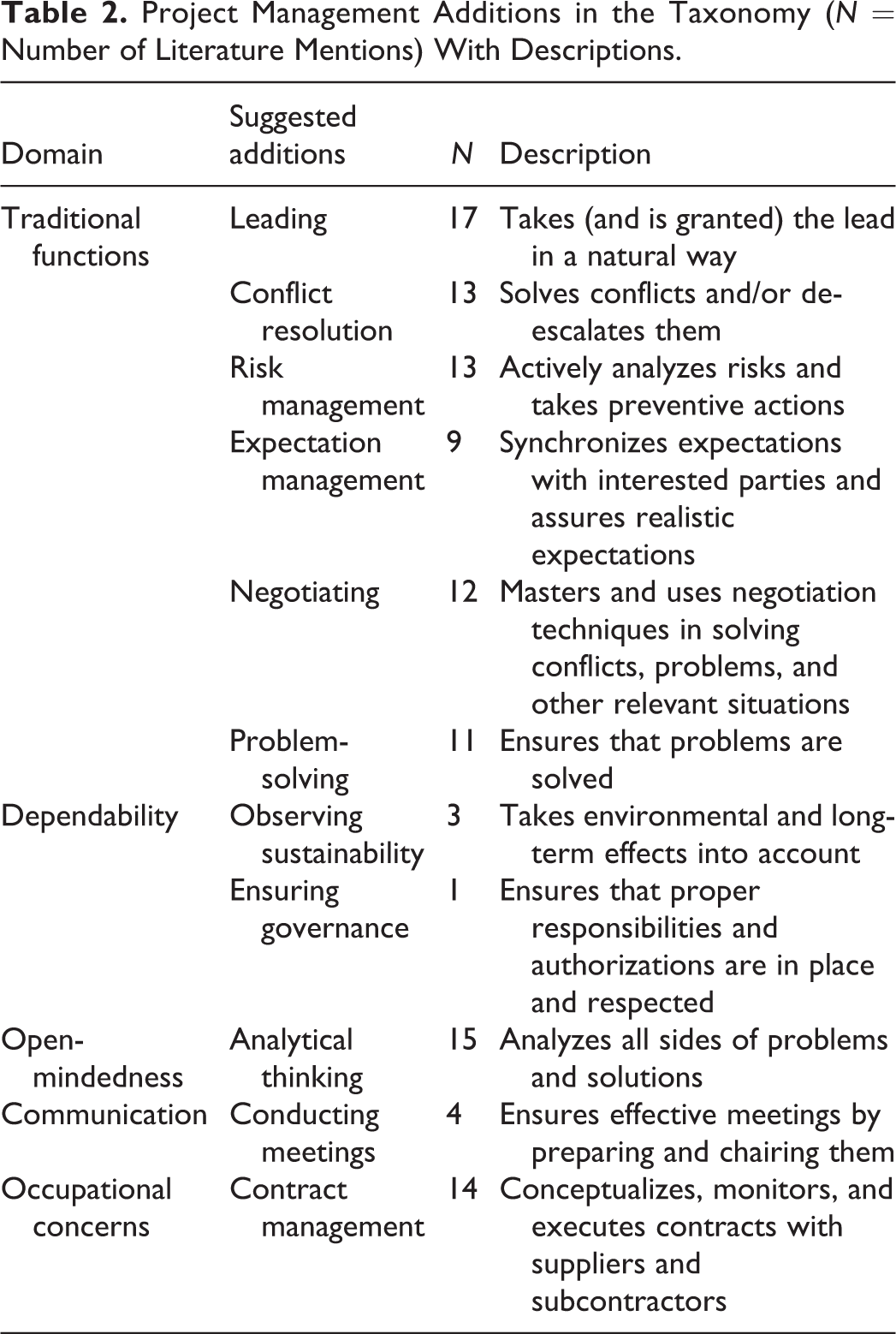
Several of these additions can be easily argued, based on the studies used and the differences between management and project management. The very nature of (most) projects makes conflict resolution, negotiating, and expectation management more of a necessity. Risk management is inexorably linked to project management.
Problem-solving is an addition, although problem awareness is already incorporated in the taxonomy with the description “Perceives situations that may require action to promote organizational success.” Rather than changing the nature of the original taxonomy, problem-solving is added, described as “Ensures that problems are solved.”
Other additions are analytical thinking, conducting meetings, and contract management. Competences specifically mentioned in studies, lacking a counterpart in the taxonomy. An earlier observation noted that recent literature does not use established trends such as governance and sustainability (Nijhuis et al., 2015); this more extensive list of studies did find some (but not many).
The most interesting and debatable addition is “leading,” since it can be argued that leading is an overall competence. Oren (2011) states that leadership is a core competency in the success of a project and that without it the project manager will fail to leverage the team. Several references in the literature suggest that leadership is not only being appointed the leader and taking the lead but also being granted the leadership position (DeRue & Ashford, 2010; Gadeken, 2002; Roill, 2004). Project managers typically work with team members outside their direct authority. Being granted the leading role and/or position could be of great importance, although it cannot be certain that this is really meant by the studies found. This taxonomy describes leading as “Takes (and is granted) the lead in a natural way,” adding “in a natural way” to emphasize the contrast with management (by position).
With these additions, the proposed taxonomy for project management competences has 75 competences in 11 domains. A vast majority (93% or 672) of the R-competences can be ordered using the constructed taxonomy. The 7% R-competences that could not be ordered mostly span more than one domain (37). The other two unclassified categories are past experience (8) and education (4).
Results
In the remainder of the article, all previous research is used with equal weight, regardless of the number of respondents. The Discussion section sheds light on the effects of using respondent count as a weighting factor.
The competences from the reviewed literature show a bias compared with those of a taxonomy (Figure 2). The emphasis in the studies is relatively more on researching traditional functions and job knowledge and relatively less on developing oneself and others, information management, dependability, person orientation, and task orientation. Focusing on the subset of the 25 smaller publications, removing 300 of the 672 competences classified, the spread of incorporated competences over the domains of the taxonomy does not change considerably (the highest change of 3% in share for traditional functions; the remaining changes are 2% or less). This observation remains, even when restricting the view to important or important in the subset as illustrated in Figure 2; the skewness remains.
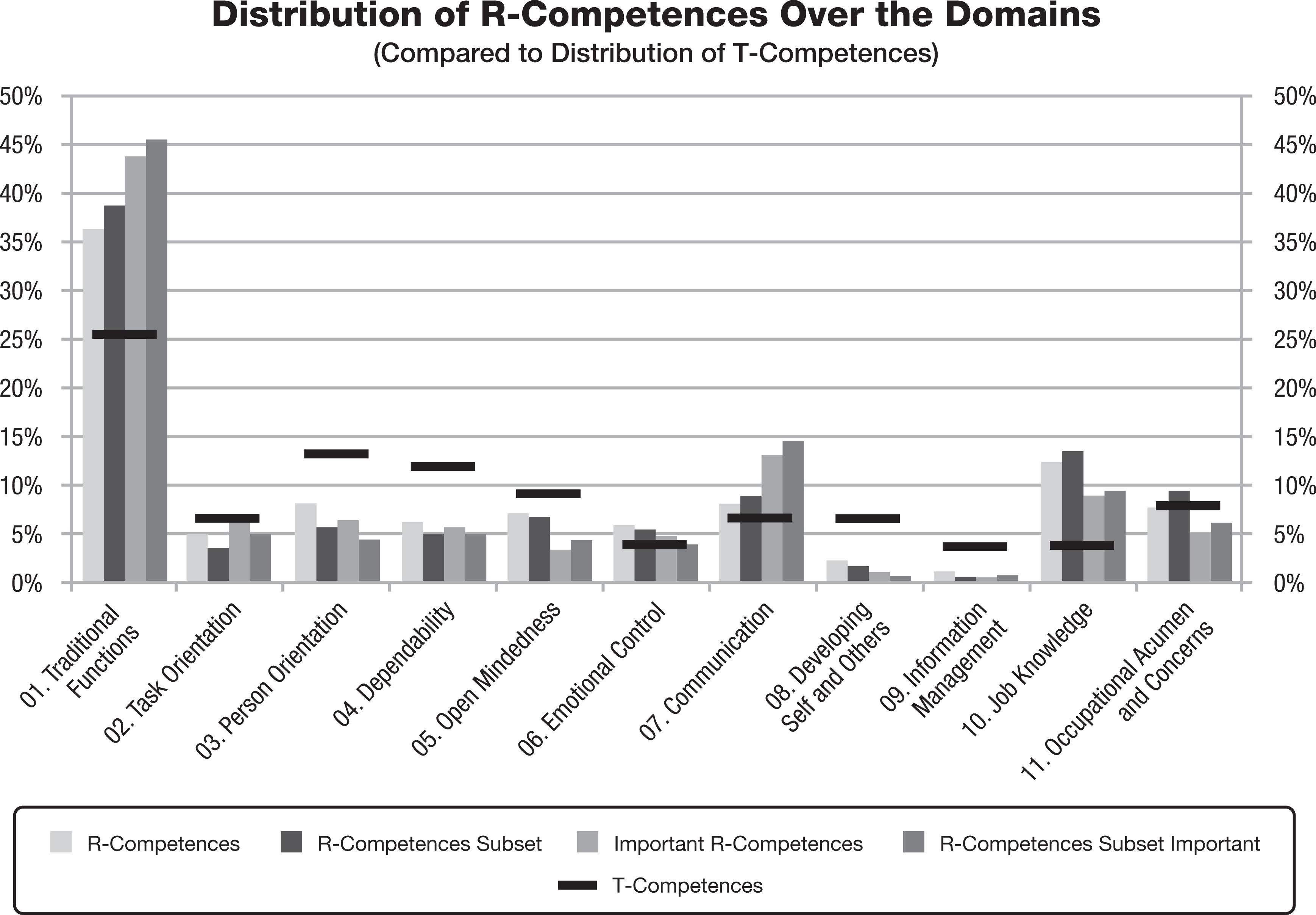
Distribution of T-competences, R-competences, and important R-competences over the taxonomy.
The causes of the skewness are found in the steps to building a survey. As noted earlier, the vast majority of the found studies build their own list of competences to research, quite often referring to an elaborate process of validating this list, but rarely referring to an outside source of competences.
A detailed view of competences and scoring can be found in Appendix D. In total, 47 of the 75 competences in the taxonomy received one or more important “votes” from the incorporated studies. Scoring 100% are approachability, coordination, information sharing, and ensuring governance, but these are all mentioned only in one study. The competence leading occurs in 17 of the 30 studies and scores an 82% importance rate (scoring important in 14 out of these 17 studies), and team building with 22 occurrences scores 55%.
Thirteen T-competences have no direct match in any of the studies (1 in 6). Concentrating on the subset of 25 smaller studies, the list of T-competences that do not have a direct link grows from 13 to 23, only 2 of them initially scoring more than 50% important (problem awareness and seeking input). The relative score of the T-competences in the subset of studies is also listed in Appendix D. “Robust important” is introduced in this article for competences that are included in at least four studies and found important in a majority of them (scoring 50% or higher). The 16 robust important competences are highlighted in Appendix D.
About one half of the robust important competences are normal competences for any degree in higher education, such as listening skills, oral communication, conducting meetings, problem-solving, written communication, trustworthiness, initiative, and customer focus (see Appendix D). This overlap with higher education competences has been identified before (Project Management Institute, 2015b).
On average, “container” competences have a higher chance of being labeled important than the more specific directly linked R-competences. To rephrase: When respondents are asked to evaluate a competence that is of a somewhat general nature such as communication, they are more inclined to note this as being more important than when evaluating more specific competences such as listening, oral communication, and written communication.
Validation Study
Methodology
Focus groups (Plummer-D’Amato, 2008a, 2008b) are used to explore the concept of criticality in project management from the perspective of the experienced project manager. Participants share thoughts and interact on the subject. Focus groups not only generate ideas but also assist in anchoring people’s thoughts (Kahneman, 2011), in this case those about criticality. After a short introduction about the research, the group session starts by discussing the question: “Do you experience differences in qualities between project managers (yourself) and project members?” The interaction continues on to the next question: “Are these differences in line with the expectations set on project managers?” The interaction resulting from these questions typically lasts more than an hour. After a short discussion on critical processes, all participants mark the T-competences they think they are better at than other team members are. This is done individually to ensure an equal contribution of all individual participants (Kahneman, 2011).
This process is repeated 10 times with different focus groups, totaling 69 Dutch participants, 61 male and 8 female. The individual answers serve as validation data.
The groups vary in size and nature, from open invitation groups to company groups. Two groups consist of students and alumni of a master’s degree study aimed at professionals in project management. All groups consist only of experienced project managers, averaging 12 years in the field of project management, 18 years working on projects, and an average age of 45 years. Their experience in the project context varies; as illustrated in Figure 3, several of the participants have experience in more than one context, with an average of 1.8 contexts per participant. The question specifically asked about the nature of projects, not in which industry they had been managed: An information technology (IT) project in a construction company counts as an IT context. The distribution of these contexts varies greatly per group, as expected given the different natures of the groups.
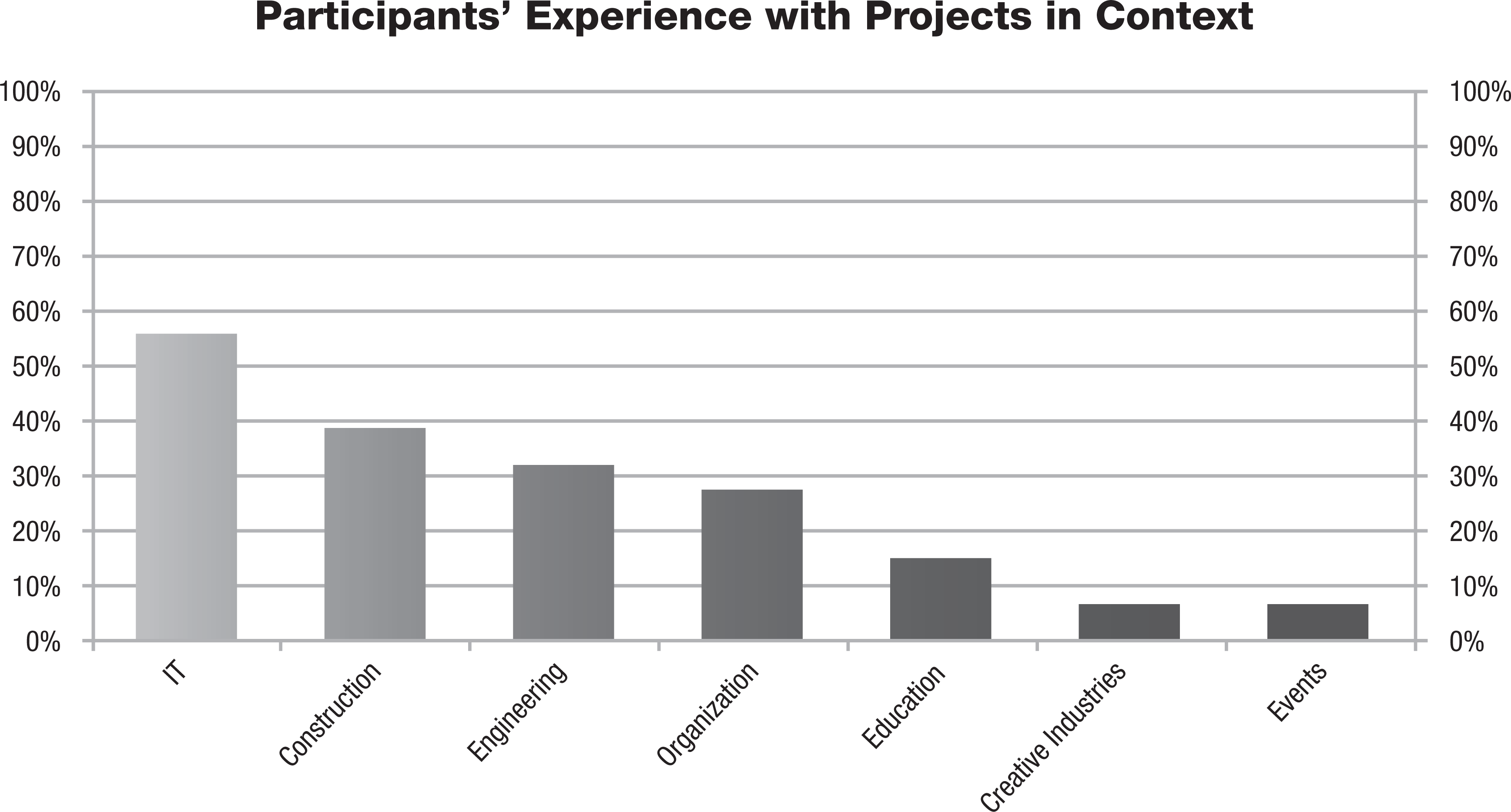
Participants’ context experience.
Results
The distribution of markings over the domains shows similarity with the spread of T-competences over the domains as illustrated in Figure 4. The greatest difference in share is 3%: occupational acumen and concerns. The remainder of the differences is 2% or less. This similarity can be seen with almost all of the groups individually.
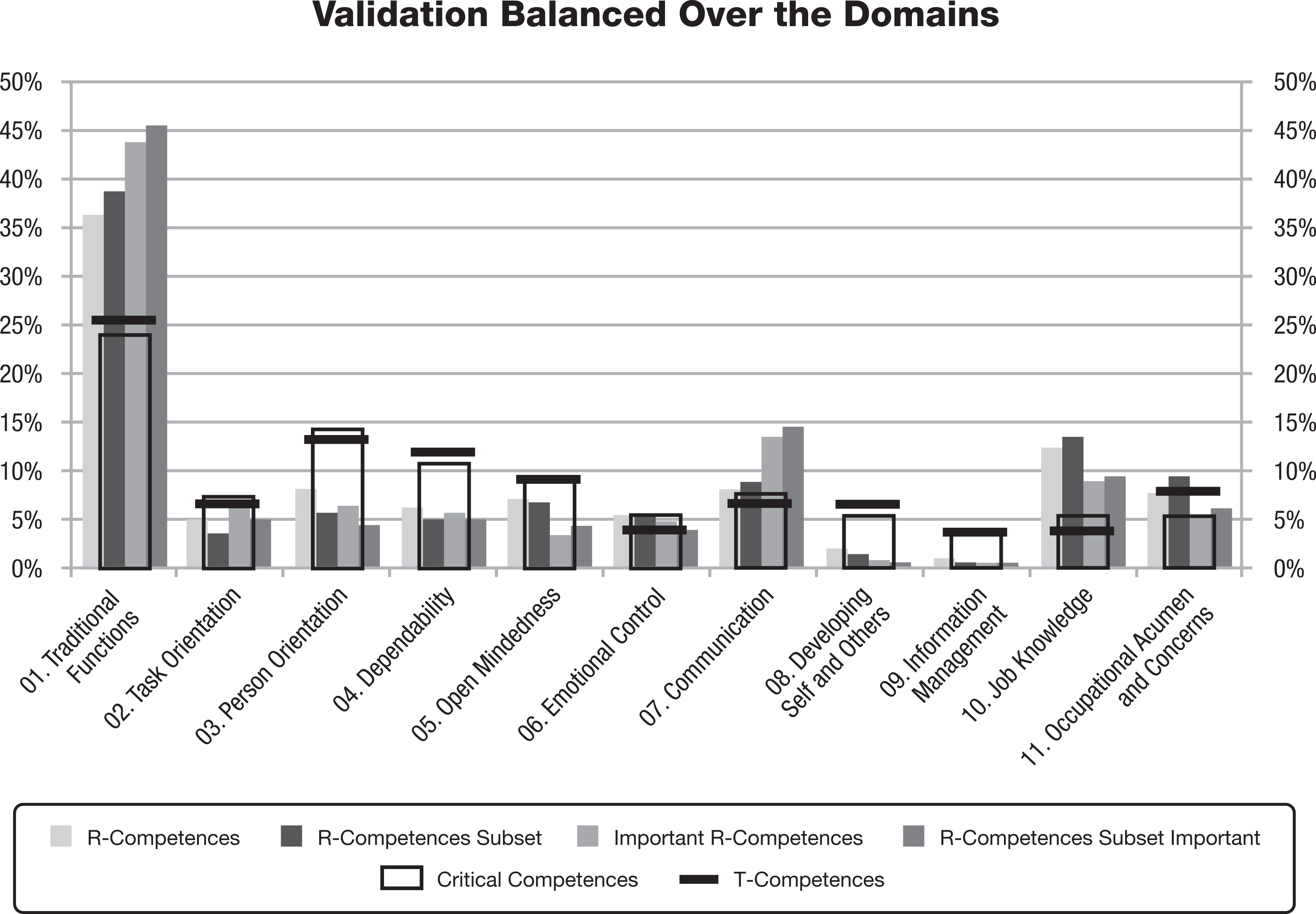
Distribution of markings over the domain.
Some competences show a high score of being marked as critical and others receive few markings, as illustrated in Figure 5, with details shown in Appendix D. There do not appear to be real winners in this research: No competences get marked as being critical by more than 80% of the participants (comparable with a cutoff of 4 on a 5-point Likert scale used in some of the studies). This pattern of high scoring versus low scoring without real winners can be seen in all groups individually.
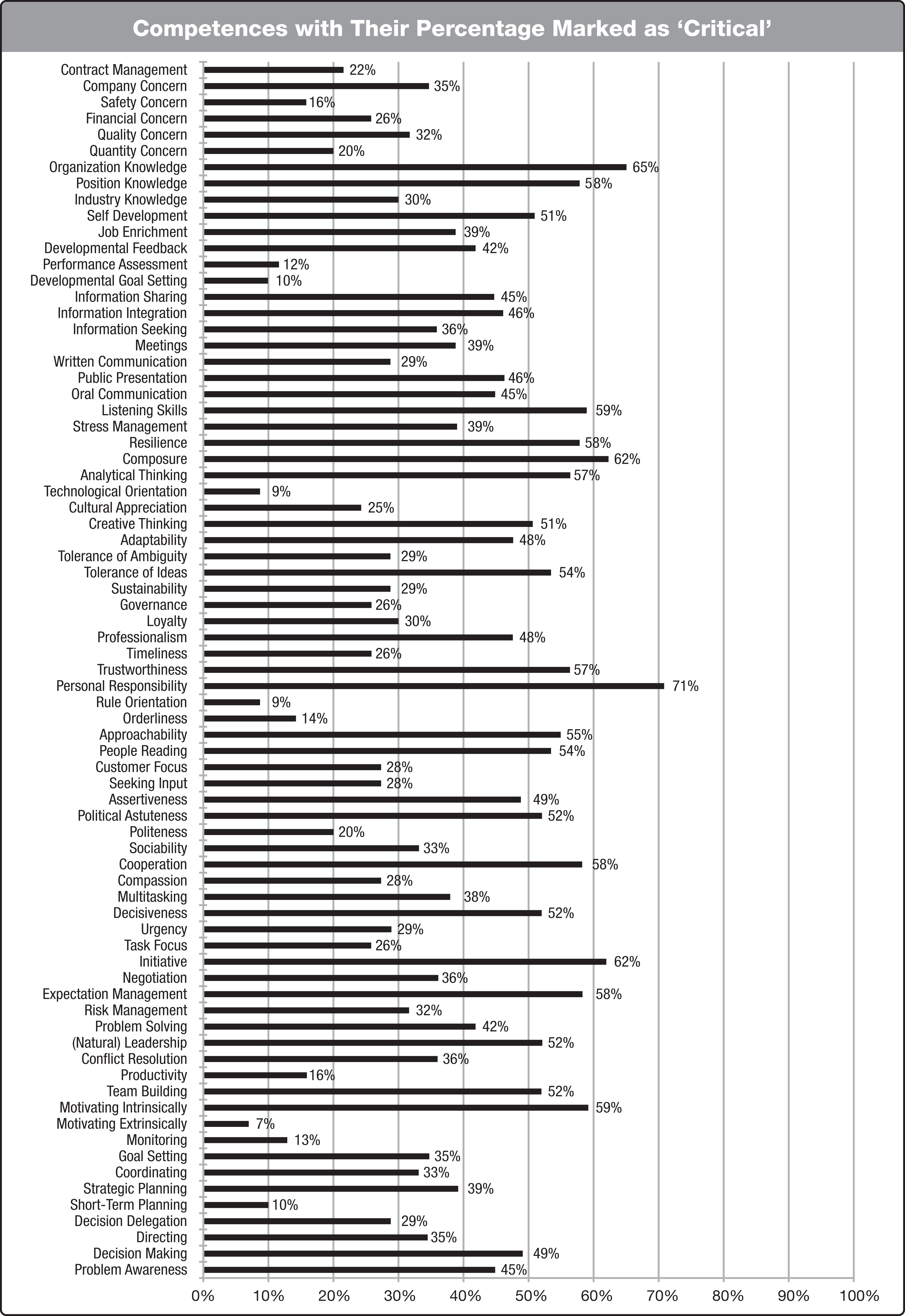
Percentage marked as critical per competence.
The highest scoring competence—personal responsibility—receives a marking from 71% of the participants. Twenty-one competences that get more than 50% markings are labeled as critical competences, which compares with the definition of robust important competences. A little less than one third of the competences are critical.
Discussion
The question this article poses is whether previous research can provide higher education with a basis for educational needs. Several steps have been taken. A recognized taxonomy from management research has been used to order almost all of the competences derived from the previous research. The ordering allows the culmination of previous research into a table (see Appendix D) with high and low scoring competences. Twenty-two competences score more than 50% important. Robust important is introduced as competences incorporated in at least four of the thirty studies and scoring more than 50% important (16 competences). But do either of these two serve as a basis for educational needs?
A validation research has been performed by experienced Dutch project managers, using criticality as a criterion. The use of criticality, comparing the project managers’ competences with those of the team, leads to different results than the culmination of previous research. Critical competences are defined as being marked by at least 50% of respondents to be critical. Several general competences do not appear on the list of critical competences such as oral communication, conducting meetings, problem solving, written communication, and initiative. Of the top ten critical competences only three are important when combining the 30 previous studies. Only seven of the sixteen robust important competences are supported by the validation study and nine are not supported. Of the 21 competences found critical by the validation study, fourteen are not in the list of robust important competences, two of them—people reading and tolerance of ideas—were not even used by any of the 30 studies reviewed (see Appendix D).
Before the central question can be answered, two underlying assumptions need to be addressed: Can the diverse previous research be aligned? And can a Dutch-based study be used as a validation study?
Of the 30 studies found, only five have a universal context, seven report on a limited number of contexts, and the majority reports on or targets a single context. Likewise, most of these studies report on findings in a single country, and only a few report on findings considering more than one country or even globally. As these studies also show, it is hard to achieve a large number of respondents, with a median of 79.5. This illustrates that performing yet another research study would exhibit a risk of not representing the profession, with all the nuances of contexts and regions if they do exist. It is logical to try to benefit from an alignment of these studies since they represent over 4,700 respondents and job descriptions.
The taxonomy allows for several cross-sectional comparisons of the incorporated studies. Several contexts can be discerned, with the smallest context being information technology (IT) with three studies and a total of 73 R-competences. The other contexts are construction (seven studies), universal (five studies), diverse contexts (six studies), and others (nine studies). An argument for context independence is found at the competence level: If a competence is incorporated into at least one study in one context, it has an 83% chance of being incorporated into another context and a 63% chance of being incorporated into at least three out of five contexts. This effect is without counting the effect of frequently used overall and multiple competences, which overlap with several of the competences.
As noted, a large part of the studies incorporated use a list of competences as a basis for their research. All of them take elaborate steps to come to their specific list of competences to research—sometimes by referring to an outside source. The studies that code the competences afterward take elaborate steps in coding. Incorporated competences are therefore a good indication of what is important to research in the context. In different contexts, the incorporated studies show similarities of incorporated competences. This effect remains when restricted to important competences: IT has 20 important T-competences important, of which 1 is unique; construction has four unique important out of 36; diverse contexts shows 1 unique out of 23; universal 1 out of 24; and other contexts, 4 out of 43.
Comparing the studies performed in specified regions such as Europe (seven studies), North America (eight studies), Asia and Africa (five studies), and studies with an unspecified region (five studies) shows the same effect: a competence incorporated in any of the regions has a 75% chance of being incorporated into at least one other region and a 54% of being incorporated into three or all four. The two Dutch-based studies incorporated—with a total of 39 T-competences—are hardly unique. Only four competences are incorporated that are not incorporated into any of the regions (compensating for the Netherlands being part of Europe). The studies show many similarities in incorporated competences between the regions. Again, the effect remains when looking at important competences, especially when discounting ‘overall’ competences: Africa has no unique important T-competences (out of 13), Asia has one (out of 16) and Australia and New Zealand have one (out of 11). North America has no unique important T-competences (out of 26), Europe has two (out of 42), and the unspecified regions have five (out of 38). Studies that cover diverse regions show no unique important T-competences out of 14.
With these results, the alignment of previous research can be argued to be logical. To a large extent, similar competences are researched and important competences are hardly unique for context or region. In large part, this conclusion supports the comparison of Dutch-based research with the culmination of previous research.
The regions that were subject in the used literature are diverse, but do show a bias toward ‘Anglo-Saxon’ countries, including the United States, Canada, Australia, and New Zealand. A comparison between a Dutch and an Anglo-Saxon perspective can be found in Cultures Consequences (Hofstede, 2001). The Netherlands and the Anglo-Saxon countries are roughly comparable in four of the five index values and only really differ on the fifth index: masculinity. The other regions incorporated into the studies show more differences on the index values and do not deliver a different focus in researched or important competences.
In summary, the 30 studies on project management competences in different contexts and regions are already reasonably aligned and therefore should be comparable with the Dutch-based validation study.
This, however, does not prove that a uniform set of competences for teaching project management in higher education exists. Previous research apparently overlaps in researched competences, hence showing communality in results. The T-competence industry knowledge—which is often incorporated—is a potential indicator for industry dependence. It is not a high-ranked competence, but scores reasonably in both previous research and the validation presented here. Whether project management has a uniform set of competences is still up for debate and settling this debate is not necessary before answering the central question of this article.
Two notable differences between the previous research and the validation study need to be examined: competences incorporated in both show a different scoring and several competences incorporated in the taxonomy (and therefore in the validation study) are not incorporated in any of the 30 studies found. The remaining possible explanations for these differences are interpretation, respondent group, and criticality.
The validation study in this article is an additional project management competence study. Unlike most of the incorporated studies, it uses a validated basis (from management) with validated additions from project management competence research, using only experienced project managers as respondents, anchoring respondents on criticality, and supplying descriptions of the competences to the respondents.
The noted interpretation of terms allows for errors in the ordering process reported in this article. The same errors can and will be made by respondents that are supplied with a list of competences to tick as the majority of the studies apparently did. Using a base taxonomy, which leads to high agreement among experts (Tett et al., 2000) reduces interpretation errors. It is therefore argued that the possibility of these interpretation errors are not the major source of the found differences, which are neither futile nor small.
The vastness of the difference is illustrated by the results of the student classification in relation to the expert classification of R-competences. The results in this article are based on the expert classification. Although the agreement between expert and student classification is not high (only 78%), the resulting student classification would not lead to different conclusions. The student classification reveals the same skewed distribution found in previous research as the expert classification. There are hardly any differences in the scoring of importance or robust importance (a mere 10% would change), upholding the large dissimilarity between research and the validation study reported in this article.
Another illustration of the great difference is the effect of a weighting factor. The results presented used an equal weight for each publication. Using the number of respondents (or advertisements) as a weighting factor favors larger studies. This slightly affects the order of importance of the competences. In the lower end of the robust important competences there is a shift, which only produces bigger differences between previous research and the validation study.
The reported studies usually did not supply descriptions and the validation study did. This does eliminate interpretation errors by respondents. Whether these interpretation errors in previous research affected the outcomes is speculative and needs a follow-up study to be answered. Given the similarities between the results of the previous research, a big effect is not likely.
The validation study used experienced project managers (over five years of experience) to ensure reflection on criticality. The studies usually did not restrict respondents to that group, sometimes even mixing project managers with consultants and educators. The respondent group could affect the outcomes. Senior management has a different view of the profession than the professional him or herself (Crawford, 2005), and the extent of this difference is not quantified. Little is known about the possible different views of other groups of respondents. Preliminary research shows little discrimination between senior and junior project managers (Nijhuis, 2017b). It is therefore argued that the difference in respondent group is not the main source of the found differences.
The research method for the validation study differs from the previous research. Focus groups were used to anchor participants on criticality. Focus groups do have limitations, such as discussing what is easily mentioned rather than what is really important (Plummer-D’Amato, 2008a; Plummer-D’Amato, 2008b). To circumvent this, a comprehensive list of all competences has been issued to prevent missing important competences. There is no one-on-one relation between often discussed and high-scoring competences. Another side effect of focus groups is the possible movement from an individual to a group view (Wright & Wells, 1985). This has been avoided by taking two actions: First, the discussion on competences and the actual survey were separated by two other discussions, such as critical processes. Second, the participants were given the explicit instruction to reflect on one’s own competences—not to provide a general profile. This resulted in a great variance in the number of competences marked by an individual in each group and the discussed pattern of high versus low scoring without real winners in each group, whereas the discussion suggested a consensus.
Eliminating interpretation and the respondent group as important explanations for the found differences leaves anchoring on criticality as an important source. The results show that anchoring on criticality eliminates several general important competences. Generally important implies the necessity for incorporation in any type of higher education, not in a project management specialization. The use of criticality allows for focus on the defining aspects of the profession, but does not explain the found gaps and skewness in previous research.
Several studies start with a clean sheet for their competences or at least start from almost scratch, building a fresh list of competences to research. This will inevitably lead to missing some competences that could be important, as illustrated by several T-competences that were not or hardly incorporated into the results. Most notably are the critical competences ‘people reading’ and ‘tolerance of ideas,’ which did not have any counterpart in any of the studies. It should not be possible, combining so many integral studies in this field, that two critical competences are completely missed.
In the validation study several competences are barely marked, yet the results show no skewness as previous research does. The clean sheet method apparently leads to this skewness, researching what is easily mentioned rather than researching what is needed or important, which is a common risk in group sessions (Plummer-D’Amato, 2008a; Plummer-D’Amato, 2008b). The clean sheet method apparently favors traditional functions, job knowledge, and communication over other domains. The clean sheet method also leads to using a multitude of terms meaning roughly the same and using the same terms for different intentions, whereas several T-competences are not incorporated or incorporated only into a very small number of studies, necessitating the introduction of robust importance (incorporated into at least four studies and found important).
This article shows an overlap between management and project management. Some of the few competences added to an existing management-based taxonomy (Simonet & Tett, 2013) could even be relevant to management. Several of the original competences are found important by previous research and/or critical by the validation research. The validation research also provides clues on competences in the taxonomy that do not define the profession of project management for experienced project managers, suggesting clues to the overlap and the differences between project management and management competences.
Conclusions and Recommendations
The research question is: “Can higher education use the analysis of previous research (Appendix D) as a basis for identifying educational needs in project management?” Based on this article, the answer should be no—the previous research focuses too much on general important competences and not on the specific characteristics and needs of the profession (criticality). Even with 30 studies combined, the total volume of researched competences is not sufficiently comprehensive. The validation study, used to confront previous research, is an interesting starting point for a useful competence study for higher education but should be broadened and must also be aimed at junior project managers in order to serve as a useful foundation.
The notion that project management and management are alike is supported by this article. Starting with a clean sheet for project management competence research leads to results that can only be compared with others by using a fitting taxonomy to classify the results in an unambiguous manner. This article presents such a taxonomy. Research into project management competences can be tested on rigorousness by matching the incorporated competences with this taxonomy.
In doing competence research, the competences researched need to be thoroughly defined and the descriptions need to be supplied to the respondents in order to reduce interpretation differences. Asking for importance of “container” competences that cover several competences, such as communication or leadership, distorts the results, showing a higher chance of being labeled important without revealing useful information. Asking for importance distorts the results. Several general competences emerge on top because they are important overall, yet they do not define the essence of the specific occupation. As illustrated in the article, the use of criticality shows promise in removing this distortion.
Further research is needed to properly define the educational needs in project management education in order to build curricula that can face existing critics and to test if critical project management competences are indeed universal or context and/or region dependent. The use of criticality in future competence research is recommended. Further recommendations for competence research would be to supply descriptions of competences to respondents and avoid the use of “container” competences. Further research is needed to determine whether or not a universal set of project management competences for use in higher education exists.
Footnotes
Appendix A
List of Incorporated Competence Studies With Their Characteristics, Sorted Alphabetically by Last Name of First Author
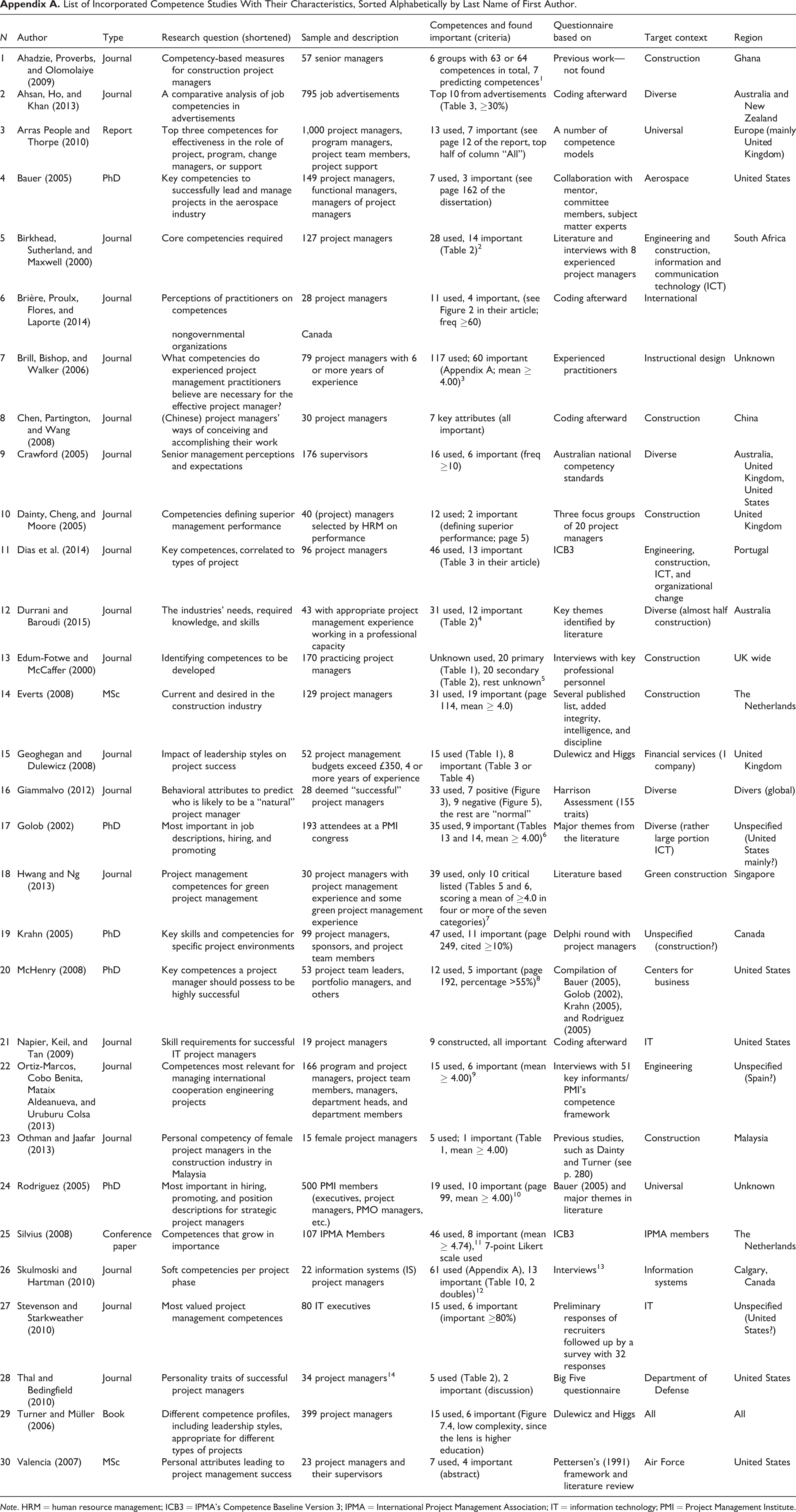
| N | Author | Type | Research question (shortened) | Sample and description | Competences and found important (criteria) | Questionnaire based on | Target context | Region |
|---|---|---|---|---|---|---|---|---|
| 1 | Ahadzie, Proverbs, and Olomolaiye (2009) | Journal | Competency-based measures for construction project managers | 57 senior managers | 6 groups with 63 or 64 competences in total, 7 predicting competences 1 | Previous work—not found | Construction | Ghana |
| 2 | Ahsan, Ho, and Khan (2013) | Journal | A comparative analysis of job competencies in advertisements | 795 job advertisements | Top 10 from advertisements (Table 3, ≥30%) | Coding afterward | Diverse | Australia and New Zealand |
| 3 | Arras People and Thorpe (2010) | Report | Top three competences for effectiveness in the role of project, program, change managers, or support | 1,000 project managers, program managers, project team members, project support | 13 used, 7 important (see page 12 of the report, top half of column “All”) | A number of competence models | Universal | Europe (mainly United Kingdom) |
| 4 | Bauer (2005) | PhD | Key competencies to successfully lead and manage projects in the aerospace industry | 149 project managers, functional managers, managers of project managers | 7 used, 3 important (see page 162 of the dissertation) | Collaboration with mentor, committee members, subject matter experts | Aerospace | United States |
| 5 | Birkhead, Sutherland, and Maxwell (2000) | Journal | Core competencies required | 127 project managers | 28 used, 14 important (Table 2) 2 | Literature and interviews with 8 experienced project managers | Engineering and construction, information and communication technology (ICT) | South Africa |
| 6 | Brière, Proulx, Flores, and Laporte (2014) | Journal | Perceptions of practitioners on competences | 28 project managers | 11 used, 4 important, (see Figure 2 in their article; freq ≥60) | Coding afterward | International nongovernmental organizations | Canada |
| 7 | Brill, Bishop, and Walker (2006) | Journal | What competencies do experienced project management practitioners believe are necessary for the effective project manager? | 79 project managers with 6 or more years of experience | 117 used; 60 important (Appendix A; mean ≥ 4.00) 3 | Experienced practitioners | Instructional design | Unknown |
| 8 | Chen, Partington, and Wang (2008) | Journal | (Chinese) project managers’ ways of conceiving and accomplishing their work | 30 project managers | 7 key attributes (all important) | Coding afterward | Construction | China |
| 9 | Crawford (2005) | Journal | Senior management perceptions and expectations | 176 supervisors | 16 used, 6 important (freq ≥10) | Australian national competency standards | Diverse | Australia, United Kingdom, United States |
| 10 | Dainty, Cheng, and Moore (2005) | Journal | Competencies defining superior management performance | 40 (project) managers selected by HRM on performance | 12 used; 2 important (defining superior performance; page 5) | Three focus groups of 20 project managers | Construction | United Kingdom |
| 11 | Dias et al. (2014) | Journal | Key competences, correlated to types of project | 96 project managers | 46 used, 13 important (Table 3 in their article) | ICB3 | Engineering, construction, ICT, and organizational change | Portugal |
| 12 | Durrani and Baroudi (2015) | Journal | The industries’ needs, required knowledge, and skills | 43 with appropriate project management experience working in a professional capacity | 31 used, 12 important (Table 2) 4 | Key themes identified by literature | Diverse (almost half construction) | Australia |
| 13 | Edum-Fotwe and McCaffer (2000) | Journal | Identifying competences to be developed | 170 practicing project managers | Unknown used, 20 primary (Table 1), 20 secondary (Table 2), rest unknown 5 | Interviews with key professional personnel | Construction | UK wide |
| 14 | Everts (2008) | MSc | Current and desired in the construction industry | 129 project managers | 31 used, 19 important (page 114, mean ≥ 4.0) | Several published list, added integrity, intelligence, and discipline | Construction | The Netherlands |
| 15 | Geoghegan and Dulewicz (2008) | Journal | Impact of leadership styles on project success | 52 project management budgets exceed £350, 4 or more years of experience | 15 used (Table 1), 8 important (Table 3 or Table 4) | Dulewicz and Higgs | Financial services (1 company) | United Kingdom |
| 16 | Giammalvo (2012) | Journal | Behavioral attributes to predict who is likely to be a “natural” project manager | 28 deemed “successful” project managers | 33 used, 7 positive (Figure 3), 9 negative (Figure 5), the rest are “normal” | Harrison Assessment (155 traits) | Diverse | Divers (global) |
| 17 | Golob (2002) | PhD | Most important in job descriptions, hiring, and promoting | 193 attendees at a PMI congress | 35 used, 9 important (Tables 13 and 14, mean ≥ 4.00) 6 | Major themes from the literature | Diverse (rather large portion ICT) | Unspecified (United States mainly?) |
| 18 | Hwang and Ng (2013) | Journal | Project management competences for green project management | 30 project managers with project management experience and some green project management experience | 39 used, only 10 critical listed (Tables 5 and 6, scoring a mean of ≥4.0 in four or more of the seven categories) 7 | Literature based | Green construction | Singapore |
| 19 | Krahn (2005) | PhD | Key skills and competencies for specific project environments | 99 project managers, sponsors, and project team members | 47 used, 11 important (page 249, cited ≥10%) | Delphi round with project managers | Unspecified (construction?) | Canada |
| 20 | McHenry (2008) | PhD | Key competences a project manager should possess to be highly successful | 53 project team leaders, portfolio managers, and others | 12 used, 5 important (page 192, percentage >55%) 8 | Compilation of Bauer (2005), Golob (2002), Krahn (2005), and Rodriguez (2005) | Centers for business | United States |
| 21 | Napier, Keil, and Tan (2009) | Journal | Skill requirements for successful IT project managers | 19 project managers | 9 constructed, all important | Coding afterward | IT | United States |
| 22 | Ortiz-Marcos, Cobo Benita, Mataix Aldeanueva, and Uruburu Colsa (2013) | Journal | Competences most relevant for managing international cooperation engineering projects | 166 program and project managers, project team members, managers, department heads, and department members | 15 used, 6 important (mean ≥ 4.00) 9 | Interviews with 51 key informants/PMI’s competence framework | Engineering | Unspecified (Spain?) |
| 23 | Othman and Jaafar (2013) | Journal | Personal competency of female project managers in the construction industry in Malaysia | 15 female project managers | 5 used; 1 important (Table 1, mean ≥ 4.00) | Previous studies, such as Dainty and Turner (see p. 280) | Construction | Malaysia |
| 24 | Rodriguez (2005) | PhD | Most important in hiring, promoting, and position descriptions for strategic project managers | 500 PMI members (executives, project managers, PMO managers, etc.) | 19 used, 10 important (page 99, mean ≥ 4.00) 10 | Bauer (2005) and major themes in literature | Universal | Unknown |
| 25 | Silvius (2008) | Conference paper | Competences that grow in importance | 107 IPMA Members | 46 used, 8 important (mean ≥ 4.74), 11 7-point Likert scale used | ICB3 | IPMA members | The Netherlands |
| 26 | Skulmoski and Hartman (2010) | Journal | Soft competencies per project phase | 22 information systems (IS) project managers | 61 used (Appendix A), 13 important (Table 10, 2 doubles) 12 | Interviews 13 | Information systems | Calgary, Canada |
| 27 | Stevenson and Starkweather (2010) | Journal | Most valued project management competences | 80 IT executives | 15 used, 6 important (important ≥80%) | Preliminary responses of recruiters followed up by a survey with 32 responses | IT | Unspecified (United States?) |
| 28 | Thal and Bedingfield (2010) | Journal | Personality traits of successful project managers | 34 project managers 14 | 5 used (Table 2), 2 important (discussion) | Big Five questionnaire | Department of Defense | United States |
| 29 | Turner and Müller (2006) | Book | Different competence profiles, including leadership styles, appropriate for different types of projects | 399 project managers | 15 used, 6 important (Figure 7.4, low complexity, since the lens is higher education) | Dulewicz and Higgs | All | All |
| 30 | Valencia (2007) | MSc | Personal attributes leading to project management success | 23 project managers and their supervisors | 7 used, 4 important (abstract) | Pettersen’s (1991) framework and literature review | Air Force | United States |
Note. HRM = human resource management; ICB3 = IPMA’s Competence Baseline Version 3; IPMA = International Project Management Association; IT = information technology; PMI = Project Management Institute.
Appendix B
Domains and Competences of the Taxonomy.
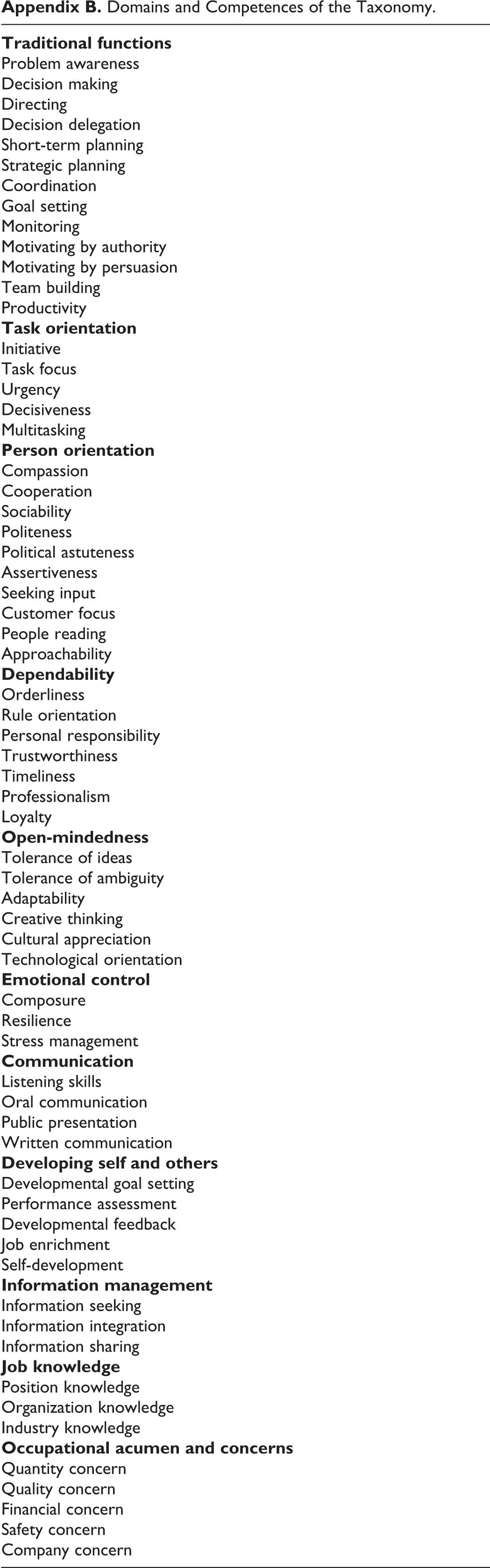
|
|
| Problem awareness |
| Decision making |
| Directing |
| Decision delegation |
| Short-term planning |
| Strategic planning |
| Coordination |
| Goal setting |
| Monitoring |
| Motivating by authority |
| Motivating by persuasion |
| Team building |
| Productivity |
|
|
| Initiative |
| Task focus |
| Urgency |
| Decisiveness |
| Multitasking |
|
|
| Compassion |
| Cooperation |
| Sociability |
| Politeness |
| Political astuteness |
| Assertiveness |
| Seeking input |
| Customer focus |
| People reading |
| Approachability |
|
|
| Orderliness |
| Rule orientation |
| Personal responsibility |
| Trustworthiness |
| Timeliness |
| Professionalism |
| Loyalty |
|
|
| Tolerance of ideas |
| Tolerance of ambiguity |
| Adaptability |
| Creative thinking |
| Cultural appreciation |
| Technological orientation |
|
|
| Composure |
| Resilience |
| Stress management |
|
|
| Listening skills |
| Oral communication |
| Public presentation |
| Written communication |
|
|
| Developmental goal setting |
| Performance assessment |
| Developmental feedback |
| Job enrichment |
| Self-development |
|
|
| Information seeking |
| Information integration |
| Information sharing |
|
|
| Position knowledge |
| Organization knowledge |
| Industry knowledge |
|
|
| Quantity concern |
| Quality concern |
| Financial concern |
| Safety concern |
| Company concern |
Appendix C
Descriptions Used (Traditional Functions Only). Changes to the Taxonomy (Simonet and Tett, 2013) in Italic.
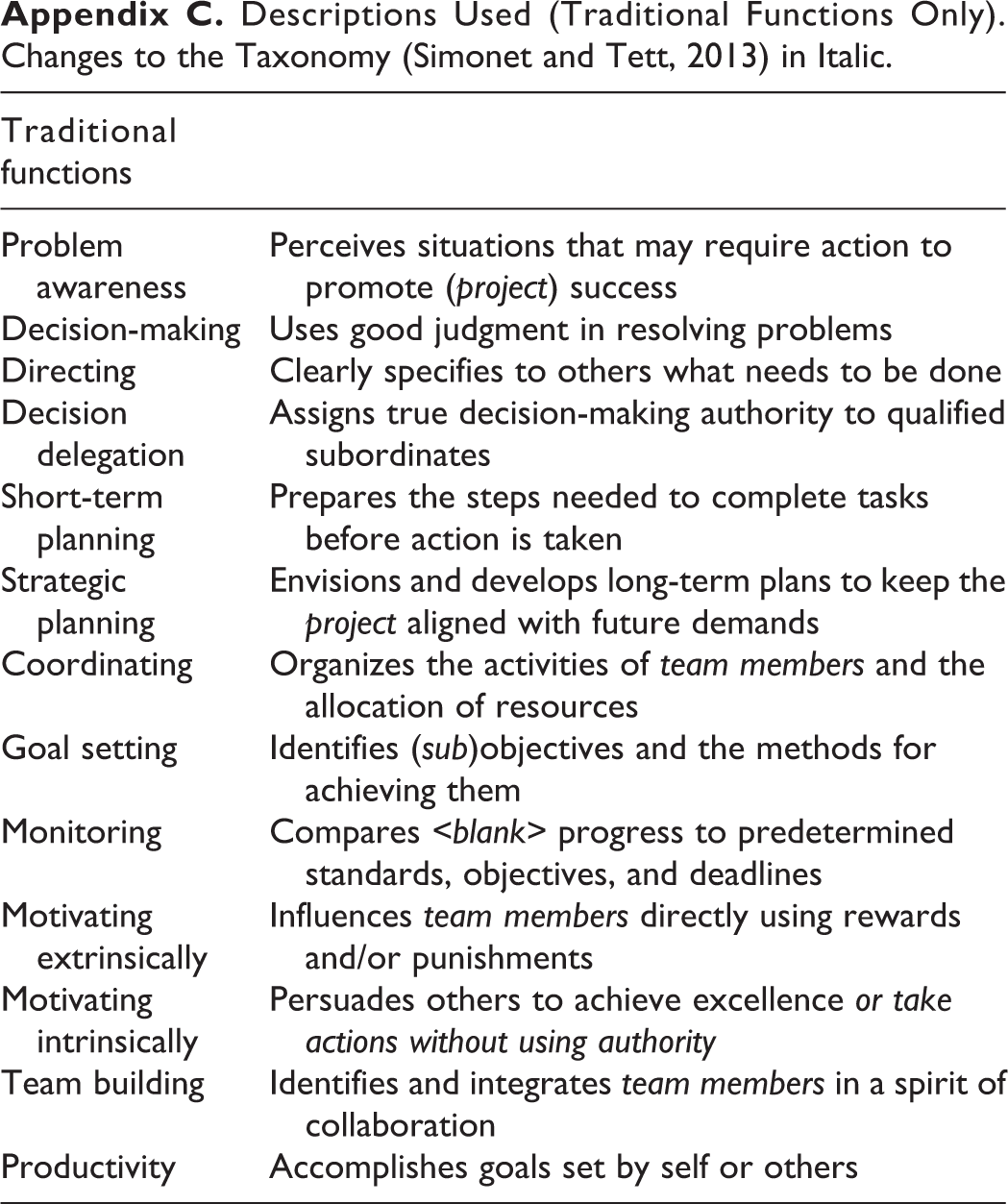
| Traditional functions | |
|---|---|
| Problem awareness | Perceives situations that may require action to promote (project) success |
| Decision-making | Uses good judgment in resolving problems |
| Directing | Clearly specifies to others what needs to be done |
| Decision delegation | Assigns true decision-making authority to qualified subordinates |
| Short-term planning | Prepares the steps needed to complete tasks before action is taken |
| Strategic planning | Envisions and develops long-term plans to keep the project aligned with future demands |
| Coordinating | Organizes the activities of team members and the allocation of resources |
| Goal setting | Identifies (sub)objectives and the methods for achieving them |
| Monitoring | Compares <blank> progress to predetermined standards, objectives, and deadlines |
| Motivating extrinsically | Influences team members directly using rewards and/or punishments |
| Motivating intrinsically | Persuades others to achieve excellence or take actions without using authority |
| Team building | Identifies and integrates team members in a spirit of collaboration |
| Productivity | Accomplishes goals set by self or others |
Appendix D
Results of the Combination of Studies, the Subset, and the Validation Study. Robust Important and Critical Are Highlighted.
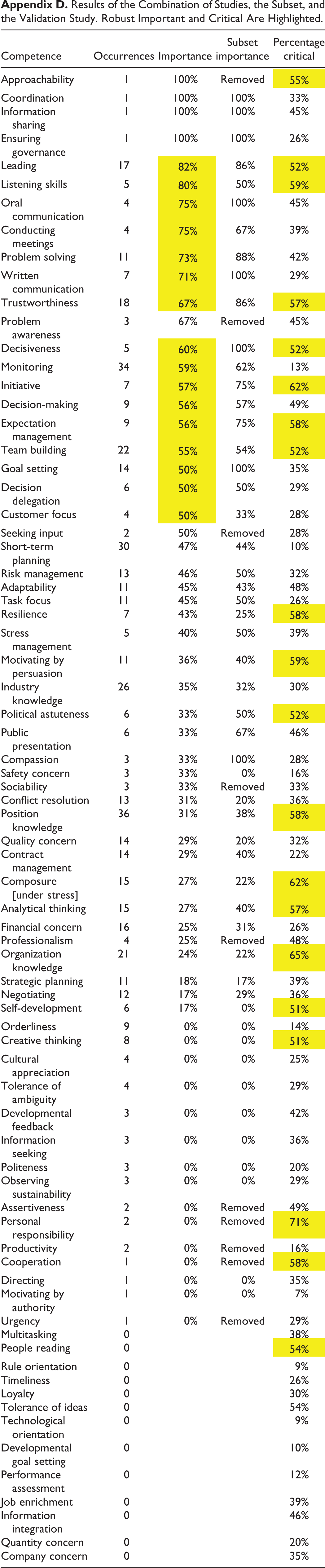
| Competence | Occurrences | Importance | Subset importance | Percentage critical |
|---|---|---|---|---|
| Approachability | 1 | 100% | Removed | 55% |
| Coordination | 1 | 100% | 100% | 33% |
| Information sharing | 1 | 100% | 100% | 45% |
| Ensuring governance | 1 | 100% | 100% | 26% |
| Leading | 17 | 82% | 86% | 52% |
| Listening skills | 5 | 80% | 50% | 59% |
| Oral communication | 4 | 75% | 100% | 45% |
| Conducting meetings | 4 | 75% | 67% | 39% |
| Problem solving | 11 | 73% | 88% | 42% |
| Written communication | 7 | 71% | 100% | 29% |
| Trustworthiness | 18 | 67% | 86% | 57% |
| Problem awareness | 3 | 67% | Removed | 45% |
| Decisiveness | 5 | 60% | 100% | 52% |
| Monitoring | 34 | 59% | 62% | 13% |
| Initiative | 7 | 57% | 75% | 62% |
| Decision-making | 9 | 56% | 57% | 49% |
| Expectation management | 9 | 56% | 75% | 58% |
| Team building | 22 | 55% | 54% | 52% |
| Goal setting | 14 | 50% | 100% | 35% |
| Decision delegation | 6 | 50% | 50% | 29% |
| Customer focus | 4 | 50% | 33% | 28% |
| Seeking input | 2 | 50% | Removed | 28% |
| Short-term planning | 30 | 47% | 44% | 10% |
| Risk management | 13 | 46% | 50% | 32% |
| Adaptability | 11 | 45% | 43% | 48% |
| Task focus | 11 | 45% | 50% | 26% |
| Resilience | 7 | 43% | 25% | 58% |
| Stress management | 5 | 40% | 50% | 39% |
| Motivating by persuasion | 11 | 36% | 40% | 59% |
| Industry knowledge | 26 | 35% | 32% | 30% |
| Political astuteness | 6 | 33% | 50% | 52% |
| Public presentation | 6 | 33% | 67% | 46% |
| Compassion | 3 | 33% | 100% | 28% |
| Safety concern | 3 | 33% | 0% | 16% |
| Sociability | 3 | 33% | Removed | 33% |
| Conflict resolution | 13 | 31% | 20% | 36% |
| Position knowledge | 36 | 31% | 38% | 58% |
| Quality concern | 14 | 29% | 20% | 32% |
| Contract management | 14 | 29% | 40% | 22% |
| Composure [under stress] | 15 | 27% | 22% | 62% |
| Analytical thinking | 15 | 27% | 40% | 57% |
| Financial concern | 16 | 25% | 31% | 26% |
| Professionalism | 4 | 25% | Removed | 48% |
| Organization knowledge | 21 | 24% | 22% | 65% |
| Strategic planning | 11 | 18% | 17% | 39% |
| Negotiating | 12 | 17% | 29% | 36% |
| Self-development | 6 | 17% | 0% | 51% |
| Orderliness | 9 | 0% | 0% | 14% |
| Creative thinking | 8 | 0% | 0% | 51% |
| Cultural appreciation | 4 | 0% | 0% | 25% |
| Tolerance of ambiguity | 4 | 0% | 0% | 29% |
| Developmental feedback | 3 | 0% | 0% | 42% |
| Information seeking | 3 | 0% | 0% | 36% |
| Politeness | 3 | 0% | 0% | 20% |
| Observing sustainability | 3 | 0% | 0% | 29% |
| Assertiveness | 2 | 0% | Removed | 49% |
| Personal responsibility | 2 | 0% | Removed | 71% |
| Productivity | 2 | 0% | Removed | 16% |
| Cooperation | 1 | 0% | Removed | 58% |
| Directing | 1 | 0% | 0% | 35% |
| Motivating by authority | 1 | 0% | 0% | 7% |
| Urgency | 1 | 0% | Removed | 29% |
| Multitasking | 0 | 38% | ||
| People reading | 0 | 54% | ||
| Rule orientation | 0 | 9% | ||
| Timeliness | 0 | 26% | ||
| Loyalty | 0 | 30% | ||
| Tolerance of ideas | 0 | 54% | ||
| Technological orientation | 0 | 9% | ||
| Developmental goal setting | 0 | 10% | ||
| Performance assessment | 0 | 12% | ||
| Job enrichment | 0 | 39% | ||
| Information integration | 0 | 46% | ||
| Quantity concern | 0 | 20% | ||
| Company concern | 0 | 35% |
Notes
Declaration of Conflicting Interests
The author(s) declared no potential conflicts of interest with respect to the research, authorship, and/or publication of this article.
Funding
The author(s) received no financial support for the research, authorship, and/or publication of this article.