




Abstract
Shortages of teachers of students with visual impairments (TVIs) and orientation and mobility (O&M) specialists are well documented in the United States, though specific research has not been conducted in Tennessee. The following report documents the results of two statewide surveys in Tennessee during the 2021–2022 school year that explored the current vacancies, caseload size, and experiences of TVIs and O&M specialists. One survey was sent to TVIs and O&M specialists and the second survey was sent to special education administrators in the state. Results indicate that more than half of TVIs and O&M specialists are planning to leave their position in the next 5 years, while administrators anticipate lower numbers departing than professionals report. Caseload size parallels national averages, which are above the recommended caseload size. Districts in rural areas are more likely to have long-term vacancies. Implications and next steps are discussed.
Keywords
Students with visual impairments (VI) are affected by ongoing teacher shortages due to the low-incidence nature of the disability and the need for highly specialized instruction (Barnett & Huang, 2024; Bell & Silverman, 2019; Savaiano et al., 2022). Access to high-quality, specially designed instruction by well-trained professionals is critical to postsecondary success for students with visual impairments (Cavenaugh & Giesen, 2012; Lund & Cmar, 2020). There are persistent and pervasive shortages of teachers of students with visual impairments (TVIs) and orientation and mobility (O&M) specialists, who provide services to students with VI in schools (Howley & Howley, 2021; Savaiano et al., 2022; USDOE, 2022). The shortage can be attributed, in part, to low availability of personnel preparation programs for special education teachers and low enrollment in these programs (Peyton et al., 2021). Furthermore, teachers are leaving their roles due to profound stress, poor school climates, and inadequate support from administration (García & Weiss, 2020).
Special Education in Tennessee
In Tennessee, 36.1% of schools and 28.8% of students are in rural areas, with a greater percentage of students in rural areas living in poverty compared with most other U.S. states (Showalter et al., 2023). National research has found that schools with high populations of students who qualify for free and reduced lunches are twice as likely to have teacher shortages (U.S. Government Accountability Office [GAO], 2022). Because rural school districts often do not have the resources to find or fund low-incidence professionals, centralized services (e.g., district or regionally based rather than school-based) are critical to meeting these districts’ needs for qualified personnel (See et al., 2020).
There is very limited information available for stakeholders seeking to gain insight into the supply and demand of educators across Tennessee. Teacher shortages in the state are unknown due to the “decentralized system of job postings” (Tennessee Higher Education Commission, 2023, p. 4). The most comprehensive data on the current educator workforce come from an annual statewide survey of teachers, which captured data from more than 13,000 school-based professionals in 2023 (Tennessee Higher Education Commission, 2023). However, this survey excludes most TVIs and O&M specialists, as they are itinerant professionals working across multiple schools, and the survey includes only teachers working in one school building. Shortages for TVIs can be estimated, in part, by the number of TVI licenses issued, but no information is available on how many of those professionals are actively working in the state. The process of counting O&M specialists is even more challenging, as Tennessee does not have a teacher licensure for O&M. As a result, it is unknown exactly how many TVIs and O&M specialists are actively employed in the state (A. Huang, personal communication, December 20, 2023).
Graduating new professionals into the field is one way to address the shortage; however, Tennessee has not had an O&M preparation program since 1995. Of the two teacher preparation programs for TVIs in the state, there have been multiple periods during which only one program has actively accepted students. Furthermore, the programs in Tennessee graduate small cohorts (approximately three to 10 students each), which is aligned with the national average of eight students per cohort (American Association for Employment in Education [AAEE], 2023).
Considerations for Rural Special Education
Nationally, there are identified trends in rural special education, which are relevant to better understanding special education in Tennessee and implications for rural schools, TVIs, and O&M specialists. Historically, and ongoing, there is an emphasis on preparing teachers to work in urban areas and the need of students in urban communities at the expense of preparing teachers to work in rural schools and communities (Rude & Miller, 2018). Many teachers in rural communities are teaching outside of their area of certification, likely due to the substantive shortage of teachers. In a national survey of 203 rural special educators, only 3% reported being certified in visual impairments or hearing impairments, yet 19% were serving students with these disabilities (Berry et al., 2012). This is concerning, given the highly specialized expertise TVIs and O&M specialists hold. Finally, in rural schools, one in 10 students has moved in the last year (Showalter et al., 2023). Having such a mobile or fluctuating population can make program planning (anticipating caseload needs, budget, etc.) very difficult when supporting such a low-incidence population as students with visual impairments.
A Broader Perspective on Shortages
While data are not publicly available in Tennessee, there have been attempts at state and national levels to account for the shortages. The current best estimate is that there are approximately 150 TVIs and O&M specialists in the state working with students (A. Huang, personal communication, December 20, 2023; Savaiano et al., 2022). Previous estimations of funded vacancies for TVIs and O&M specialists at the national level have been identified as flawed (Kirchner & Diament, 1999; Mason & Davidson, 2000; Savaiano et al., 2022). Even if accurate, these estimates are more than 20 years old and in need of updating. To better understand needs and shortages, researchers in Ohio developed a detailed analysis of all sensory disability professionals in their state: TVIs, O&M specialists, teachers of deaf and hard of hearing students, teachers of deafblind students, and interveners (Howley & Howley, 2021). They used a state-held database of licensures and information from educational service agencies in the analysis of professionals. They estimated that the state had 140 TVIs and O&M specialists currently working and posited that that the state needed a total of 359 TVIs and O&M specialists. The difference was a need for 250% more TVIs and O&M specialists in the state than currently employed. Nationally, the issues of establishing numbers for vision specialist employment and shortages in education are ongoing. The Office of Special Education Programs (OSEP, 1997, 2023) presents a report of special education data every year to detail the current state of special education services. Although staffing for O&M specialists is included, there is no state-level information for TVIs (OSEP, 2021).
Nationally, the ongoing shortage of TVIs and O&M specialists is generally recognized, even if not quantified (e.g., Ajuwon & Craig, 2008; Mason & Davidson, 2000; Savaiano et al., 2022). The anticipated future need for TVIs and O&M specialists is unknown. To assess the shortage and its effects on the provision of special education services in Tennessee, two statewide surveys were conducted in 2022: one of TVIs and O&M specialists and one of special education administrators. The current study aims to answer the following research questions:
What are the reported vacancies of TVIs in Tennessee?
What are the reported vacancies of O&M specialists in Tennessee?
What are the implications of vacancies of educational vision professionals in Tennessee?
How do the perceptions of anticipated attrition and hiring differ between vision professionals and administrators in Tennessee? (a) What factors contribute to the anticipated attrition of vision professionals in Tennessee? (b) What factors contribute to perceptions of needing to hire vision professionals in Tennessee?
Method
Two statewide surveys were run simultaneously to capture perspectives of vision professionals (TVIs and O&M specialists) and special education administrators in Tennessee districts in 2022. Both surveys assessed the workloads, experiences, and current and future employment needs for TVIs and O&M specialists. The current report presents the findings of both surveys concurrently to provide insight into the landscape of vision services in the state. The research survey was approved by Vanderbilt University’s Institutional Review Board.
Recruitment
Survey 1 was sent to all TVIs and O&M specialists who were working in Tennessee in 2022. For Survey 1, participants were recruited through direct emails from the research team, the Tennessee AER (Association for the Education and Rehabilitation of the Blind and Visually Impaired) listserv, and announcements shared by the Resource Center for the Visually Impaired, a division of the state school for the blind and the management hub for vision-specific instructional materials in the state.
Survey 2 was designed to be answered by one special education administrator or vision services coordinator per district. Participants for Survey 2 were recruited through direct contact with the lead special education administrator in each of the 147 districts in Tennessee. Both surveys were open from April 19 through May 31, 2022. Recruitment was run in two primary waves, with initial emails sent the week of April 19, and follow-up reminder emails sent the week of May 12. All recruitment was conducted via email.
Survey Instruments
The surveys were developed and tested by the research team prior to conducting the survey. The survey was piloted and proofread by preservice teachers who were graduate students at the PI’s institution. They provided feedback to the research team on clarity of survey questions and any technical issues they encountered in the survey. The survey was created and implemented through REDCap.
In Survey 1, TVIs and O&M specialists were asked questions across five thematic areas: (a) demographic information, (b) workload, (c) vacancies and likelihood to hire, (d) experience and caseload, and (e) future plans. These sections included a combination of yes-no, multiple-choice, and open-ended questions about the participants’ jobs, caseloads, vacancies, and overall perceptions of their role(s). The following optional write-in questions provided participants space to share more about their experiences working as a TVI or O&M specialist in the state of Tennessee: (a) In your own words, can you tell us what it’s like working as a vision professional in TN? (b) Can you tell us about the supports you think are most needed for students with VI in your school district(s)? (c) Is there anything else you’d like to share about working in one or more school districts?
In Survey 2, questions were developed for administrators across three thematic areas: (a) district demographics, (b) employment of TVIs and O&M specialists, and (c) the likelihood of hiring additional professionals. Respondents were asked to report on the number of vacancies within their district as well as how long each vacancy had been posted. They were also asked how the district employed their vision professionals (i.e., district employee or contracted, full- or part-time). Finally, optional open-ended questions provided space for administrators to share more information on services for students with visual impairments and the educators who serve them in their districts. A copy of the surveys is available upon request from the first author.
In both surveys, respondents were asked two questions on the likelihood that their district would hire a TVI or an O&M specialist given adequate funding and qualified candidates. The survey allowed respondents to rate the likelihood on a Likert-type scale with 1 being “definitely would hire” and 5 being “extremely unlikely to hire.”
Data Analysis
Quantitative analysis for all research questions consisted of descriptive statistics (frequency, mean, standard deviation, min/max). Due to relatively small sample sizes, inferential statistics (correlations and chi-square tests) had been planned but were not run on the final dataset. Research questions 1 and 2 were addressed using responses from administrators in Survey 2 who provided quantitative data related to vacancies of TVIs and O&M specialists in their districts. Crosstabulations were also used to identify patterns in these data. In research question 3, descriptive statistics were run from Survey 1 data to understand the connection between vision professionals’ perspectives on vacancies and details of their current roles. To address research questions 4a and 4b, descriptive statistics from both surveys relating to attrition and hiring were calculated and reported.
To explore the implications of vacancies in context, qualitative data from Survey 1 was analyzed and reported for research question 3. Two members of the research team developed a priori codes based on the research questions. Two members of the research team independently coded all qualitative data using the established codes. They came to consensus on the final coding to ensure the themes were representative of the perspectives of the respondents. From the a priori codes, eight major themes were identified to summarize the data: (a) best practice, (b) joy of the profession, (c) burnout, (d) the need for more professionals, (e) caseload sizes, (f) lack of understanding, (g) funding and salary, and (h) urbanicity. Individual responses that addressed multiple themes maintained both thematic codes, such as the duality of joy for the profession and burnout. For research question 4a, one member of the research team conducted a mixed methods analysis by separating responses based on respondents’ self-reported likelihood to leave their position. Then, in vivo coding was used to extract representative quotes from each group for Figure 1. A second member of the research team reviewed selected responses to ensure fidelity to the overall perspective of each group.
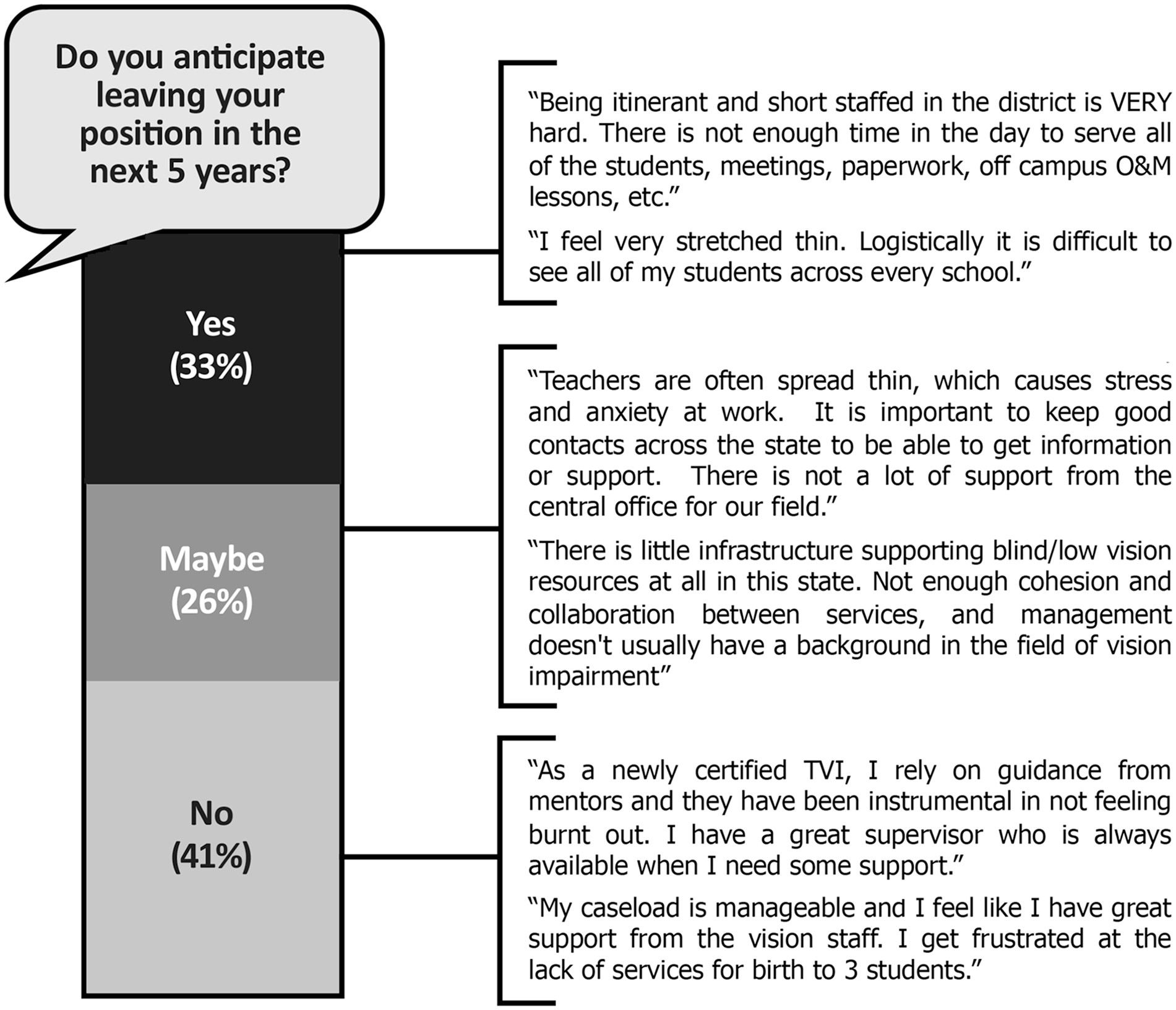
Perceptions of Professionals Based on Likelihood to Leave Position.
Results
Participant Demographics in Survey 1
A total of 83 vision professionals responded to the survey for an estimated 55.3% response rate. Of the 83 participants, 65 (78.3%) were employed as TVIs, six (7.2%) as O&M specialists, and 12 (14.4%) were dually employed as TVIs and O&M specialists. Demographics of respondents can be found in Table 1. TVIs had an average of 13.7 years of experience (range: 1–48, SD = 10.7), and O&M specialists reported an average of 16.7 years of experience (range: 4–30, SD = 10.4). The majority of respondents (63.1%, n = 53) held itinerant positions. Respondents were fairly evenly distributed across Tennessee regions, with the largest representation (38.5%, n = 45) from the Mid Cumberland region—the region which includes Nashville and the Tennessee School for the Blind. One third of professionals (33.3%; n = 24) worked in suburban districts, 27.8% (n = 20) worked in rural districts, and 26.4% (n = 19) worked in urban districts. The remaining professionals worked across mixed urbanicity districts.
Demographics of TVIs and O&M Specialists in Survey 1.
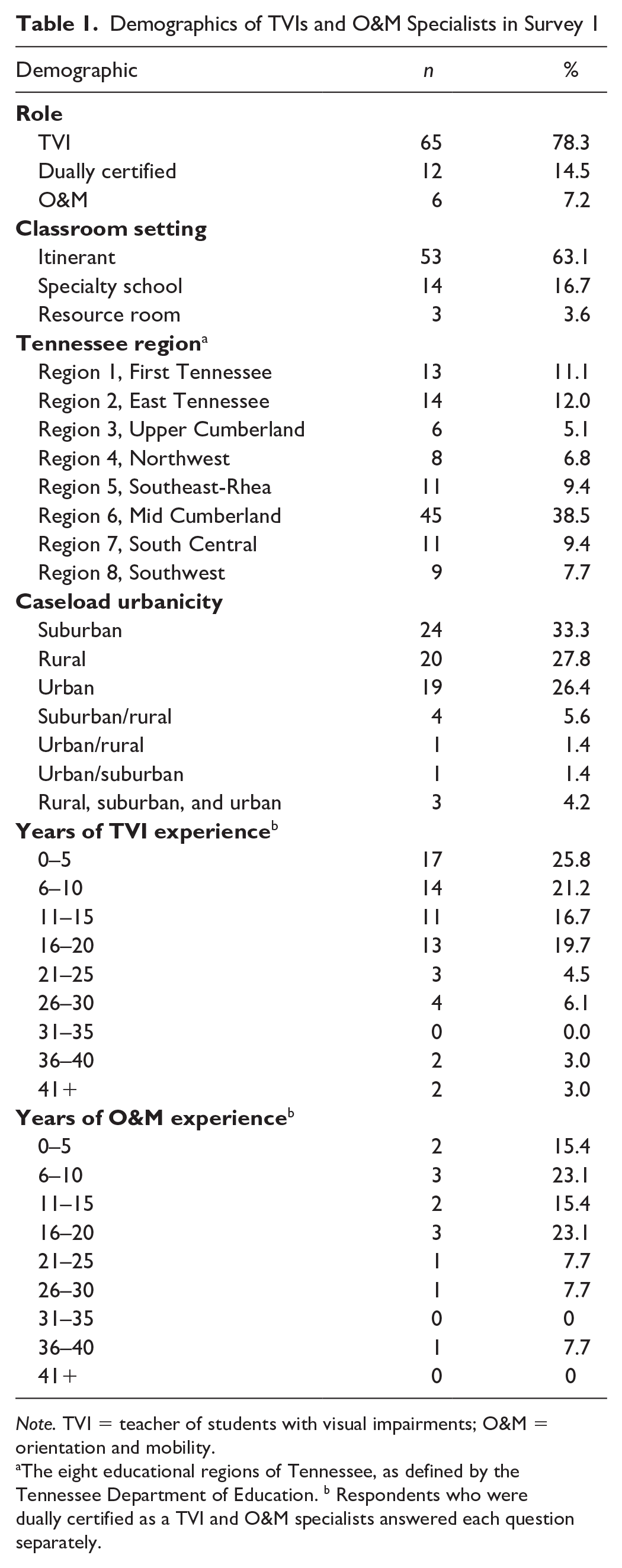
Note. TVI = teacher of students with visual impairments; O&M = orientation and mobility.
The eight educational regions of Tennessee, as defined by the Tennessee Department of Education. b Respondents who were dually certified as a TVI and O&M specialists answered each question separately.
One quarter of TVI caseloads (n = 16) had six to 10 students, and 14 TVI caseloads (21.2%) had one to five students. Caseload demographics can be found in Table 2. Five O&M specialists (38.4%) reported an O&M caseload of one to five students. Vision professionals reported serving an average of 11.1 schools in the 2021–2022 school year (SD = 13.4, range = 1–65). Dually certified professionals reported their O&M and TVI caseloads separately. Two TVI caseloads and two O&M caseloads were spread across 16 districts. Of the remaining five TVI caseloads (7.4%) and three O&M caseloads (21.4%) which spanned multiple districts, the range was from 2 to 11 districts. The majority of the responding 67 professionals with TVI caseloads (89.5%, n = 60) worked in one district. Of the seven professionals serving multiple districts as TVIs, six (85.7%) worked in rural or rural-mixed districts (e.g., suburban/rural, urban/rural). The average rural TVI served 2.9 districts. A slight majority of the responding 14 O&M specialists’ caseloads (64.3%; n = 9) spanned one district. All suburban/urban O&M specialists (n = 7) served one district, while two rural O&M specialists served one district. The average rural O&M specialist served 7.29 districts (range: 3–16 districts).
Number of Schools, Districts, and Students Served by Responding TVIs and O&Ms.

Note. Values may not equal 100% due to rounding. TVI = teacher of students with visual impairments; O&M = orientation and mobility specialist.
Sixty of these 63 TVIs reported working in one district. b Nine of these 11 O&M specialists reported working in one district.
Participant Demographics in Survey 2
Administrators from 49 districts in Tennessee responded to Survey 2. With 147 school districts in the state during the 2021–2022 school year, the response rate for the administrator survey was 33.3%. All 49 administrators represented public schools. Most respondents (79.6%, n = 39) were either a special education administrator or director. Seven (14.3%) identified as Vision Service Leads, and three (6.1%) checked an “other” response. The majority of administrators (67.3%, n = 33) represented rural districts. Participation was received from all eight regions of Tennessee, with just under half of respondents (46.9%, n = 23) from either the Mid Cumberland (greater Nashville) or Southwest (greater Memphis) regions. The third most responses were received from the South Central region (16.3%, n = 8). Between three and five administrators, each were from the remaining regions (First Tennessee, East Tennessee, Upper Cumberland, Northwest, and Southeast-Rhea).
Research Question 1: Reported TVI Vacancies
In Survey 2, Tennessee administrators provided information about current employment and vacancies in their districts. Of the 49 districts represented, 35 (71.4%) either employed or contracted a TVI, with 15 districts (30.6%) having a full-time TVI on staff. All urban and suburban districts (n = 16) employed or contracted a TVI. Of the 33 rural districts, 19 districts (57.6%) employed or contracted a TVI while 14 districts (42.4%) did not. Three of the 14 districts that did not employ or contract a TVI reported a TVI vacancy.
A total of 13 vacancies were reported across nine districts. Of the reported TVI vacancies, three vacancies (23%) were open for 0 to 6 months, two in suburban, and one in an urban district. Five vacancies (38%) were open 7 months to 1 year; two in rural and three in urban districts. Three vacancies (23%) were open 1.6 to 2 years; two in rural districts one in a suburban district. Two vacancies (15%) were open for 2 years or more, both in a single urban district. There were more vacancies (n = 6) in urban districts than suburban (n = 3) or rural districts (n = 4). Multiple vacancies were most common in urban districts (i.e., three vacancies and two vacancies), while just one suburban district reported two vacancies. No rural districts reported multiple vacancies. Due to the small sample size (n = 13), inferential statistics could not be calculated, but visual analysis of the data did not seem to indicate a connection between urbanicity and the length of time a vacancy was open.
Research Question 2: Reported O&M Specialist Vacancies
Administrators in Survey 2 provided details on O&M employment and vacancies in their districts. Of the surveyed districts, 44.9% (n = 22) either employed or contracted an O&M specialist, with 10.2% (n = 5) employing a full-time O&M specialist. Three districts (7%) reported a current O&M specialist vacancy, for a total of three vacancies. All three vacancies were open for at least a year. The vacancies in suburban districts were open for 1.1 to 1.5 years and 1.6 to 2 years. The longest vacancy, open for more than 2 years, was in an urban district. In total, 27 districts reported neither employing nor contracting an O&M specialist. Of districts not currently employing an O&M specialist, only one reported a vacancy. All three districts reporting an O&M vacancy employ a TVI and two of those districts currently employ an O&M specialist as well.
Administrators responding to write-in questions expressed hardship in finding vision professionals to serve their students. Many referenced a reliance on outreach services from the Tennessee School for the Blind. Administrators acknowledged that outreach services are not a complete solution to lack of personnel, with one respondent explaining, “[Outreach] is provided on a limited basis. These individuals are stretched too thin also.”
Research Question 3: Implications of Vacancies
Lowered Quality of Instruction
Teachers of students with visual impairments and O&M specialists in Survey 1 reported many factors affecting their profession and the provision of vision special education services in Tennessee. Respondents underscored significant challenges given the current landscape of education. They cited large caseloads and limited number of vision professionals as most directly limiting their ability to provide best practice services to their students. The pervasive issue of large caseloads was evident in the data, as documented in Table 2. Almost 30% of respondents (n = 20) reported having more than 20 students on their caseloads, with eight respondents (11.4%) reporting a caseload of 41+ students. When asked to share more about their experiences, over half of the respondents (n = 49) expressed the need for more TVIs and O&M specialists to fill vacancies and to mitigate burnout of the current professionals in the field. The collective concern and need for change was encapsulated by one professional who said, “I worry for the future of our field when I think about how hard it is to find qualified applicants for the jobs that we always seem to have open.”
The Weight of Being the Only TVI or O&M Specialist
In Survey 1, respondents (n = 71) reported the number of TVIs and O&M specialists working in their district(s). Because participants could report for multiple districts, 86 responses were gathered. Around half (51.1%; n = 44) indicated that multiple TVIs were employed in their district. Regarding O&M, 22.1% (n = 19) responses showed districts had multiple O&M specialists working in their district.
A theme particularly common among respondents serving as the only TVI or O&M specialist in their district was a reported sense of responsibility to provide best practice for their students. Simultaneously, these individuals recognized the impossible task of covering all aspects of every student’s needs on their own. Many voiced a sense of isolation, stemming from other educators’ limited understanding of the vision professional’s role and their students’ needs. Figure 2 shows respondents’ perspectives on being a “lone ranger” in the field.

The Impact of Being the Only Teacher of Students With Visual Impairments (TVI) or Orientation and Mobility (O&M) Specialist.
Lack of Administrative and Systemic Support
Twenty percent (n = 11) of vision professionals who answered open-ended questions reported feeling limited by a lack of understanding from administrators. Respondents expressed that their capacity to provide quality services is affected by administrators not understanding the needs of students with VI or the professionals who educate them. One respondent said, “Administrators do not understand services for vision students, and I am currently serving over 40 students.” Another respondent expressed similar difficulties and said, “I love my job, but it’s rarely understood.”
Dialectics Within the Profession: Joy and Burnout
It is important to note that nearly half (n = 38; 42%) of all responding TVIs and O&M specialists emphasized a genuine affinity for their job. These positive comments often highlighted the rewarding nature of working with students with VI and their teams: “I enjoy the students. I enjoy helping provide access to their world around them. I enjoy helping them make progress and seeing the ‘aha’ moments.” Participants described a love for working with their students, frequently juxtaposed with challenges faced in the role. For example, one stated, “When people ask me about my job, I share that it’s very rewarding, but I’m exhausted.” Half of the statements on job enjoyment (n = 19) provided a nuanced perspective that couches the joy in the realities of the job such as hours spent traveling, juggling schedules of many students, supporting numerous families, and feeling overworked. One respondent reported having gone to 75 Individualized Education Program (IEP) meetings in the 2020–2021 school year. The layered complexity of the role can be summed up by one respondent, who said:
I love my job. I just don’t have enough time to do it properly. I’m split between positions and don’t have enough time in my day to make modifications, see students, interface with general education teachers AND do my “other assignment.”
Research Question 4a: Factors Related to Attrition of TVIs and O&M Specialists
Professionals Leaving Their Positions
In Survey 1, TVIs and O&M specialists were asked if they anticipated leaving their position in the next 5 years. Of the 70 professionals who responded to the question, the majority (n = 41) replied with “yes” (n = 23) or “maybe” (n = 18). Forty percent (n = 29) indicated they would stay. Figure 1 provides representative perceptions of the field based on professionals’ likelihood to leave. It is of note that 25 of the 41 respondents who indicated they may leave also reported they were within 5 years of retirement. The aging population of professionals was evident in the write-in responses, with one vision professional saying, “Most TVIs in our region are at the age of retirement. More programs are needed to train new TVIs.” Rural districts will be hardest hit by these departures, as 13 of 20 (65%) professionals leaving were from rural districts. Comparatively, 14 of 24 (58.3%) professionals in suburban districts and eight of 17 (47%) professionals in urban districts anticipate leaving. The majority (6 of 9, 66.7%) of professionals with a caseload spanning multiple urbanicities also plan on leaving in the next 5 years.
A pairwise correlation was run to identify if there was a correlation between participants’ caseload size, geographic region, and likelihood of leaving. No statistically significant relationships were found, although the sample size is relatively small (n = 70).
Administrators’ Anticipation of Professionals Leaving
In Survey 2, administrators were asked if they anticipated any TVIs that they employed or contracted with would retire or leave in the next 5 years. With 30 participants responding, 11 (36%) indicated they expected that one or more TVIs would definitely leave or were likely to leave the field in the next 5 years. Twelve districts (40%) responded that it was somewhat likely or slightly possible that one or more TVIs may retire or leave. Eight districts (23%) did not anticipate any TVIs in their district retiring or leaving in the next 5 years. Administrators’ perceptions of TVIs’ likelihood of leaving were the same across rural and suburban districts, while the responses of administrators in urban districts were skewed toward expecting TVIs to leave. Due to the small sample size (n = 11), pairwise correlations were not run to identify potential correlations between administrators’ anticipation of professionals leaving and other factors.
In Survey 2, administrators were asked if they anticipated that any of the O&M specialists they employed or contracted with would retire or leave in the next 5 years. Of the 19 responding administrators, four (21%) indicated that they expected that one or more O&M specialists would definitely leave or were likely to leave the field. Six (32%) responded that it was somewhat likely or slightly possible that one or more O&M specialists would leave the field. Nine (48%) did not anticipate any O&M specialists they employed or contracted retiring or leaving the field in the next 5 years. While administrators in urban and some suburban districts anticipated some turnover, most suburban and rural districts were not anticipating any of their O&M specialists leaving.
Research Question 4b: Factors Related to Hiring TVIs and O&M Specialists
Likelihood of Hiring TVIs
In Survey 1, TVIs and O&M specialists rated the extent to which they thought their district was likely to hire TVIs within the next 5 years if funding and qualified candidates were available. The response scale ranged from 1 (“definitely hire”) to 5 (“extremely unlikely to hire”). Because the TVIs and O&M specialists were asked to report on the likelihood to hire for each district they worked in, 85 responses were captured in total. Forty-six responses (54%) indicated their district would definitely hire or was likely to hire a TVI. Sixteen (19%) indicated their district might hire a TVI. Twenty respondents (24%) said that it is unlikely or extremely unlikely that their district will hire a TVI in the next 5 years.
Administrators were asked the same question in Survey 2, with the same response scale as reported above for Survey 1: if funding and qualified candidates were available, was their district likely to hire TVI(s) within the next 5 years? Twenty-two (50%) administrators would definitely hire or likely hire a TVI, while eight (18%) administrators might hire a TVI. Fourteen (32%) administrators were unlikely or extremely unlikely to hire a TVI, even if funding and qualified candidates were available.
Likelihood of Hiring O&M Specialists
In Survey 1, TVIs and O&M specialists rated the extent to which they thought their district was likely to hire O&M specialists within the next 5 years if funding and qualified candidates were available, using the same 1 (“definitely hire”) to 5 (“extremely unlikely to hire”) scale described above. As reported above, respondents could report for up to three districts that they worked in, so across the 70 participants, information was collected for 85 districts. Thirty-three responses (39%) indicated the district would definitely hire or likely hire an O&M specialist. Fifteen (18%) indicated their district might hire an O&M specialist. Thirty-seven respondents (44%) said that it is unlikely or extremely unlikely that their district will hire an O&M specialist within the next 5 years.
In Survey 2, administrators were asked to rate the extent to which their district would or would not hire O&M specialists within the next 5 years if funding and qualified candidates were available, using the same 1 (“definitely hire”) to 5 (“extremely unlikely to hire”) scale described above. Of the responding administrators, eight (18%) said they would definitely hire or likely hire an O&M specialist. Nineteen (44%) said they might hire an O&M specialist. Sixteen (37%) participants said they were unlikely or extremely unlikely to hire an O&M specialist, even if funding and qualified candidates were available.
Discussion
There are long-standing vacancies in Tennessee for both TVIs and O&M specialists, and administrators have difficulty filling positions with qualified candidates. As a result of these vacancies, currently employed TVIs are stretched thin. Approximately half of the responding TVIs carried a caseload larger than eight students, which has been recognized as a reasonable caseload size (Mason & Davidson, 2000). While TVIs and O&M specialists reported loving their profession, they also reported high levels of burnout and wanting to leave the field. The majority (60%) of TVIs and O&M specialists plan to leave the field in the next 5 years, many due to retirement. Rural districts will be harder hit than urban areas by these departures (65% vs. 47%). These findings relate to trends and issues at the national level pertaining to employment of low-incidence education personnel.
Amplified Impact of Shortages and Vacancies in Rural Education
Rural school districts face the highest risk for chronic shortages in staffing, with special education positions being especially challenging to fill (Berry et al., 2012; Feng & Sass, 2018; See et al., 2020). Given the very specialized training of TVIs and O&M specialists, they are generally in high-demand and low supply (AAEE, 2023). According to the 2023 Tennessee Educator Survey, only 20% of administrators in rural districts have a large enough pool of applicants to hire qualified personnel (Blinsted, 2023). Tennessee’s experience parallels national trends, with majority of school districts (79.4%) having challenges in finding qualified candidates to fill vacancies (AAEE, 2023). The results of the current survey indicate 65% of rural vision professionals anticipate leaving the field. This is aligned with, though higher than, previous national research which found 42% of rural special education teachers planned to leave special education in the next 5 years (Berry et al., 2012). It is unlikely that administrators will have an adequate applicant pool to draw from, if they get any applicants at all. In addition to hiring challenges, the expected attrition for vision professionals in the current study is three times higher than expected for teachers in the state. Twenty percent of all teachers are expected to leave the field in the next 5 years (Professional Educators in Tennessee, 2022) compared with 60% of TVIs and O&M specialists in the current study.
Discrepancies Between Educators and Administrators
Findings from the current study suggest a discrepancy between administrator and teacher perceptions on the need to hire TVIs and O&M specialists. There was relative agreement across respondents on the need to hire TVIs (vision professionals: 54%; administrators: 50%). There was a marked difference between perception of the need for hiring O&M specialists (vision professionals: 39%; administrators: 18%). Furthermore, there was a marked difference in anticipation of professionals leaving within the next 5 years. While 60% of TVI and O&M specialists planned to leave the field within the next 5 years, only 36% of school administrators expected one or more TVIs to leave or retire, and 21% of administrators expected one or more O&M specialists to leave or retire. These projections do not account for currently vacant positions, or potential student growth over the next 5 years. More research is needed to identify school administrators’ rationale for hiring vision personnel and explore the disconnect between TVIs and O&M specialists’ perceptions of staffing needs and the perceptions of administrators.
Connection Between Working Conditions and Teacher Attrition
Findings from the current study shed light on the working conditions and professional shortages in rural areas of Tennessee. Teachers of students with visual impairment vacancies reported in rural districts were open for longer periods of time compared with urban and suburban districts. While no vacancies for O&M specialists were reported in rural areas, one can posit that is due to small caseload sizes and lack of awareness of the role of O&M specialists. In Ohio, research suggests that more rural districts are contracting TVIs and O&M specialists through an educational service agency (ESA) to provide services, compared with larger, metropolitan school districts (Howley & Howley, 2021).
Tennessee is one of only seven states in the United States that does not have regional cooperatives or an intermediary ESA (Polk, 2021). Educational service agencies provide administrative support and cost-effective service delivery to the districts they serve, which can include hiring and funding special education and related service providers, particularly professionals focused on low-incidence disabilities. The effects of rural- and economic-based shortages in Tennessee are compounded by the burden on each district to locate, hire, and fund their own TVIs and O&M specialists. In rural districts, TVIs were more likely to hold other responsibilities in addition to a part-time vision caseload. One TVI summarized their experience serving in a rural district saying, “It is very difficult in a rural district where you wear so many hats . . . There is never enough of me to go around.” By contracting with an agency or ESA, a vision professional can ensure they are only being hired to a specific job (e.g., be a TVI and/or O&M specialist) and the district can ensure they have the qualified staffing to provide appropriate special education services.
Having large caseloads of students to support was a major area of concern for many respondents. One respondent encapsulated their experience with the statement, “I am being asked to reduce my scope of services to the bare minimum for students,” representing a significant number of the TVI and O&M specialist respondents who noted a need to hire more professionals to reduce their own burnout. Results indicate that approximately 40% of responding TVIs held a caseload of 16 or more students during the 2021–2022 school year. Research recommends that TVI caseloads should be no more than eight to 12 students, with considerations for individual student need and travel feasibility between schools; for example, professionals in rural areas will likely cover larger geographic areas and need more time to travel between schools compared with professionals in urban or suburban areas (Ferrell et al., 2014; Mason & Davidson, 2000). While these oversized caseloads are problematic, they are representative of the caseload issues throughout the United States (national average: 19–21 students, Zebehazy et al., 2023; Texas: 18 students, Robinson, 2022).
Limitations
There are a few limitations that should be considered along with the results of this survey. First, it was the first survey of its kind conducted in Tennessee. While the vacancies and need for TVIs and O&M specialists is generally recognized throughout the United States, there are no Tennessee-specific results to compare these findings to. Second, only one third of Tennessee school districts responded to Survey 2. As a result, the potential vacancies and need for TVIs and O&M specialists in most districts were not captured. Furthermore, all administrators represented public schools; professionals in charter and private schools may have different experiences. While it is estimated that the survey had a 50% response rate from TVIs and O&M specialists in the state, the true population of working professionals is unknown, and the experiences of all professionals may not be represented.
Implications and Next Steps
Several implications for practice are evident from the current study. The study first and foremost highlights the need to better understand the current TVI and O&M vacancies and projected attrition of current professionals. The discrepancy between the perceptions of vision professionals and administrators is concerning since administrators often need time to advocate or find the budget to create new positions. Districts will need to anticipate an extended timeline to fill new vacancies given the many long-standing vacancies and unfilled positions in the state. As rural regions are more affected, districts may want to consider incentives to recruit current teachers already living in their area to obtain TVI or O&M specialist credentials. This may be the most practical short-term solution because recruiting new teachers to personnel preparation programs and then to live in a rural community is increasingly challenging. Bringing back O&M training to Tennessee, along with expanding initiatives to recruit more professionals to be trained as TVIs, is a long-term solution to the shortage issue as well. If an O&M program is restarted in Tennessee, there should be an emphasis placed on considerations for providing services in rural communities.
Next steps should include conducting a replication or expansion of the current study as this was the first study of its kind in Tennessee. Future research can explore if the results from this survey are found in future years, capture up-to-date vacancies and shortages in the state, and possibly explore the source of discrepancy in perceptions between TVIs and O&M specialists and special education administrators on the need to hire more vision professionals.
Footnotes
Declaration of Conflicting Interests
The author(s) declared no potential conflicts of interest with respect to the research, authorship, and/or publication of this article.
Funding
The author(s) received no financial support for the research, authorship, and/or publication of this article.
