




Abstract
Individuals with disabilities are less likely than their peers without disabilities to be employed or enrolled in postsecondary education. Even with federal legislation efforts designed to provide targeted supports to this population, the discrepancy persists. Students with disabilities who attend schools in rural settings may experience additional barriers to employment and postsecondary enrollment not faced by those in urban and suburban locales. This article reviews post-school outcomes and barriers that youth with disabilities in rural areas may encounter. These may include concerns related to transportation, limited opportunities, and varied perceptions on the value of higher education. In addition, special educators in rural schools may have limited training opportunities and a wide range of position responsibilities that require expertise in many areas. Then, to help address these discrepancies, strategies to support students and improve services are presented in four broad areas, including (a) augmenting teacher training and practice, (b) partnering with vocational rehabilitation, (c) improving public policy, and (d) leveraging the strengths of rural communities.
Although federal legislation aims to increase positive post-school outcomes for individuals with disabilities (e.g., Individual with Disabilities Education Improvement Act, 2004; Workforce Innovation and Opportunity Act, 2014), many people with disabilities find themselves unengaged after finishing high school (i.e., unemployed or not enrolled in a postsecondary education or training program). When compared with students without disabilities, high school students with disabilities are much less likely to be prepared for some kind of postsecondary education or training (Lipscomb et al., 2017). Discrepancies also exist when looking at the workforce. Although paid employment may be especially important for individuals with disabilities (Wehman, 2011), employment rates for individuals with disabilities lag when compared with those without disabilities (21.3% compared with 65.4%; U.S. Bureau of Labor Statistics, 2023).
These discrepancies may be even more pronounced for individuals with disabilities who live in rural areas. In addition to disability being more prevalent in rural areas, students tend to have fewer financial resources, have limited or no access to public transportation, fewer walkable employment options, and are more likely than others to be unemployed (W. A. Erickson et al., 2018; Test & Fowler, 2018). The location of a student’s hometown may also impact enrollment in postsecondary education; those who live in rural areas are less likely than students residing in other locales to take a college placement exam and experience lower expectations that they will attend postsecondary education (Lipscomb et al., 2017). The unique challenges associated with remote locations have a significant impact on the extent to which students with disabilities can attain their post-school goals.
Special Education in Rural Settings
Students who live in rural settings are more likely (by 10 percentage points) than those in urban areas to be receiving special education services through an Individualized Education Program (IEP; Lipscomb et al., 2017); one quarter of all students with disabilities attend rural schools (Carter et al., 2021). Although students with disabilities in rural schools may experience some benefits related to their locale (e.g., strong community support, closer relationships with teachers and students), unique challenges may exist (Berry & Gravelle, 2018). Some of the most significant barriers to post-school goal achievement for youth with disabilities in rural settings involve transportation. This impacts individuals and families in a variety of ways, including limited access to (a) health and disability-specific support services, (b) postsecondary education opportunities, (c) employment options, and (d) engagement with others in the community (Test & Fowler, 2018). In addition to these transportation-related barriers, Test and Fowler (2018) described rural challenges related to community expectations and the value of education, limited opportunity, and cultural beliefs unique to remote living.
Special educators who work in rural settings also face challenges that could impact the extent to which they can deliver transition services to their students. First, rural districts often struggle to recruit and retrain special educators who are certified, and those who are certified struggle with effective transition planning (Morningstar et al., 2018). Second, special educators in rural areas are rarely provided trainings or given resources regarding the use of evidence-based transition practices (Morningstar et al., 2018; Williams-Diehm et al., 2018), thus causing them to learn about transition planning on the job (Plotner et al., 2016). Limited knowledge in these areas may lead to even greater challenges for special educators, such as producing compliant IEPs. Hott et al. (2021) review of compliant IEPs in rural districts found that fewer than 7% of IEPs met regulatory standards. This is concerning as compliant, high-quality transition plans lead to greater transition programming and post-school outcomes (Kraemer et al., 2022; Landmark & Zhang, 2012). Finally, rural special educators may face professional isolation by serving as the only teacher trained to adequately support students with disabilities (Berry & Gravelle, 2018). The isolation, in addition to other common challenges faced by special educators (e.g., time, budget concerns), may mean that teachers feel like they are solely responsible for the entire population of students with disabilities in their school. Supporting post-school transition becomes just one of their many duties. The weight of these responsibilities may result in a special education teacher who becomes a jack of all trades, but a master of none. Deardorff et al. (2021) hypothesized this juggling of responsibilities explains findings suggesting that rural special educators are less equipped to support high school students with disabilities who are transitioning to life after high school. This hypothesis aligns with previous research that found the parents of students with disabilities perceived the transition planning process to be inadequate for preparing students from rural communities for postsecondary success (Miller-Warren, 2016).
Postsecondary Education for Youth With Disabilities in Rural Areas
As general long-term benefits of postsecondary education include superior health, wages, self-efficacy, and critical thinking skills (Hout, 2012; Mayhew et al., 2016), it is not surprising that many young Americans make the decision to continue their education past high school. Although, when looking at total population (those with or without disabilities), people from urban areas are more likely than people who live in rural communities to enroll in postsecondary education (47% in cities and 29% in rural areas; National Center for Educational Statistics, 2015). General barriers for students in rural settings interested in pursuing postsecondary education opportunities include perceived academic deficits, limited understanding about applying for college and seeking financial aid, school counselors not presenting college as a viable option, and geographic distance from campuses (Morton et al., 2018).
Postsecondary education enrollment rates for students with disabilities are significantly lower than those students who do not experience disabilities (60.1% vs. 67.4%; Newman et al., 2011). When considering the intersectionality of disability and rurality, additional barriers may impact a student’s decision to enroll, including (a) academic performance, (b) fear of the unknown, (c) concerns about traditional rural values and losing rural identity, and (d) lack of understanding that students with disabilities can be successful in college (Friesen & Pruc-Stephenson, 2016; Morton et al., 2018; Scott et al., 2016). Parental expectations may also factor into postsecondary education enrollment outcomes for students. Families from rural areas are less likely to report the expectation that their child with an intellectual disability will continue on to 2-, 4-year, or vocational training programs after high school (Bouck et al., 2021). Lipscomb et al. (2017) also found students with disabilities in rural settings are less likely than those in urban and suburban settings to believe that they will continue their education in a postsecondary setting and take college entrance exams.
Additional challenges may be faced by students with disabilities who enroll in higher education. Barriers to success in a higher education degree program for students with disabilities may include: (a) low expectations and understanding of faculty members, (b) advisors who are unresponsive and have limited knowledge of disability supports, (c) stressors associated with being a college student with a disability, and (d) poor quality of support services (Hong, 2015).
Employment for Youth With Disabilities in Rural Areas
Individuals living in metro areas experience a higher rate of labor force participation than those living in rural areas of the United States (63.7% vs. 57.6%; U.S. Department of Agriculture, 2019). Lower rates in rural areas may be due to barriers to economic development, such as limitations caused by geographic remoteness, inadequate access to technology, and limited employment opportunities and diversification (U.S. Congress Joint Economic Committee, 2017). These barriers to employment may be compounded by other factors experienced by individuals with disabilities who live in rural communities. As many individuals with disabilities may have specialized healthcare needs, the remote nature of rural communities may make access to these services difficult, thus impacting the extent to which an individual can maintain regular employment (W. A. Erickson et al., 2018).
The limited number of available jobs can be a significant challenge to anyone living in a rural setting and experiencing disability may further reduce opportunities for job-seekers (Adams et al., 2019). To seek employment in a more populated area, individuals living in rural settings may travel to work. However, due to limited options for public transportation in rural communities, individuals with disabilities who may rely on others to get to and from work may be further marginalized (McDaniels et al., 2018). Job-seekers with disabilities in rural areas may have more limited access to job training and employment supports, such as vocational rehabilitation (VR) services (Adams et al., 2019). Support for employers considering hiring an individual with a disability (e.g., understanding of reasonable accommodations, disability awareness) may also be limited in rural communities (Adams et al., 2019). Family and employer concerns related to health and safety may also present barriers to employment for individuals with disabilities (Kucharczyk et al., 2021).
Limited availability of training and support options for students in rural communities may also impact the extent to which a student with a disability can develop the skills necessary to find and maintain employment. For example, transition-specific programing, a predictor of positive post-school outcomes for youth with disabilities (Mazzotti et al., 2021), may not be possible for students in rural communities due to the specialized nature of the service. In addition, special educators in rural settings may not have the expertise or capacity to provide these supports and services as they may be working with a wide range of student needs and ages. This may result in students with disabilities in rural areas not receiving high-quality transition planning while in high school, leaving them ill-prepared to successfully enter the workforce (Deardorff et al., 2021). Even with these challenges, youth with disabilities in rural settings are more likely than those in urban settings to engage in work experience (Lipscomb et al., 2017), another predictor of positive post-school outcomes (Mazzotti et al., 2021). These barriers to supporting employment and postsecondary education goals for youth with disabilities in rural communities are significant, however, stakeholders can take action to improve the landscape.
Recommendations for Practice
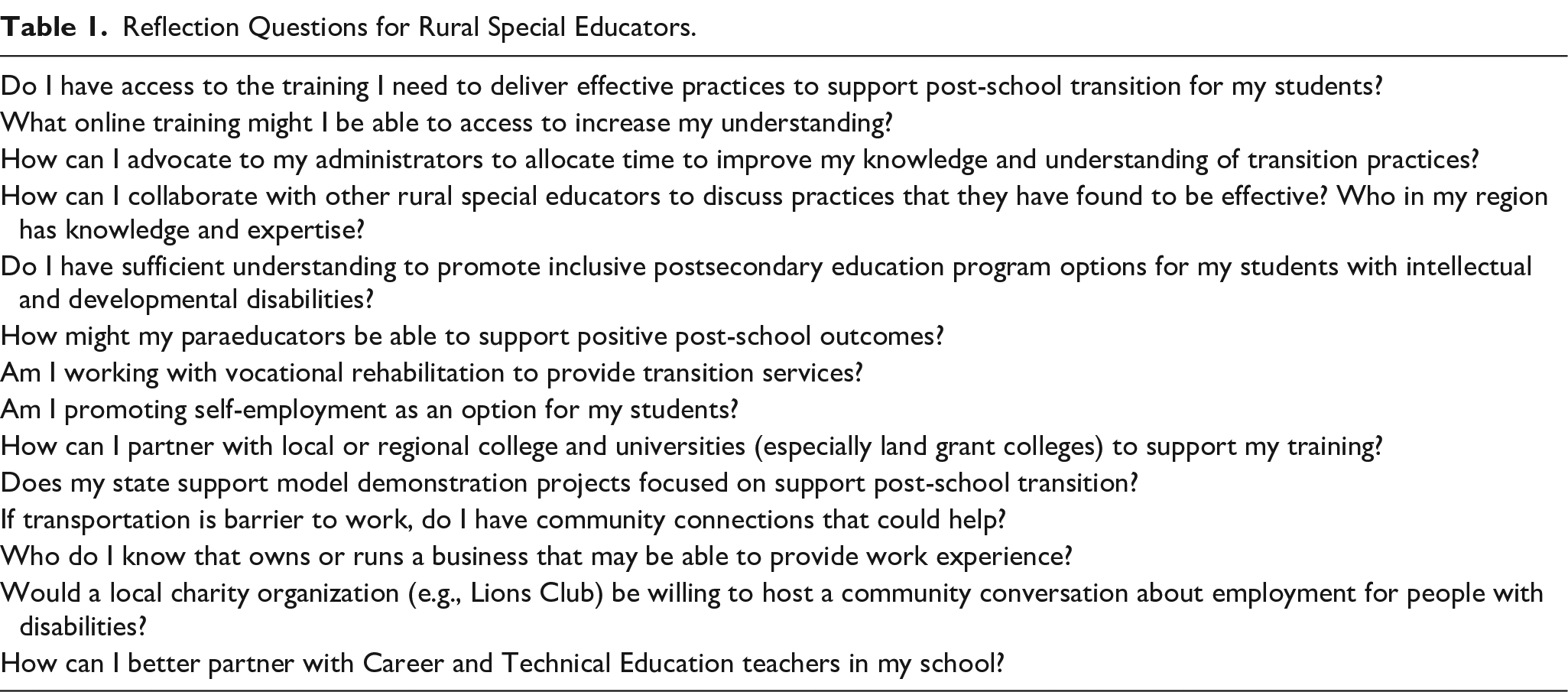
Although there is value in identifying barriers related to post-school outcomes for youth with disabilities in rural communities, these challenges will remain without an emphasis on improvements. The following sections present recommendations in four general areas, including (a) augmenting teacher training and practice, (b) partnering with VR, (c) improving public policy, and (d) leveraging the strengths of rural communities. Table 1 includes a list of reflection questions rural special educators can ask themselves, based on the recommendations for practice provided below.
Reflection Questions for Rural Special Educators.
Improve Teacher Training and Practices
Professional development customized for rural educators can enhance the use of transition evidence-based practices to support students’ post-school outcomes. Although the research on transition training and professional development is limited (Bruno et al., 2021; Morningstar & Mazzotti, 2014), the use of accessible training opportunities is one way to enhance rural educators’ knowledge and skills. For example, A. S. G. Erickson et al. (2012) found that pre–post-test scores measuring transition competencies after participation in a Transition Seminar Series (an online learning experience) increased for rural special educators significantly. Rural special educators reported that they were able to apply the information learned but requested more opportunities for collaboration via discussion boards and projects. Online training and resources can typically be accessed asynchronously, which allows educators to build it into their schedules, access the materials as needed, and build their toolboxes of resources (Thoma et al., 2022).
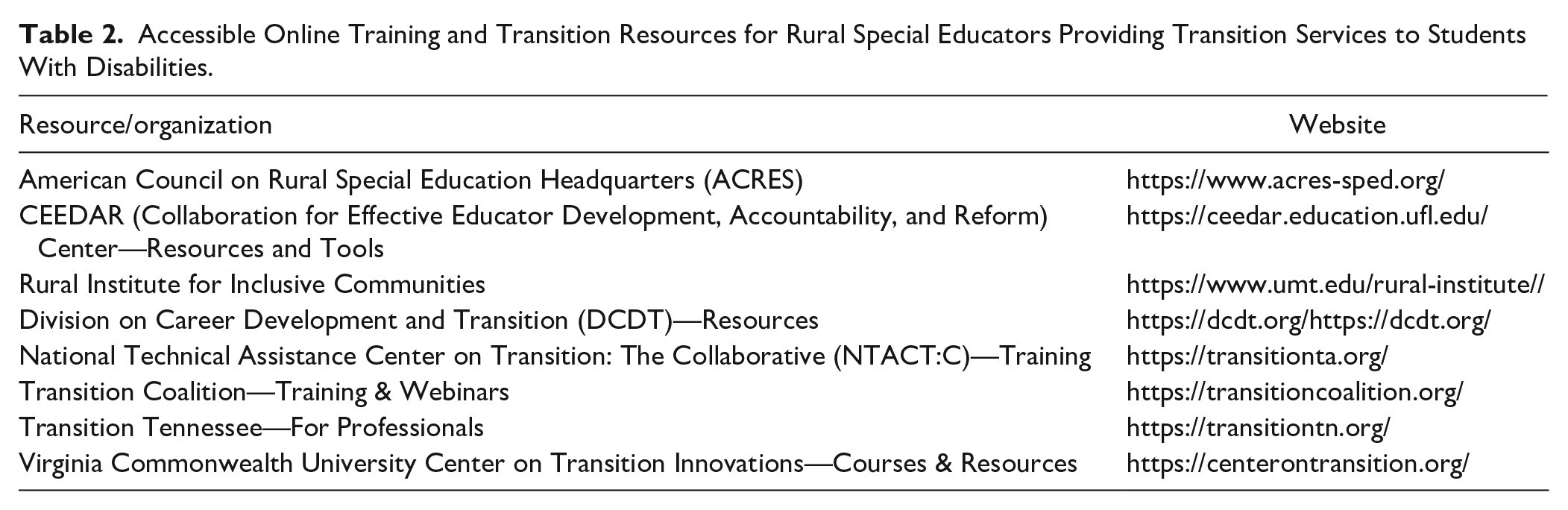
As school districts seek to enhance professional development opportunities for educators, considering online trainings offered through professional organizations (i.e., Council for Exceptional Children [CEC], Division on Career Development and Transition [DCDT], American Council on Rural Special Education [ACRES]), or social media sites (i.e., Twitter/X, Facebook groups, LinkedIn) can open many opportunities for rural special educators to enhance their knowledge and skills. In addition, seeking out training or opportunities via universities could also be a way to bring accessible professional development to teachers. For example, Thoma et al. (2022) developed online modules focused on supporting educators use of a Universal Design for Transition Framework. Courtade et al. (2017) found the use of online courses, virtual coaching, and online professional learning communities allowed rural special educators to not feel professional isolation and offered more opportunities for collaboration as they accessed a 3-year professional development program. Training for in- and pre-service teachers should include opportunities for educators to reflect on their own experiences related to rurality to better understand their own locale biases (Panos & Seelig, 2019). A list of online training opportunities and resources can be found in Table 2.
Accessible Online Training and Transition Resources for Rural Special Educators Providing Transition Services to Students With Disabilities.
Rowe et al. (2020) provide recommendations for rural educators looking to improve employment and postsecondary outcomes for youth with disabilities. Recognizing that teachers in rural areas may have limited access to face-to-face in school opportunities, which were even further limited during COVID-19 restrictions, most of these recommendations are able to be accessed remotely. Rural special educators may also consider seeking training and skill development though the use of eCoaching with Bug-in-Ear technology (Horn, 2021). This technology involves teachers receiving real-time support and guidance, delivered through a small earpiece headphone, by a trainer who is not physically present in the room. As this strategy does not require the support person to be physically present, it may be especially valuable in rural settings where teachers have limited access to training.
Looking specifically at supporting enrollment in postsecondary education, rural special educators should have access to training to gain a better understanding of potential paths for their students. Delivering these trainings remotely may increase access to a greater number of special educators (Thoma et al., 2022). Training should include information about inclusive postsecondary education for students with intellectual and developmental disabilities. Families may not be aware of these options, many of which include residential components (Grigal et al., 2022), and increased teacher awareness could support family engagement and empowerment.
There may also be value in providing training to paraeducators in practices related to post-school transition. Barrio and Hollingshead (2017) found that paraeducators in rural communities were eager for training opportunities and workshops can be effective to gain skills and knowledge. Targeted paraeducator training specific to improving post-school outcomes can help expand the school-based support team for youth with disabilities.
Partnerships With Vocational Rehabilitation
Special educators should consider developing partnerships with state VR personnel, who may have higher levels of expertise in areas related to post-school transition (Plotner et al., 2017). Inter-agency collaboration is a hallmark of high-quality transition services (Kohler et al., 2016) and VR can be a key partner with schools to deliver effective services to support employment outcomes for youth with disabilities (Noonan et al., 2008). By design, VR covers all geographic areas in the United States, including rural settings (Ysasi et al., 2018). Collaboration with VR may lead to additional services to students through pre-employment transition services (pre-ETS) while students are in high school (Scheef & McKnight-Lizotte, 2022). Accessing pre-ETS related to counseling on postsecondary education enrollment and work-based learning experiences may provide students and families from rural areas with the skills and knowledge needed to increase successful outcomes in these critical areas. For instance, there is strong research evidence suggesting that paid work experience while in high school is a strong predictor of being employed post-school (Carter et al., 2012; Mazzotti et al., 2021; Wehman et al., 2015).
Vocational rehabilitation personnel may be able to support self-employment for individuals with disabilities, an option that may be particularly viable for individuals in rural communities. Previous research has shown that adults with disabilities in rural areas engage in self-employment at higher rates than adults with disabilities in other locales (Ipsen & Swicegood, 2017; Revell et al., 2009). To facilitate partnerships with VR in rural locales, schools and VR personnel may need to develop plans for outreach and brand marketing to families and students. Making these introductions and connections may be especially important in rural areas as students and families may be unaware of available VR services (Ysasi et al., 2018). In addition, care should be taken to ensure that students with disabilities living in rural areas receive the services needed to achieve their career and employment goals. Grey (2021) found that VR customers in rural areas were more likely than those in urban areas to receive training services and less likely to receive job search and job retention services. Practitioners and VR personnel should consider the full spectrum of services offered to students with disabilities to ensure the unique needs of each individual is being met.
To develop relationships with VR personnel, Scheef and McKnight-Lizotte (2022) identified practices to improve collaboration with VR personnel. These include (a) contact VR offices to identify a local counselor, (b) schedule introductory meetings to develop the relationship and better understand VR services, (c) become familiar with Pre-ETS to better understand how VR may be able to help support employment goals, (d) consider specific requests for support (related to pre-ETS) rather than broadly asking for assistance, (e) seek training opportunities to complete with VR personnel, and (f) seek to formalize the relationship with inter-agency agreements.
Public Policy Improvements
The challenges facing rural schools are complex and will likely require increased public investment and policy innovations to improve post-school outcomes for youth with disabilities. From a broader perspective, changes are needed to improve rural special education systems by addressing teacher recruitment and retention, training and professional development, and partnerships between rural schools and universities (Rude & Miller, 2018). For instance, states may wish to develop dual enrollment high school courses that allow students in rural communities interested in special education opportunities for authentic classroom experiences. A wider range and availability of “grow your own” and career change programs within rural areas may also increase the recruitment and retention of special educators. Virtual training, technical assistance, and coaching in special education-related areas may also help rural teachers gain the skills and supports needed to remain within the field. In addition, targeted and purposeful partnerships between university teacher preparation programs and local rural school districts can be developed to alleviate some of these barriers (Rude & Miller, 2018).
In addition, policy innovations focused on transition planning and practices could improve the quality of transition services that students with disabilities receive and ultimately lead to improved post-school outcomes. State or federally funded model demonstration projects investigating new approaches to coordinated transition service delivery in rural areas could help schools and VR agencies better meet the requirements of Individuals with Disabilities Education Act (IDEA, 2004) and Workforce Innovation and Opportunity Act (WIOA, 2014) by better leveraging limited resources and supporting the development of interdisciplinary transition teams that include school social workers and related service providers (Kucharczyk et al., 2021). Providing federal funding for district-level transition specialists and beginning transition activities in middle school could give rural schools additional time and resources needed to develop and deliver high-quality transition programming for students with disabilities (Burke & Sandman, 2015). Finally, federal grant funding for improved internet access and transportation resources within rural communities could expand career possibilities for students with disabilities through more opportunities for online vocational and postsecondary course enrollment and work experiences while in high school. Federal and state legislation that tackles rural special educator recruitment, training, retention, transition-focused research within rural communities, school-based transition policies, and larger rural challenges (e.g., internet access, transportation) is needed to begin to address these complex issues and identify effective approaches for improving post-school outcomes.
Leveraging the Strength of Rural Communities
Although individuals with disabilities who live in rural communities face a variety of barriers impacting employment and postsecondary education opportunities, the close-knit nature of many rural communities can prove to be a significant benefit (Berry & Gravelle, 2013). For example, lack of public transportation options may limit opportunities for individuals with disabilities in rural communities (W. A. Erickson et al., 2018). However, it may be that the close relationships formed in many rural communities can be leveraged for ride share opportunities. Rural communities may have stronger social capital and greater sense of community (Berry & Gravelle, 2013; Rowe et al., 2020), and they report long-standing relationships with students and families (Williams-Diehm et al., 2014). Collaboration between schools, families, and related service providers can lead to improved post-school outcomes. Promoting opportunities for interactions between those with and without disabilities in schools can also be beneficial in developing cultural and social capital for all students (Trainor, 2008). Therefore, as rural communities experience strong networks of support beyond the school setting (i.e., religious leaders, employers) opportunities may become available by leveraging those relationships.
These close community relationships may also support the development of a community mindset that people with disabilities are employable and can make meaningful contributions to the workplace. It may be appropriate to gather community members to discuss post-school outcomes for individuals with disabilities. Arranging community conversations in rural settings can be effective in increasing employment opportunities for students with disabilities, developing community awareness, and promoting family engagement (Carter et al., 2021). Local organizations (e.g., Chamber of Commerce, Lions Club) may be able to support these efforts.
Looking specifically at schools, the embracement of career and technical education (CTE) in rural communities (Ferguson, 2018) may be well-aligned with amplified efforts to involve CTE to support appropriate transition services for youth with disabilities (Harvey et al., 2020). Special educators in rural schools may have additional opportunities to connect their students with existing CTE courses and offerings, which may in turn lead to increased interest in and access to future postsecondary education/training and employment opportunities. Considering that involvement with CTE is a predictor of positive post-school outcomes (Mazzotti et al., 2021), special educators should be especially keen on seeking these opportunities for their students.
Conclusion
Special educators and support personnel are tasked with supporting the post-school goals of youth with disabilities, which may include employment and postsecondary education. Even with their unique strengths, students from rural communities may be less likely to find employment or continue their education in a postsecondary setting than their same-age peers from other locales. Improved supports in schools, collaboration, and policy development can help supplement efforts to increase positive post-school outcomes for students with disabilities from rural areas. Research that further examines the transition experiences of students and investigates innovative approaches into service delivery is needed to begin to identify transition-related best practices for students with disabilities living in rural communities.
Footnotes
Declaration of Conflicting Interests
The author(s) declared no potential conflicts of interest with respect to the research, authorship, and/or publication of this article.
Funding
The author(s) received no financial support for the research, authorship, and/or publication of this article.
