




Abstract
The Individuals with Disabilities Education Act (IDEA) mandates high-quality special education services for U.S. students with visual impairments (VI) in their least restrictive environment. Due to shortages of teachers of students with visual impairments (TVIs) and other resources, however, many students with VI, especially those in rural or remote areas, receive limited Individualized Education Program (IEP) services from TVIs and may not consistently receive appropriately adapted materials for accessing the class content in a timely manner. One possible solution is hybrid service modality, consisting of in-person and remote instruction. This article discusses considerations for conducting high-quality hybrid services and practical strategies that TVIs can implement during the preparation and instruction of students with VI.
Bill is 13 years old and lives in a small town that is a 90-min drive to the nearest city. Over the summer, he experienced significant vision loss, so he will be starting eighth grade with special education services. His district did not have a teacher of students with visual impairments (TVI), so the district contracted with a TVI in a neighboring region. Ideally, Bill should receive daily direct support from a TVI, however, due to travel logistics, she was only able to work with Bill twice a week. As a result, Bill made some, but limited, progress in the fall. In the spring, Bill’s school district switched to 100% virtual learning due to the COVID-19 pandemic. Bill’s grades dropped further because he did not have sufficient assistive technology skills to access his school’s learning platform and navigate digital assignments independently. Although his lessons with his TVI continued remotely and focused on assistive technology and self-advocacy, Bill was increasingly frustrated with his academic classes, infrequently logging on for class and not completing assignments.
All students with disabilities have protections and access to special education services in the United States (Individuals with Disabilities Education Improvement Act [IDEA], 2004). However, students in rural areas, compared with those in urban areas, are more likely to be diagnosed with a disability while also being less likely to receive special education services (Zablotsky & Black, 2020). Furthermore, rural school districts often have low student enrollment numbers and are geographically isolated from other districts (Gutierrez & Terrones, 2023). Simultaneously, the TVI shortage is worse in rural communities (Ajuwon & Craig, 2007; Garcia & Harley, 1991). Given the geographically large distribution of students with VI in rural communities and TVI shortage, it can be logistically challenging for students with VI to receive regular in-person services from a TVI. Although these issues have been ongoing in rural communities, the COVID-19 pandemic added a new layer of need and urgency for providing meaningful education to students while teachers and students had to be physically distant from another.
The COVID-19 pandemic significantly affected all aspects of Grades K-12 education. In the United States, the nationwide closure of public schools significantly affected academic planning, with online or hybrid in-person instruction becoming the major modality of teaching for the period from March 2020 to January 2022 (United Nations Educational, Scientific and Cultural Organization, 2022). Adapting to emergency remote instruction brought many challenges to teaching and learning (Huck & Zhang, 2021). Students faced challenges such as poor time management skills (Lindner et al., 2020) and mental health struggles (YouthTruth, 2020).
The regression of academic and developmental skills was even more pronounced for students with visual impairments (VI; Rosenblum et al., 2020). Teachers faced challenges such as weakening communication between students, their families and school staff (Margolius et al., 2020), lack of training, supports and self-efficacy on online instruction (Marshall et al., 2020), and inequities access to resources, devices and support (Bacher-Hicks et al., 2020). Emergency remote learning led to learning loss in many areas. According to 64% teachers, more students demonstrated less academic progress during the 2020–2021 school year than the previous year (United States Government Accountability Office, 2022).
Special education researchers and educators have identified potential benefits and feasible practices to deliver services in remote teaching settings. Rooted in remotely provided medical services, telepractice has been established as an efficient intervention modality, with established guidelines for practice (e.g., Houston, 2014). The benefits include timely delivery of services, fewer occurrences of cancelation, and more options for service delivery locations, make telepractice favored by specialists in the field of education. McCarthy et al. (2019) showcased in their literature review that telepractice was widely discussed as efficient supplemental services for early intervention of children with deafness or hearing loss. Phangia Dewald (2019) conducted a study with three families of children with VI. Results indicated hybrid service delivery, with TVI-lead in-person services and remote services conducted by Orientation and Mobility (O&M) specialists, were comparable to the in-person services in participants’ perception and level of excellence of fully in-person home visiting practices. For school-age students with VI, although distance learning was not considered a common instruction modality prior to the COVID-19 pandemic, videoconferencing was discussed as a feasible model to coach professionals (Yarbrough, 2019). Ericson and Rudinger (2021) described successful examples of remote vision services during the pandemic. In two cases presented, educational teams used various virtual instruction tools and communication strategies to help two students improve the proficiency using the assistive technologies.
Why Is Delivering High-Quality Vision Services Necessary?
Recent research demonstrates that the IDEA Annual Child Count report (U.S. Department of Education, 2022) significantly underestimates the total number of students with VI receiving special education services (Schles et al., 2021). Furthermore, most students with VI in United States attend local schools with their peers (U.S. Department of Education, 2022). The materials, devices, and skills necessary to access inclusive environments must be provided by the educational team to ensure students have access to a free and appropriate education (FAPE).
In the United States, TVIs must be available to all students with VI, especially in rural and remote areas, online schools, and in high-need public schools (Spungin et al., 2016). TVIs often have large caseloads due to the teacher shortage. In Texas, between 2015 and 2020, the number of VI professionals increased by <1% while the number of students with VI increased 15% (Shore, 2020). Anecdotally, as the shortage of TVIs gets more extreme in some regions, an increasing number of students are being placed at schools for the blind rather than being educated in their local district because there are not enough local TVIs to provide adequate services. Educational teams are supposed to ensure “a full continuum or array of educational placements and services for students with visual impairments” (Huebner et al., 2006, p. 1). Providing students with high-quality remote instruction could benefit students whose Individualized Education Program (IEP) team feels they could thrive in their local school even if a local TVI is unavailable.
Students with VI have the rights to FAPE in their least restrictive environment (LRE). To achieve the best practices, TVIs and O&M specialist should provide instructional services to promote students’ independence and access to academic materials and school environments. The best practices, however, are not always implemented due to factors including shortage of well-trained professionals, inequity of access caused by economical and geographical factors, as well as events such as COVID-19 pandemic. Virtual instruction and remote service delivery have the potential to remove the time and space barriers to ensure students with VI’s access to their LRE. Currently, there is limited research on promising practices for TVIs to provide remote instruction. This article will discuss the logistics of TVIs delivering high-quality services in hybrid instruction modalities (both remote and face to face) to students with VI.
Strategies to Ensure High-Quality Hybrid Instruction
There are two main considerations to ensure high-quality hybrid instruction from TVIs for students with VI. The first involves the technology, student’s technology skills, and teacher’s advanced preparation. These factors must be considered and reviewed prior to any remote instruction. The second consideration are strategies for ensuring quality of the live remote instruction itself.
Preparing Skills, Materials, and Devices Prior to Instruction
Remote instruction requires students to have pre-requisite skills, and often technology, not required for in-person instruction. The following section provides an overview for how TVIs can prepare students with prerequisite skills for remote instruction and how to make sure students with VI receive adapted materials to have equal access to class content. Figure 1 provides a visual conceptual model for what TVIs need to consider prior to implementing remote instruction.
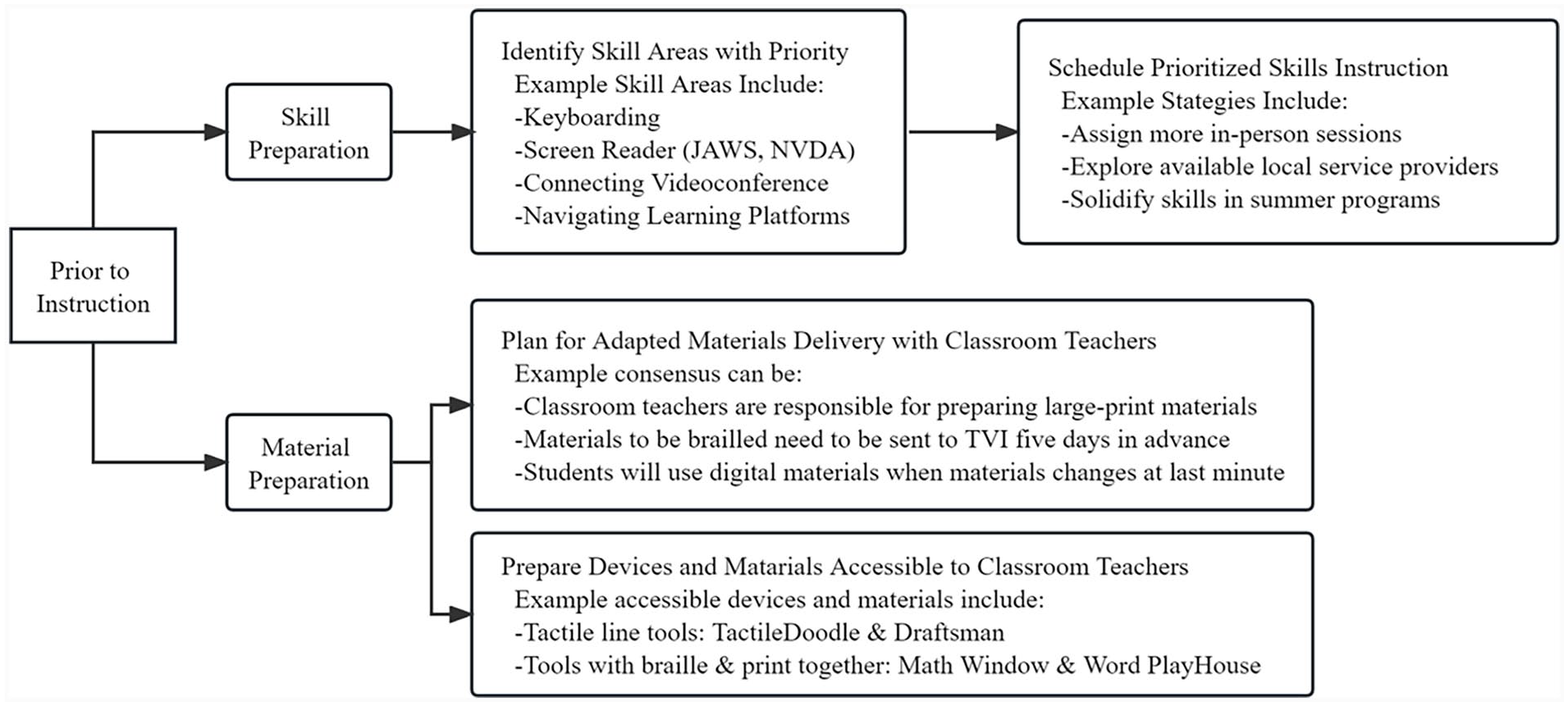
Conceptual map of skill and material preparation considerations.
Identifying skills of focus for students’ VI services
To deliver any type of remote instruction, basic assistive technology (AT) skills are the critical prerequisite (Ericson & Rudinger, 2021; Silverman et al., 2022). TVIs must determine students’ strengths and needs in an expanded core curriculum (ECC) or AT assessment prior to the delivery of any remote instruction. Such assessments will determine which skills are necessary for the online instruction to be successful. Skills for online instruction should be placed at higher priority so that other instruction may follow remotely. Prerequisite skills for remote instruction include keyboarding, screen reader keystrokes, screen magnification, and connecting to videoconferencing software.
General classroom technology should be considered alongside vision-specific AT. Teachers of students with visual impairments should equally assess students’ ability to access their school’s digital learning platform (e.g., Google Classrooms, Canvas, Schoology). This can help prevent the student from falling behind their peers on access core curriculum content by also prioritizing technology access. Currently, there are several reliable ECC and/or AT assessments TVIs may use to evaluate students’ skills. Table 1 provides an overview of the most commonly used resources. Once target skills are identified, TVIs need to determine the location and modality of service hours to teach the skills. TVIs can deliver comprehensive instruction on the prerequisite skills for remote instruction, using in-person service time to introduce new skills and use remote service time to reinforce the skills.
Select Expanded Core Curriculum and Assistive Technology Assessment Tools for Assessing Students’ Prerequisite Skills.
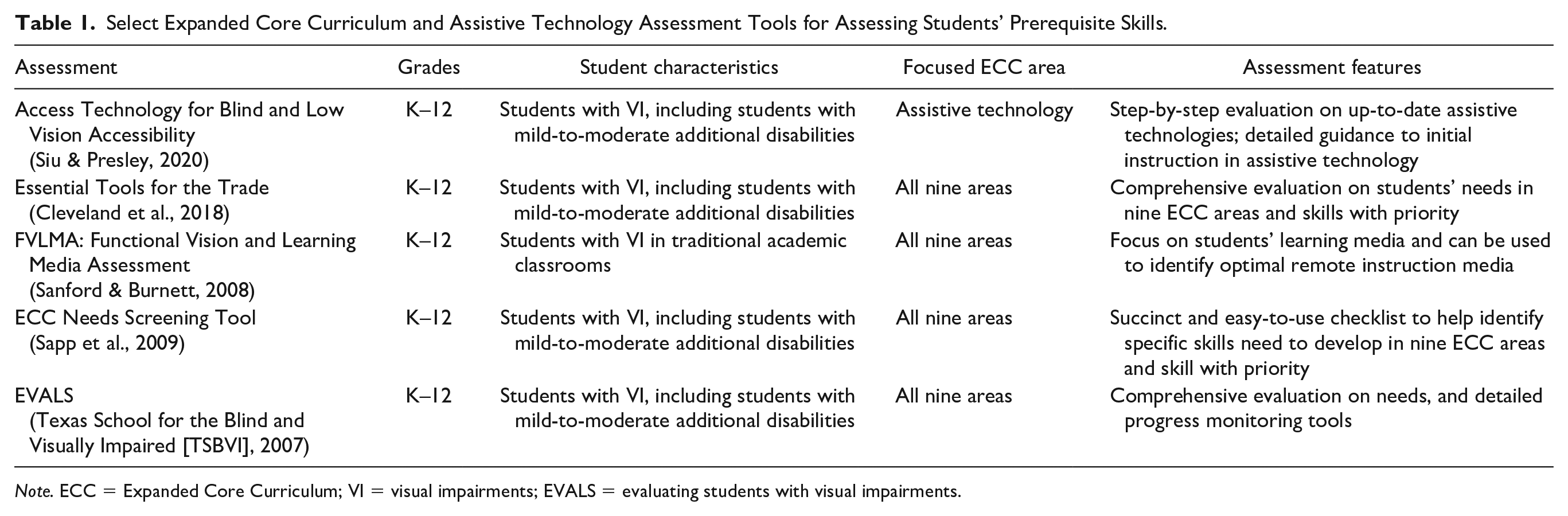
Note. ECC = Expanded Core Curriculum; VI = visual impairments; EVALS = evaluating students with visual impairments.
Initial in-person instruction is not always an option, so school teams may need to consider additional sources of support for in-person to bridge the skill gap for the TVI’s remote instruction. One strategy is that the school team can assign a paraeducator or other adult to be present for the remote instruction to help with facilitation. The education team can also look for services from other providers to prepare students with the skills. For example, the American Printing House for the Blind’s regional Centers for Assistive Technology Training (CATT) may be able to provide support, or state-funded departments (e.g., Vocational Rehabilitation, Commissions for the Blind) may have AT centers that can support school-age students. Lastly, summer camps designed for students with VI are also available around the country, and many of them can set solid foundations of skills necessary for remote instruction. For example, the Texas School for the Blind and Visually Impaired provides ECC training and braille class in summer, and the assorted videoconferencing reinforcement sessions after the training were found effective in the maintenance of skills (Rose, 2020).
Planning accessible materials for classroom instruction
Many students with VI rely on adapted, accessible academic materials to access academic content. Classroom teachers and TVIs should proactively communicate on how to share classroom materials so they can be adapted with enough advance notice. Communication will ensure that students have access to materials in a timely manner, regardless of how frequently a TVI is physically at their school. During collaboration, TVIs and classroom teachers should come to consensus on the following items:
Who is responsible for adapting materials? For example, a classroom teacher can be taught to produce large print while the TVI or Braillist is responsible for braille and tactile graphics.
What materials can the student use in a digital format (provided by the classroom teacher) compared with needing hard-copy braille produced by the TVI? Students’ preference and literacy/AT skills should be considered.
How far in advance should classroom teachers give materials to the TVI? Factors such as how the TVI can get materials delivered to the school would play a role.
How should the education team communicate when the learning materials are changed at the last minute? For example, can digital materials take the place of braille materials? For older students, they may have the skills to adapt their own materials and/or partnered with a peer.
Beyond these examples, making good use of cloud services can ease TVIs’ workload for material preparation. The TVIs may request access to cloud services in the school district and classroom teachers can share materials in the system. Students who have the skills and security permissions to also access materials can benefit more from the platform.
Preparing tactile materials that are accessible to students and classroom teachers
TVIs and braille transcribers are the only members of the educational team trained to make high-quality braille materials and tactile graphics. As a result, classroom teachers should take advantage of available tools that are user-friendly and do not require prior knowledge of the braille or tactile graphics for in-the-moment accessibility. For example, TactileDoodle and Draftsman from American Printing House for the Blind (APH) are easy-to-use tools to generate raise line graphics. Classroom teachers can use the tools to explain concepts for students by producing shapes on the drawing film. The Math Window is another example of tool that is accessible to classroom teachers. Students can show their works and operation procedure on the Math Window and the print label on each braille cell is visible to teachers. This allows teachers to review and comment on students’ work and correct any mistakes. Additionally, the APH catalog contains many products that are accessible to classroom teachers and students with VI. As TVIs do for traditional in-person collaborations, TVIs providing remote services can educate classroom teachers on APH’s resources available through Quota Funds to promote students’ accessibility to class content at no cost to the school team (American Printing House for the Blind, 2022).
Ensuring Quality During Remote Instruction
Individualized pull-out (1:1) instruction is perhaps the most common service delivery model for TVIs’ service time with students with VI. For some students, this can translate to remote instruction where the student and TVI meet in real-time through video and/or audio-conferencing tools. To ensure high-quality instruction, however, logistical factors such as must be considered (e.g., Trust, n.d.). The following outlines key considerations to promote more engaging and accessible instruction.
Adjusting lighting and camera angles
There are many resources available online to help everyone have better lighting and camera angles for being well-lit on camera. Most strategies suggest facing natural light or lamp light to prevent appearing poorly lit on the screen. This can be helpful for TVIs to be more visible on the screen. However, photophobia is common among students with VI. Putting a light source in front of these students or asking them to face the sunlight will negatively affect them. One common accommodation is to cover the lamp with filters or apply thin curtains on the window to soften the light. Students with light sensitivity may benefit from improved lighting, increasing the quality of video, and also the TVI’s ability to see the student, ultimately resulting in higher quality instruction.
When the instruction is related to hand movements, such as keyboarding or braille, TVIs should consider the camera angle. Cameras on the laptops and computer monitors are typically designed to point at users’ faces. As a result, TVIs may consider requesting assistance from teachers or paraprofessionals, or coaching the student, on to how set up a second camera (e.g., an iPad) where TVIs can see the students’ hand movements.
Using clear and accurate language to give directions
Hand-under-hand technique, a strategy to let students’ hands rest on teachers’ hands to feel the movement or to navigate different objects, is best practice when working with students with VI (National Center on Deaf-Blindness [NCDB], 2021). In remote instruction, however, the absence of physical contact prevents teachers from using hand-under-hand. In lieu of physical prompting, teachers need to clearly articulate instructional directions. Of additional consideration, videoconferencing often produces symmetric image on teachers’ screen. For this reason, TVIs should be aware of student’s left and right in the screen at the beginning of instruction to avoid giving confusing directions. TVIs should also avoid using ambiguous prepositions such as “this” or “that.” For example, when working on the Math Window, TVIs should tell students “Take the number 3 block on the upper right corner” instead of “Taking the square next to your hand.” Last, TVIs should also be aware of the audio quality. A ripping noise often appears when the internet connection is not stable or when the speaker’s voice is too loud. To achieve better sound effect, it is suggested that TVIs should speak more slowly to enunciate their words and use a headset with a microphone rather than rely on a built-in microphone.
Utilizing various tools in video conferencing software
Video conferencing software have built-in functions that can promote engaging and accessible remote instruction (Technology Education and Learning Support [TEALS], n.d.). For example, in Zoom the whiteboard tool can enable students and teachers to work on the same content synchronously. This can both prevent students getting lost when switching between conferencing software and online documents and serve as an interactive notetaking platform. The whiteboard can be used in place of a physical behavior token board to track students’ performance.
The virtual background is another key accessibility function in most video conferencing platforms. The virtual background can help TVIs create a learning setting with less visual clutter, which is critical for students with VI, especially cortical VIs to locate the important information faster (McDowell & Budd, 2018). Lastly, being able to take cover control remotely of a student’s device can be a helpful feature to have access to as well. When students mistakenly change the settings, cannot find their cursor, or get lost using their computers, the function of remote control can enable TVIs take student back to where they start and resume the instruction.
Conclusion
Students with VI have the right to receive high-quality TVI services and accessible instructional materials in their LRE. Remote and hybrid TVI service delivery is a realistic solution to teacher shortage issues as well as for the possibility of providing more routine services to students in geographically remote areas. To ensure successful remote instruction, TVIs should first assess students’ foundational technology skills to determine if the student has the necessary prerequisites to engage in remote instruction. Once the student’s assessment is completed, TVIs can work with school teams to either provide instruction in the prerequisite skills or develop a learning plan to address other key areas of instruction. By having consistent, clear communication with the students’ classroom teachers and other support staff, students’ remote support by a TVI can be a positive experience for all. Since the population of students with VI is greatly heterogeneous, TVIs should also be creative applying the strategies to best meet students’ individual needs.
Footnotes
Declaration of Conflicting Interests
The author(s) declared no potential conflicts of interest with respect to the research, authorship, and/or publication of this article.
Funding
The author(s) received no financial support for the research, authorship, and/or publication of this article.
