




Abstract
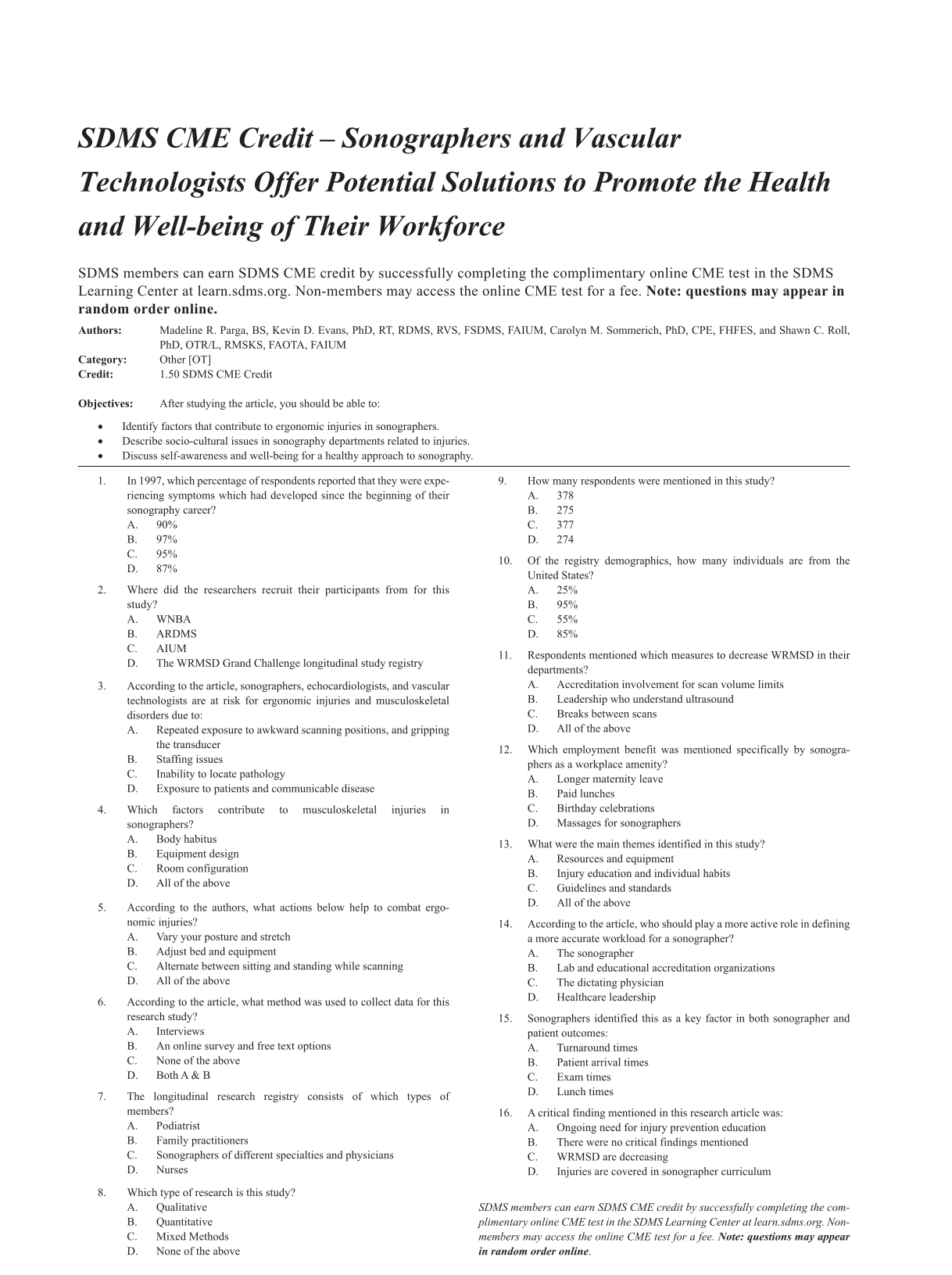
SDMS members can earn SDMS CME credit by successfully completing the complimentary online CME test in the SDMS Learning Center at learn.sdms.org. Non-members may access the online CME test for a fee.
Identify factors that contribute to ergonomic injuries in sonographers.
Describe socio-cultural issues in sonography departments related to injuries.
Discuss self-awareness and well-being for a healthy approach to sonography.
In 1997, which percentage of respondents reported that they were experiencing symptoms which had developed since the beginning of their sonography career? A. 90% B. 97% C. 95% D. 87%
Where did the researchers recruit their participants from for this study? A. WNBA B. ARDMS C. AIUM D. The WRMSD Grand Challenge longitudinal study registry
According to the article, sonographers, echocardiologists, and vascular technologists are at risk for ergonomic injuries and musculoskeletal disorders due to: A. Repeated exposure to awkward scanning positions, and gripping the transducer B. Staffing issues C. Inability to locate pathology D. Exposure to patients and communicable disease
Which factors contribute to musculoskeletal injuries in sonographers? A. Body habitus B. Equipment design C. Room configuration D. All of the above
According to the authors, what actions below help to combat ergonomic injuries? A. Vary your posture and stretch B. Adjust bed and equipment C. Alternate between sitting and standing while scanning D. All of the above
According to the article, what method was used to collect data for this research study? A. Interviews B. An online survey and free text options C. None of the above D. Both A & B
The longitudinal research registry consists of which types of members? A. Podiatrist B. Family practitioners C. Sonographers of different specialties and physicians D. Nurses
Which type of research is this study? A. Qualitative B. Quantitative C. Mixed Methods D. None of the above
How many respondents were mentioned in this study? A. 378 B. 275 C. 377 D. 274
Of the registry demographics, how many individuals are from the United States? A. 25% B. 95% C. 55% D. 85%
Respondents mentioned which measures to decrease WRMSD in their departments? A. Accreditation involvement for scan volume limits B. Leadership who understand ultrasound C. Breaks between scans D. All of the above
Which employment benefit was mentioned specifically by sonographers as a workplace amenity? A. Longer maternity leave B. Paid lunches C. Birthday celebrations D. Massages for sonographers
What were the main themes identified in this study? A. Resources and equipment B. Injury education and individual habits C. Guidelines and standards D. All of the above
According to the article, who should play a more active role in defining a more accurate workload for a sonographer? A. The sonographer B. Lab and educational accreditation organizations C. The dictating physician D. Healthcare leadership
Sonographers identified this as a key factor in both sonographer and patient outcomes: A. Turnaround times B. Patient arrival times C. Exam times D. Lunch times
A critical finding mentioned in this research article was: A. Ongoing need for injury prevention education B. There were no critical findings mentioned C. WRMSD are decreasing D. Injuries are covered in sonographer curriculum
SDMS members can earn SDMS CME credit by successfully completing the complimentary online CME test in the SDMS Learning Center at learn.sdms.org. Non-members may access the online CME test for a fee.