




Abstract

Kevin’s goals: In 2012, I offered Dr Dashottar a post-doctoral position, to work in my research lab. Dr Dashottar had completed his PhD and was looking for additional skills and time to publish his dissertation work. Amit’s doctoral studies had been primarily working in a one-on-one mentored relationship with only a few colleagues, in his lab. Upon accepting my job offer, I talked with Amit about the very different climate that existed in our workplace. In our lab, we had a PhD student, several MS students, two undergraduate researchers, and a highly involved administrative assistant. Lab meetings were weekly, and our culture was one that valued everyone’s opinion. This was demonstrated by the degree to which our undergraduate students openly asked questions and made suggestions on funded projects. My desire was to bring a post-doctoral researcher into the lab to add leadership and also to provide an important voice to the kinds of research we were conducting. I also wanted to provide Amit with a richer, more team-based work experience that was mindful of his background and need for inclusion. The following inclusive framework has been proposed by Shore et al and has been used for describing the degree to which belongingness and uniqueness work together (see Figure 1). 1
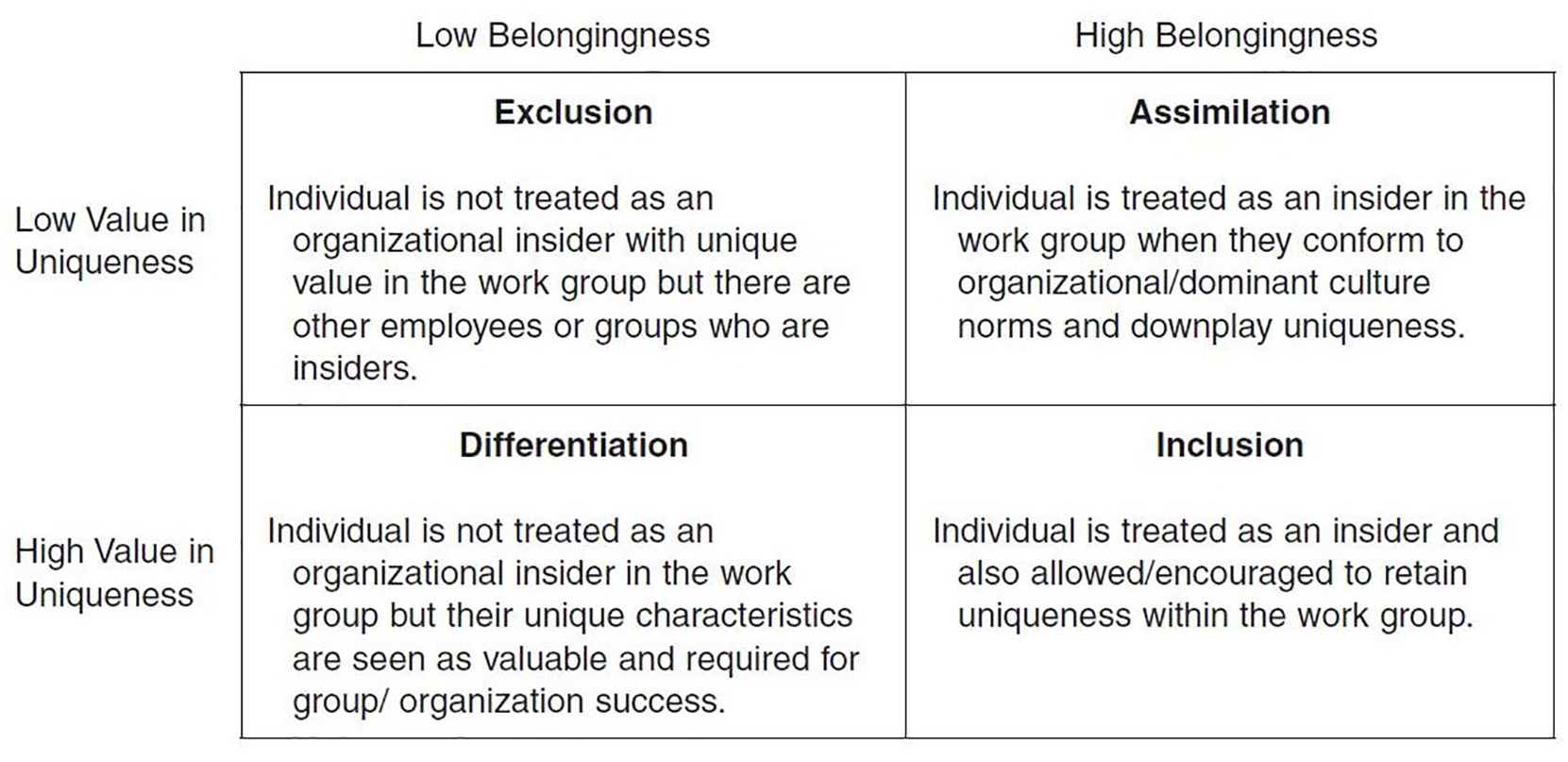
Inclusion framework.
It was my desire to bring Amit to the lab, based on his highly valuable and unique research. This was coupled to a potential for Amit to feel a low sense of belonging. Using the inclusive framework, this placed Amit at that particular level of differentiation, but my goal was to move to inclusion. To make this progression, it was important to not only focus on ways to reinforce his high value but also move to a state of high belonging. It was important to work with Amit and our group to achieve the level of inclusion that benefited our entire work team and positively influence the work we were conducting. This was not as simple as hiring the person and hoping it would turn out as expected. At our first lab meeting, all our staff actively talked and expressed a variety of opinions. This was a huge shift for Amit but demonstrated the group’s willingness to include him. As the leader, I dedicated my efforts to moving Amit and the workgroup through these inclusive dimensions, as outlined by Shore et al.
Amit’s goals: I was excited about joining Kevin’s lab and working with his staff and students. Upon my arrival, I did not feel excluded at any point by Kevin or by anyone else in the lab. I would attribute this ease of entry to the culture of the lab that he had created before I accepted his offer. My goals were to further advance my technical expertise in the use of shear wave elastography (SWE). Using the Shore et al model, I would say that the research project that I was proposing was highly unique and was seen as valuable by Kevin and the rest of the research group. In addition, I wanted to experience being part of a bigger research team and the leadership role as a Post-doctoral researcher. I saw this as an opportunity that I was ready to invest in by learning new skills that would benefit both my career and the lab. The trick was to get others (besides Kevin) interested in this new line of scientific inquiry. I wanted to work with the staff and also advance my own line of research thereby making the work more inclusive and fostering a high sense of belonging.
Selecting a Successful Work Project That Fosters Inclusion and Teamwork
One of the ways to make Amit feel an important part of our team was to select a project that benefited him as well as members of our lab as part of the work process. Mor Borak has stated that success in fostering an inclusive workplace is hinged on the degree to which individuals sense that they are an important part of the workplace. 2 He suggests that “these processes include access to information and resources, connectedness to supervisor and co-workers, and ability to participate in and influence the decision-making process.” 2 In my situation, I wanted to demonstrate my trust for Amit and his ability to learn to lead a team and complete a research project. In my ways, I was trying to use some of the contextual antecedents that were provided by Shore et al (see Figure 2). 1 Choosing a basic science experiment that Amit could lead and be assisted by our staff reinforced the tenants of an inclusive climate, leadership, and practices, which supported his shoulder research.3,4 These were all done to provide Amit with a feeling of workgroup inclusiveness and give experiences for the next stage of his career. The outcomes for my lab were high-quality interactions among our employees, increased satisfaction, and certainly even higher job performance. These outcomes don’t come without careful cultivation and providing strong guidance to the entire group of employees. Shore et al claim that diverse individual experiences can be extremely positive when there is a sense of belonging and value for their unique skill set. 1

Antecedents and outcomes of inclusion.
Amit’s sense of inclusion: It’s easy to describe diversity and inclusion in a very narrow framework of gender, race, nationality, and so on. I believe that my work in Kevin’s lab demonstrates that diversity is also the ideas that come from outsiders. In a time in higher education where diversity, equity, and inclusion (DEI) issues are more important than ever, achieving the DEI goals need vision, expertise, competent leadership, and a significant level of trust among leadership and employees.
My work in Kevin’s lab not only provided me with additional technical expertise in the use of SWE but I also gained significant experience of leading research project with undergraduate and graduate students as part of the team. This process was not always smooth but the level of trust and inclusion that Kevin had fostered made it much easier for me to voice my comments, agreements, and specially disagreements. The experiences and skills that I developed while working with Kevin and observing Kevin’s leadership is something that I try to model when initiating new students in my lab now!
The Employee-Organizational Relationship (EOR)
Shore et al have also explored the added dimension of culture and the sense of belongingness that forms the EOR. One facet of concern is how the employee processes and evaluates their relationship with the organization and the contribution of the employer. 5 Meeting with Amit, we discussed not only his ongoing research but also how to secure future employment. This personal relationship helped to foster a sense of belongingness and also increased the value of the EOR. I welcomed Amit’s suggestions, as they provided context around our work practices. These discussions, both personal and in team meetings, paid huge dividends. It was important for us to listen, learn, and execute based on Amit’s leadership experiences. I would submit that the team did achieve the goal of inclusiveness as well as strengthening the EOR. A by-product of these discussions and changes in our work educated our graduate and undergraduate students, in ways that I could never have provided (see Figure 3). These are just a small example of how the workplace can profit by working to make a more inclusive workplace.

Dr Dashottar supervising Zach Walker, our pre-med student, working in the basic science lab, to evaluate a shoulder joint. Zach is currently a first-year Emergency Medicine resident.
In summary, it is hard work, but these are important changes that need to be implemented in labs and clinics. Research conducted by Randel et al found that a positive relationship exists between a work leader’s inclusive attitude and work group–directed helping behaviors, particularly when accompanied by a positive psychological diversity climate. 6
The importance of making these workplace changes and fostering these inclusive environments starts with the leader—