Abstract

The implementation of sonographic training, in premedical undergraduate and medical school settings, is becoming increasingly popular with innovation in both technologies and curriculums. During my undergraduate career, I was afforded the opportunity to interact with sonography from a research and an educational standpoint, and have since come to regard this experience as foundational in preparation for a career in medicine. Now, as I am interviewing at medical schools across the United States, I have taken the time to reflect on the 3 years I spent learning sonography, brainstorming novel ways to use this technology, and implementing sonography in a clinical research setting. I look forward to utilizing and refining the invaluable skills gained as a result of my interactions with sonography, as I continue on my medical career. I hope to use my experiences to not only inspire other premedical undergraduate students to seek out ultrasound research opportunities but also highlight the benefits of sonographic laboratories and principal investigators for providing deep learning opportunities.
There are a multitude of benefits that can arise from premedical undergraduate student involvement in research. Sonographic research serves as an outlet for both formal and informal education as there are times where learning will be conducted in structured, goal-oriented, instructor-led formats (formal education), and there are other times where the learning will occur in an unplanned and self-directed manner, with no specific goals (informal education). This type of sonography-based education leads to students having the opportunity to obtain critical clinical skills. They can gain hands-on experience working with imaging equipment and interacting with medical professionals from diverse backgrounds, acquire indispensable clinical scanning and research-related clerical skills, and will have a strong potential for patient interaction. They also will be exposed to the importance of conducting research from a team-based approach and the successful collaboration necessary for high efficacy. With innovations and advancing technology making sonography more and more prevalent across specialties in the medical field, modern ultrasound equipment systems are continuing to become the new “physician’s stethoscope.” 1 As a result, premedical undergraduate students involved in sonography research will be able to take the skills they gained from working in their labs and directly apply them to their future educational endeavors and medical practices. This concept was supported by survey research collected by Stone-McLean et al. Responses from medical students, residents, and educators indicated a preference for specific sonographic content integration that was tied to and helped fill their perceived needs. 2
Premedical students are bombarded with pressure to engage in research to immerse themselves in the scientific process and to prepare them for the rigorous detail necessary for success in medical school. While research is paramount for the understanding of how the medical field advances and of why peer-reviewed literature is held to such high standards, the pressure to get involved may misguide some undergraduates. There is a chance for these students to commit to working or volunteering in a laboratory where they have little interest and gain little benefit from the experience. Approaching research from the sole vantage point of building a resume can negatively affect the student’s goals and the laboratory’s mission. This is why first and foremost when considering an undergraduate research experience, the student must be willing to reach out to intriguing labs, but realize they may receive rejections before finding the right fit. The student should question their research interests before entering a lab. Are they more drawn to clinical or nonclinical research? Would the student prefer working at a bench mixing reagents or out in the field collecting insect samples? Would they like to have patient interactions or would they prefer to complete work on their own schedule analyzing data sets? When students have engaged in this type of introspection, then the student may begin participating in a type of research that is meaningful for them and the lab. From an instructor’s or principal investigator’s viewpoint, this is also important to consider when onboarding undergraduates. An in-depth hiring and interviewing process will give the best chances of adding a meaningful team member who can be counted on to carry their weight. For undergraduates who are drawn to research in a clinical setting, training in sonography could be a great personal fit.
In order for the student’s learning and research experience to provide the greatest benefit to themselves and the investigator, the 2 parties must communicate and reach an understanding of the student’s motivations, commitment, and goals. A student must be clear with how deeply they wish to get involved with using sonography so that the mentor can properly gauge their curiosity and help them to achieve their desired outcomes. This can be visualized using a modified version of Bloom’s taxonomy of educational objectives (Figure 1), where individuals can fall on different sonographic competency levels. 2 A student who is excited about sonography and is committed to coming to the lab a few times a month to assist falls into the affective learning category. These are students who show positive attitudes, values, and behaviors toward sonographic research, but may not wish to dive deeper in the field. Those who encapsulate the characteristics of the affective category and go on to demonstrate a strong motivation for using an ultrasound equipment system, capture images, and improve their scanning techniques would be in the psychomotor category. Finally, under the guidance of a supportive and involved mentor, an exceptionally motivated student may move to the cognitive category where they can understand the diagnostic component of sonograms and grade various images for pathology or research criteria. Every individual student should not be expected to reach the cognitive stage or even the psychomotor stage, but rather should be encouraged and given ample opportunities to explore sonography at their desired competency level. It is a delicate back and forth between the mentor and mentee to find where each individual falls on this proposed learning continuum, but can prove extremely rewarding when carried out efficiently. No matter the depth of a student’s learning, with commitment, they can play a meaningful role in helping the lab and can gain relevant skills for their future.
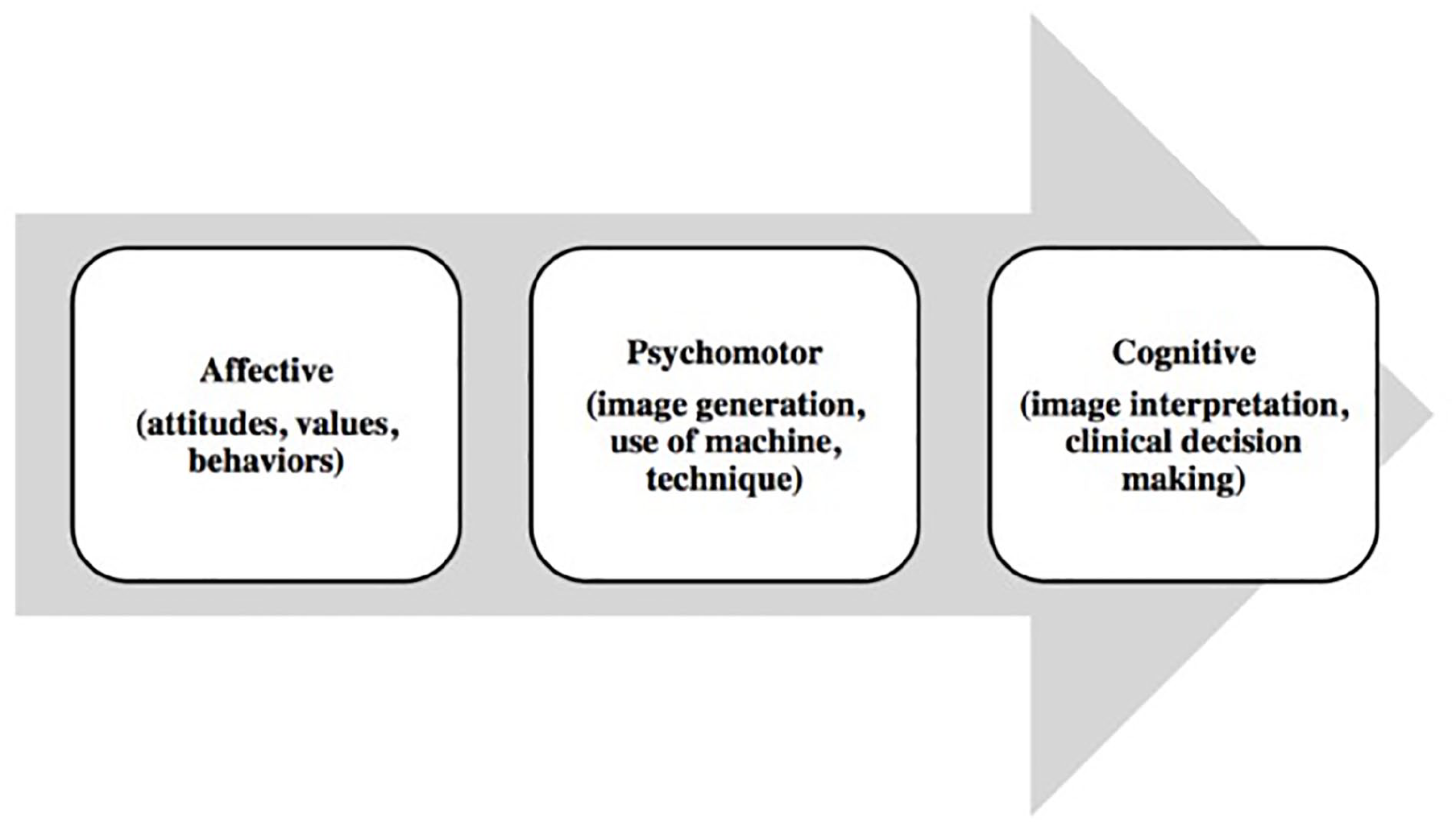
A modified version of Bloom’s taxonomy of educational objectives for medical students learning sonography.
The continuously improving and emerging technology of sonography will play a role in many future physicians’ careers. Early exposure and education of sonography to premedical students can prove vital to investigators and students alike when implemented efficiently and can lead to scientific discoveries, well-rounded medical student applicants, and a new generation of exciting innovators.