



Abstract

“I was taught that the way of progress was neither swift nor easy.”
The motto Stand on the shoulders of giants is a fixture within science, touted on the Google Scholar website, and emphases that intellectual progress is built upon the work of intellectuals who have gone before. It was made infamous by the father of physics, Sir Isaac Newton, who stated, “If I have seen further it is by standing on the shoulders of Giants.” 1 Newton may have alluded to giants, but what about the giantesses? How often do you hear about giantesses?
Giants and giantesses aside, the work of women in science is legendary. This piece highlights a couple of women scientists and would like to note the acronym STEM (science, technology, engineering, and math) according to the US National Science Foundation, refers to as “all fields of fundamental science and engineering, except for medical sciences” 2 The exclusion of applied medical sciences, when referring to STEM, may strike some as underscoring the inherent gender bias; however, it may be more likely the federal National Institute of Health fills this financial void and is the reason behind the omission. Women make up approximately 75% of the health workforce worldwide. 3 According to the latest SDMS Salaries and Benefits report, women make up 88% of sonographers, and 83% of sonography educators. 4 Regardless of the definition of STEM, sonographers should not be disqualified as thinking of themselves as scientists. It requires highly technical work, deep anatomic knowledge, applies and propels scientific discoveries broadly, as well as unveils singular discoveries in patients every day.
Whether you have been inspired by women in science in your own life, or have found it in an article or book, the brilliance and creativity is often mixed with undisputable determination, pushing against societal norms and expectations. 5 By recognizing the past, being cognizant of the pearls and pitfalls of the present, and building a brighter future, women in science may inspire perseverance in sonographers of all genders.
The Past
It has been over a century since one of the most influential women in science, Marie Curie, became the first woman to be awarded the Nobel Prize in science. (Figure 1) Furthermore, she became the first person to win two Nobel Prizes, in physics in 1903, and in chemistry in 1911. Curie was prolific, publishing 32 scientific papers in only 4 years. 5 Despite her accolades, the connection of her work to the term “radiology” is largely obscured to this day. Many sonographers work within radiology departments and are familiar with National Radiologic Technologist Week which corresponds and commemorates Wilhelm Conrad Rontgen’s discovery of x-rays on November 8, 1895. 6 However, the term roentgenology is scarcely used beyond medical imaging professionals.

Marie Curie, 1903 Nobel Prize portrait. Dr. Curie won the Nobel Prize in Physics in 1903 and the Nobel Prize in Chemistry in 1911. (Nobel foundation, Public domain, via Wikimedia Commons).
Shortly after Rontgen’s discovery, Henri Becquerel stumbled upon radioactivity. However, it was Marie Curie who first coined this term “radioactivity” (Figure 3). Previously it was referenced as Roentgen rays, and from Becquerel’s work uranic or Becquerel rays. 7 Can you imagine working in the field of Uranicology or Becquerelology?
It was Marie Curie, along with her husband Pierre, however, who figured out how to measure the intensity of radioactivity was accomplished with the aid of the piezoelectric effect discovered earlier in 1880 by Pierre and his brother, Jacques Curie. 8 Furthermore, their oldest daughter, Irene, would continue their work on radioactivity, and also win a Nobel Prize in Chemistry (Figure 2). The Nobel Prize in 1903 was thus awarded to both Becquerel and the Curies. However, while Marie had the insights and did much of the work, they wanted to award the Nobel Prize only to her husband. As a result, half the prize went to Becquerel, and the Curies split the other half. 9
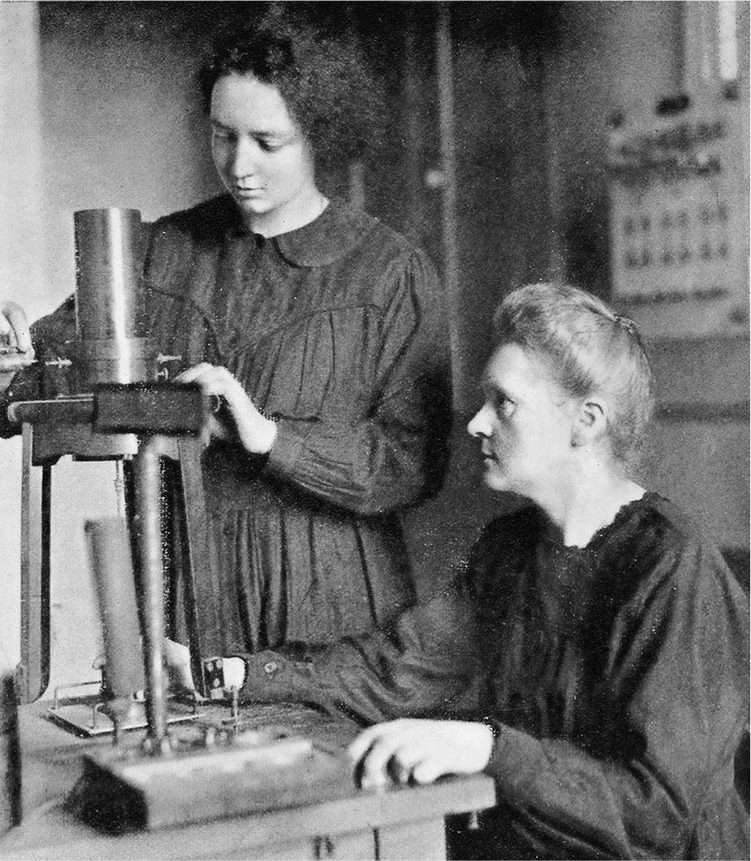
Marie and daughter Irène, 1925. Irène Joliot-Curie, along with her husband, Frédéric Joliot-Curie, won a Nobel Prize in Chemistry in 1935 for the discovery of artificial radioactivity. (Unknown author, CC BY 4.0 <https://creativecommons.org/licenses/by/4.0>, via Wikimedia Commons).
When Madame Curie (as she is often referred, while she did receive a doctorate of science [PhD] in physics) was the first person to have the accolade of two Nobel Prizes, this time in chemistry for her discovery of Radium and Polonium, the award ceremony speech recognized, “Indeed, research on radium has led during recent years to the birth of a new branch of science, radiology, which already commands institutes and journals of its own in the great scientific countries.” 7
The life of Dr. Marie Curie is awe-inspiring, filled with both tenacity and humility. During World War I, she equipped Renualt trucks with the first radiologic equipment, x-ray machines (which she worked to improve over the years) and drove these mobile trucks to the front lines in France to aid doctors. (Figure 3) Madame Curie learned to drive and fix these “Little Curies” coining the idea of the ambulance. She made around 20 such vehicles and taught over 150 women how to take x-rays, who, along with Marie Curie, the first Red Cross Director of Radiology, imaged an estimated one million wounded men. 10
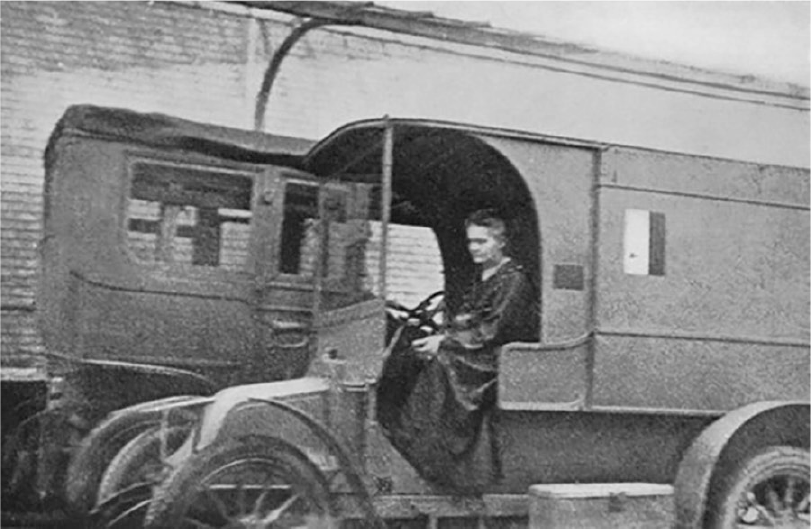
Marie Curie in a mobile Military Hospital X-Ray-Unit, ca. 1915. During WWI, Marie Curie built and drove these “Little Curies” to the front lines of battle in France to x-ray wounded soldiers to help doctors remove shrapnel. (Unknown author, Public domain, via Wikimedia Commons).
Present
Women in science have come a long way from the cold, improper working conditions, often lacking basic health-and-safety measures, along with supplies that Marie Curie and others faced. 5 Despite the physical workplace improvements, women are still severely underrepresented in science as a whole. Women of color are behind even further gap in scientific representation (See Table 1). Female innovators and entrepreneurs are further disadvantaged via funding—while 40% of companies are started by women each year, only 2% of these women receive venture funding. 11
At a Glance: Women in Science Today.

Abbreviation: UNESCO = United Nations Educational, Scientific and Cultural Organization.
UNESCO Science Report: toward 2030 (2021).
National Center for Education Statistics Report (2015).
This is why promoting women in science is to be commended. One example is Johns Hopkins Technology Ventures’ Pitch It On! A competition for female inventors, where women may win up to $10,000 for their innovations. The most recent winner of this event, Sridevi Sarma, an associate professor in the Department of Biomedical Engineering at Johns Hopkins, developed a heat map of the brain, called EZTrack, to aid doctors in determining the source of seizures in drug-resistant epilepsy patients, which affects roughly 30% to 40% of epileptics. 11 Dr. Sarma is a modern-day role model of how women are improving life through research and science.
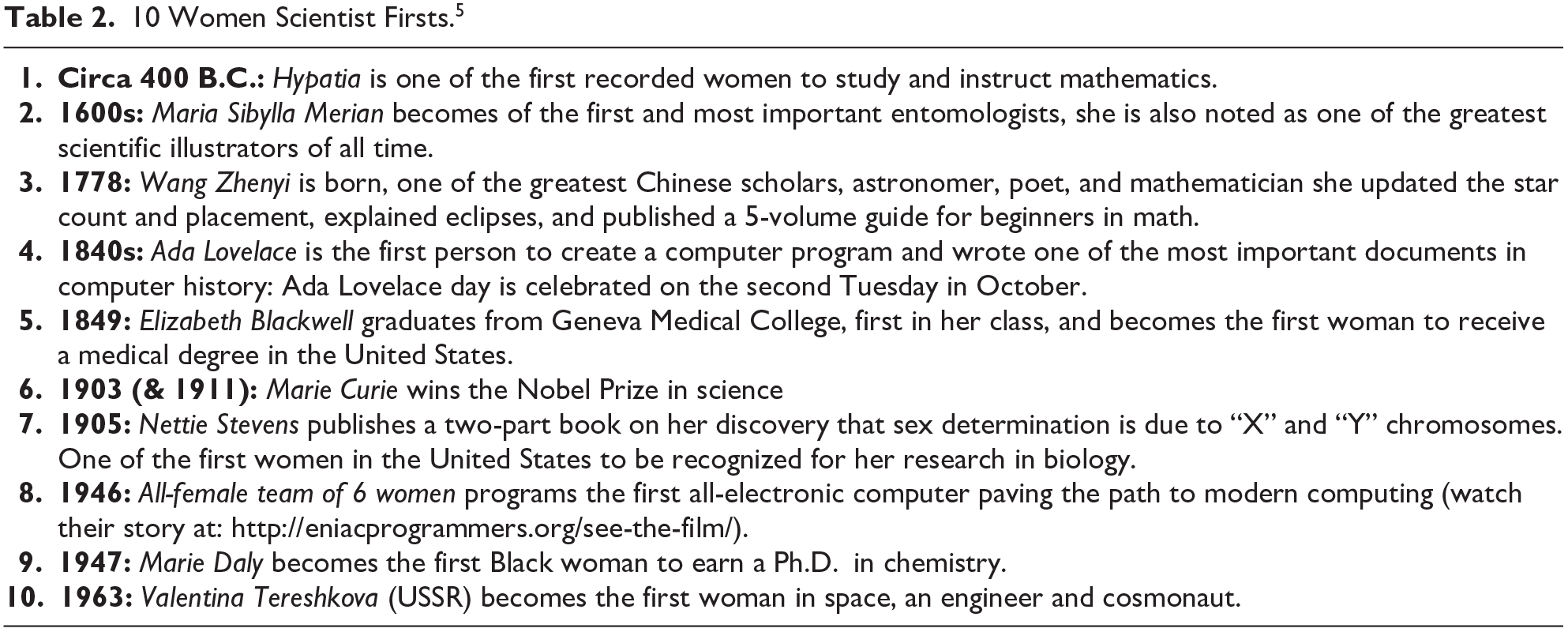
Despite an inherently male Google Scholar motto, the company is committed to improving leadership representation amongst underrepresented groups by 30% by 2025. Furthermore, Google reports the search for “women in science” recently hit a 10-year high, and in the past year the term “first woman” was searched more than ever before. 12 It is these countless trailblazers who are propelling the world toward equality. For a select few see Table 2.
10 Women Scientist Firsts. 5
Future
Undoubtedly, a lot has changed in the past century, and some may even (naively) consider equality as being achieved. Yet, women in science still state the feeling of being outsiders, and the impression of being reluctantly let in has not completely dissipated, as described in the film Picture of a Scientist by Sharon Shattuck and Ian Cheney. The film also provides a way forward, stating, “Let’s move away from a culture of compliance, and toward a culture of change.” 13 True has been realized, and according to the World Economic Forum, gender parity is not projected to be achieved for another century. 14 So, how do we strive for change to meet parity in our lifetimes?
Firstly, encourage women in their scientific, as well as educational pursuits. Promotion to leadership can often only be provided with the necessary qualifications of education and knowledge. Education is never wasted! Next, celebrate women, and women in science. Here are a few dates to note:
February 11th is the International Day of Women and Girls in Science
March 8th is International Women’s Day
March is Women’s History Month in the United States
The second Tuesday in October (October 12, 2021) is Ada Lovelace Day to commemorate the achievements of women in STEM (Figure 4)

Watercolor portrait of Ada Lovelace by Alfred Edward Chalon around 1840. Ada was the daughter of Lord Byron, English poet, and Lady Bryon, an English mathematician nicknamed the “princess of parallelograms.” (Alfred Edward Chalon, Public domain, via Wikimedia Commons).
Finally, model it. We are all responsible for our own actions, thoughts, and words on a daily basis.
14
Even seemingly benign conversations with the public as a sonographer can have an impact. Is it a camera or a transducer? Are we technicians or technologists? Do we just take pictures? Individually and collectively, we have all been guilty of “dumbing down” our knowledge. Hopefully through modeling an inquisitive and persistent pursuit of science, we can empower not only our profession, but ourselves, our families, and our patients. We never know who is watching; perhaps the next first woman to