



Abstract

In the midst of the COVID-19 pandemic and the race to develop a safe and effective vaccine to combat the novel coronavirus, medical research has never been more front and center in our society. Careers in the health care and biomedical research industry account for approximately 650,000 jobs in the United States. 1 With an anticipated growth of 5% over the next decade, this is a sector of industry with which all health care workers are bound to have some level of interaction. Getting involved in health care research, early in your career or better yet during undergraduate or professional training, will position you for future contributions or enable you to support it execution.
Beyond gaining familiarity, engaging in undergraduate research may be the first step in a lifelong career within the biomedical research industry. The National Institutes of Health (NIH) alone grants approximately $40 billion annually to universities and institutions for medical research. This combined with other funding agencies and private industry resulted in just under $195 billion spent on medical and health research in 2018, a figure which has increased by more than 6% over the last 5 years. 2 With this previous, and expected growth rate, there will most certainly be a need for well-qualified and trained researchers in the workforce and match the demands of rapidly advancing health care innovations.
Upon entering the radiologic sciences program, during my undergraduate education, I had no intention of getting involved in research. This was mostly because I knew little about research in health care and the important role it serves. Fortunately though, research topics were woven into our curriculum, and department faculty were always encouraging students to get involved in their ongoing projects. At that time, my advisor Dr. Kevin Evans was beginning a study investigating a novel use of ultrasound imaging to detect musculoskeletal pathology, in particular carpal tunnel syndrome. Because this was a novel application in its early stages, investigations were done in an animal model. Doing so allowed us to remove many confounding variables to provide a clearer representation of variables being examined, and thereby stronger evidence of the use of sonography to detect median nerve inflammation.
I was able to get involved right away and was tasked with collecting data. This meant performing sonograms on the wrists of Macaca fascicularis primates. Scanning the wrists of monkeys was certainly nothing I imagined doing; however, the hands-on experience was invaluable. I learned a great deal about gathering pre-clinical evidence and performing research in an animal model. If I had stopped my undergraduate research experience at this point and ended my involvement with just participating in data collection, I still would have gained a much better understanding of research in health care. However, I elected to get more involved in the project, which propelled my experience far beyond any initial expectations.
At this same time, I met with my advisor to formulate my own research question, related to the study, and developed a subcomponent of the main study of the carpal tunnel study that was being performed. Going through this exercise not only provided me with insight into research methodology and study design, but it also resulted in a portion of the study for which I was responsible. Now, I was able to contribute to the overall findings of the study while still “owning” a piece that I could see through the entire process of data collection, analysis, and reporting.
Once all our data were collected and images assessed, I was able to work with biostatisticians to analyze the data and begin interpreting the results. While examining the study findings, I learned how to review the relevant literature to determine how our findings compared with the existing evidence, and how to scientifically report our results. I did so by drafting manuscripts that went on to be published in scientific journals, and also creating and presenting scientific posters at university research forums and professional meetings.
The exposure I received to research during my undergraduate time ended up completely altering the initial plan I had for my career. The knowledge and experience I received resulted in developing skills in data collection, data analysis, literature review, and scientific writing/reporting gained, which I was able to keep building upon. After obtaining my undergraduate degree, I decided to make research part of my long-term career goals, going on to complete my Master’s and PhD. I did this continuing the same line of investigation that I began during my undergraduate research experience.
Brief Overview of Research Types
Irrespective of the academic or industry sector, there are a wide range of career options in the type and level of research. Opportunities in pre-clinical research, such as my undergraduate experience involves working in a lab, often with animals or novel technologies. This is also referred to as Basic Research or Experimental Research. The focus of this type of research is to perform initial safety or efficacy evaluations for a new treatment or technology to determine feasibility and whether further investigation should be pursued. Safety is also confirmed before advancing to further investigations in humans. Pre-clinical research is highly standardized and performed in a controlled environment. It is typically done in small subject populations and involve only a single dependent variable that is tested. This type of research comes with its own set of challenges as it is difficult to devise and execute a research strategy to remove any confounding variables which may obstruct the ability to obtain conclusive evidence regarding the variable being tested.
On the opposite end of the spectrum is clinical research. Clinical research, including experimental research characterized as study phases I to IV, is performed in humans and relevant patient populations to confirm efficacy and safety of new treatments or procedures. These are typically much larger in size compared with basic research studies. As a result, they require logistical considerations in addition to scientific expertise to effectively conduct these large-scale projects, while preserving the integrity of the date being collected. As clinical research is the precursor to gaining regulatory approvals, a new drug/technology can be brought to market, data integrity is of the upmost importance, and many additional requirements must be implemented to ensure studies are performed in compliance with expectations set forth by regulatory bodies. Observational research is another form of clinical research. Also known as noninterventional research, and just as the name implies, it involves monitoring a specific patient population undergoing standard clinical care to gather data regarding a particular type of treatment or intervention.
Other career opportunities exist with companies who provide specific services to support various components of biomedical research. One example of this is contract research organizations (CROs), which can be contracted to manage research studies and provide certain associated services such as regulatory support, clinical monitoring, cardiac monitoring, central laboratory services, and/or central imaging services. Furthermore, there are specialized CROs (and associated functional areas) that provide expertise and a more focused approach in a particular therapeutic area or type of research. With various CROs, or alike concentrations, there are endless career options to fit those with a specific area of interest or niche expertise.
Imaging Core Laboratories
In my current role, I work in an imaging core laboratory that is part of a CRO. We provide central management services for imaging data acquired in clinical research studies (clinical trials) that use radiologic biomarkers as study endpoints. Imaging measures are typically used to evaluate treatment efficacy or safety. As mentioned previously, clinical research is performed in large sample populations, meaning it requires the involvement of numerous locations to enroll and collect data on study patient participants. Locations that recruit patients for a clinical trial are referred to as a clinical site. Often, clinical sites for a given trial are located all over the globe. Just as in clinical practice, there are differences in scanning protocols, scanner type (make/manufacturer/model), technical settings, interpretation criteria, and so on among participating clinical sites. Furthermore, imaging required for a study may not be routinely acquired as part of routine care at each location, or only a portion of views acquired from a standard imaging acquisition protocol may be needed. Our responsibility as an imaging core lab is to standardize as much of the imaging-related components as possible to limit variability in the imaging data. Within our lab is a large group of imaging technologists spanning all modalities (MR, CT, ultrasound/ECHO, Nuc Med, DXA, etc.) who play a large role in developing standardized procedures for image acquisition and interpretation. Furthermore, they ensure this is adhered to throughout the study.
Initially, a standardized imaging acquisition protocol is developed to meet the needs of each specific study. Our imaging technologists assist in this development by providing technical input, and also contributing manufacturer-specific instructions to accommodate different scanner types and makes/models. This is distributed to all clinical sites, and our imaging technologists work closely with site imaging technologists to ensure full understanding of the acquisition protocol and answer any questions they might have. Throughout the study, we centrally collect study images in our lab so our imaging technologists can have oversight of the imaging being performed. They monitor the quality, making sure image sets are acquired in accordance with the study acquisition protocol and are of technical adequacy for study measurements to be performed. Beyond image data collection, we also commonly perform central interpretations of study images. Here, a single (or small group) of central readers (imaging physicians, often radiologists or cardiologists) perform image measurements used for study analyses. This limits variability associated with image measures. Our imaging technologists work closely with the central physician readers during their review to provide support and also commonly perform preliminary image measurements. The role of an imaging technologist within an imaging core lab perfectly hybridizes knowledge of performing imaging in a clinical setting with imaging research principles and can be a great opportunity for technologists wishing to leave the clinical setting while still heavily using their expertise on a daily basis.
Outside of clinical research, many opportunities exist specifically working with imaging technologies. This research focuses on the advancement and development of imaging modalities for commercial purposes. Companies who develop imaging systems, no matter the modality must test their new technologies prior to bringing them to the market. While many of these companies look to biomedical engineers and medical physicists to devise and build new imaging techniques, technical input and consultation from those with a clinical perspective are critical. Imaging technologists with an understanding of research and some experience carrying out studies make the ideal candidate for these roles. Once developed, new technologies then must still be tested to both make sure the scanner is safe and accurate, and confirm its clinical utility through field testing. Again, technologists with an understanding of research are well-positioned to offer a unique perspective from both a scientific and clinical standpoint.
Even if this does not seem a likely career move, participating in undergraduate research can still significantly enhance your education and be beneficial during your job search by making you a well-rounded candidate to prospective employers. Undergraduate research is commonly thought of as a way for research faculty to get “free help”; however, in my experience and from what I have observed both as an undergraduate researcher and in my post-graduate life, this could not be further from the truth. Even if only involved in a tertiary capacity, getting involved in research provides exposure to an enormous industry that is, in general, largely unknown. With emerging inter-disciplinary research techniques and the continued efforts to improve the quality of our health care industry, it is inevitable that you will encounter it at some point throughout your career.
Participating in research in a larger capacity has added benefits. Developing a research question, planning a way to investigate it, and the assessing outcome data all aid in the development of critical thinking skills. It also assists with problem solving, both of which can be applied to any job type. More specifically, research experience can help develop
Analytical and statistical skills from data analyses,
Writing skills from drafting scientific literature to report results,
Presentation and communication skills if able to present findings at research forums or professional conferences.
At the end of my undergraduate research experience, I was fortunate enough to have contributed to a few scientific articles reporting our findings. I was also provided with the opportunity to present my research at the SDMS annual meeting, and also at my university (Figure 1). Getting to present your research not only is a great experience, but also provides networking opportunities with future employers and graduate schools. Along these lines, it is also a way to meet and interact with other undergraduate researchers.
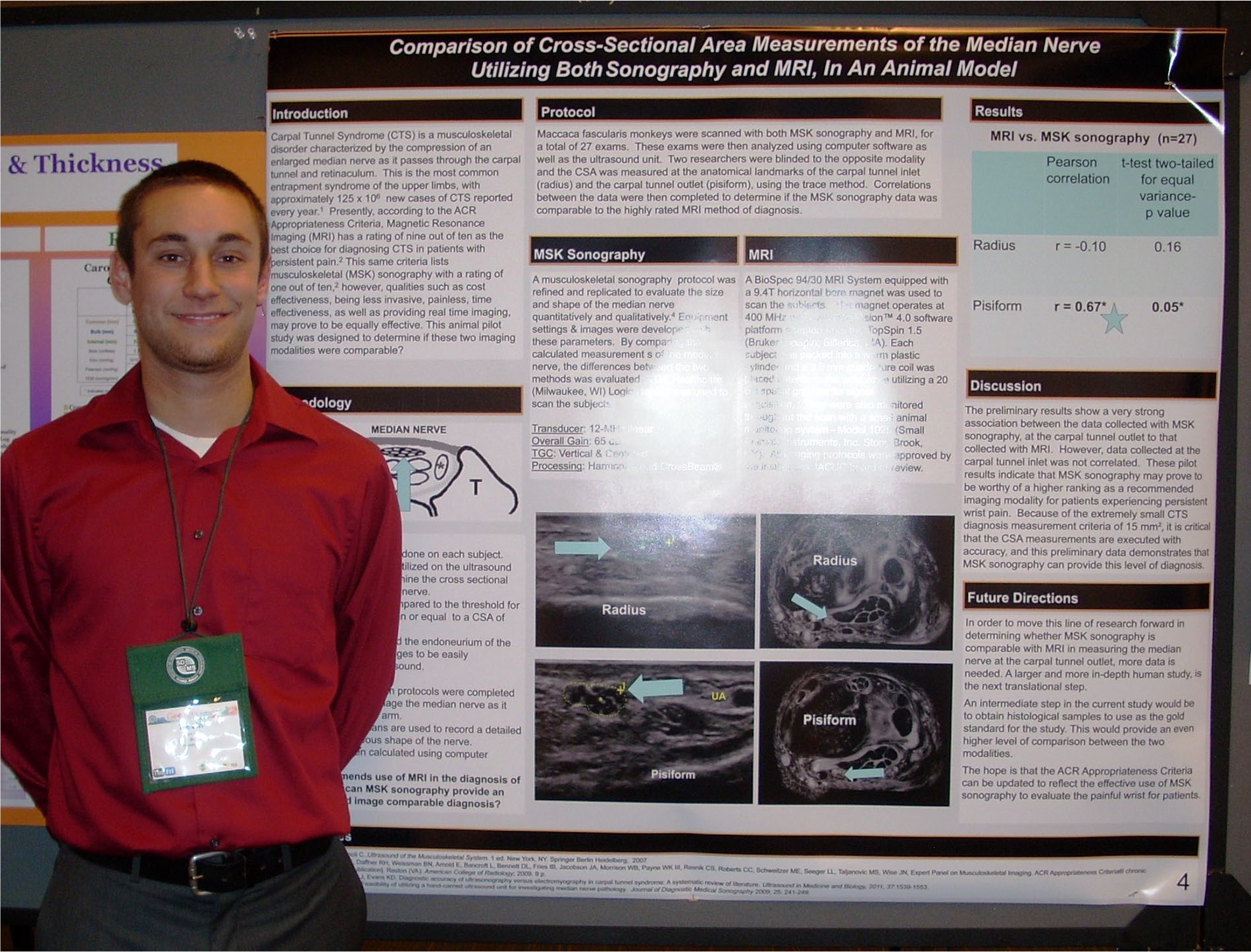
Kevin Volz exhibiting his poster at SDMS at 2011 annual conference.
Whether deciding to pursue employment or to apply for acceptance in graduate degree programs, particularly in the medical or health care fields, it has come to be expected that some degree of research experience be on the candidate’s resume for the reasons mentioned above. Advanced degree programs and employers are looking for individuals with the skills that are developed as part of an undergraduate research experience. Also, getting involved in research as an elective component of your undergraduate experience shows willingness to learn, expand horizons, and go beyond the minimum requirements to graduate. The criticality of research on post-graduate applications has become evident now with many universities implementing a required research project or program to graduate.
How to Get Started
So how do you get involved in undergraduate research. For some this may be obvious, but depending on your school and area of study, it may not be so evident. Some ways to get started are
Begin reading scientific literature in your field of interest, such as the JDMS
Contemplate what type of research to get involved in Pre-clinical versus clinical Therapeutic area Imaging modality
Talk to your college advisor or program faculty to see what options are available. Opportunities to get involved may exist within your own department or at your institution. Getting involved at the institutional level Provides exposure to new areas/technologies Inter-disciplinary projects
Take a research course if offered to gain foundational knowledge of research principles, design, methodologies, and so on.
My main goal was to highlight an area of health care that can be equally challenging and a rewarding career. It is a path that enables health care workers, particularly imaging technologists or those with an imaging background, to transition from a clinical setting and apply their unique expertise to the development of new treatments and technologies. It can be an opportunity to contribute in the development of a therapy that positively affects millions of individuals when successful. Hopefully, this sparks readers to consider research as an opportunity to explore different areas of biomedical research. For those who have already decided against getting involved in research, hopefully this demonstrates how research has evolved through specializations and innovative techniques, and shows how there is seemingly a role for all areas of interest. The other purpose was to highlight the benefits of participating in undergraduate research. Beyond simply gaining direct experience, it builds useful critical thinking and problem-solving skills that are applicable to any type of career. In addition, it demonstrates motivation and initiative to potential employers and graduate admissions reviewers. Undergraduate research enhances the educational experience through exposure to new areas and the development of lifelong skills useful both in and out of the laboratory that well-position you for opportunities after graduation. I encourage everyone to consider exploring opportunities in research by way of an undergraduate research experience as it may end in an unexpected but rewarding career.