




Abstract

Editor-in-Chief Kevin D. Evans, PhD, RT(R)(M)(BD), RDMS, RVS, FSDMS

It is a great honor to have been selected as the new editor-in-chief of the Journal of Diagnostic Medical Sonography (JDMS). I have been a strong supporter of this journal—not just as a writer but also as a student of the discipline. When I began my clinical career, I was always searching for quality sources to learn more about the various applications of sonography. In our clinical lab, the staff often shared articles that they read in Medical Ultrasound, the precursor to the JDMS. Reading and discussing published articles was a way to study current clinical applications as well as an outlet for sonographers to publish their work. The JDMS not only influenced my career but has affected many sonographers by supporting the profession in this way.
In 2008, Dr. Boyce and I published an article in the JDMS about fostering a hierarchy of professional evidence. 1 In that article, we wanted to educate readers on the levels of evidence that culminate in changing clinical practice (Figure 1). It is through this pyramid of stacked evidence that we can advance the implementation of emerging applications of sonography for the benefit of our patients. It is imperative that scientific discoveries and clinical advancements, at each successive level, be converted into published manuscripts that build the evidence. I continue to encourage my graduate and undergraduate students not only to conceive of research ideas and innovations but to plan them as studies that will “climb the pyramid.” As the new editor-in-chief, I am asking an even broader audience of traditional and nontraditional users of sonography to take this challenge—add your voice to the evidence to support the effectiveness of sonography for patient care. Together as a community of scientists and clinicians, we have an incredible opportunity to promote this technology.
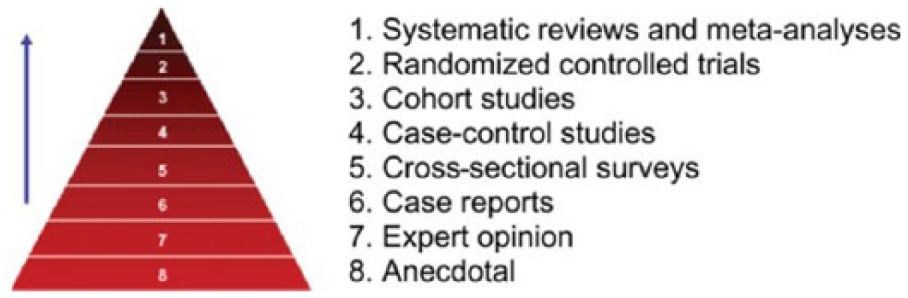
Evidence-based levels of evidence.
I encourage all potential authors, old and new, to consult our newly revised JDMS Authors Manual. This manual is an important first step in preparing your work for dissemination to the community. If you are a new author who is interested in making a contribution to the profession, you might want to start by identifying a novel, challenging, or unexplored research question. I also suggest working together in a team to explore ideas and share the writing process. Developing a manuscript in this way is much like a relay race that has each member of the team working together to cross the finish line. Finally, don’t underestimate the importance of a senior scientist or lead sonographer to provide mentorship and support as you work toward your goal of writing a high-quality manuscript.
As the seventh editor-in-chief, I am anxious to build on the reputation of the journal to continue its tradition of supporting the growth of the profession. I want to publish literature that reflects the current explosion of advances in the field. This is such an exciting time in the use of sonography for diagnosis, surveillance, and—yes—treatment. Our collective responsibility is to use our journal to report on these advancements, including new protocols, applications, and uses of sonography as well as embracing the ever-widening circle of sonography users—physicians, athletic trainers, rehabilitation professionals, and so on. It is vital to tap into these advancements and leverage the ever-widening pool of contributors to build the evidence that demonstrates the power of sonography.
I am pleased to be entering the role as part of a very distinguished team of editors who will be working with me to ensure that the quality of the work published is timely and of scientific importance. We now have an editorial assistant, Mulubrhan Woldemariam, BA, BS, RDMS, RVT, who will help with the anticipated influx of article submissions and ensure timely processing. We will also have expert guidance from Dora DiGiacinto, Med, RDMS, RDCS, Derek Butler, BS, RVT, RDCS, RDMS, RT, and our new associate editors, Shawn Roll, PhD, OTR/L, RMSK-S, and Angela Butwin, MS, RT, RDMS. Supported by our executive office, we will work to diligently publish the best work and leverage it to advance the use of sonography. As a team, we are also excited to announce that we have submitted an application to have JDMS articles indexed through PubMed Central. Having archived issues and articles from the JDMS indexed through this service will provide greater visibility for our profession and increase the number of individuals who can access the content published in our journal, ensuring that sonographers can be influential in the ever-evolving health care environment.
In a 2013 article, Donaldson and Cooke 2 stated that assessing the scientific influence of a research team, based on their published works, is a method to gauge their contributions to the field. As users of this amazing technology, we have the ability to leverage scientific influence that will move innovation from the bench to the bedside. Together, we can influence and grow the levels of scientific evidence!!!