




Abstract
The purpose of this survey study was to investigate the perceptions of music teachers in the state of Wisconsin about their use of Individualized Education Programs (IEPs) in music classrooms. One hundred seventy-nine music educators completed the survey. Music teachers indicated that many of them do not have access to student IEPs and that student IEP goals and objectives typically lack relevance to the music classroom. Teachers also reported limited use of IEPs to plan daily instructional activities and develop curriculum, and noted they needed more planning time to effectively implement IEPs.
The Individuals with Disabilities Education Act (IDEA), which was a 1990 reauthorization of the Education for All Handicapped Children Act, requires schools to provide eligible children with an appropriate education in the least restrictive environment possible (U.S. Department of Education, n.d.). Once a child qualifies for special education services, a school team works with the parents to develop an IEP, or individualized education program (Lee, n.d.). An IEP is a plan that determines what services to provide for students with disabilities. Once the IEP is formalized, the school provides services and tracks student progress (Office of Special Education and Rehabilitative Services, 2000). The IEP is then reviewed at least once a year to determine whether changes are needed. Lee-Tarver (2006) wrote that the IEP “reflects the dynamic process involved in developing, reviewing and revisiting the education program to best serve the child with disabilities” (p. 263).
The IDEA requires that all regular education teachers, special education teachers, and related service providers have access to student IEPs (Jellison, 2015). This includes music teachers, although they have long reported discomfort with or even a disconnect from both the IEP process and placing students with disabilities in the music classroom (Atterbury, 1986; Darrow, 1999; Frisque et al., 1994; Gfeller et al., 1990; Gilbert & Asmus, 1981; McCord & Watts, 2010; VanWeelden & Whipple, 2014). To be in compliance with the law and in order to best serve students with disabilities, it is important for music teachers to engage with the creation and implementation of IEPs.
IEPs in General Education
Previous research findings in special and general education settings have indicated that teachers find aspects of implementing IEPs difficult. Results from early studies in this field (Dudley-Marling, 1985; Kaye & Aserlind, 1979; Morgan & Rhode, 1983) suggested that teachers felt IEPs were often ineffective and complicated to utilize. In a qualitative content analysis of IEPs for 46 students from nine states, Giangreco et al. (1994) noted that IEP documents tended to be vague and inconsistent, were teacher-centered (focusing on teacher and staff behaviors rather than students), and discipline-referenced (based on the values of specific disciplines like physical therapy or speech pathology). The authors theorized that if IEPs were shorter, better organized, and more relevant, teachers would find them more useful.
Recent research indicates that although teachers are now more comfortable with IEPs, the quality of both the document and teacher implementation of the IEP can be improved (Bray & Russell, 2018; Fowler et al., 2019; Rotter, 2014). Bray and Russell (2018) conducted one of the few qualitative comparative case studies on the role of IEPs in a secondary inclusive setting. They found IEPs lacked specificity and did not provide enough guidelines for instruction. In fact, the IEPs ultimately indicated only superficial accommodations. Findings of a survey by Rotter (2014) indicated similar issues with IEP documents. Rotter surveyed general and special educators in New Jersey on their use of IEPs, and although most respondents found the IEP useful and reported they received and utilized IEPs in a timely manner, teachers felt the document needed to be simplified and made more specific.
Another issue expressed by educators was the issue of lack of time for implementation. In a survey of special educators sponsored by the Council for Exceptional Children (Fowler et al., 2019), the majority of respondents said they frequently used the IEP to plan instruction and found their special education colleagues well-prepared to provide specialized instruction. However, special educators did not rate paraprofessionals or general education colleagues as well-prepared, and they indicated they did not have sufficient time to plan lessons using the IEP, to plan with teaching partners, or to plan with IEP team members.
IEPs in Music Education
Many music teachers, like general education teachers, have expressed their discomfort or lack of engagement with developing and implementing IEPs, particularly in the early years of mainstreaming and inclusion (Atterbury, 1986; Frisque et al., 1994; Gfeller et al., 1990; Gilbert & Asmus, 1981). Gilbert and Asmus (1981) surveyed 789 music educators across the United States and found that only 24% of teachers had been part of the development of IEPs at that time, although findings from later studies indicated even lower reports of engagement (Atterbury, 1986; Gfeller et al., 1990). A study by Frisque et al. (1994) may provide insight into this phenomenon. They found only 6% of music teachers felt they had adequate preparation time to individualize plans for each learner, and only 12% had regular access to consultants in special education, suggesting that many music teachers lacked time and support for individualizing instruction.
Often, music teachers are not even included in the IEP process. In an interview study of 35 music teachers in the Midwestern United States, one participant noted, “I would be happy to try to go [to an IEP meeting] if I even knew when they were. The lack of information we receive about some of these students is amazing” (Darrow, 1999, p. 267). Even in more recent studies, music teachers are largely underrepresented in the IEP process. McCord and Watts (2010) investigated the involvement of 201 music educators from the Midwest in the IEP process and found that 63% of respondents did not participate in the development of IEPs, with many indicating scheduling or exclusion kept them removed from the process, and only 9% even felt competent to adapt instruction for students with disabilities. VanWeelden and Whipple (2014) surveyed 1,128 music educators from across the United States regarding educational preparation and instructional supports and found the majority of teachers (73%) had little or no involvement in the IEP process and were rarely consulted about placement decisions (77%).
Although these researchers examined music teachers’ involvement with IEPs, little research has been done within the field of music education to better understand how music teachers interact with IEPs, how they perceive IEPs in their classrooms, and what resources they need to effectively implement them.
Purpose and Questions
The purpose of this survey study was to investigate the perceptions of music teachers in the state of Wisconsin about IEPs in music classrooms. The study was guided by the following questions:
What was the preparation music teachers received for teaching students with disabilities?
What was the involvement of music teachers in the IEP development process for students with disabilities?
Did music teachers have access to IEPs and, if so, how did they perceive them?
What supports did music teachers feel they needed for working with students with disabilities?
Method
For this study, I used a survey design using questions from existing surveys in general education (Dudley-Marling, 1985; Lee-Tarver, 2006; Rotter, 2014) and music education (McCord & Watts, 2010; Miksza et al., 2022; VanWeelden & Whipple, 2014). I revised the original questionnaire based on feedback from two inservice music educators, two music teacher educators (MTEs) who specialize in teaching students with disabilities, and a statistician. Based on the feedback they provided, I edited some questions and responses for clarity.
The questionnaire had five sections and included fixed and open-response items. The first section included demographic information such as gender identity, age, experience, ethnicity, teaching emphasis, and preparation/professional development received that was centered on teaching students with disabilities (McCord & Watts, 2010; Miksza et al., 2022; VanWeelden & Whipple, 2014). The second section asked teachers about their role in developing IEPs, the number of IEP meetings they attended in a typical school year, and, if they did not attend IEP meetings, why that was the case (McCord & Watts, 2010; VanWeelden & Whipple, 2014).
The third section focused on accessing and reading IEPs (Dudley-Marling, 1985; Rotter, 2014). Teachers were asked about the ease with which they were able to access student IEPs, when they received them, when in the school year they read student IEPs, the frequency with which they consulted them, and how they summarized or saved IEP information for use. Section 4 asked music teachers about their personal perceptions of IEPs (Lee-Tarver, 2006; Rotter, 2014). Participants responded to prompts by using a 4-point slider anchored by 1 = strongly disagree and 4 = strongly agree. I used a 4-point scale to prevent people from selecting a neutral option. See Table 2 for the prompts in this section. The Cronbach’s alpha estimate of internal consistency for the scale was .77 which is considered an acceptable level of reliability (Shrestha, 2021).
The final section centered on teacher recommendations (Rotter, 2014; VanWeelden & Whipple, 2014). Teachers were first asked to identify supports they needed to better serve students with IEPs. This section also included two open-ended questions in which teachers were asked for recommendations on how to improve IEPs or the IEP process, and the final question asked teachers whether there was anything else they wanted to share regarding student IEPs in the music classroom.
I distributed the survey via email to a stratified random sample of Wisconsin music educators through Qualtrics after institutional review board (IRB) approval was granted by the university in which I teach. Participants were given a link to the survey in the email, and the first question asked them to grant their agreement for participation. The survey ended automatically for anyone who did not consent. To make survey distribution more manageable, I created a stratified recruitment plan using thegeneralizer.com based on school characteristics such as district size, school population, student race/ethnicity, proportion of English language learners, and proportion of students receiving free/reduced lunch to ensure representation across these categories (Tipton & Miller, 2022). The sample was proportionally stratified to reflect the proportions of schools in these categories across Wisconsin. I then used publicly available school websites to obtain music teacher email addresses. Emails were distributed to 1,000 music teachers. Of the 185 teachers who responded, 179 completed the entire questionnaire (17.9%).
I sent potential participants an email invitation that included an explanation of the study and a link to the survey in November of 2021 with two follow-up emails sent over a 3-week period. The survey closed in December of 2021. Participants were able to skip any items they did not want to answer. At the end of the survey, individuals who were interested in being entered into a drawing to receive a US$100 Amazon gift card supplied their email address. This incentive was used as a means to increase the survey response rate (Singer, 2018). Upon closure of the survey, each survey response was coded with a unique ID number and all identifiers were stored separately from the survey responses on a password-protected, encrypted cloud drive. I used descriptive statistics to analyze the fixed response questions and the constant comparative method (Lewis-Beck et al., 2004) to analyze the open responses. All open responses mentioned in the results were the best exemplars of the themes that emerged through analysis.
The typical PK–12 teacher in this study was White/Caucasian (94.9%), taught for almost 15 years, identified as female (73.7%), and was most likely to have earned a bachelor’s degree (54.5%) or a master’s degree (43.8%) as their highest attained degree. Ninety-six percent of participants earned their certification through a traditional teacher certification program. Most of the participants identified as general music teachers (55.3%), followed by band (21.8%); choir (15.6%); orchestra (3.4%); some combination of band, choir, and/or orchestra (3.4%); and music history/appreciation (0.6%). See Table 1 for complete demographic information.
Demographic Characteristics of Respondents (N = 179).
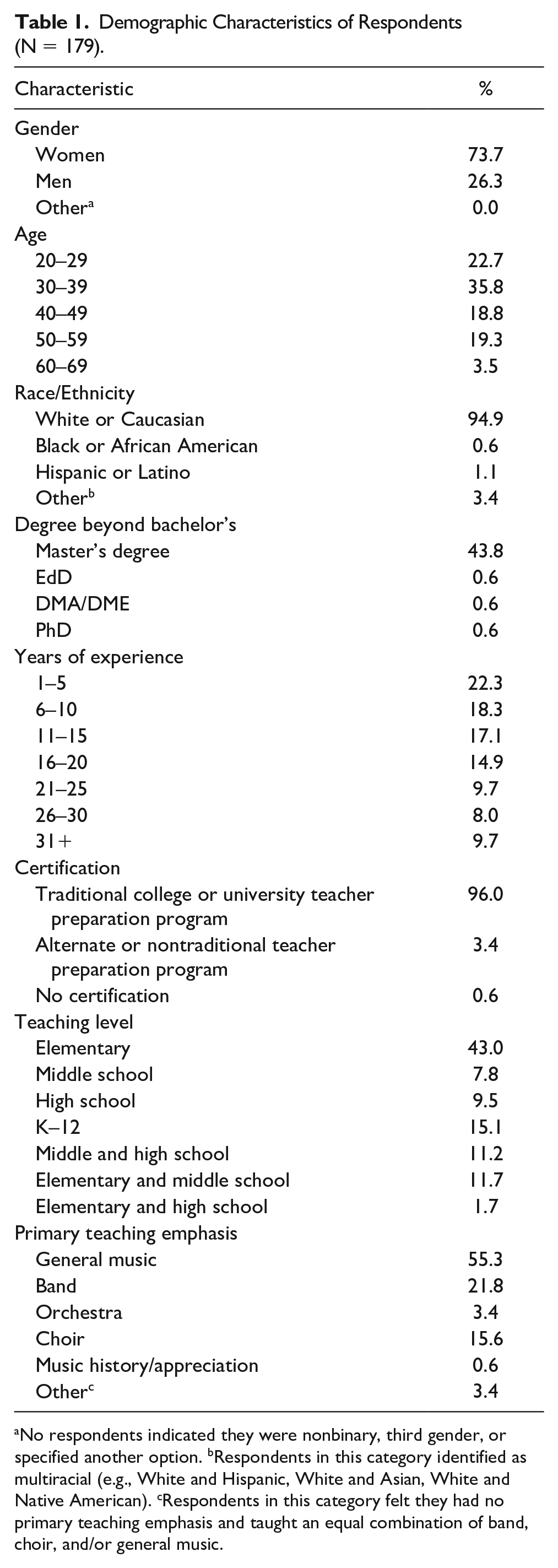
No respondents indicated they were nonbinary, third gender, or specified another option. bRespondents in this category identified as multiracial (e.g., White and Hispanic, White and Asian, White and Native American). cRespondents in this category felt they had no primary teaching emphasis and taught an equal combination of band, choir, and/or general music.
Results
Teacher Preparation
Most music teachers (74.3%) reported they completed some coursework on teaching students with disabilities during their preservice or graduate education, with 27.9% taking two or more courses on this topic. The types of activities in these courses included readings, lectures, and discussion (69.3%); observation (36.3%); field-based teaching (17.9%); and evaluation and assessment (3.4%). Most participants (57.6%) had attended a professional development clinic or workshop on teaching students with disabilities, with 43.6% attending one or two, and 14% attending three or more. However, 42.5% of music teachers had not taken part in any professional development instruction on teaching students with disabilities.
Involvement in IEP Development Process
Most respondents were part of the development of student IEPs in some capacity, such as participating in case studies or filling out evaluation forms (78.1%). Of those who had participated in IEP development, the most common ways of being involved were being asked to fill out a form about students undergoing a case study (29.8%), to consult on a case study (24.2%), or to fill out a form updating student progress for an IEP meeting (14.6%). However, 21.9% of music teachers indicated they had not been asked to be part of the development of student IEPs in any capacity.
Although many teachers were part of the development of IEPs, only 52.8% of music teachers surveyed attended IEP meetings in an average school year. Of those who did attend IEP meetings, the frequency of attendance ranged from one to 15 meetings a year, although most (21.3%) attended about one meeting a year. Those who indicated they attended fewer than three IEP meetings a year were asked why they did not attend more meetings. A majority of those teachers reported that they were not told about or invited to those meetings (83.1%). Other reasons for not attending IEP meetings included scheduling conflicts (4.4%), being told they do not need to attend (5.9%), or the teacher was not interested in attending (3.0%). Some of the teachers provided additional information about IEP meeting attendance via open-response questions. Participants noted that specialists (music, art, P.E., drama) were generally not included in IEP meetings. In the words of one respondent, “If the music teacher would be given the option to attend, then all special areas should be invited to attend, and [we’ve been told] ‘that many teachers in the IEP meeting could be intimidating/overwhelming to parents.’”
Accessing IEPs
Although most music teacher respondents indicated they had easy access to student IEPs (69.1%), 30.9% felt their access was restricted or difficult to obtain. For those teachers who lacked access, 30.9% said IEPs were stored in a place that was difficult to access (e.g., a locked room or an online system they were not able to access). Others (16.4%) noted their administrators told them that they did not need access to IEPs as they were not general or special educators. Respondents were also given the option of writing in an answer. Several wrote they only received an IEP summary sheet (often referred to as an IEP at a Glance document) that lacked specificity. Some reported they were not told which students even had IEPs. One teacher noted, “They are not shared with me unless I request them. I am not even aware a student is on an IEP unless I specifically ask.” Others were actually blocked from seeing student IEPs: “I was told by the Special Education teacher that they don’t want everyone looking at IEPs to prevent labeling. It took two years of asking to get copies of the IEP at a Glance write-ups for my students.” Participants were also asked at what point in the school year they received IEP access. Only 4.0% of music teachers had access prior to the beginning of the school year. Most teachers gained access at the beginning of the school year (50.3%) or within a few weeks of the start of school (27.7%). A few (2.3%) received access on a rolling basis as IEP meetings finished. Those who selected “other” indicated a variety of answers, including “when I request access” and “when they realize they’ve forgotten to give IEPs . . . to specialists.”
Utilizing IEPs
Most music teachers (78.2%) read the IEP within days of getting access to the document, with 8.6% reading it after a week or two of receiving access, and another 8.6% reading the IEP only as issues arose. Some teachers (4.6%) did not read student IEPs even with access to the document. When asked how frequently they consulted the document after the initial reading, 31.3% acknowledged they did not look at the IEP after the initial reading. Of those who did consult the IEP after the first reading, 46.6% of teachers reviewed the document once a term, with 19.6% consulting the documents monthly, and 2.5% consulting them weekly. Teachers were also asked how they summarize or save information when reading IEPs, and most (58.5%) indicated they did not summarize or save IEP information. Among those who did save or summarize IEP information, 18.4% marked on the IEP document, 15.0% took notes, and 8.2% used some other format to summarize the information for ease of review.
Teacher Perceptions of IEPs
In the next part of the survey, teachers rated their level of agreement with statements about IEPs (see Table 2). Most teachers (79.3%) felt it was important for them to be part of the IEP process for their students. Eighty-nine percent of respondents agreed or strongly agreed with the statement, “I understand how to read and interpret student IEPs.” However, only 25.8% felt they had sufficient planning time to implement student IEPs, with a majority of teachers disagreeing (47.9%) or strongly disagreeing (26.4%).
Percentage of Respondents on Items Concerning Teacher Perceptions of IEPs.
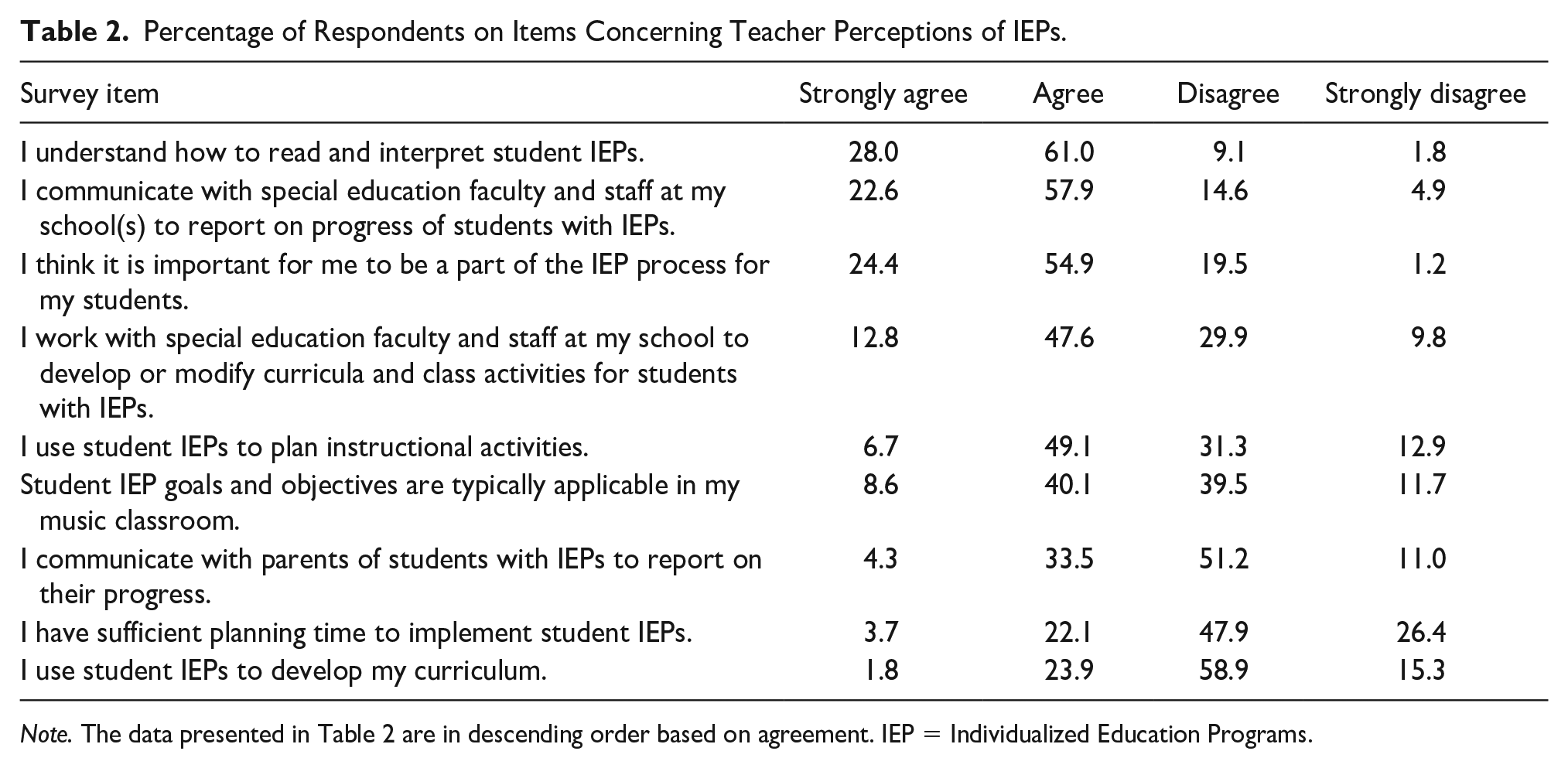
Note. The data presented in Table 2 are in descending order based on agreement. IEP = Individualized Education Programs.
When presented with the statement, “Student IEP goals and objectives are typically applicable in my music classroom,” teacher responses were almost evenly split, with 48.8% in agreement and 51.2% disagreeing. Most teachers tended to use IEPs for planning daily instructional activities (55.8%), but only 25.8% used them as part of their curriculum development. However, 60.4% of music teachers reported they worked with special education faculty and staff to develop or modify curricula and class activities for students with IEPs, and 80.5% communicated with special education staff and faculty to report on student progress. Only 37.8% of respondents indicated they communicated with parents of students with IEPs to report on their progress.
Music Teacher Supports
Teachers were asked what would help them to better support students with IEPs, and the most popular answers were receiving adequate resources (such as assistive technology and adaptive materials), having more opportunities for collaboration with special education teachers and paraprofessionals, receiving professional development for better serving students with IEPs, and access to related service personnel (occupational therapists, physical therapists). Respondents were also given the opportunity to provide an open-ended response regarding recommendations for improving IEPs and the IEP process. One of the most common responses was to simply include music teachers in both the development and implementation of IEPs. One teacher noted the need for specialists to have easy access to IEPs:
Specialists should have the same access to IEPs that regular classroom teachers have. It is essential for optimum student learning that we be aware of the strengths or challenges each of our students carry, so that we can tailor our lesson plans appropriately. Music class is uniquely well suited for differentiated instruction. In addition, it is also a place where students who struggle in what are considered core classes can shine. It is simply a matter of discovering the student’s strengths and highlighting those as we simultaneously work to achieve goals that the student may find more difficult.
Another also mentioned the importance of being invited to IEP meetings: “We teach the child, too! Invite us to the IEP meeting. We see them in a different situation [than general and special education staff/faculty] and may have different insights.”
Another frequently cited recommendation was improving the IEP or IEP at a Glance documents to include music-specific goals and modifications. The teachers overwhelmingly felt that IEPs tended to be focused on reading and math goals to the exclusion of music and other “specialized” areas. One teacher associated the lack of support for students with IEPs in music class with the subject’s perceived value in the curriculum:
Most of the time, [special education] teachers planning IEPs do not deem music an ‘important’ class, so issues specific to band are not addressed in the IEP. It is all on me—without the special education teacher or para[professional] support—to teach those students.
Another teacher echoed this: “Include expectations for all specials. So many goals are academically oriented or written in a way that includes one-on-one support for the student, that these are neither attainable nor practical in a group setting!” One teacher provided an example of how a lack of consideration for the specific curricular requirements in music impacted her, noting, “Music is rarely considered. I have a student with half fingers, and nothing is written in her IEP about how to play ukulele or recorder.”
Respondents also indicated the need for more support within the classroom from paraprofessionals and special education staff. One respondent wrote,
I have many students who have behavioral supports in their IEP all day long in their classroom but do not receive those same supports in specials classrooms despite having the same behavior concerns in my classroom. Special education departments often view music classes as an opportunity to give special education aids their greatly needed breaks but pile the labor of regulating that student’s behavior onto music teachers without any additional support.
This was echoed in other responses as well:
[K]ids who have aides or help get NONE of it during my class, which, objectively, has some of the most sensory overloading things. I wish IEPs could state specifically that kids need that support staff “even in music” so we could get the help we need.
Discussion
The purpose of this study was to investigate the perceptions of Wisconsin music teachers about IEPs in the music classroom. There were some limitations that should be considered when interpreting the data. There was an overall lack of demographic variability of the respondents. Also, a majority of respondents were elementary general music teachers. Elementary generalists typically interact with all students in a school. Therefore, they teach more students with disabilities than their peers who teach at the secondary level, where music is more often an elective option. In addition, there was the potential for nonresponse bias, meaning people who did not respond to the survey may have viewed the topic as unimportant. This could potentially skew the results because those who did respond may have more positive feelings about using IEPs and working with students with disabilities than those who did not respond. The low response rate could indicate that results were biased by selective nonresponse. There was also a possibility of social desirability bias, meaning participants may have responded in a way to present themselves in the most positive light. The findings are also limited to a specific geographic location in the Midwestern United States. Although the results are not generalizable to the greater United States, there are some important insights that could help us to improve both music teacher education and inservice teacher experiences.
Teacher Preparation
Most respondents in this survey completed coursework on teaching students with disabilities in their preservice/graduate education. However, 10% of respondents had never taken any coursework on teaching students with disabilities. A recent study by Culp and Salvador (2021) indicated that about half of undergraduate music education programs require at least one music-specific course on teaching students with disabilities, whereas over 20% of undergraduate programs do not offer or require this type of music-specific course. Although Culp and Salvador focused on music-specific coursework, I looked more broadly at any coursework focused on teaching students with disabilities (music-specific or not). This suggests there are still universities that do not provide any coursework centered on teaching students with disabilities.
If you combine this lack of coursework with the finding that over 40% of respondents in the current study had never received professional development or attended a clinic/workshop focused on teaching students with disabilities, this means a large portion of teachers are generally unprepared or underprepared for understanding and implementing IEPs in their classrooms. This percentage is consistent with a previous study by VanWeelden and Whipple (2014) in which 46% of music educator respondents received no inservice development on teaching students with disabilities. They also found teachers who attended professional development related to teaching students with disabilities in music felt more prepared to work with diverse learners. Given that this number has only minimally changed over the past 8 years is troubling and may indicate that some administrators (who generally choose the topics for professional development) think specialist teachers do not need to have access to IEPs or make adaptations like general education teachers do.
There is also room for growth in the types of activities included in coursework focused on teaching students with disabilities. The most common course activities were readings, lectures, discussion, and observation. Few courses had field-based teaching experiences with disabled populations, and only a small fraction covered evaluation and assessment. Previous research has indicated preservice teachers feel more confident and prepared to work with students with disabilities when they have music-specific experience in the field and understand adaptive assessment (VanWeelden & Whipple, 2005a, 2005b, 2007, 2014) Although some coursework on teaching students with disabilities is better than none, music-specific coursework and professional development opportunities are best for music educators as classes and clinics with a general education focus can be considered out of context and irrelevant by some music educators (Conway, 2002, 2012).
IEP Involvement and Access
A majority of respondents (78.1%) reported taking part in the development of student IEPs in some capacity, either through being consulted on a case study, filling out a form about a student undergoing a case study, updating student progress for an IEP meeting, or being asked to attend an IEP meeting. This is much higher than participation rates reported in previous studies (McCord & Watts, 2010; VanWeelden & Whipple, 2014), which is promising for the field. However, almost half of the survey respondents in the current study reported they do not attend IEP meetings, and of those who do attend IEP meetings, most attend only an average of one meeting in a school year. Most of the respondents who do not attend IEP meetings are not told about or invited to meetings. In the open-ended questions, many respondents indicated they would be open to or even excited about attending IEP meetings, but they are excluded either by special education staff or by administrators. When music teachers are not involved in the IEP process, that can make it difficult to successfully include all students and adapt instruction.
For those music educators who had access to IEPs, only 4% had access prior to the beginning of school, which means that for many, IEPs are often an add-on after the curriculum is already developed for the school year. In addition, over half of the respondents indicated they did not summarize or save IEP information, and a third noted they did not consult the IEP after the first reading. This may be due to the fact that elsewhere in the survey, over half of the music teachers indicated that student IEP goals and objectives are often not applicable in the music classroom. However, teachers who lack a depth of engagement with the IEP may make errors or forget which students need accommodations, which is in violation of the students’ rights as outlined in the IDEA.
Teacher Perceptions and Supports
A majority of teachers felt they understood how to read and interpret IEPs. Yet, there are still some music teachers who report that they do not know how to read and interpret the document. This could be attributed to several reasons found in the current study, such as a lack of previous coursework, lack of inservice professional development, and a lack of access to IEPs. Research in both general and music education has highlighted a need for simplification of the IEP and more clarity in student goals and accommodations (Bray & Russell, 2018; Fowler et al., 2019; Giangreco et al., 1994; McCord & Watts, 2010; Rotter, 2014). All teachers, including music teachers, are required by law to adhere to the principles of the IDEA. Music education licensure programs, professional development organizations, school administrators, and special educators should be working with all teachers to ensure they are in compliance with the IDEA and understand how to interpret IEPs.
Respondents also identified challenges with implementing IEPs. As found in previous studies (Darrow, 1999; VanWeelden & Whipple, 2014), teachers overwhelmingly felt they needed more planning time to effectively implement IEP accommodations. Many music teachers teach the entire student population (e.g., elementary general music teachers) or have classes that are larger than typical general education classes (e.g., large ensemble classes). This makes providing effective accommodations for large numbers of students difficult when preparation time is limited. Another issue was that about half of the teachers felt IEP goals and objectives were not applicable to the music classroom. When IEPs lack specificity, it is difficult for teachers to individualize instruction for the students’ needs (Rotter, 2014). It may also be more difficult for teachers of performance-based classes to find connections between adaptations focused on math and writing to a performance-based curriculum than it would be for music teachers whose classes are not performance-based.
Only about half of teachers indicated that they use student IEPs to plan instructional activities. As previously mentioned, this may be due to the nature of the adaptations provided in the IEP and the difficulty of applying those adaptations in a performance-based environment. However, most teachers reported limited use of IEPs for curriculum development. This is not surprising, given that most teachers did not receive student IEPs prior to the school year. Many teachers plan or revise their curriculum prior to the beginning of school, which means IEPs are more likely to be an add-on (in daily instructional activities) rather than integrated into curriculum development. If teachers had IEPs sooner and were paid for their planning time over the summer, they could universally design their curriculum, which “guides the design of instructional goals, assessments, methods, and materials that can be customized and adjusted to meet individual needs” (CAST, 2023, UDL at a Glance section). In addition, even when they did gain access, many teachers rarely consulted the document and/or did not find it useful. This, combined with the lack of preparation time that teachers indicated, creates a situation where it is almost impossible for many teachers to provide adequate instruction and create a positive and successful learning environment for all students. However, a majority of music teachers indicated they worked with special education faculty and staff to develop or modify curricula and communicated student progress to them. The music teachers in the current study appeared to be more comfortable with initiating contact and collaborating with special education experts than respondents in previous studies (Gfeller et al., 1990; VanWeelden & Whipple, 2014).
As found in previous studies, teachers stated an overall need for more resources and supports for teaching students with disabilities, including easier access to IEPs and IEP meetings, assistive technology, adaptive materials, more time for collaboration with special educators and paraprofessionals, professional development opportunities, and access to therapists and student support staff (Darrow, 1999; Frisque et al., 1994; Gfeller et al., 1990; McCord & Watts, 2010; VanWeelden & Whipple, 2014). Unfortunately, these needs have not changed much over the last 30 years.
Recommendations
The frustration teachers expressed in the open-ended responses about their lack of supports for teaching students with disabilities and implementing IEPs was palpable. Many indicated they wanted to better serve students with IEPs but were impeded by forces outside of their control. Based on the findings in this study, I recommend music teachers make a concerted effort to engage special educators and administrators in a dialogue about their roles in the school and their needs for serving students with IEPs. Many people outside of music assume the music classroom is more of a recreational experience than an academic learning environment. Sharing learning goals, documenting student growth via assessments, requesting more support through professional development, and asking to engage in the IEP process in a meaningful way are all steps through which music teachers can educate administrators and special educators about the nature and needs of the music educator and the role they can play in the IEP process.
However, the onus of responsibility should not only be placed on inservice music teachers. MTEs, researchers, and advocacy groups like our state and national music organizations have a role to play as well. MTEs have a responsibility to bring coursework focused on teaching music to students with disabilities into the collegiate curriculum if they have not already done so, and to audit existing courses to make sure they include field experiences and adaptive assessments. Music education researchers who study disability in music classrooms should consider sharing their research in venues where special educators and administrators can gain access to their scholarship. If they are able to learn more about the needs and concerns of music educators, they may be more open to including specialist teachers in the IEP process and providing more support. Advocacy organizations can support the needs of music teachers by providing professional development opportunities, and by informing and engaging parents, school districts, policymakers, and other stakeholders.
Researchers could investigate the ways in which MTE programs prepare preservice teachers to read and utilize IEPs to determine best practices in the field. In addition, there is a need for research exploring administrator and special educator beliefs about the role of the music teacher in the IEP process. The more information we acquire will help music educators to be inclusive and foster success for students with IEPs. Students with disabilities have a right to a positive and productive learning experience, including within the music classroom. However, teachers’ attempts to provide this experience may be fruitless without more supports. When music educators have adequate access to IEPs, preparation time, and preservice and inservice professional development on utilizing IEPs, they are better able to meet the learning goals of students with disabilities and are made equal partners in the development and implementation of their learning plans. If music education is intended to be for all students, then we need to make sure our instruction, curricula, and learning environments reflect that.
Footnotes
Declaration of Conflicting Interests
The author(s) declared no potential conflicts of interest with respect to the research, authorship, and/or publication of this article.
Funding
The author(s) received no financial support for the research, authorship, and/or publication of this article.
