



Abstract
The purpose of this pilot study was to examine elementary general music teachers’ familiarity with, agreement with, and perceptions of restorative justice practices. Participants (N = 49) included practicing elementary general music teachers who were members of the California Music Educators Association, the Florida Music Educators Association, the Missouri Music Educators Association, the New England Orff chapter, and an Orff chapter in Southern California. Findings indicated that participants were moderately familiar with their perceived ideas of restorative justice. They reported moderately high levels of agreement with a restorative justice ideology but held largely negative perceptions regarding the approach and its implementation in elementary music classrooms. Results suggest that although many elementary music teachers generally agree with a restorative justice ideology, they face challenges in implementing restorative justice–based approaches in their classrooms. Administrative support, professional development opportunities, and future research on the topic are needed.
Elementary general music teachers are tasked with providing foundational formal music learning experiences for many students in the American public education system, while also facing a myriad of difficult social and emotional challenges and conflicts among and between students (Edgar, 2017). As a result, classroom management is a topic that consistently emerges among music teachers (Caldarella et al., 2017; Gee, 2022; Gordon, 2001, 2002; Potter, 2021; Ryan, 2020). When teachers provide a healthy social environment and establish positive relationships in elementary music classrooms, this can facilitate more successful classroom music learning (Byo & Sims, 2015; Zins & Elias, 2007). In the current study, we aimed to investigate elementary music teachers’ ideologies regarding classroom management to discover if and how they are successful in establishing positive classroom environments for the youngest music learners.
Review of Literature
Understanding the social and emotional aspects of students’ behaviors is important for teachers to support and build relationships with students (Collaborative for Academic, Social, & Emotional Learning, 2021). Emotionally positive classrooms can also promote students’ academic and social successes (Zins & Elias, 2007). Specifically, social-emotional learning (SEL) is the process of acquiring and applying the knowledge, attitudes, and skills necessary to recognize and manage emotions effectively; developing caring and concern for others; making responsible choices; establishing positive relationships; and handling challenging situations. Although SEL focuses on the development and the prevention of problematic behaviors (Collaborative for Academic, Social, & Emotional Learning, 2021), it also spotlights the development of students’ emotional and social skills, which can directly affect their experiences at school (Friedlaender et al., 2014; Greenberg et al., 2003).
In terms of the effectiveness of addressing SEL in the classroom, Gest et al. (2014) studied the quality of teacher–student interactions, peer and community bonding and motivation, as well as students’ social behavior among elementary teachers (N = 54) and students in the Midwest and Northeastern United States. They found that elementary teachers who implemented strategies to manage the social dynamics of the classroom experienced more positive social behavior from students in addition to favorable academic trends. Váradi (2022) aimed to find connections between artistic education and SEL and reported that arts education positively affects SEL competencies both in school and as an after-school extracurricular activity. Furthermore, music education can support SEL in growing and understanding our emotions (Schellenberg & Mankarious, 2012), self-regulating our emotions (Sakka & Juslin, 2018), taking responsibility for our actions (Davidson & Good, 2002), developing empathy (Egermann & McAdams, 2013), and expressing ourselves (Gold et al., 2017). Shaw (2022) examined the association between high school music participation and social and emotional outcomes. Findings indicated that there were no strong associations and that there might be connections between enrollment in music courses (e.g., band, choir, orchestra) and social-emotional outcomes.
Just as students’ social and emotional growth are important in any classroom environment, so is the connection to how teachers approach students’ behavior. Music teachers are the architects of their classrooms and learning environments, and how they choose to address student behavior is a topic that necessitates investigation. According to Jorgensen (2015), certain teaching approaches and ideologies, while often well-intentioned, may in fact “patronize, diminish, and dehumanize” students (p. 21). On the contrary, fair representation, voice, democratic processes, and respect are foundational tenets for teaching toward emotionally supportive, socially just, and empowering environments for students in music classrooms (Dalton et al., 2006; Elliott, 2007; Prilleltensky, 2012). These tenets are reflected in a particular facet of social justice known as procedural justice (Rawls, 1971, 1999). Procedural justice is focused on the espousal of ideologies and the enacting of processes that contribute to creating a socially just environment (Jorgensen, 2015; Prilleltensky, 2012). Music teachers may be enacting certain practices and espousing ideologies in their music classrooms which directly align with the principles of procedural justice. Using a procedural justice lens, we explored and identified some ideologies and practices of music teachers that might set the stage for socially just, supportive environments and experiences for students in music classrooms.
One framework that aligns with the tenets of procedural justice is restorative justice (RJ). RJ focuses on engaging people’s feelings of responsibility to others in and around their community (Tyler, 2006). According to the National Education Policy Center (Gregory & Evans, 2020), RJ in education is a comprehensive, school-wide approach that focuses on relationships, justice, equity, resilience, and well-being. RJ practices are aimed to be proactive and responsive including values and principles such as dignity, respect, accountability, and fairness while focusing on relationships and repairing conflicts. These practices can “create a sense of belonging and provide a system of communal accountability that sets the stage for repairing harm that may arise from student or educator behavior” (International Institute for Restorative Practices, 2022, p. 1). RJ in education, often an “add-on” approach to an existing discipline system (Sabornie & Espelage, 2023), emerged to reduce the number of students suspended or expelled in K-12 schools (Losen, 2015) and is intended to bring everyone (e.g., students, educators, administrators, parents/guardians) together to resolve issues and build relationships as opposed to controlling students’ misbehaviors through punitive measures (Sabornie & Espelage, 2023).
RJ programs in schools can differ from professional development for teachers to guided restorative conferences with students and staff (Darling-Hammond et al., 2020). More recently, RJ programs have been proactive in nature whereby administrators and educators promote an interconnected school community and healthy learning environment with activities such as peace- and community-making circles and meditation (Sabornie & Espelage, 2023). Additional components of RJ in action include affective statements and questions, informal and formal conferences, and applying discipline with high levels of student support and structure from the teacher (Costello et al., 2009). Using RJ signals a shift in education away from reactive practices that isolate students’ wrongdoing toward relationship-focused practices that bring people together (Morrison et al., 2005), and it influences teachers’ mindset from that of control to collaboration (Buckmaster, 2016).
Darling-Hammond et al. (2020) reviewed the effectiveness of RJ in K-12 schools in the United States and found that RJ can cause improvements in discipline and reduce misbehavior, bullying, and student absences. In a study of the experiences of high school students in a classroom implementing RJ (Gregory et al., 2016), there was a correlation between teachers’ use of RJ practices and more positive teacher–student relationships. They also discovered that higher implementation of RJ practices could be linked to more equitable approaches in terms of discipline. Hill (2019) examined teachers’, counselors’, and administrators’ attitudes and beliefs toward RJ practices. Findings indicated that these groups were generally supportive of RJ practices and interventions. Participants also agreed that RJ practices such as circles, mediations, and restorative language improved student performance. After the implementation of RJ programs in elementary and middle schools, other scholars (Carroll, 2017; Cook et al., 2018; Duong et al., 2019) reported that there were significantly fewer instances of disruptive behavior in classrooms. Although many positive outcomes of RJ have been recorded, a challenge is the ability to effectively implement it school- and district-wide with needed buy-in from educators, staff, and administrators (Gray, 2021).
Prior research findings suggest that RJ practices in the classroom may be linked to improvements throughout the school (Darling-Hammond et al., 2020; Gregory et al., 2016); however, we have yet to fully understand the beliefs and practices of the teachers who often provide the first formal music education experiences for students—elementary general music teachers. These are the teachers who provide music education to the widest segment of the school population, reaching all students in music for often the first and last time (Abril & Gault, 2006). Furthermore, there are no studies on whether elementary general music teachers’ classroom management beliefs and practices align with a restorative justice ideology (RJI). Although various definitions appear in the literature:
[c]lassroom management is clearly about establishing and maintaining order in a group-based educational system whose goals include student learning as well as social and emotional growth. It also includes actions and strategies that prevent, correct, and redirect inappropriate student behavior. (Emmer & Sabornie, 2015, p. 8)
Classroom management has also been explained as the “actions teachers take to create an environment that supports both academic and social-emotional learning” (Evertson & Weinstein, 2006, p. 4). When connecting SEL and classroom management, the sole focus is not on controlling students’ behavior. Rather, it is centered on fostering SEL competencies (Schwab & Elias, 2015), which build healthy interactions between students and teachers and promote positive relationships and routines such that both students and teachers feel valued, respected, and cared for (Espelage et al., 2023).
According to Byo and Sims (2015), “[m]usic educators have long recognized that in order to facilitate productive learning environments with diverse and large groups of students . . . music teachers would need to be especially good at managing their teaching environments” (p. 222). Teaching experience had a significant impact on elementary general music teachers’ self-efficacy for classroom management whereas school setting (e.g., suburban, urban, rural/small town) did not, and external factors such as parent/guardian involvement and students’ home environments largely influenced behavior in the classroom (Potter, 2021). In addition, Gee (2022) discovered that elementary general music teachers (N = 341) experienced the most preparation in classroom management from working with mentor teachers and in their supervised fieldwork, whereas creating classroom rules, expectations, and teaching procedures were most often discussed during coursework.
It is unclear how music teachers’ approaches to classroom management might align with more socially equitable approaches like RJ. Music education researchers have yet to systematically investigate elementary general music teachers’ familiarity with RJ practices and its connection to their approach to classroom management. In our investigation, we aimed to uncover and examine specific teacher beliefs and practices that contribute to equitable classroom environments in music classrooms. Thus, the purpose of this pilot study was to examine elementary general music teachers’ familiarity with, agreement with, and perceptions of RJ practices in music education. The following research questions guided the study:
Method
We utilized a questionnaire for this descriptive study to examine elementary general music teachers’ familiarity with, agreement with, and perceptions of RJ practices in music education. We designed this investigation for practicing elementary general music teachers in the United States during the fall of 2021.
Data Collection Instrument
To measure elementary general music teachers’ familiarity with, agreement with, and perceptions of RJ, we adapted items from the Restorative Justice Ideology Questionnaire (Roland et al., 2012). According to Roland et al. (2012), RJ beliefs and practices can reduce behavioral infractions and promote a school culture of restoration and student engagement. The authors of the Restorative Justice Ideology Questionnaire also recommended future studies pertaining to interventions of RJ practice in schools. For our investigation, we applied this questionnaire to the field of music education, specifically those teaching elementary general music.
Roland et al. (2012) granted permission for use of the survey instrument, which we modified for our target population of practicing elementary general music educators. For the purposes of our study, the questionnaire consisted of 17 questions. Part I (items 1–6) gathered demographic information, Part II (items 7–9) pertained to familiarity with RJ, and Part III (items 10 and 11) contained the Restorative Justice Ideology Questionnaire (Roland et al., 2012) in which participants responded to 16 individual statements. Finally, Part IV (items 12–17) contained open-ended items specifically aimed at RJ in the context of an elementary general music classroom. The complete questionnaire is presented as online Supplemental Material.
In Part II of the questionnaire, we solicited responses from participants about their familiarity with RJ as a classroom management approach based on three indicators: their interest in, their knowledge of, and their confidence in using a RJ classroom management model. In the first item of the section, we asked participants to indicate their level of interest in using RJ practices as a classroom management approach on a scale from 0 to 10 (0 = not at all/don’t care a bit; 5 = a fairly interesting concept and I might invest in learning more; 10 = extremely interested and invested in the concept). We also asked participants to indicate their level of knowledge about RJ classroom practices and approaches on a scale from 0 to 10 (0 = I know absolutely nothing; 5 = I could explain the basics; 10 = I’m an expert who could teach others). Participants indicated their confidence in their ability to implement RJ practices in the music classroom on a scale from 0 to 10 (0 = no confidence at all; 5 = I could be effective half the time; 10 = extremely confident/I am effective on a daily basis). Finally, we asked participants to indicate if they have implemented any RJ practices in their elementary general music classroom by choosing Yes, No, or Maybe followed by an open-ended response asking for specific examples of these types of programs and practices.
To answer the second research question, we adapted the Restorative Justice Ideology Questionnaire (Roland et al., 2012) for elementary general music teachers. Participants responded to items using a 5-point Likert-type scale anchored by 1 (strongly disagree) and 5 (strongly agree). We evaluated scores such that higher scores indicated a stronger agreement with an RJI. Likewise, lower scores reflected less of an agreement with the tenets of an RJI. Some items required reverse scoring due to item wording. These scores, along with all items’ overall means, standard deviations, and response frequencies, are indicated in Tables 1 and 2.
Means and Standard Deviations of Restorative Justice Ideology Questionnaire Likert-Type Item Prompts.
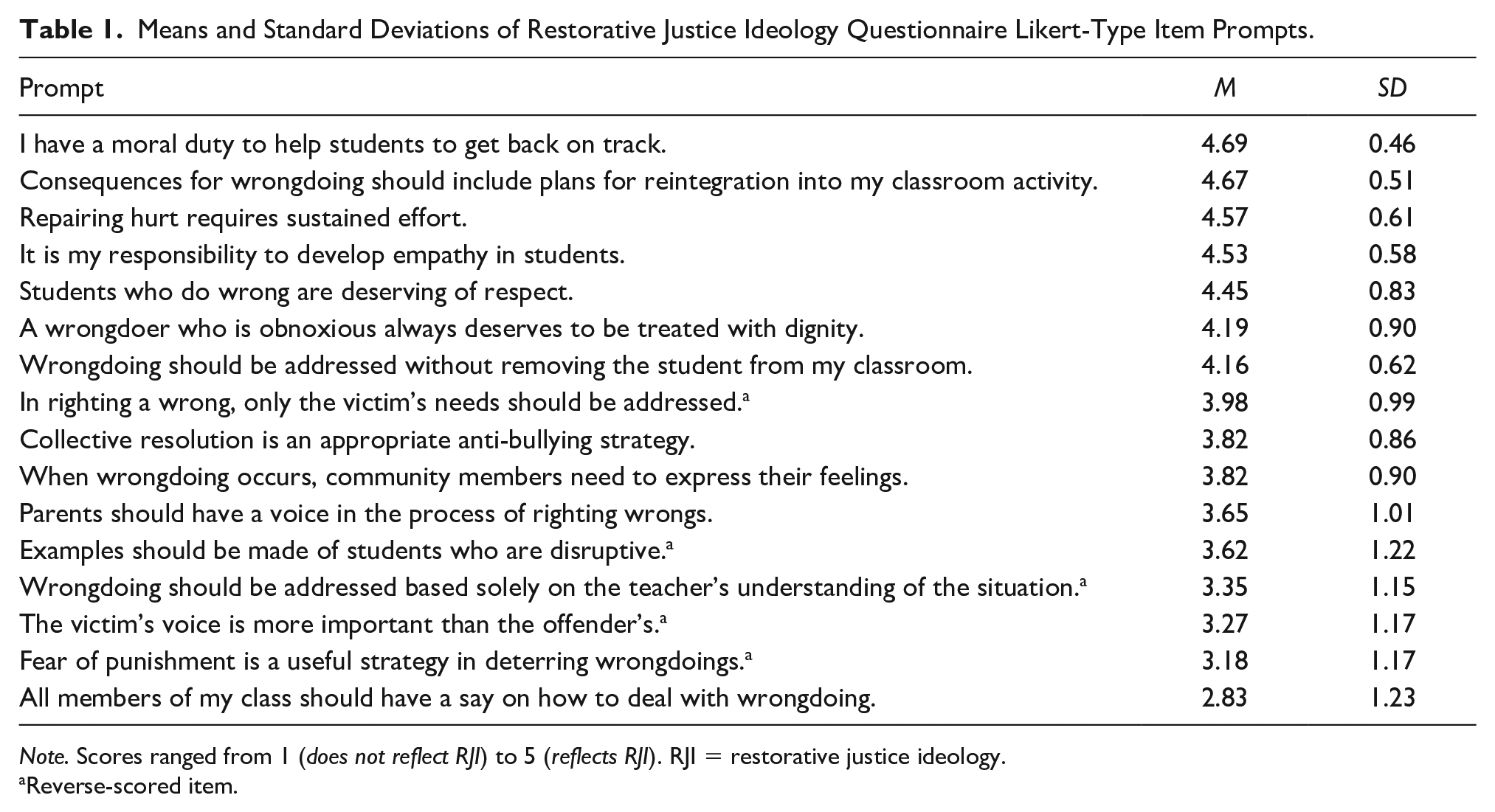
Note. Scores ranged from 1 (does not reflect RJI) to 5 (reflects RJI). RJI = restorative justice ideology.
Reverse-scored item.
Frequencies by Score of Restorative Justice Ideology Questionnaire Likert-Type Item Prompts.
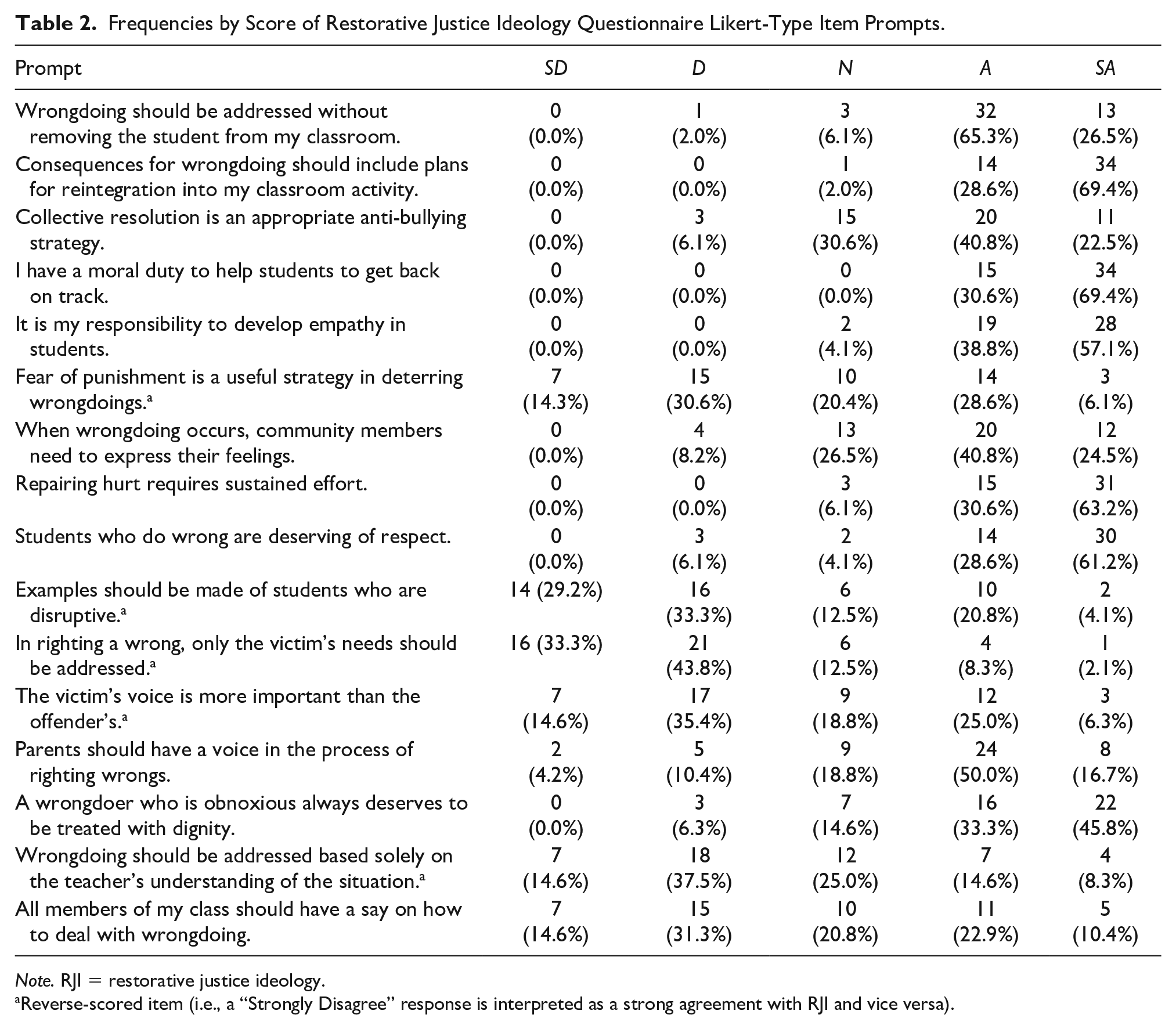
Note. RJI = restorative justice ideology.
Reverse-scored item (i.e., a “Strongly Disagree” response is interpreted as a strong agreement with RJI and vice versa).
To answer the final research question, we asked open-ended questions regarding participants’ perceptions of RJ as a framework and their perceptions of implementing it in their elementary music teaching contexts. We elicited qualitative data for this research question due to the varied nature of possible responses. Questions included the following: “What challenges might teachers encounter when implementing this approach?”; “How have restorative justice practices influenced or impacted students in your elementary general music classes?”; and “Would you consider implementing restorative justice practices in your classroom? Why or why not?”
Procedure
The human subjects committee at the secondary author’s institution granted us permission to conduct this pilot study. Our target population, practicing elementary general music teachers, included self-identified members of state music education organizations, which consisted of the California Music Educators Association, the Florida Music Educators Association, the Missouri Music Educators Association, the New England Orff chapter, and an Orff chapter in Southern California. We utilized convenience sampling to recruit participants through these organizations’ listservs and social media platforms.
We distributed the questionnaire, through Qualtrics, over a 2-month period in the fall of 2021 through listservs (Missouri Music Educators Association, Florida Music Educators Association) and social media platforms (California Music Educators Association, New England Orff chapter, Orff chapter in Southern California). For each platform, we distributed the survey once during that 2-month time frame. Our recruitment language included an invitation to the study, purpose statement, estimated questionnaire completion time, and an online link to the questionnaire. We utilized an anonymous link, generated by Qualtrics, to avoid collecting identifying participant data. When participants completed the pilot questionnaire, they also had the opportunity to complete a brief follow-up survey to provide feedback on their questionnaire-taking experience.
Participants
In the demographic portion of the questionnaire, we collected information regarding six characteristics of the participants: gender, age, ethnicity, highest level of education, years of teaching experience, and school community type. The majority of the participants identified as White and female (n = 43), whereas only six participants identified as male, which is generally representative of the elementary teacher population in the United States (National Center for Education Statistics, 2021). In addition, most participants identified as White or Caucasian (n = 44), with several other ethnicities (American Indian or Alaska Native, Asian or Asian American, Black or African American, Hispanic or Latinx, and Other) represented by one participant each. The ages of participants displayed a wider range, spanning from 20 to 24 years (n = 2) to 65 years and older (n = 2), but most participants identified as somewhere between 24 and 64 years. One respondent preferred not to disclose their age.
Participants varied in their highest degree achieved, their years of teaching experience, and their school communities. The majority indicated having earned either a bachelor’s degree (n = 20) or a master’s degree (n = 24), whereas five participants earned a doctoral degree. Both the most experienced (21+ years) and least experienced (1–5 years) teachers in the sample were represented by 12 participants, with the next largest groups being those who had taught for 6 to 10 years and 11 to 15 years (both groups n = 10). Finally, in regard to teaching experience, the smallest group consisted of those participants with 16 to 20 years of teaching experience (n = 5). The most common school community type represented by the participant pool was suburban (n = 23), followed by rural or small-town communities (n = 13). Ten respondents taught in urban communities, and three participants indicated “other” in response to community type.
Data Analysis
To answer the first research question regarding elementary music teachers’ familiarity with formalized RJ practices and programs, we utilized quantitative descriptive analysis based on interval scale data from participants’ responses on Part II of the survey instrument along with qualitative open coding (Creswell, 2012) of answers to open-ended responses in Part IV of the questionnaire.
After collecting data via the questionnaire, we exported the data from Qualtrics to SPSS 27.0 for analysis. After removing incomplete responses from the data, we calculated descriptive statistics (frequencies and percentages) for the responses of 49 participants. For the open-ended questions, we transferred the data to a Google document and utilized open coding (Creswell, 2012) to identify categories pertaining to teacher interest, familiarity, and perceptions of RJ.
Results
We first provide the results of the descriptive analysis of interest, familiarity, and agreement regarding an RJ classroom management model and the emergent findings from the analysis of open-ended responses.
Research Question 1: To What Extent Are Elementary General Music Teachers Familiar With Formalized RJ Practices and Programs?
Knowledge levels of RJ practices and programs were the lowest on average of the three indicators (N = 48; M = 3.50; SD = 2.67). Forty percent of the participants indicated a two or lower on the knowledge level scale out of 10. Overall, interest levels of the participants (n = 47) were moderate (M = 5.87; SD = 2.83) regarding RJ practices. The most frequent response on a scale of 0 to 10 was a 5, with 14 participants indicating this level of interest. The final familiarity indicator was the participants’ confidence levels. Similar to the other two indicators, confidence levels of elementary general music teachers (N = 47) were moderately low (M = 4.04; SD = 3.09). More than half of the participants who responded to this item (n = 24) chose a four or lower on the confidence indicator for RJ practices in the classroom. (For more details regarding the familiarity indicators, see Table 1). Consistent with the results of the indicators presented previously, the most common response for whether teachers use RJ approaches was Maybe (n = 21). Sixteen participants responded Yes, and 12 indicated No. After analyzing the open-ended responses to this question (n = 10), one specific classroom management program was referenced—Conscious Discipline. 1 Most responses referred to generalized classroom management practices that participants perceived as falling under the ideology of RJ. Some examples included building relationships and community in the classroom, establishing routines and procedures, using positive reinforcement, and allowing time for conversation with students. Overall, the results suggest that familiarity with formalized RJ practices and programs was moderate to moderately low for this pilot sample of elementary general music teachers.
Research Question 2: To What Extent Do Elementary General Music Teachers’ Beliefs and Practices Reflect an RJI?
The responses indicated that the participants reflect a moderately high level of agreement with most tenets of an RJI as a classroom management approach. Overall means for item responses ranged from 2.83 (“All members of my class should have a say on how to deal with wrongdoing”) to 4.69 (“I have a moral duty to help students to get back on track”). For seven of the 16 items on the RJI Questionnaire, participants’ responses were in the 4.00 to 4.69 range. Some examples of items with means in this range were “Consequences for wrongdoing should include plans for reintegration into my classroom activity” (M = 4.67), “Repairing hurt requires sustained effort” (M = 4.57), and “It is my responsibility to develop empathy in students” (M = 4.53). Eight out of the 16 Likert-type-style prompts resulted in overall means in the 3.00 to 3.98 range. Some items in this range included “In righting a wrong, only the victim’s needs should be addressed” (M = 3.98; reverse scored), “Collective resolution is an appropriate anti-bullying strategy” (M = 3.82), and “When wrongdoing occurs, community members need to express their feelings” (M = 3.82). Only one item resulted in an overall mean of less than 3: “All members of my class should have a say on how to deal with wrongdoing” (M = 2.83; reverse scored).
Research Question 3: What Are Elementary General Music Teachers’ Perceptions of RJ in Theory and in Practice?
When asked about perceptions of RJ in theory and practice, most of the participants (n = 43) gave at least one response to the open-ended prompts. Although most respondents did provide answers to the open-ended questions, many (n = 30) were short and vague with little detail. However, data analysis of the more detailed responses (n = 13) revealed some positive perceptions of the term “restorative justice.” Examples of these positive perceptions included an openness to learning more about RJ as an approach (e.g., “I have no idea what this is, but am interested in learning!”), whereas others stated that their students benefit from practices perceived to be inspired by RJ. Specifically, one participant wrote that when RJ practices are implemented, students feel safe, they “buy in,” and it creates a “team” atmosphere. Two respondents cited the successful use of “restorative conferences” to address behavioral disruptions, and another mentioned the collaborative creation of a “social contract” that helped to establish a positive classroom environment. Overall, some responses indicated an openness to RJ as an ideology, but others indicated that some teachers are using RJ approaches with varied levels of perceived success.
During the analysis process, we identified challenges, roadblocks, and detractors as the main theme of the responses. One category under this theme was a lack of training, understanding, and knowledge of the topic. Several participants identified their own lack of knowledge on the topic with statements including, “I really don’t have a clue, because I have never used this practice in my class.” Other respondents referenced parents’, administrators’, and other community members’ ignorance, lack of support, or even opposition to RJ. One participant indicated that RJ is “just a buzzword”—a fad or trend that the teacher will not worry about implementing due to its perceived transience as a concept in education. Other participants viewed RJ work in elementary general music classrooms as idealistic and identified major flaws in its implementation at the school-wide level of discipline and consequences. One respondent wrote, “We run into problems . . . because of this restorative justice work . . . students feel untouchable because of the lack of consequences.” Another teacher cited behavioral issues with groups of students as a reason not to implement RJ. The participant identified the problem as “THOSE classes” who do not respond to “positive reinforcement” tactics. This teacher was not convinced that RJ is a viable solution to behavioral problems.
The most common category under the challenges, roadblocks, and detractors theme was the no time trope. Too many students, not enough time in class, and curriculum mandates were a few of the specific reasons teachers gave as to why they would not (or could not) choose to implement RJ practices in their classrooms. One respondent wrote, “I see kids for 50 min once a week. I don’t have time for misbehavior.” Another participant articulated the no time trope in this way: “Classroom momentum must be maintained for a successful session. Stopping the class to deal with a student who is dysregulated and acting out is counter-productive to elementary music education.” Another teacher reasoned that RJ approaches in elementary general music classrooms “take more time to implement . . . it seems quicker and easier to apply more traditional punitive systems.” In addition, one respondent cited students’ lack of “life skills” as a confounding variable that adds complexity to the no time problem:
Students don’t have the life skills or background knowledge that is needed to make full educated decisions on how the outcome will affect themselves/others. And in the short amount of time we have to teach music skills, it would be difficult to find time to train them in the methodology.
These responses indicate that some teachers recognize the complexity and challenge of implementing RJ practices and reflecting an RJI in a music classroom and see this complexity as a significant roadblock to these types of classroom management approaches.
Discussion
The purpose of this study was to examine elementary general music teachers’ familiarity with, agreement with, and perceptions of RJ practices and ideologies in music education. We found that participants in this pilot study were moderately familiar with their perceived ideas of RJ, reported moderately high levels of agreement with an RJI, but held largely negative perceptions regarding the approach and its implementation in elementary general music classrooms. One interesting outcome of this investigation relates to the perceptions and preconceived notions about RJ as a concept and in practice. Many respondents wrote that they were not familiar with a formalized concept of RJ, and many suggested that the researchers provide a formalized definition of RJ. We recognize that the decision to omit an operational definition affected the responses we received in this pilot study. If we had provided respondents with a definition, they might have been able to connect with and better understand the concept and, in turn, may have offered a clearer picture of how their beliefs and practices relate to RJ. In future iterations of the survey, we plan to consider a redesign of the survey in this aspect.
Although many respondents were not familiar with a formalized concept of RJ, when asked to respond to specific RJ beliefs and practices, the majority responded strongly in favor of RJ as an approach and an ideology, and many did indicate a high level of agreement with the tenets of RJI as defined by the Restorative Justice Ideology Questionnaire (Roland et al., 2012). More investigation is needed to determine whether this phenomenon is true for a broader sample of elementary general music teachers.
Our qualitative data suggested that respondents are implementing some of the values of RJ in their approaches to classroom management. Some participants mentioned how they value creating relationships with students, which is a vital aspect of RJ (Wubbels et al., 2015). Another respondent mentioned repairing conflicts through “restorative conferences” with students (Gregory & Evans, 2020). One participant mentioned the benefit of RJ approaches for students, including feeling safe, feeling part of the “team,” and having more agency and control. This aligns with the findings of Gregory et al. (2016) in high school classrooms.
However, we found that participants had several negative associations with RJ in the open-ended responses that did not appear in the positively skewed Likert-type item data. Some respondents admitted there is value in RJ as an approach but are skeptical and will continue to rely on traditional, punitive approaches in the name of “efficiency,” “classroom momentum,” and students’ lack of “life skills.” In the forthcoming full study, significant attention will be paid to the segment of teachers who abide by these ideals. In addition, some participants identified administrators, parents, and community members as stakeholders who might challenge the ideology of RJ in the classroom. This runs contrary to previous research findings by Hill (2019) who found administrators’ attitudes and beliefs toward RJ practices were generally supportive and positive.
One limitation of the current study is that it depends entirely on the perceptions of the elementary general music teachers, not the firsthand, direct responses of other school community members on the topic. However, the teachers’ perceptions of opposition from administrators might also be an important phenomenon to investigate. In addition, relatively few respondents (n = 13) gave full or detailed answers to the open-ended prompts. This may indicate that the qualitative data analysis is not truly representative of the nuanced perceptions of the whole sample of participants. In a future study, we aim to gather more quantitative and qualitative data on this topic to uncover more about music teachers’ perceptions of RJ.
As this is the first study to examine RJ perceptions and ideals of elementary general music teachers, we aim to investigate this topic further with a larger and broader sample of music teachers at the national level. We plan to recruit more participants and a more geographically representative sample to reflect all regions of the United States. We acknowledge the small sample size as a limitation of this pilot study, but we plan to use the feedback we received to implement a well-designed, full-scale study with an informed perspective.
Implications and Future Research
In this pilot study, we found that there are elementary music teachers working toward providing safe, supportive, and socially just spaces for students in their classrooms. These teachers are embodying beliefs and enacting practices that align with RJ as a concept and as an approach to addressing behavior in their classrooms and schools. Some teachers who are enacting these practices do not have a formalized understanding of RJ, which does not take away from the work they do with students. However, sense-making opportunities regarding formalized concepts like RJ might offer teachers a chance to connect their existing knowledge and beliefs to an existing framework (Dolfing et al., 2021). Sense-making is a reflective process in which an individual attempts to assimilate or accommodate new ideas into their prior experiences and knowledge (Luttenberg et al., 2013; Spillane et al., 2002). Teachers who engage in sense-making regarding new professional learning can gain a sense of ownership and agency in their teaching which can lead to positive outcomes for students (Ketelaar et al., 2012). Thus, it may be beneficial for music teacher educators and music teacher professional development providers to offer opportunities for collaborative sense-making, alongside new frameworks, vocabulary, and other tools for music teacher discourse on topics surrounding RJ.
We also found that there are many music teachers who hold negative perceptions about RJ—mostly stemming from practical and implementation issues, but some participants disagree ideologically. More research is needed to explore the nuance of the data collected in this study. For example, most of the Likert-type items were skewed toward the positive, indicating a relatively strong alignment with RJI for most of the respondents. However, on several of the reverse-scored items, participants were more evenly dispersed across the spectrum. For the item, “Fear of punishment is a useful strategy in deterring wrongdoings,” more than half of the respondents (n = 27) were neutral, agreed, or strongly agreed. This indicates that there are music teachers who agree with some tenets of RJ but disagree with or are unsure about other aspects of the approach and concept. In the future, researchers might investigate why there are some aspects of RJ that music educators agree with and others that they do not see as appropriate or viable in the music classroom.
Many teachers cited legitimate roadblocks and challenges as to why they do not implement RJ approaches in their classroom. Prior research has indicated that many administrators support RJ practices and expect their teachers to implement these types of approaches (Hill, 2019). It would be beneficial for teachers and administrators to consider the real challenges to successful implementation—especially in the unique spaces of elementary general music classrooms. Professional and dedicated collaboration is needed to create ways to make implementation of RJ practices a reality instead of something that is considered unrealistically ideal.
We focused solely on the perceptions and self-reported beliefs, insights, and practices of elementary general music teachers. In furthering this field of study, researchers might observe and document the actual practices of music teachers of all kinds (e.g., elementary, high school, ensemble-based teachers) and how these practices align with the tenets of RJ or if their self-reported beliefs and practices align with their observed practices. In addition, research that compares the perceptions of different groups of stakeholders (music teachers, parents, administrators) would be illuminating, especially based on the mixed results of prior research.
Ultimately, the results of this study show some positive perceptions and outcomes regarding its implementation, while also highlighting the many nuanced challenges presented by this innovative approach to classroom management. There is more to uncover regarding the complexities surrounding RJ as an ideology and a mode of classroom management practice in the music classroom. However, we can conclude that many elementary general music teachers provide safe and supportive learning environments for their students, regardless of their knowledge and understanding of RJ.
Supplemental Material
sj-docx-1-upd-10.1177_87551233231155126 – Supplemental material for Restorative Justice and Classroom Management in Elementary General Music Classrooms
Supplemental material, sj-docx-1-upd-10.1177_87551233231155126 for Restorative Justice and Classroom Management in Elementary General Music Classrooms by Jennifer Gee and Melissa Ryan in Update: Applications of Research in Music Education
Footnotes
Declaration of Conflicting Interests
The author(s) declared no potential conflicts of interest with respect to the research, authorship, and/or publication of this article.
Funding
The author(s) received no financial support for the research, authorship, and/or publication of this article.

Supplemental Material
Supplemental material for this article is available online.
Notes
References
Supplementary Material
Please find the following supplemental material available below.
For Open Access articles published under a Creative Commons License, all supplemental material carries the same license as the article it is associated with.
For non-Open Access articles published, all supplemental material carries a non-exclusive license, and permission requests for re-use of supplemental material or any part of supplemental material shall be sent directly to the copyright owner as specified in the copyright notice associated with the article.
