



Abstract
Background
The respiratory care profession faces significant workforce shortages, exacerbated by increasing retirements, declining enrollment in respiratory therapy (RT) programs, and rising demand for RT services. To address these challenges effectively, organizations need to understand the factors that influence employer selection among senior respiratory care students and early-career RTs, enabling improved recruitment strategies.
Methods
A nationwide cross-sectional survey was conducted to identify factors influencing employer selection among RT students in the final year of their entry-to-practice programs and early-career RTs who graduated within the past 5 years. Respondents ranked their top five decision-making factors across three primary domains: employment preferences, shift preferences, and workplace preferences.
Results
A total of 295 respondents (178 students and 117 RTs) were included. Salary was ranked as the most influential factor in employer selection across both groups. Among students, the next most important factors were autonomy, workplace environment, benefits, and schedule flexibility. For RTs, the order was work environment, autonomy, schedule flexibility, and benefits. Most respondents favored 12-hour day shifts, emphasizing the importance of work–life balance. Academic hospitals and trauma centers were identified as the most preferred workplace settings among RT students. More than 90% of respondents expressed interest in new graduate residency programs, with no significant differences across degree levels, age, or residential locations.
Conclusions
When selecting employers, senior RT students and early-career RTs prioritize competitive salaries, professional autonomy, flexible scheduling, comprehensive benefits, and initiatives that support work–life balance. Additionally, senior RT students expressed high interest in new graduate residency programs.
Keywords
The respiratory care profession is facing significant workforce shortages due to increasing retirements, declining enrollment in respiratory therapy programs, and rising demand for respiratory care services. To sustain the workforce, healthcare leaders must develop effective strategies for attracting and retaining new respiratory therapists (RTs). This nationwide survey identified key factors that influence employer selection among senior RT students and early-career RTs. Salary, professional autonomy, flexible scheduling, comprehensive benefits, and work–life balance emerged as top priorities. Both groups showed strong preferences for 12-hour shifts and day shifts. Additionally, senior RT students expressed high interest in new graduate residency programs.QUICK LOOK
Current knowledge
What this paper contributes to our knowledge
Introduction
The respiratory care profession is facing a workforce shortage that could jeopardize essential healthcare services.1–3 This shortage may worsen in the coming years due to planned retirements, declining enrollment in respiratory care programs, and an anticipated rise in demand for respiratory care services.4–6 According to the 2024 American Association for Respiratory Care (AARC) Human Resources Survey, an estimated 80,655 RTs are projected to retire by 2030. 4 Meanwhile, enrollment in respiratory care educational programs has declined, with only 12% of programs reporting enrollment levels at or above 90% of capacity. 5 The US Bureau of Labor Statistics forecasts a 13% increase in demand for RTs by 2033. 6 Despite this projected growth in demand, the number of licensed RTs has increased by only 6% in the past 4 years (2020–2024). 4 This limited workforce expansion is unlikely to adequately address the growing needs of an aging population with increasing life expectancy.6–8 Consequently, healthcare organizations may face significant challenges in ensuring their respiratory care departments are adequately staffed to meet patient care needs.
The COVID-19 pandemic exacerbated these workforce challenges. The surge in respiratory illnesses made RTs among the most in-demand allied healthcare professionals. 2 A 2021 survey reported that 96% of healthcare facilities relied on temporary allied healthcare professionals in 2020, and 75% were actively recruiting them to address ongoing staffing shortages. 2 Despite such efforts, burnout remains a critical concern—79% of RTs reported experiencing burnout. 9 Contributing factors include understaffing and high workloads, which are often a direct result of insufficient staffing. 10 Moreover, negative interactions with burned-out RTs may foster antagonistic views of the profession among students and new graduates, potentially discouraging them from pursuing careers in respiratory care or remaining in the field. A survey assessing the impact experienced RTs have on career decisions of RT graduates found that 48% of recent RT graduates had experienced workplace bullying, and 46% agreed that negative attitudes or comments from experienced RTs created a poor image of the respiratory care profession. 11 This worsens the understaffing problem, creating a vicious cycle that perpetuates workforce shortages and further strains the existing workforce.
To address these challenges, healthcare organizations must improve their ability to recruit and retain newly graduated and early-career RTs. Understanding what these professionals prioritize when selecting an employer is essential to developing effective recruitment strategies. While previous research has examined RT workforce preferences, these studies have been limited to specific regions of the United States and focused primarily on RT retention.12,13 The findings indicated that salary was the most important factor associated with RTs’ retention.12,13 For instance, a survey of RTs in Louisiana noted that 46% of respondents who intended to leave the profession cited salary concerns as the reason. This study also noted the importance of adequate staffing and opportunities for professional development. 12 Similarly, a study of New York RTs found that limited career advancement and scope of practice were key drivers for leaving the profession. 13
Comparable studies in other healthcare disciplines also highlight the importance of employment preferences.14,15 For instance, nurses often value flexible work schedules and professional autonomy, while Canadian physiotherapists prioritize practice setting, specialty alignment, mentorship, job stability, and total compensation.14,15 Additionally, positive experiences during clinical training have also been shown to influence employer selection. 15
Despite these insights, a critical gap persists in understanding the specific employment preferences at a national level, especially among respiratory care students and early-career RT professionals. To address this, we conducted a nationwide survey to investigate the factors affecting employer selection, including employment preferences, shift preferences, and preferred workplace settings. We also assessed their interest in pursuing respiratory care residency.
Methods
This cross-sectional study surveyed senior respiratory care students in the final year of their entry-to-practice programs and early-career RTs who graduated within the past 5 years. The survey was open from June to October 2024. Individuals residing outside the United States or enrolled in a respiratory therapy degree advancement program (except for those individuals who were less than 5 years post-graduation from their entry-to-practice program) were excluded. Surveys with more than 10% unanswered questions were also planned to be excluded from analysis (all responses had less than 10% unanswered questions, so none were excluded for this reason). The study was approved by the Institutional Review Board at Rush University (24010203-IRB01).
The survey instrument was developed based on a literature review to identify key factors influencing employment preferences. It was designed and distributed electronically using a secure web application (REDCap). Survey domains included employment preferences, workplace settings preferences, and shift preferences. Respondents were asked to rank their top five factors from a list of 13 employment-related attributes, including salary, career ladder opportunities, workplace environment/culture, professional autonomy (defined as use of RT-driven protocols for patient care), facility/employer reputation, commute, professional development opportunities (reimbursement for non-degree educational opportunities), tuition reimbursement/forgiveness, mental health days, schedule flexibility, sign-on bonus availability, ability to perform advanced skills (e.g. lung ultrasound, arterial line insertion, intubation, and cross-training), and benefits (e.g. retirement, medical, dental, and vision). The survey also assessed respondents preferred shift duration and schedule, interest in new graduate residency programs, and willingness to pursue advanced degrees. Additional questions addressed preferences for respiratory care students in workplace settings, including academic hospitals, non-academic hospitals, trauma centers, and home care. Demographic data were also collected, including age, ethnicity, educational level, geographic location, professional credentials, and year of graduation. The survey underwent content and construct validation by a panel of 10 respiratory care content experts with prior survey research experience, 10 senior respiratory care students, and 5 early-career RTs. Reliability testing was conducted using a pilot group of 10 senior respiratory care students and 5 early-career RTs.
Student participants were recruited through program directors of accredited respiratory care programs across the United States, who were asked to forward the survey to their senior cohorts. Contact information for program directors was obtained from the Commission on Accreditation for Respiratory Care website. Early-career RT participants were recruited through the AARC membership platform (AARC Connect) initially. Due to a low number of responses through AARC Connect, additional recruitment was done via professional social media networks, such as LinkedIn.
Data were analyzed using descriptive and inferential statistics. Categorical variables were summarized as frequencies and percentages, and chi-square tests were employed to examine differences between groups. Statistical significance was set at p < .05. All analyses were conducted using SPSS version 26.0 (IBM, Armonk, NY).
Results
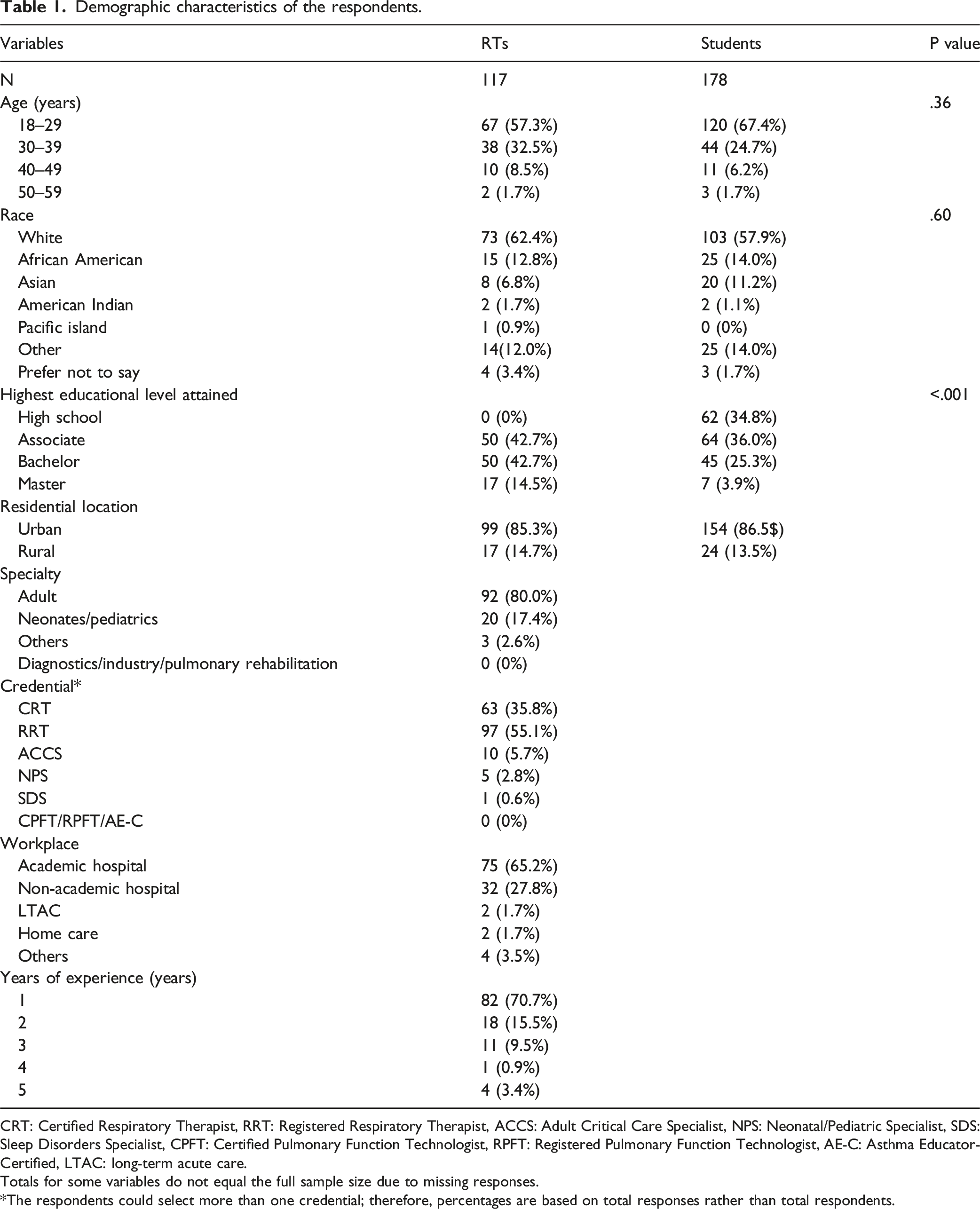
A total of 323 individuals clicked the survey link and entered the survey. After applying the eligibility criteria, 28 responses were excluded: 21 respondents were practicing RTs with more than 5 years of experience, and an additional 7 indicated that they were not senior respiratory care students or early-career RTs. The final sample included 295 respondents (178 senior respiratory care students and 117 early-career RTs). Geographic distribution of respondents varied across the United States, as illustrated in Figure 1. Respondent demographic characteristics are detailed in Table 1. Respondents’ distribution across US states. This map illustrates the geographic distribution of survey respondents, showing the number of respondents from each state. Demographic characteristics of the respondents. CRT: Certified Respiratory Therapist, RRT: Registered Respiratory Therapist, ACCS: Adult Critical Care Specialist, NPS: Neonatal/Pediatric Specialist, SDS: Sleep Disorders Specialist, CPFT: Certified Pulmonary Function Technologist, RPFT: Registered Pulmonary Function Technologist, AE-C: Asthma Educator-Certified, LTAC: long-term acute care. Totals for some variables do not equal the full sample size due to missing responses. *The respondents could select more than one credential; therefore, percentages are based on total responses rather than total respondents.
Salary was the top-ranked factor influencing employment selection for both respiratory care students and early-career RTs (Figure 2(A)–(B)). Other highly ranked factors included workplace environment, benefits, schedule flexibility, and professional autonomy, with slight variations in ranking order between the two groups. Respondents’ employment preferences: (A) student; (B) RTs.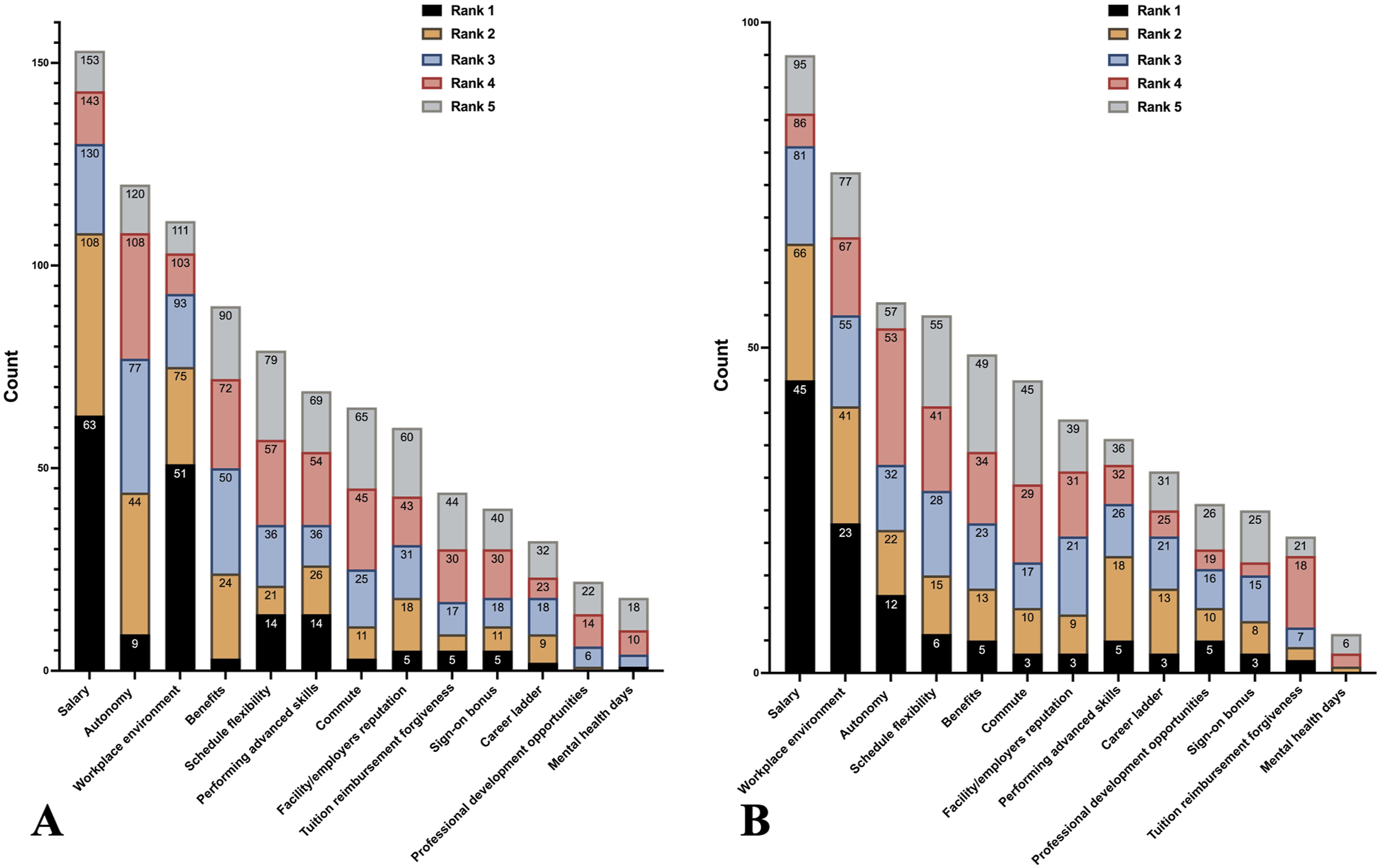
A sub-analysis explored employment preferences based on demographic factors, including academic degree, age, and residential location (Supplemental Figure S1–S4). The top five preferences remained consistent across all groups, with some notable differences. Tuition reimbursement replaced schedule flexibility among respiratory care students and early-career RTs with master’s degrees. Facility reputation ranked in the top five among students with associate degrees and respondents aged ≥ 40 years, displacing professional autonomy and schedule flexibility, respectively. Commute became a top-five factor for early-career RTs with associate degrees and rural residents, replacing benefits and professional autonomy in those subgroups.
The majority of respondents preferred 12-hour shifts (75%) and day shifts (53%), with work–life balance playing a crucial role in job selection (Figure 3 (A)-(B)). Respondents aged 40–49 were the only group to express equal preference for day and night shifts. Despite these differences, no significant differences were observed between students and early-career RTs or across degree levels, age groups, or residential locations (all P < .05) (Supplemental Figures S5–S7). Work–life balance was identified as an important factor by 81% of students and 78% of early-career RTs, and over 80% of respondents strongly agreed with the statement: “maintaining a healthy work–life balance is important when I consider a job offer from a potential employer.” Respondents’ shift preferences: (A) shift duration; (B) shift schedule.
Respiratory care students were asked to indicate their preferred workplace settings. Across all demographics, academic hospitals and Level I trauma centers were the most favored (Figure 4; Supplemental Figure S8). Notably, younger students (aged 18–39 years) had a stronger preference for these settings than those aged ≥40 years (Supplemental Figure S9). Both urban and rural students preferred academic hospitals and Level I trauma centers, though rural students expressed slightly greater interest in non-academic hospitals (Supplemental Figure S10). None of these differences were significant. Students’ workplace preferences.
The majority of respondents (91%) expressed strong interest in pursuing a new graduate respiratory care residency program, with no significant differences observed across degree level, age, or residential location.
Discussion
In this nationwide survey, we found that salary is the top preference for both student and early-career RT respondents. Other highly ranked factors include professional autonomy, workplace environment and culture, benefits (e.g., retirement, medical, vision, and dental), and schedule flexibility. While these preferences were consistent across groups, their relative importance varied slightly.
Salary was the top preference for both RT students and early-career RTs, indicating that it plays a vital role in recruitment. This aligns with prior studies that found salary significantly influences job selection among practicing RTs and other healthcare professionals.12,13,15 Our findings further underscore the importance of offering competitive salary packages to attract and retain skilled professionals. In contrast, sign-on bonuses—commonly used by healthcare employers as recruitment incentives—were among the least influential factors in employer preference for both groups. This discrepancy may reflect a broader preference for sustainable, long-term compensation over one-time financial incentives. These findings indicate that sign-on bonuses may have a role in recruitment but are less likely to be as influential in decision-making as long-term, substantial employment benefits.
Autonomy was also a key preference among both groups and has been previously associated with increased job satisfaction and retention among nurses and RTs.14,16 For instance, Madden et al. found that RT-driven protocols improved job satisfaction. 16 Our findings support this evidence, suggesting that autonomy is not only valued but actively sought by RTs when selecting an employer.
Schedule flexibility emerged as another significant preference, consistent with findings from a previous cross-sectional review on nurse recruitment and retention, which identified flexible work schedule as a significant factor. 14 In our study, both senior students and early-career RTs also expressed a strong preference for 12-hour shifts and day shifts. These preferences likely reflect a broader desire for work–life balance, which the majority of respondents cited as an important consideration when selecting an employer.
Many top preferences for employers identified in this study—such as salary, workplace environment and culture, schedule flexibility, and autonomy—are also associated with burnout among RTs. 10 This suggests that RTs may actively seek out roles that support their overall well-being. Addressing these factors may help reduce burnout, improve retention, and potentially alleviate staffing shortages and high workloads, which are themselves contributors to burnout. 10
Although previous studies have shown that professional development opportunities contribute to RT retention,11,12 they did not rank among the top preference in our study. However, more than 90% of respondents expressed interest in organizations that offer a residency program. While few studies have examined such programs specifically related to RT recruitment, Patel et al. found that a multi-site RT residency program improved new graduates’ confidence and job skills. 17 Similar programs in nursing have been associated with smoother transitions into practice and improved 1-year retention rates of new graduates.18–20 The strong interest in new graduate residency programs underscores the need for structured transition initiatives to support workforce entry and retention.
Lastly, our subgroup analysis revealed some differences in employer preference. For example, master’s degree students and graduates valued tuition reimbursement/loan forgiveness more than those with associate or bachelor’s degrees, likely reflecting their high tuition costs and student loan debt. Additionally, respondents from rural areas prioritized shorter commutes, possibly due to longer distances between home and work leading them to prioritize shorter driving distances.
Future research should explore the long-term impact of these preferences on RT retention, the effectiveness of various recruitment strategies such as sign-on bonuses and residency programs, as well as the most desirable models for achieving schedule flexibility among RTs.
This study has several limitations. The sample size was relatively small, which may limit the generalizability to all new graduates and early-career RTs. Many respondents were from Texas and Illinois—this may have an impact on the responses due to potential similarities based on geographical location. Furthermore, due to the distribution method, we could not calculate the survey response rate, as the total number of potential respondents was unknown.
Conclusion
When selecting an employer, senior RT students and early-career RTs prioritized competitive salaries, autonomy in clinical practice, workplace environment, benefits, flexible scheduling, benefits, and work–life balance. Both groups showed a strong preference for 12-hour shifts and day shifts. Senior RT students’ favored workplaces were academic hospitals and Level 1 trauma centers. Additionally, senior RT students expressed high interest in new graduate residency programs. These findings can inform employer strategies aimed at improving recruitment and retention in the RT workforce.
Supplemental Material
Supplemental Material - Employer selection preferences among senior respiratory care students and early-career RTs: A national survey
Supplemental Material for Employer selection preferences among senior respiratory care students and early-career RTs: A national survey by Dana L. Evans, Fai AlBuainain, Nicholas Garcia Rincon, Jie Li in Respiratory Care Reports
Footnotes
Author contributions
Study design: DLE and JL.
Literature search: DLE, JL, and NR.
Data collection: JL and NR.
Analysis of data: JL and FA.
Manuscript preparation: DLE, FA, and JL.
Manuscript review: DLE, FA, and JL.
Funding
The authors received no financial support for the research, authorship, and/or publication of this article.
Declaration of conflicting interests
The authors declared the following potential conflicts of interest with respect to the research, authorship, and/or publication of this article: Dr. Li discloses research funding from the COPD Foundation, American Association for Respiratory Care, MEKICS Co. Ltd, and Vincent Ltd., and speaker fees from the American Association for Respiratory Care, Aerogen Ltd., Vincent Ltd., and Fisher & Paykel Healthcare Ltd. Dr. Li is also a section editor of Respiratory Care. Ms Evans is the President of the American Association for Respiratory Care. Other authors do not have relationships to disclose.
Supplemental Material
Supplemental material for this article is available online.
References
Supplementary Material
Please find the following supplemental material available below.
For Open Access articles published under a Creative Commons License, all supplemental material carries the same license as the article it is associated with.
For non-Open Access articles published, all supplemental material carries a non-exclusive license, and permission requests for re-use of supplemental material or any part of supplemental material shall be sent directly to the copyright owner as specified in the copyright notice associated with the article.
